




About this worksheet
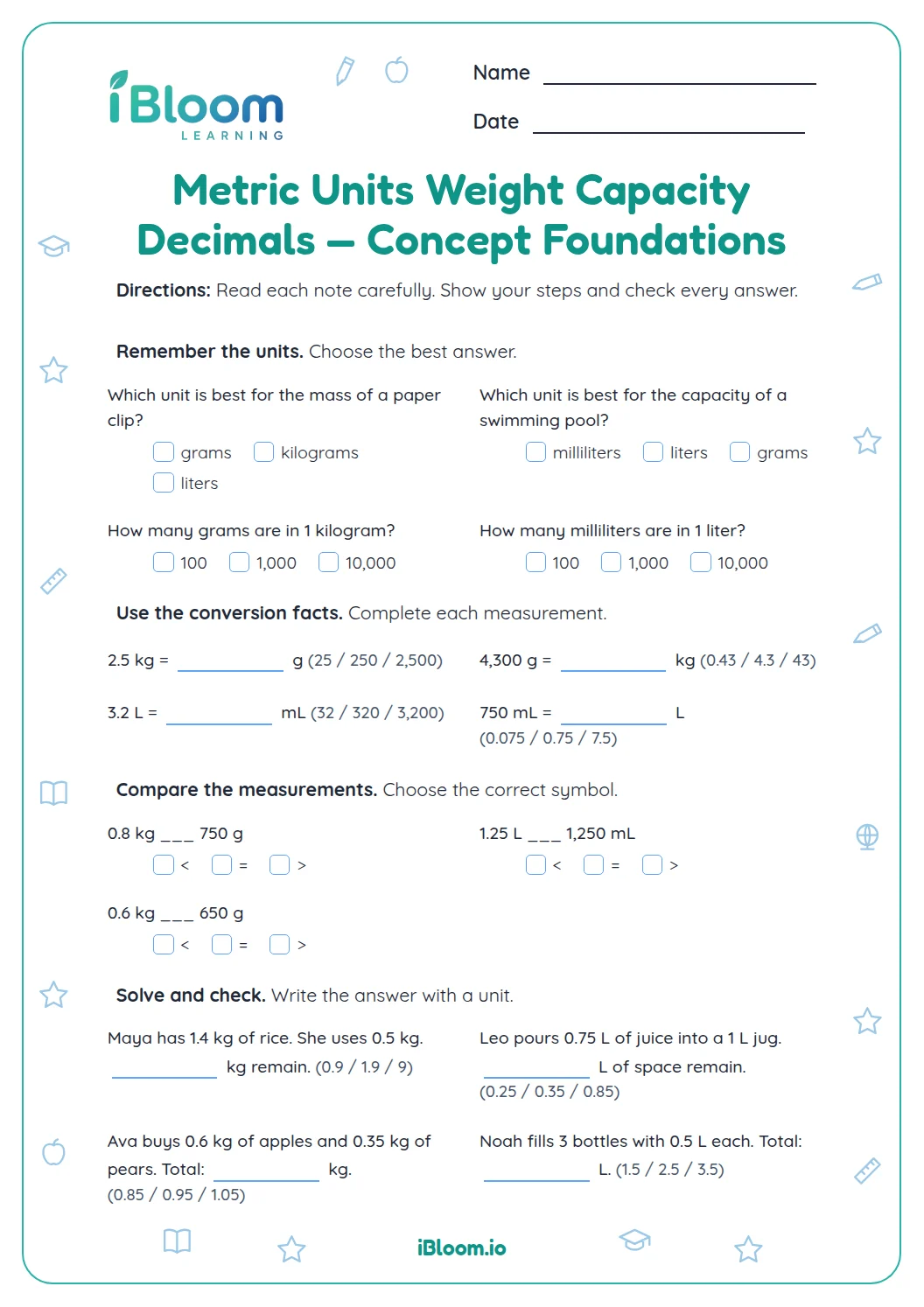
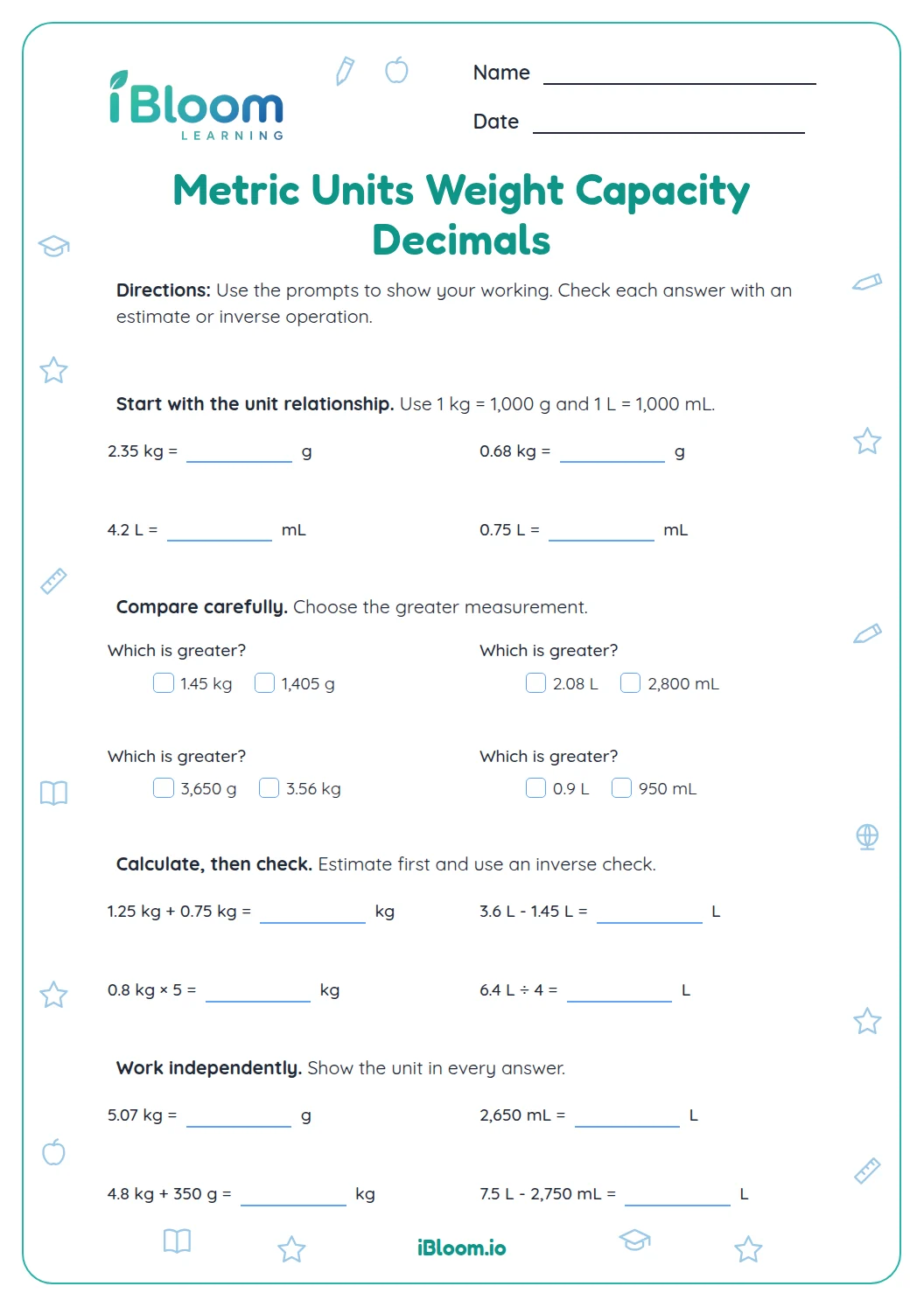
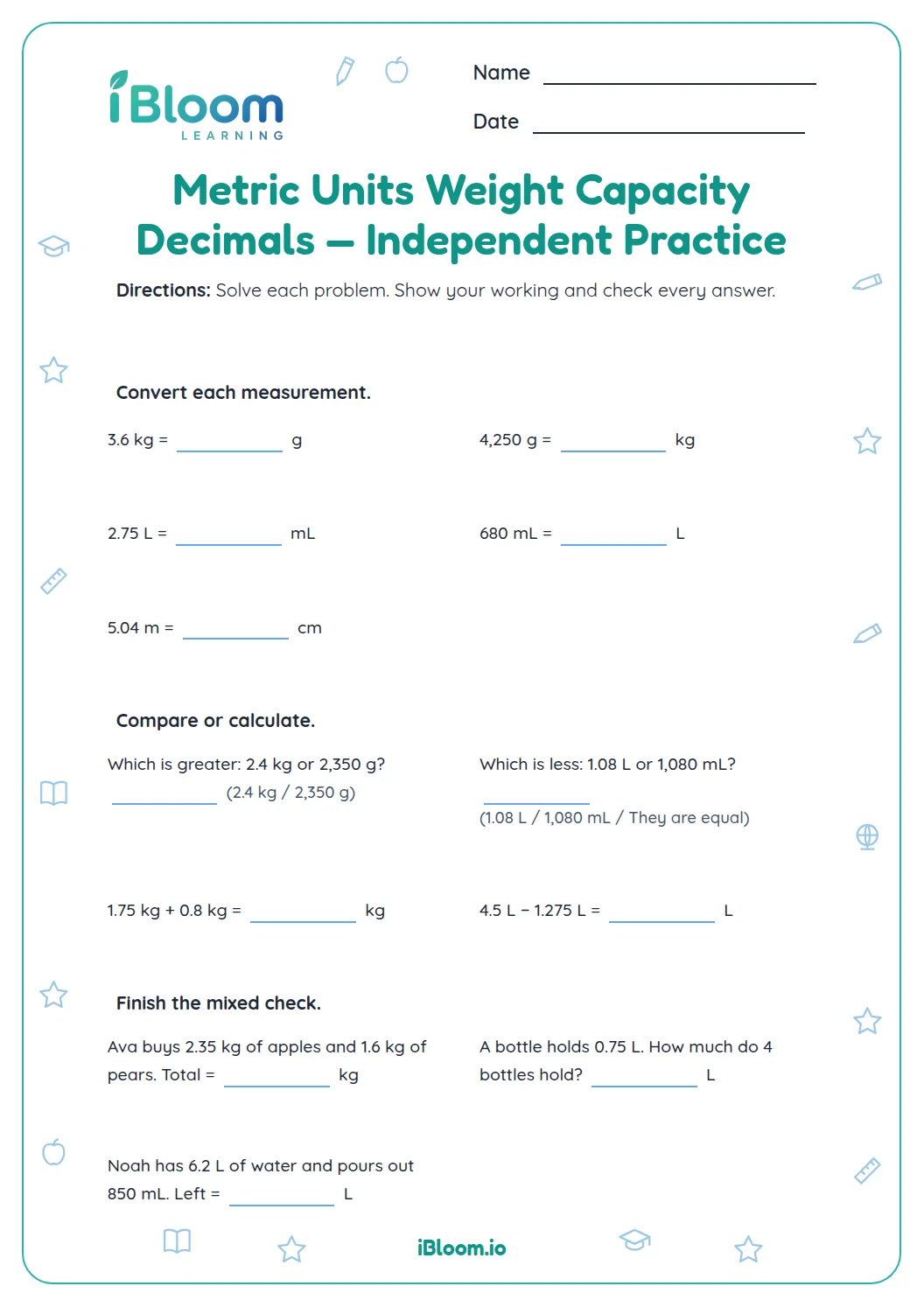
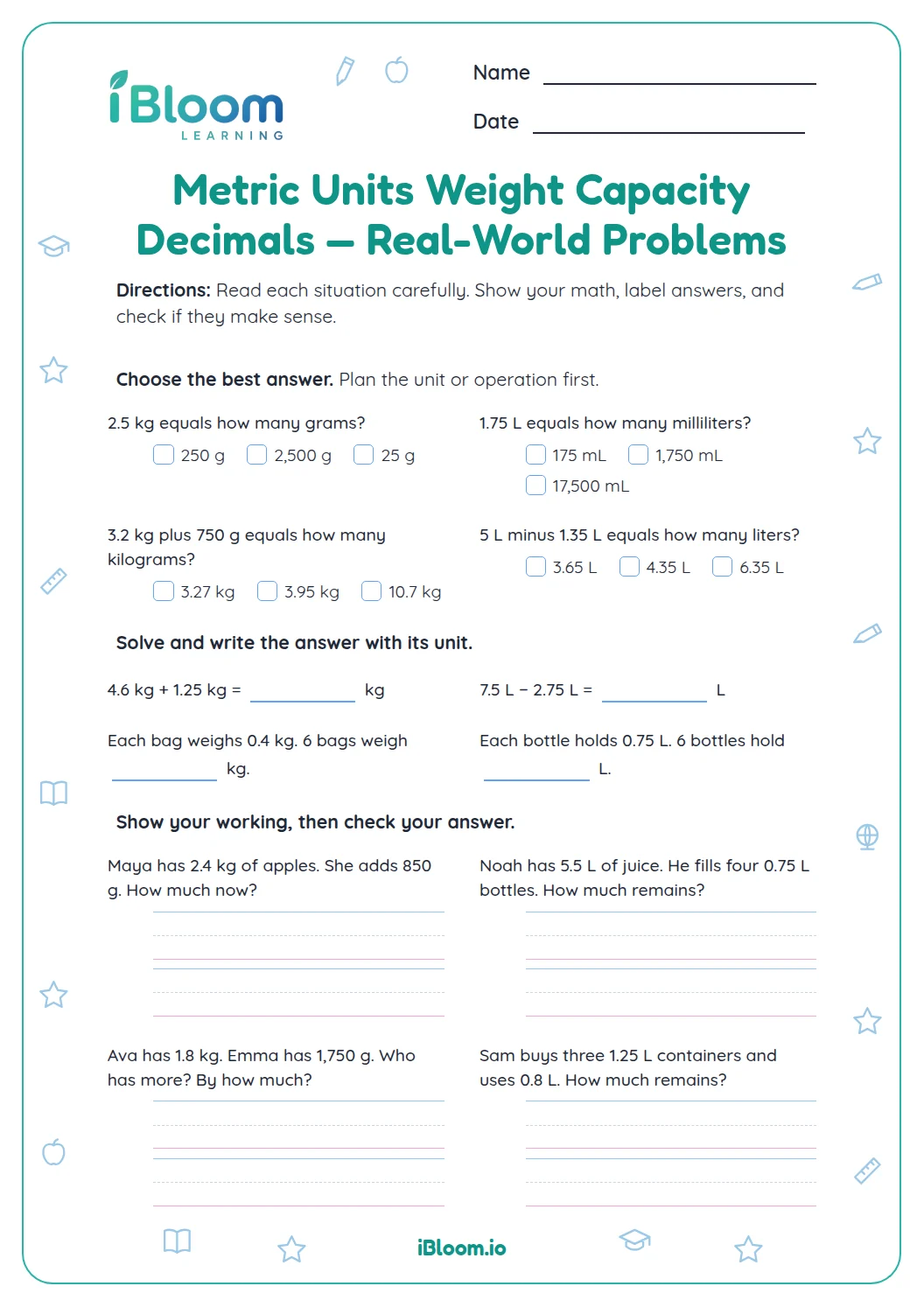
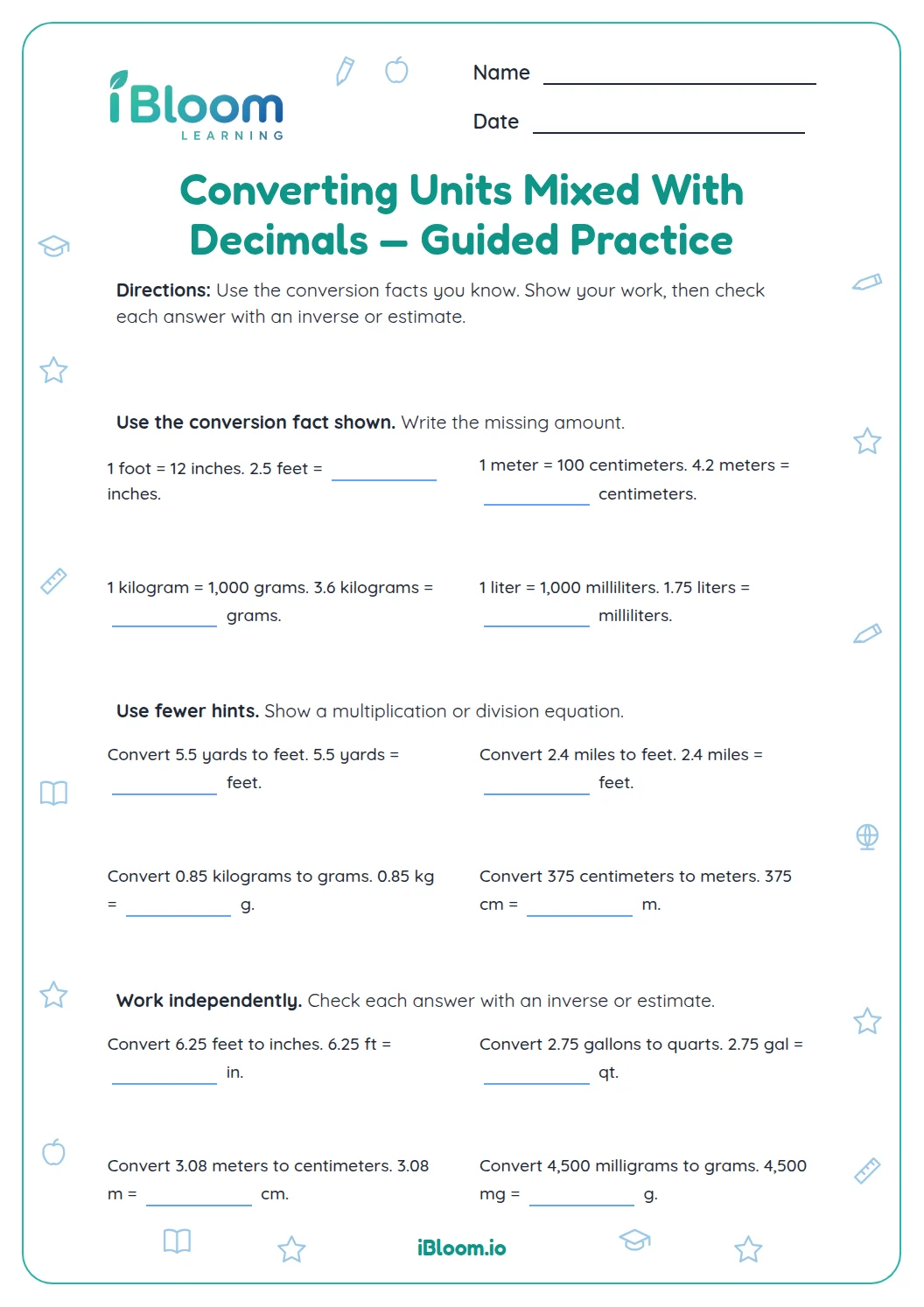
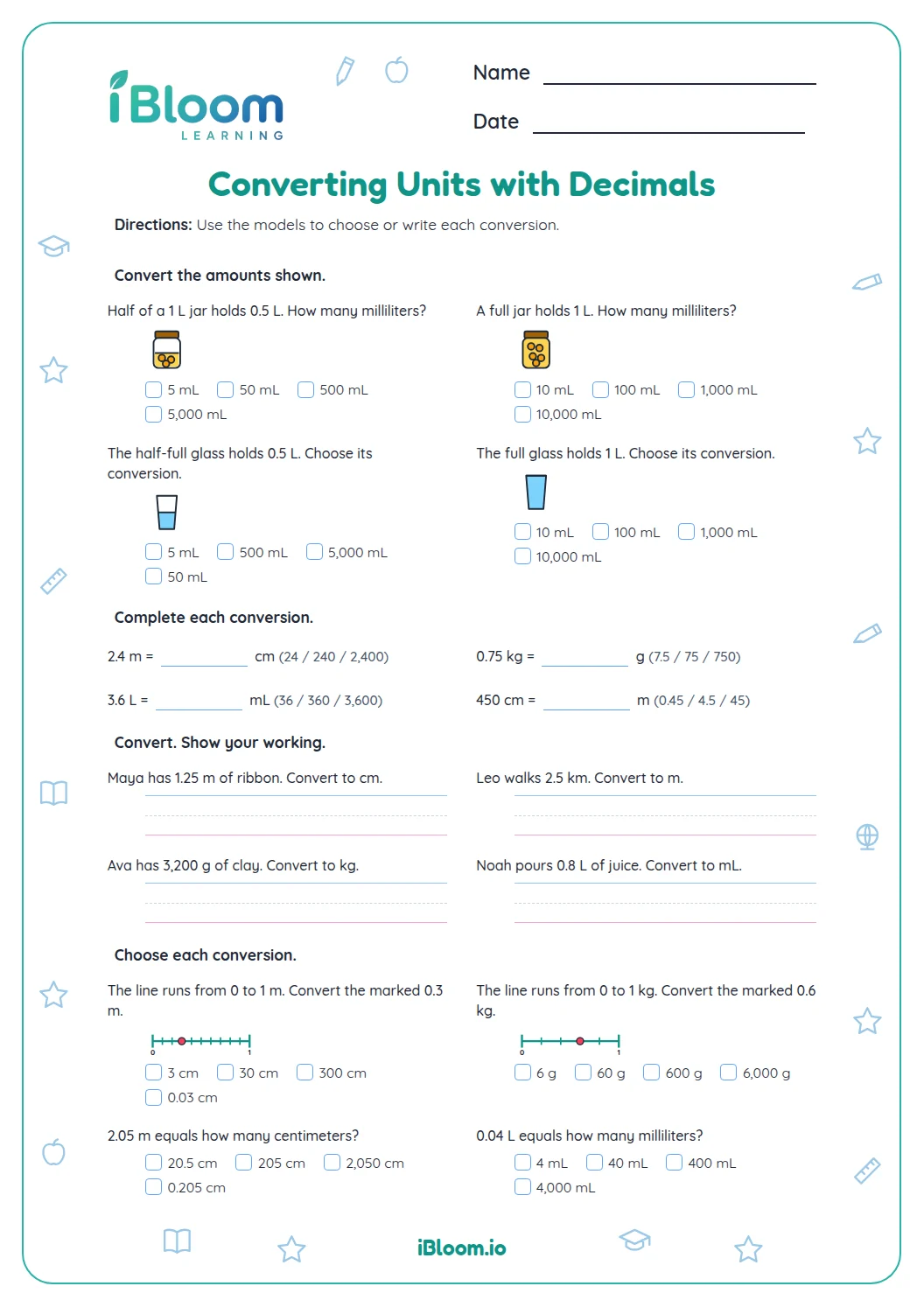
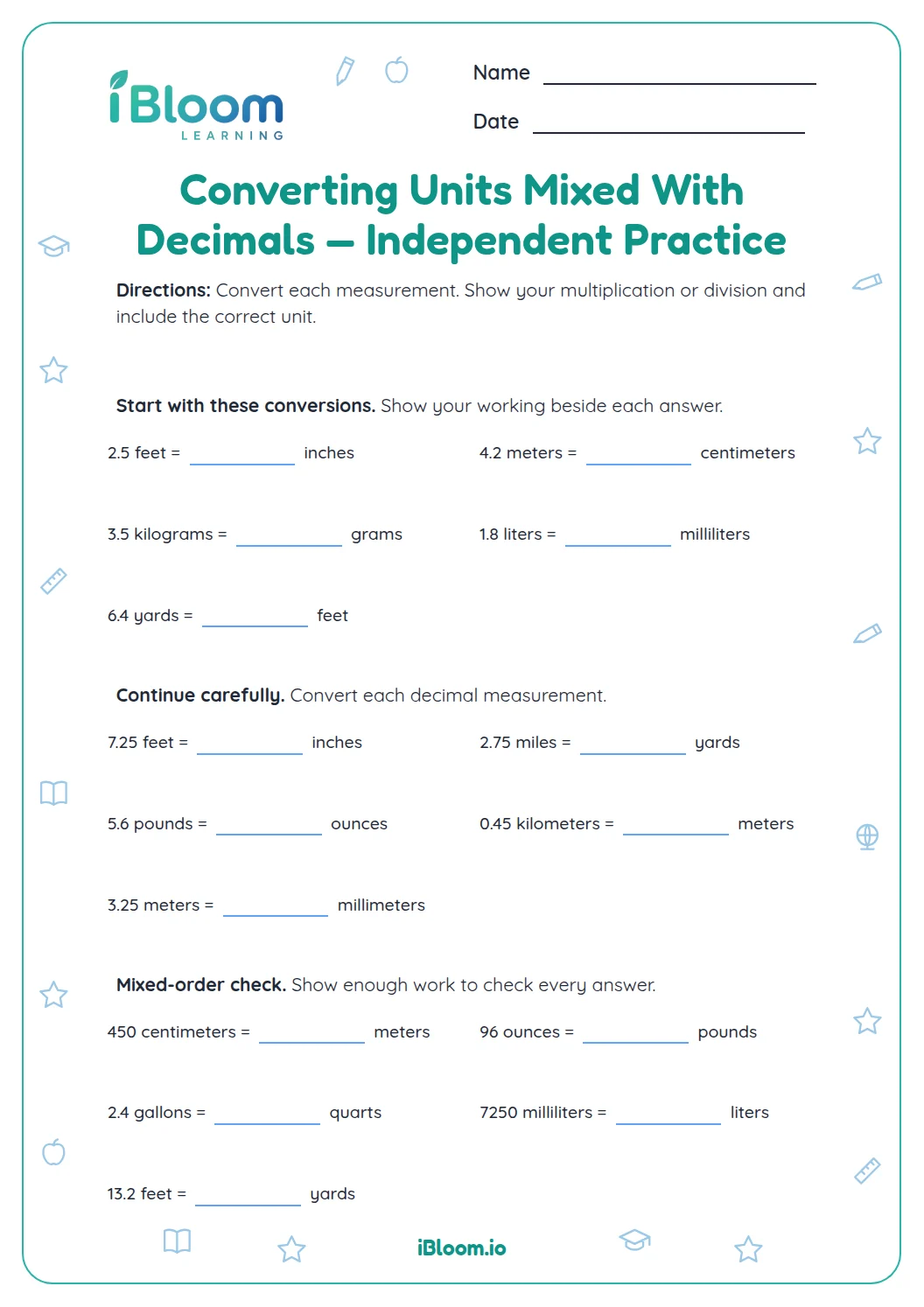
This Grade 5 printable practices converting metric units of mass and capacity, comparing equivalent measures, and solving measurement problems. Six conversion questions lead into four comparisons and four problems that require converting before adding or subtracting. The work supports CCSS 5.MD.A.1, which includes converting units within a measurement system and using those conversions in real-world problems. A separate answer key shows the results.
Aligned to 5.MD.A.1
How do you convert between kilograms and grams?
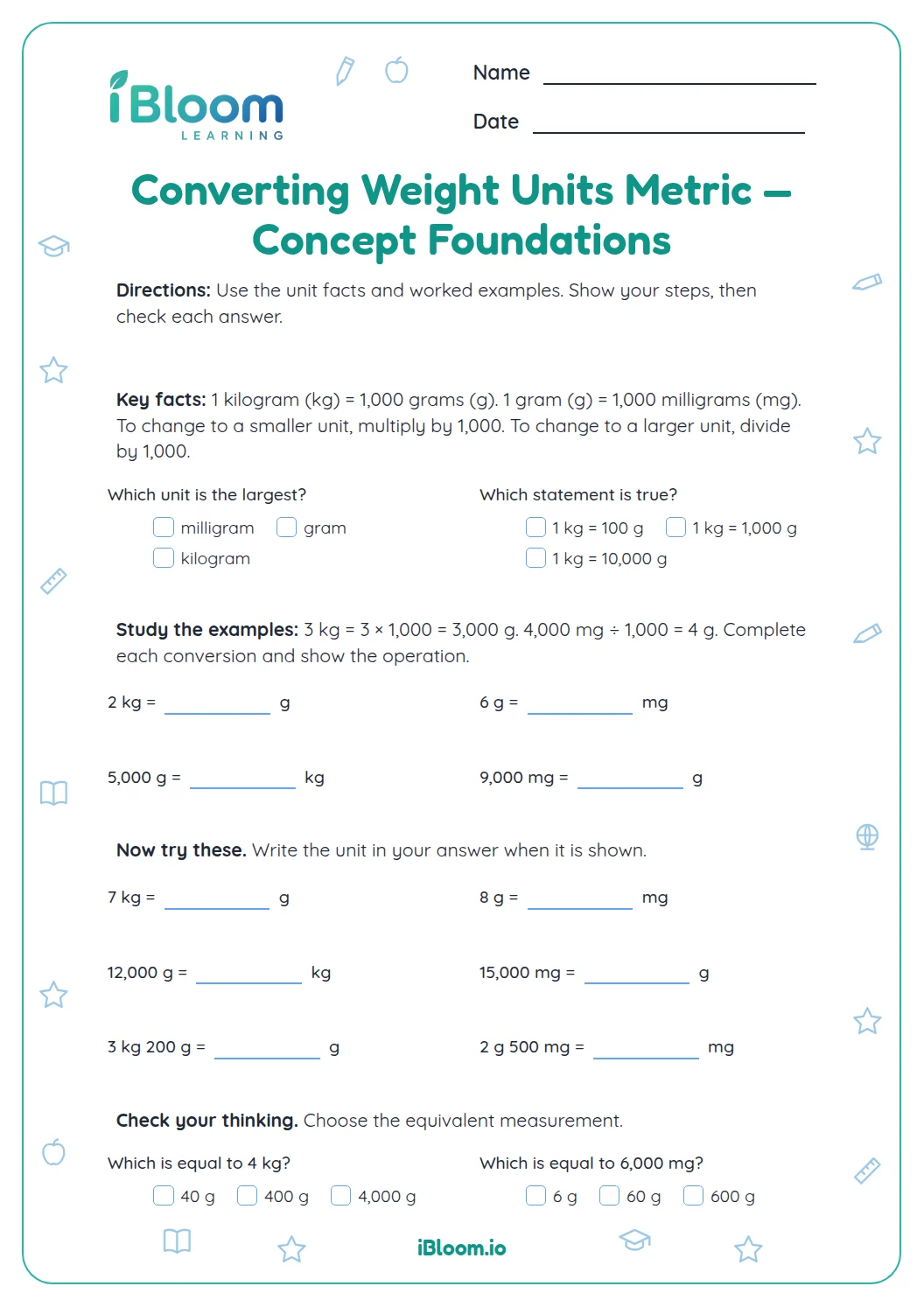
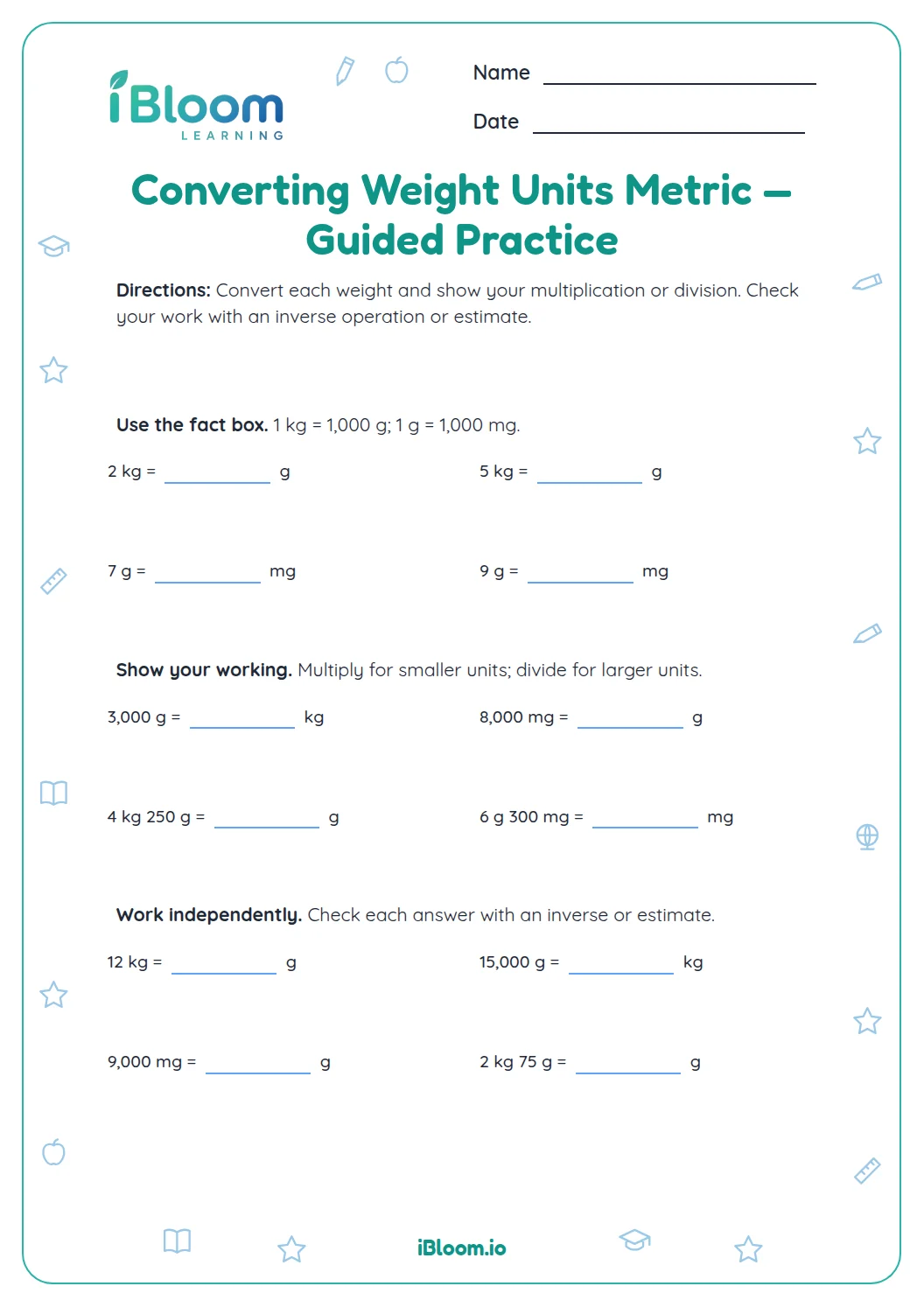
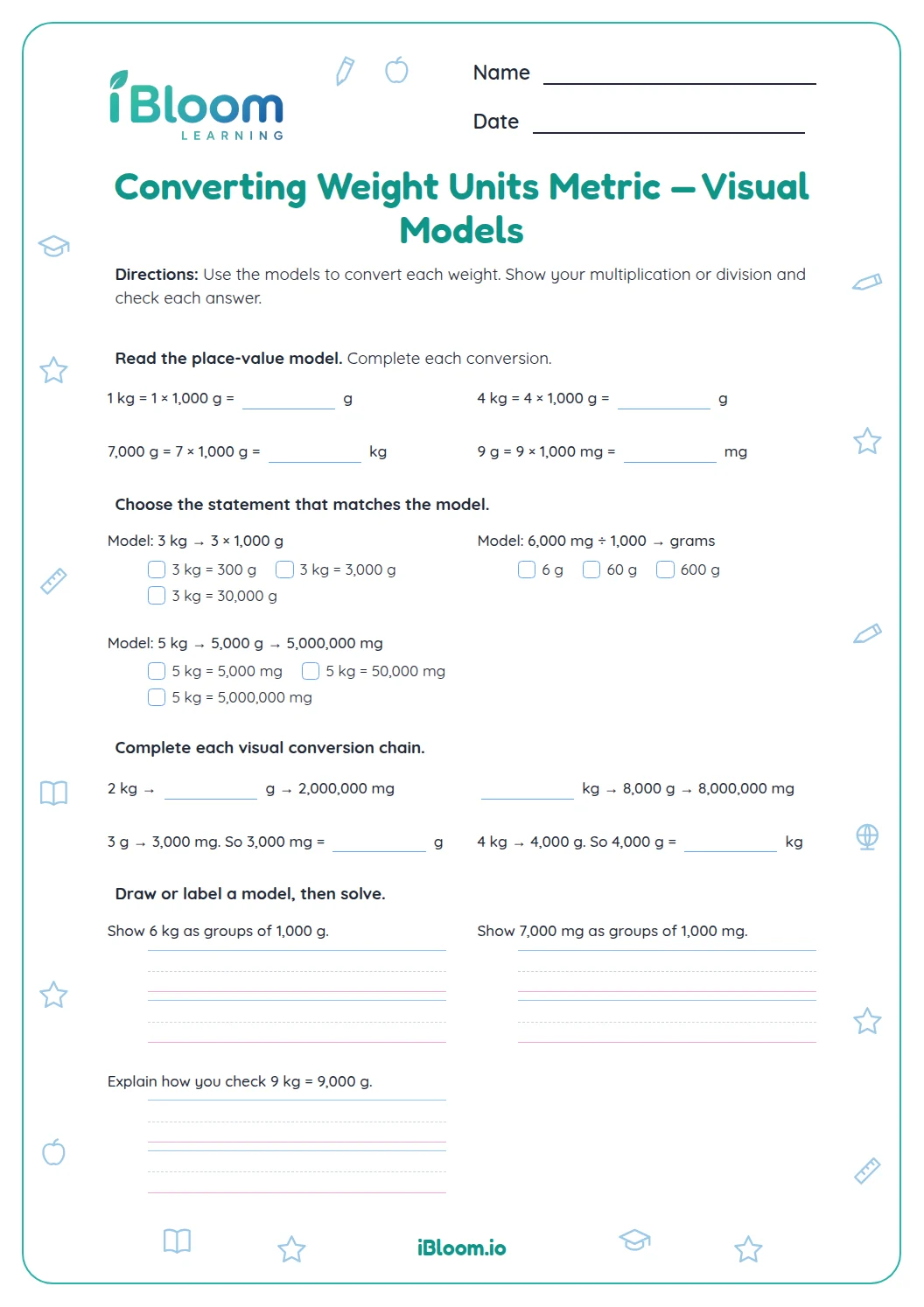
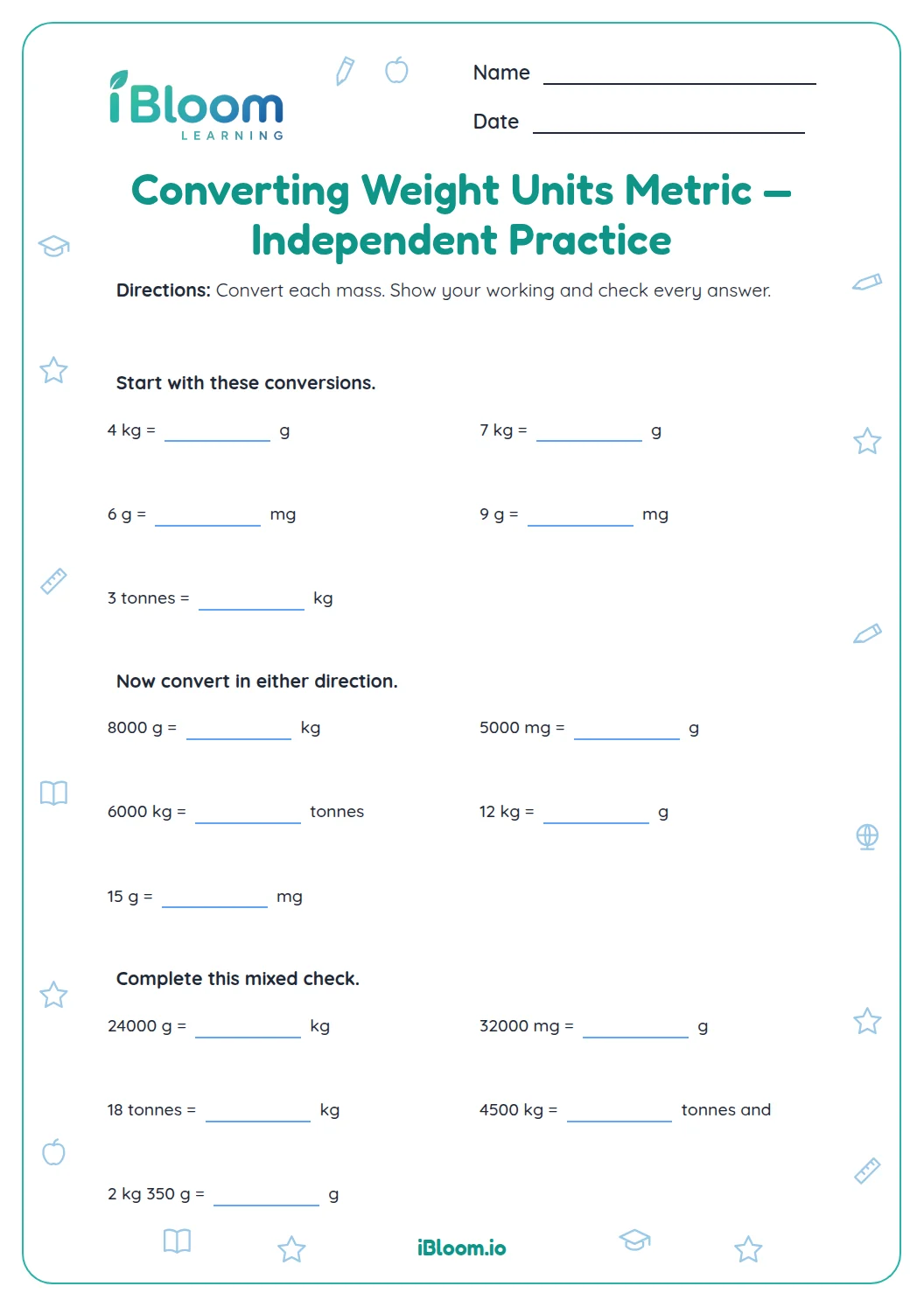
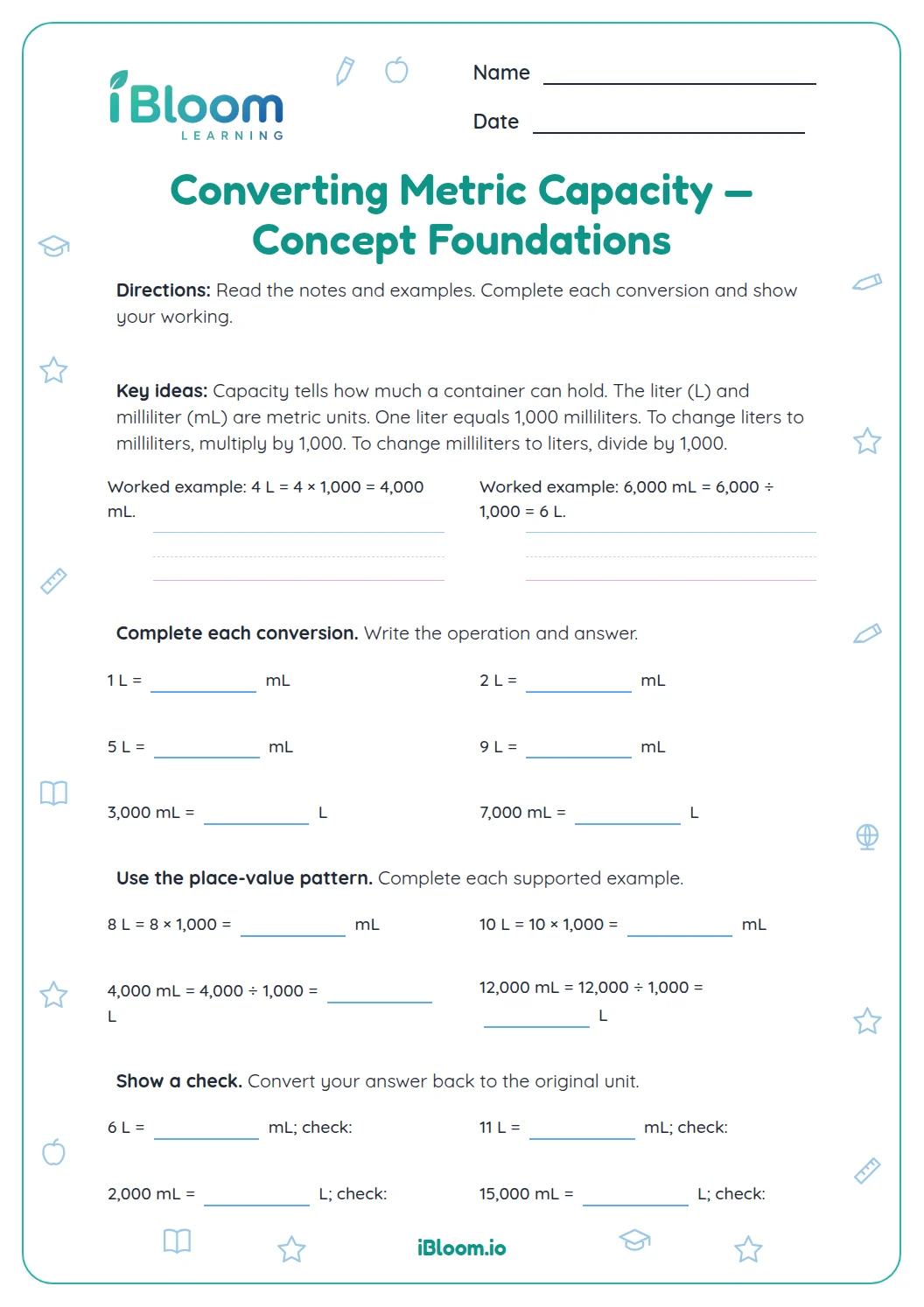
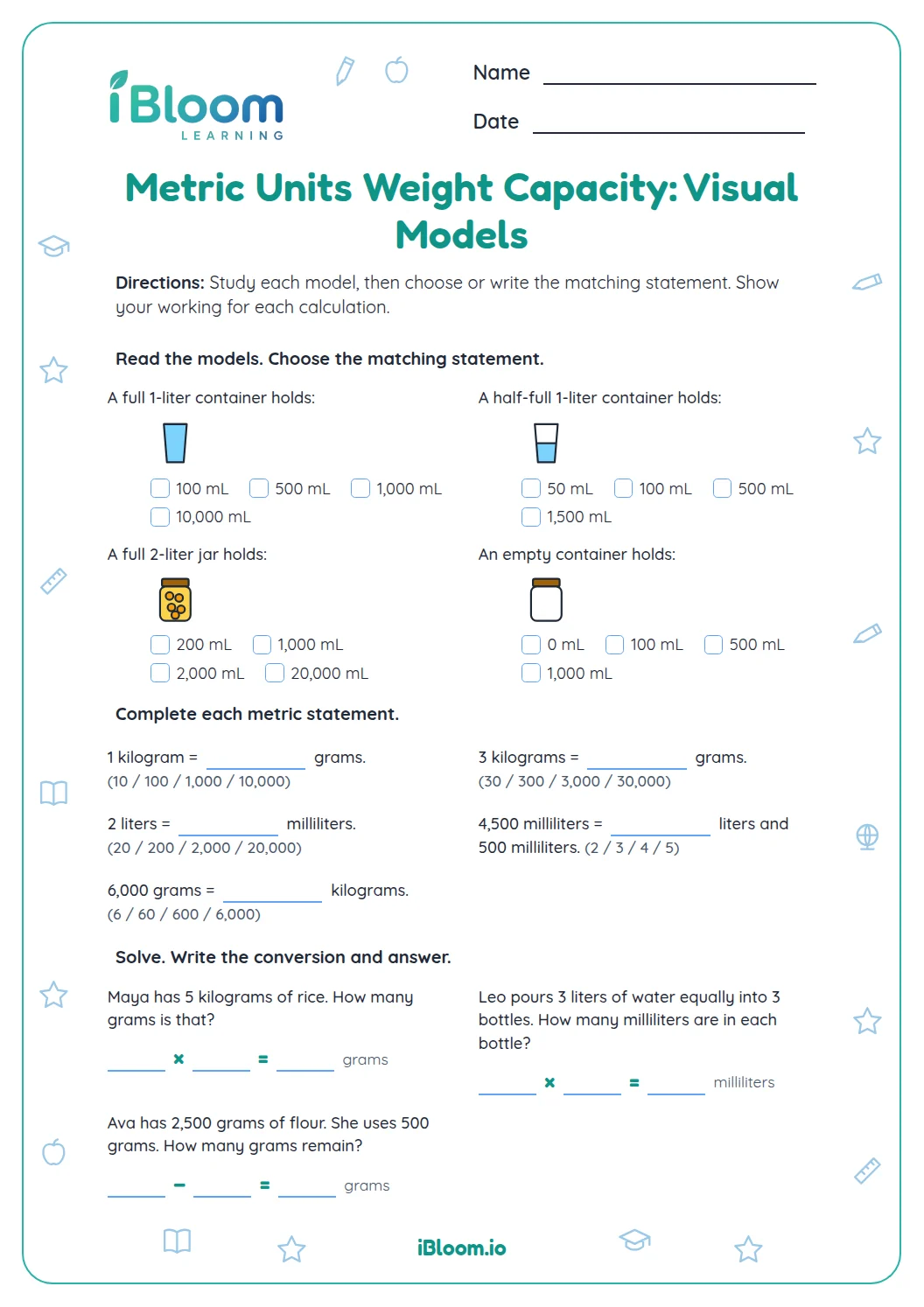
One kilogram equals 1,000 grams. Multiply kilograms by 1,000 to express a mass in grams; divide grams by 1,000 to express it in kilograms. For example, 3.6 kg is 3,600 g.
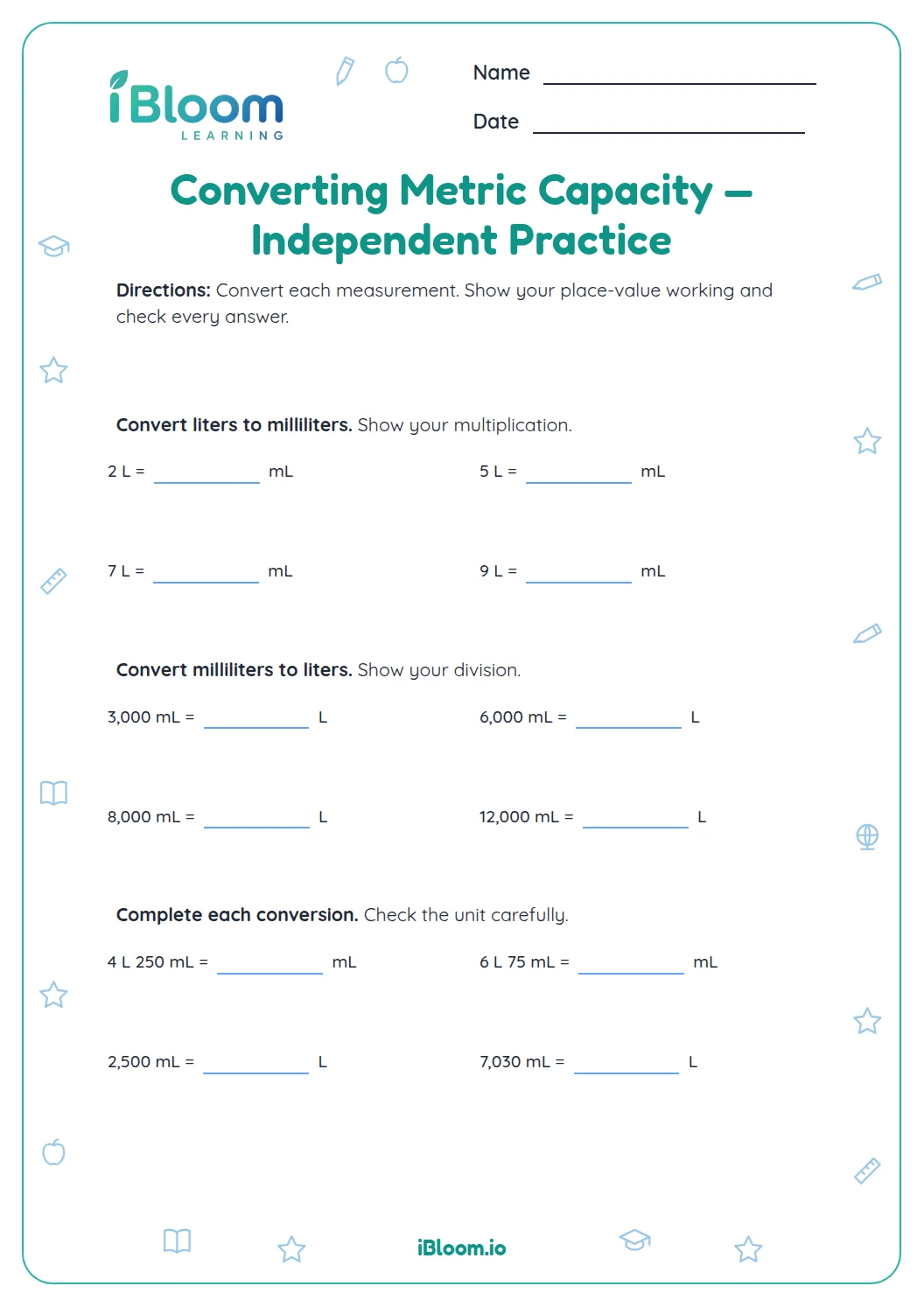
The same place-value relationship applies to capacity: one liter equals 1,000 milliliters. Question 2 converts 4,250 mL to 4.25 L.
- 13.6 kg × 1,000 = 3,600 g
Why put two measures in the same unit?
A number alone does not tell which measure is greater when the units differ. Convert both measures to grams or both to milliliters, then compare the values. In question 9, 0.6 kg and 600 g are equal because 0.6 × 1,000 = 600.
How do conversions help solve the story problems?
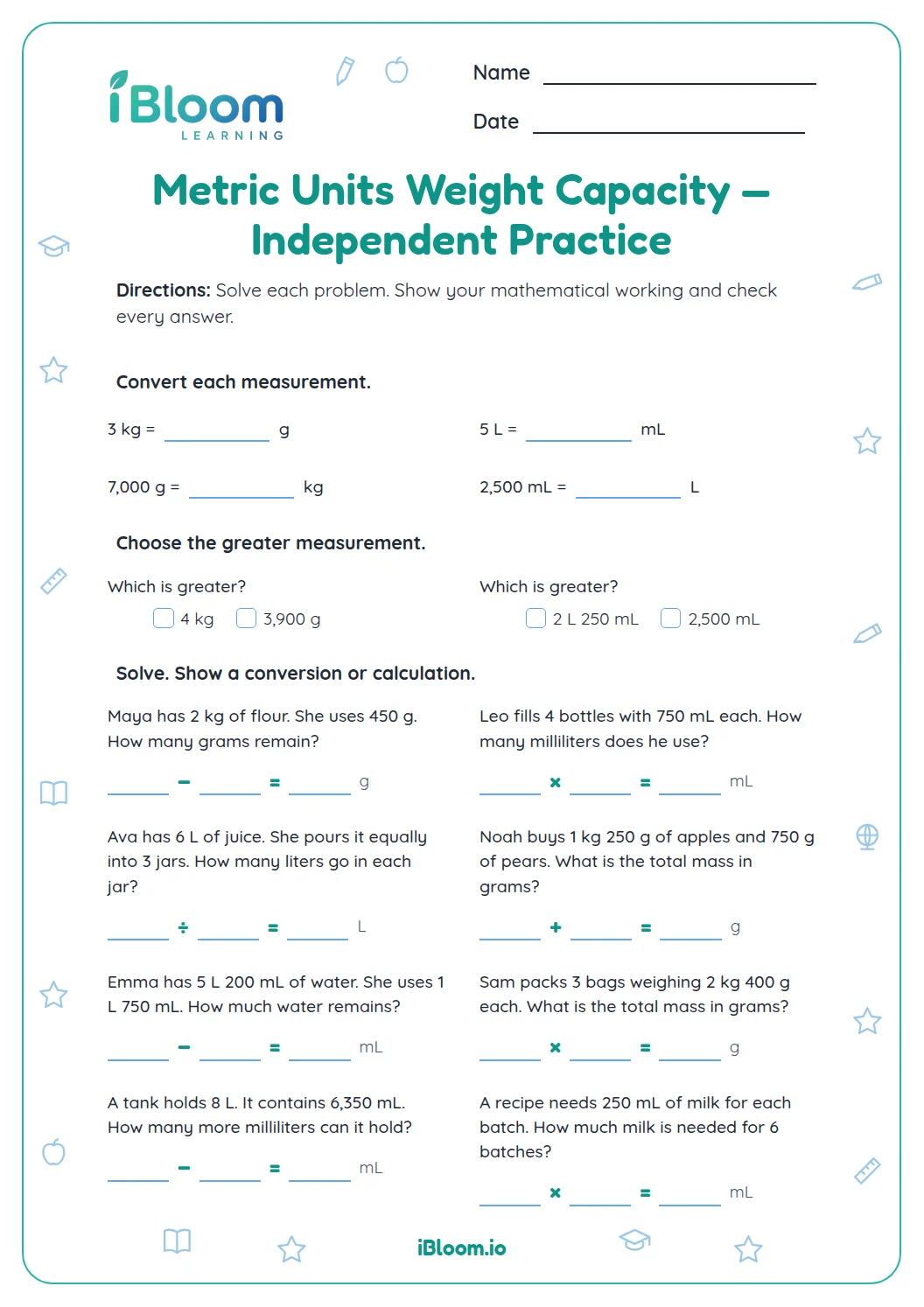
For adding or subtracting measures, first express both quantities in the same unit. In question 11, 2.4 L becomes 2,400 mL; after 650 mL is poured out, 1,750 mL remains. Use an equation to keep the quantities organized.
- Questions 1–6: convert mass and capacity
- Questions 7–10: compare converted measures
- Questions 11–14: solve multistep measurement stories
How to use this worksheet
- 1Mark whether the quantity is mass or capacity.
- 2Recall that 1 kg = 1,000 g and 1 L = 1,000 mL.
- 3Move the decimal point three places when converting by 1,000.
- 4For comparisons and stories, rewrite quantities in matching units.
- 5Write and solve an equation, then include the requested unit.
- 6Check the answer key and recompute any missed conversion.
Common mistakes and quick fixes
The mistake
Writing 4,250 mL as 42.5 L.
The fix
Since 1,000 mL make 1 L, divide 4,250 by 1,000 to get 4.25 L.
The mistake
Adding 1.25 kg and 750 g as 1.2575.
The fix
Convert first: 1.25 kg is 1,250 g, then add 750 g.
The mistake
Comparing 0.9 kg directly with 850 g.
The fix
Convert 0.9 kg to 900 g; then compare 900 g and 850 g.
Common Core alignment
This worksheet supports the listed Common Core skill through focused practice.
Convert metric mass and capacity units, then use conversions in measurement problems.
On this sheet: The sheet asks students to convert between kilograms and grams and liters and milliliters, compare equivalent measures, and solve multi-step measurement contexts.
Show the official wordingHide the official wording
Convert among different-sized standard measurement units within a given measurement system (e.g., convert 5 cm to 0.05 m), and use these conversions in solving multi-step, real world problems.
What to practice next
Make more practice
Further reading
Questions parents and teachers ask
How many grams are in a kilogram?
One kilogram equals 1,000 grams. Multiply kilograms by 1,000 to express a mass in grams; divide grams by 1,000 to express it in kilograms. The worksheet applies both directions, and the requested unit keeps each result clear. A unit label makes the final answer easier to interpret.
How many milliliters are in a liter?
One liter equals 1,000 milliliters. The worksheet uses this relationship to convert capacity measures before comparing or solving a story problem. Keeping the unit beside each number makes the relationship easier to follow. A unit label makes the final answer easier to interpret.
Why are there decimal answers?
A measure can be smaller than one whole larger unit. For example, 375 grams is 0.375 kilogram, and 4,250 milliliters is 4.25 liters. Decimals show equivalent metric amounts precisely. A unit label makes the final answer easier to interpret.
Should students show an equation?
Yes. Each of the final four word problems gives working space for a conversion equation. Convert both quantities to matching units first, then calculate and label the result with its metric unit. The answer key helps verify the value and units for each situation.
What is included in the answer key?
The key lists all 14 answers, including units for story problems. It gives each completed conversion and the result after the story operations, so students can check both the arithmetic and unit choice. A unit label makes the final answer easier to interpret.