



About this worksheet
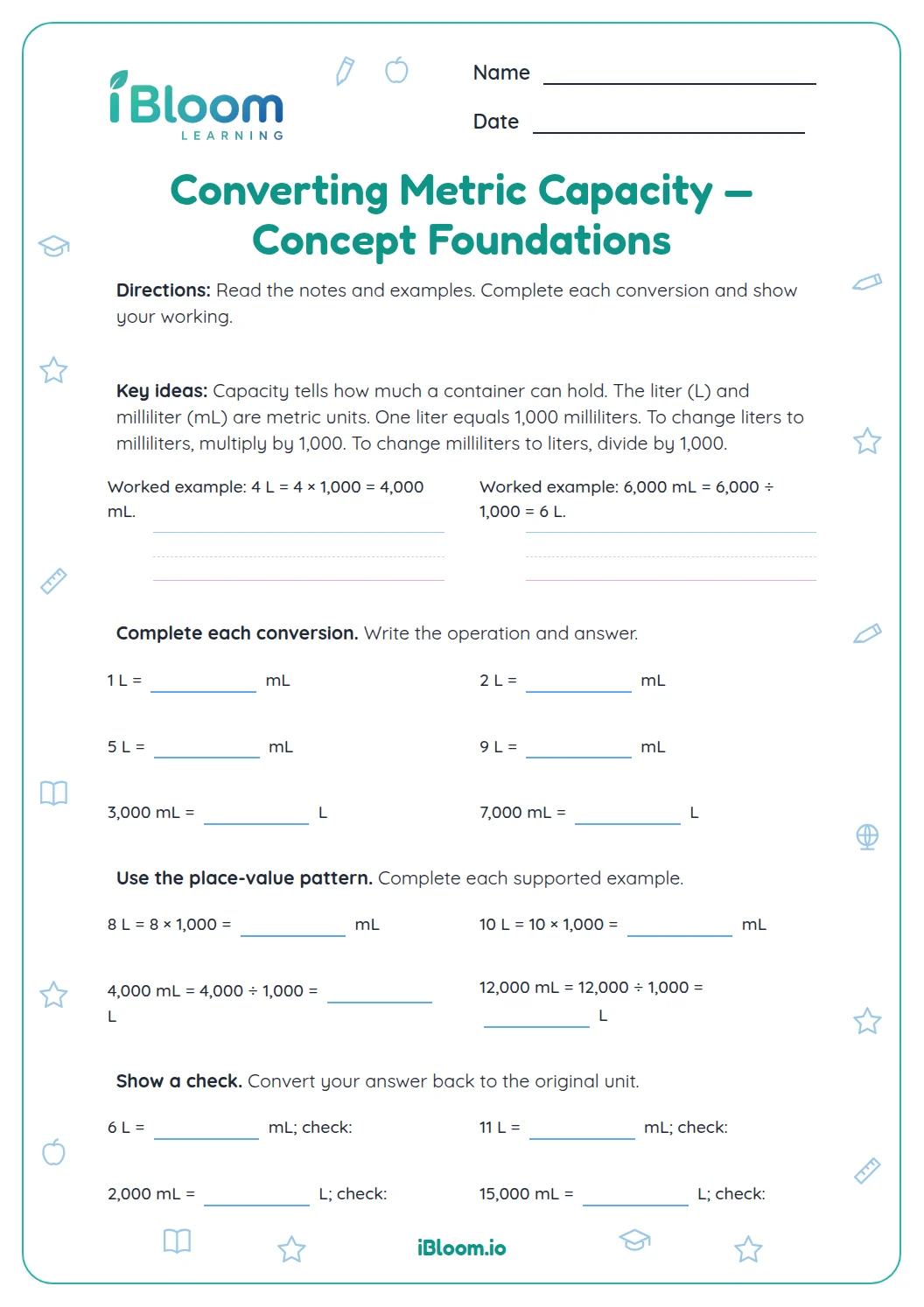
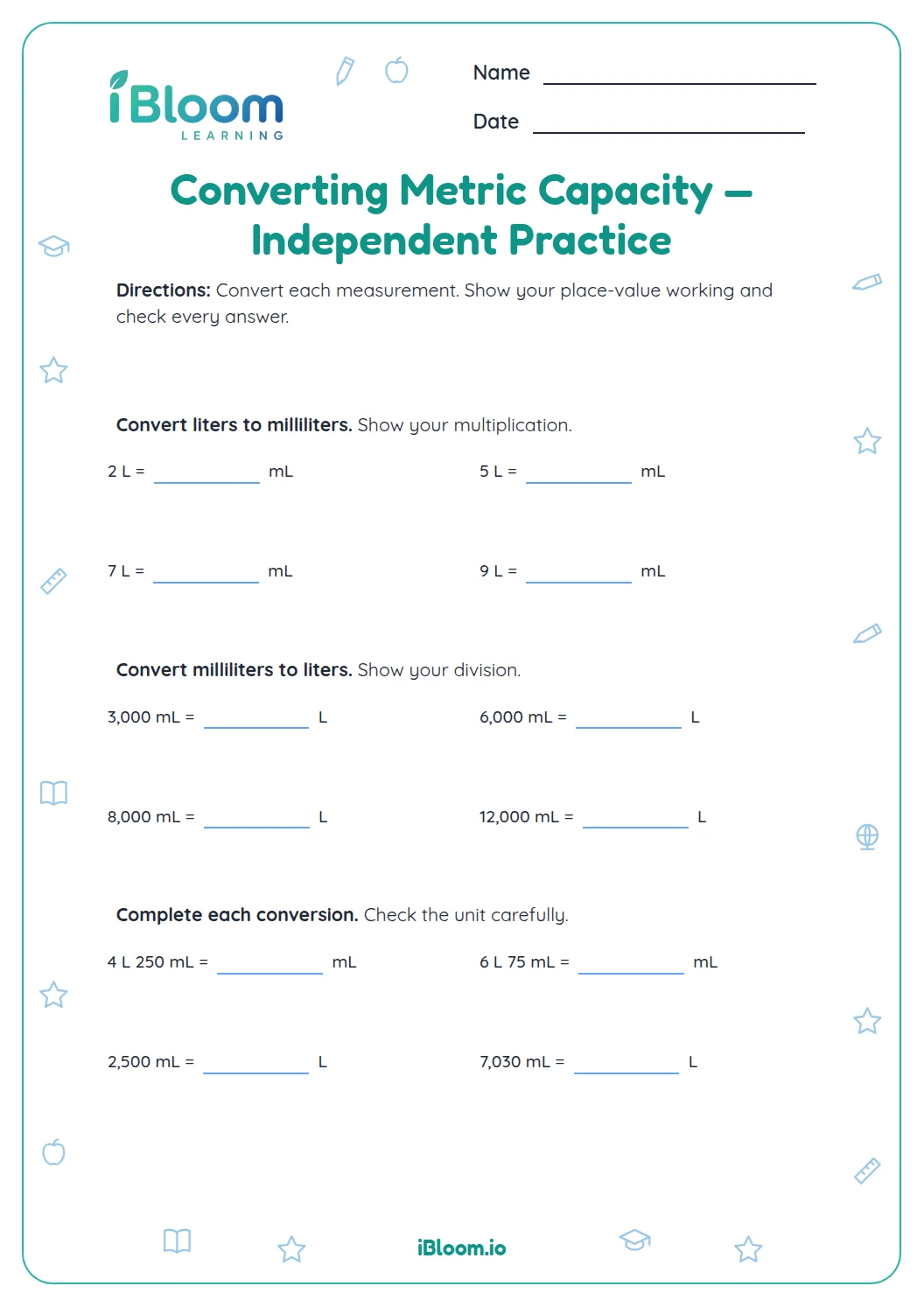
This Grade 5 metric capacity worksheet begins with one-liter container models, then asks students to convert in both directions between liters and milliliters. The final problems use those conversions to add and subtract capacity amounts. For example, students can change 1.5 L to 1,500 mL before adding 750 mL. The 14 questions fill two worksheet pages, with a separate answer key, and practice the unit conversions described in Common Core 5.MD.A.1.
Aligned to 5.MD.A.1
What do the container models show?
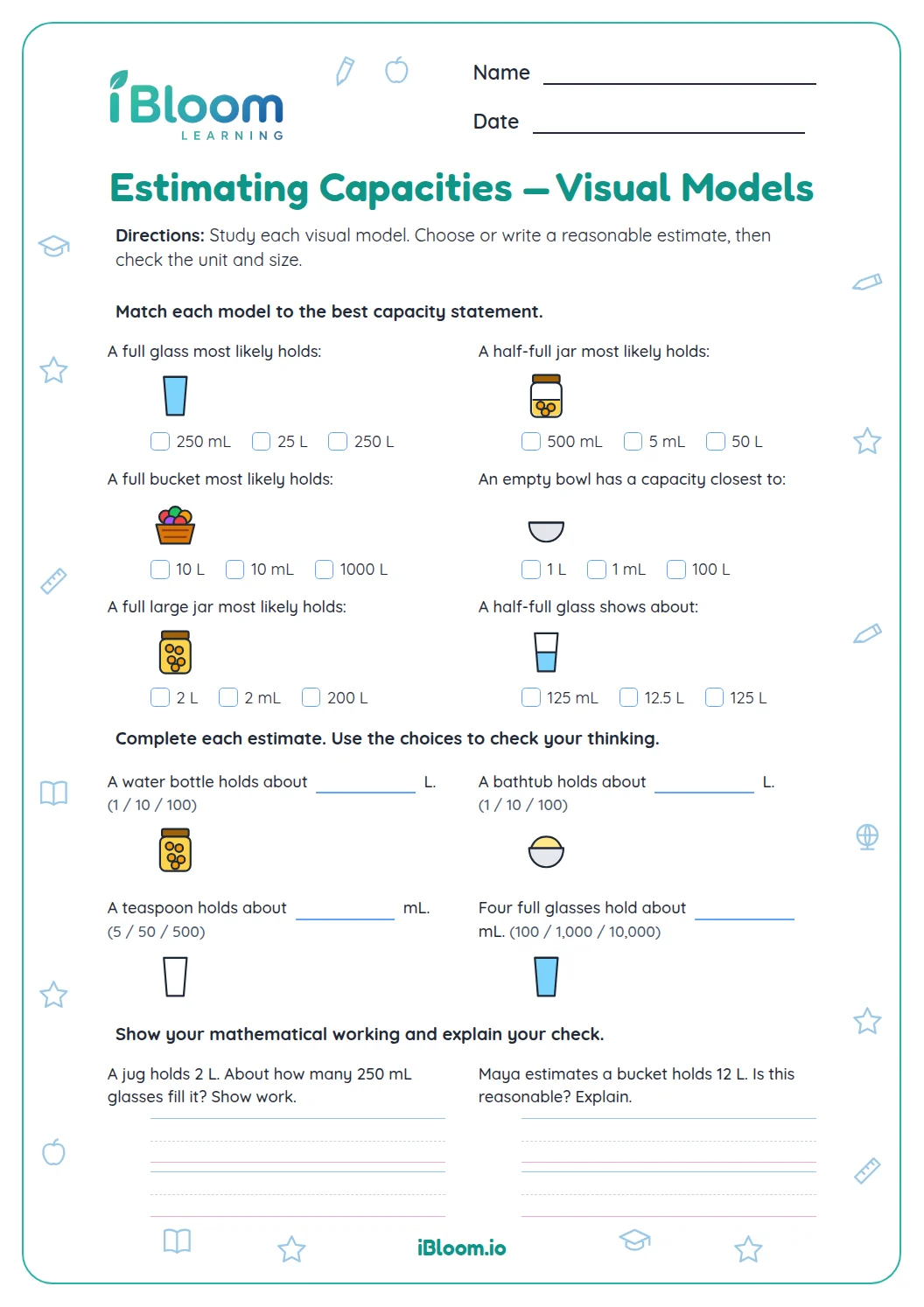
Each drawing is a one-liter container. Since 1 L equals 1,000 mL, container A is full and holds 1,000 mL; container B is half-full and holds 500 mL.
- 1Container A: 1,000 mL; container B: 500 mL
How do students convert between L and mL?
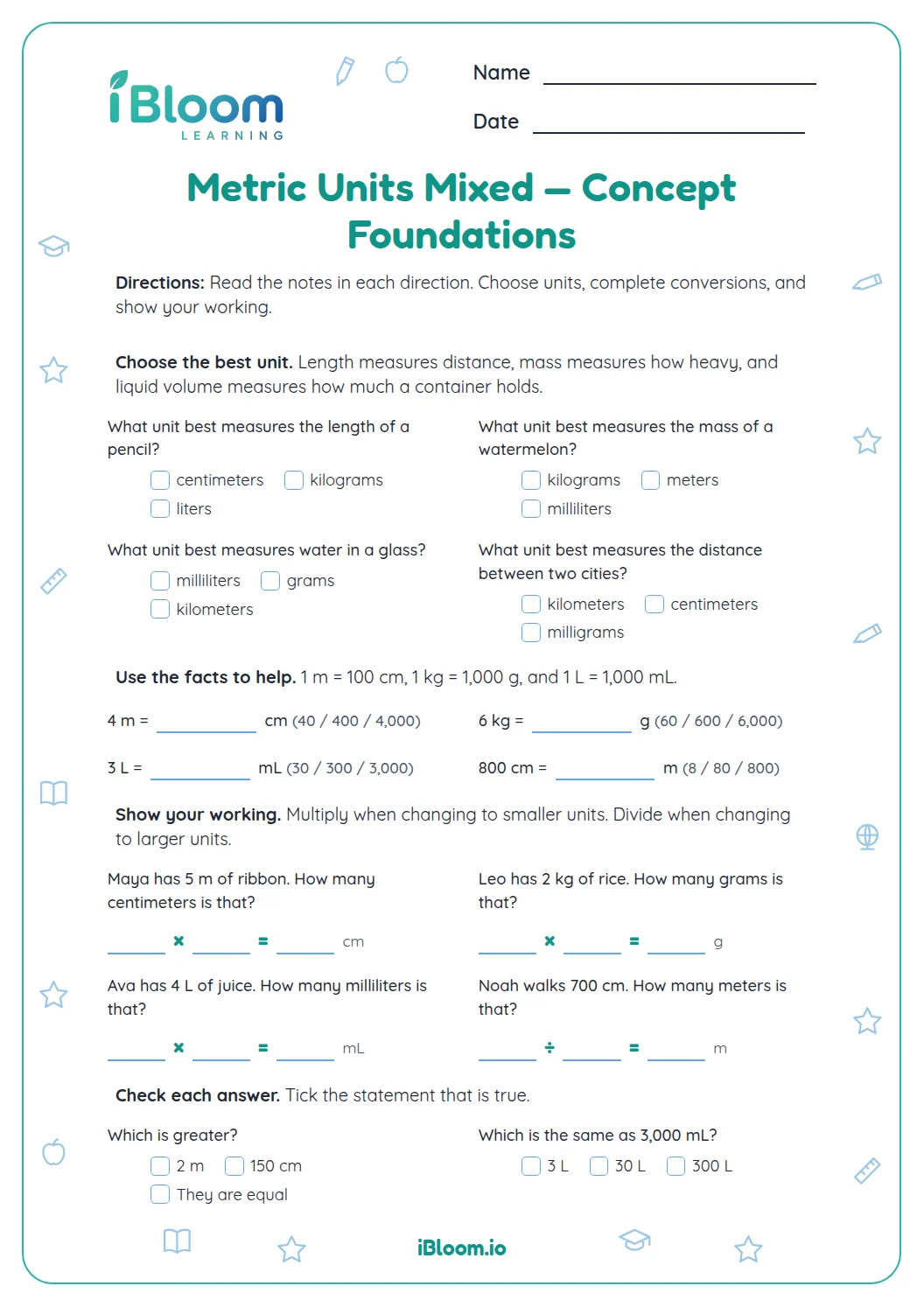
Multiply liters by 1,000 to find milliliters. Divide milliliters by 1,000 to find liters. Keep the unit with the answer and check whether the decimal placement makes the amount larger or smaller in the expected direction.
- 10.8 L × 1,000 = 800 mL
How do conversions help with capacity problems?
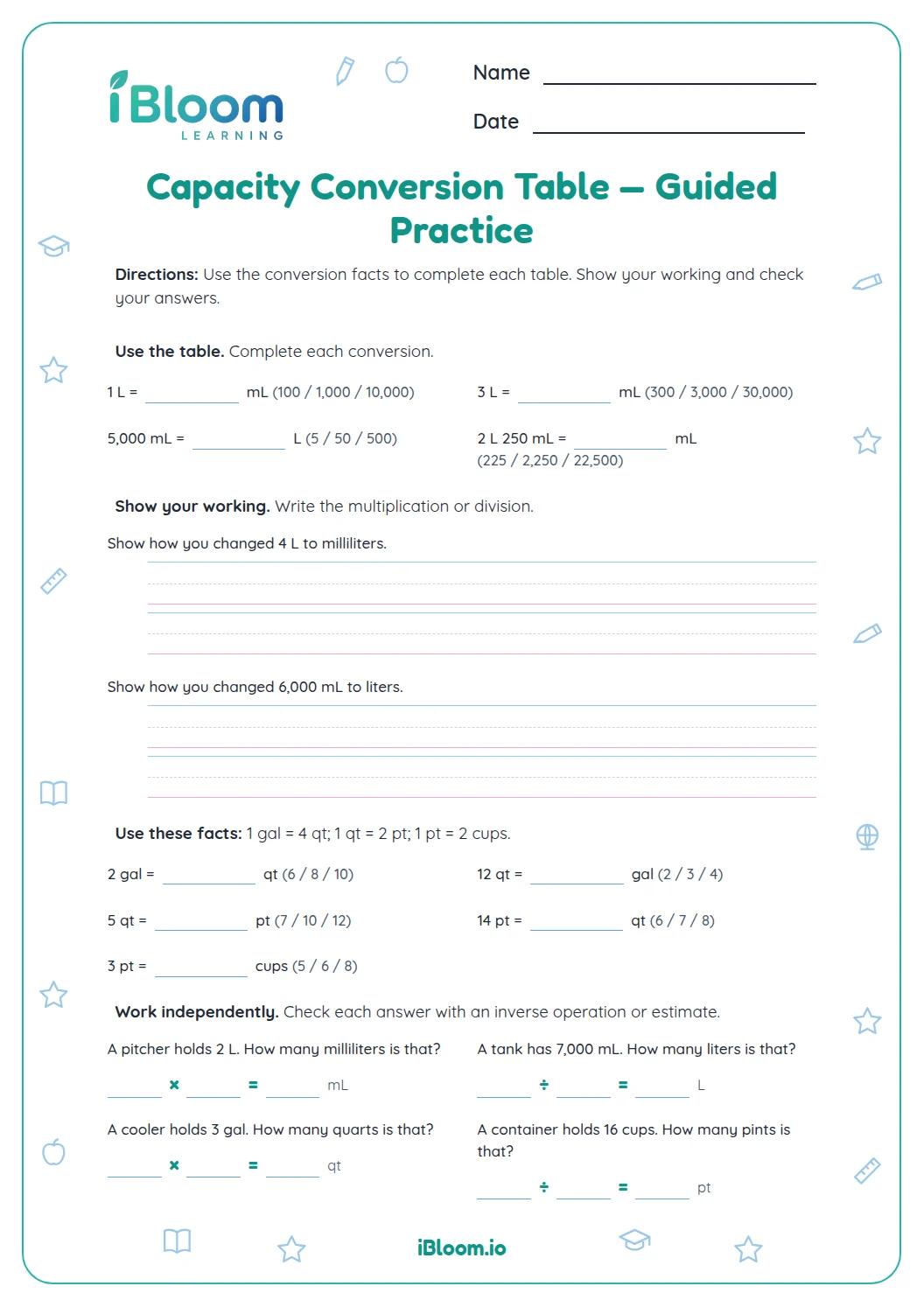
Make the units match before adding or subtracting. For two jugs, change 1.5 L to 1,500 mL, then add 750 mL to get 2,250 mL.
How to use this worksheet
- 1Keep 1 L = 1,000 mL visible while working.
- 2For each container, find the filled fraction of 1,000.
- 3Multiply liters by 1,000 to write milliliters.
- 4Divide milliliters by 1,000 to write liters.
- 5For word problems, convert all amounts to the same unit before calculating.
Common mistakes and quick fixes
The mistake
Moving the decimal the wrong direction when changing mL to L.
The fix
Since a liter is a larger unit, the number of liters is smaller.
The mistake
Adding 1.5 L and 750 mL before converting.
The fix
Rewrite both amounts as milliliters first.
The mistake
Writing a correct number with the wrong unit.
The fix
Label each answer in L or mL.
Common Core alignment
These questions use metric unit conversions to solve capacity problems.
Convert liters and milliliters, then use those conversions in capacity problems.
On this sheet: The page converts L and mL in both directions and uses conversions to add and subtract amounts.
Show the official wordingHide the official wording
Convert among different-sized standard measurement units within a given measurement system (e.g., convert 5 cm to 0.05 m), and use these conversions in solving multi-step, real world problems.
What to practice next
Make more practice
Further reading
Questions parents and teachers ask
What conversion should students remember?
One liter equals 1,000 milliliters. Multiply a liter amount by 1,000 to find milliliters, and divide a milliliter amount by 1,000 to find liters. The first question connect this relationship to full, half-full, quarter-full, and three-quarter-full one-liter containers.
Does the worksheet include decimal conversions?
Yes. Students convert values such as 0.8 L and 3,500 mL, then use the same relationship in capacity situations. The answer key includes units for the word problems so learners can check both the number and the measurement. A useful check is whether the size makes sense.
How many milliliters are in half a liter?
Half a liter is half of 1,000 milliliters, which is 500 mL. The half-full container model shows that amount visually. Students can also calculate it by multiplying 0.5 by 1,000 or dividing 1,000 by 2. Students can see the matching half in the one-liter drawing.
When should students convert before adding?
Convert both amounts to the same unit before adding or subtracting. For example, change 1.5 L to 1,500 mL before adding 750 mL. After the units match, perform the operation and label the result with that unit. This also keeps the final unit clear.
What is the answer to the cooler problem?
The cooler starts with 5 L, or 5,000 mL. Subtract the 2,300 mL poured out to get 2,700 mL remaining. This question checks whether students can convert a whole liter amount before subtracting a milliliter amount. The calculation is 5,000 − 2,300 = 2,700.
How long does this metric capacity page take?
Plan for about 20 minutes. Students first interpret two container drawings, then work with five direct conversions and five word problems. Showing the conversion step can help a learner catch a decimal-place error before using the answer key. Pause between parts if the learner needs more time.