


About this worksheet
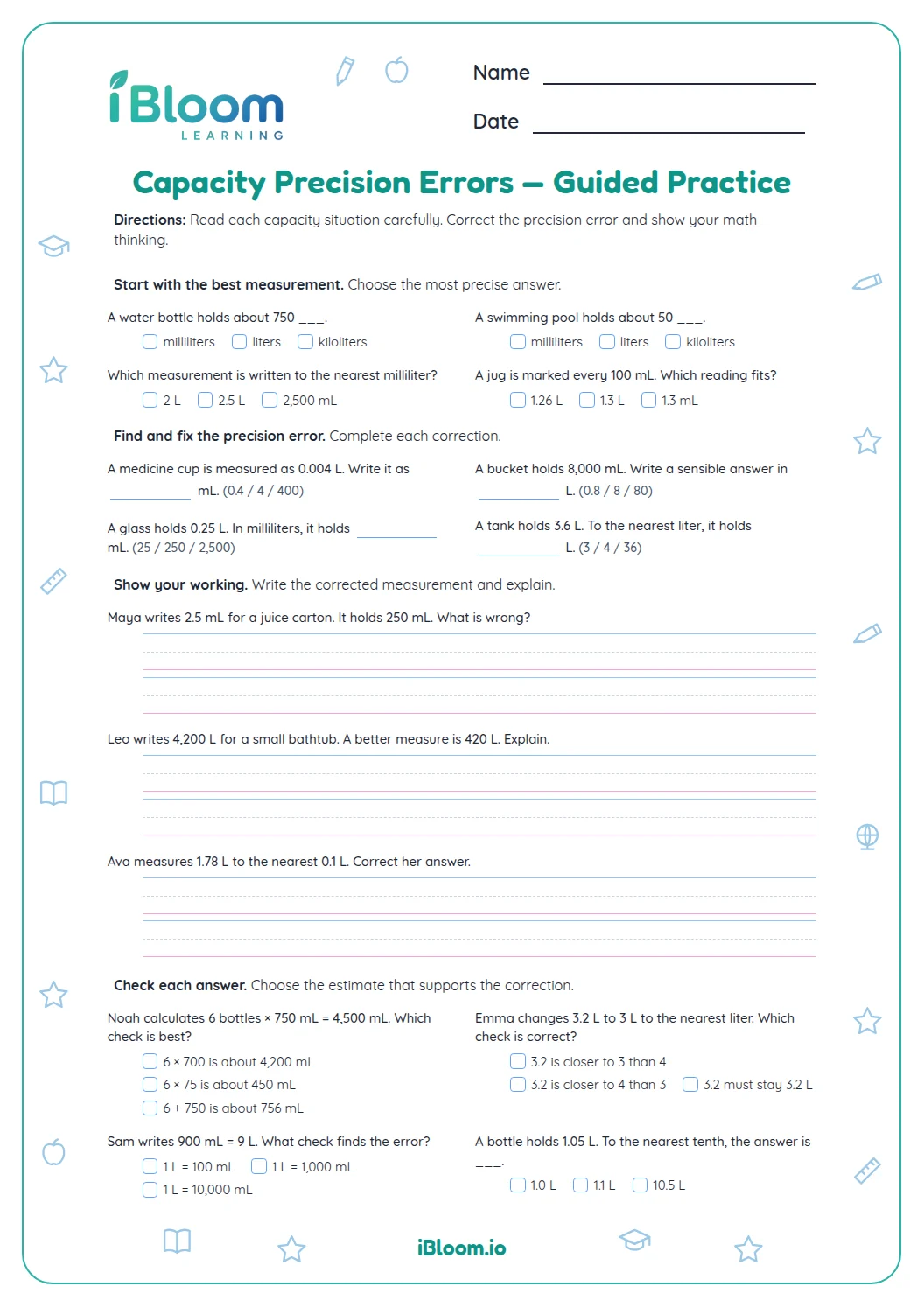
This free printable Grade 5 worksheet helps students convert capacity measurements among milliliters, liters and kiloliters. A completed metric table anchors the first examples; students then convert in both directions and solve four short capacity problems. The 16 questions practice multiplying or dividing by 1,000 while tracking units, including multi-step conversions. These conversions align with Common Core 5.MD.A.1. The two-page worksheet and separate two-page answer key include direct conversions and real-world applications.
Aligned to 5.MD.A.1
How does the conversion table help?
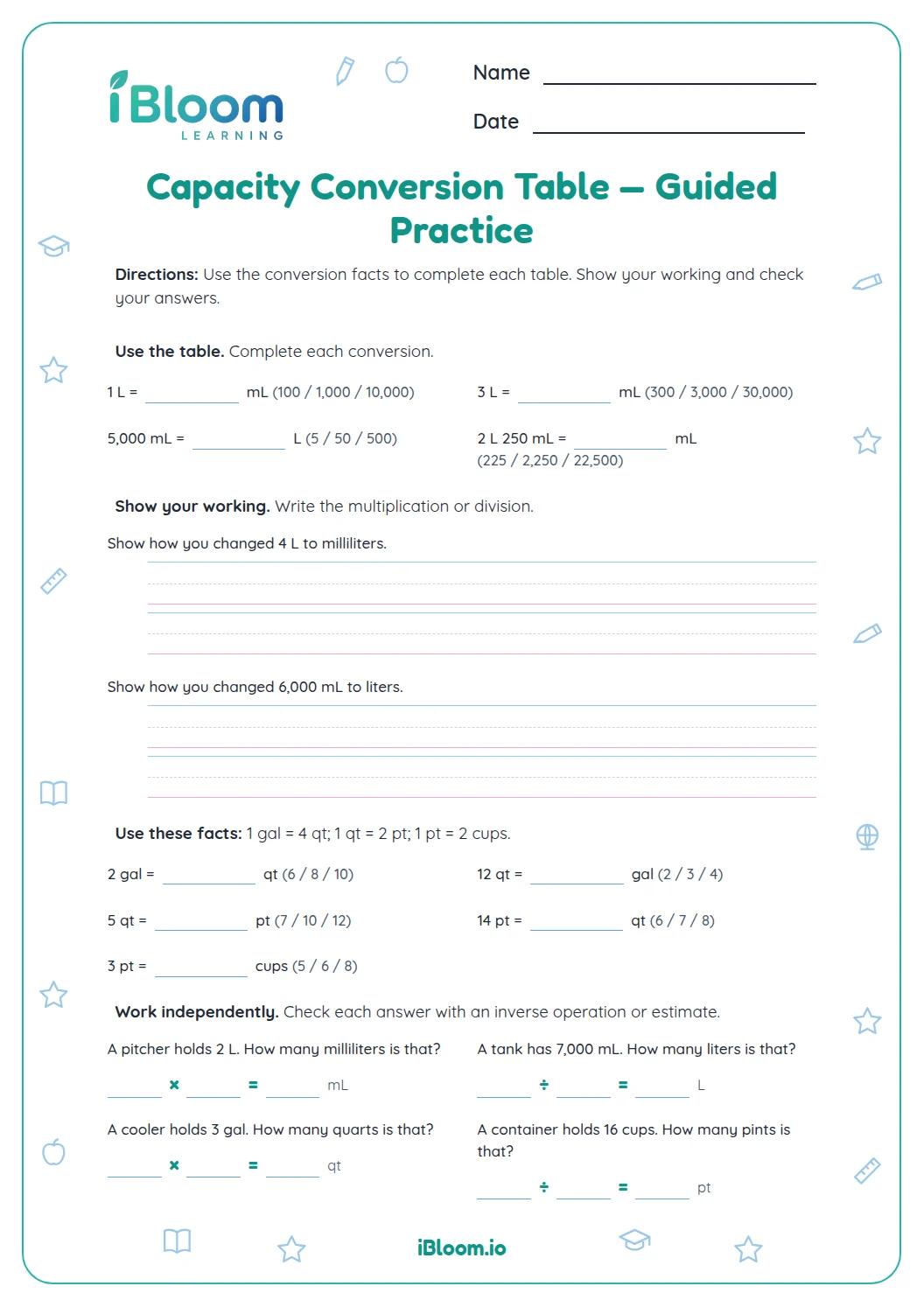
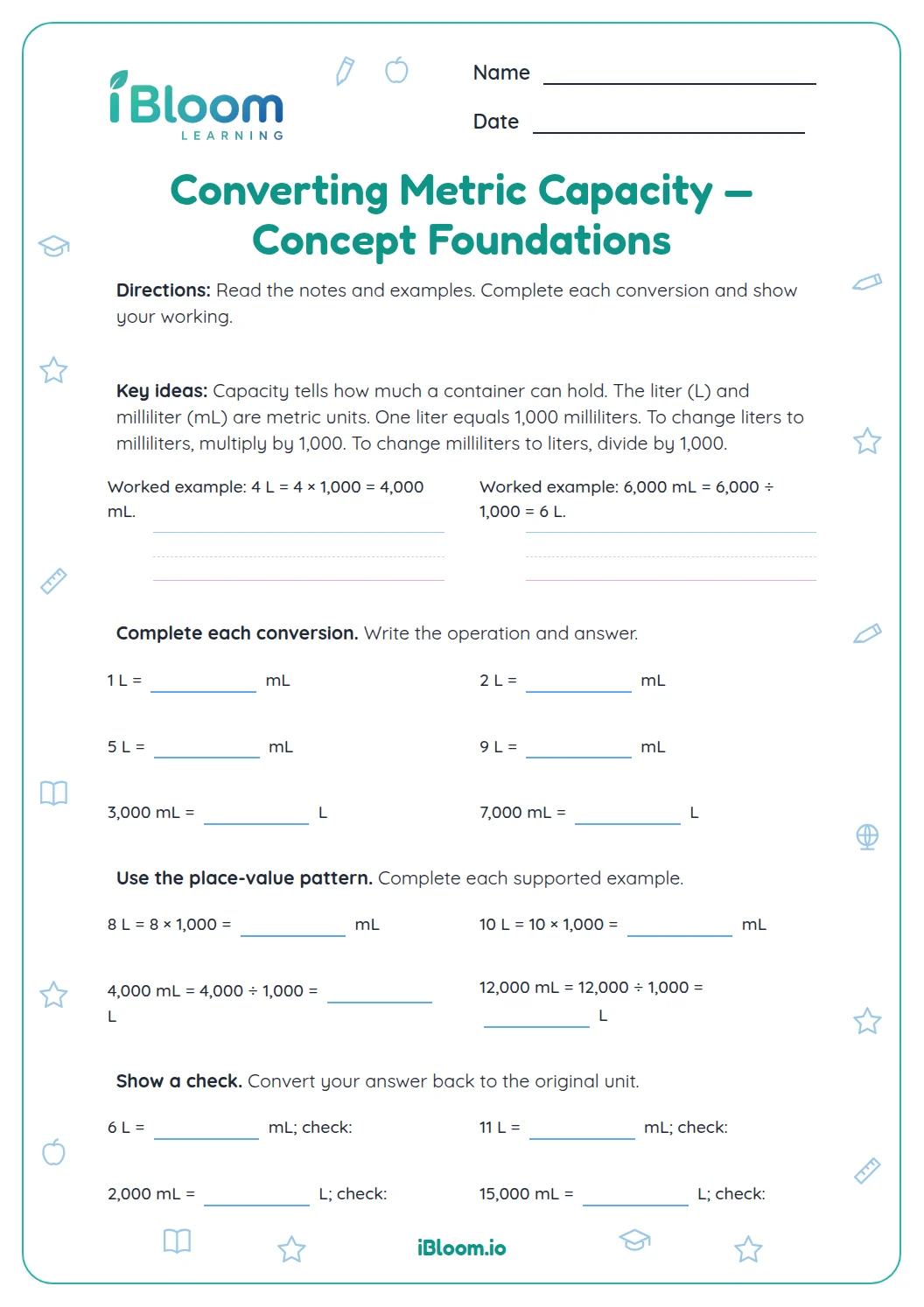
The table shows equivalent amounts in liters and milliliters. Since 1 L = 1,000 mL, 4 L is four groups of 1,000 mL, or 4,000 mL.
For conversions between liters and kiloliters, use 1 kL = 1,000 L. Moving to a smaller unit multiplies the number by 1,000; moving to a larger unit divides it by 1,000.
- 14 L = ___ mL
- 2Use 1 L = 1,000 mL.
- 34 × 1,000 = 4,000
- 4So 4 L = 4,000 mL.
What steps keep the units straight?
Name the starting and target units before calculating. Then choose multiply or divide and attach the target unit to the answer.
How can students check a conversion?
Convert the result back to the starting unit. For example, 4,000 mL ÷ 1,000 = 4 L, so the conversion is consistent.
How to use this worksheet
- 1Write the starting unit and the unit you need.
- 2Find how many 1,000-unit steps separate them.
- 3Multiply when converting to smaller units.
- 4Divide when converting to larger units.
- 5Label the answer and convert back to check.
Common mistakes and quick fixes
The mistake
Multiplying when moving to kiloliters
The fix
Kiloliters are larger than liters, so divide liters by 1,000.
The mistake
Dropping a group of three zeros
The fix
Use the conversion table and check by reversing the operation.
The mistake
Writing a correct number with the wrong unit
The fix
Include the requested unit after every number.
Common Core alignment
Convert metric capacity units and use conversions in multistep problems.
On this sheet: Students convert among milliliters, liters and kiloliters, including multistep capacity problems.
Show the official wordingHide the official wording
Convert among different-sized standard measurement units within a given measurement system (e.g., convert 5 cm to 0.05 m), and use these conversions in solving multi-step, real world problems.
What to practice next
Make more practice
Further reading
Questions parents and teachers ask
How many milliliters are in 1 liter?
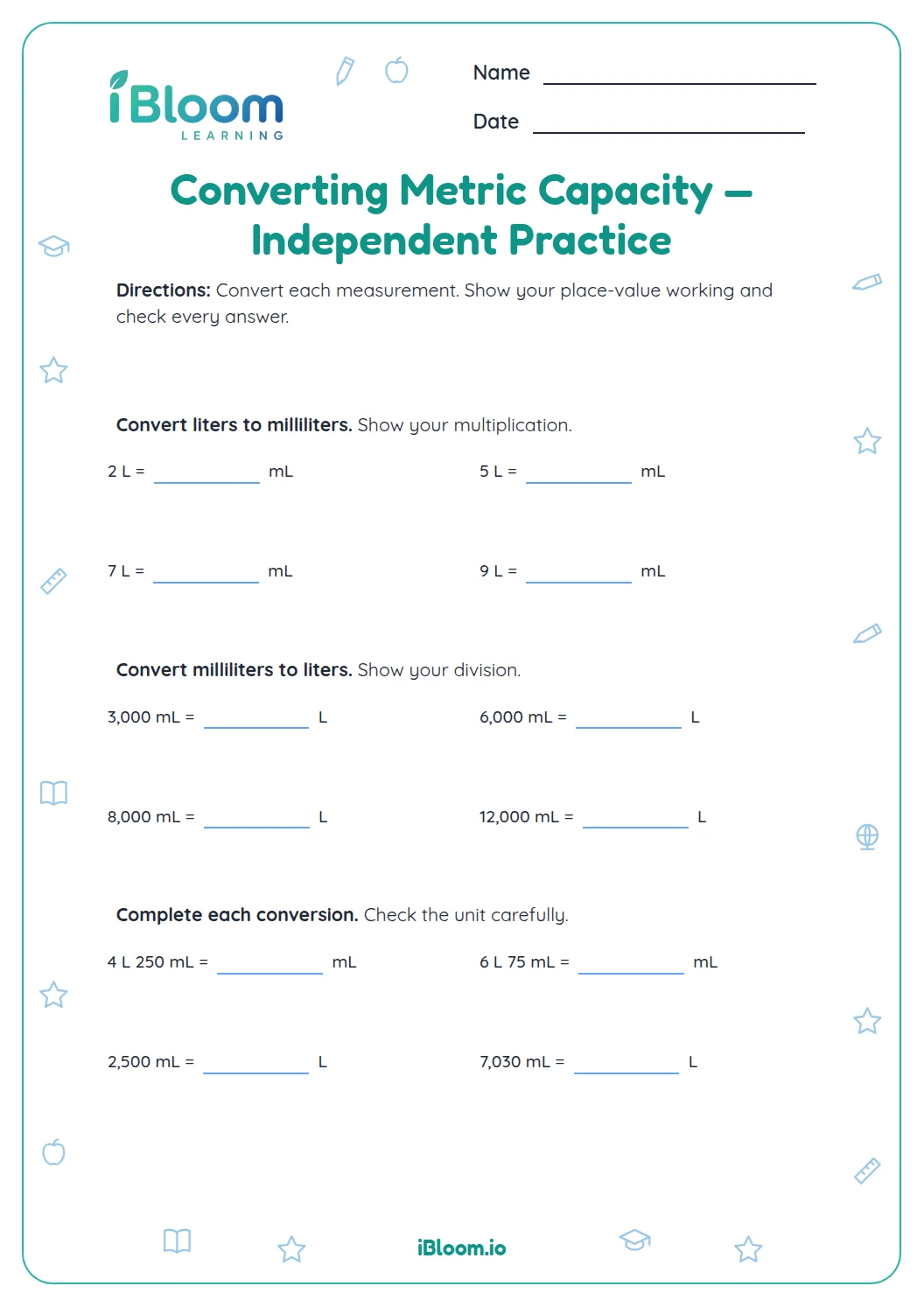
There are 1,000 milliliters in 1 liter. The table on this worksheet uses that relationship to show equivalent capacities, such as 4 L and 4,000 mL. Students can multiply liters by 1,000 to find milliliters, then divide by 1,000 to check.
How many liters are in 1 kiloliter?
One kiloliter equals 1,000 liters. Questions 5–8 practice conversions between those two units in both directions. Divide liters by 1,000 to get kiloliters, or multiply kiloliters by 1,000 to get liters. Students can check each answer by converting back to the starting unit.
What units does this worksheet use?
The practice uses milliliters (mL), liters (L) and kiloliters (kL). Students convert within the metric system and include the requested unit with each answer. The table and worked example reinforce the relationship between adjacent units, while the word problems ask students to apply those conversions to capacity amounts.
Does the answer key include answers to the word problems?
Yes. The answer key gives a value with the correct unit for all 16 questions, including the four capacity word problems. Students can also check a conversion by reversing the multiplication or division. For example, divide a milliliter answer by 1,000 to see whether it returns to the given liters.
How can I help if a student mixes up multiply and divide?
Ask which unit is larger. Converting to a smaller unit makes the number larger, so multiply by 1,000; converting to a larger unit makes the number smaller, so divide by 1,000. Have the student estimate before calculating, then use the table and reverse the operation to check.