

About this worksheet
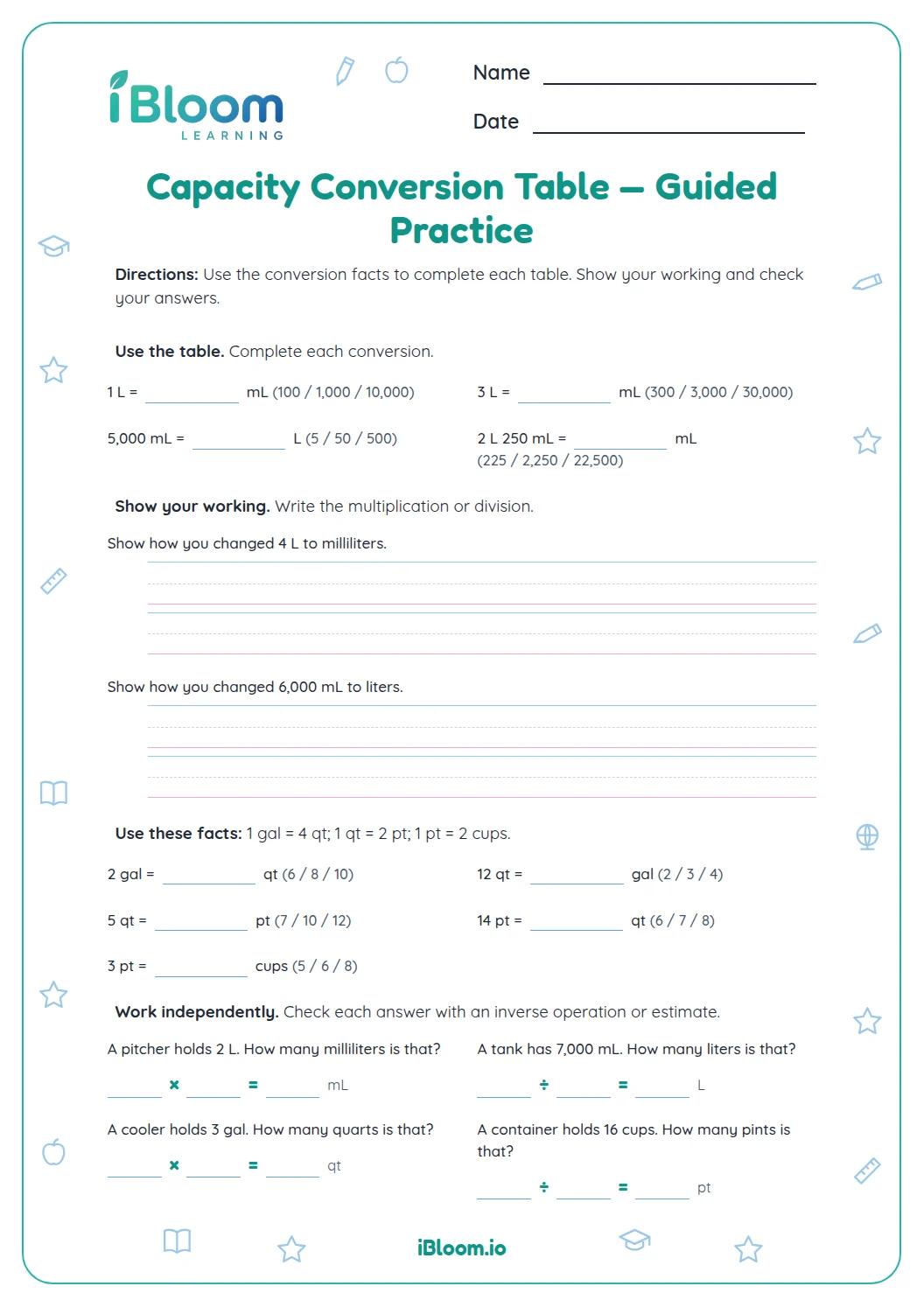
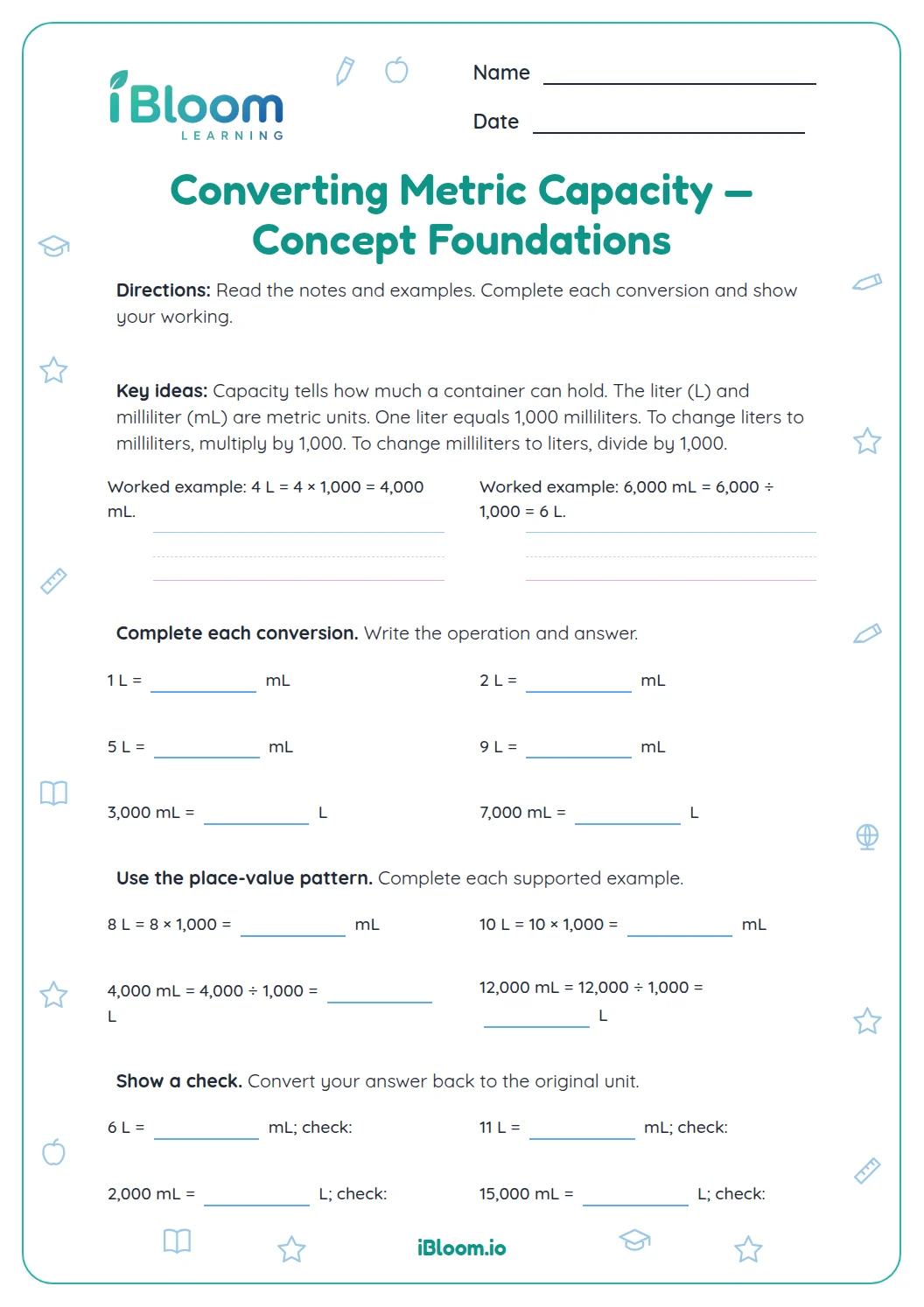
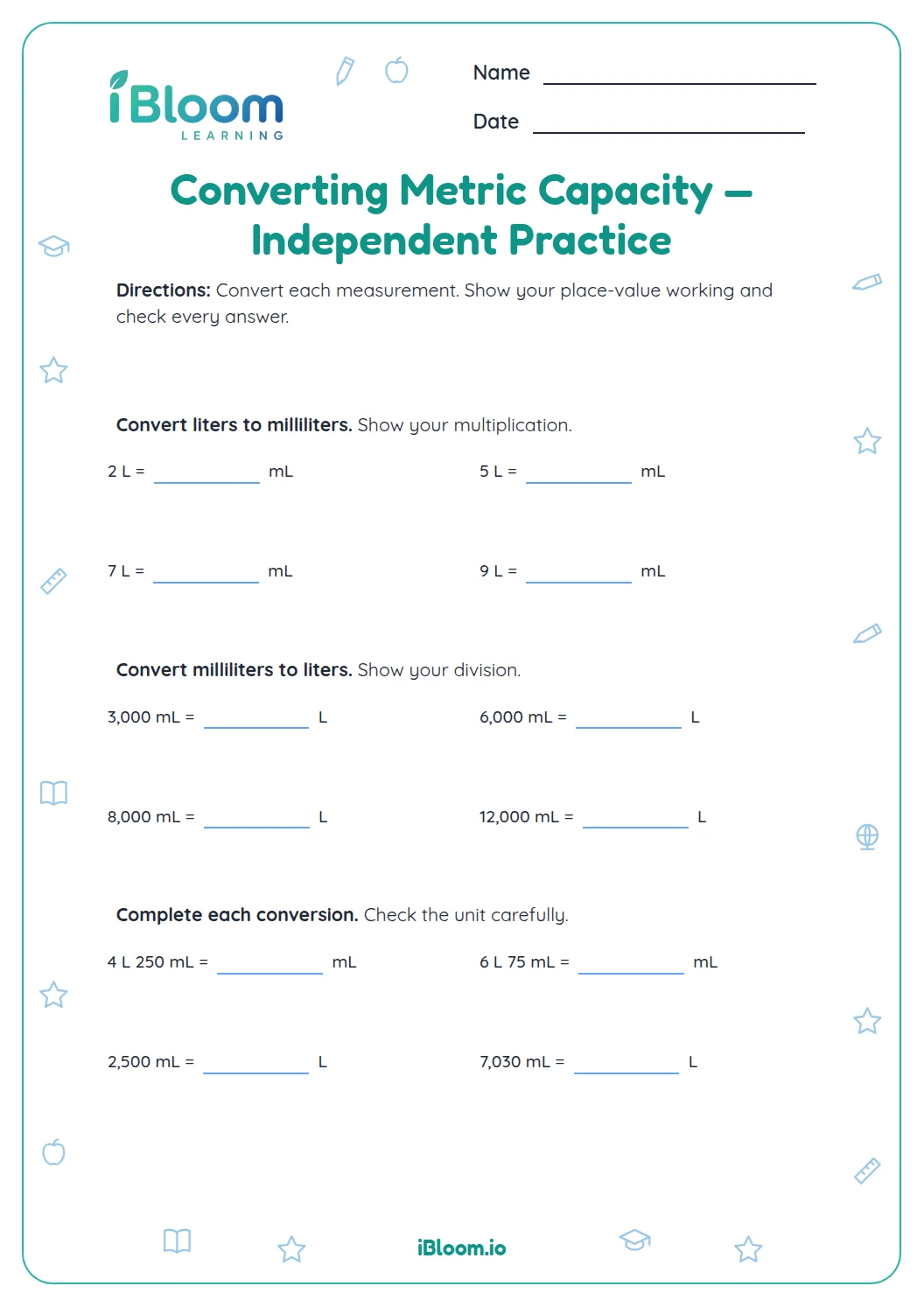
This Grade 5 printable practices metric capacity conversions among liters, milliliters, and kiloliters. Students complete two tables, convert measurements, and solve situations about bottles, soup, lemonade, and a pool. A final pair of questions asks students to check a conversion claim and compare an amount with one kiloliter. The work applies CCSS 5.MD.A.1 to metric units and real-world problems.
Aligned to 5.MD.A.1
How do the metric units relate?
One liter equals 1,000 milliliters, and one kiloliter equals 1,000 liters. Part A asks students to use these relationships in direct conversions.
- Questions 1–6 convert among L, mL, and kL.
What entry completes the capacity table?
Part B gives a liters-and-milliliters table with one missing value. Read the column labels, then use 1 L = 1,000 mL to complete the entry.
- Question 7 completes one metric conversion table.
How can a student solve a capacity situation?
Convert to a common unit before multiplying or subtracting. Keep the unit in the final answer.
- 1Question 10: Seven bottles hold 500 mL each.
- 27 × 500 = 3,500
- 3Ava uses 3,500 mL.
How can students check a conversion?
The last two questions ask students to test a claim and compare a quantity with 1 kL. These checks bring the conversion facts back into view after the story problems.
How to use this worksheet
- 1Read the part direction before starting.
- 2Complete the first item together and name the strategy.
- 3Work through the remaining items one at a time.
- 4Reread each response and check its units or punctuation.
- 5Use the answer key to correct any missed step.
Common mistakes and quick fixes
The mistake
Treating 1 L as 100 mL.
The fix
Write 1 L = 1,000 mL before moving the decimal or multiplying.
The mistake
Adding 500 L to 2 kL without converting first.
The fix
Change 500 L to 0.5 kL, or change 2 kL to 2,000 L, then add.
The mistake
Leaving off the unit.
The fix
Copy the unit requested in the question after the number.
This worksheet applies metric unit conversions to tables and capacity situations.
Convert metric units and use those conversions in real-world problems.
On this sheet: Students convert among liters, milliliters, and kiloliters in tables and capacity situations.
Show the official wordingHide the official wording
Convert among different-sized standard measurement units within a given measurement system (e.g., convert 5 cm to 0.05 m), and use these conversions in solving multi-step, real world problems.
What to practice next
Make more practice
Further reading
Questions parents and teachers ask
Which units does this worksheet use?
There are 14 questions: six direct conversions, one metric conversion table, five real-world capacity problems, and two reasoning checks. Students use liters, milliliters, and kiloliters. The answer key lists the completed table and numerical answers with units for checking.
How many questions are on the worksheet?
There are 19 questions across four parts: six direct conversions, two tables, nine real-world capacity problems, and two reasoning checks. Students move from conversion facts to tables, then to applications and a final review of whether quantities make sense.
What is one example from the page?
Question 10 asks how much liquid Ava uses when she fills seven bottles with 500 mL each. Multiply 7 by 500 to get 3,500, then label the answer in milliliters. The key shows 3,500 mL and the unit requested.
How should a student handle mixed units?
Convert one amount so both quantities use the same unit before adding or subtracting. For example, change 2,000 mL to 2 L before subtracting it from 5 L. Keep the unit in the answer to show what the number measures.
How is the answer key organized?
The key follows the worksheet questions and gives the two completed tables, numerical answers, and units. For the multiple-choice checks, it identifies the correct statement or comparison. Ask the student to explain one conversion while reviewing rather than only marking answers right or wrong.