

About this worksheet
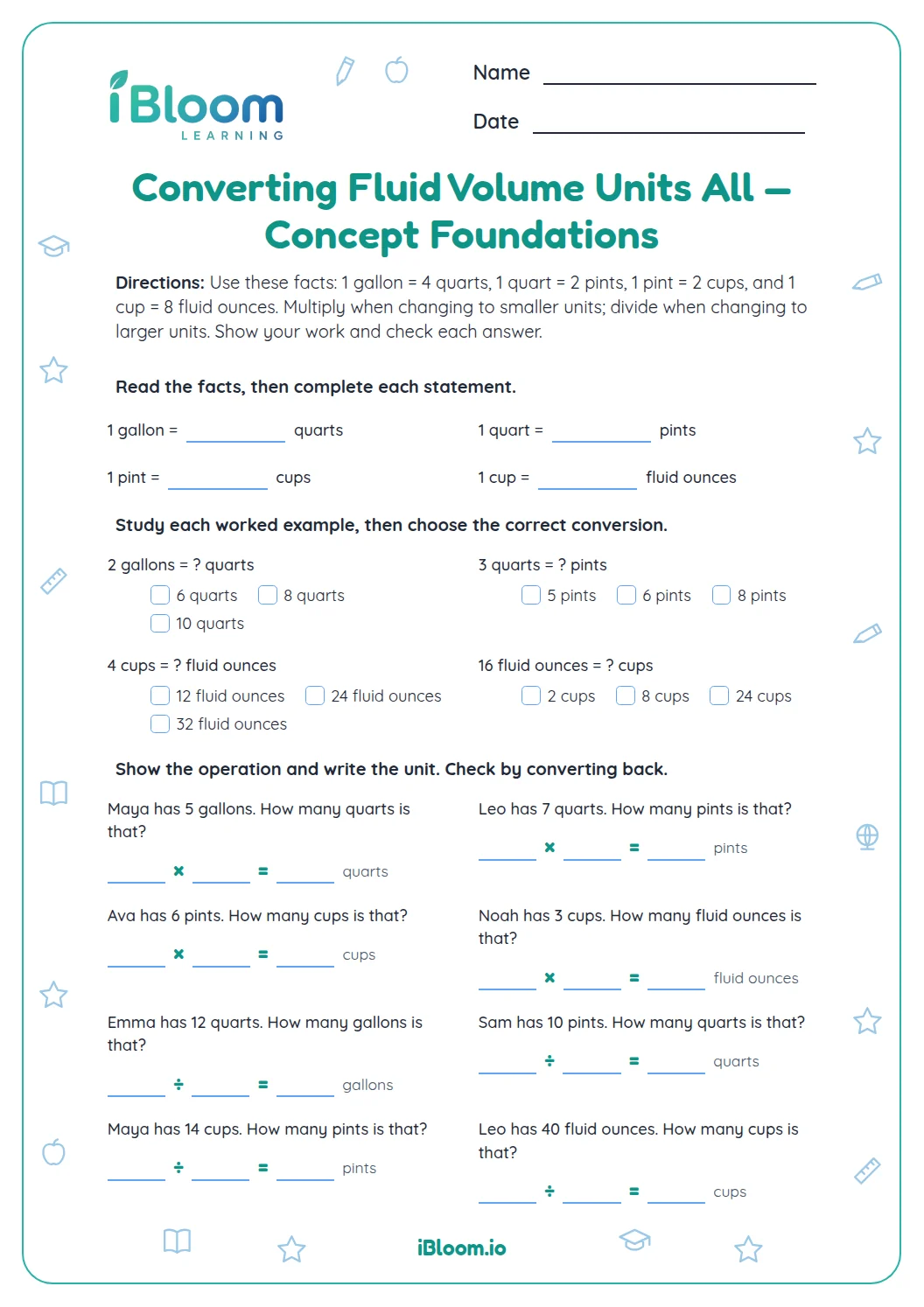
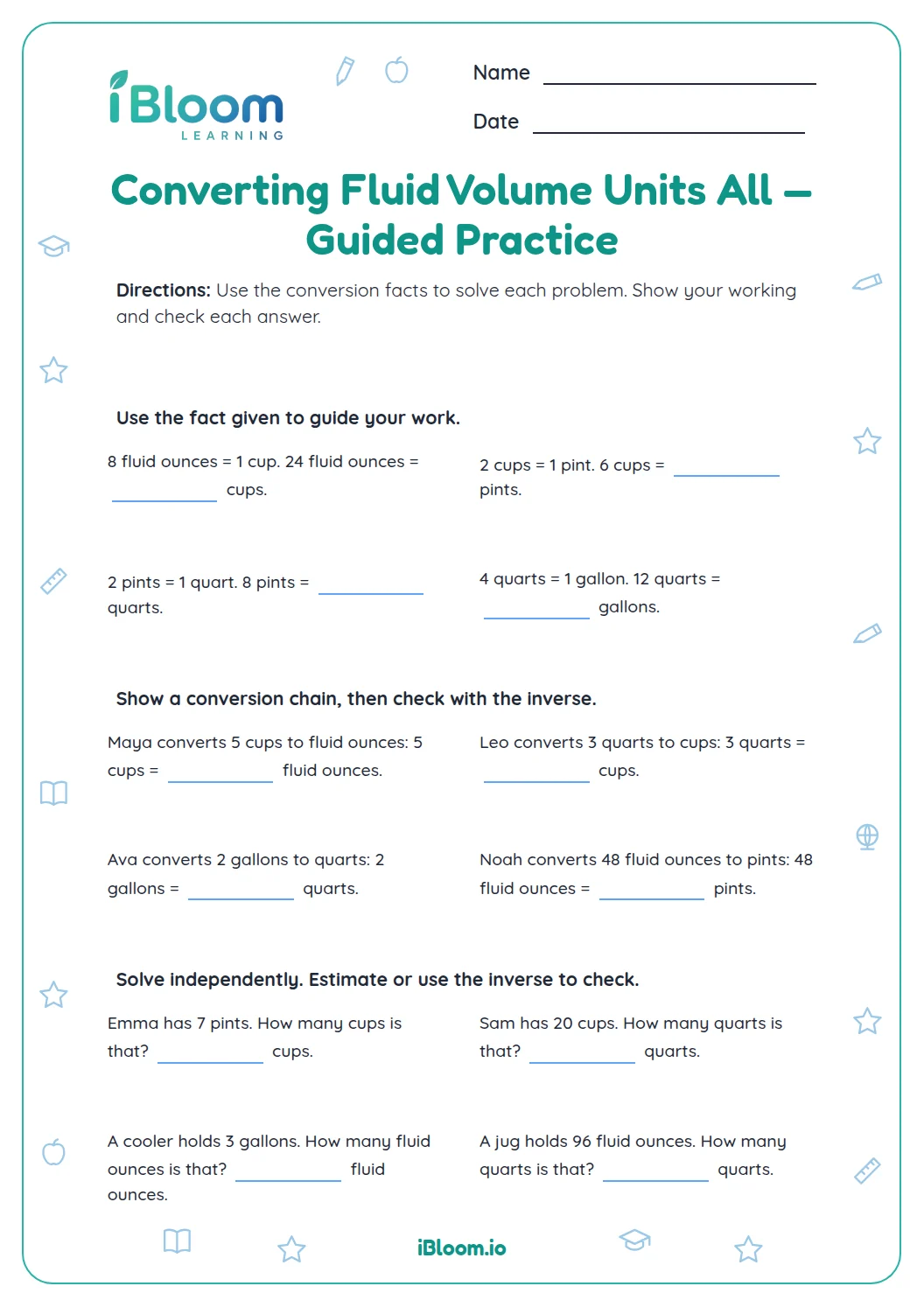
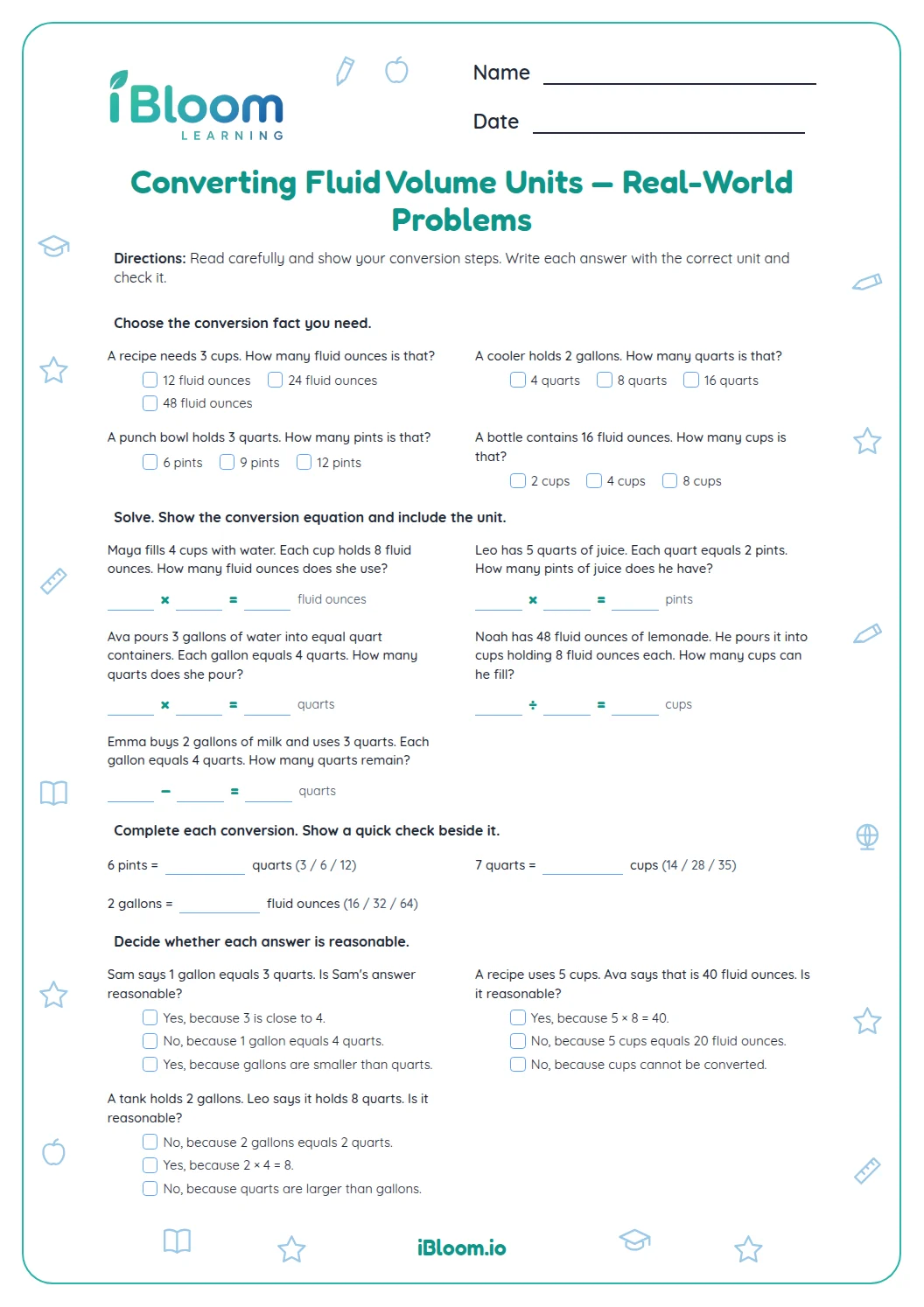
This free Grade 5 worksheet gives students practice converting customary fluid-volume units. Students use an equivalence table, convert among fluid ounces, cups, pints, quarts and gallons, then solve two situations that require a conversion before subtracting or combining amounts. The work builds from direct conversions to multi-step customary-unit problems. A separate answer key is included.
Aligned to 5.MD.A.1
How do customary capacity units connect?
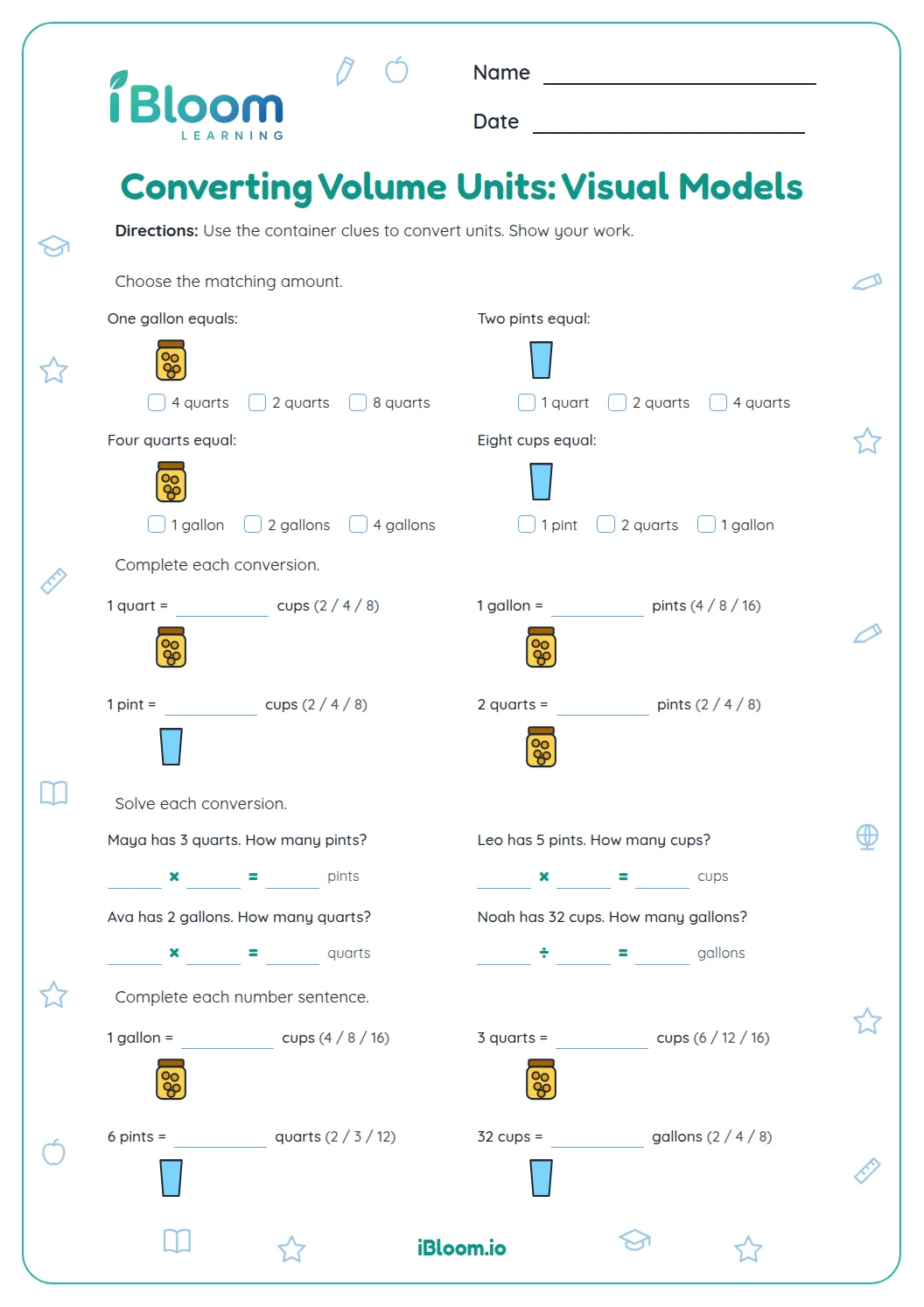
The customary relationships build from cups to pints, quarts and gallons: 2 cups make 1 pint, 2 pints make 1 quart, and 4 quarts make 1 gallon. Fluid ounces connect to cups at 8 fluid ounces per cup. Decide whether the question asks for a larger or smaller unit before choosing multiplication or division.
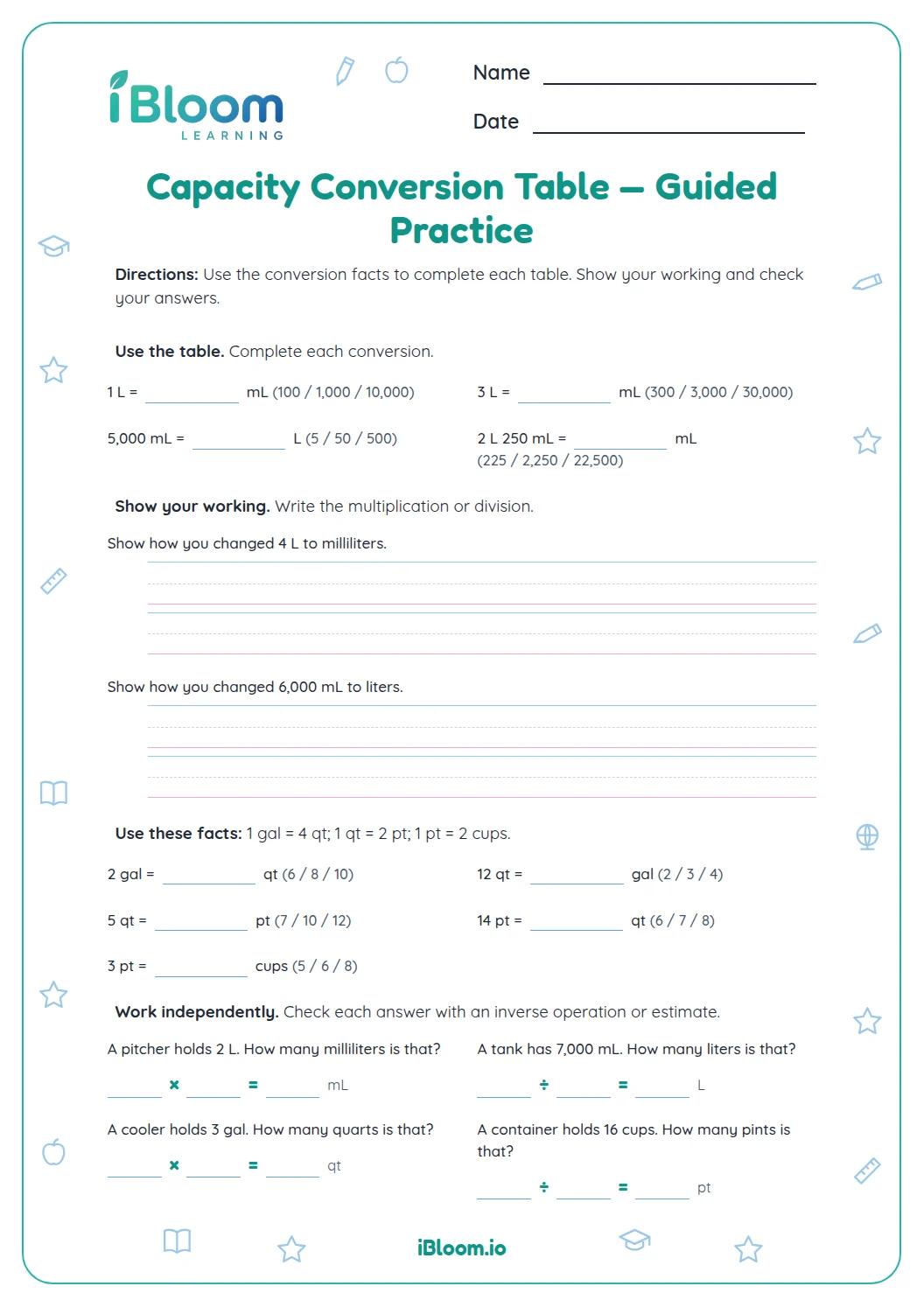
Question 1 includes a small conversion table. It shows that 1 gallon equals 4 quarts and 16 cups, so 3 gallons equal 12 quarts. The unit label matters: 12 alone does not tell whether the answer is quarts, cups or gallons.
- 13 gal = ___ qt
- 21 gal = 4 qt
- 33 × 4 = 12
- 4Answer: 12 qt
How can you chain customary units?
When two units are not adjacent in the conversion chain, move through a familiar unit. To change gallons to cups, first change gallons to quarts, then quarts to cups. Question 9 changes 3 gallons to pints: 3 gallons are 12 quarts, and 12 quarts are 24 pints.
How do the story problems use conversions?
Convert each amount to matching units before adding or subtracting. In question 15, 3 cups plus 5 cups makes 8 cups, or 4 pints. The units in the final answer match the amount requested.
- 13 c + 5 c = 8 c
- 22 c = 1 pt, so 8 c = 4 pt
- 3Answer: 4 pt
What is in each part of the worksheet?
The sheet starts with direct customary equivalences and a table, moves to conversions between familiar units, then finishes with two situations that require a conversion before solving. The separate answer key lets students check their work afterward.
- Part A: five direct conversions and a unit table
- Part B: nine customary conversions
- Part C: two customary fluid-volume stories
How can a student work through the page?
- 1Write the unit relationship beside the first few problems.
- 2Mark whether the target unit is larger or smaller than the starting unit.
- 3Choose multiplication or division based on that change.
- 4Convert each amount before combining amounts in a story.
- 5Write a unit after every answer and compare it with the question.
- 6Use the answer key to redo any missed conversion with the relationship shown.
Common conversion mistakes
The mistake
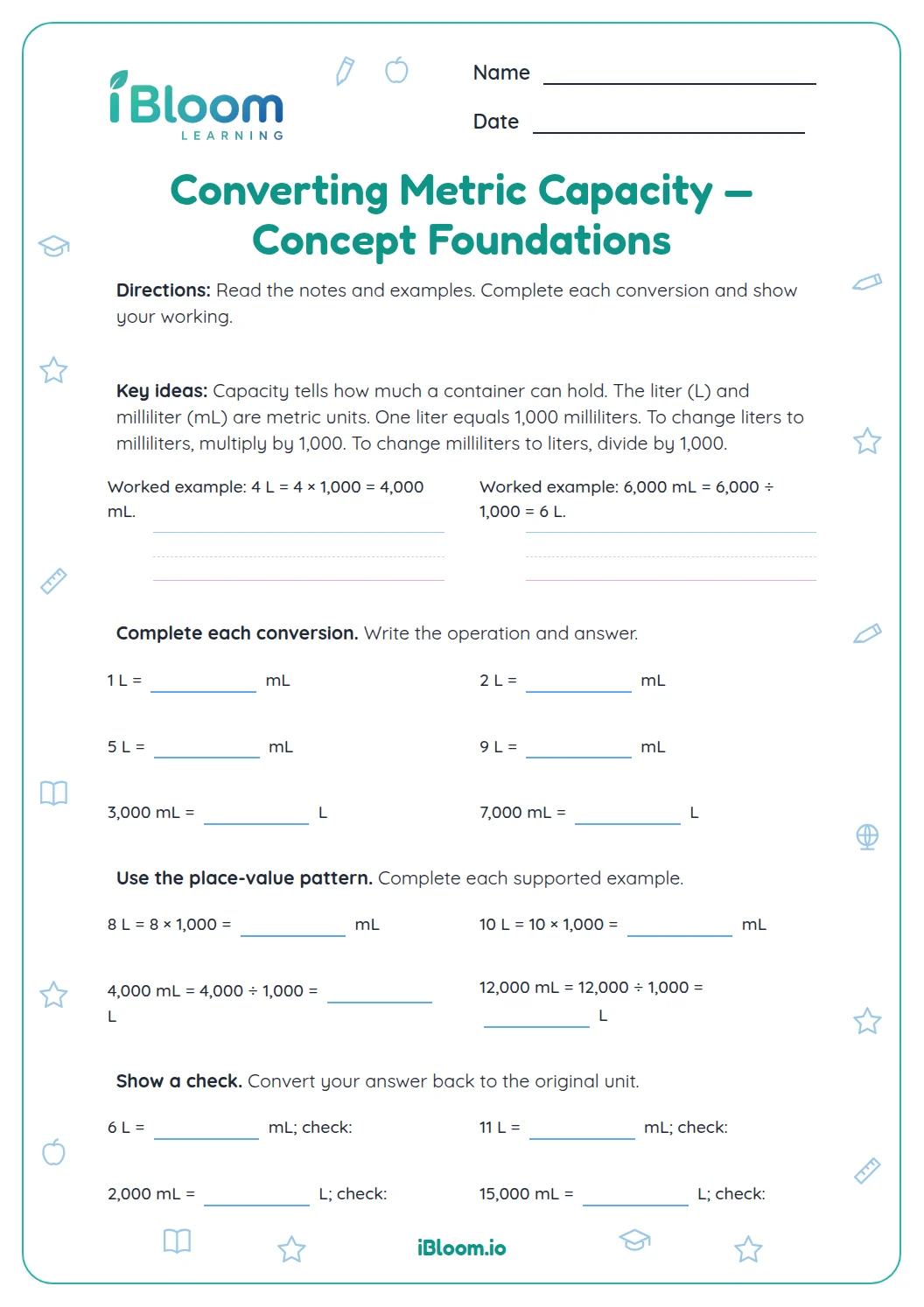
Multiplying when converting to a larger unit, such as changing milliliters to liters.
The fix
Ask whether the new unit is larger; fewer larger units fit in the same amount, so divide by 1,000.
The mistake
Using 2 cups per quart instead of 4.
The fix
Build the chain: 2 cups per pint and 2 pints per quart, so 4 cups per quart.
The mistake
Adding gallons and quarts before converting them to one unit.
The fix
Convert both amounts to quarts or both to gallons first, then combine.
Common Core alignment
This worksheet practices the skill described in the standard below.
Convert customary and metric fluid units and use conversions in word problems.
On this sheet: Students convert standard capacity units and apply the conversions in multi-step stories.
Show the official wordingHide the official wording
Convert among different-sized standard measurement units within a given measurement system (e.g., convert 5 cm to 0.05 m), and use these conversions in solving multi-step, real world problems.
What to practice next
Make more practice
Further reading
Questions parents and teachers ask
How many questions are on the fluid-volume worksheet?
There are 16 questions across three parts. Students convert customary units, use a table, chain familiar unit relationships, and solve two stories that use those equivalences. The parts move from direct conversion to applying a conversion in a practical situation.
Which customary units appear on the page?
The direct-conversion section uses fluid ounces, cups, pints, quarts and gallons. Students use relationships among those units, including 4 quarts in a gallon and 8 fluid ounces in a cup. The word problems also ask them to combine or compare customary amounts.
Which units are on the worksheet?
The questions use fluid ounces, cups, pints, quarts and gallons. Students use relationships among these customary units, including 8 fluid ounces per cup, 2 cups per pint and 4 quarts per gallon. The table helps organize several equivalent amounts.
What should students do in the word problems?
Students should convert amounts to matching customary units before adding or subtracting. For example, the cooler story changes gallons to quarts before asking how many quarts are poured out or remain. A number sentence helps keep the conversion and operation in order.
Is an answer key included?
Yes. A separate answer key page lists the conversion answers and the labeled results for the two customary-unit stories. Students can finish the worksheet first, then use the key to check the arithmetic, the chosen units and the final labels.