


About this worksheet
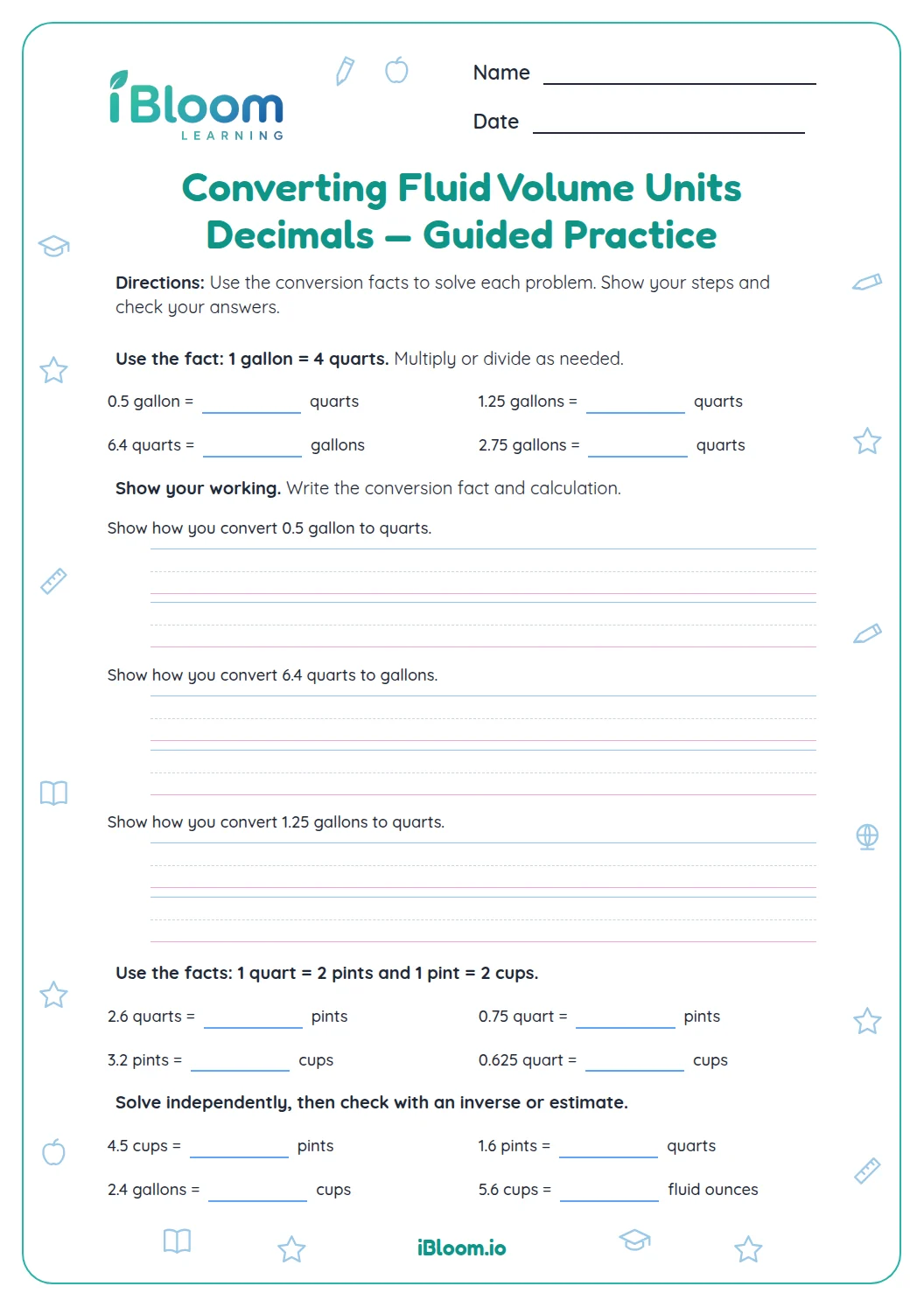
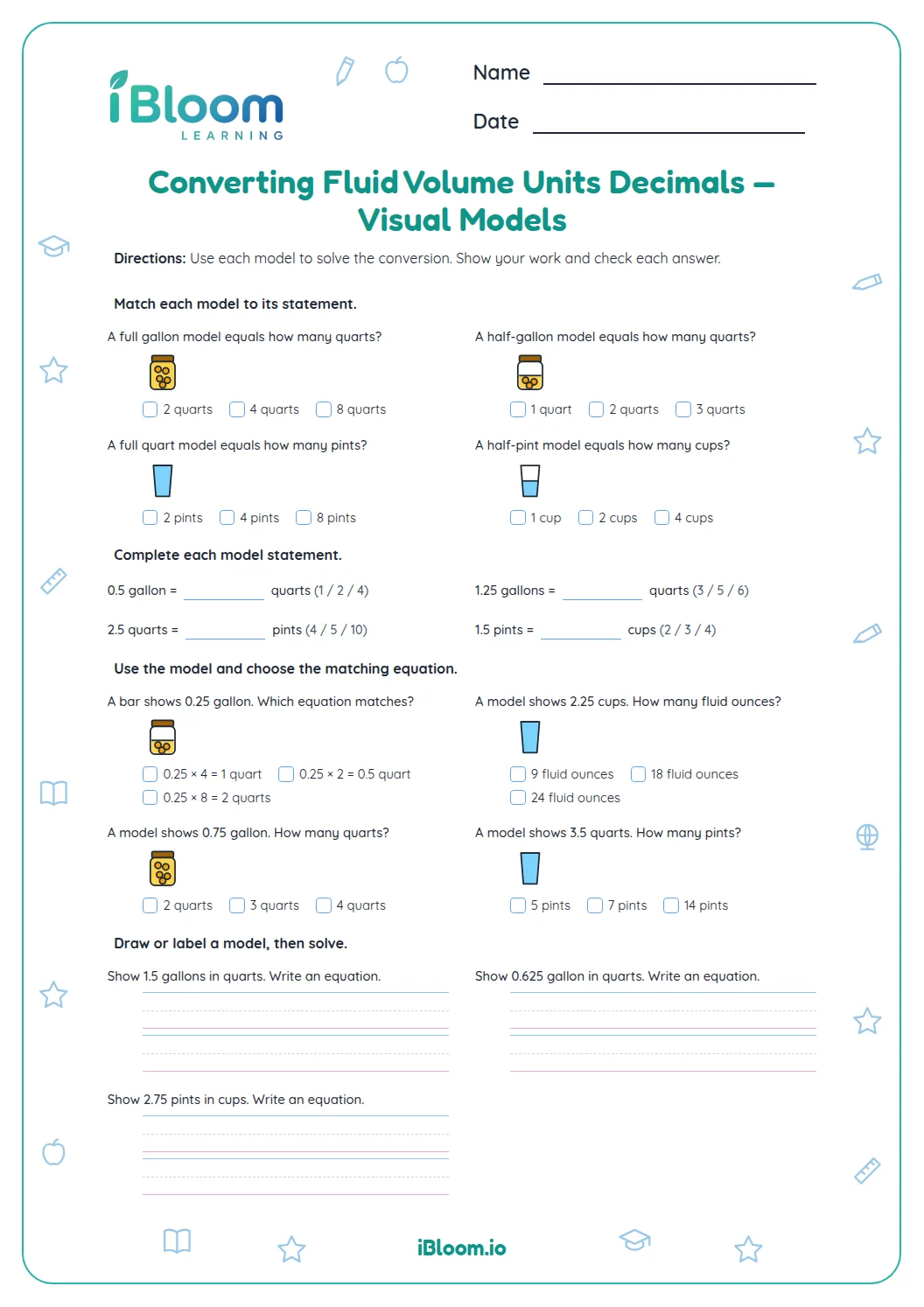
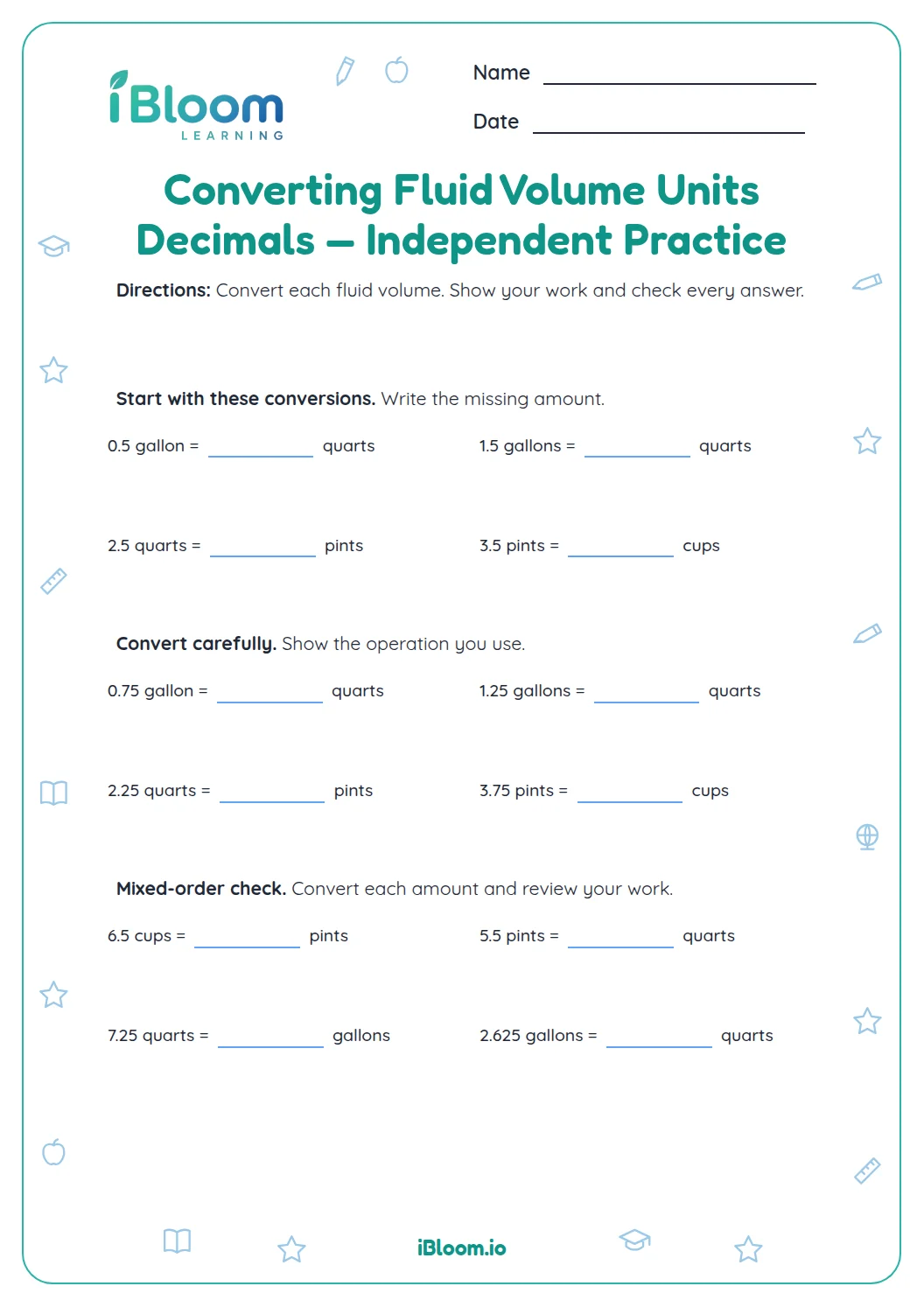
This free Grade 5 measurement worksheet practices converting fluid-volume units and using those conversions in problems. Its 14 questions move from direct customary and metric conversions to comparisons and eight situations involving recipes, containers, and amounts of liquid. Learners can convert to a shared unit before comparing or calculating. A separate answer key supports checking. The sheet practices CCSS 5.MD.A.1.
Aligned to 5.MD.A.1
How do customary fluid-volume units connect?
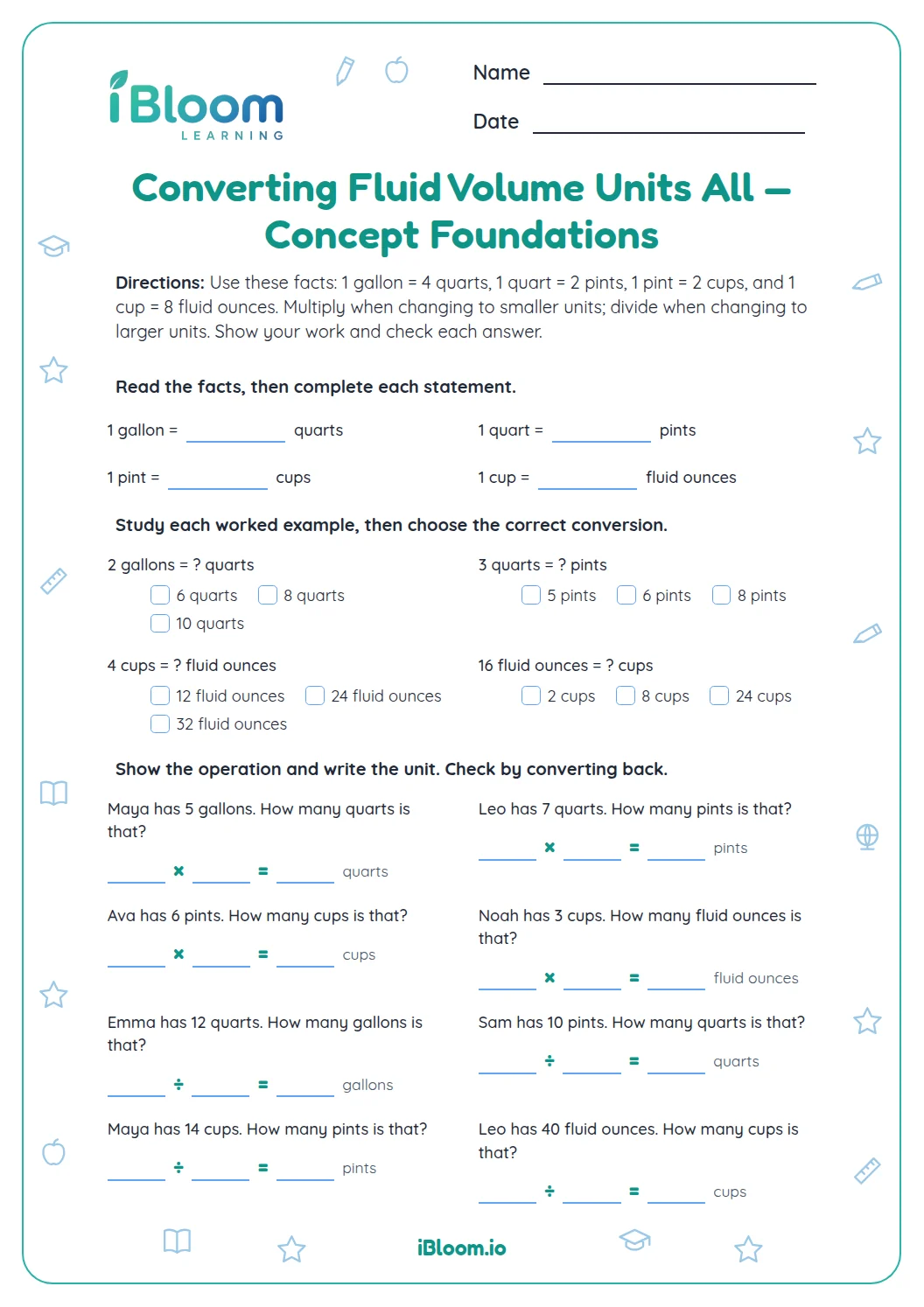
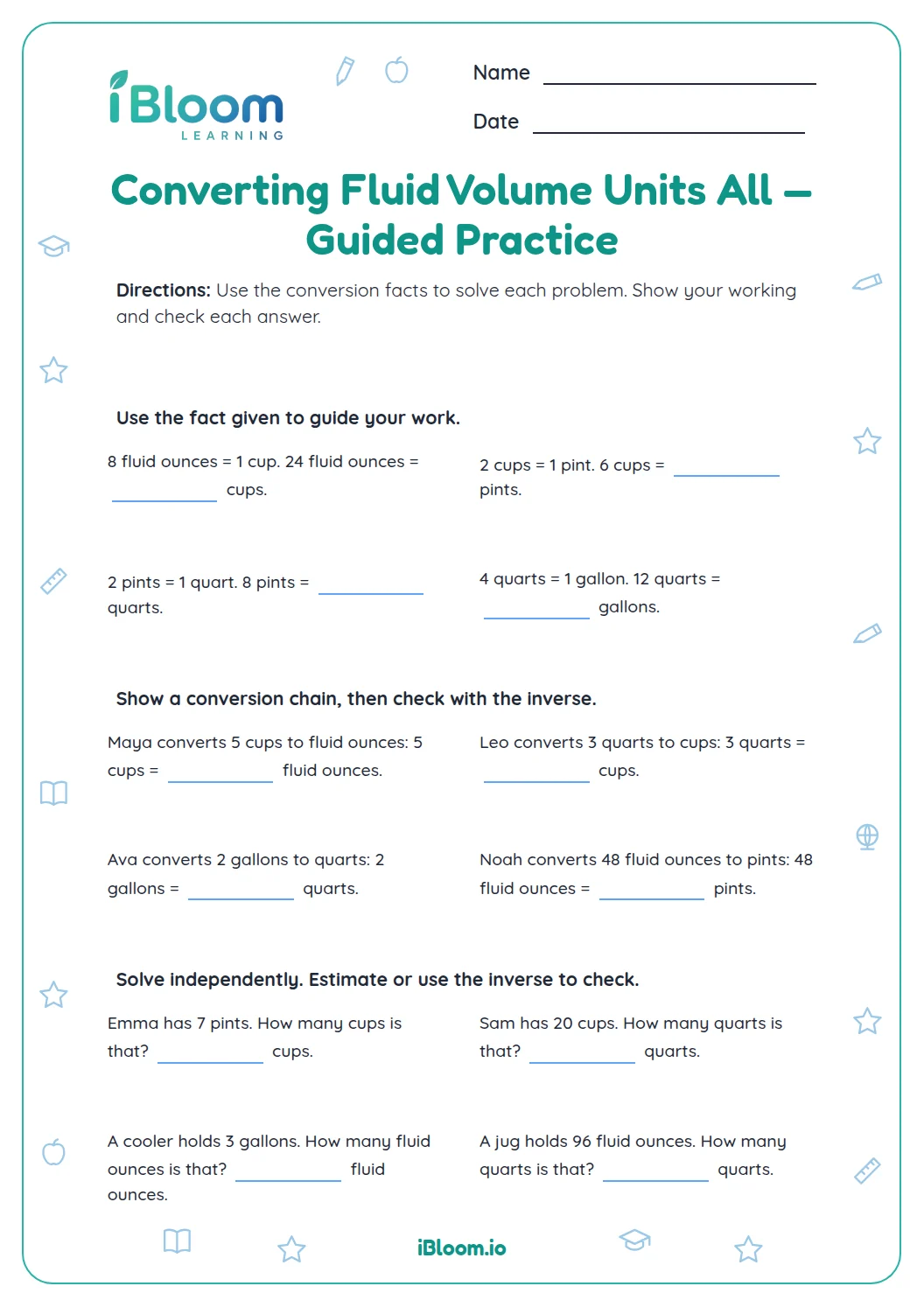
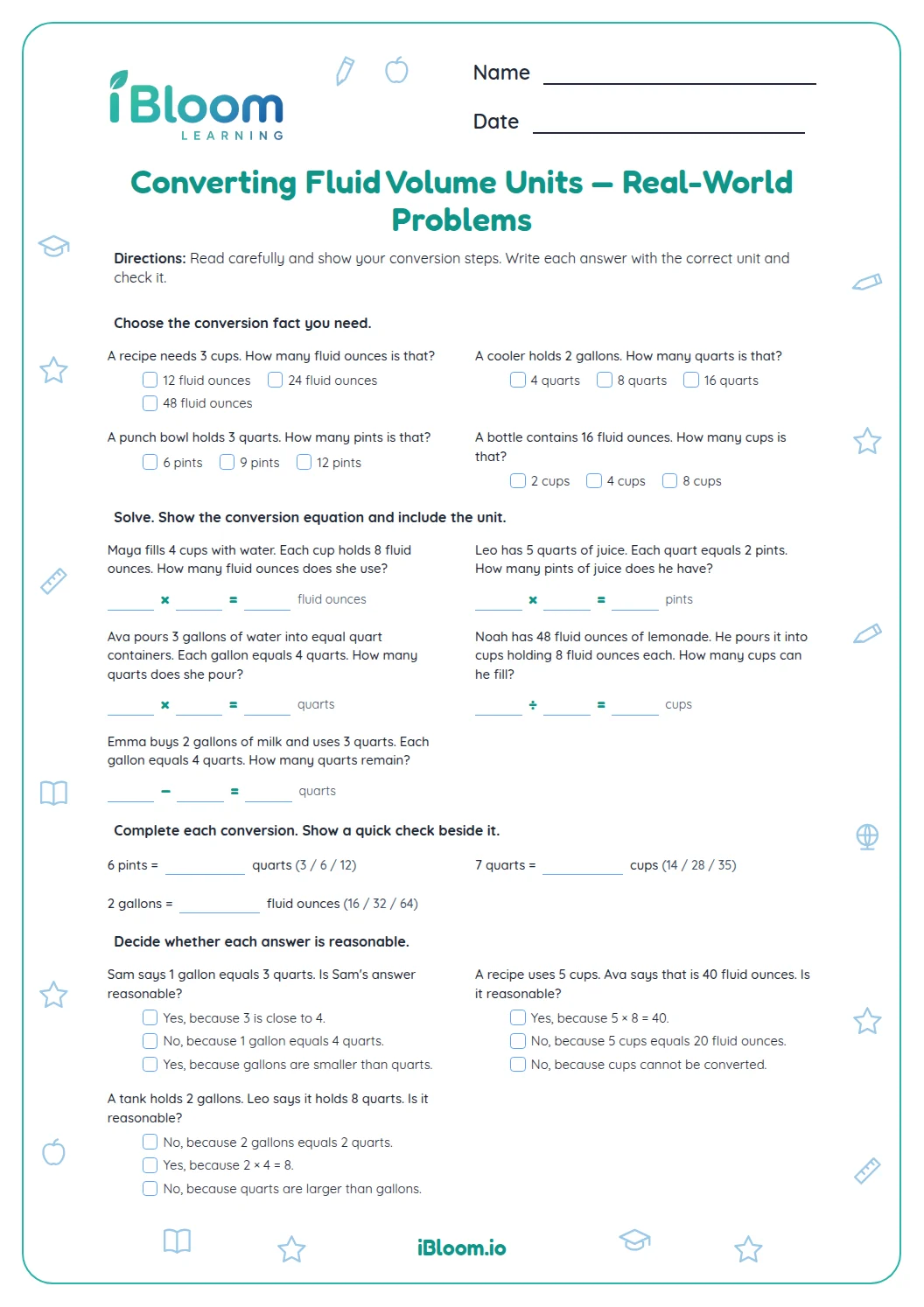
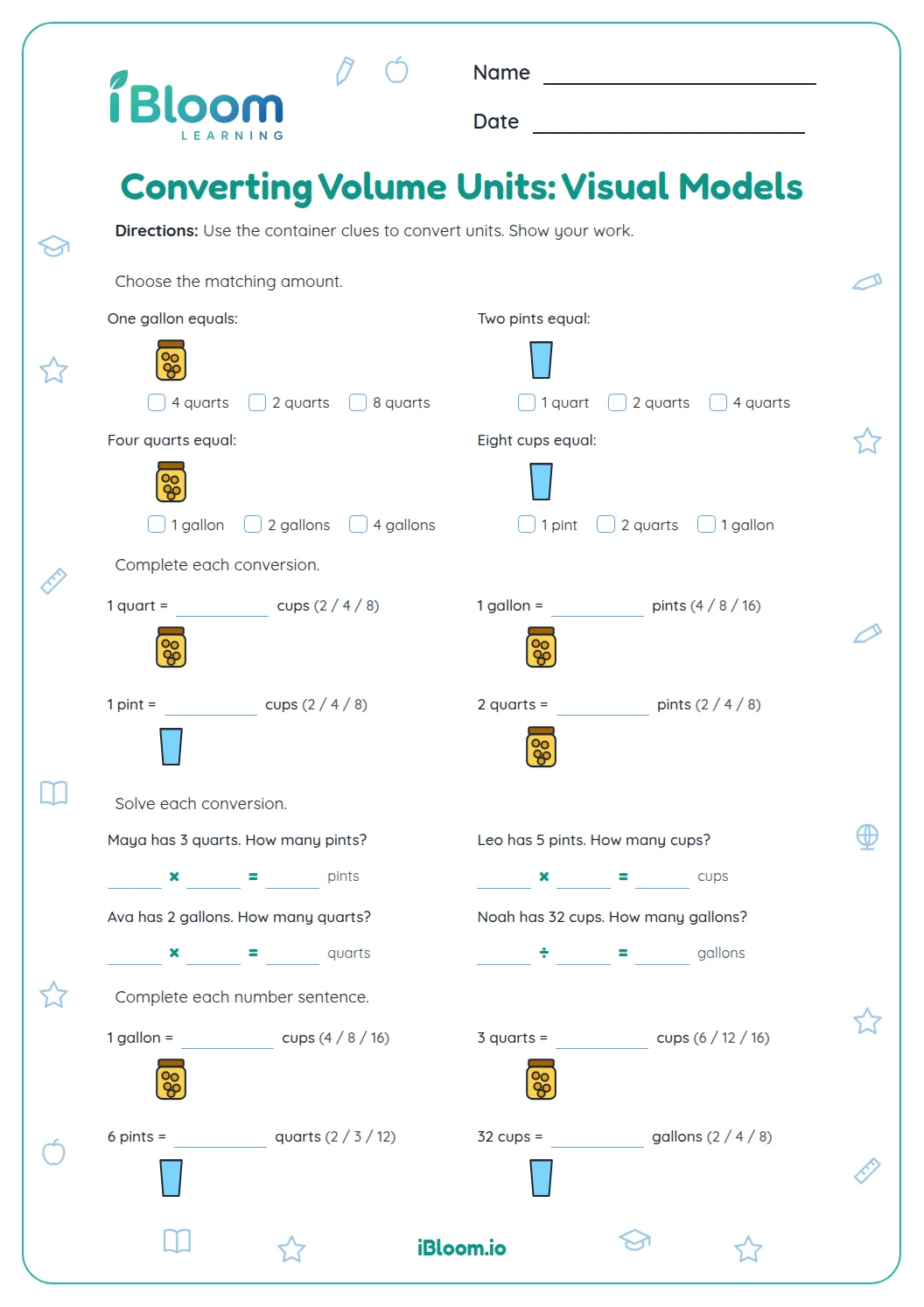
Use the relationships between cups, pints, quarts, and gallons. Two cups make a pint, two pints make a quart, and four quarts make a gallon. Multiply when moving to a smaller unit and divide when moving to a larger unit.
For q1, 3 gallons × 4 quarts per gallon = 12 quarts.
- 11 gallon = 4 quarts
- 23 gallons × 4 = 12 quarts
- 3So 3 gal = 12 qt.
How do liters and milliliters compare?
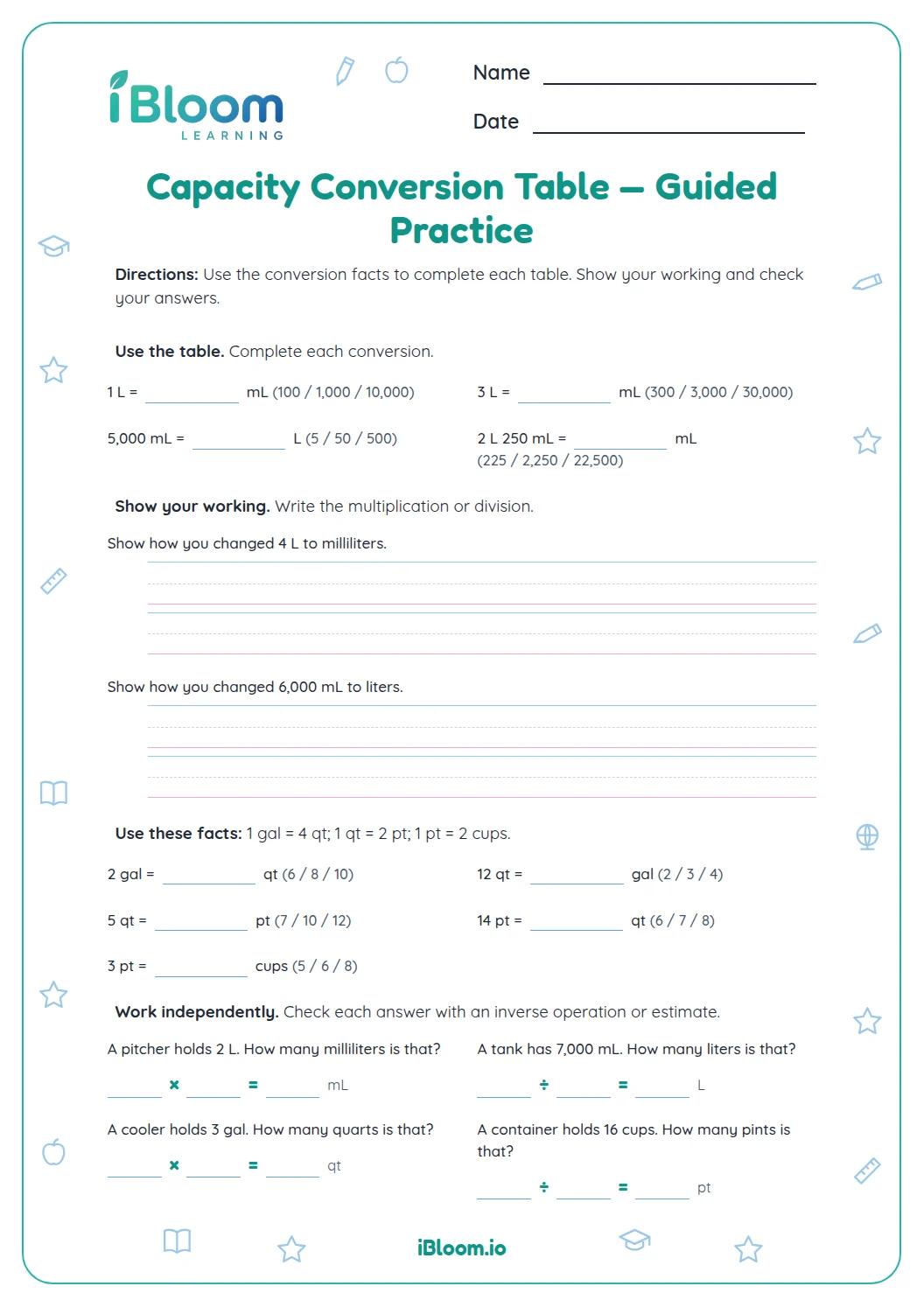
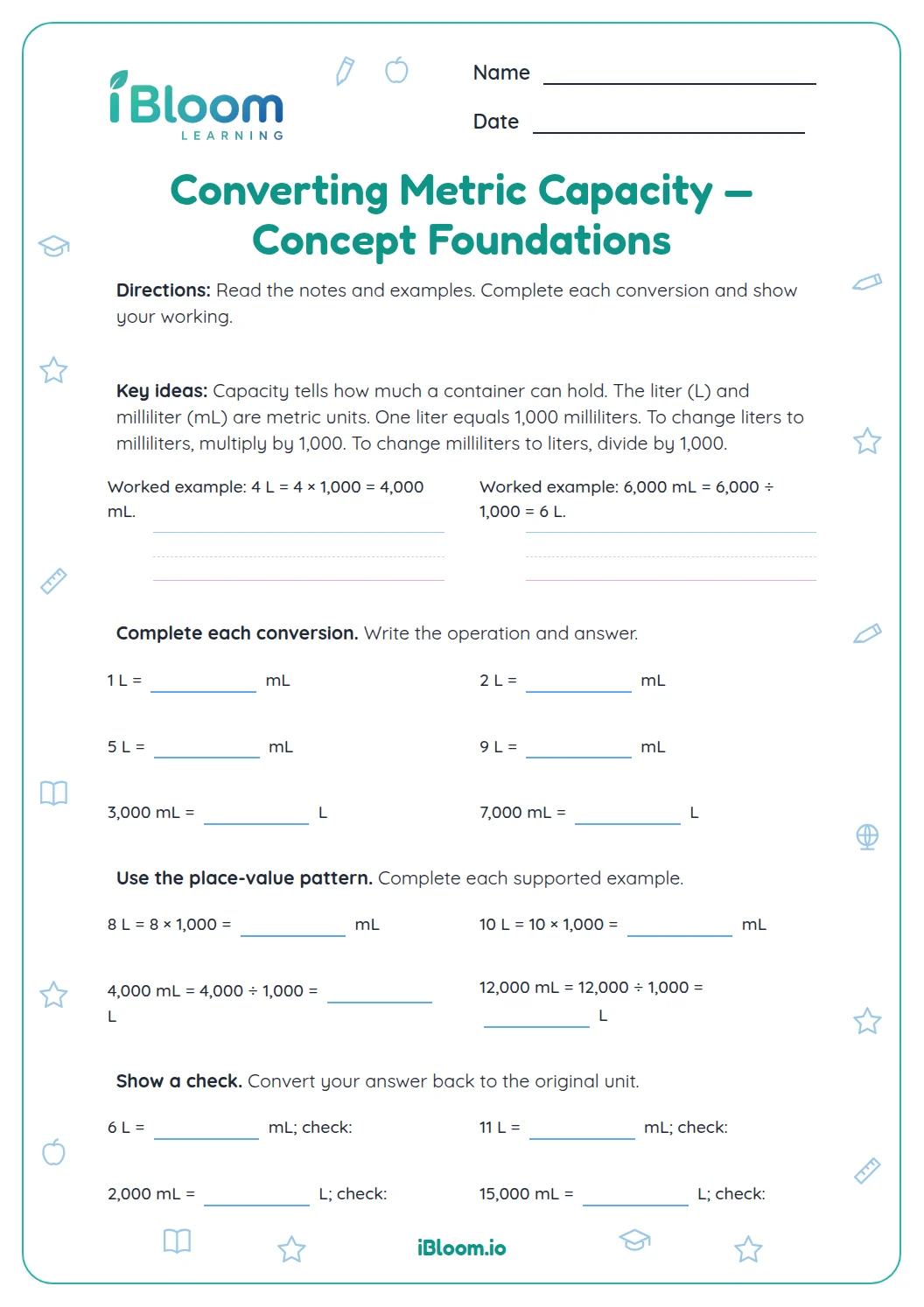
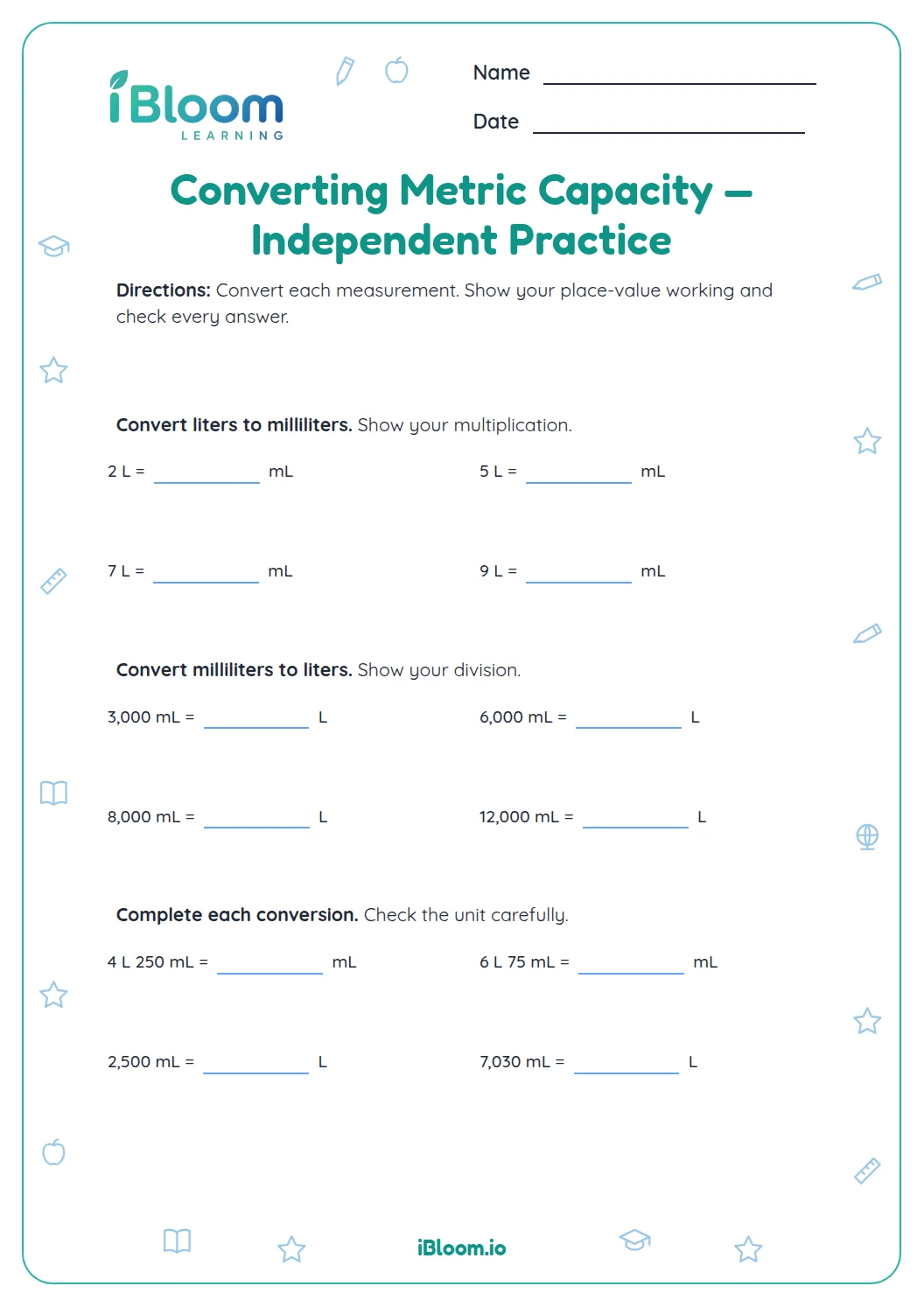
One liter equals 1,000 milliliters. Multiply liters by 1,000 to express the same amount in milliliters. For comparisons or mixed calculations, convert both quantities to the same unit before deciding which is larger or finding a difference.
What kinds of volume problems are on the page?
Part A has four direct conversions. Part B compares amounts in customary or metric units. Part C applies conversions in eight situations, including finding totals, capacities, and remaining amounts. The answer key shows concise results with units.
How does this page practice CCSS 5.MD.A.1?
Learners convert units within a measurement system and use those conversions to solve real-world, multi-step measurement problems.
How to use this worksheet
- 1Write the given amount and its unit.
- 2Choose a conversion relationship that reaches the requested unit.
- 3Multiply or divide, then label the equivalent amount.
- 4For comparisons, convert both amounts to the same unit first.
- 5For a story, complete each conversion and operation before checking the key.
Conversion slips and quick fixes
The mistake
Multiplying when converting to a larger unit.
The fix
Check the unit size: larger units need fewer units, so divide.
The mistake
Comparing a number in liters directly with one in milliliters.
The fix
Convert both amounts to liters or both to milliliters first.
The mistake
Dropping the unit in the final answer.
The fix
Write the unit requested by the question after the number.
Curriculum alignment
This worksheet practices the standard below through its questions and worked examples.
Convert units within a measurement system and use conversions in real-world problems.
On this sheet: Convert customary fluid-volume units and liters/milliliters in multi-step situations.
Show the official wordingHide the official wording
Convert among different-sized standard measurement units within a given measurement system (e.g., convert 5 cm to 0.05 m), and use these conversions in solving multi-step, real world problems.
What to practice next
Make more practice
Further reading
Questions parents and teachers ask
Which customary facts help with this worksheet?
Use 1 gallon = 4 quarts, 1 quart = 2 pints, and 1 pint = 2 cups. These relationships connect the customary units in the questions. To convert gallons to quarts, multiply by 4; to move from quarts to gallons, divide by 4.
How many milliliters are in one liter?
One liter equals 1,000 milliliters. Multiply liters by 1,000 to convert to milliliters; divide milliliters by 1,000 to convert to liters. The worksheet uses this relationship in direct conversions, comparisons, and practical situations involving liquid amounts. Keep the unit with the number during each conversion step.
Why convert before comparing two amounts?
The amounts should use the same unit so their numbers can be compared directly. For example, convert liters to milliliters before comparing with an amount already given in milliliters. Check that the conversion keeps the actual amount of liquid unchanged.
How can learners organize a multi-step volume problem?
Write each amount with its unit, convert to a shared unit when needed, and then do the operation in the story. For the pitcher question, convert 3 liters to 3,000 milliliters, subtract four 500-milliliter bottles, and convert the remaining 1,000 milliliters to 1 liter.
What is 2 gallons in cups?
Two gallons equal 32 cups. Since 1 gallon equals 4 quarts and each quart equals 4 cups, one gallon contains 16 cups; double that amount for 2 gallons. The worksheet includes a related question about filling cups from a two-gallon dispenser.
Does the sheet use customary and metric units?
Yes. The direct conversions and stories include customary units such as cups, pints, quarts, and gallons, plus liters and milliliters. Learners use the appropriate relationships within each measurement system and label results with units such as cups, quarts, or milliliters.