


About this worksheet
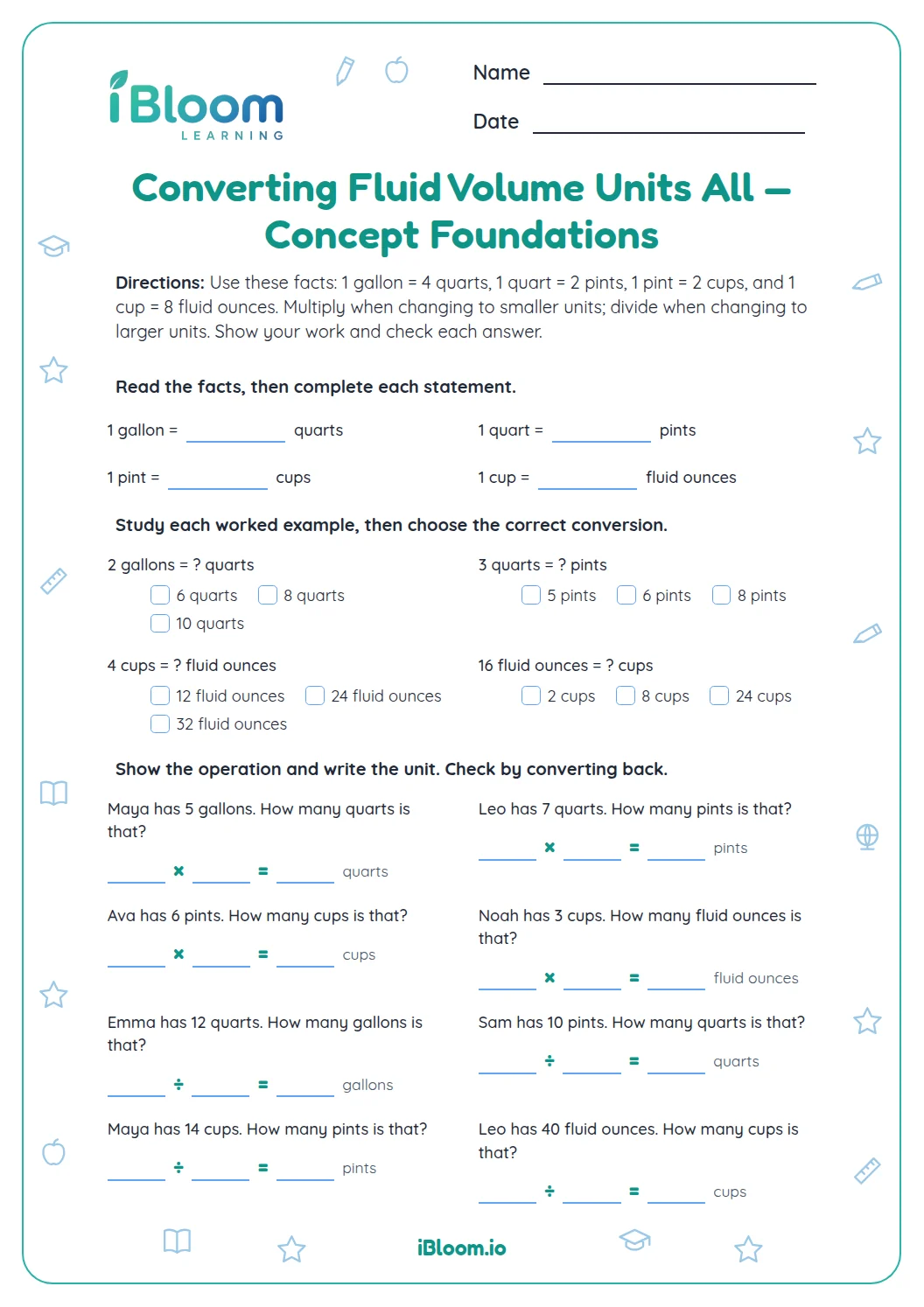
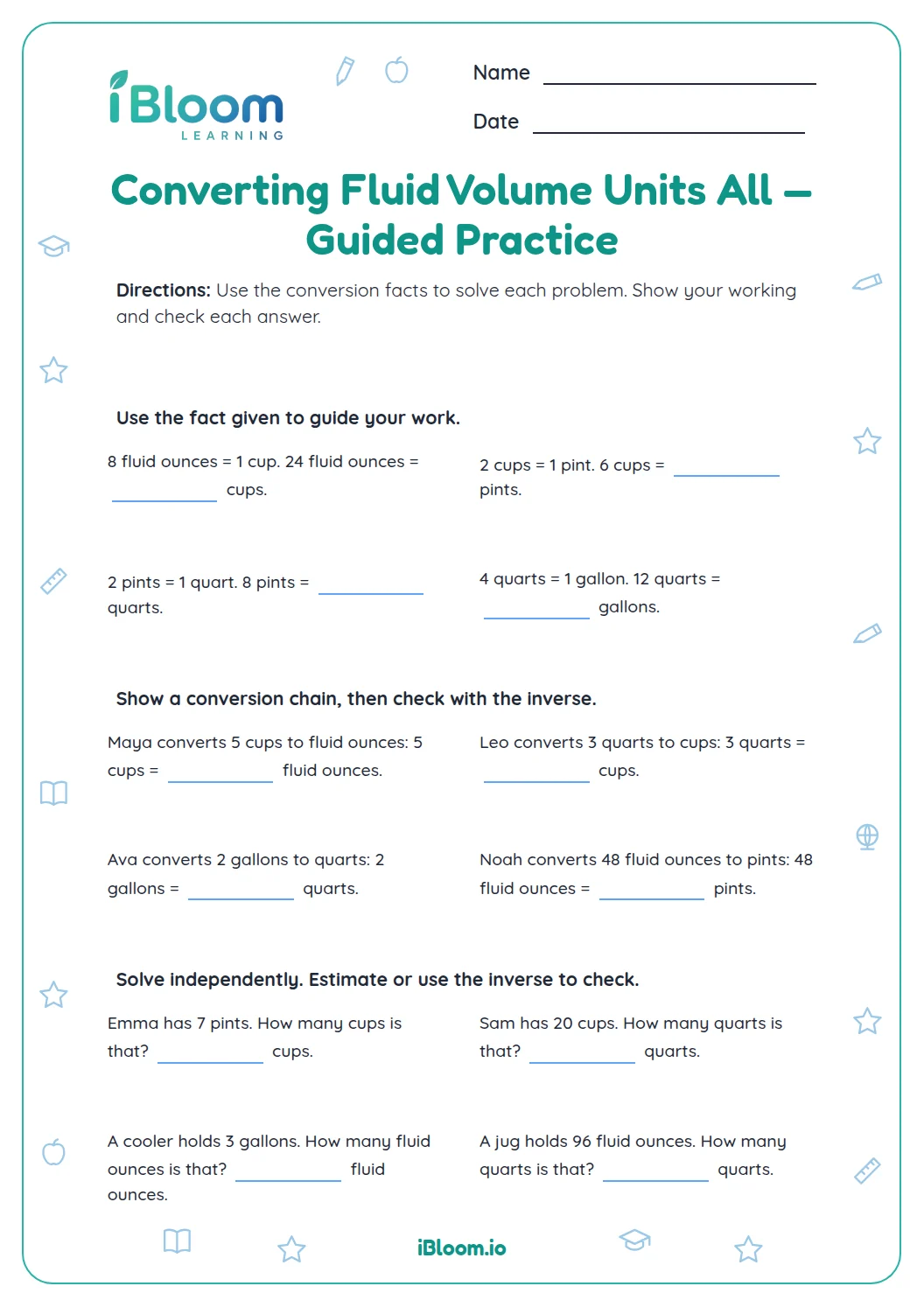
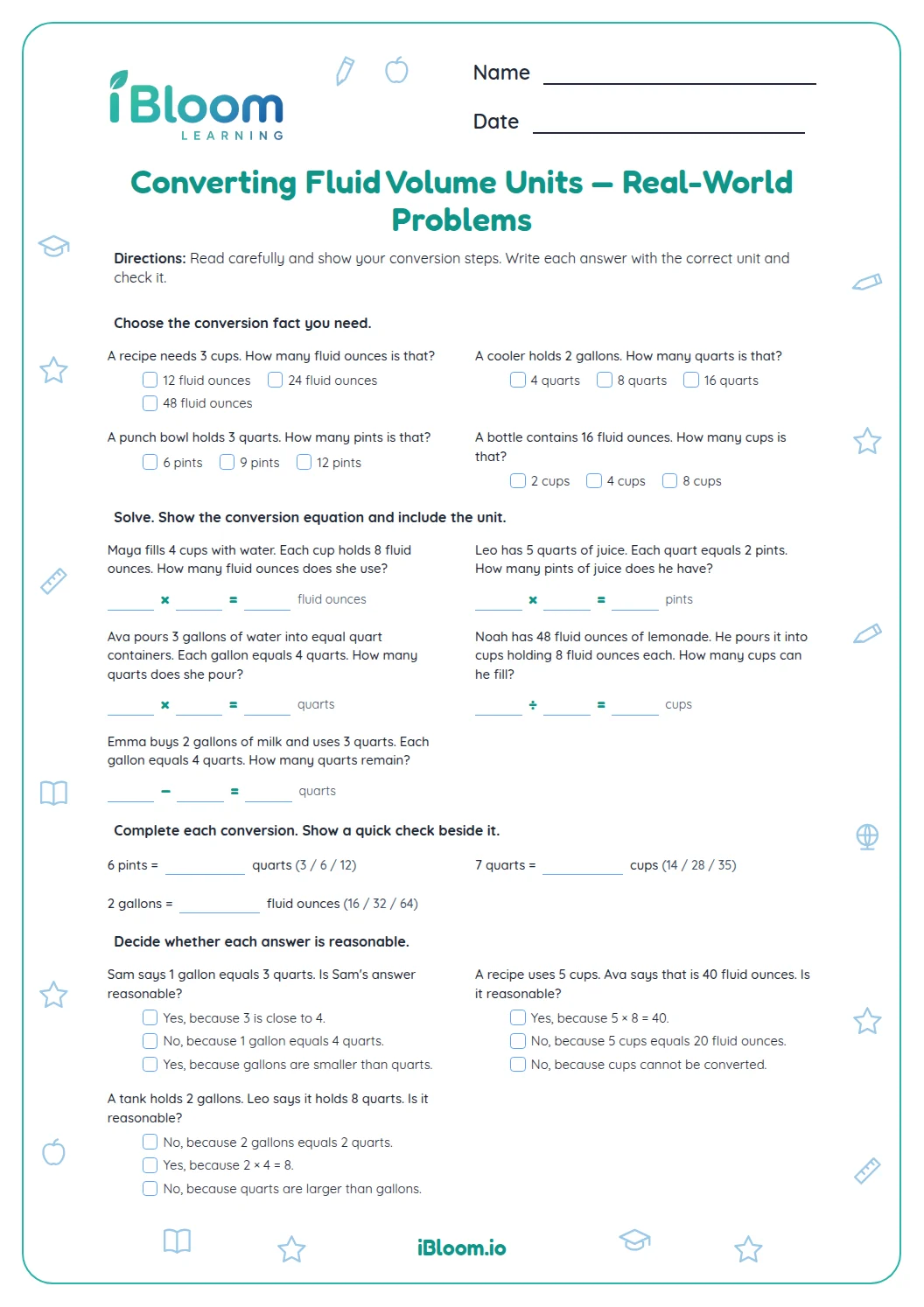
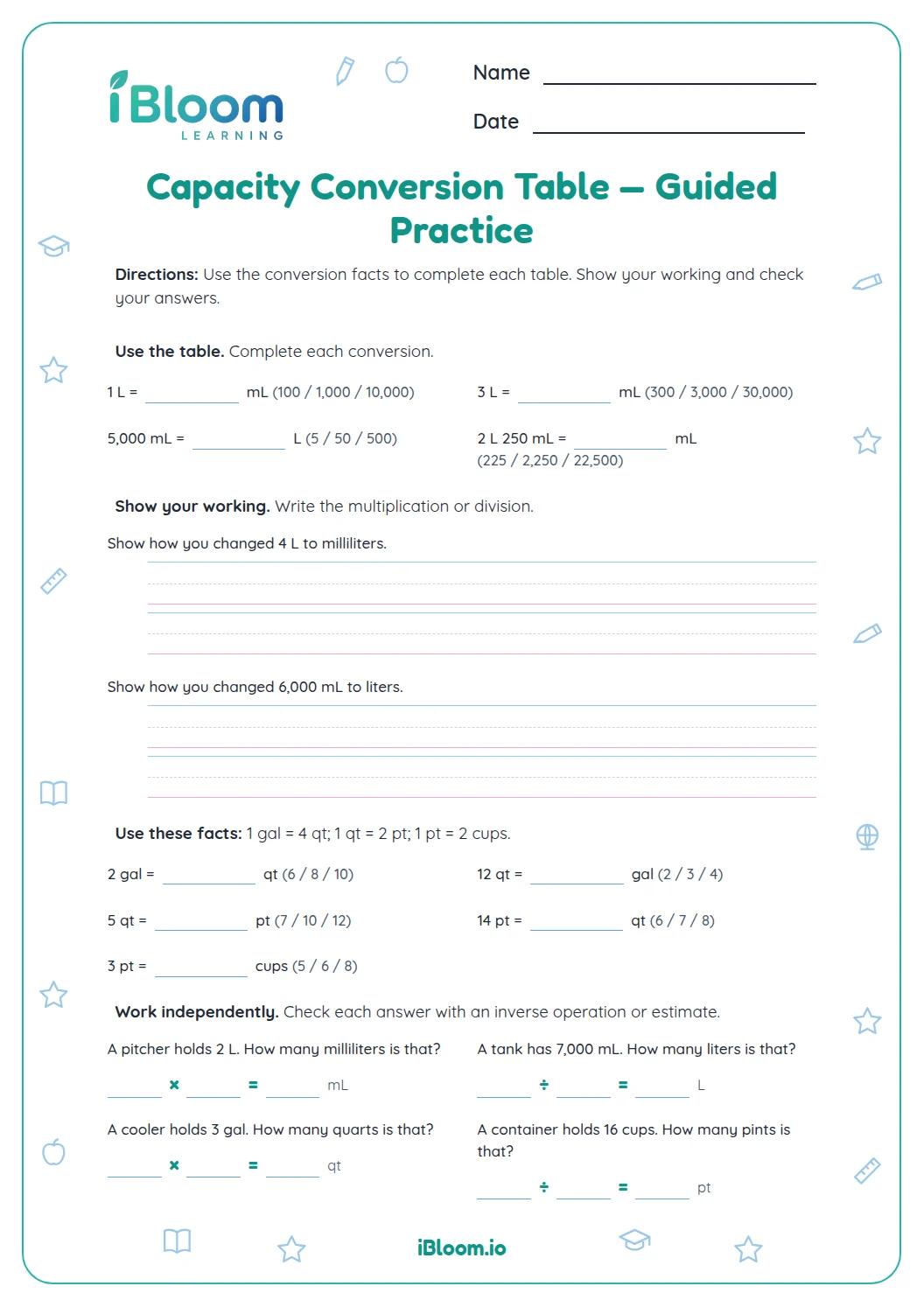
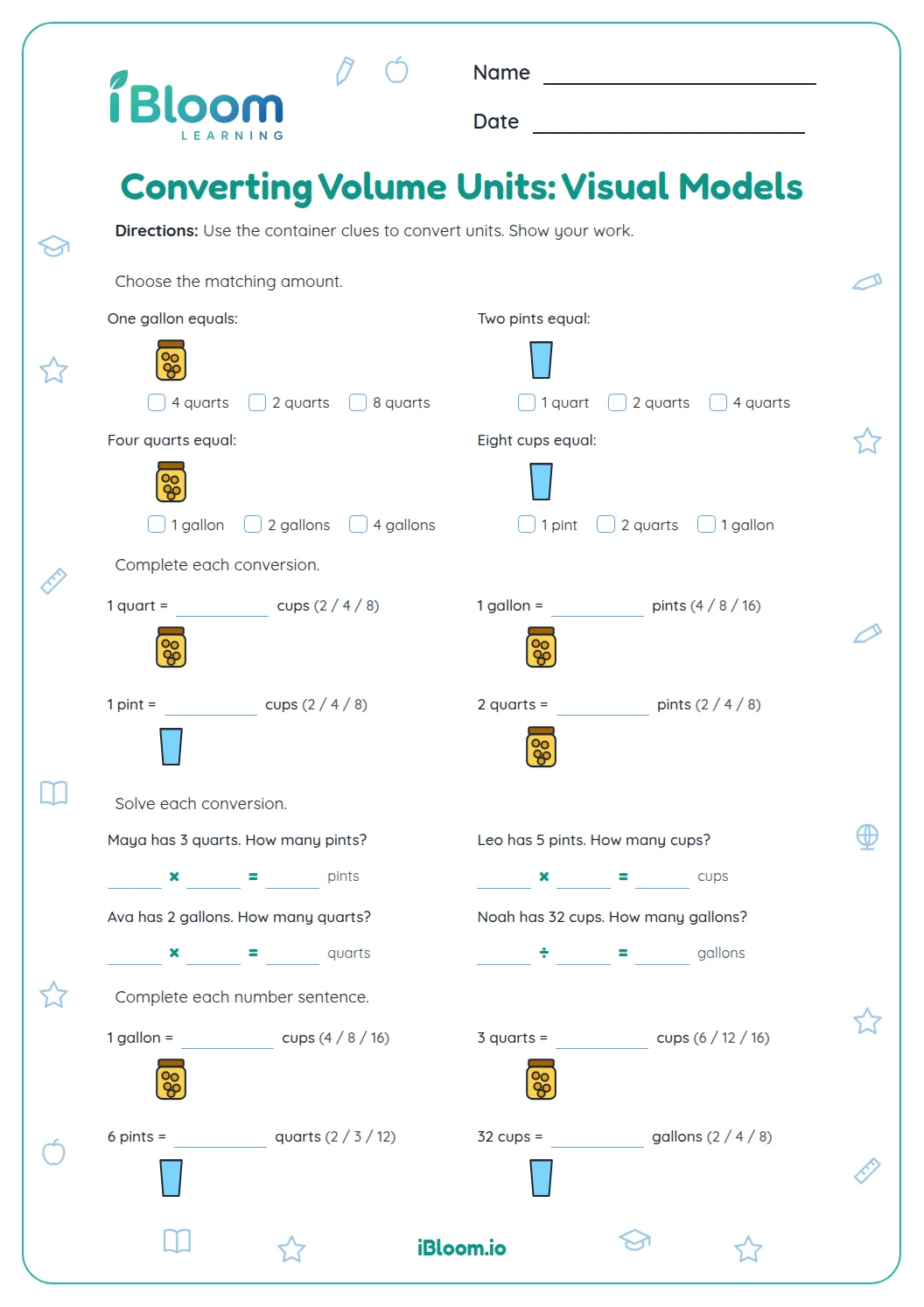
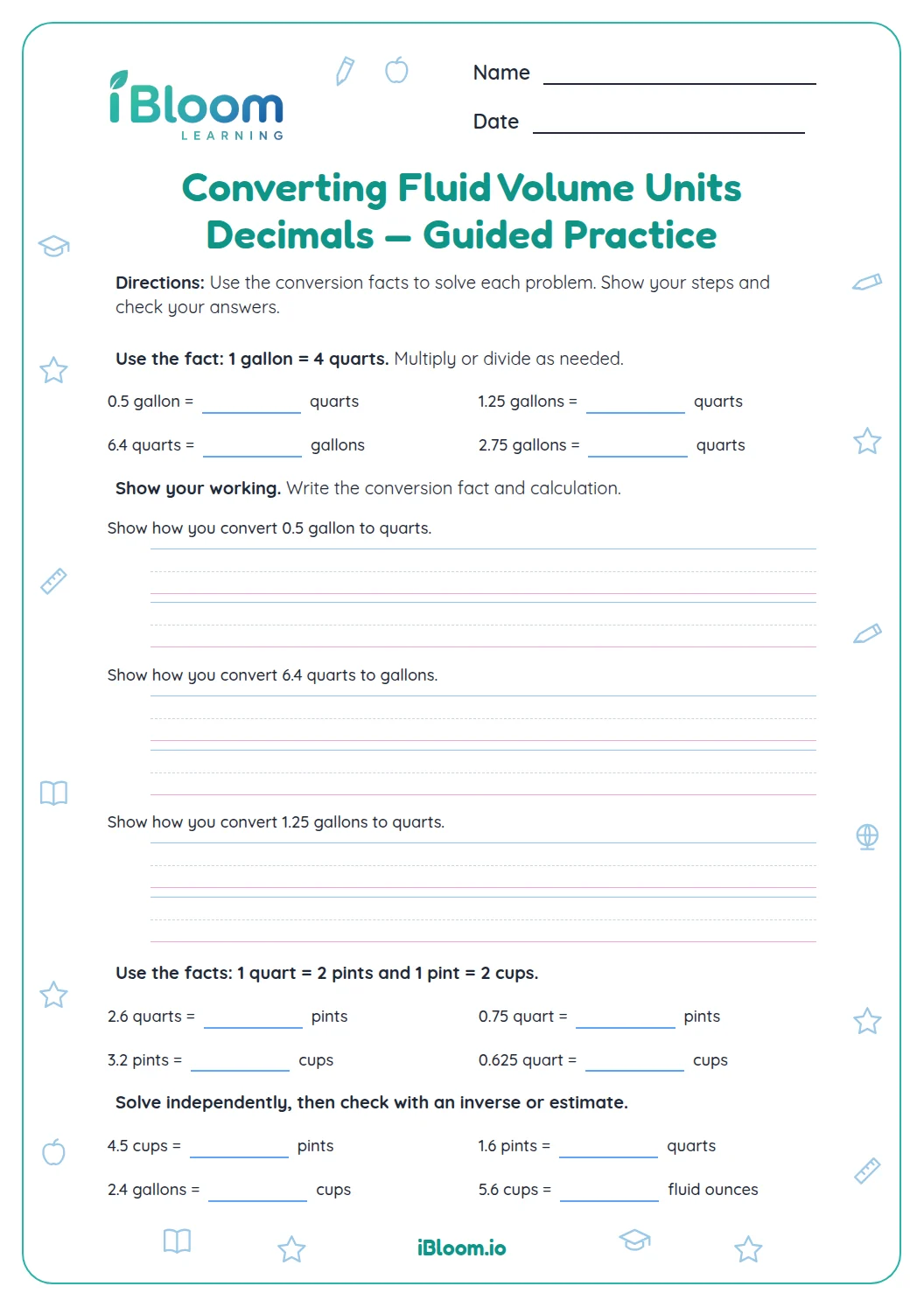
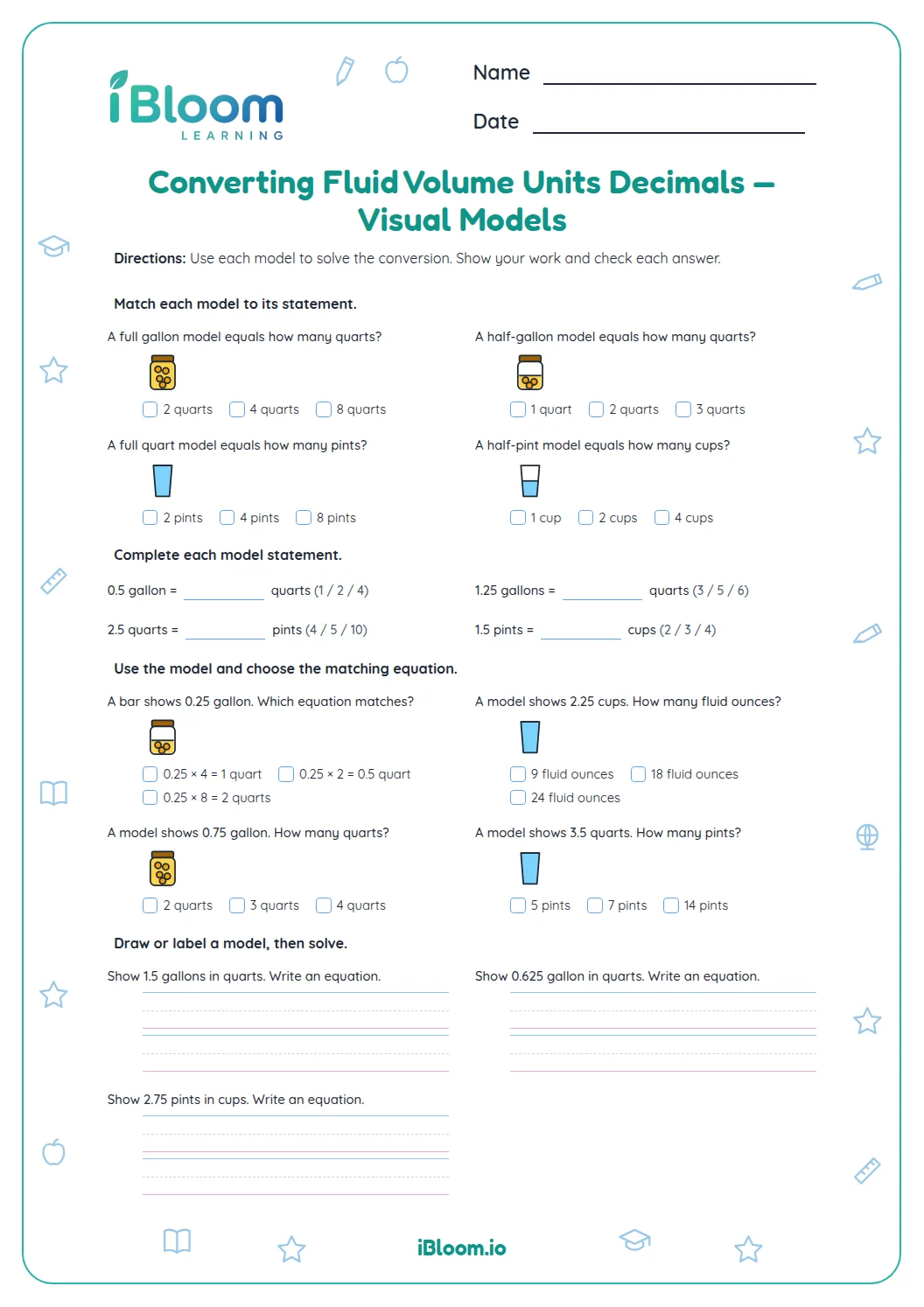
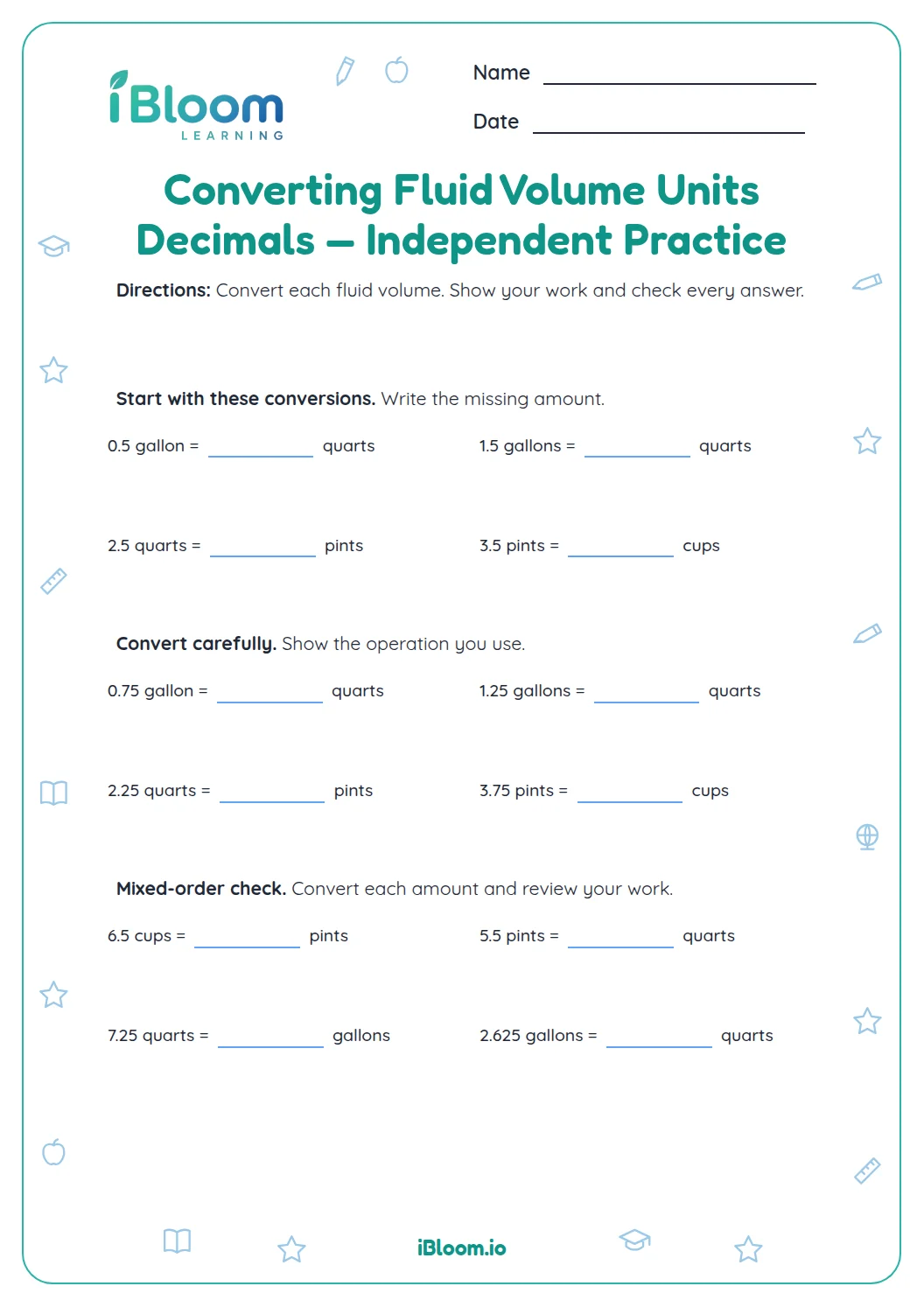
This free Grade 5 worksheet gives students 18 questions on converting customary fluid-volume units. The first parts use multiplication and division with cups, pints, quarts, gallons, and fluid ounces; later items combine unit steps and apply them in two short word problems. Students write the conversion factor and track the unit at each step, then check their results with a separate answer key. The work supports Common Core measurement standard 5.MD.A.1.
Aligned to 5.MD.A.1
Which unit facts start the practice?
Part A asks students to choose a factor for one-step changes, such as gallons to quarts or fluid ounces to cups. Keep the unit beside each number so the factor has a clear meaning.
How does Part B cross unit steps?
Part B includes conversions that pass through an intermediate unit. In q7, gallons change to quarts and then quarts to cups: multiply 3 by 4 and by 4 to get 48 cups.
What do students do with combined amounts?
Part C combines two amounts or reverses a conversion. Convert each part to the requested unit before adding; for q16, 3 quarts is 12 cups, and 12 + 2 = 14 cups.
How do the word problems use the same facts?
Part D places the unit conversions in familiar contexts. Students identify the given amount, select the requested unit, and show the factor or factors before writing an answer with its unit.
How to use this worksheet
- 1Write the unit relationship you will use.
- 2Multiply or divide by the factor that converts the starting unit.
- 3For a two-step conversion, write each step in order.
- 4Convert both amounts to the same unit before combining them.
- 5Add the requested unit to word-problem answers, then check with the answer key.
Common mistakes and quick fixes
The mistake
Multiplying when a larger unit is being changed to a smaller count?
The fix
Use the relationship in the direction shown: one gallon is four quarts, while several quarts make fewer gallons.
The mistake
Skipping an intermediate step when converting gallons to cups.
The fix
Convert gallons to quarts and quarts to cups, multiplying by 4 at each step.
The mistake
Adding amounts before they use the same unit.
The fix
Convert both quantities to the requested unit first, then add the converted amounts.
Curriculum alignment
This worksheet practices customary-unit conversions within the Common Core measurement domain.
Convert customary fluid-volume amounts by using relationships within one measurement system.
On this sheet: Convert customary fluid-volume amounts by using relationships within one measurement system.
Show the official wordingHide the official wording
Convert among different-sized standard measurement units within a given measurement system (e.g., convert 5 cm to 0.05 m), and use these conversions in solving multi-step, real world problems.
What to practice next
Make more practice
Further reading
Questions parents and teachers ask
What does this worksheet practice?
It practices customary fluid-volume conversions among cups, pints, quarts, gallons, and fluid ounces. Students use multiplication and division factors, combine units in a few equations, and apply the same relationships in two word problems. The separate answer key lists the value and unit for each response.
How many questions and pages are included?
There are 18 questions in four parts: 16 conversion equations and 2 word problems. The worksheet uses two pages, with a separate two-page answer key. The word problems ask students to show how the same conversion facts work in everyday amounts.
What is one example of a multi-step conversion?
Question 7 changes 3 gallons to cups. Since 1 gallon is 4 quarts and 1 quart is 4 cups, multiply 3 × 4 × 4 to get 48 cups. Writing each factor makes it easier to see why the number grows as the units get smaller.
Why should students write the units with their numbers?
The unit shows which conversion factor belongs in each step. For example, changing gallons to quarts uses 4 quarts for each gallon, while changing fluid ounces to cups groups 8 fluid ounces per cup. Keeping units beside the values also helps catch a result written in the wrong unit.
Is an answer key included?
Yes. The separate answer key covers all 18 questions, including the two word problems. For those final items, students should check both the number and the unit, such as 12 quarts for 3 gallons. Reviewing the factor steps can help explain a missed answer.