

About this worksheet
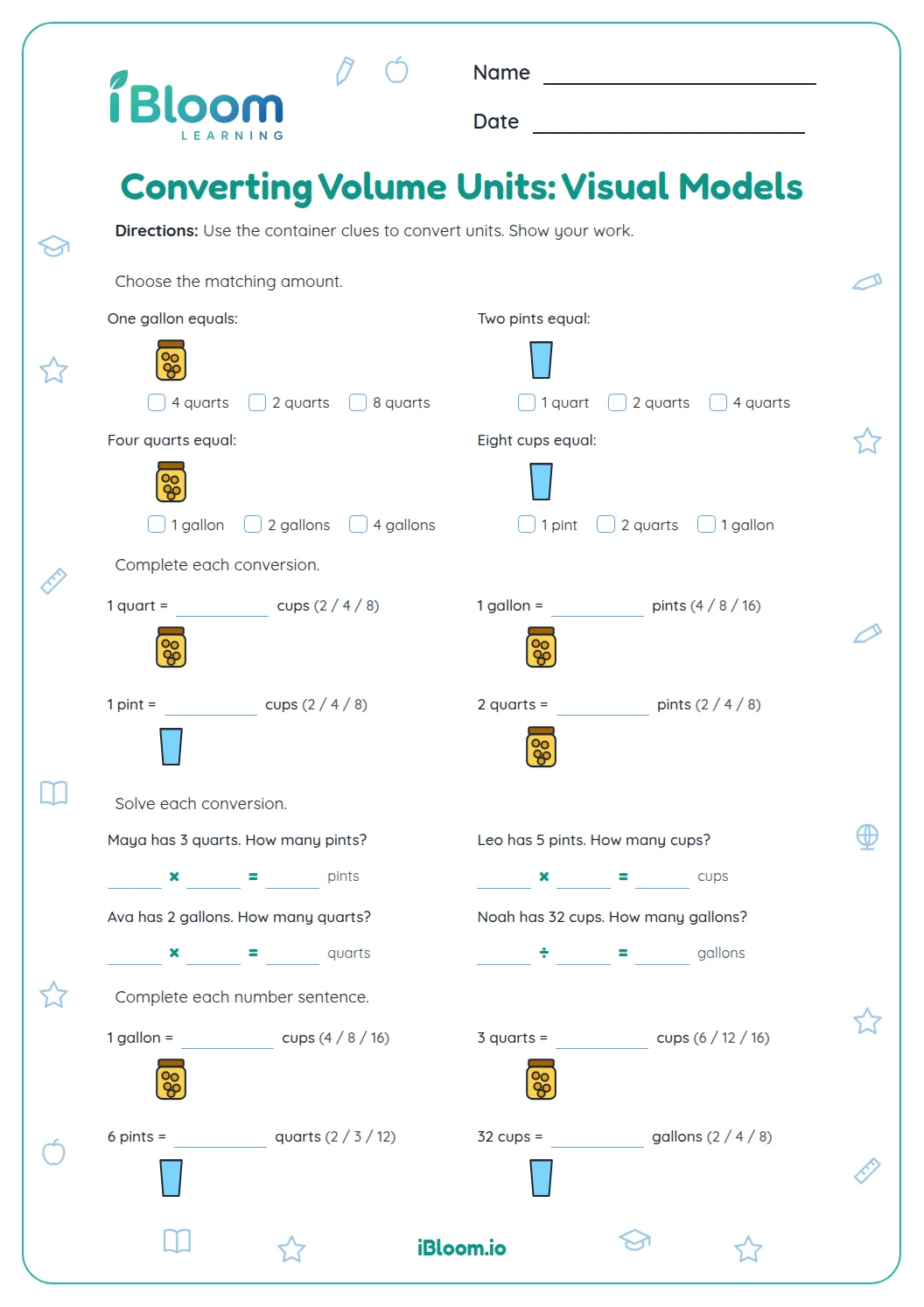
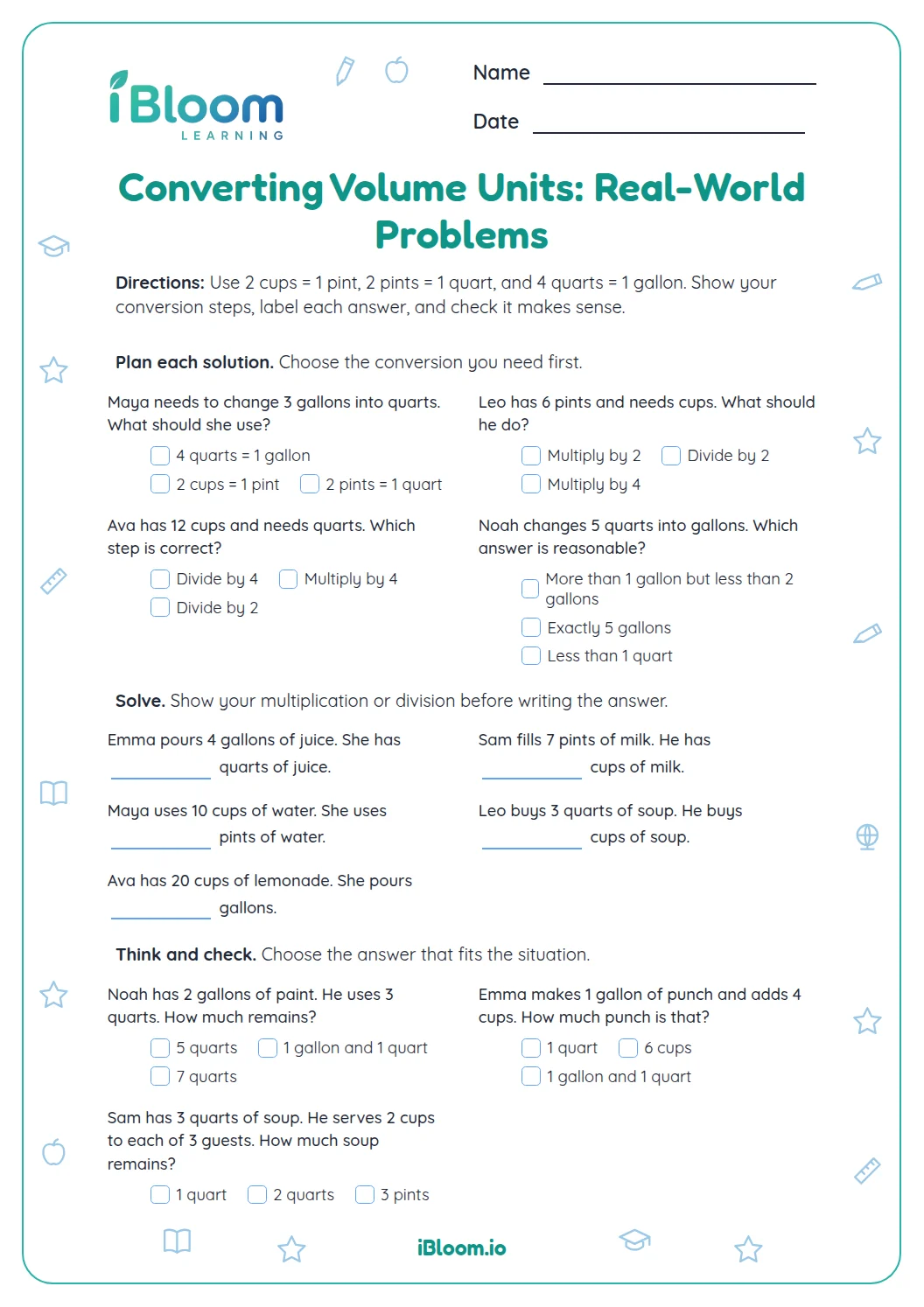
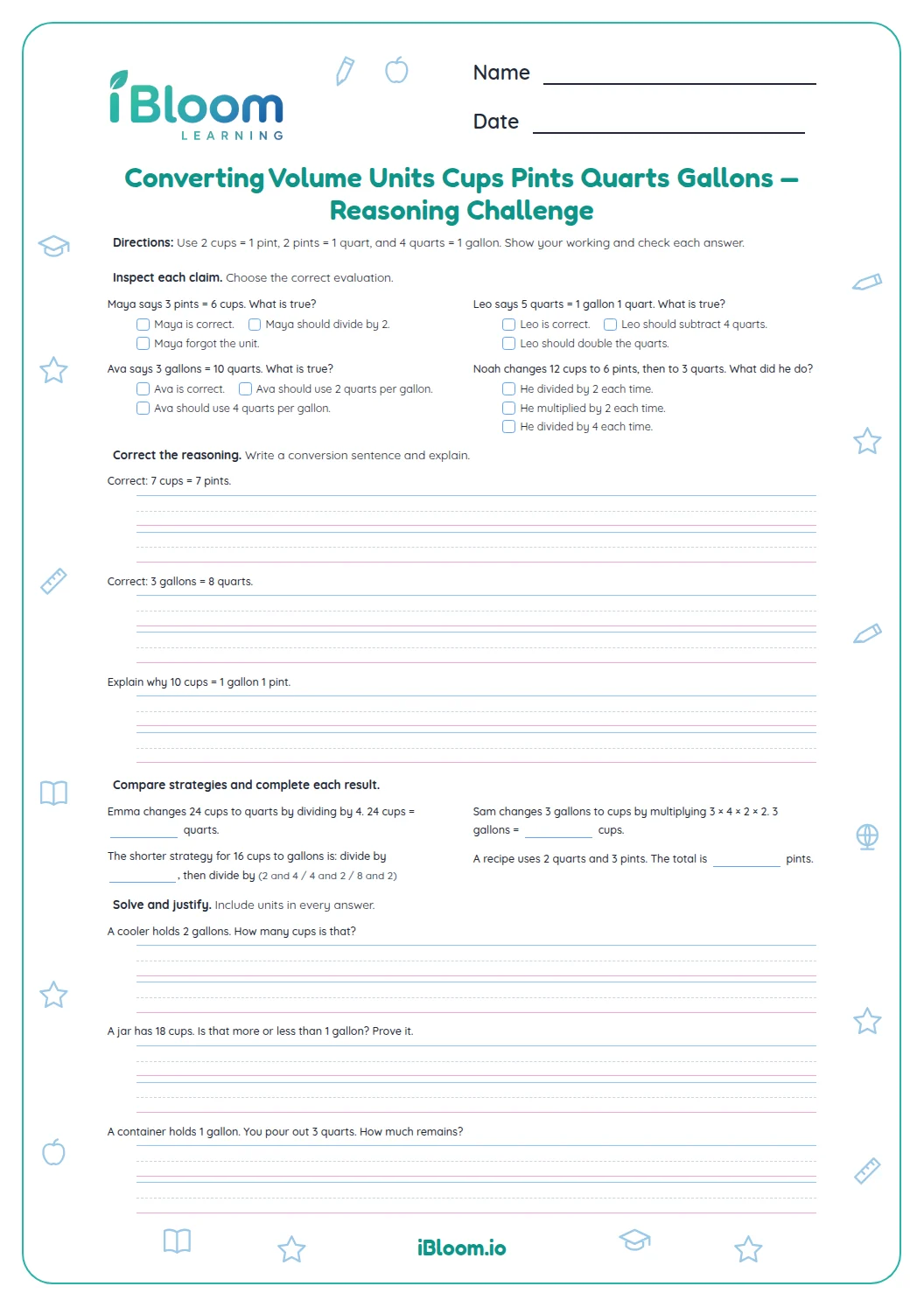
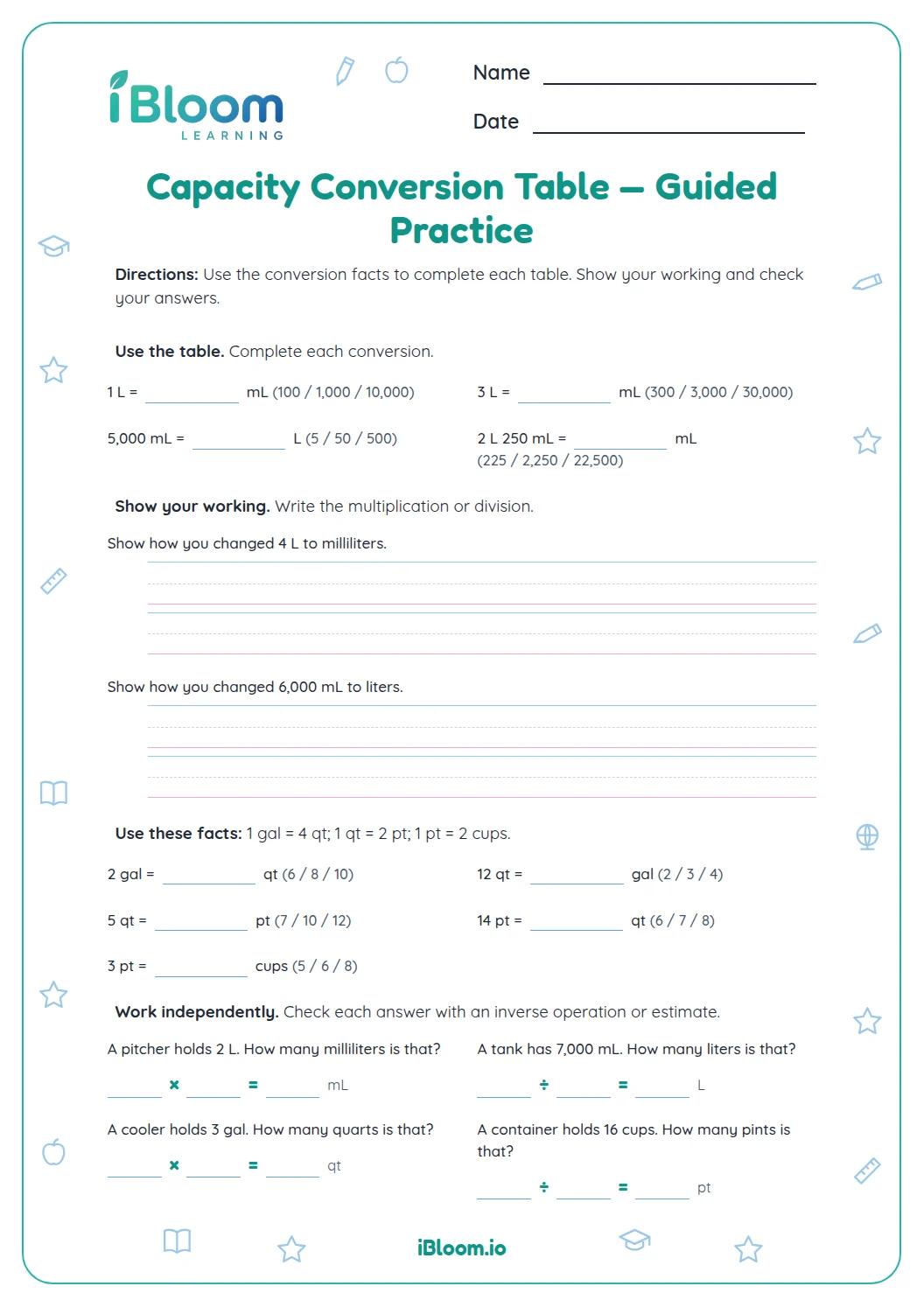
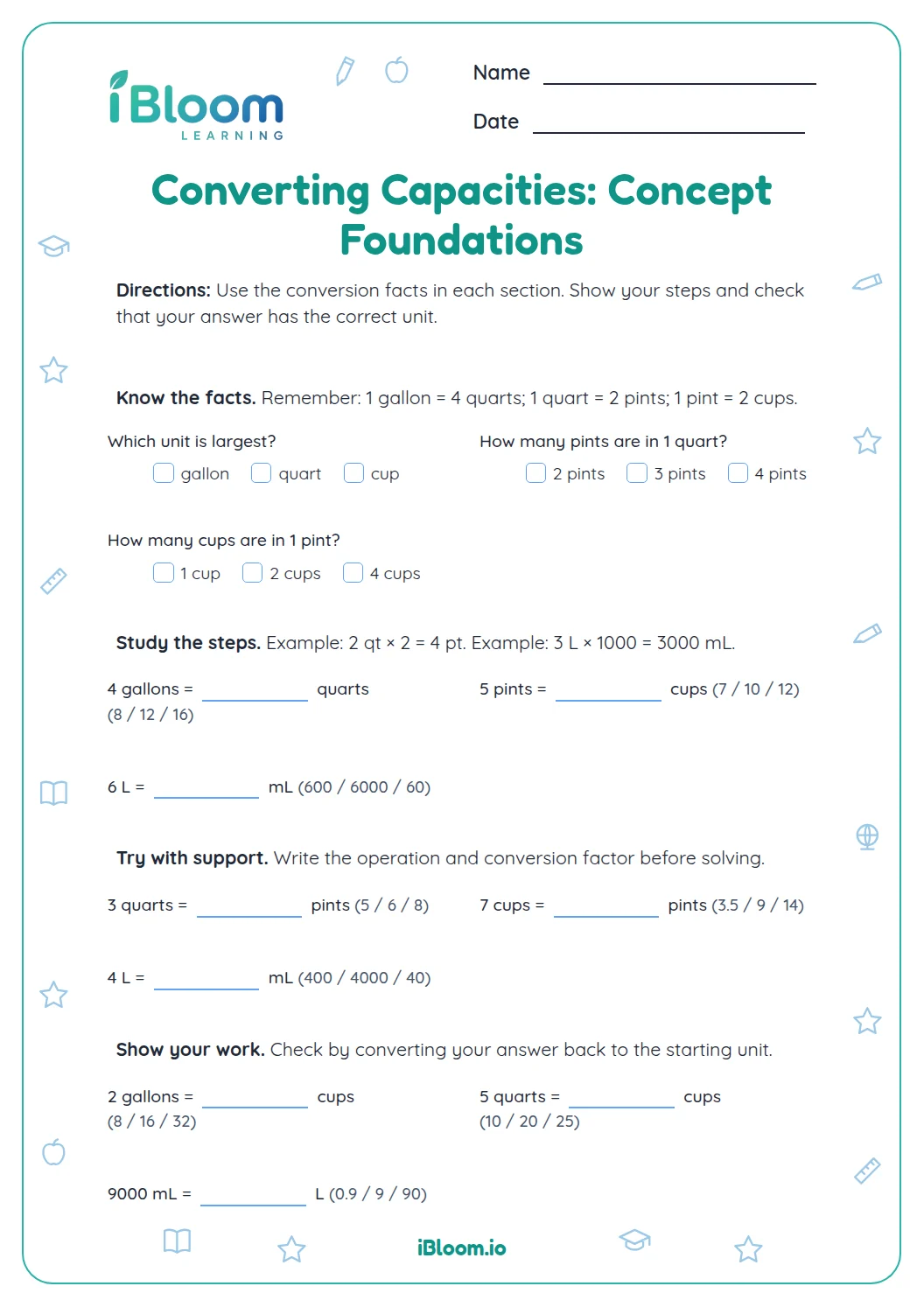
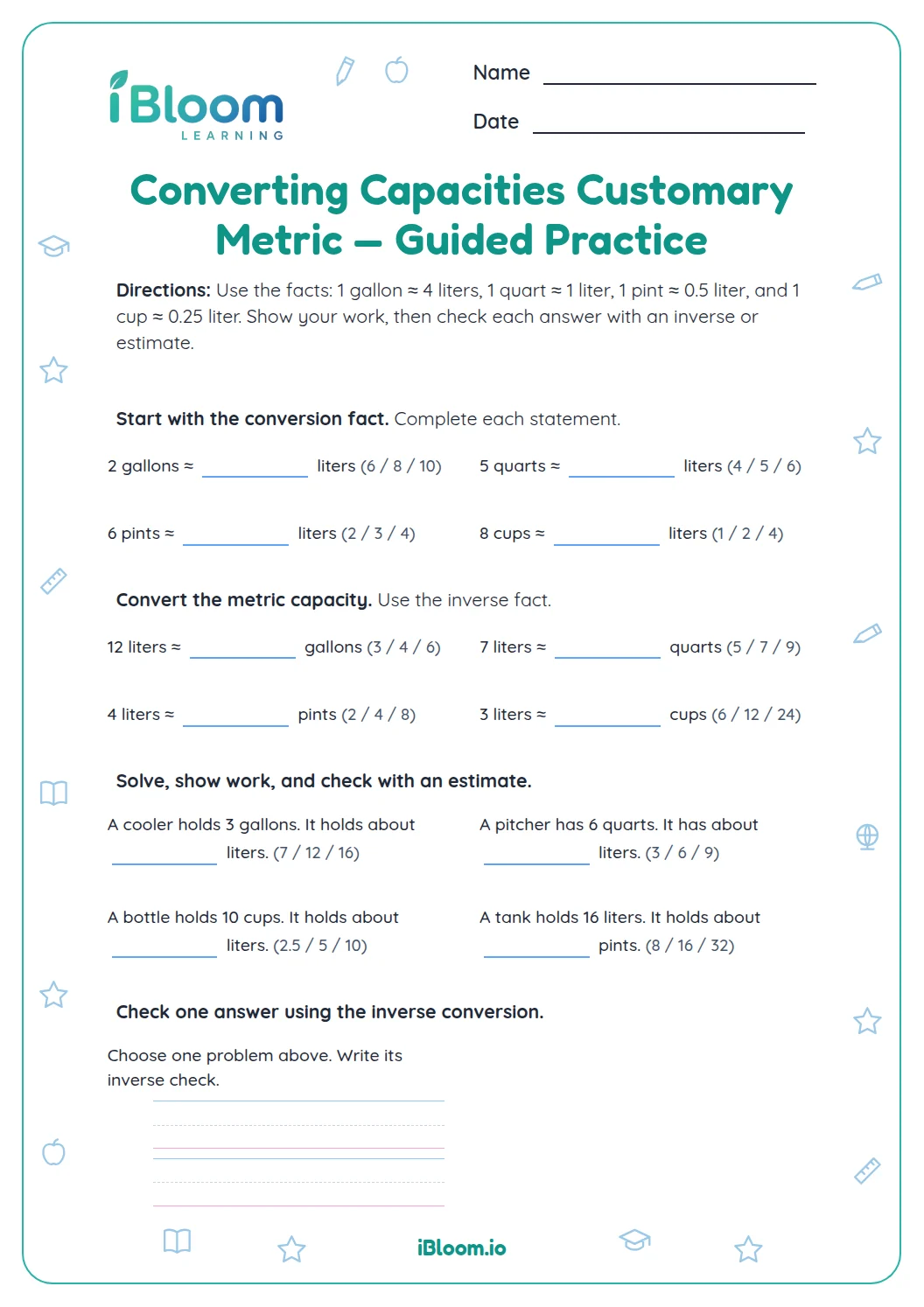
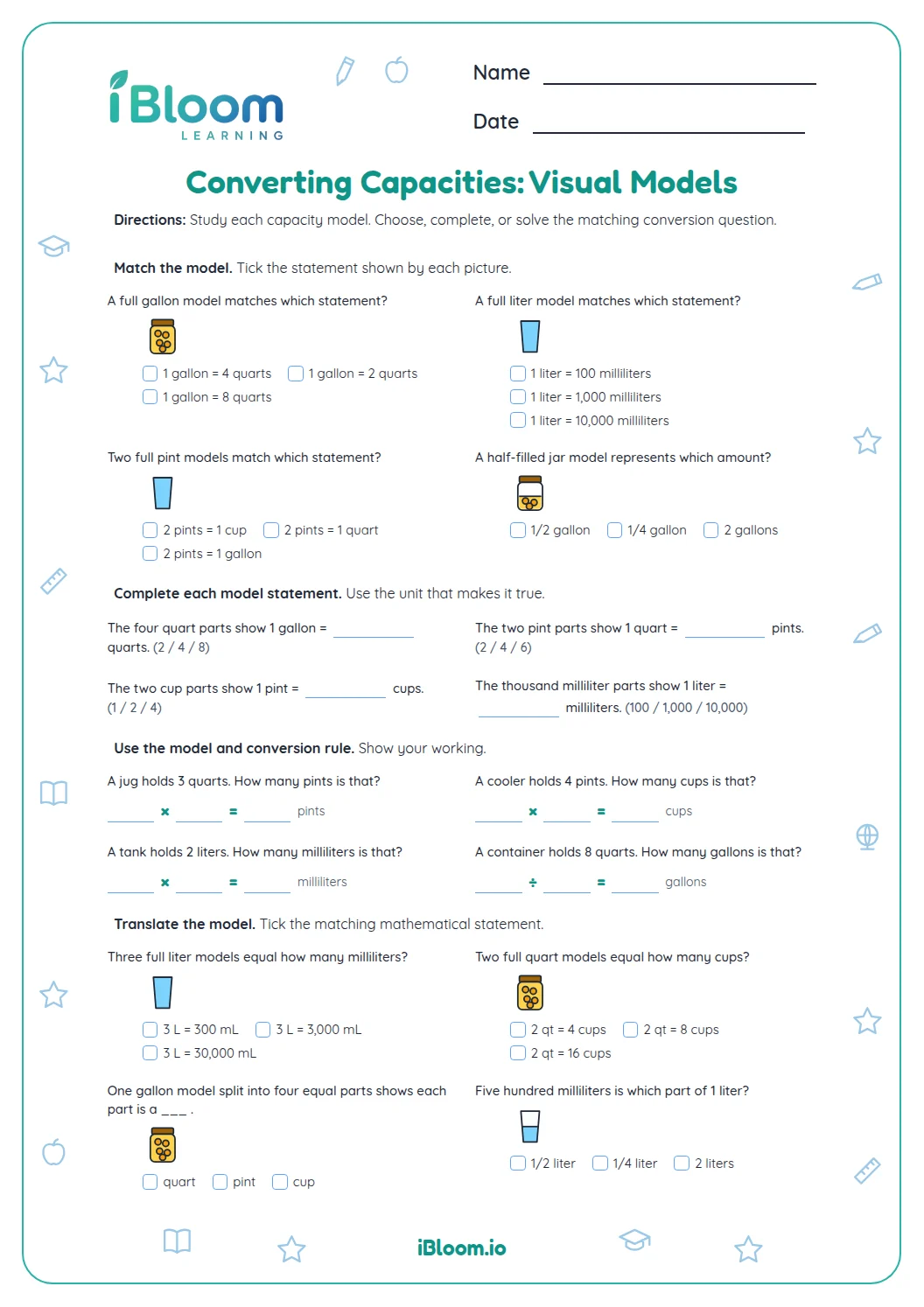
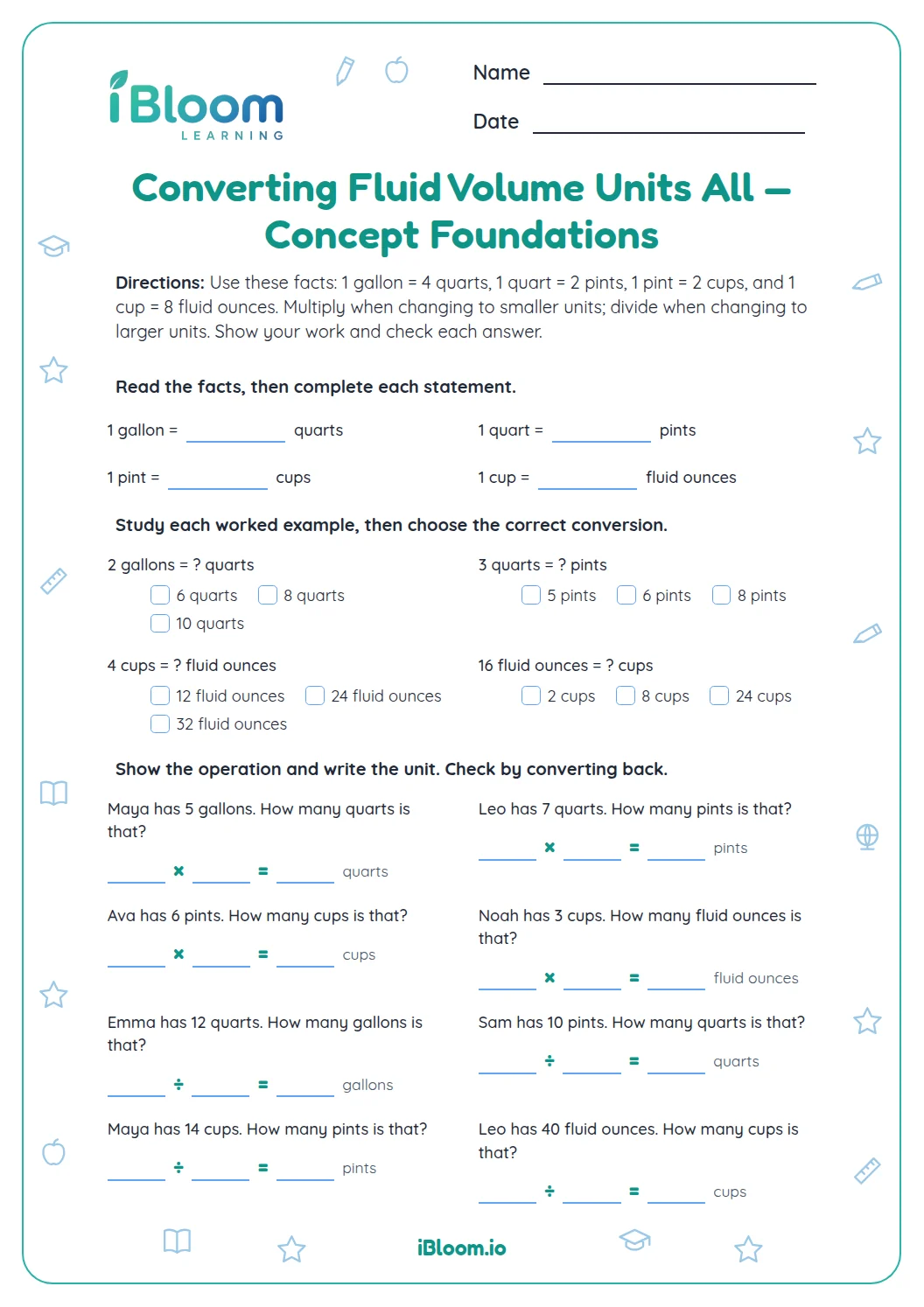
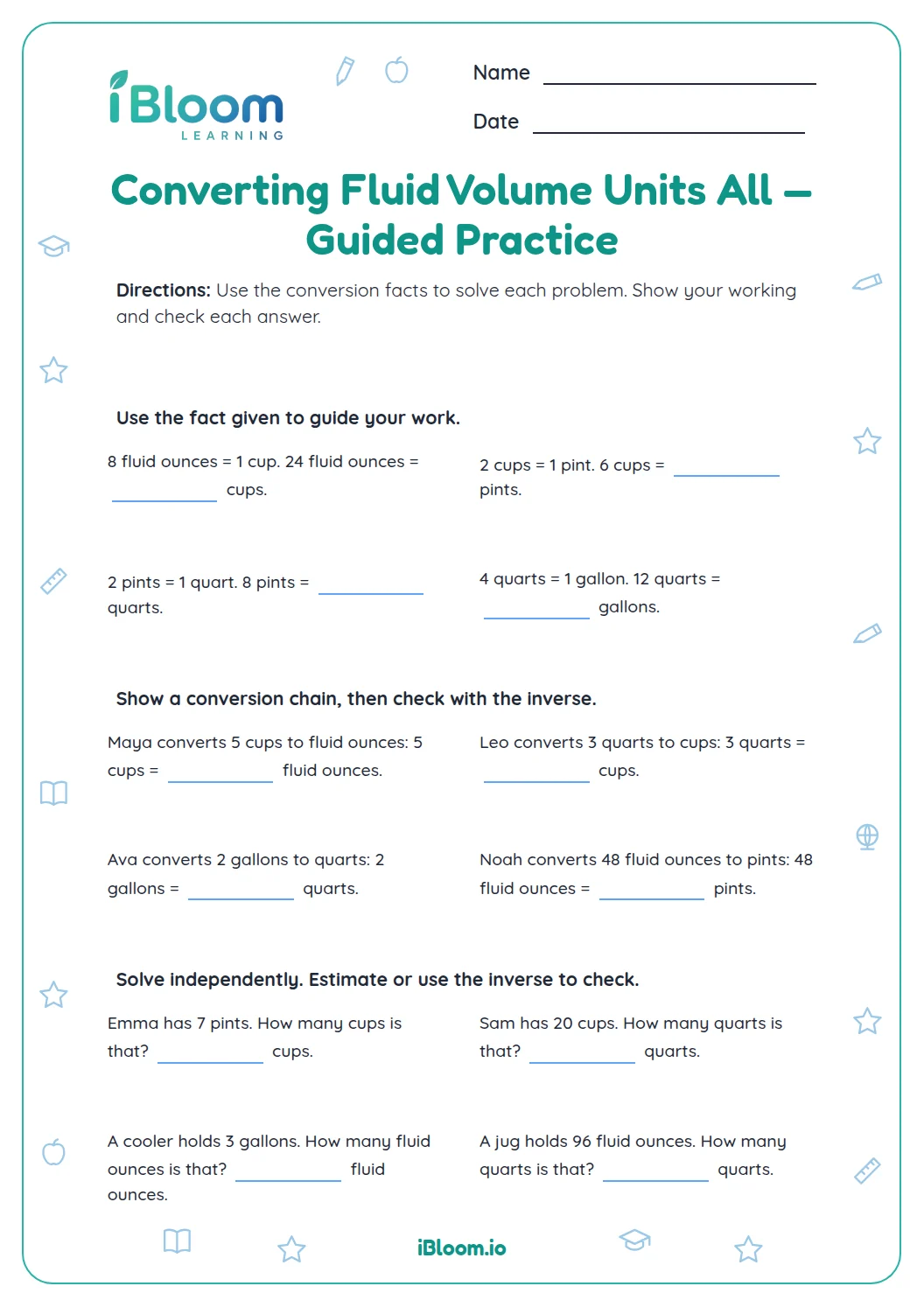
This Grade 5 worksheet practices converting customary capacity units: cups, pints, quarts, and gallons. Learners use the relationships among the units, convert larger amounts in either direction, check conversions with inverse operations, solve short container and recipe problems, and estimate between gallon amounts. The four parts build from basic facts to applications. A separate answer key gives converted amounts and check equations.
Aligned to 5.MD.A.1
Which capacity relationships appear on the sheet?
The first part reviews the basic relationships. Part B uses them to convert larger quantities, both to smaller units and back to larger ones. Part C applies conversions to containers and a recipe, then checks each result with an inverse equation. Part D estimates which gallon amount is closer to 7 quarts.
- 2 cups = 1 pint
- 2 pints = 1 quart
- 4 quarts = 1 gallon
- Check a conversion by reversing the operation
How do you decide whether to multiply or divide?
Moving from a larger unit to a smaller one increases the number of units, so multiply by the relationship. Moving from smaller units to larger ones decreases the number, so divide. For example, 3 pints contain 6 cups, while 24 cups make 12 pints.
- 13 pints × 2 cups per pint = 6 cups
How do conversions help solve the story problems?
Convert the amount into the unit the question asks for, then reverse the conversion to check it. A jug with 2 gallons holds 8 quarts because each gallon contains 4 quarts; 8 quarts ÷ 4 quarts per gallon returns 2 gallons. A recipe using 10 cups uses 5 pints, and 5 × 2 checks the result.
How can an estimate check a capacity conversion?
Compare 7 quarts with nearby whole-gallon amounts by converting the gallons to quarts. One gallon is 4 quarts and 2 gallons are 8 quarts. Seven is closer to 8 than to 4, so 7 quarts is closer to 2 gallons.
A conversion routine for customary capacity
- 1Write the relationship connecting the starting and target units.
- 2Count how many equal steps separate the units.
- 3Multiply when converting to smaller units; divide when converting to larger units.
- 4For a story, underline the unit the question asks you to give.
- 5For a comparison, convert both quantities to the same unit.
- 6Write the unit and check the answer against the original amount.
Common capacity conversion mistakes
The mistake
Using 2 instead of 4 when changing gallons to quarts.
The fix
Recall that one gallon holds 4 quarts, so multiply the number of gallons by 4.
The mistake
Dividing when changing pints to cups.
The fix
Cups are smaller units, so there are more of them. Multiply pints by 2 to find cups.
The mistake
Comparing 3 quarts and 5 pints by comparing 3 and 5.
The fix
Change 3 quarts to 6 pints, then compare 6 pints with 5 pints.
Common Core alignment
This worksheet practices converting customary measurement units and applying the conversions in problems.
Convert cups, pints, quarts, and gallons and use conversions in short problems.
On this sheet: Learners convert among customary capacity units and use the conversions in recipe, container, and comparison questions.
Show the official wordingHide the official wording
Convert among different-sized standard measurement units within a given measurement system (e.g., convert 5 cm to 0.05 m), and use these conversions in solving multi-step, real-world problems.
What to practice next
Make more practice
Further reading
Questions parents and teachers ask
How many cups are in a pint?
There are 2 cups in 1 pint. This worksheet uses that relationship in both directions: 3 pints become 6 cups, and 10 cups become 5 pints. Learners check the recipe conversion by multiplying 5 pints by 2 cups per pint to recover 10 cups.
How many quarts are in a gallon?
One gallon contains 4 quarts. To convert 2 gallons to quarts, multiply 2 by 4 and get 8 quarts. The worksheet then checks that conversion by dividing 8 quarts by 4 quarts per gallon, which returns 2 gallons. This reverses the original multiplication.
What does the worksheet mean by capacity?
Capacity is how much a container can hold. The questions use customary units for liquid amounts: cups, pints, quarts, and gallons. Learners practice converting between them and apply the relationships to examples involving water, lemonade, and a jug. These contexts keep each conversion tied to a container.
How many questions and pages are included?
There are 16 questions in four parts on two worksheet pages, followed by a two-page answer key. The sequence starts with unit facts and builds to conversions, applications, and a comparison. About 20 minutes allows time to show the conversion steps.
How can an estimate check a capacity conversion?
Compare the amount with nearby amounts expressed in the same unit. For 7 quarts, 1 gallon is 4 quarts and 2 gallons are 8 quarts. Seven is closer to 8, so 7 quarts is closer to 2 gallons. The last question practices this estimate.
What is the answer to the recipe question?
The recipe needs 10 cups of water. Since 2 cups make 1 pint, divide 10 by 2 to get 5 pints. Keep the unit in the response so it is clear the amount is expressed in pints, as the question requests.