


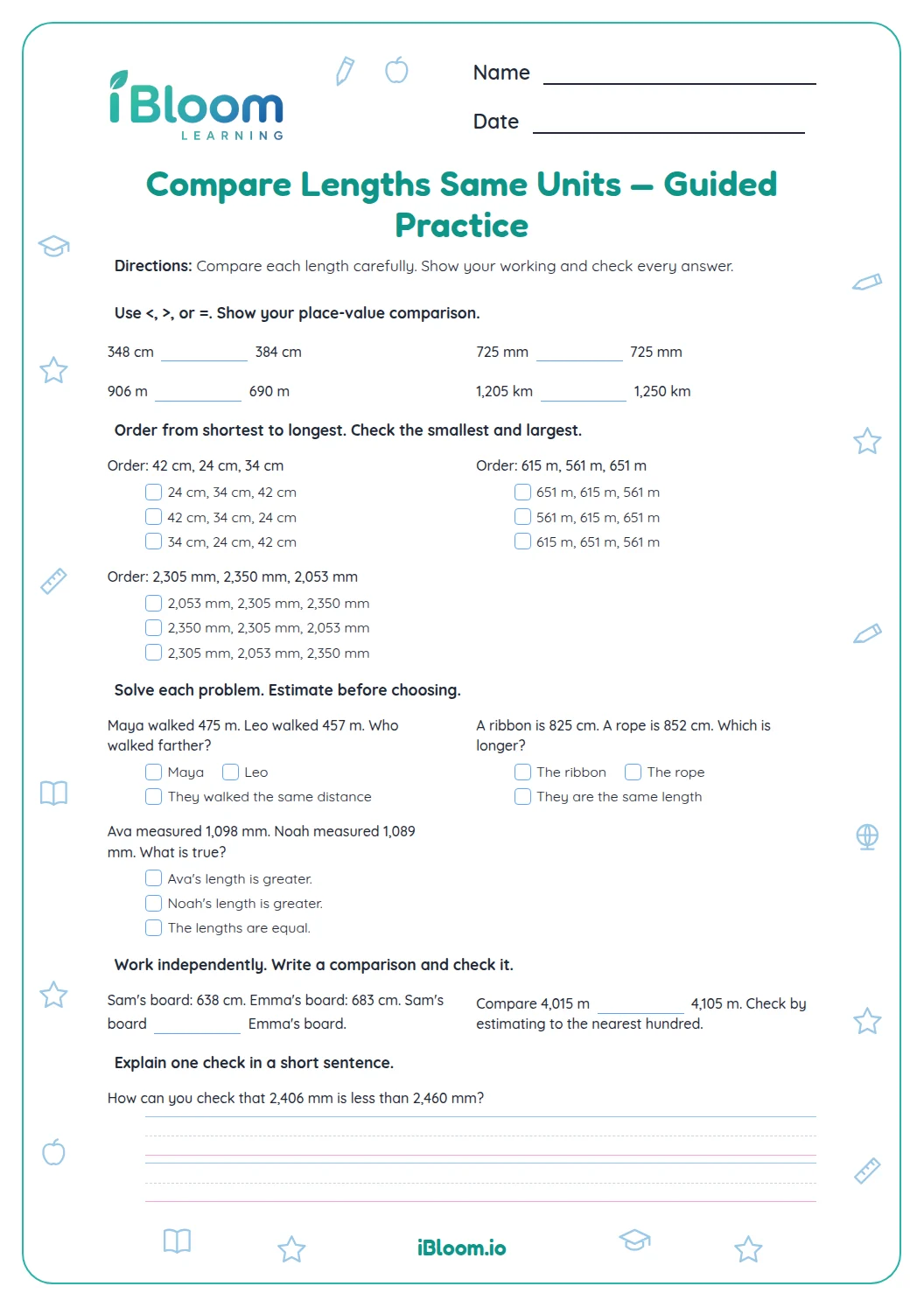
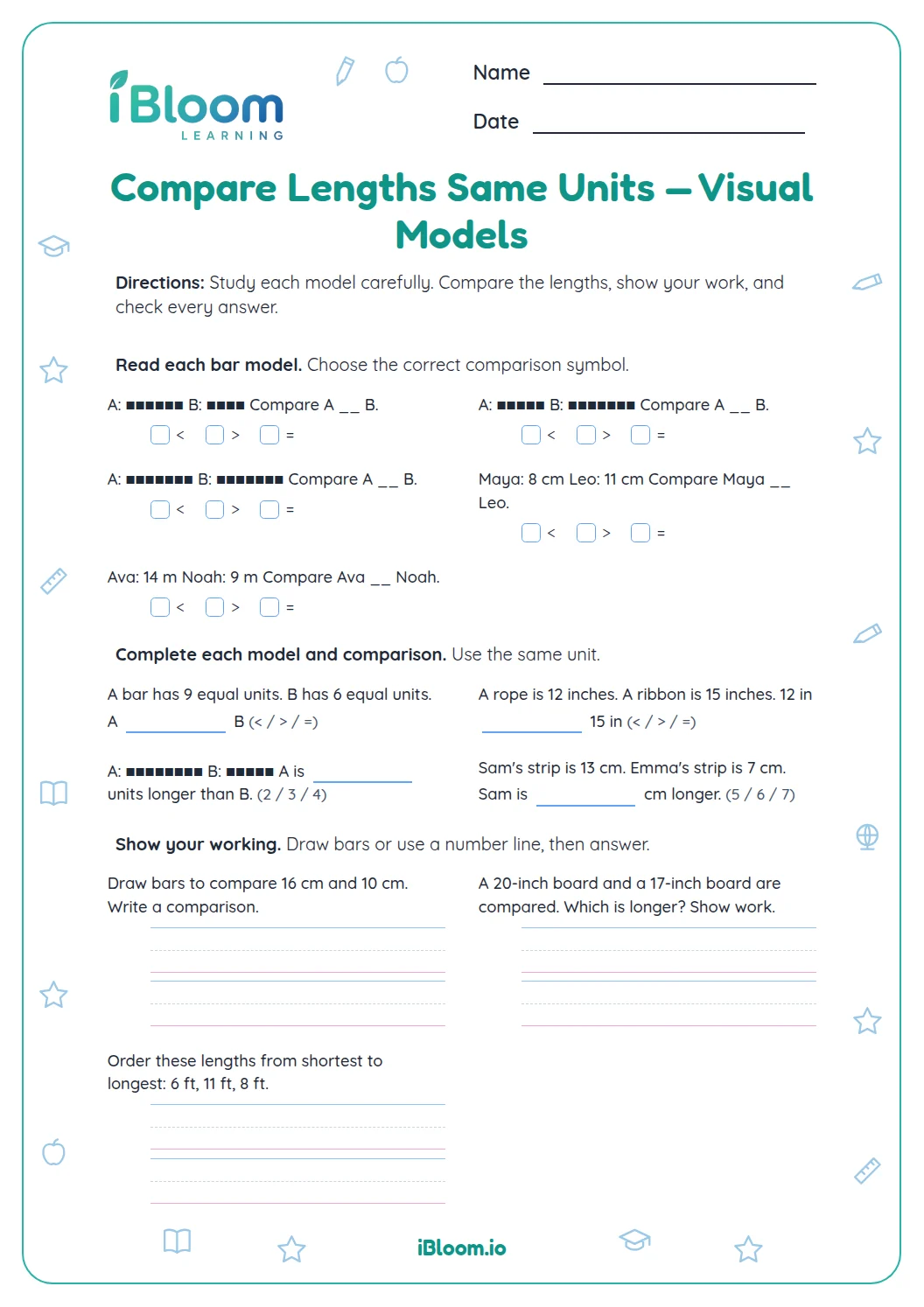
About this worksheet
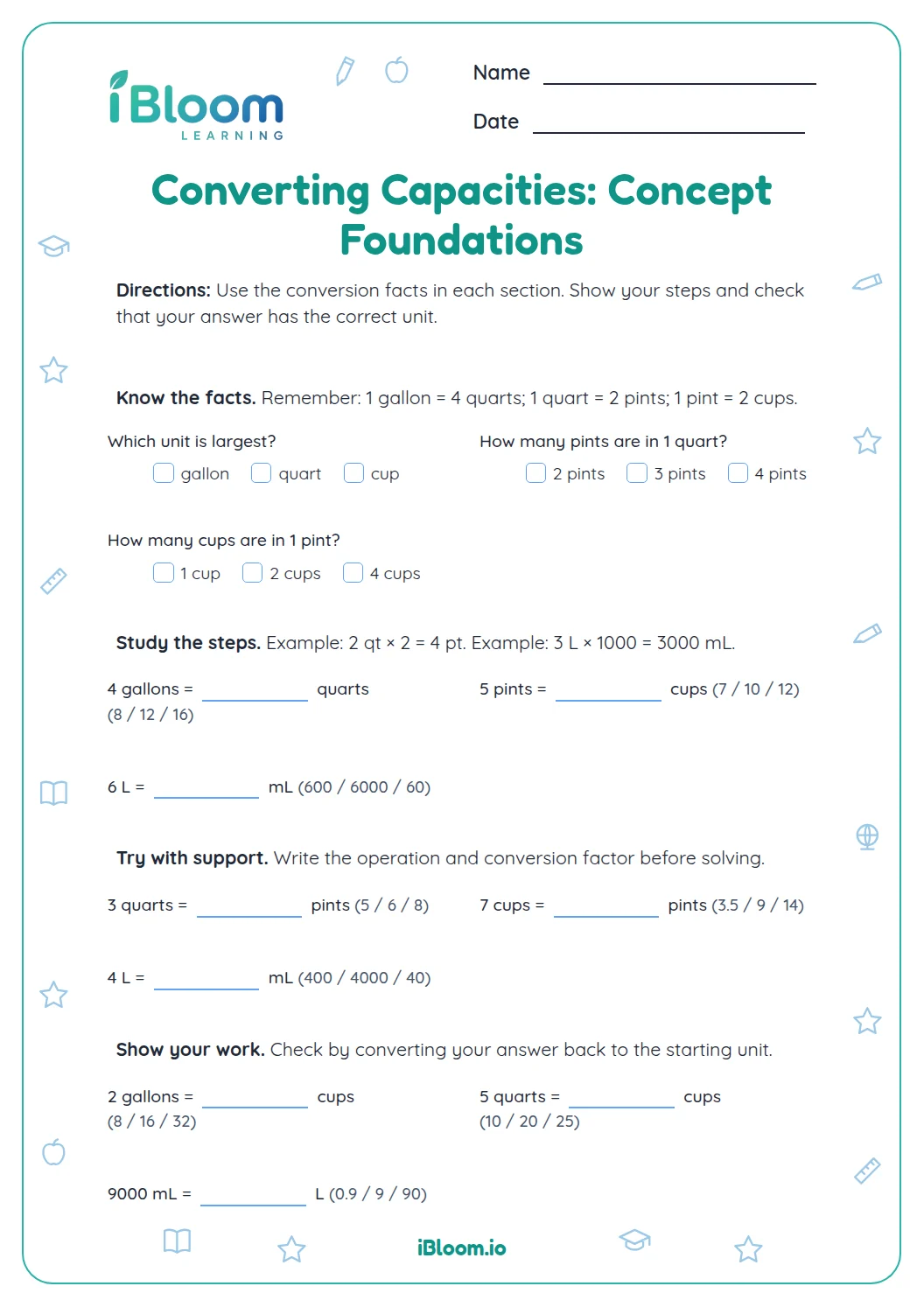
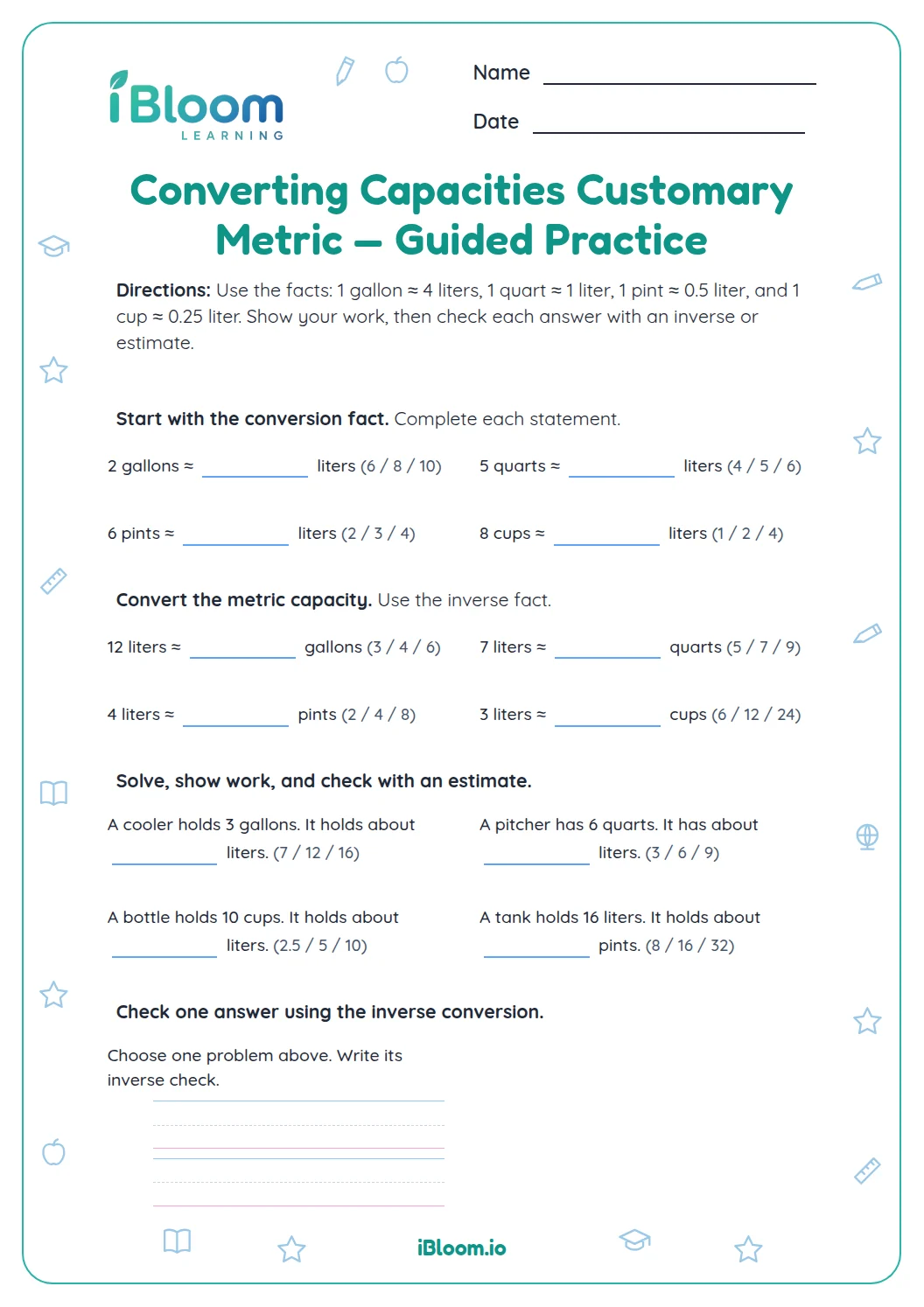
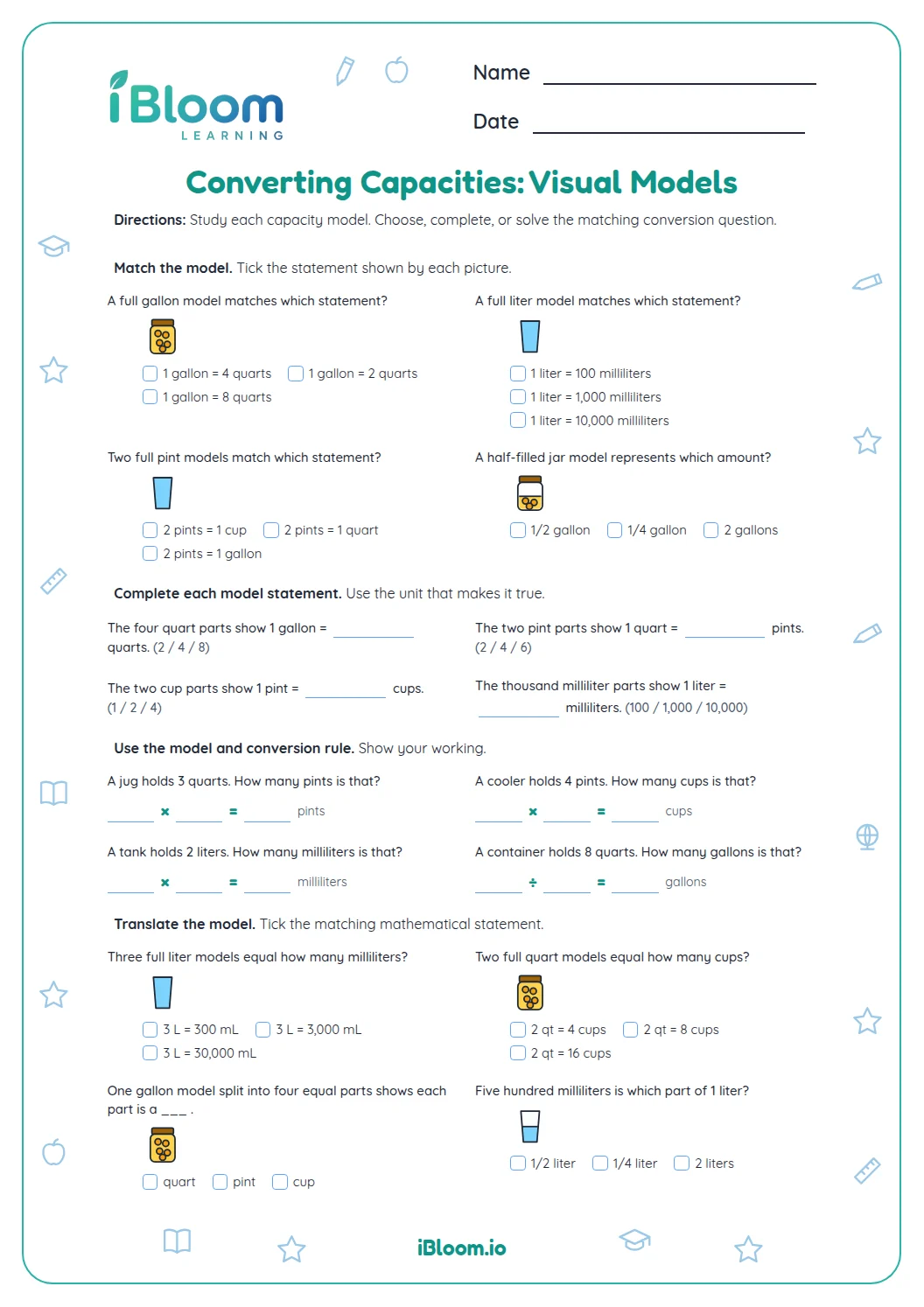
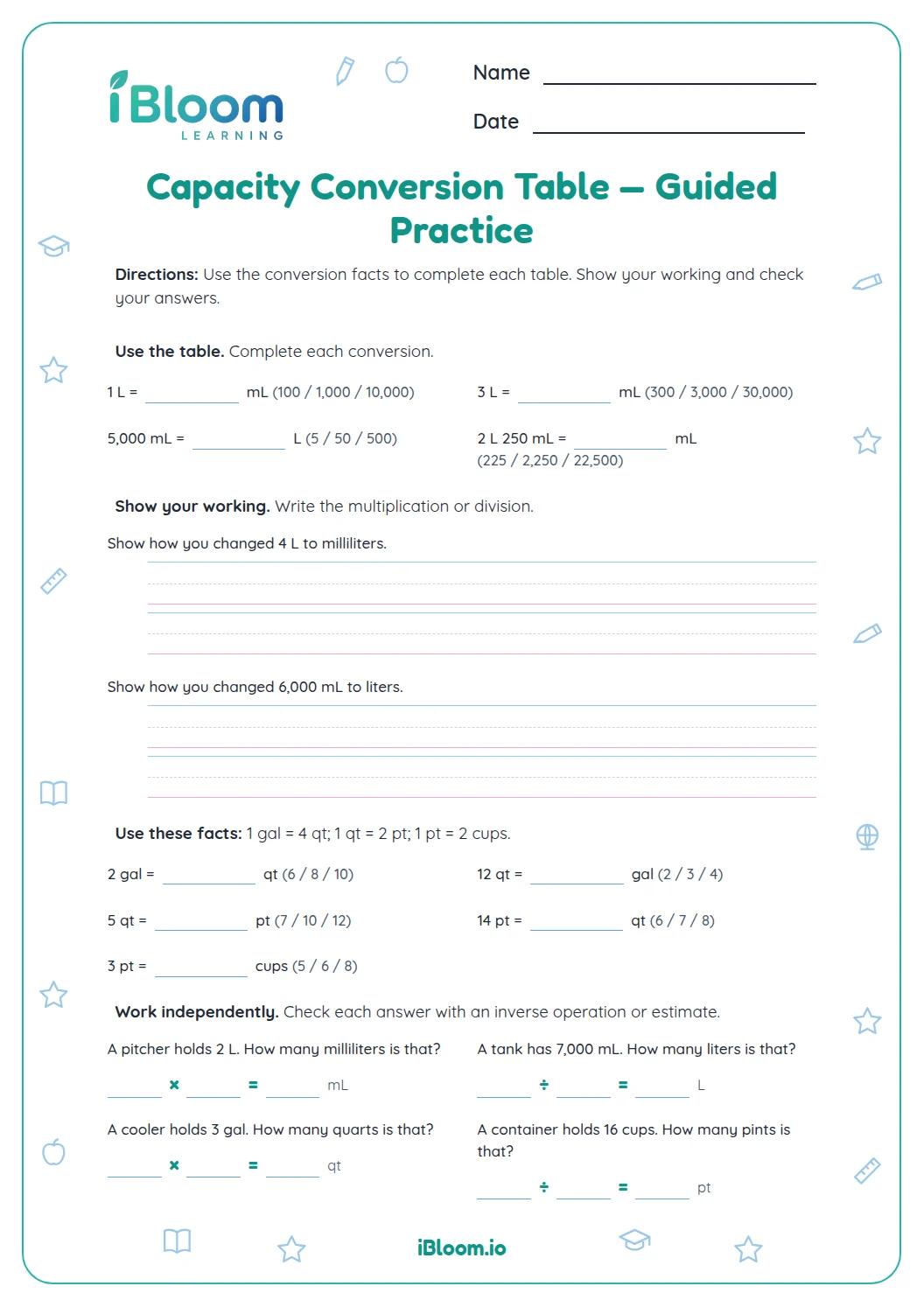
This Grade 5 worksheet practices converting capacity within customary and metric systems. Students use relationships among gallons, quarts, pints, cups, and fluid ounces, then convert liters, milliliters, and deciliters. The final questions mix units and apply conversions in short situations. There are 16 questions and a separate answer key.
Aligned to 5.MD.A.1
Which customary capacity units appear?
The worksheet includes gallons, quarts, pints, cups, and fluid ounces. Remember that one gallon equals four quarts, one quart equals two pints, one pint equals two cups, and one cup equals eight fluid ounces.
- Questions 1–5: customary conversions
- Questions 6–8: metric capacity conversions
- Questions 9–16: mixed units and application
How are liters, milliliters, and deciliters related?
One liter equals 1,000 milliliters and 10 deciliters. A conversion to a smaller unit uses a larger number; a conversion to a larger unit uses a smaller number. Keep the unit named in the question attached to the answer.
- 17 L = ___ dL
- 2Since 1 L = 10 dL, multiply 7 by 10: 7 L = 70 dL.
How can students handle a mixed-unit problem?
Convert one quantity to the unit requested before comparing or combining it. For mixed customary units, convert each part to the same unit first, then add. Check whether the answer is reasonable in the target unit.
Choose a unit relationship
- 1Identify the starting unit and the unit requested.
- 2Write the relationship that connects those units.
- 3Multiply when converting to a smaller unit; divide when converting to a larger unit.
- 4For mixed units, convert each part to one common unit before combining.
- 5Include the correct unit in word-problem answers.
- 6Estimate to check the size of the result.
Common capacity-conversion slips
The mistake
Using 4 instead of 8 when converting cups to fluid ounces.
The fix
Use 8 fluid ounces in each cup.
The mistake
Multiplying when converting to a larger unit.
The fix
A larger unit needs fewer units, so divide by the conversion factor.
The mistake
Adding mixed units before converting them.
The fix
Convert both amounts to the same unit, then add.
Common Core alignment
Students convert units within customary and metric measurement systems and apply conversions in problems.
Convert between units in one system and use conversions to solve problems.
On this sheet: Questions convert customary and metric capacities and apply those relationships in word problems.
Show the official wordingHide the official wording
Convert among different-sized standard measurement units within a given measurement system (e.g., convert 5 cm to 0.05 m), and use these conversions in solving multi-step, real world problems.
What to practice next
Make more practice
Further reading
Questions parents and teachers ask
Which customary units does the page practice?
Students convert gallons, quarts, pints, cups, and fluid ounces. The first questions use basic relationships, then later items combine units or apply a conversion in a short problem. The answer key gives numerical answers and units where the question calls for them.
What metric relationships should students know?
The worksheet uses 1 liter = 1,000 milliliters and 1 liter = 10 deciliters. Convert to a smaller unit by multiplying by the number of smaller units in one liter; convert to liters by dividing. Ask the student to point to the matching question or passage detail as they explain the choice.
How should a mixed-unit question be solved?
Convert each amount to the same unit before combining. For example, change quarts and cups to cups before adding. Then check whether the final number and unit answer the question that was asked. Ask the student to point to the matching question or passage detail as they explain the choice.
Does the worksheet include word problems?
Yes. The last part includes short capacity situations and a comparison. Students write their answers with units when the problem requests a quantity, and the key shows the intended result. Ask the student to point to the matching question or passage detail as they explain the choice.
How can I help students check a conversion?
Ask whether the target unit is larger or smaller. A quantity expressed in smaller units should have a larger number, while conversion to a larger unit should have a smaller number. Recheck the relationship if the answer moves in the wrong direction.