
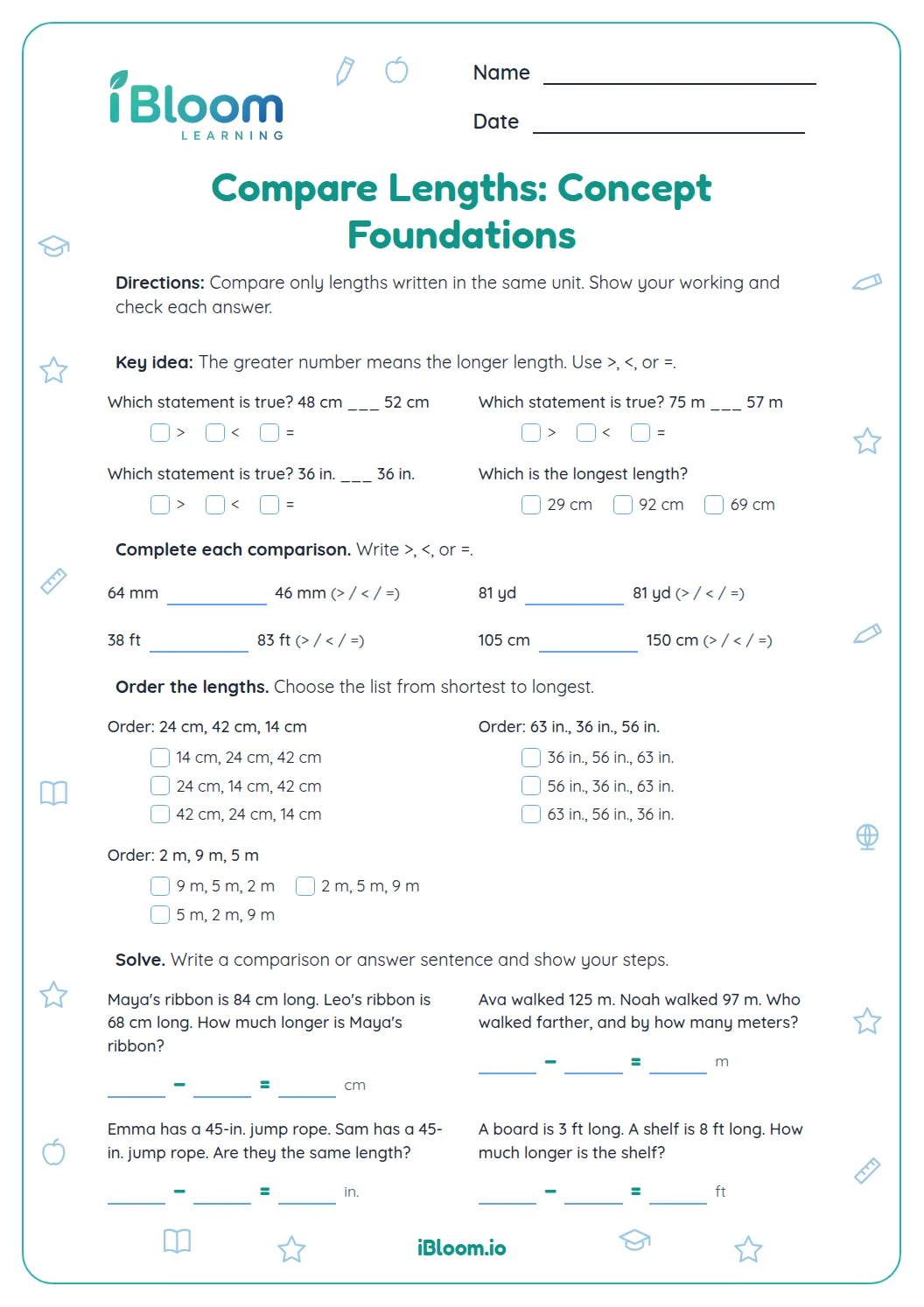
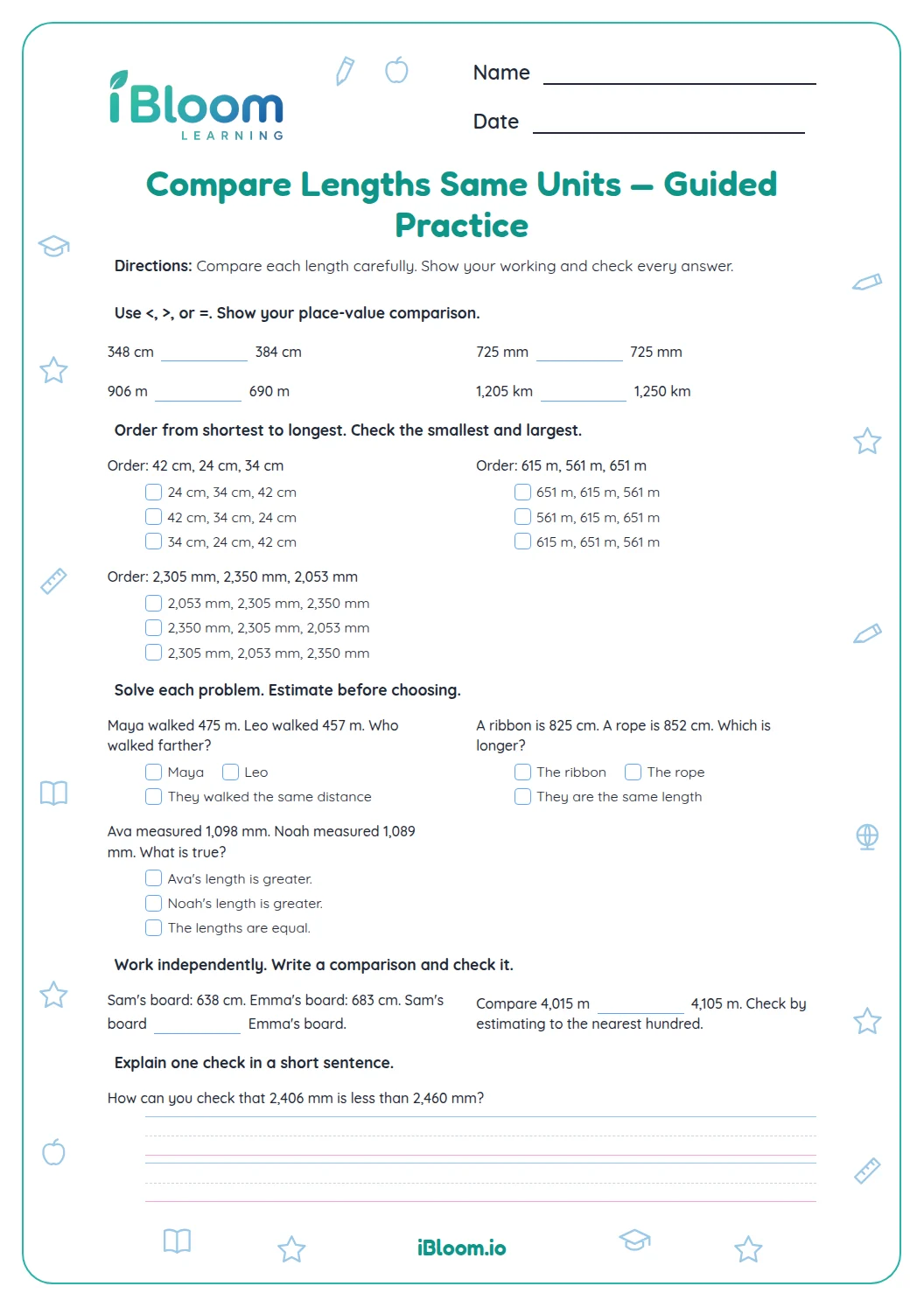
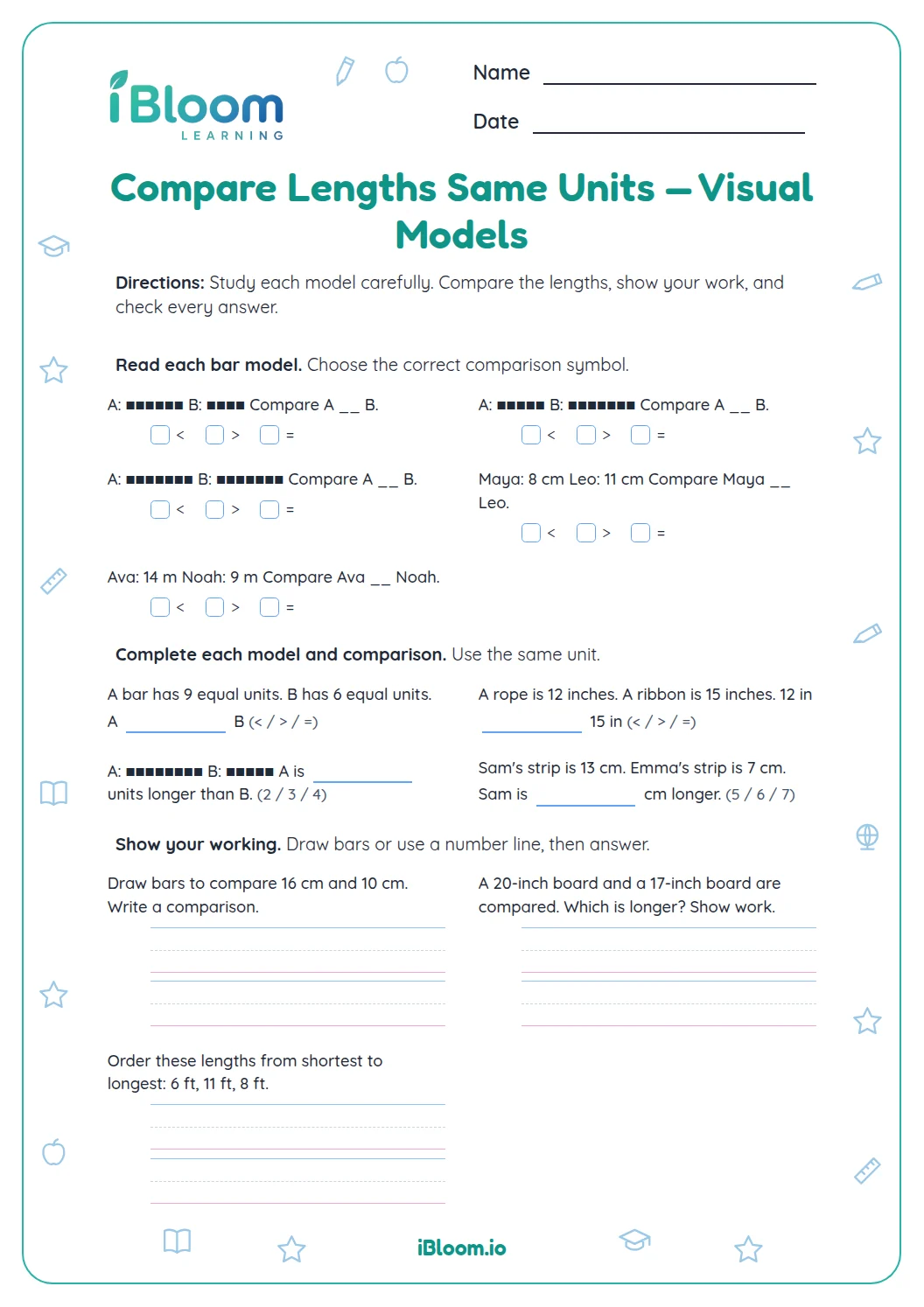
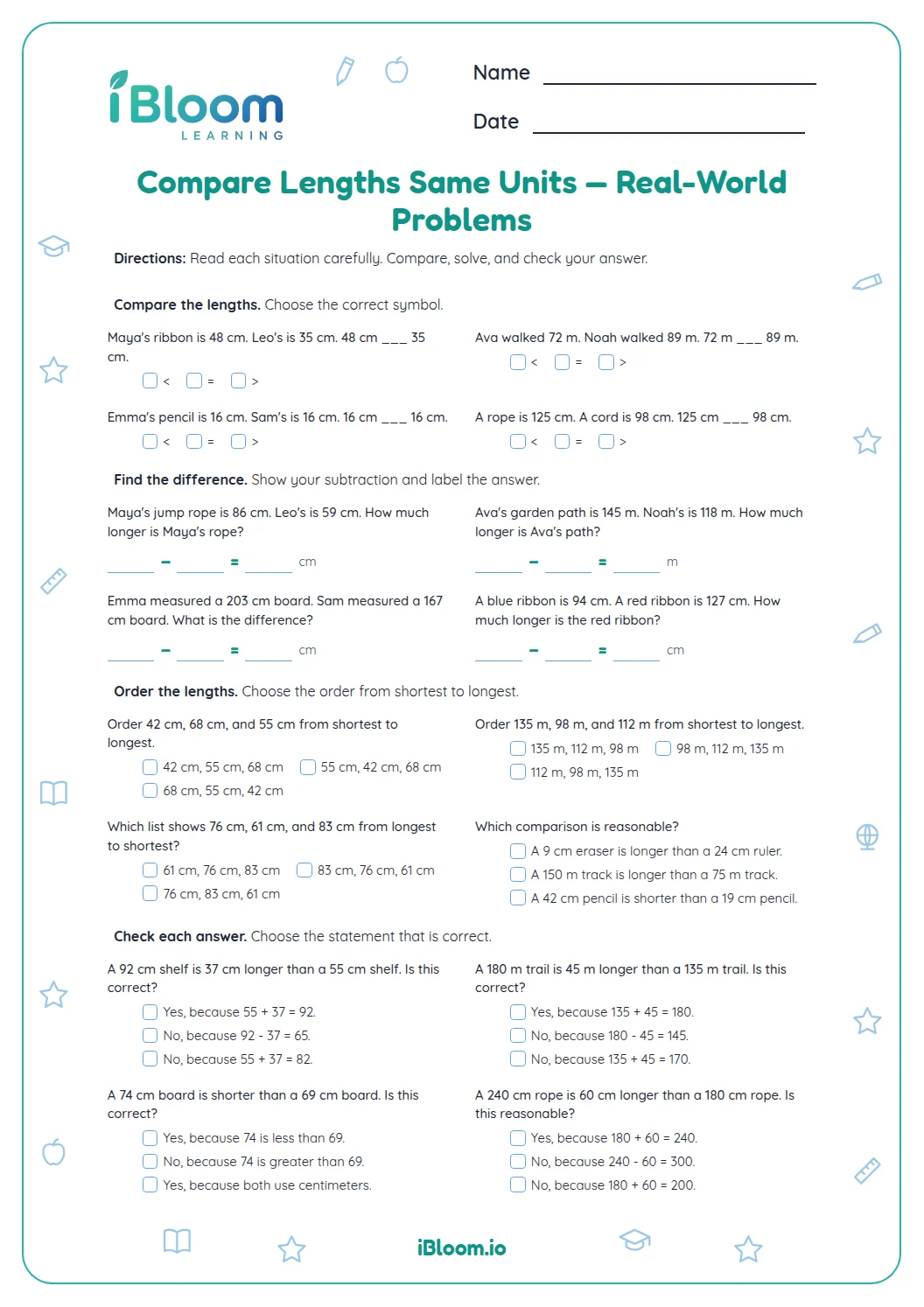

About this worksheet
This Grade 5 worksheet gives students 16 questions comparing lengths already written in the same unit. They choose <, >, or = for six pairs, find four differences, then order six groups from shortest to longest. Some lengths are decimals, so students compare place values before recording a symbol. The separate answer key gives each comparison, difference, and ordered list. The decimal comparisons align with CCSS 5.NBT.A.3.b.
Aligned to 5.NBT.A.3.b
Why compare lengths in the same unit first?
When both measurements use the same unit, compare the numerical values directly. For decimals, line up place values: 4.60 is greater than 4.20, so 4.6 m > 4.2 m.
- 14.6 m = 4.60 m
- 24.60 > 4.20
- 3So 4.6 m > 4.2 m
How do you find how much longer one length is?
Subtract the shorter measurement from the longer measurement and keep the same unit. In question 7, 36 cm − 29 cm = 7 cm. The difference answers “how much longer.”
What does the independent practice include?
Six questions compare pairs, four find differences, and six order measurements. Values include whole numbers and decimals, but the measurements within each item use one shared unit.
- Questions 1–6 compare pairs with >, <, or =.
- Questions 7–10 find a difference in the same unit.
- Questions 11–16 order three lengths from shortest to longest.
How to use this worksheet
- 1Read the unit and confirm both lengths match.
- 2For decimals, line up decimal points and compare place values.
- 3Use >, <, or = for pair comparisons.
- 4Subtract shorter from longer to find a difference.
- 5For ordering, compare the smallest values first and retain their units.
Common mistakes and quick fixes
The mistake
Comparing only the last decimal digit
The fix
Compare place values from left to right.
The mistake
Subtracting in the wrong order
The fix
Subtract the shorter value from the longer value.
The mistake
Dropping the unit in an answer
The fix
Write the shared unit after each difference or ordered length.
Common Core alignment
This worksheet practices the standard named below through its questions.
Compare decimal lengths using place value and <, =, and >.
On this sheet: Students compare decimal lengths and record comparisons with the standard symbols.
Show the official wordingHide the official wording
Compare two decimals to thousandths based on meanings of the digits in each place, using >, =, and < symbols to record the results of comparisons.
What to practice next
Make more practice
Further reading
Questions parents and teachers ask
How do I compare two lengths with the same unit?
Compare their numerical values. If the lengths are decimals, line up the decimal points and compare place values. For example, 4.60 m is greater than 4.20 m, so 4.6 m > 4.2 m. No conversion is needed when both measurements already share a unit.
Why do both measurements need the same unit?
The numbers represent comparable quantities directly when they use the same unit. A centimeter value and a meter value need conversion before their numerical sizes can be compared. This practice keeps each pair in the same unit so attention stays on comparing and ordering.
How do I find how much longer one object is?
Subtract the shorter length from the longer length. If one length is 36 cm and another is 29 cm, the difference is 36 − 29 = 7 cm. The result uses the same unit as both starting measurements.
How should learners order decimal lengths?
Compare place values from left to right, adding a zero when it helps make the decimals the same length. For example, 5.1 is 5.10, which is less than 5.25. Keep the unit beside each value while ordering. A zero at the end does not change a decimal’s value.
How many problems and pages are included?
The worksheet has 16 questions across two worksheet pages and two answer key pages. It includes six pair comparisons, four difference problems, and six ordering tasks. Every item keeps the lengths in one shared unit, and the key provides the comparison or ordered values.
What is a common comparison error?
A common error is deciding from the final digit alone, such as thinking 4.2 is greater than 4.6 because 2 is greater than 6 in an imagined comparison. Compare the whole-number and decimal places in order, starting from the left.