
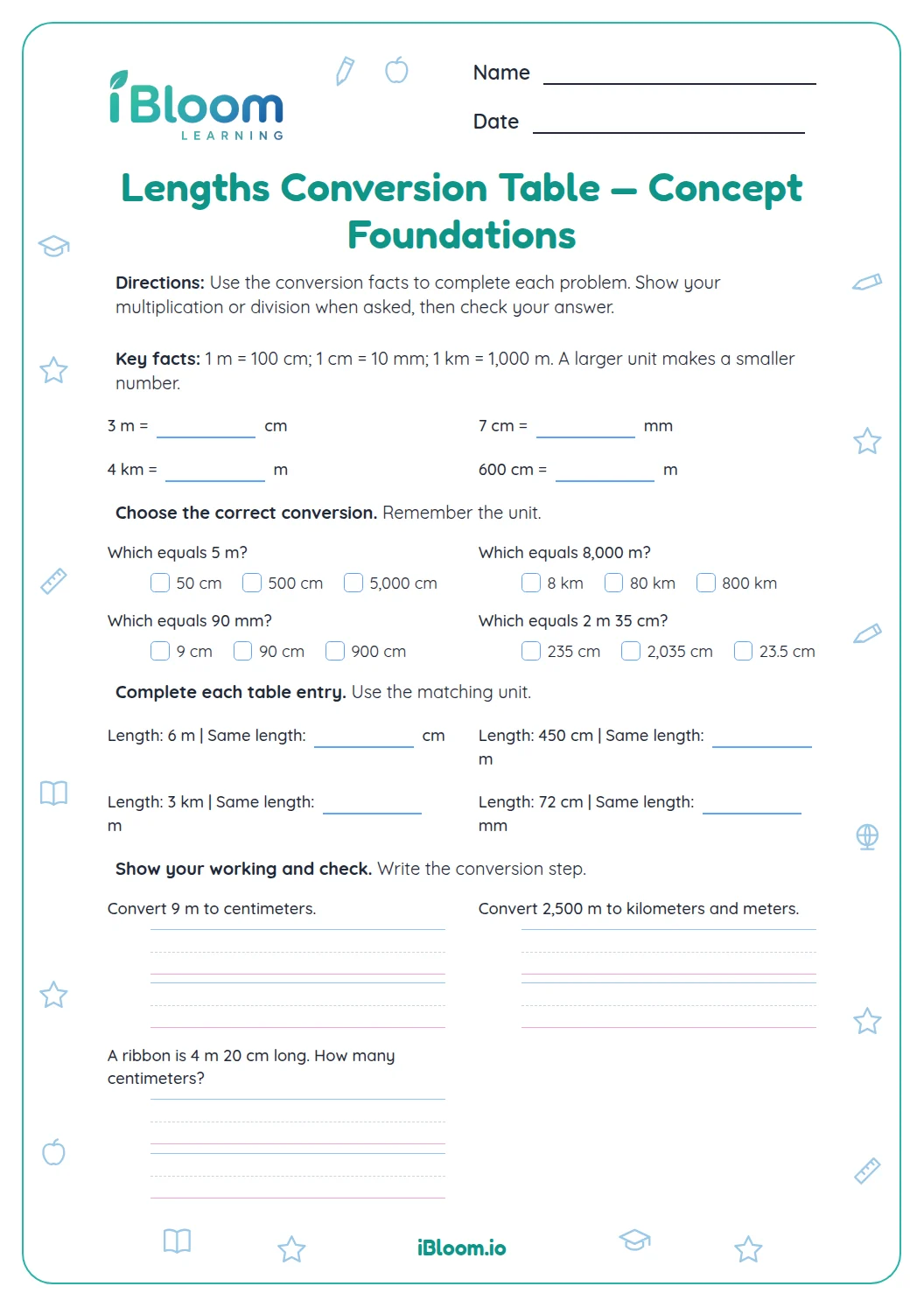
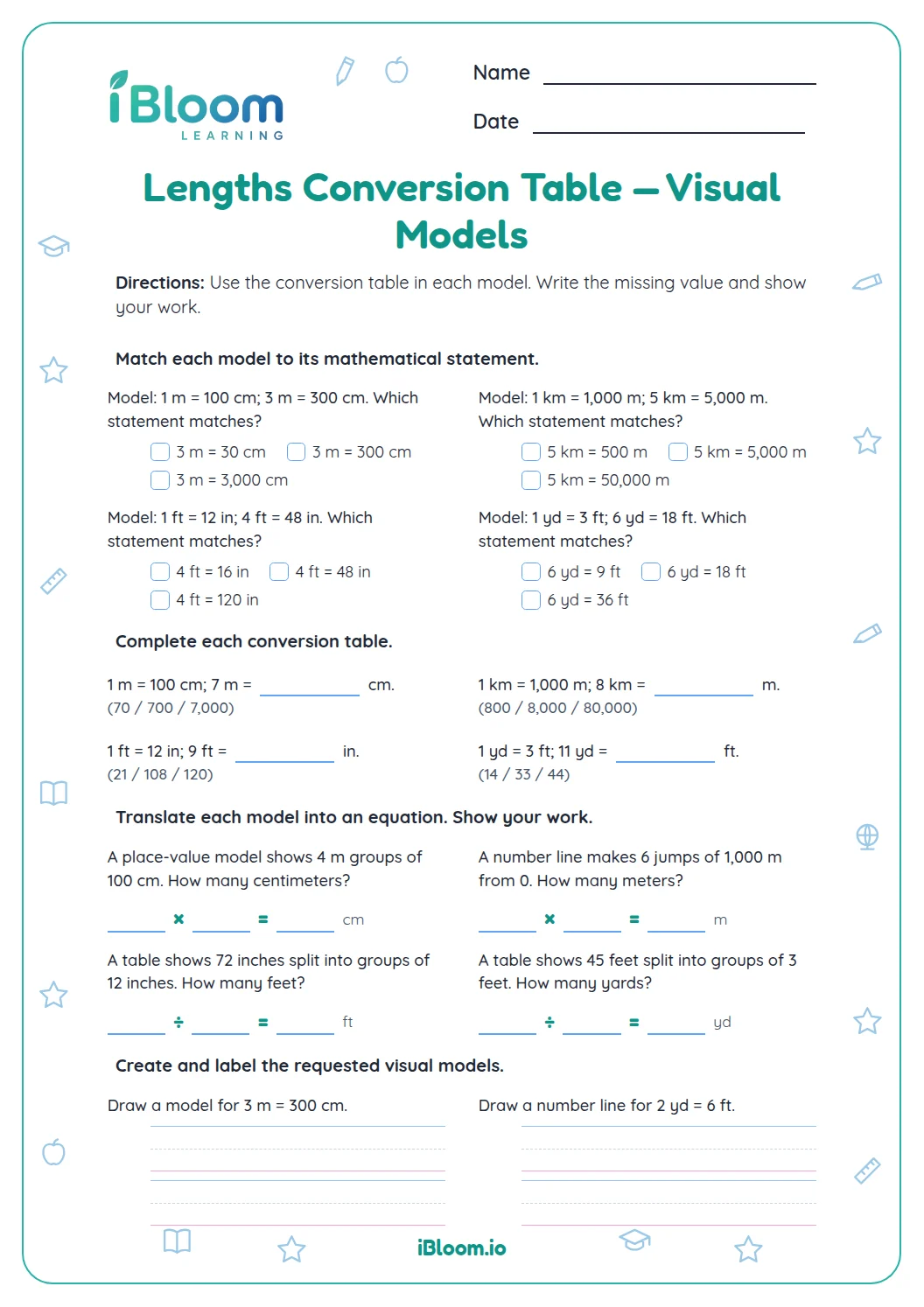
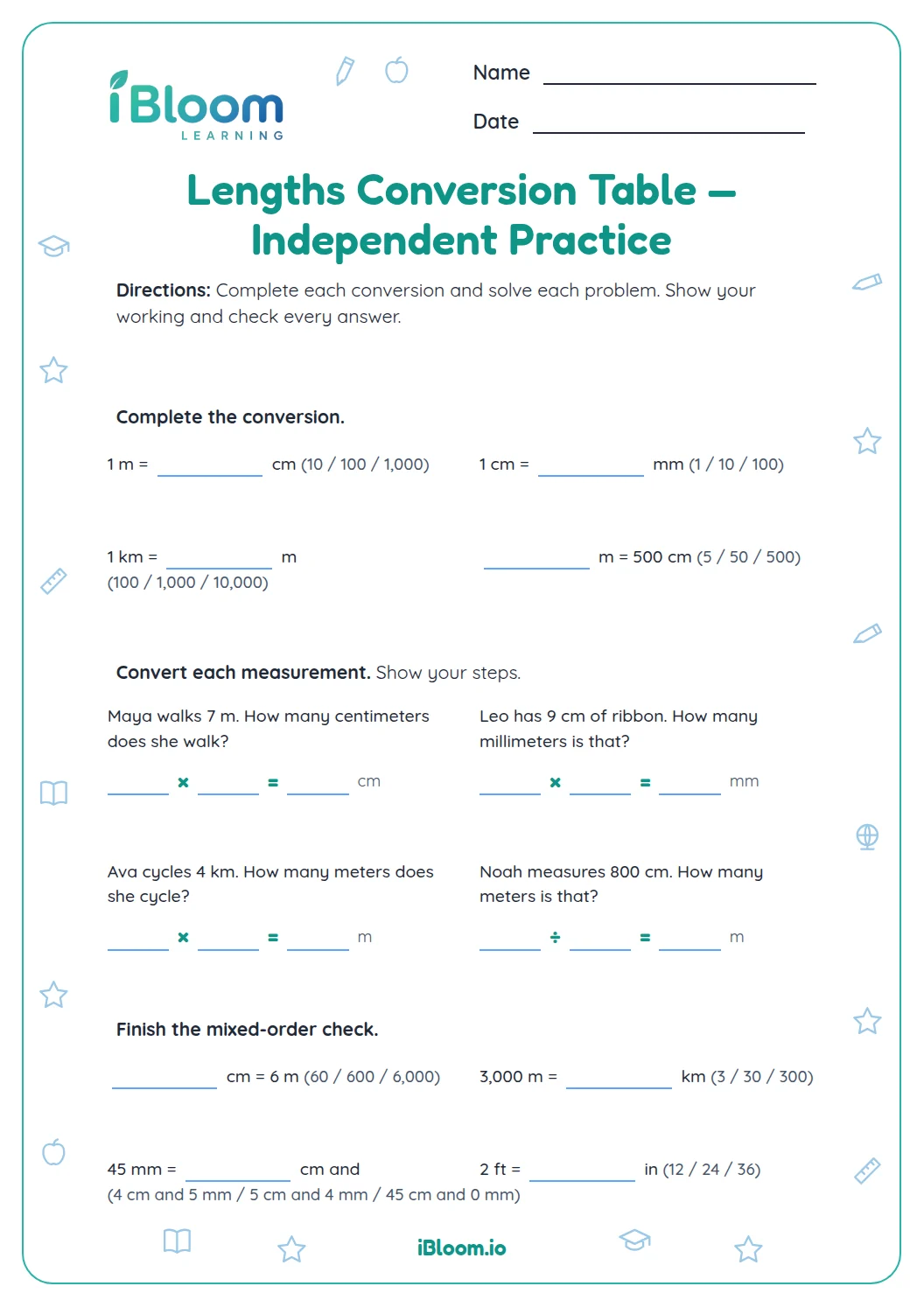
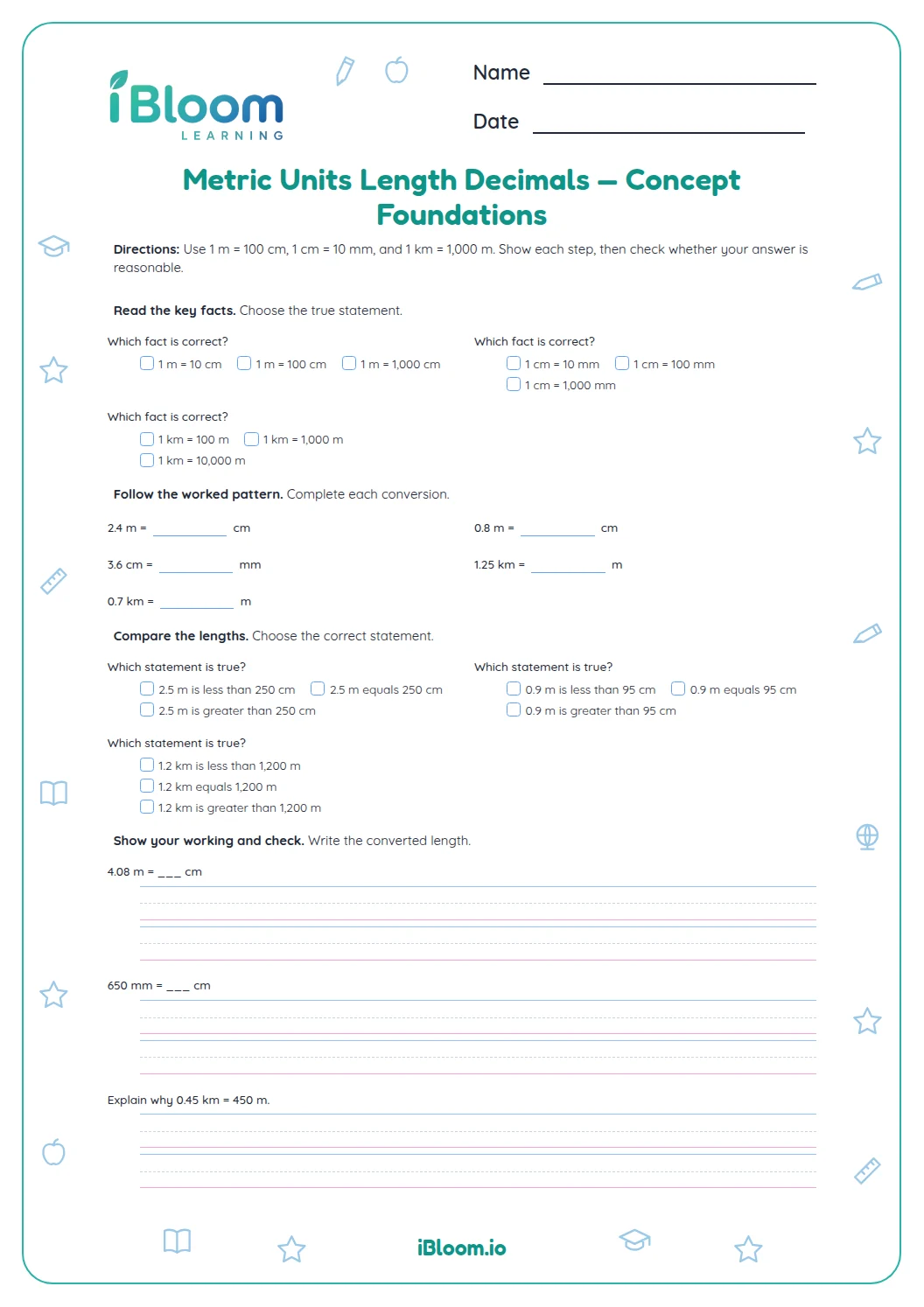


About this worksheet
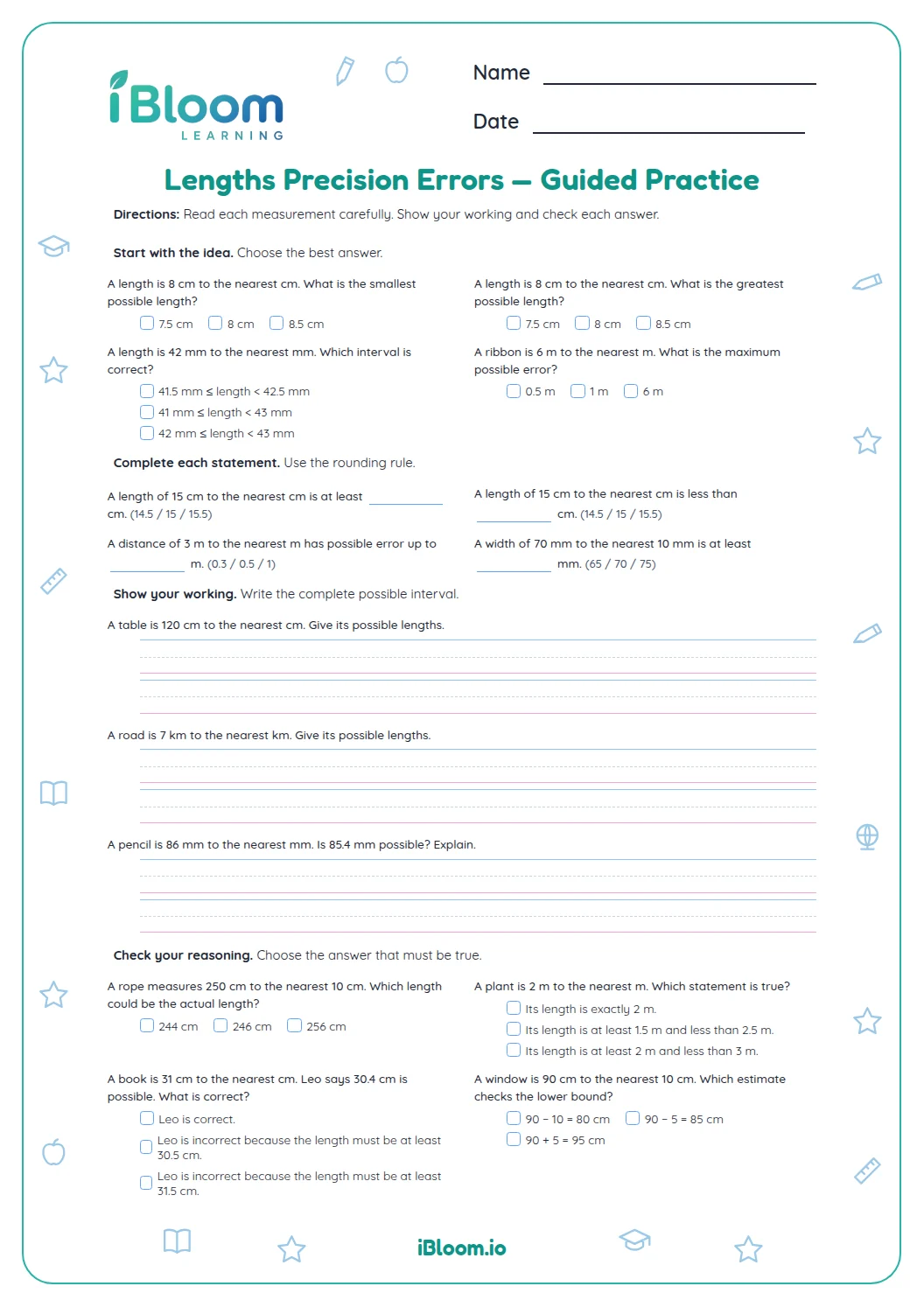
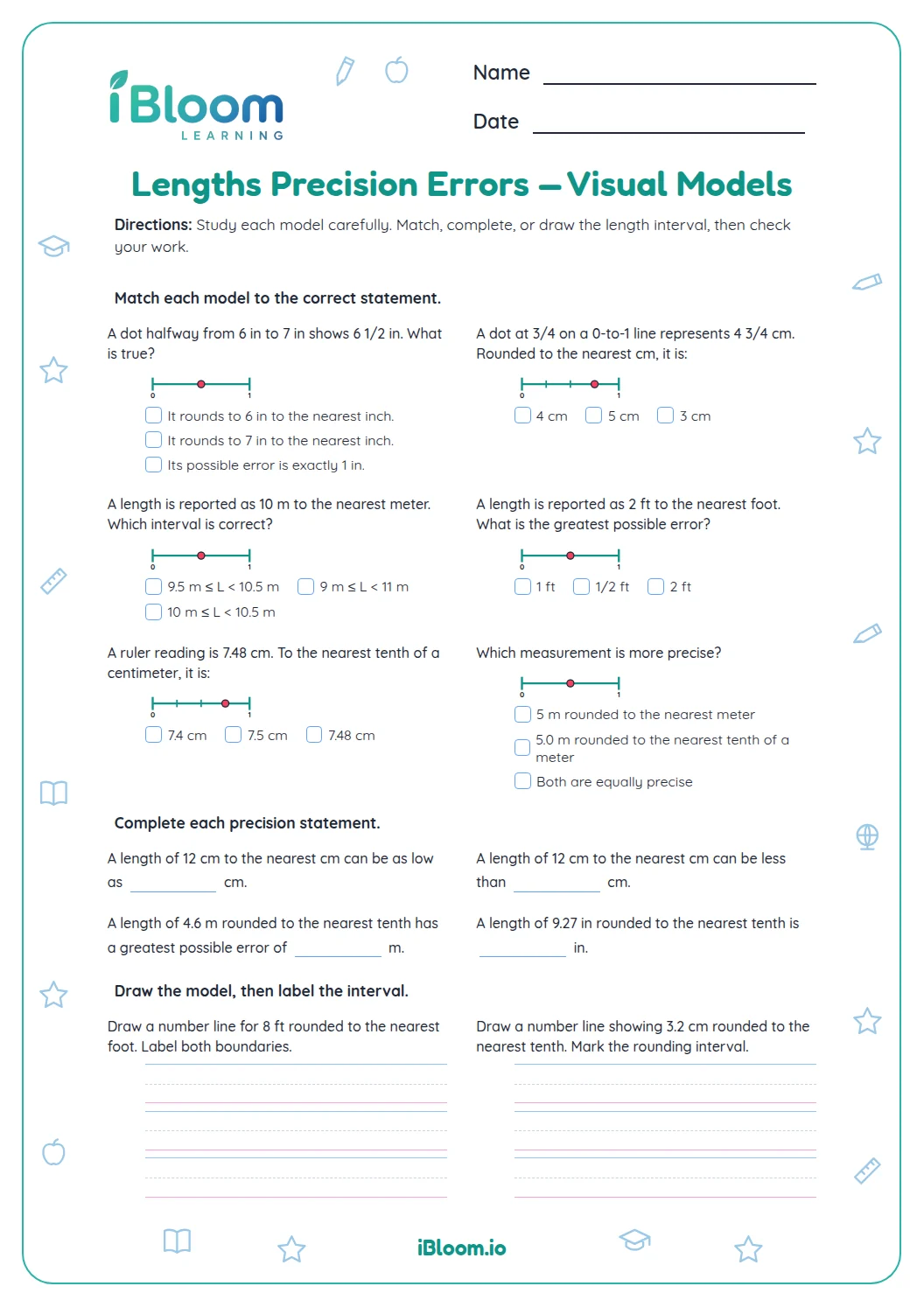
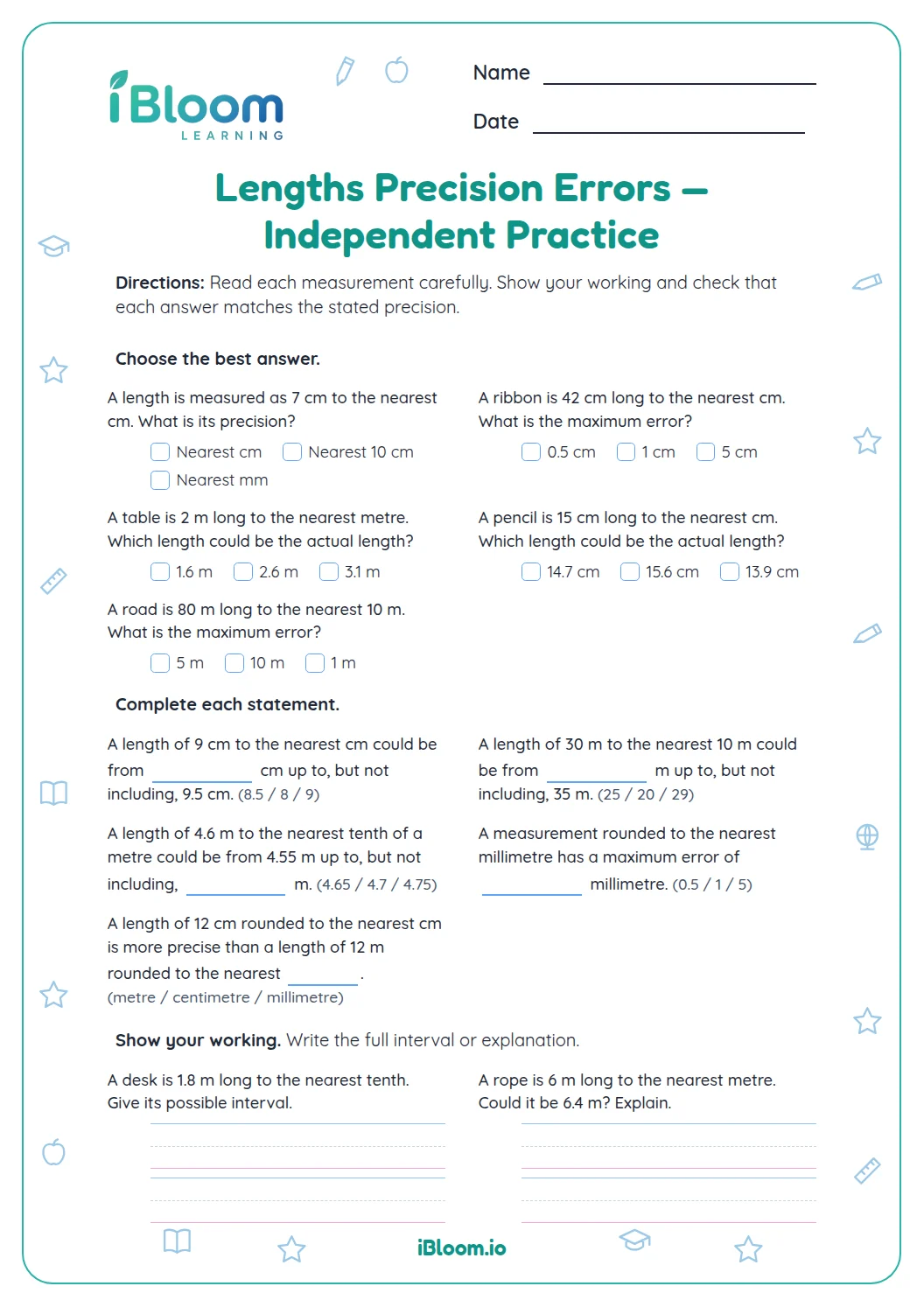
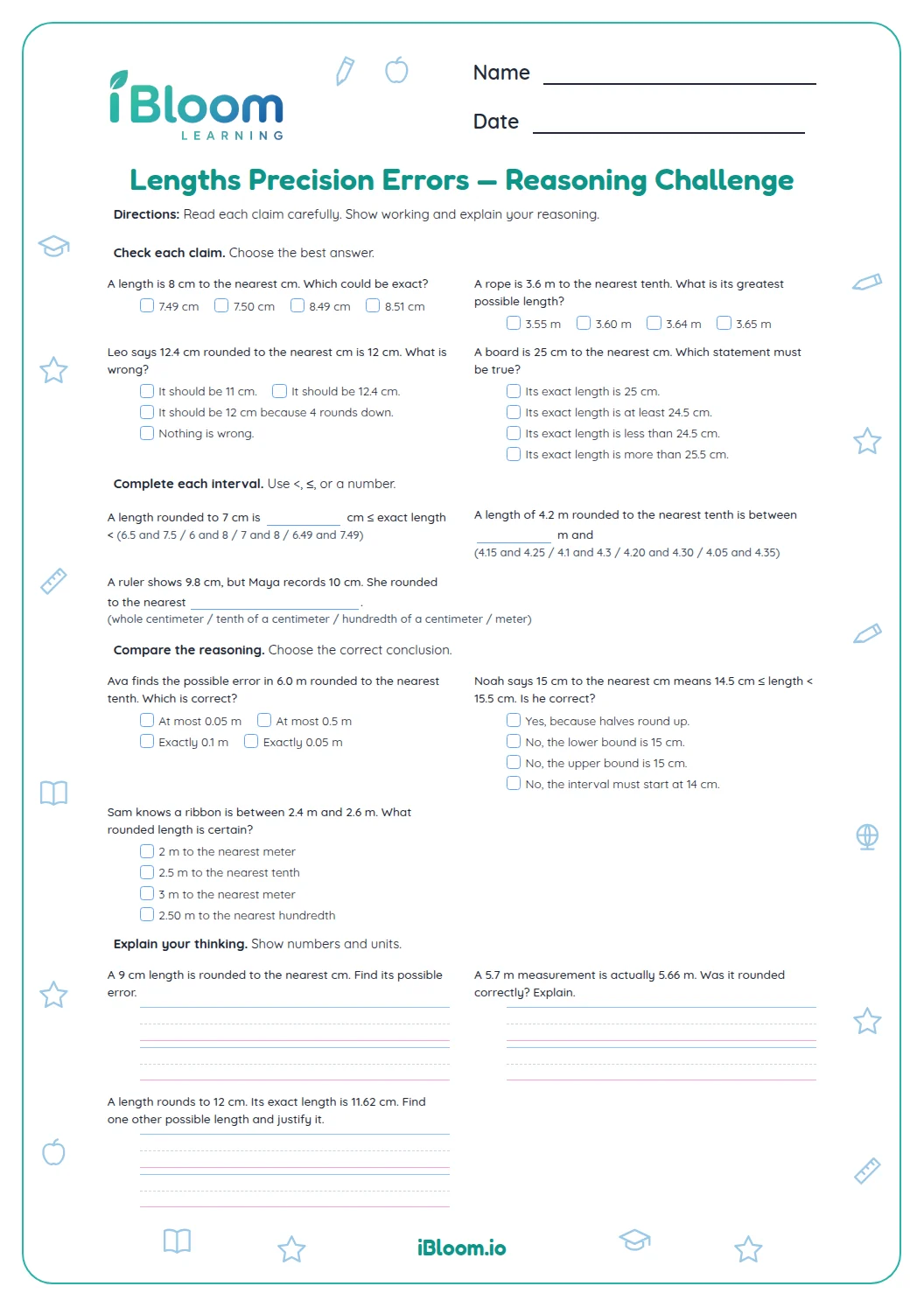
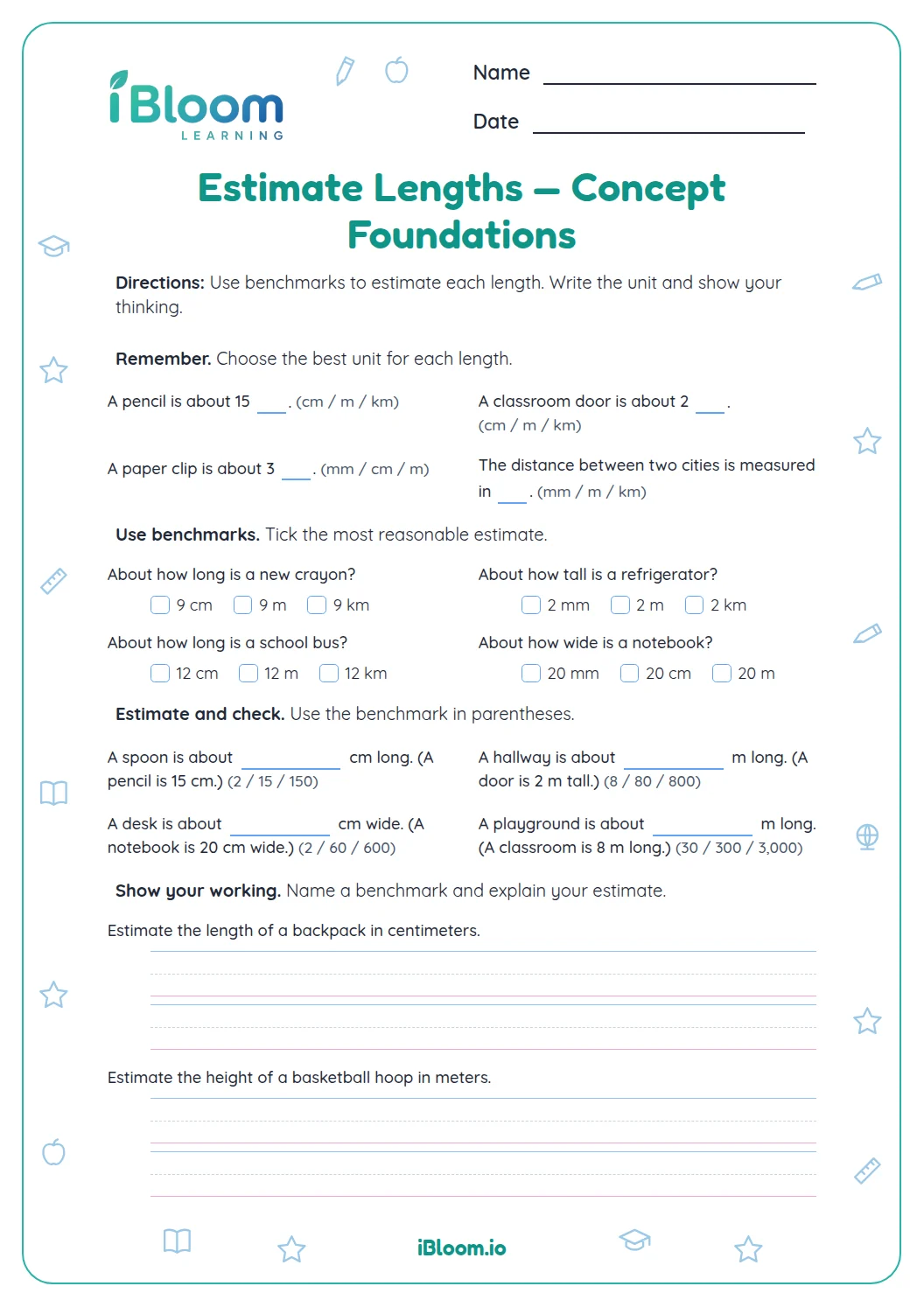
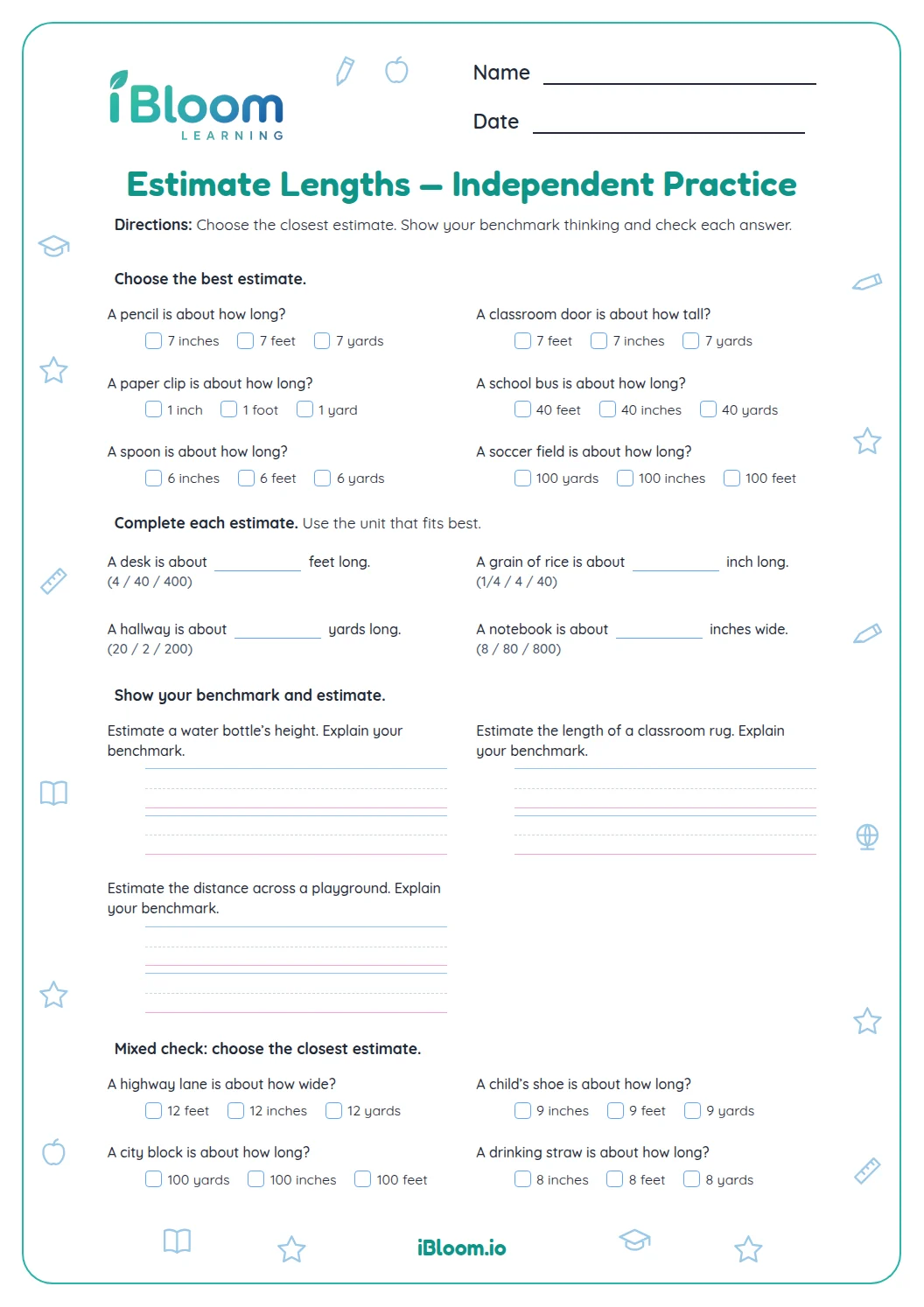
This Grade 5 printable practices how rounding changes a reported length and how to find the greatest possible error. Students round lengths and find greatest possible errors for centimeters and meters. For rounding to the nearest unit, the greatest possible error is half that unit; for nearest tenths, it is half of one tenth. The sheet includes 14 questions across three parts and a separate answer key.
How does rounding affect a length?
The first part distinguishes a rounded report from an exact measurement. For example, 45.7 cm rounds to 46 cm to the nearest centimeter because the tenths digit is 7.
- 1A length rounded to the nearest centimeter has a greatest possible error of 0.5 cm.
How do you find the greatest possible error?
Take half of the unit named by the rounding place. Nearest centimeter means 0.5 cm; nearest tenth of a meter means 0.05 m.
What will students practice?
Part A has five choices about rounded lengths. Part B asks for rounded values and error amounts. Part C asks for short explanations using the measurement unit.
How to use this worksheet
- 1Read the unit named in the question.
- 2Round by checking the digit just to the right of the target place.
- 3For greatest possible error, divide the rounding unit by 2.
- 4Include the unit in each measurement.
- 5Use the key to check calculations and explanations.
Mistakes to check
The mistake
Using the full unit as the greatest possible error.
The fix
Take half of the rounding unit: 1 cm becomes 0.5 cm.
The mistake
Rounding 12.6 cm down to 12 cm.
The fix
Look at the tenths digit: 6 rounds 12 cm up to 13 cm.
The mistake
Calling a rounded length exact.
The fix
Use “about” or describe the rounding unit because the actual length may differ.
What to practice next
Make more practice
Questions parents and teachers ask
How many questions are on the worksheet?
There are 14 questions in three parts. The practice starts with supported examples and moves toward applying rounding lengths in fill-in questions. A separate answer key is included with the printable so students can check their work afterward.
What grade is this printable for?
This worksheet is written for Grade 5. The directions and examples use the same skill throughout, with the last part asking students to apply it more independently. An adult can read a prompt aloud or talk through the first example before students continue.
Does it include an answer key?
Yes. A separate answer key is included after the worksheet pages. It gives the expected answer for selected-response items and sample responses for open-ended questions, so students can compare their reasoning rather than look for only one possible sentence.
How long will it take?
Plan for about 20 minutes to read the directions, complete all 14 questions, and check answers. Writing responses may take longer for some students. The printable can also be completed in separate short sessions at home or in class.
What is the key idea?
For rounding to the nearest centimeter, the greatest possible error is 0.5 cm. For rounding to the nearest tenth of a meter, it is 0.05 m. Students can apply this half-unit rule to each measurement and include the unit in their answer.