
About this worksheet
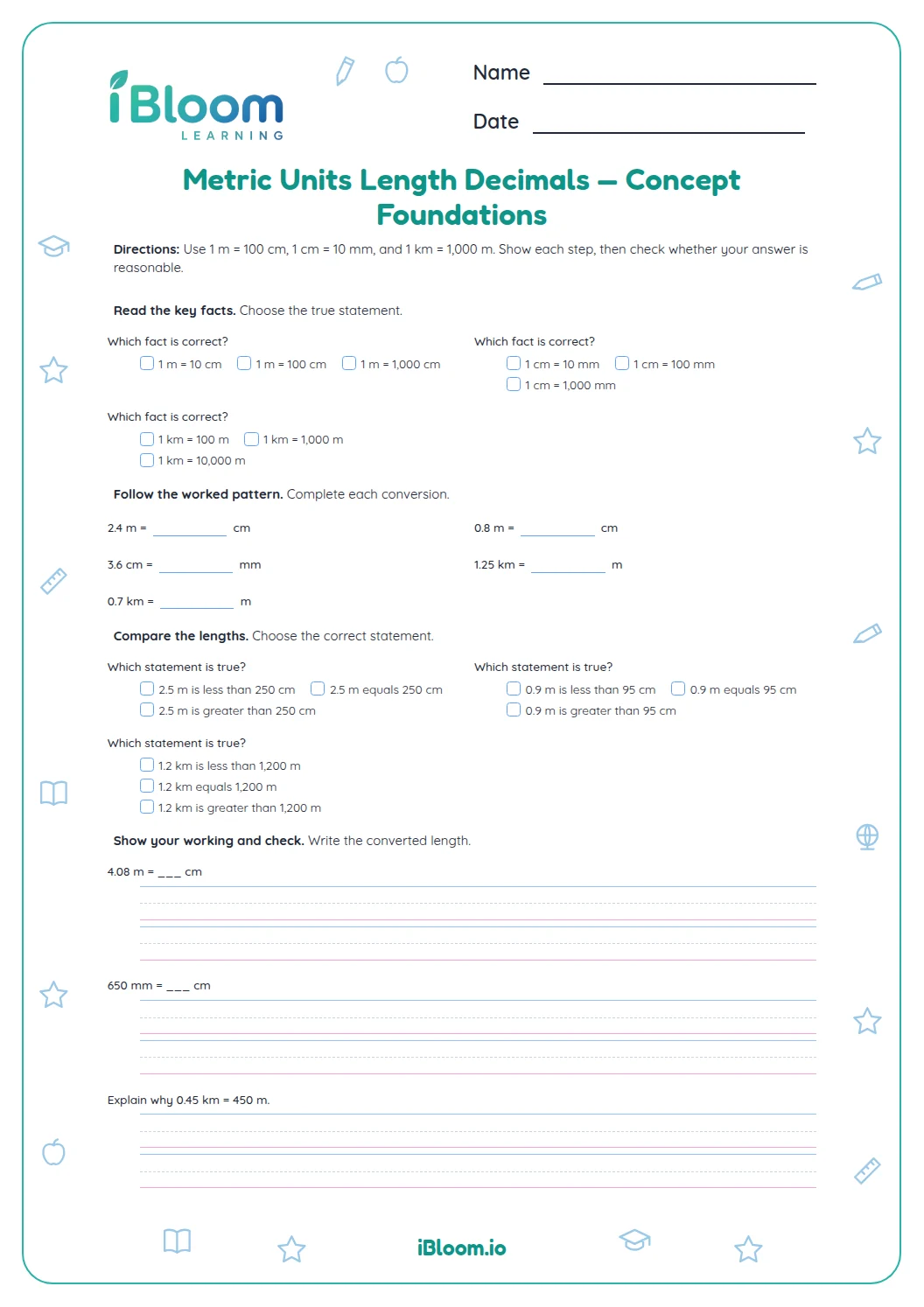
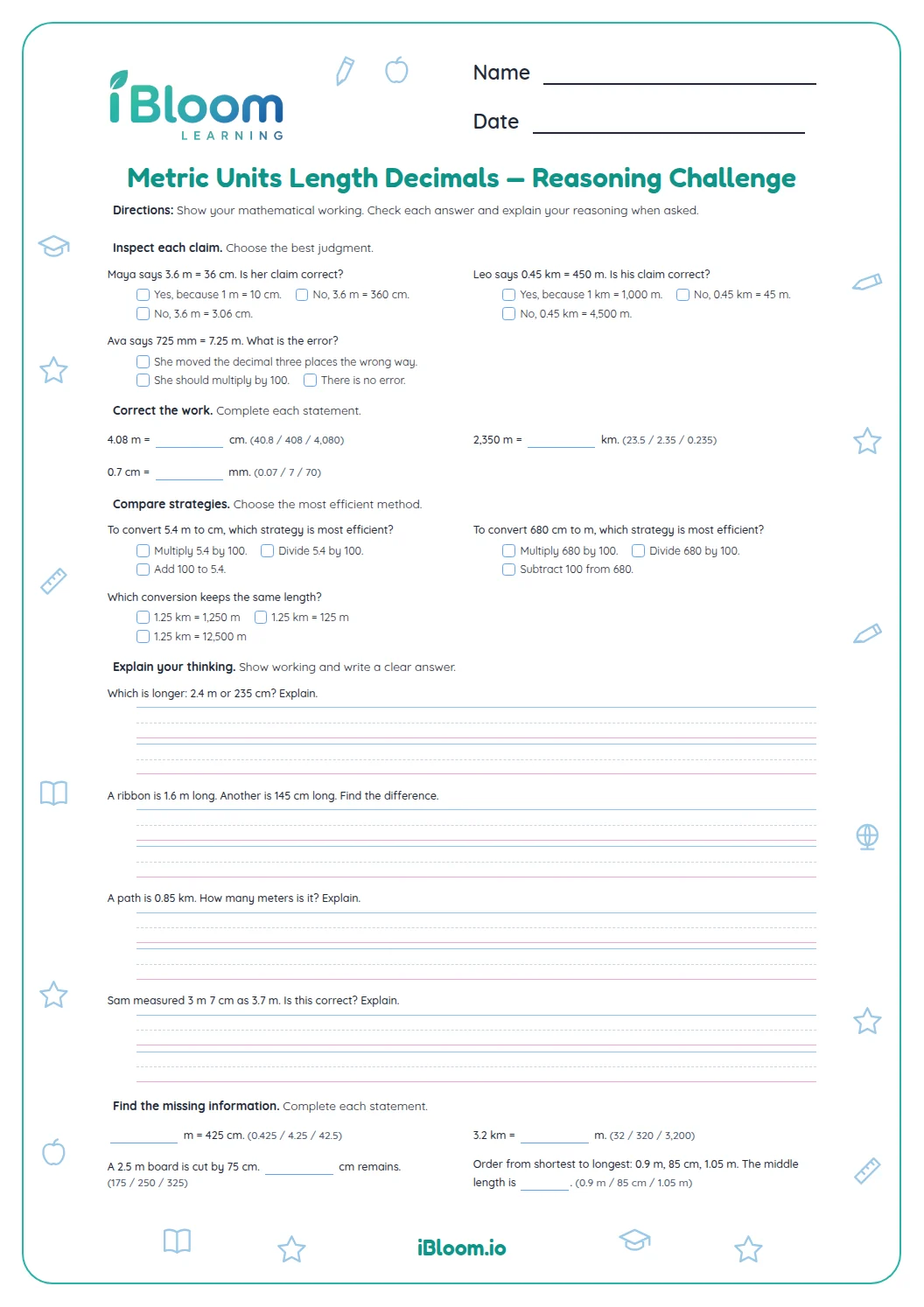
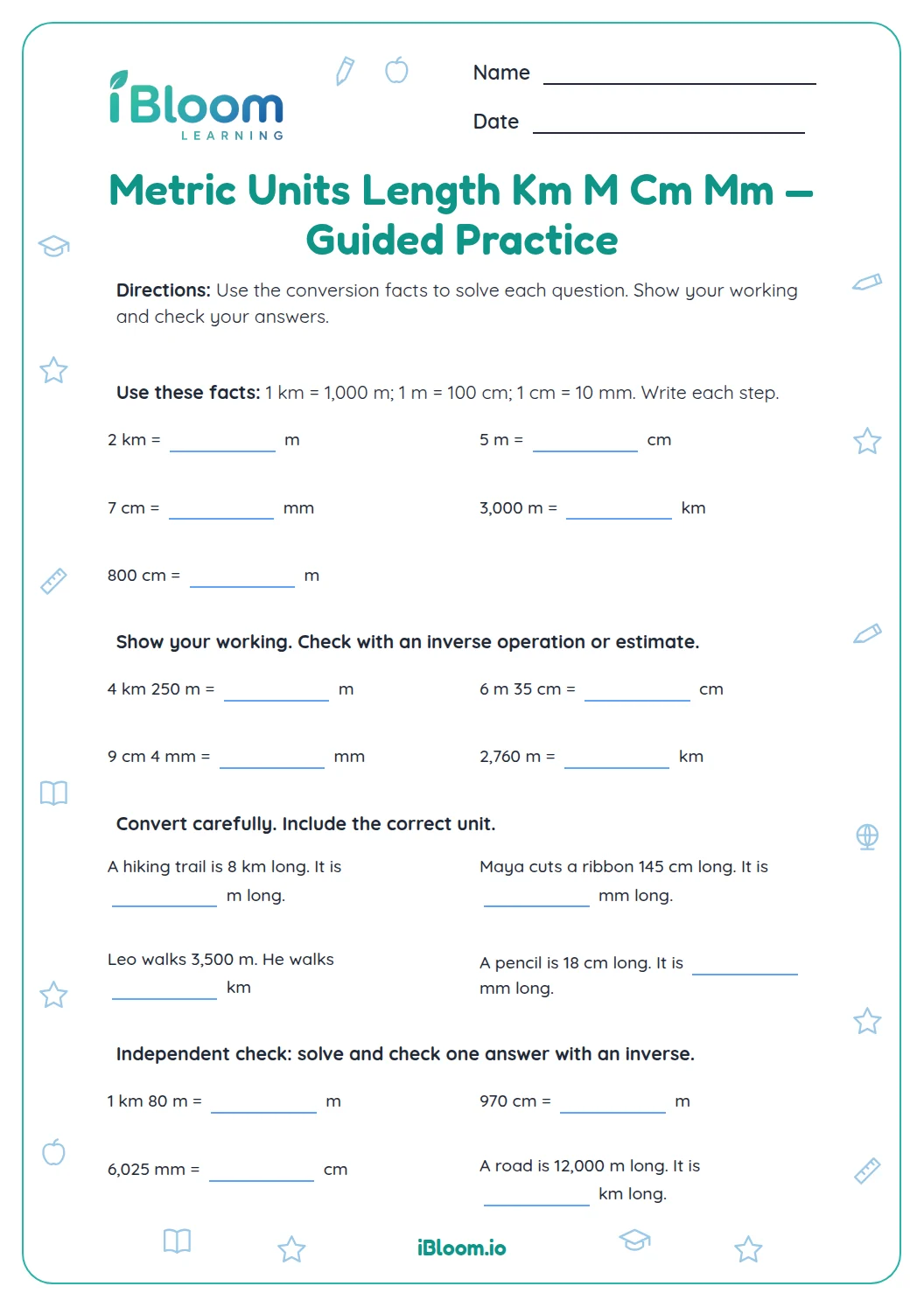
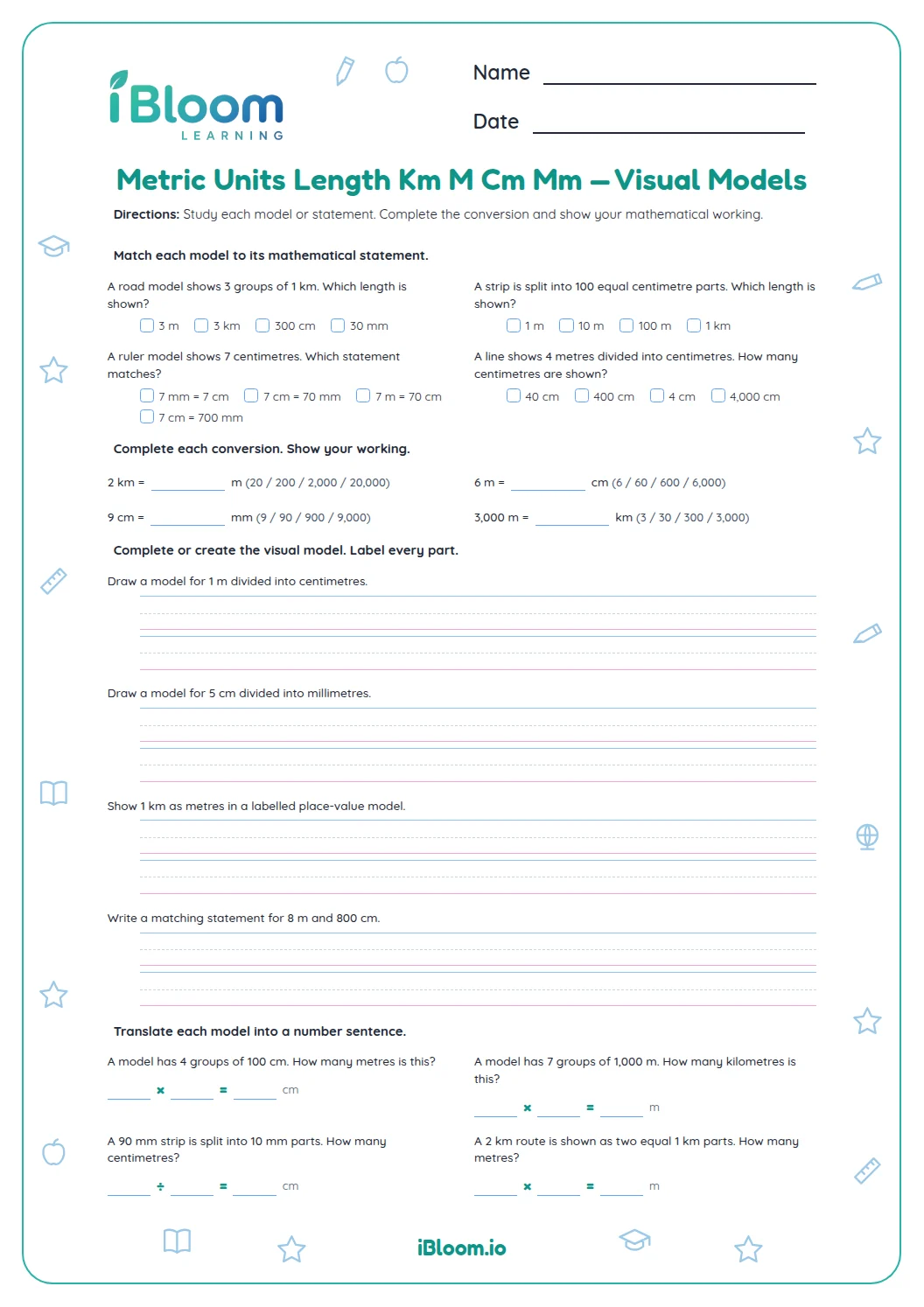
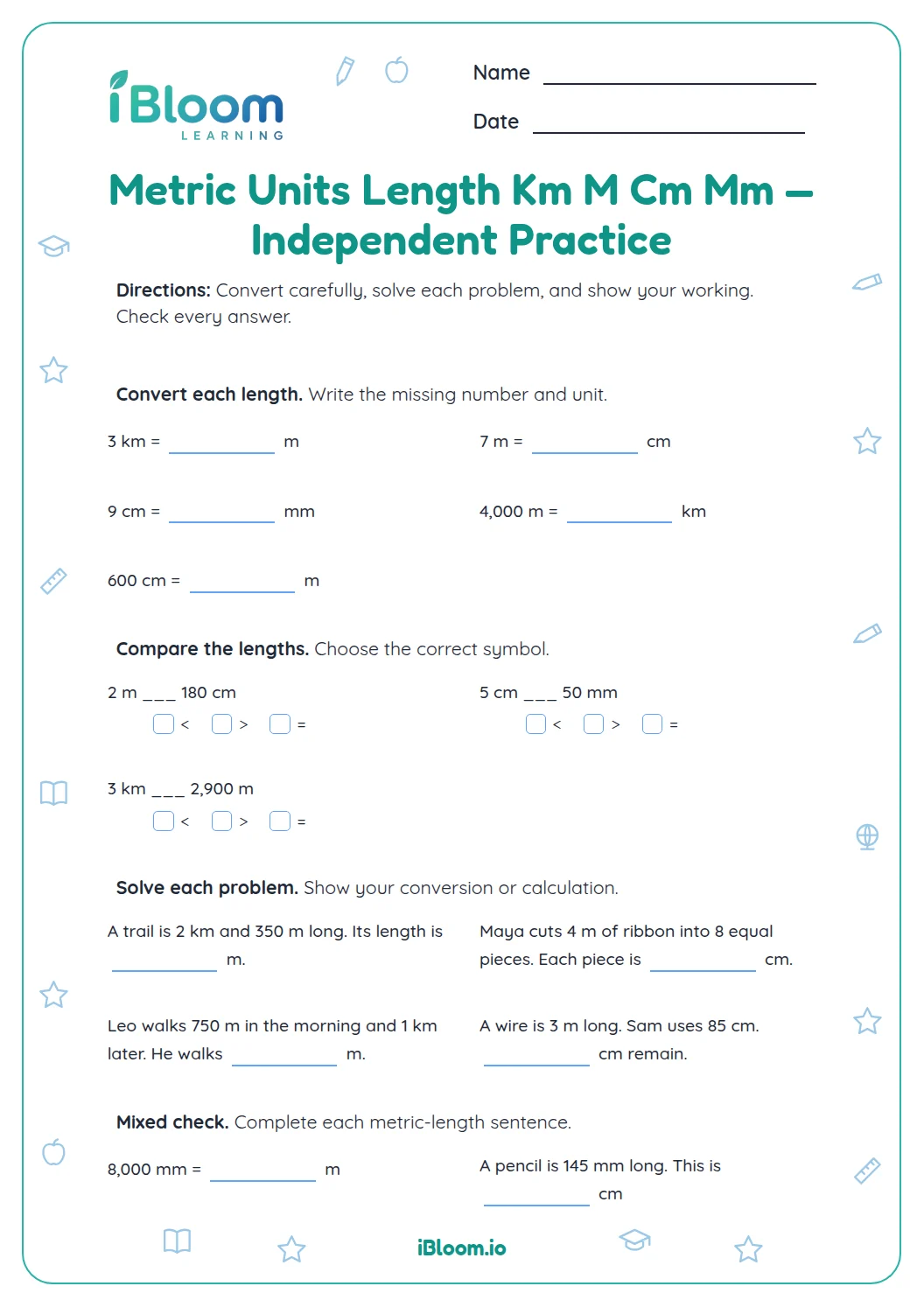
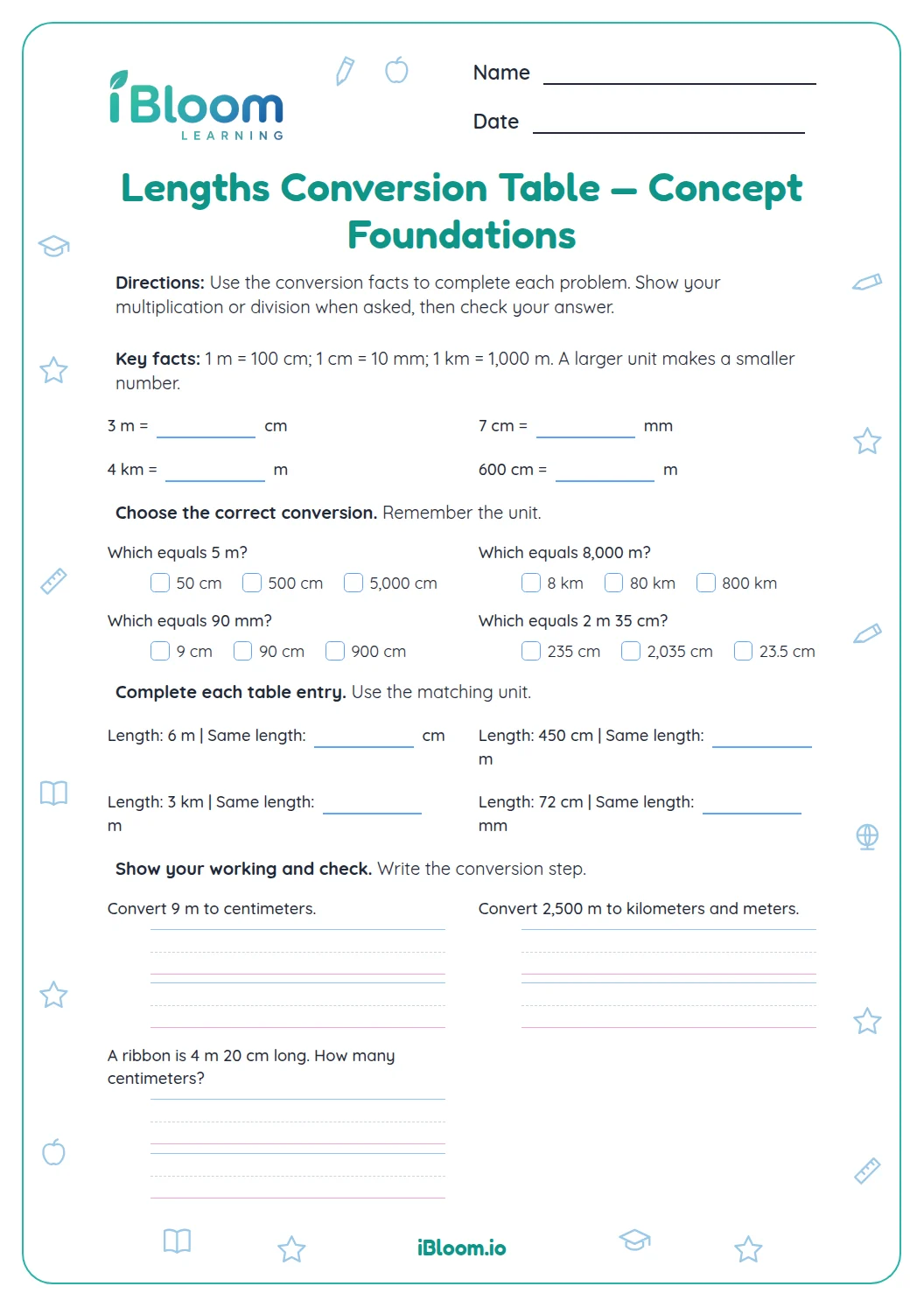
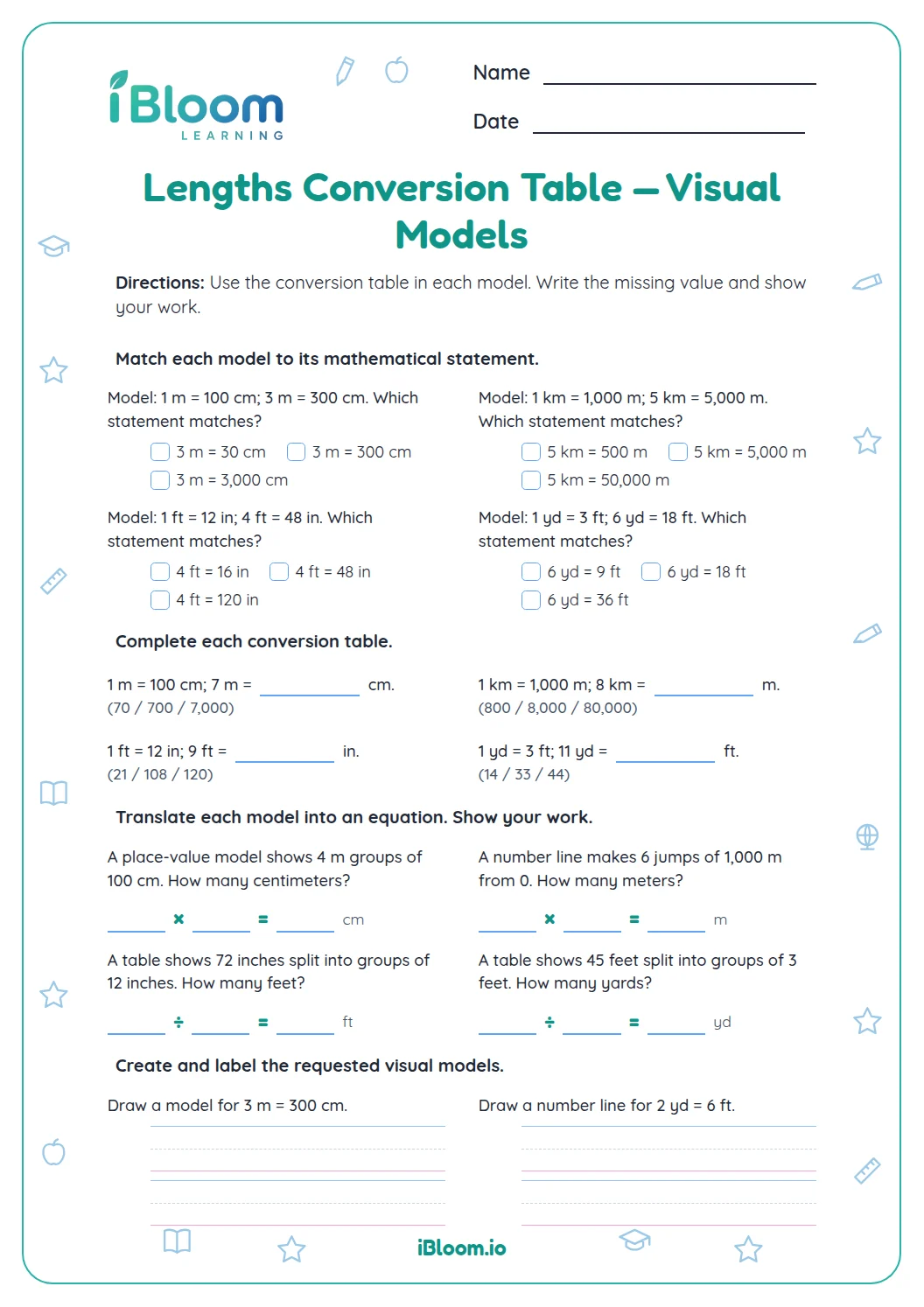
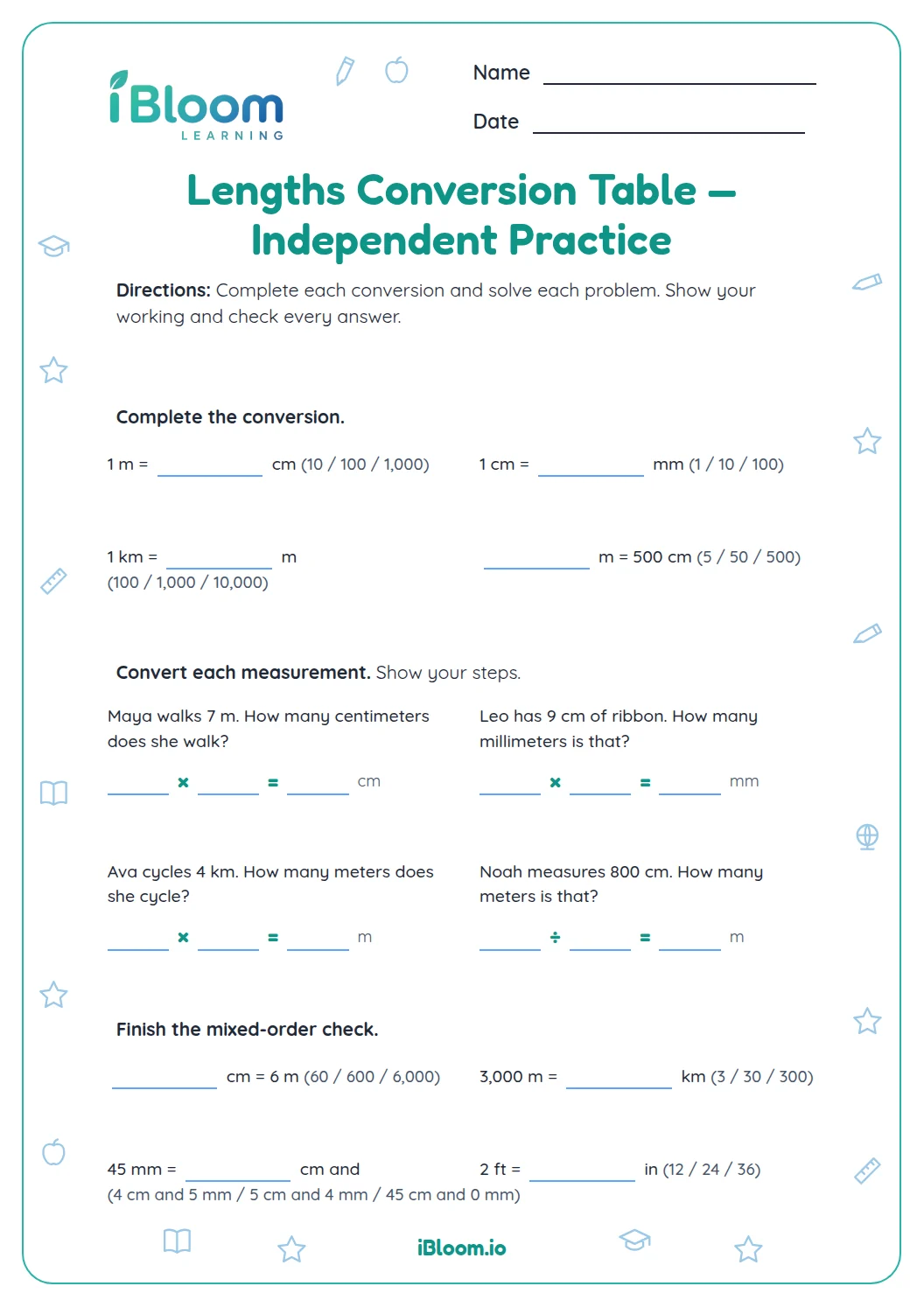
Connect decimal models to metric length. The first questions show tenths and hundredths of a meter; then convert among kilometers, meters, centimeters, and millimeters and compare lengths after renaming them in a common unit.
Aligned to 5.MD.A.1
Use decimal models for metric length
A meter can be divided into 10 equal tenths or 100 equal hundredths. Four tenths of a meter is 0.4 m. Thirty-seven hundredths is 0.37 m. Because 1 m = 100 cm, 0.37 m is also 37 cm.
When comparing lengths, first convert them to the same unit. For example, 1.08 m equals 108 cm, so those measurements are equal.
- 137 hundredths = 0.37 m
- 21 m = 100 cm
- 30.37 m = 37 cm
What will you practice?
Part A reads visual models. Part B converts decimal lengths across metric units. Part C compares and solves measurement situations.
- Part A: tenths and hundredths models
- Part B: meters, centimeters, millimeters, and kilometers
- Part C: compare lengths and solve a two-step context
- A separate answer key
A reliable conversion routine
- 1Identify the starting and target units.
- 2Use the metric relationship: 1 m = 100 cm, 1 cm = 10 mm, or 1 km = 1,000 m.
- 3Move the decimal by the number of places in the relationship.
- 4For comparisons, convert both lengths to the same unit.
- 5Include the target unit in your answer.
Common metric conversion mistakes
The mistake
Multiplying by 10 when changing meters to centimeters.
The fix
There are 100 centimeters in one meter, so multiply meters by 100.
The mistake
Comparing 1.08 m and 108 cm as if their numbers alone tell the length.
The fix
Rename both in the same unit; 1.08 m = 108 cm.
Common Core alignment
This worksheet practices CCSS 5.MD.A.1 through metric conversions and length problems.
Convert metric measurements and use conversions to solve problems.
On this sheet: Students convert metric lengths and use conversions in comparison and length problems.
Show the official wordingHide the official wording
Convert among different-sized standard measurement units within a given measurement system (e.g., convert 5 cm to 0.05 m), and use these conversions in solving multi-step, real world problems.
What to practice next
Make more practice
Further reading
Questions parents and teachers ask
How many centimeters are in a meter?
One meter equals 100 centimeters. That means 0.37 meter is 37 centimeters, while 325 centimeters is 3.25 meters. Keep the unit with each value so it is clear whether a decimal measures meters, centimeters, or millimeters. This worksheet practices those conversions and comparisons.
How do you write 37 centimeters in meters?
There are 100 centimeters in a meter, so divide 37 by 100: 37 cm = 0.37 m. The worksheet connects this conversion to a hundredths grid representing one meter. The same relationship can be checked by converting 0.37 m back to centimeters.
How many millimeters are in a centimeter?
One centimeter equals 10 millimeters. For example, 5.6 centimeters is 56 millimeters, and 128 millimeters is 12.8 centimeters. Multiplying or dividing by 10 changes the decimal value while keeping the measured length the same. Label each result with its unit.
How do you compare lengths with different units?
Convert both lengths to the same unit before comparing. For example, 1.08 meters equals 108 centimeters, so those measurements are equal. For the ordering question, write each length in centimeters and then compare the resulting numbers. The worksheet includes conversion practice first.
What do the decimal models represent?
The tenths strips and hundredths grids represent parts of a meter. Four tenths of a meter is 0.4 m; one whole meter plus four tenths is 1.4 m. The hundredths grid shows shaded hundredths, such as 37 hundredths or 0.37 m.
Is an answer key included?
Yes. A separate answer key shows the decimal lengths, metric conversions, comparisons, and story answers. Check both the number and its unit, especially when converting between meters and centimeters or between centimeters and millimeters. The sample key follows the order of the worksheet questions.