

About this worksheet
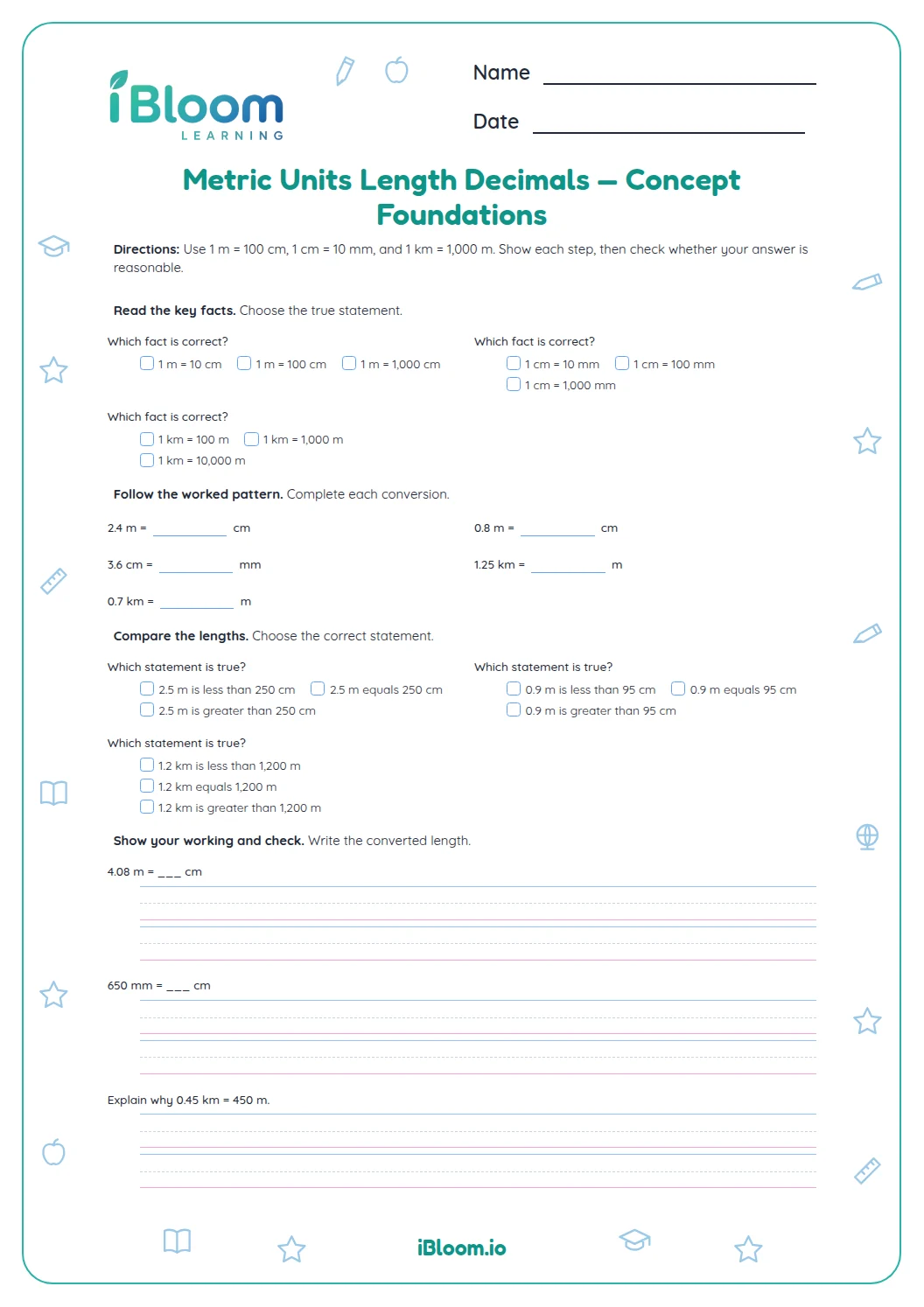
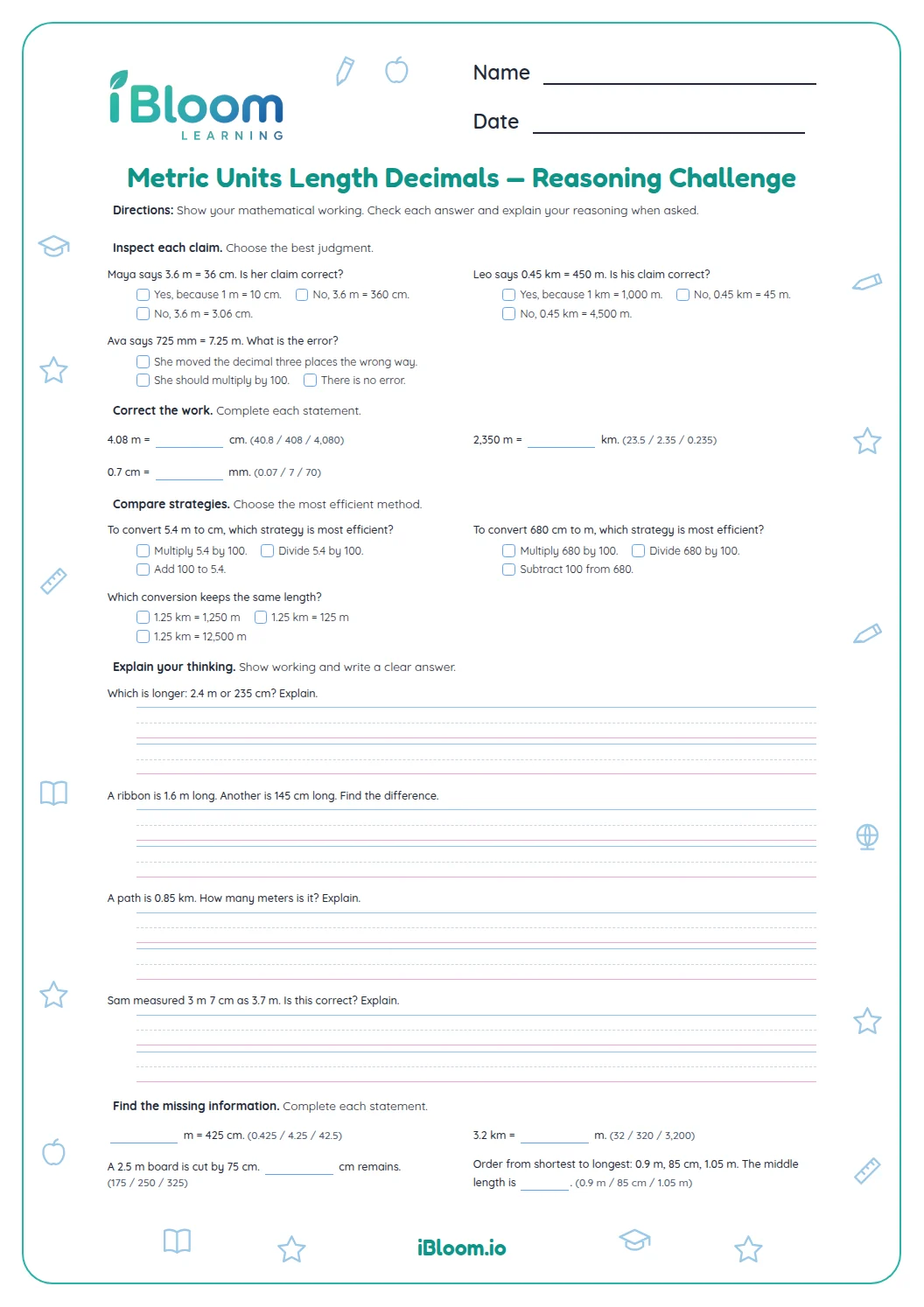
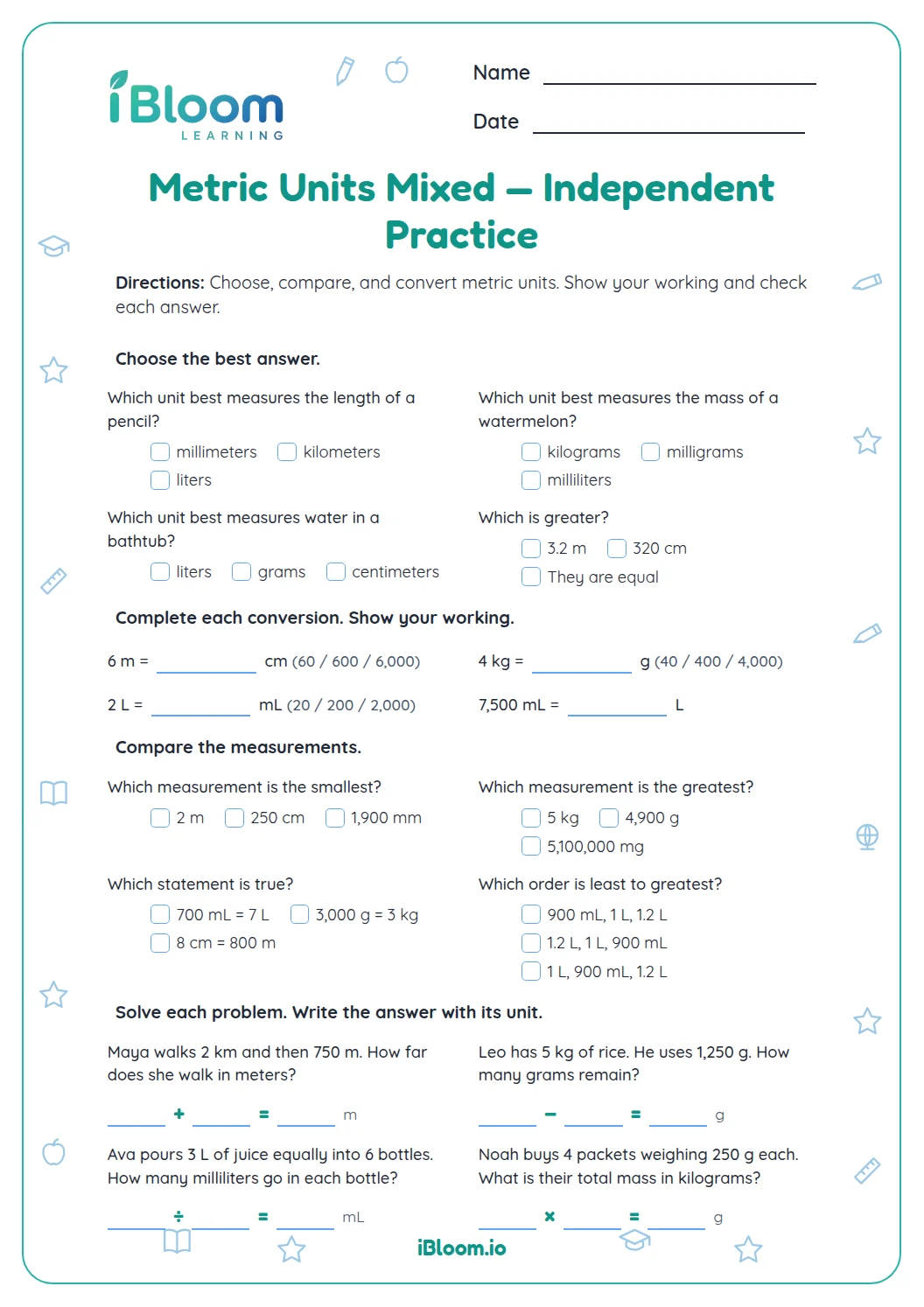
This Grade 5 worksheet builds fluency converting meters, centimeters, and millimeters with decimals. Students convert lengths, compare measures, and solve multistep situations about ribbons, boards, and projects. It practices Common Core 5.MD.A.1 and includes 14 questions across four parts, followed by a worked answer key.
Aligned to 5.MD.A.1
How are meters, centimeters, and millimeters related?
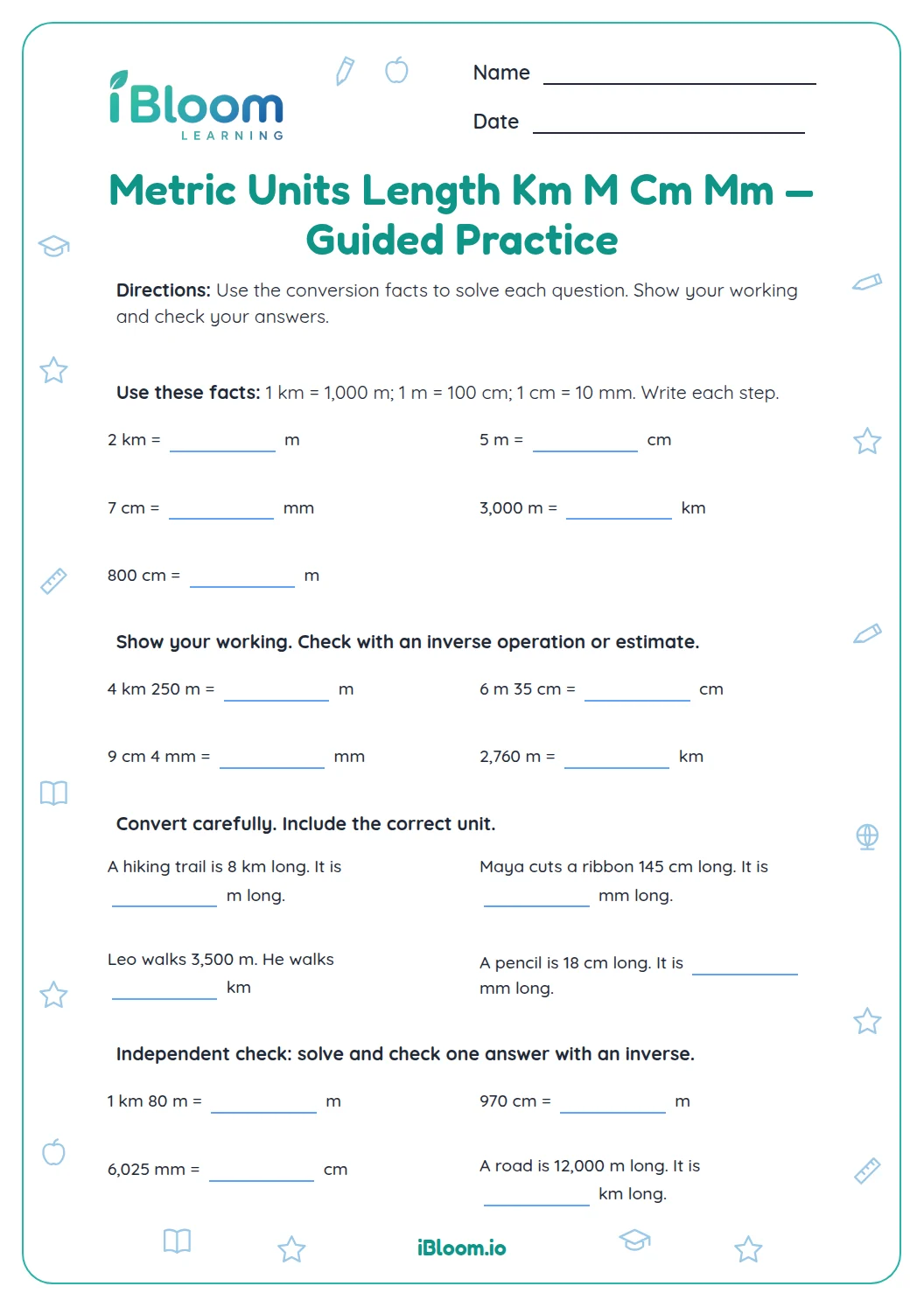
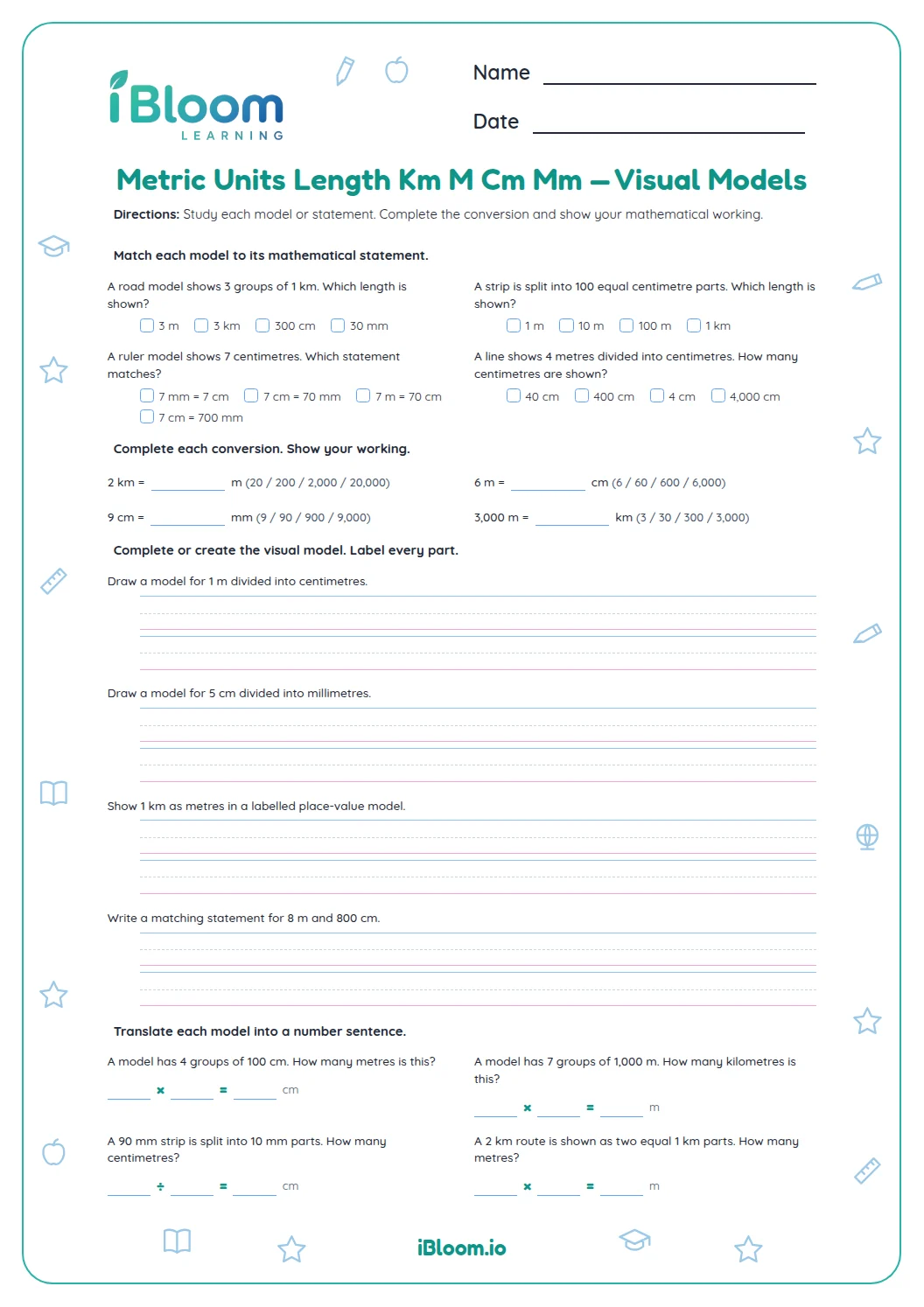
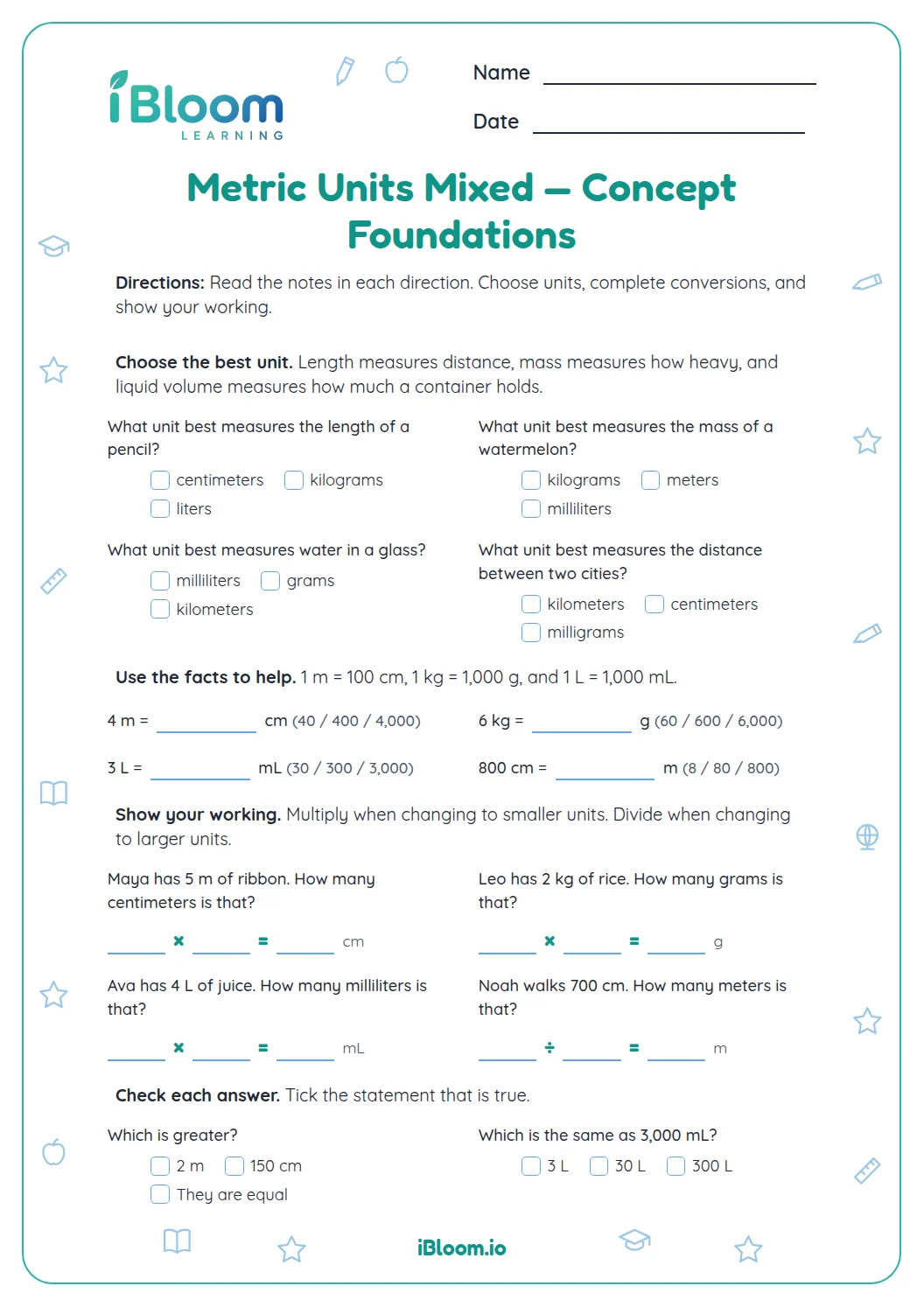
One meter equals 100 centimeters and 1,000 millimeters. One centimeter equals 10 millimeters. Use these relationships to move the decimal point carefully.
For example, 2.4 m is 2.4 × 100 = 240 cm. For a story problem, convert all lengths to the same unit before adding or subtracting.
- 12.4 m = 2.4 × 100 cm
- 22.4 m = 240 cm
How do I solve a problem with two units?
For example, convert 2.35 m to 235 cm, add 175 cm to get 410 cm, then write 4.10 m. Check that the answer uses the requested unit.
- 12.35 m = 235 cm
- 2235 cm + 175 cm = 410 cm = 4.10 m
What does each part practice?
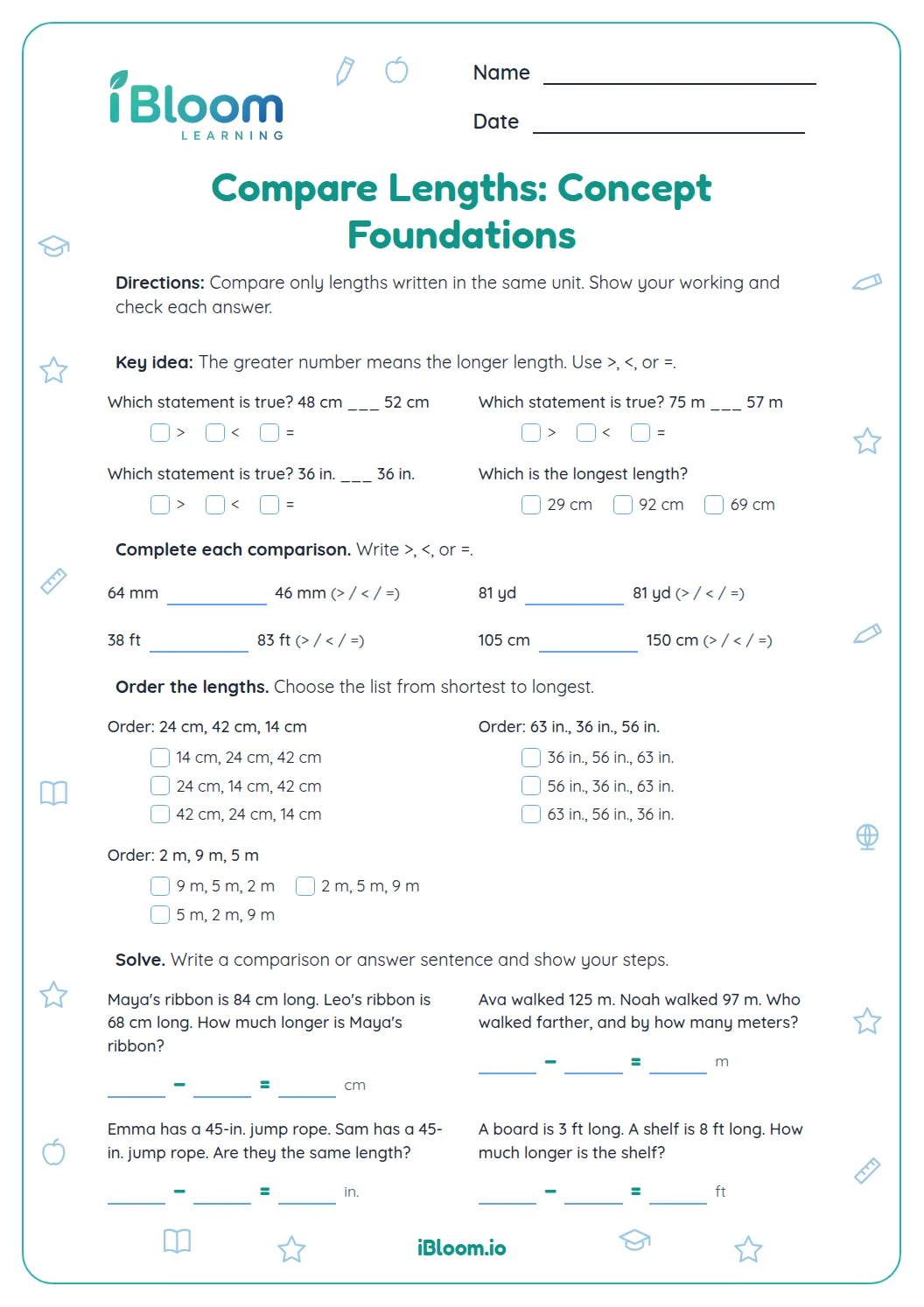
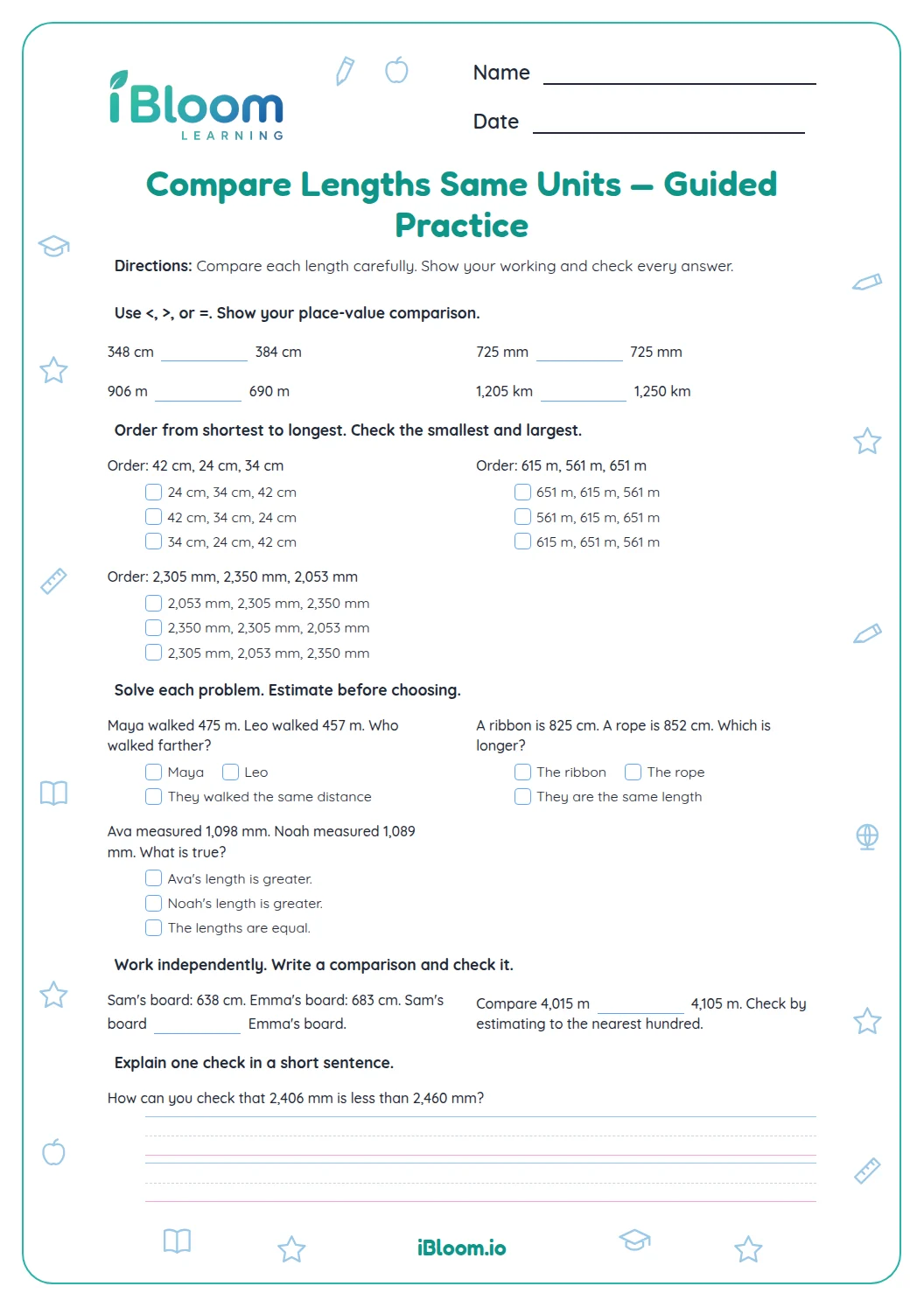
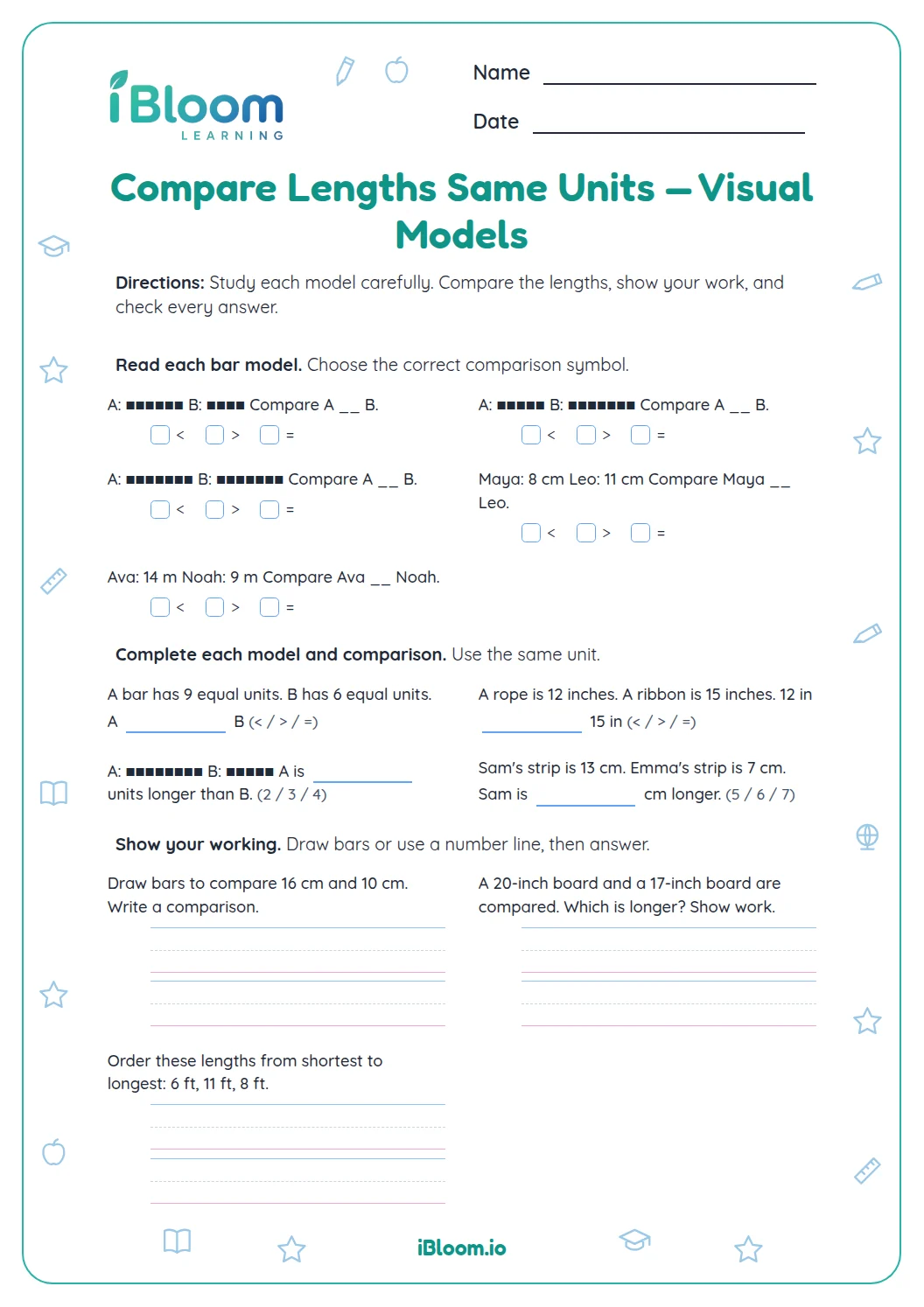
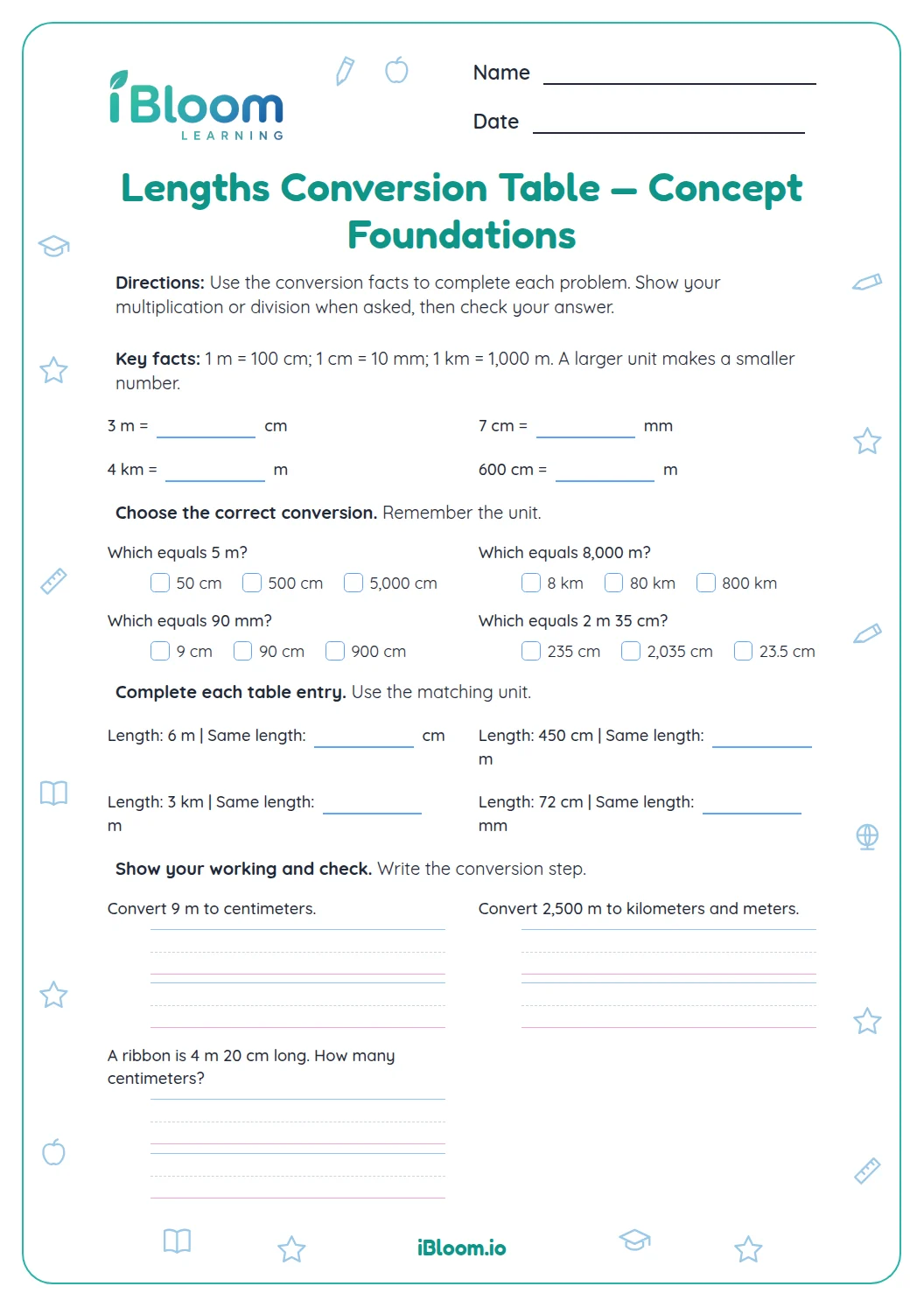
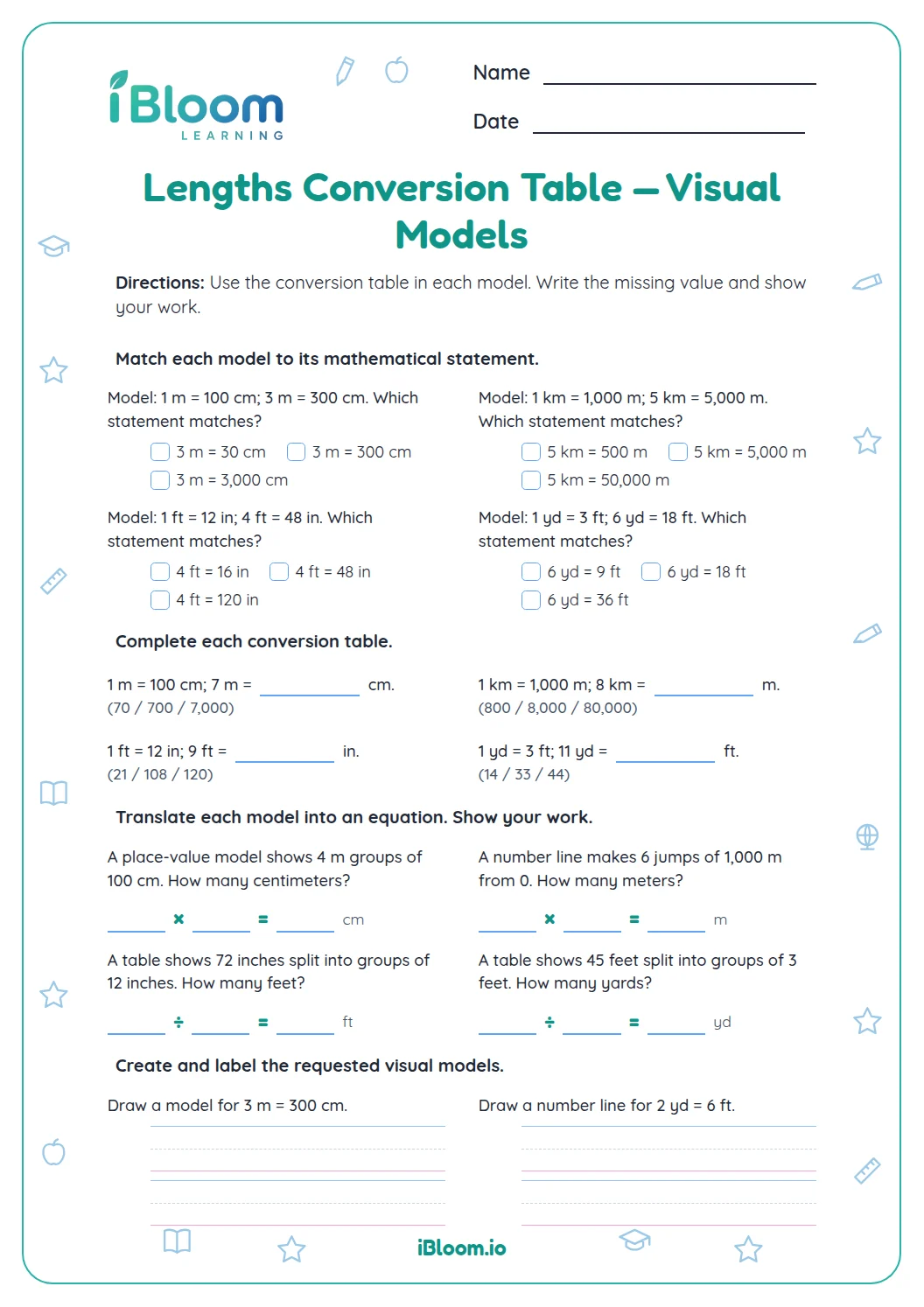
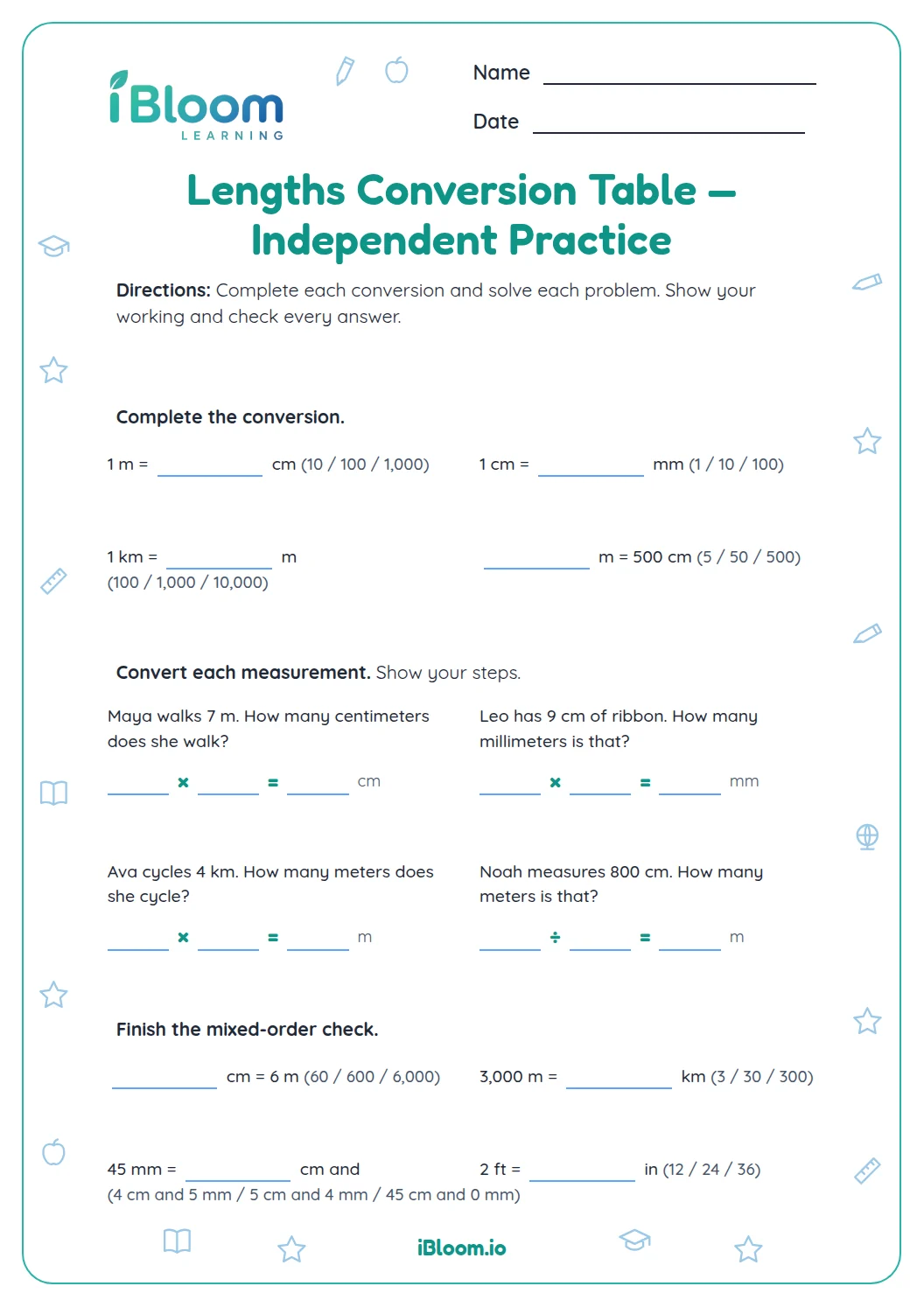
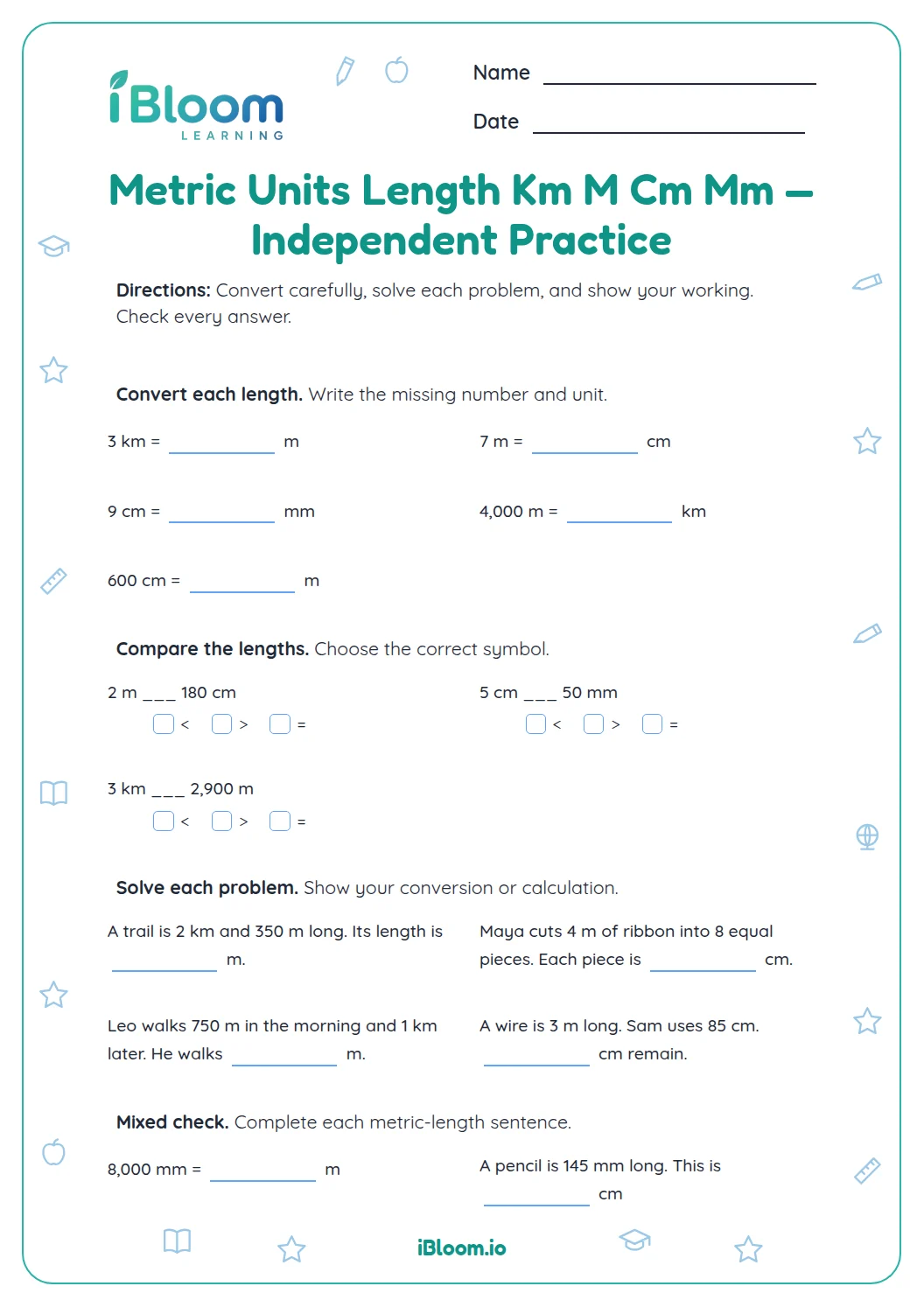
Part A practices direct conversions. Part B uses conversions in length situations. Part C compares lengths and shares a length equally. Part D combines measurements in practical problems.
How to use this worksheet
- 1Write the unit beside each given length.
- 2Convert all lengths to one unit before adding or subtracting.
- 3For multiplication or division, calculate only after converting.
- 4Convert the final result to the unit requested.
- 5Estimate the size to catch a misplaced decimal.
Common mistakes and quick fixes
The mistake
Moving the decimal the wrong way
The fix
Meters are larger than centimeters, so the number grows when converting m to cm.
The mistake
Mixing unlike units in one sum
The fix
Rewrite both lengths in the same unit before calculating.
The mistake
Dropping the unit in the answer
The fix
Copy the requested unit into the final answer.
Common Core alignment
This worksheet practices a named Common Core math skill through its problems and worked example.
Convert metric units and use conversions in multistep real-world problems.
On this sheet: Convert metric units and use conversions in multistep real-world problems.
Show the official wordingHide the official wording
Convert among different-sized standard measurement units within a given measurement system (e.g., convert 5 cm to 0.05 m), and use these conversions in solving multi-step, real world problems.
What to practice next
Make more practice
Further reading
Questions parents and teachers ask
Why convert to the same unit first?
Converting units first gives both lengths the same unit, so their values can be added or subtracted correctly. After calculating, express the result in the requested unit and estimate whether the size makes sense for the situation. The separate answer key gives each result so students can check their own work.
How many centimeters are in a meter?
There are 100 centimeters in one meter. Multiply a meter measurement by 100 to write it in centimeters; divide centimeters by 100 to write the same length in meters. For example, 375 centimeters equals 3.75 meters. The separate answer key gives each result so students can check their own work.
How many millimeters are in a centimeter?
There are 10 millimeters in one centimeter and 1,000 millimeters in one meter. To convert meters to millimeters, multiply by 1,000. For example, 0.86 meter is 860 millimeters, the same physical length. The separate answer key gives each result so students can check their own work.
What should a student write for a conversion answer?
Include both the value and its requested unit in the answer, such as 240 cm. If a unit is printed immediately after a blank, put only the number in the blank. Then check whether the value fits the size of the object.
How can I check a decimal conversion?
Estimate before converting: centimeters should be 100 times the numerical value in meters. Check by reversing the conversion; 240 cm divided by 100 returns 2.4 m. A reverse check can reveal a decimal point in the wrong place. The separate answer key gives each result so students can check their own work.