


About this worksheet
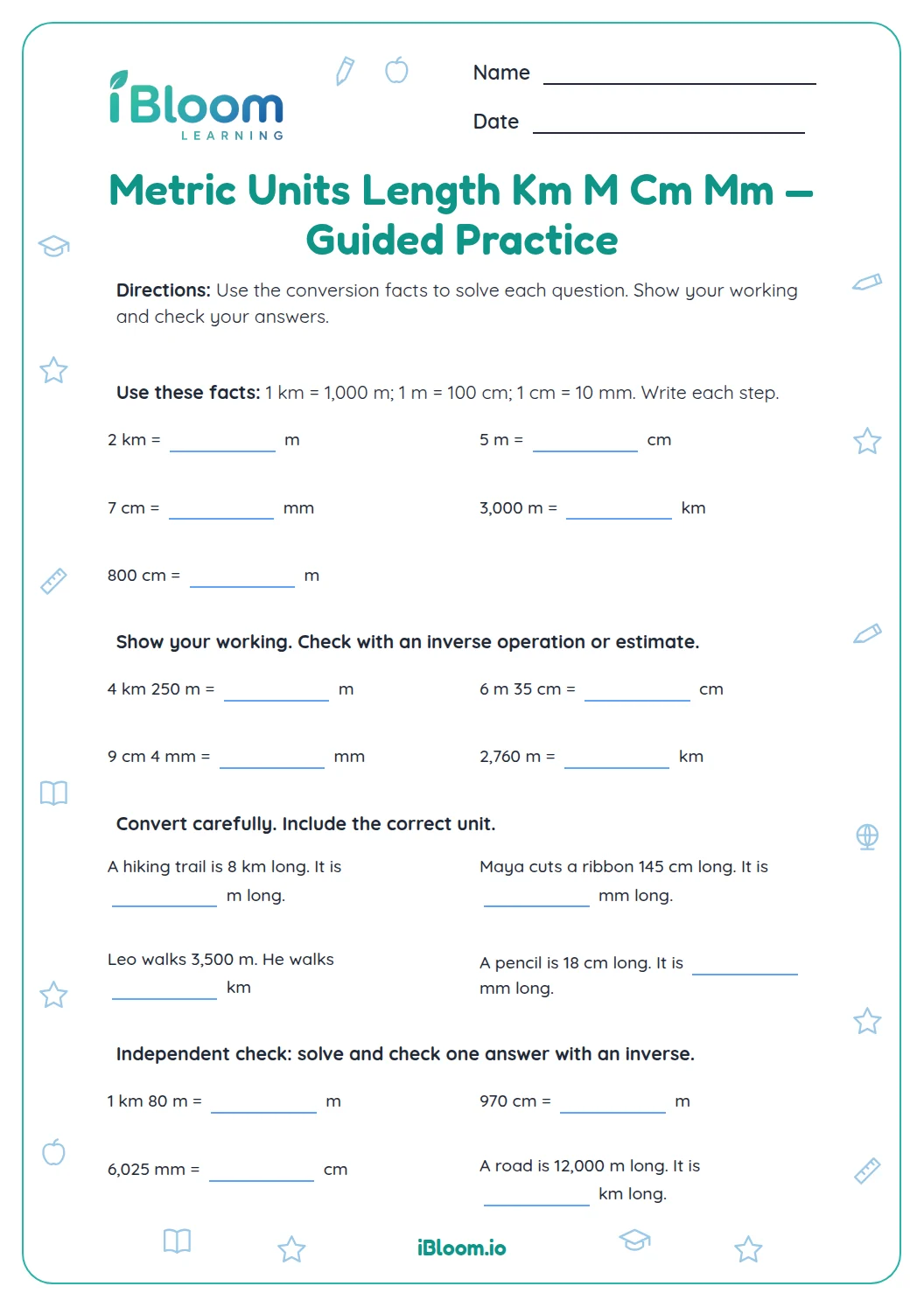
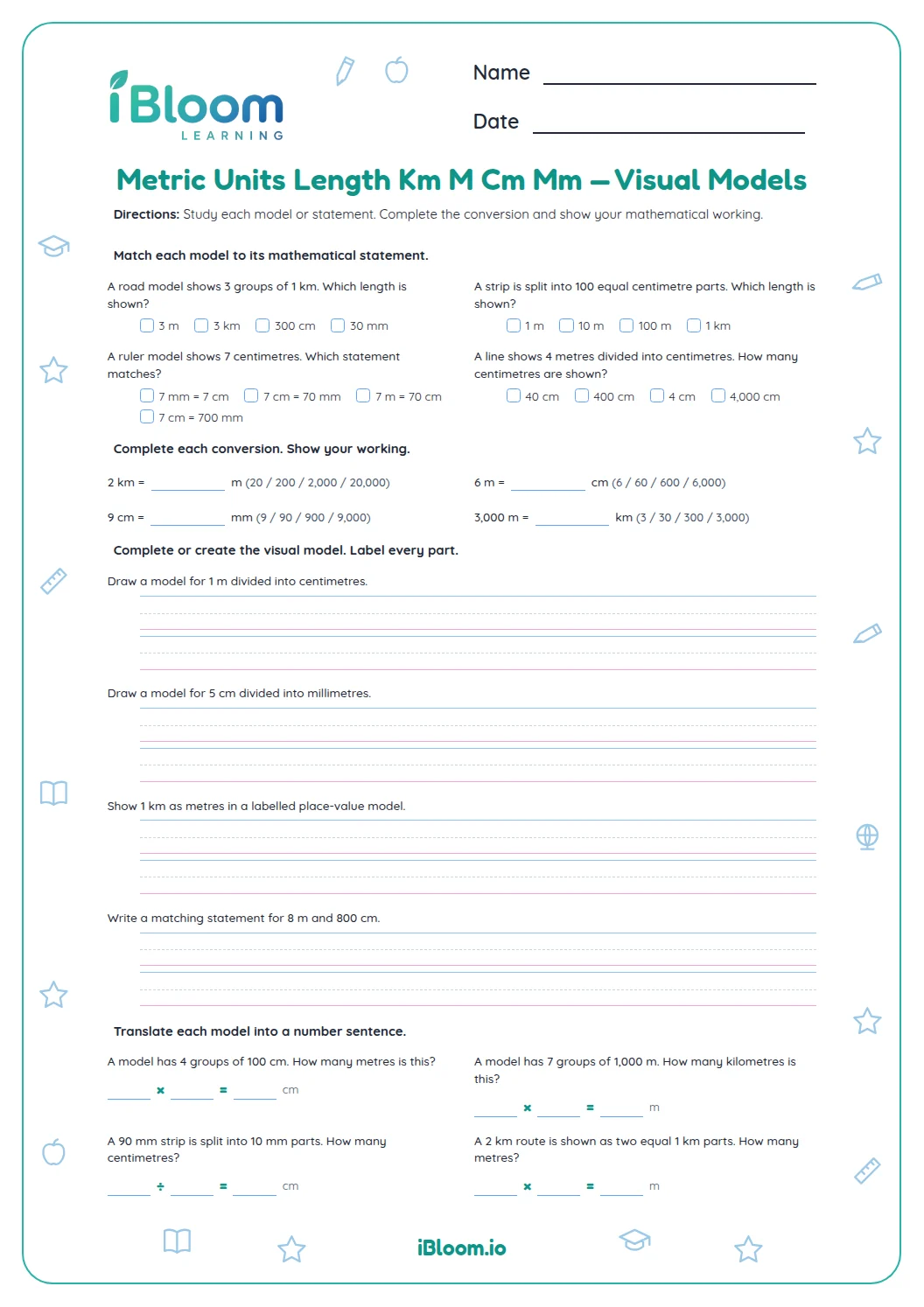
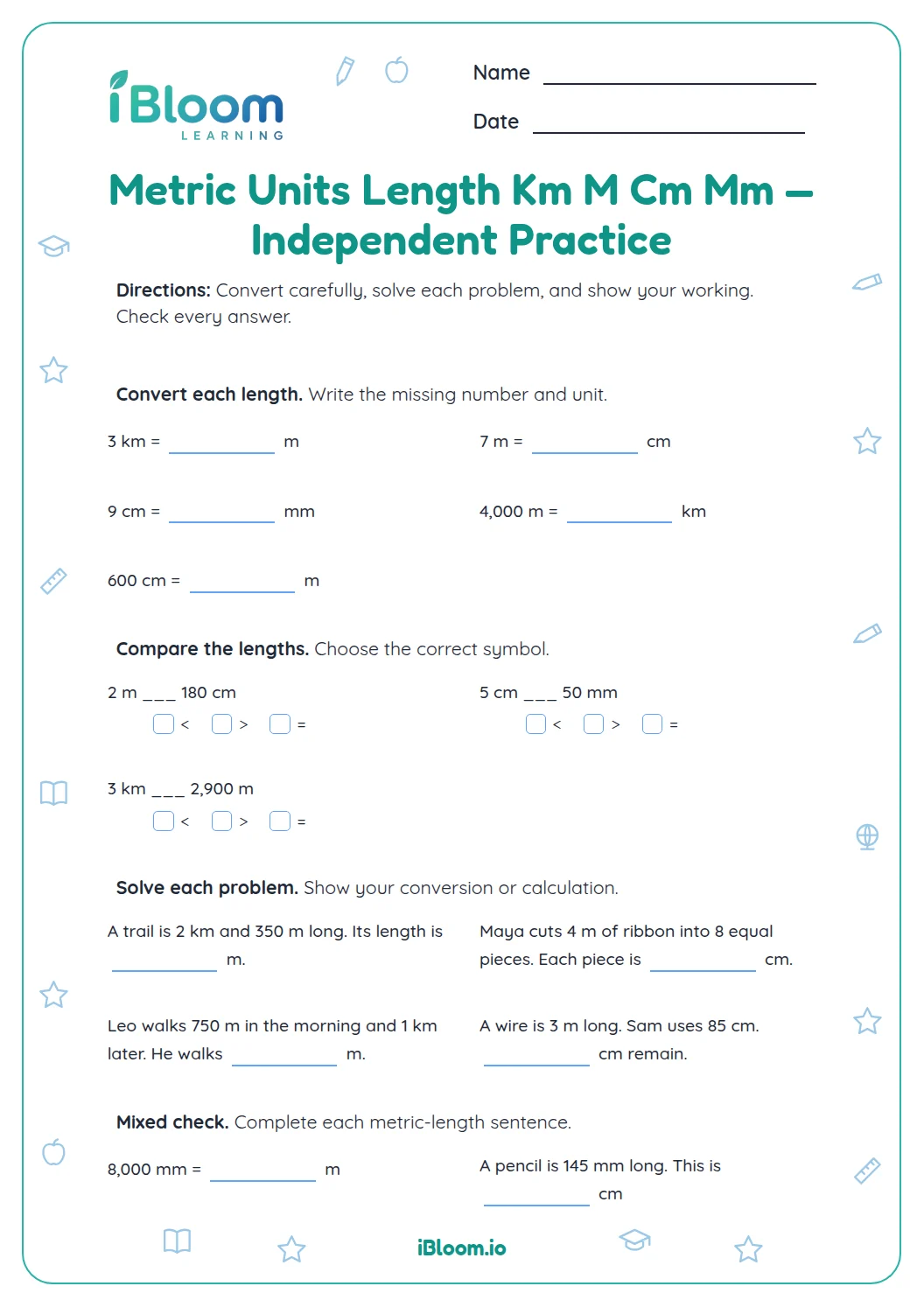
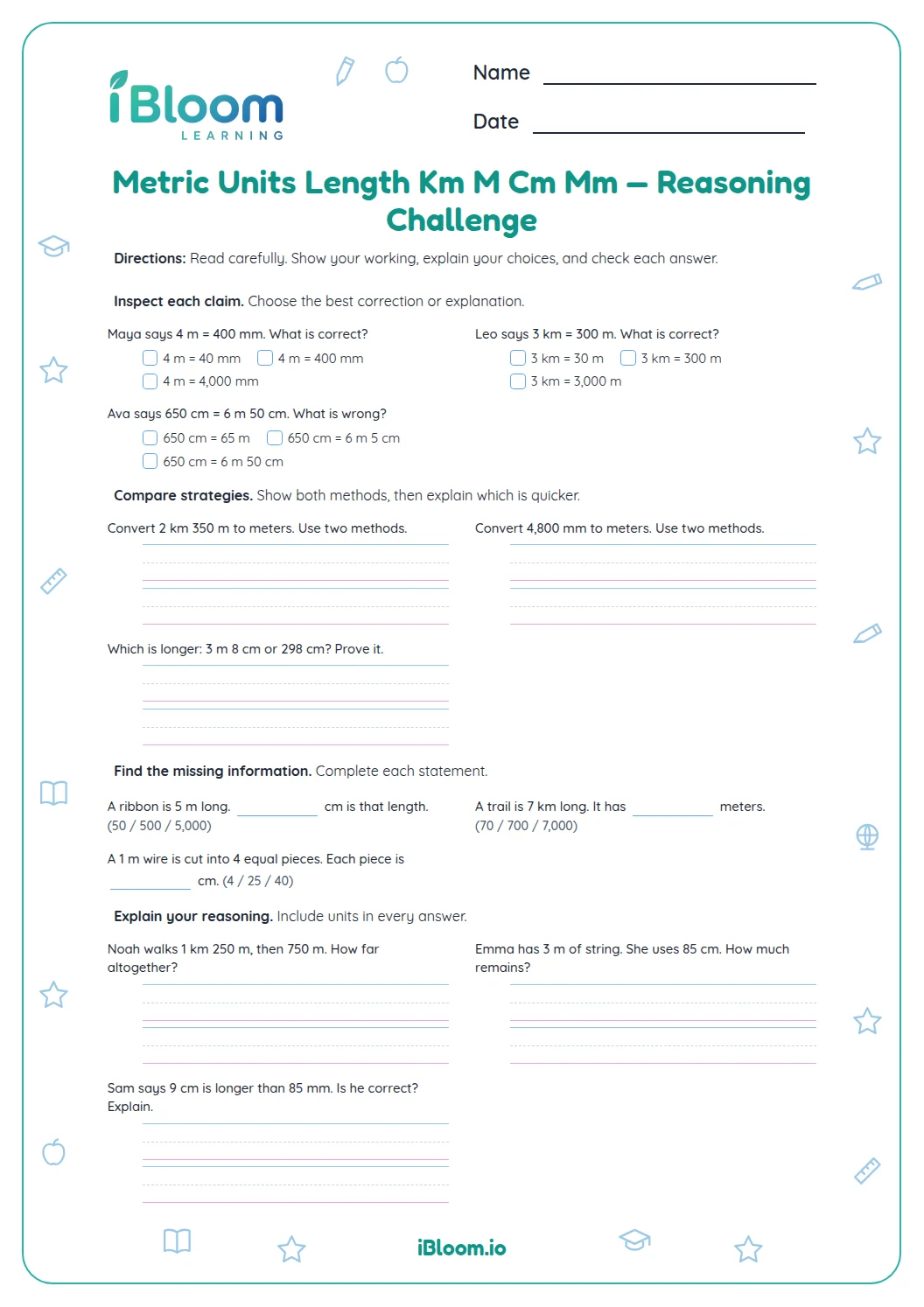
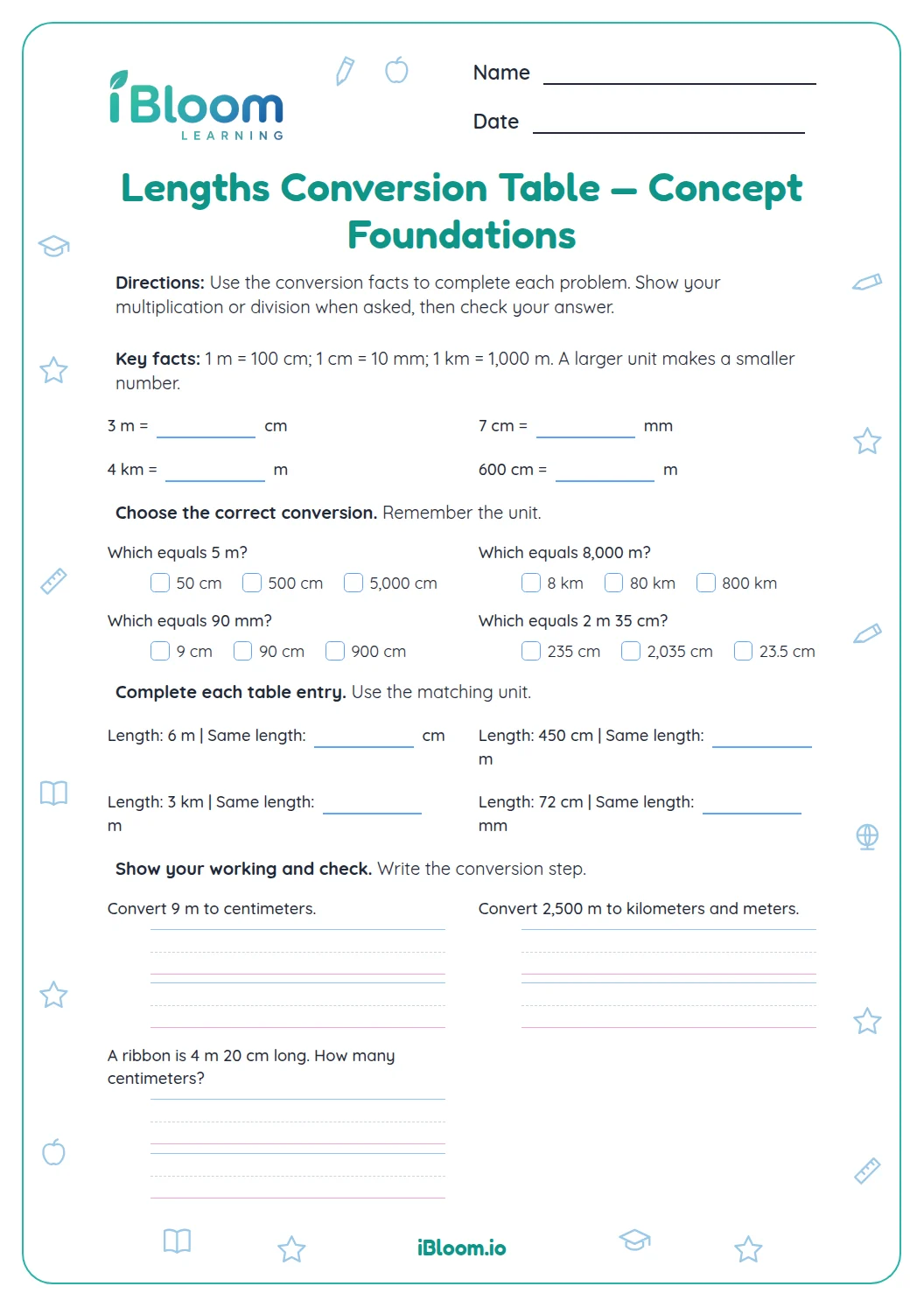
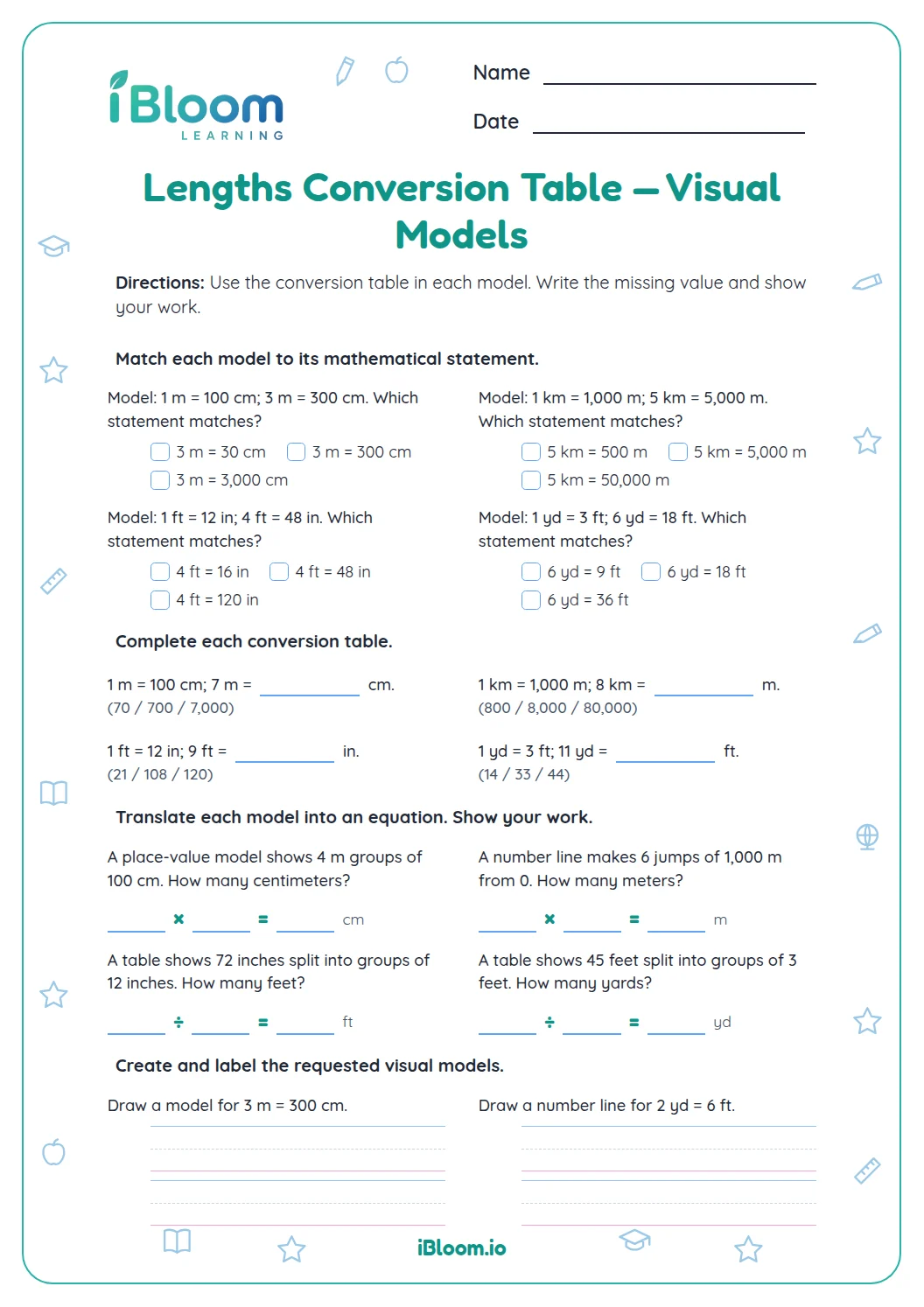
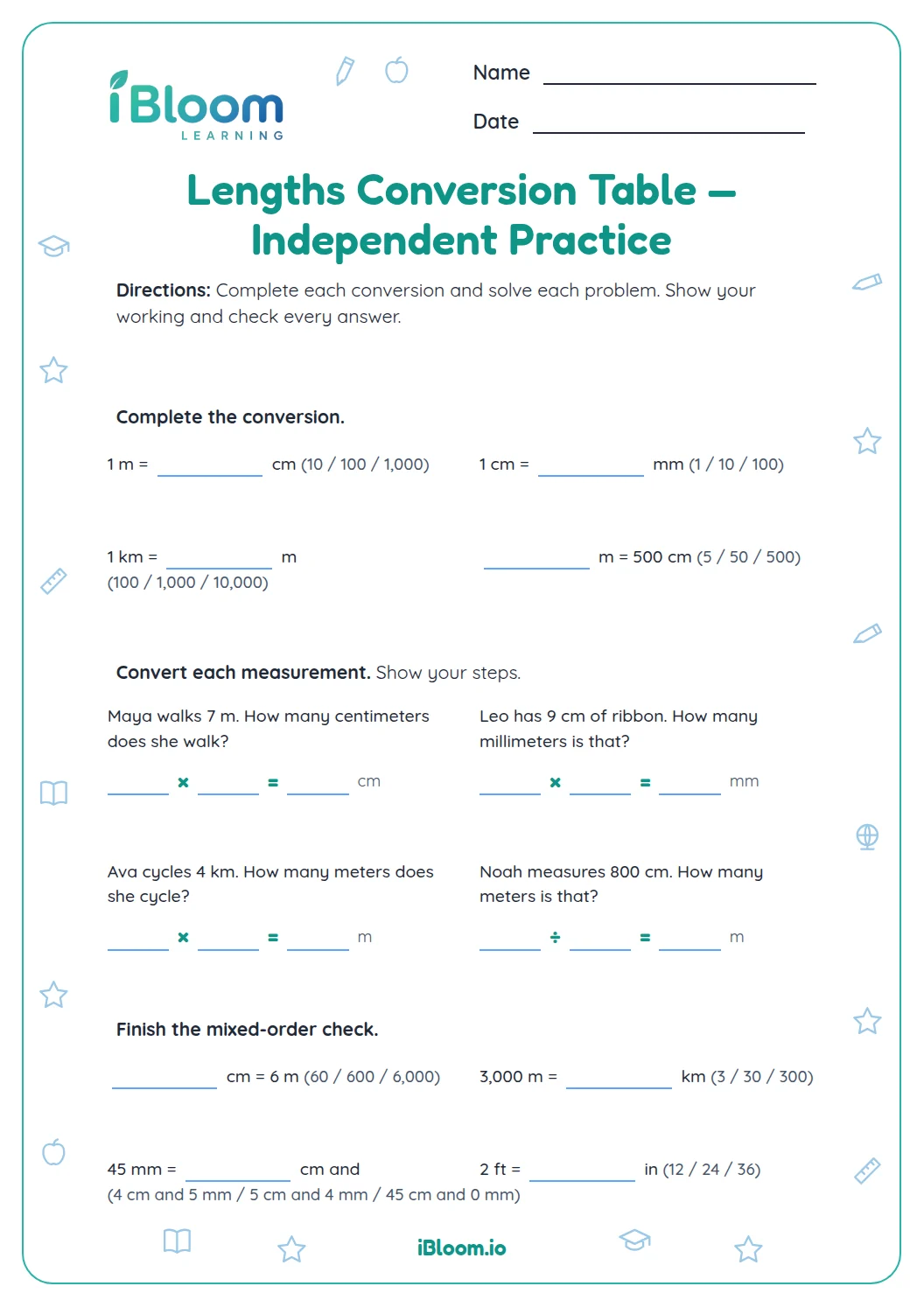
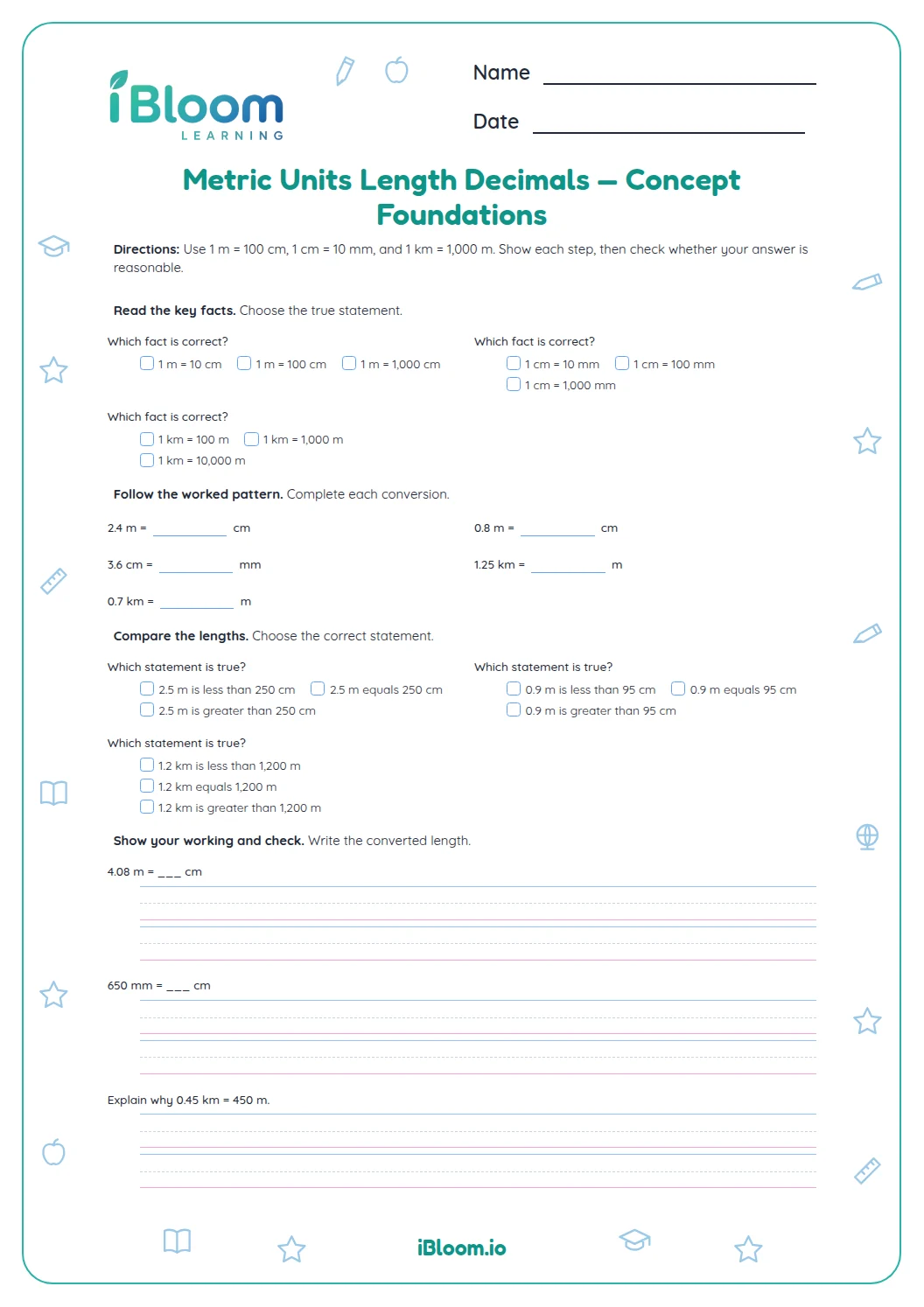
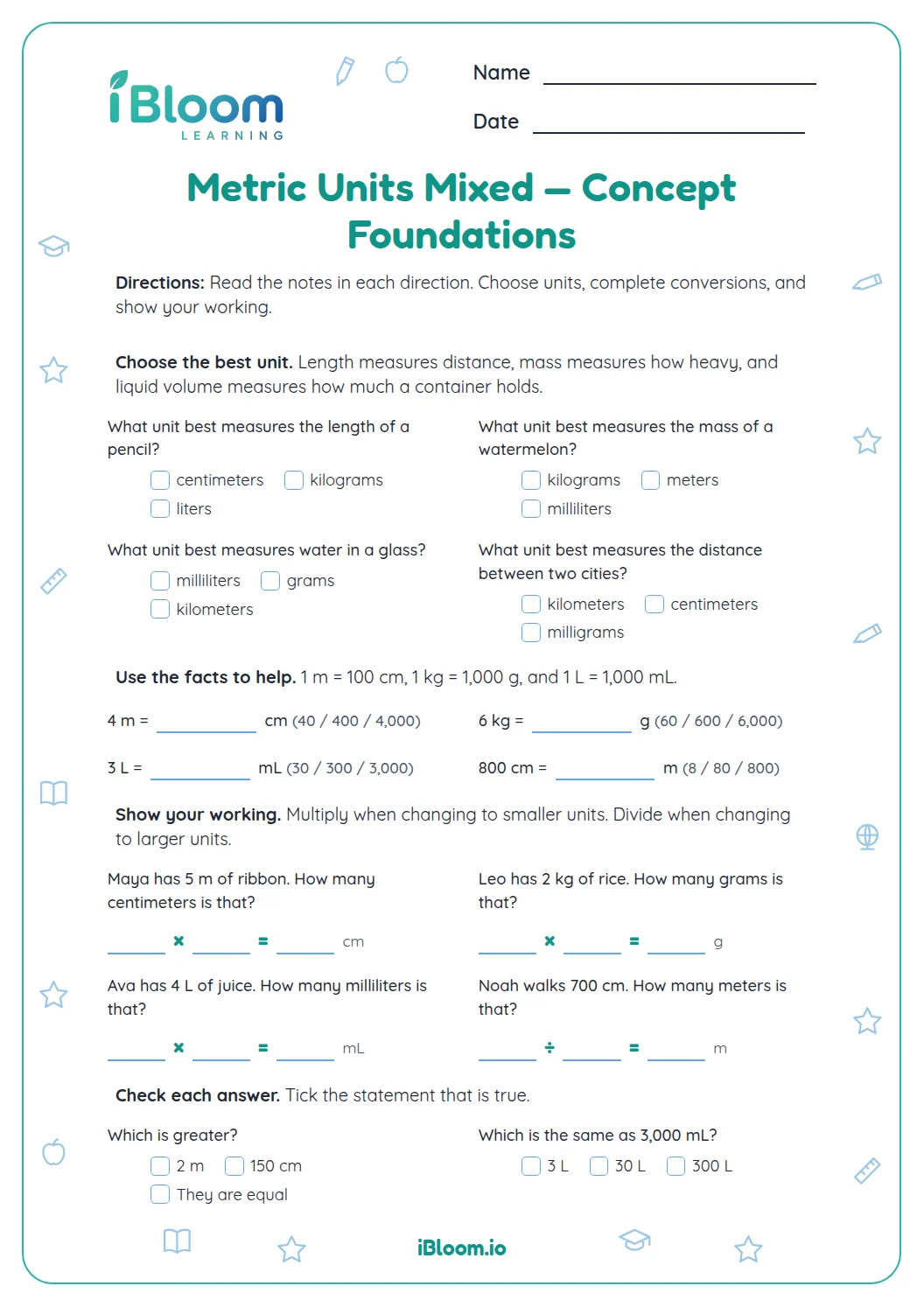
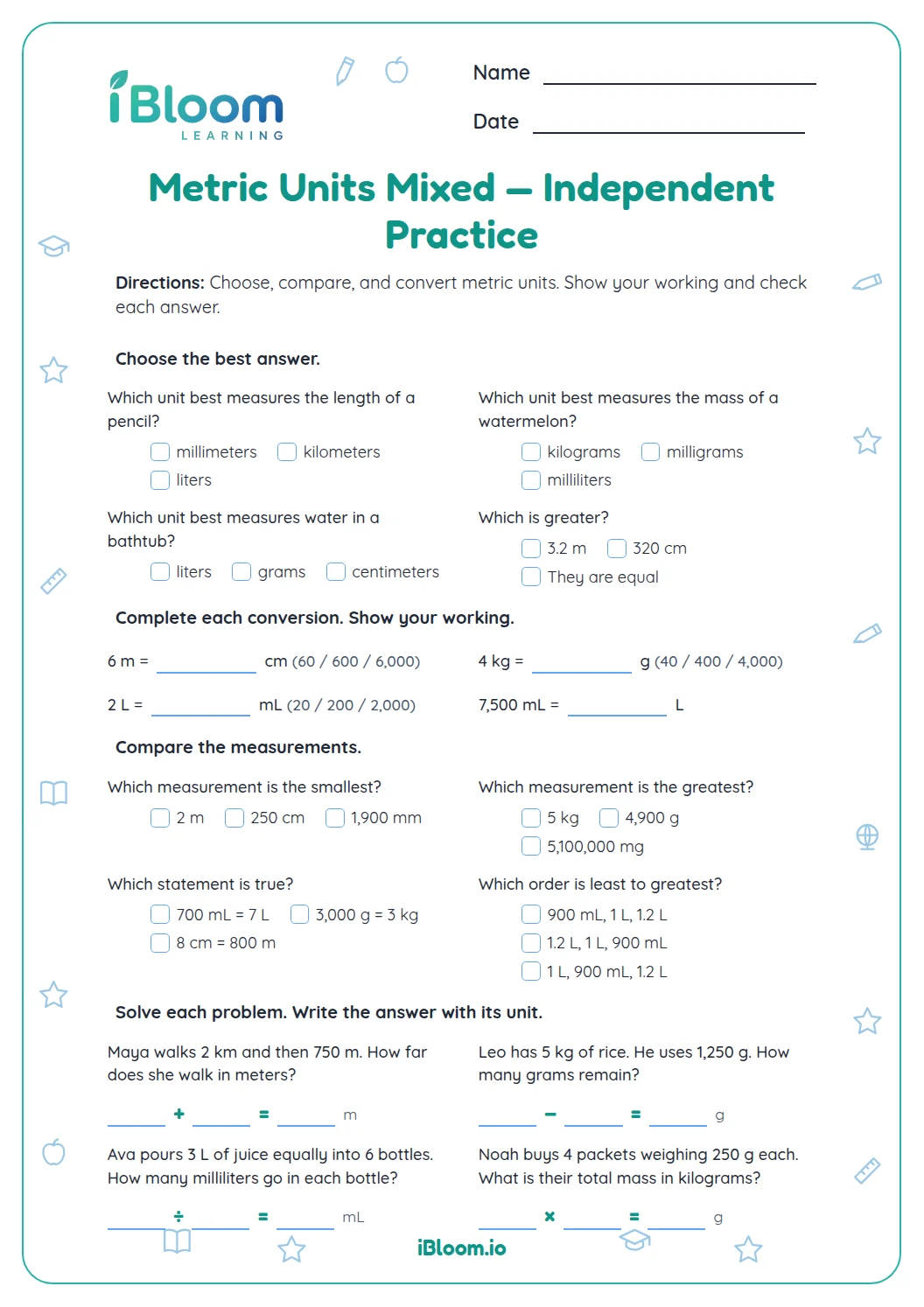
This free Grade 5 worksheet builds metric length conversions from three relationships: 1 km = 1,000 m, 1 m = 100 cm and 1 cm = 10 mm. Part A establishes those links, Part B converts in both directions, and Part C applies them to a trail and a ribbon. The 12 questions practice Common Core 5.MD.A.1. All answers are whole numbers, so students can concentrate on the unit sizes and the operation each conversion needs. A separate answer key includes the converted lengths and both word problem answers.
Aligned to 5.MD.A.1
What unit relationships does the sheet teach?
The three reference equalities are printed at the start of Part A. Students use them to find how many meters are in a kilometer, centimeters in a meter, and millimeters in a centimeter. The fourth question joins two links: 100 groups of 10 millimeters make 1,000 millimeters in a meter.
How do students choose multiplication or division?
First decide whether the new unit is smaller or larger. More small units are needed to describe the same length, while fewer large units are needed. This gives students a way to check the direction before they calculate.
- 1700 cm = ___ m
- 2100 cm = 1 m
- 3700 ÷ 100 = 7
- 4700 cm = 7 m
How do the trail and ribbon problems use conversions?
Both problems give a starting length and a part used or traveled in a different unit. Students convert the starting length to the requested unit before subtracting. For the trail, 2 km becomes 2,000 m; taking away 750 m leaves 1,250 m.
In the ribbon question, 3 m becomes 300 cm, and 300 − 80 leaves 220 cm. Encourage students to write units with the working so the subtraction clearly compares lengths measured the same way.
How to use this worksheet
- 1Read the three reference equalities aloud and identify the largest and smallest units.
- 2Complete Part A, explaining how centimeters connect meters to millimeters.
- 3For each Part B conversion, decide whether the answer should have a larger or smaller number.
- 4Multiply or divide by the unit relationship, then check by converting back.
- 5In Part C, convert to meters or centimeters before subtracting and label the final answer.
Mistakes to check and how to help
The mistake
Treating every metric conversion as a factor of 10.
The fix
Use the specific relationship: meters to centimeters uses 100, and kilometers to meters uses 1,000.
The mistake
Writing 700 cm = 70,000 m.
The fix
Meters are larger units, so fewer are needed; divide 700 by 100.
The mistake
Subtracting 750 from 2 in the trail problem.
The fix
Convert 2 km to 2,000 m first, then subtract 750 m.
Common Core alignment
Convert metric lengths and use matching units to solve two-step length problems.
On this sheet: Students convert km, m, cm and mm, then combine conversion and subtraction in two situations.
Show the official wordingHide the official wording
Convert among different-sized standard measurement units within a given measurement system (e.g., convert 5 cm to 0.05 m), and use these conversions in solving multi-step, real world problems.
What to practice next
Make more practice
Further reading
Questions parents and teachers ask
Which metric length units are included?
The worksheet includes kilometers, meters, centimeters and millimeters, written as km, m, cm and mm. Part A prints three reference equalities and asks students to complete four unit relationships. Part B mixes conversion directions, and Part C uses meters and centimeters in two everyday situations.
Why does converting to a smaller unit make the number larger?
A smaller unit fits into the same length more times. One centimeter holds ten millimeters, so 8 centimeters holds 80 millimeters. The object has not grown; only the unit used to describe it has changed. Ask students to explain that difference before checking their calculation.
How do I explain meters to millimeters?
Connect the two relationships through centimeters: one meter contains 100 centimeters, and each centimeter contains 10 millimeters. Multiplying 100 by 10 gives 1,000 millimeters per meter. Students use that connection in question 4, then apply it again to convert 2 meters in question 9.
How should students start the trail problem?
They should first express the whole trail in meters: 2 km equals 2,000 m. Both distances then use the same unit, so subtracting 750 m is meaningful. The result is 1,250 m left. The working space lets students record the conversion and subtraction as separate steps.
Can students use the unit facts while completing the sheet?
Yes, the three reference equalities at the start are meant to support the whole worksheet. Students can refer back whenever they are unsure of a conversion factor. After checking with the answer key, ask them to choose one conversion and explain why its number increased or decreased.