

About this worksheet
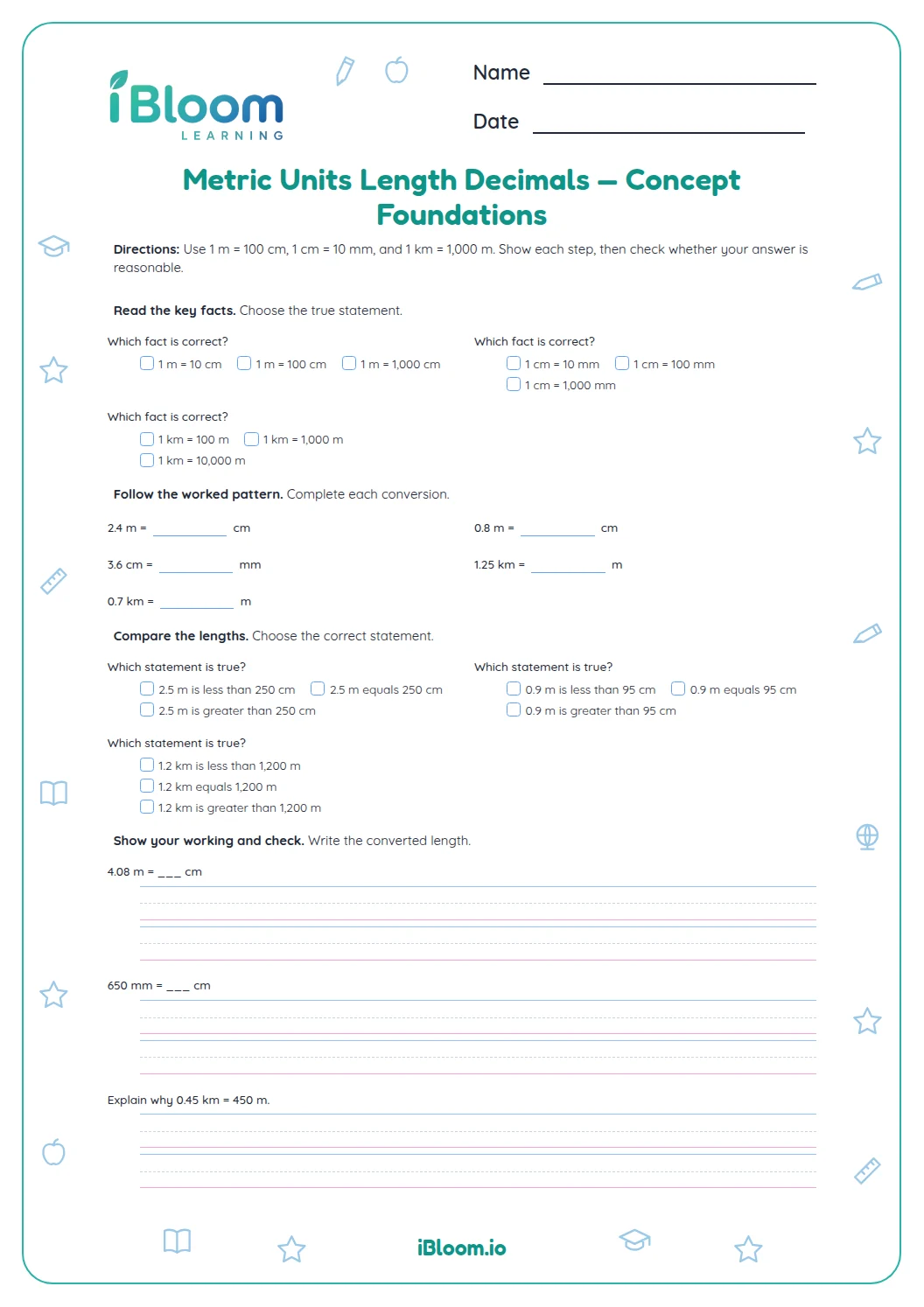
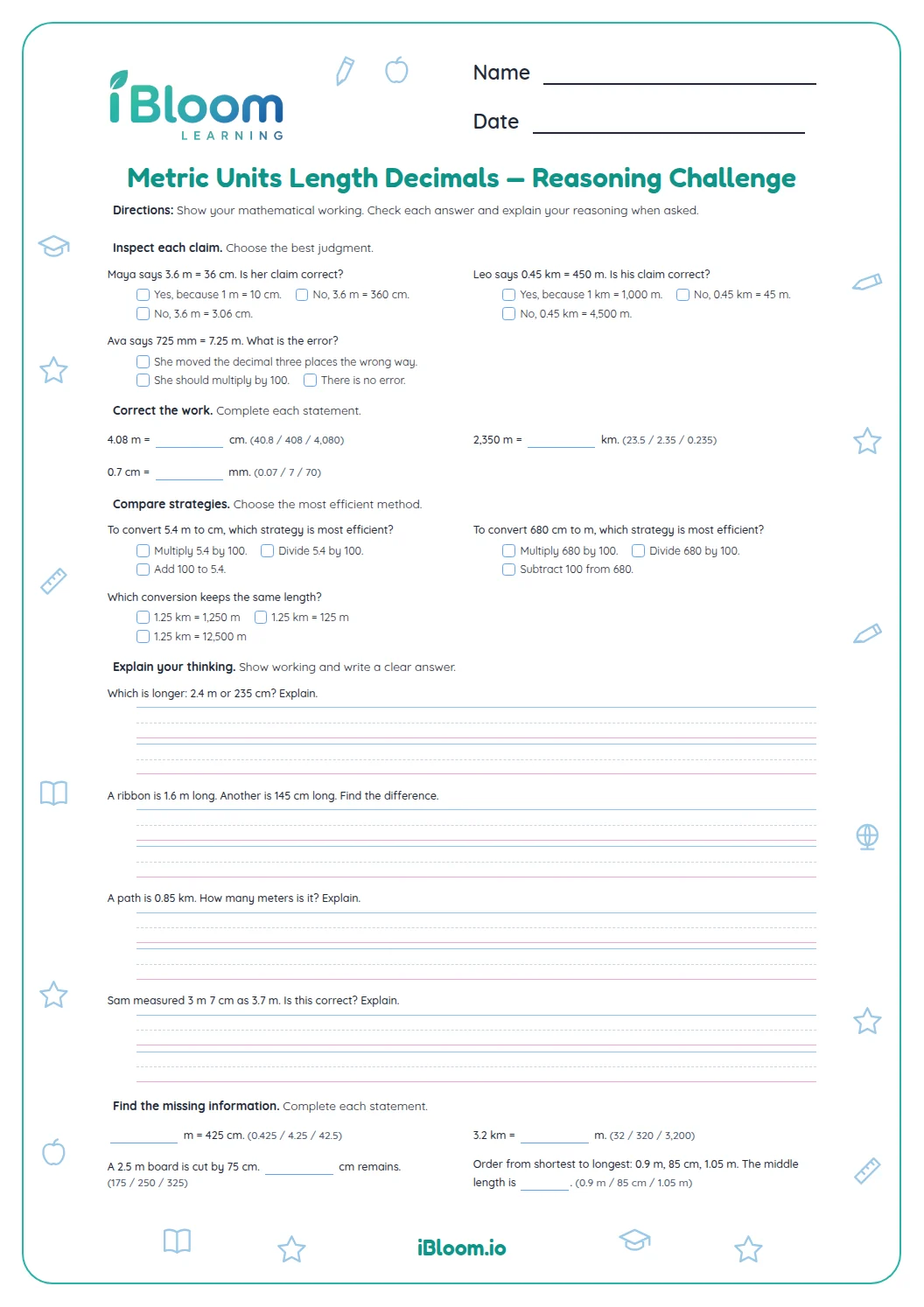
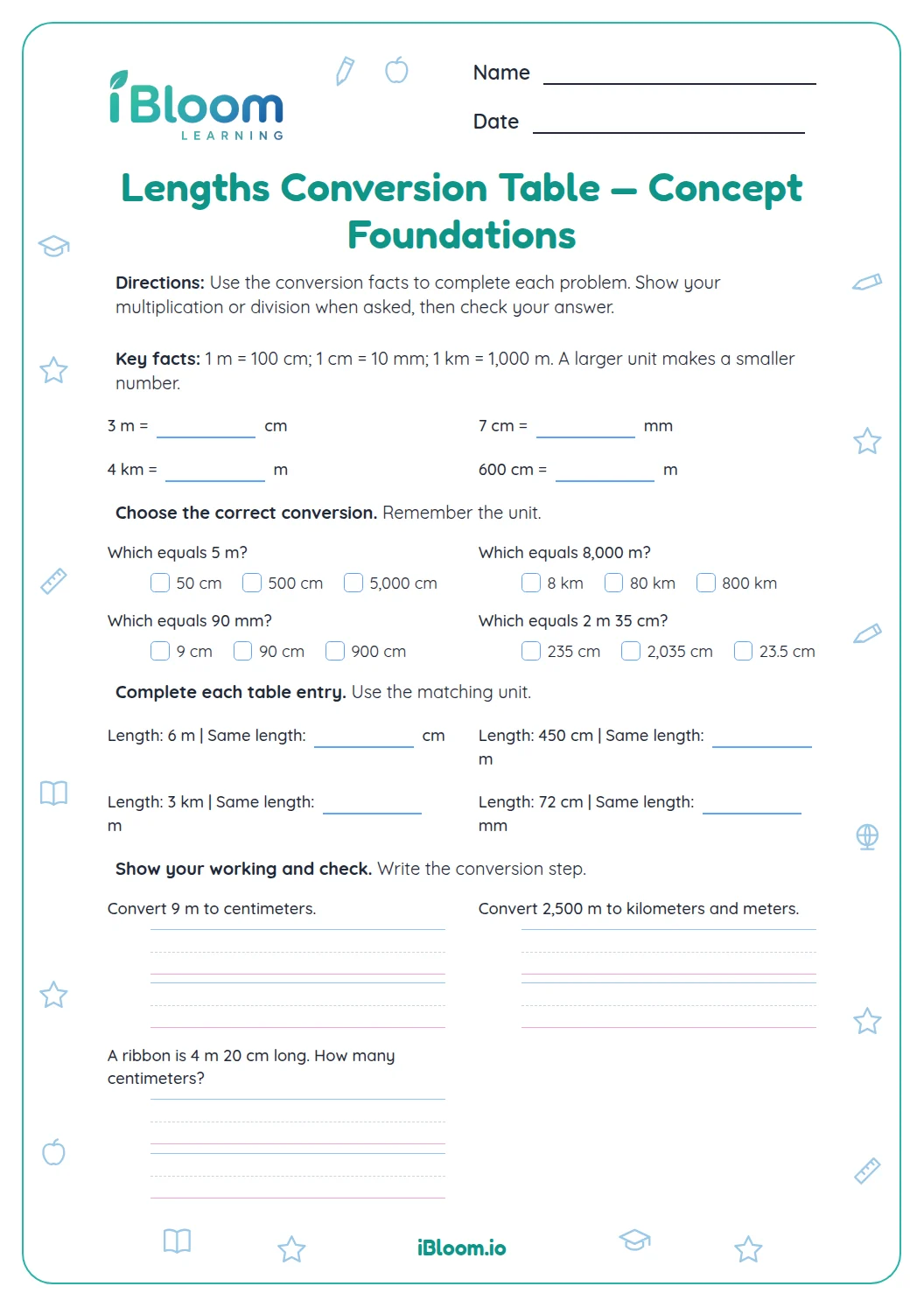
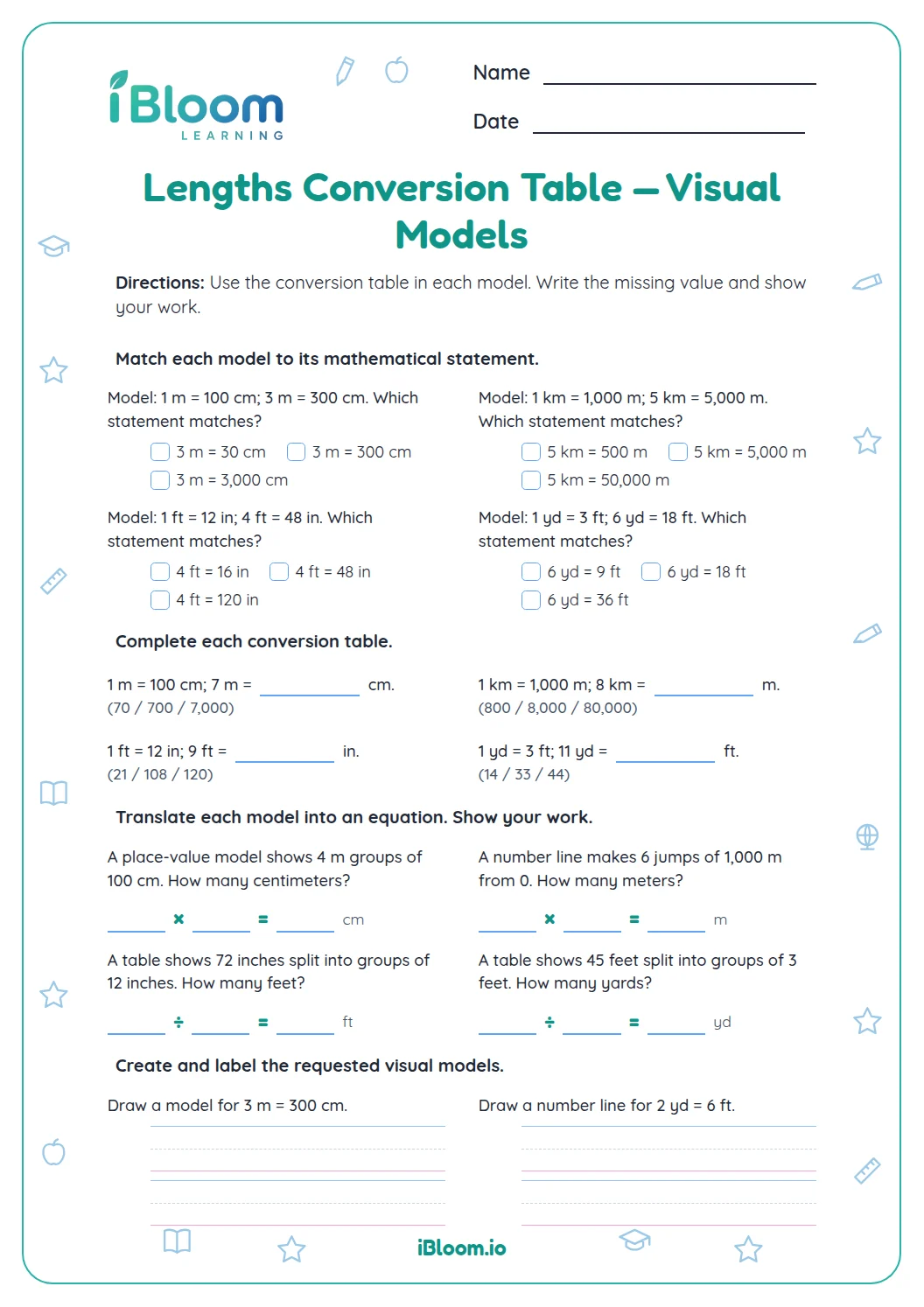
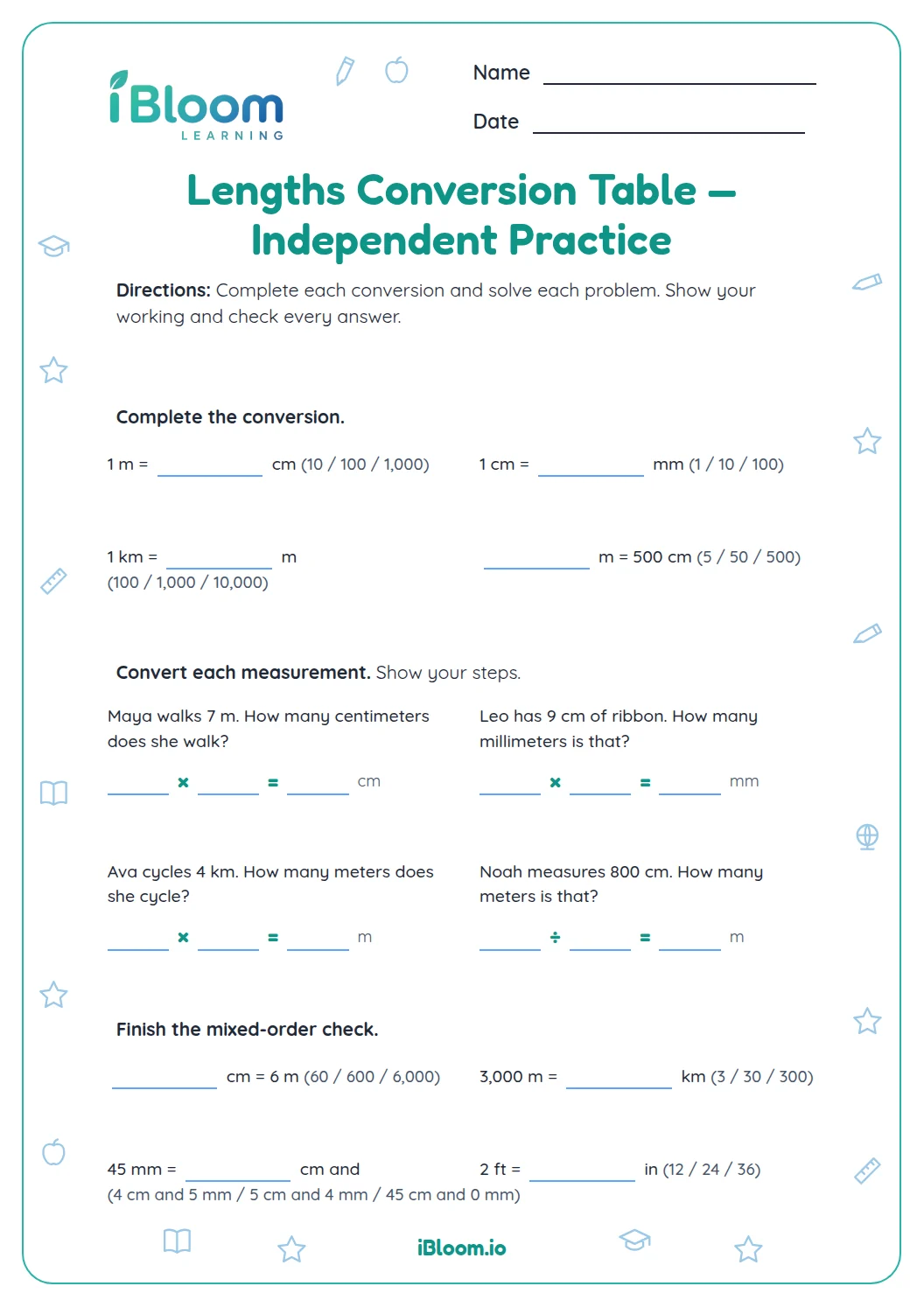
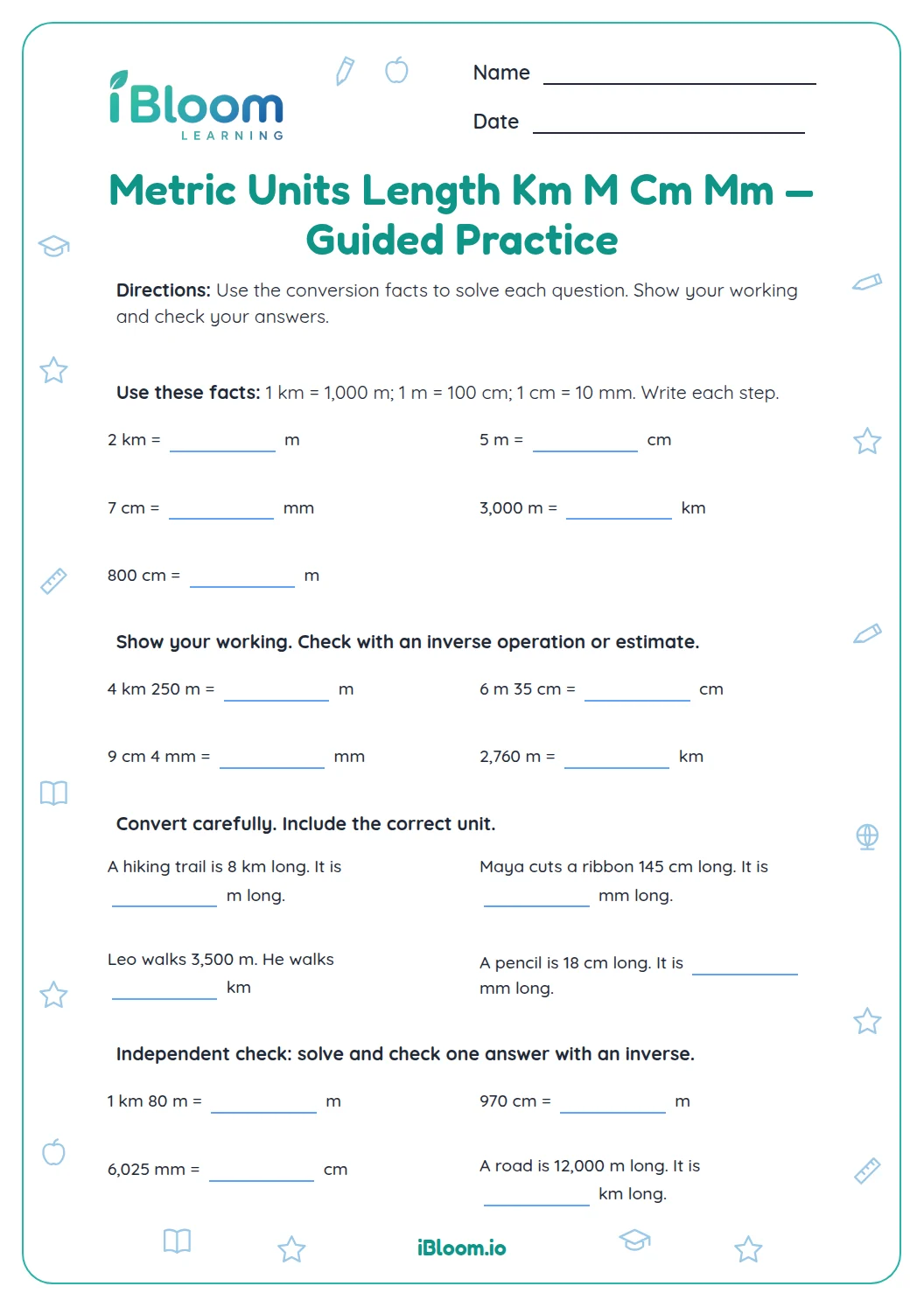
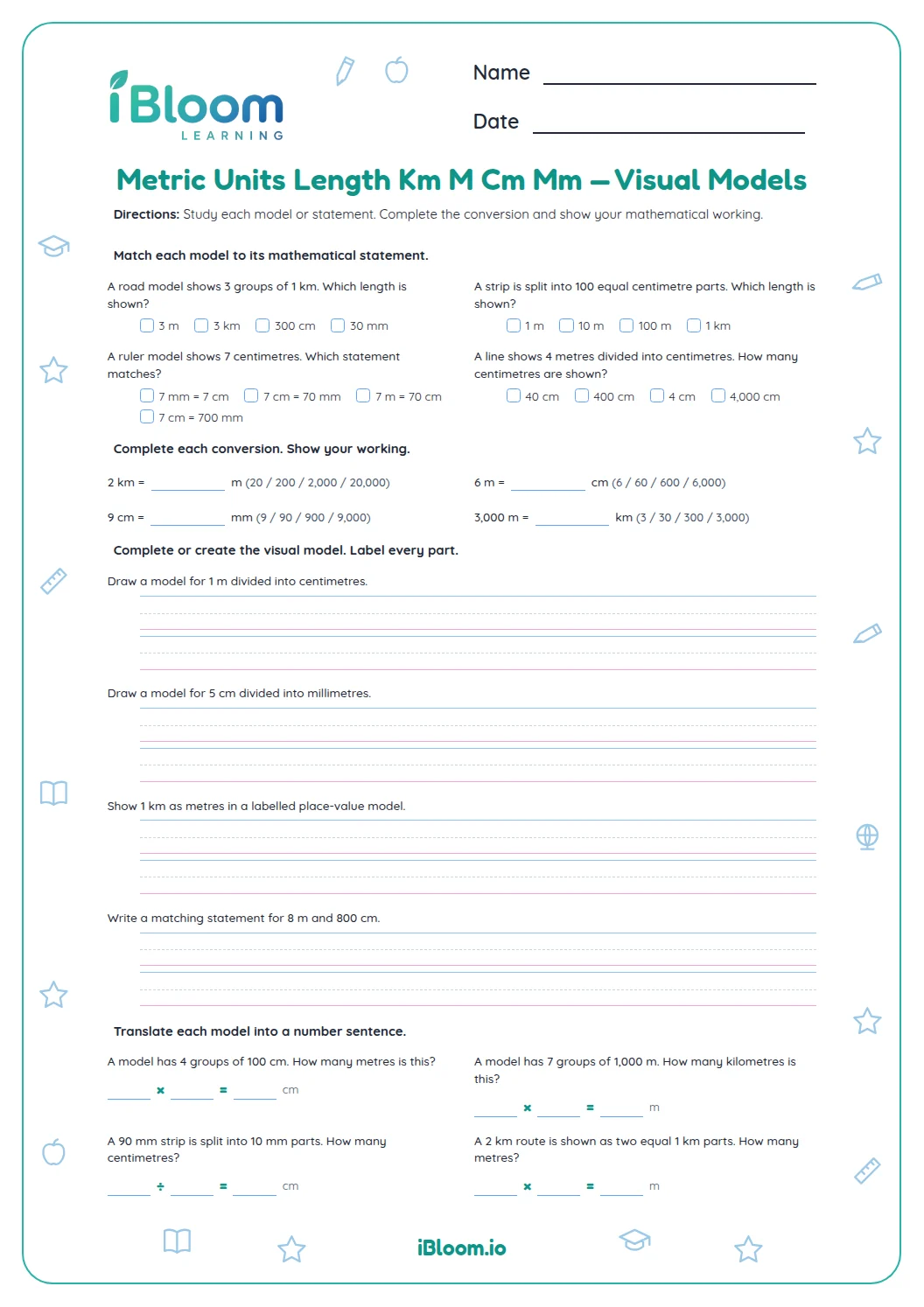
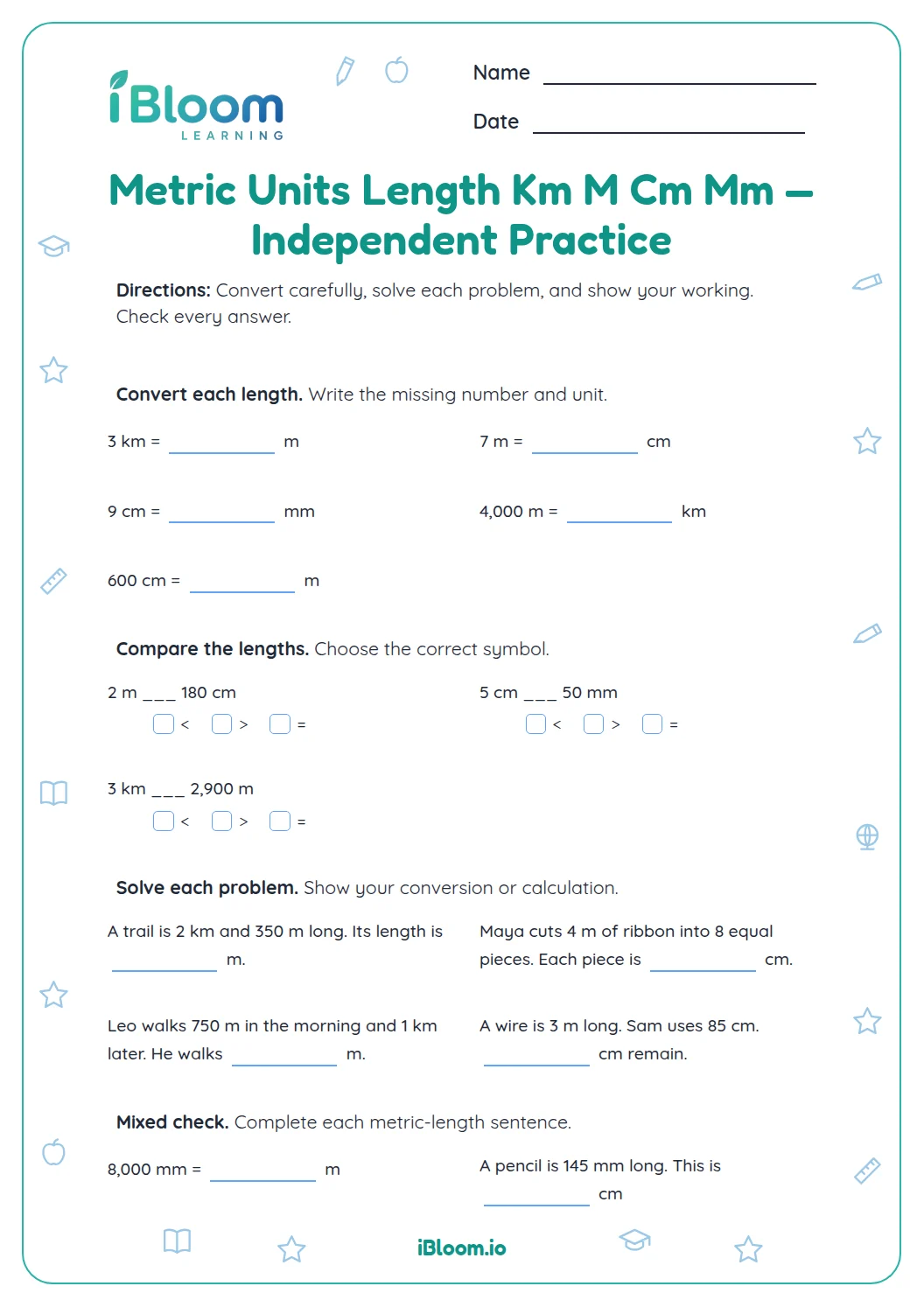
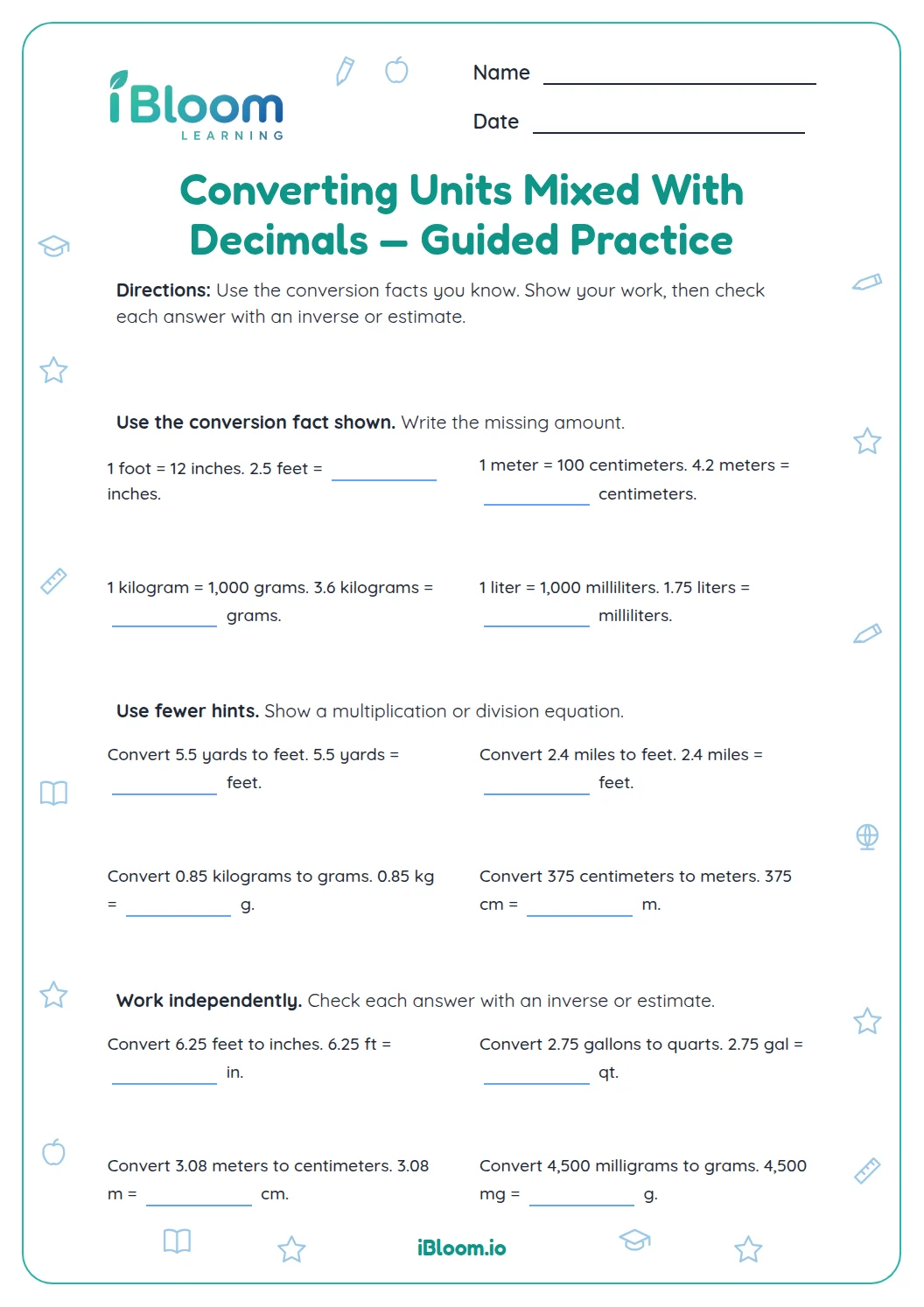
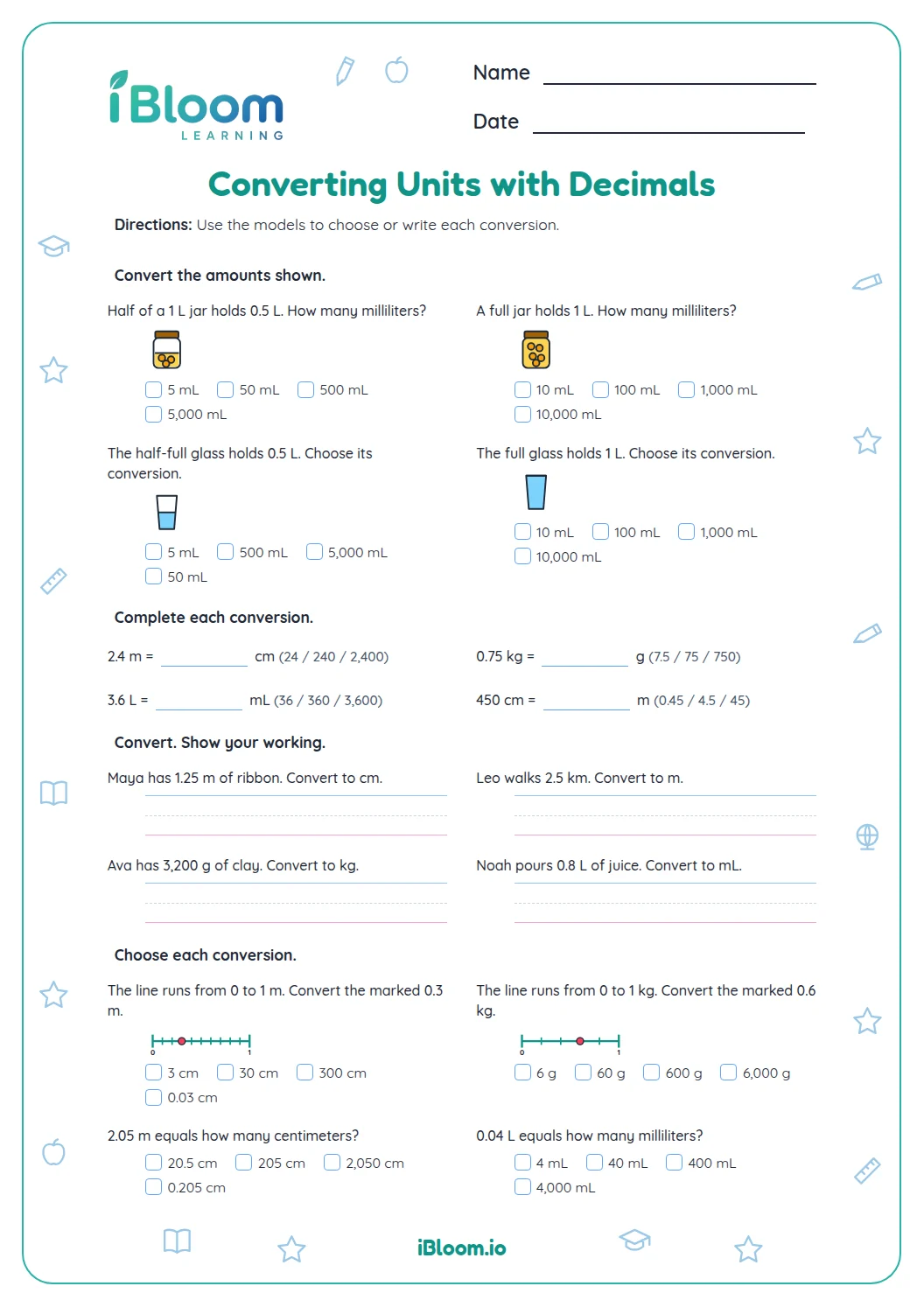
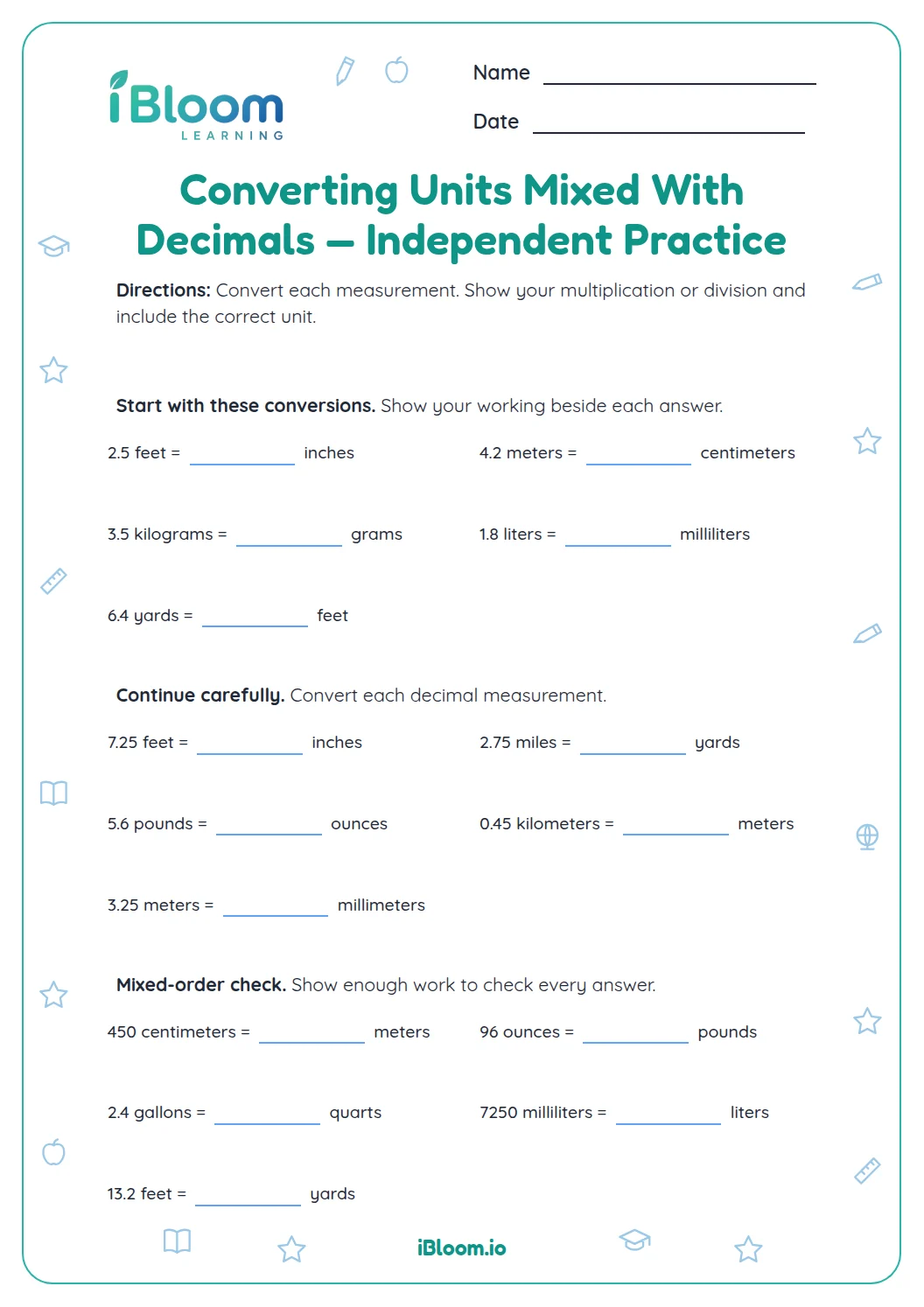
This free Grade 5 worksheet guides children through decimal length conversions using kilometers, meters, centimeters and millimeters. Four opening questions give the relationship and operation; four more ask children to choose the operation themselves. Three comparisons require matching units, and four word problems combine conversion with addition or subtraction. The sheet practices Common Core 5.MD.A.1: converting measurements within a system and using conversions in multi-step problems. A separate answer key gives all fifteen answers, with the requested units printed beside the blanks.
Aligned to 5.MD.A.1
Which metric relationships does the sheet use?
Use 1 km = 1,000 m, 1 m = 100 cm and 1 cm = 10 mm. Part A prints the relationship needed for each guided calculation. Part B asks children to choose a factor for the same units.
A smaller unit needs a larger number to describe the same length. For example, 0.6 km is 600 m. The distance stays the same; only its name and number change.
What does a guided conversion look like?
Question 1 tells children both the relationship and the operation: 1 m = 100 cm; multiply 1.25 by 100. The blank is the value in centimeters. Children can check the result by converting it back to meters.
- 11 m = 100 cm
- 21.25 × 100 = 125
- 31.25 m = 125 cm
- 4Check: 125 cm ÷ 100 = 1.25 m
How do you compare lengths written in different units?
Convert both lengths to the same unit before comparing their numbers. In question 9, 2.5 m is 250 cm. Since 250 cm is longer than 245 cm, choose 2.5 m. Question 10 compares kilometers and meters; question 11 checks an equivalent pair.
Why must word problems use matching units?
A ribbon measured in meters and a piece cut off in centimeters cannot be subtracted as bare numbers. Question 12 begins with 1.5 m of ribbon and removes 35 cm. Convert 1.5 m to 150 cm, then subtract 35 cm to get 115 cm.
The other problems ask for total walking distance, remaining cord and combined lengths of two sticks. The requested unit appears in each question so children can label their final answer correctly.
Work from the unit relationship to the answer
- 1Read the starting unit and the unit requested in the blank.
- 2Name the relationship: 1,000 m per km, 100 cm per m, or 10 mm per cm.
- 3Use the printed multiplication or division hint in Part A.
- 4Choose the factor yourself for Part B, and check whether the number should grow or shrink.
- 5In Part C, convert to matching units before choosing; use the same habit for the Part D word problems.
- 6Reverse each conversion to check it. For word problems, check the addition or subtraction too.
Mistakes to notice and how to fix them
The mistake
Writing 1.25 m = 12.5 cm.
The fix
There are 100 cm in a meter. Multiply by 100, giving 125 cm.
The mistake
Multiplying 2,350 m by 1,000 to get kilometers.
The fix
A kilometer is larger than a meter. Divide 2,350 by 1,000 to get 2.35 km.
The mistake
Subtracting 35 from 1.5 in the ribbon problem.
The fix
Convert 1.5 m to 150 cm first, then calculate 150 − 35 = 115 cm.
Common Core alignment
Convert metric lengths with decimals and use the conversions in two-step length problems.
On this sheet: Parts A and B convert metric lengths, Part C compares them, and Part D uses conversion with addition or subtraction.
Show the official wordingHide the official wording
Convert among different-sized standard measurement units within a given measurement system (e.g., convert 5 cm to 0.05 m), and use these conversions in solving multi-step, real world problems.
What to practice next
Make more practice
Further reading
Questions parents and teachers ask
Which units appear on this worksheet?
The sheet uses kilometers, meters, centimeters and millimeters, written as km, m, cm and mm. Part A gives conversion relationships, and Part B asks children to choose an operation. Part C compares lengths; Part D applies the conversions in four addition or subtraction word problems.
When should children multiply instead of divide?
Multiply when the new unit is smaller, because more of those units fit into the same length. For example, 1.25 m becomes 125 cm after multiplying by 100. Divide when the new unit is larger, as in changing 2,350 m to 2.35 km by dividing by 1,000.
How does the ribbon problem work?
The ribbon problem has 115 cm left. First convert 1.5 m to 150 cm, using 100 cm for every meter. Then subtract the 35 cm that was cut off. Keeping both lengths in centimeters makes the subtraction meaningful and matches the unit requested in the question.
Do the word problems need more than one calculation?
Yes, each word problem needs a conversion and then addition or subtraction. Use the page margin or scrap paper to record both steps before filling the blank. Label the converted measurements so you can check that the numbers being combined use the same unit.
What does the answer key provide?
The separate answer key supplies eight conversion values, three comparison choices and four word-problem values in the requested units. When reviewing a word problem, ask the child to show the conversion. Then check that the addition or subtraction combines measurements expressed in matching units.