
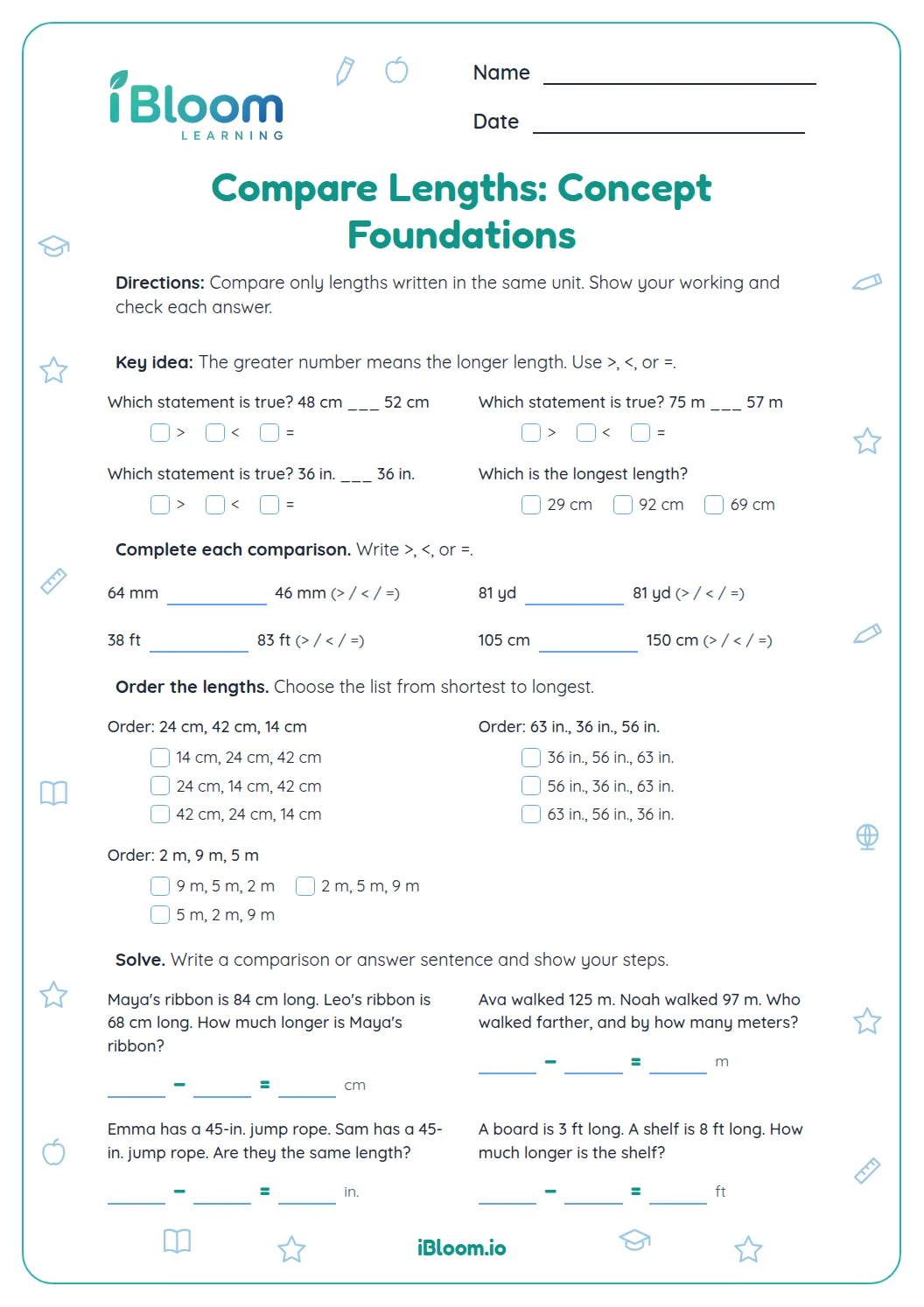
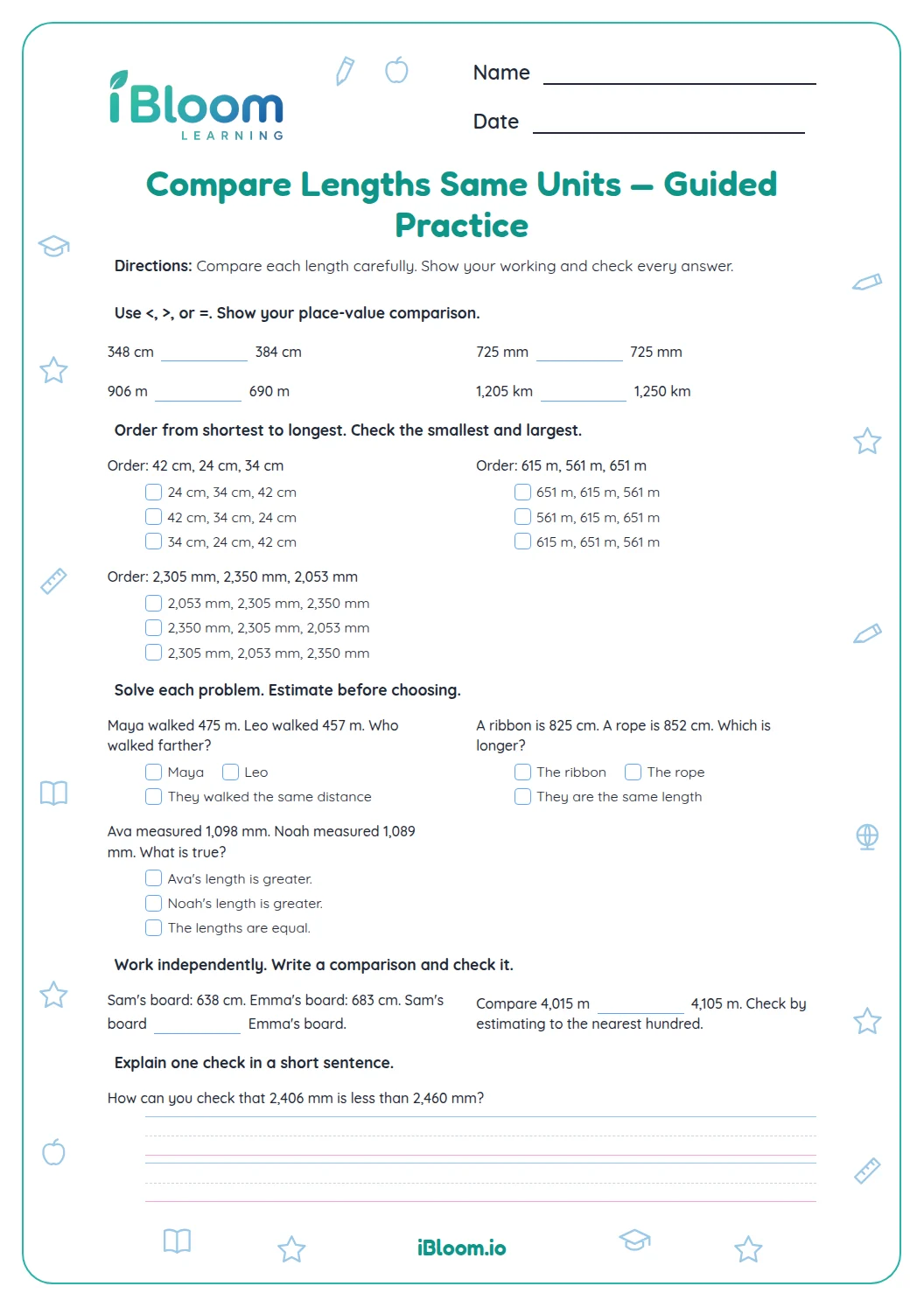
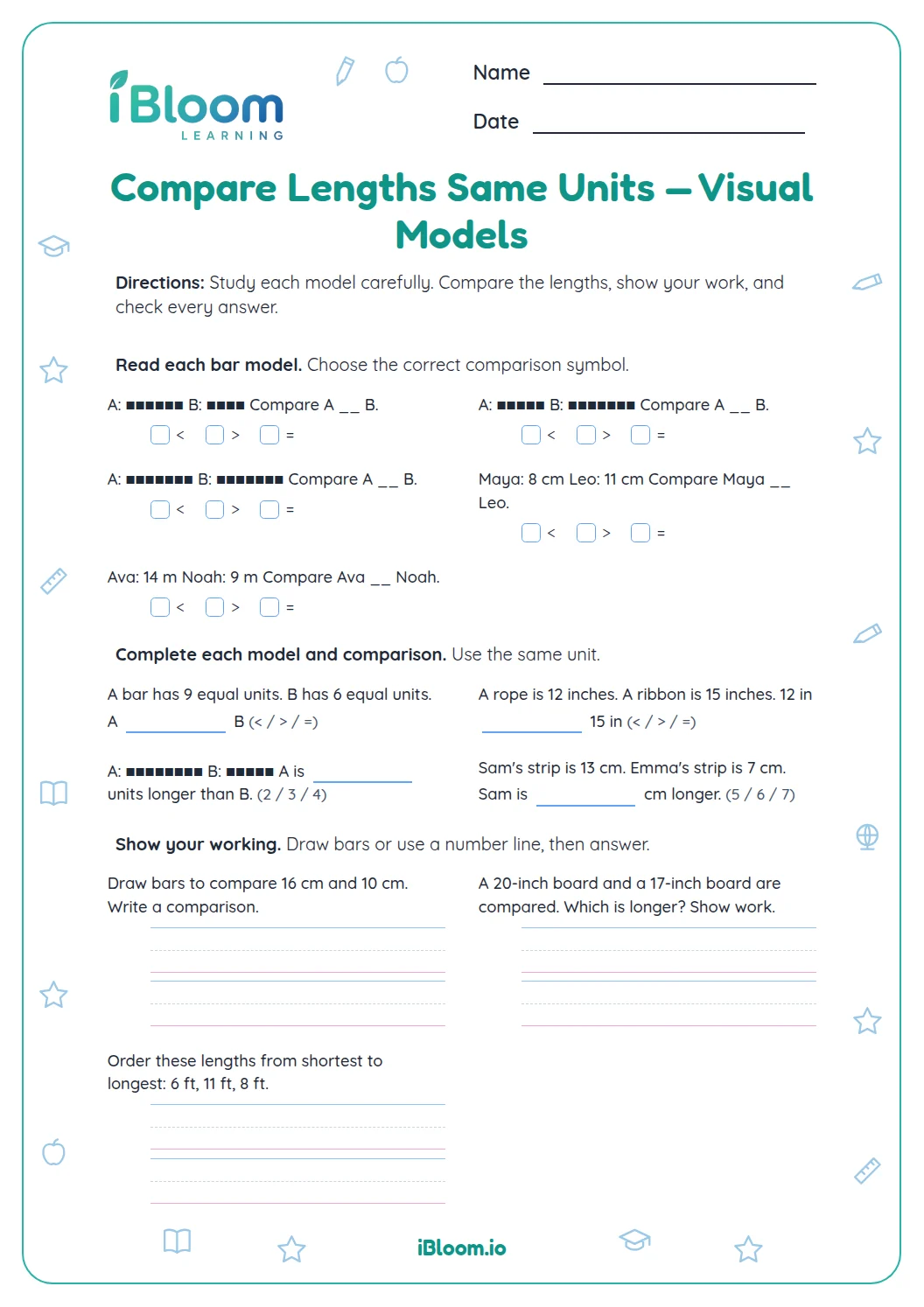
About this worksheet
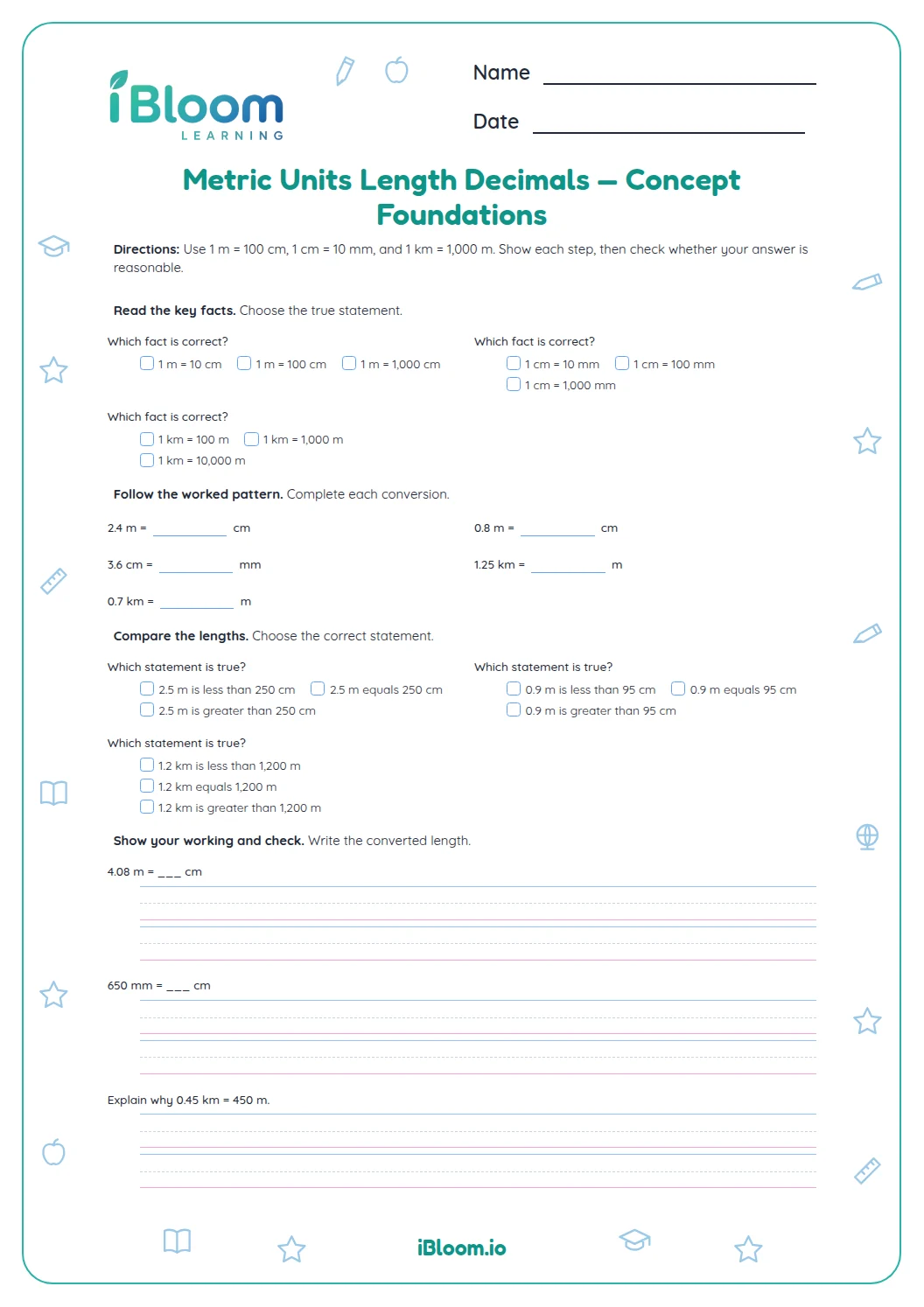
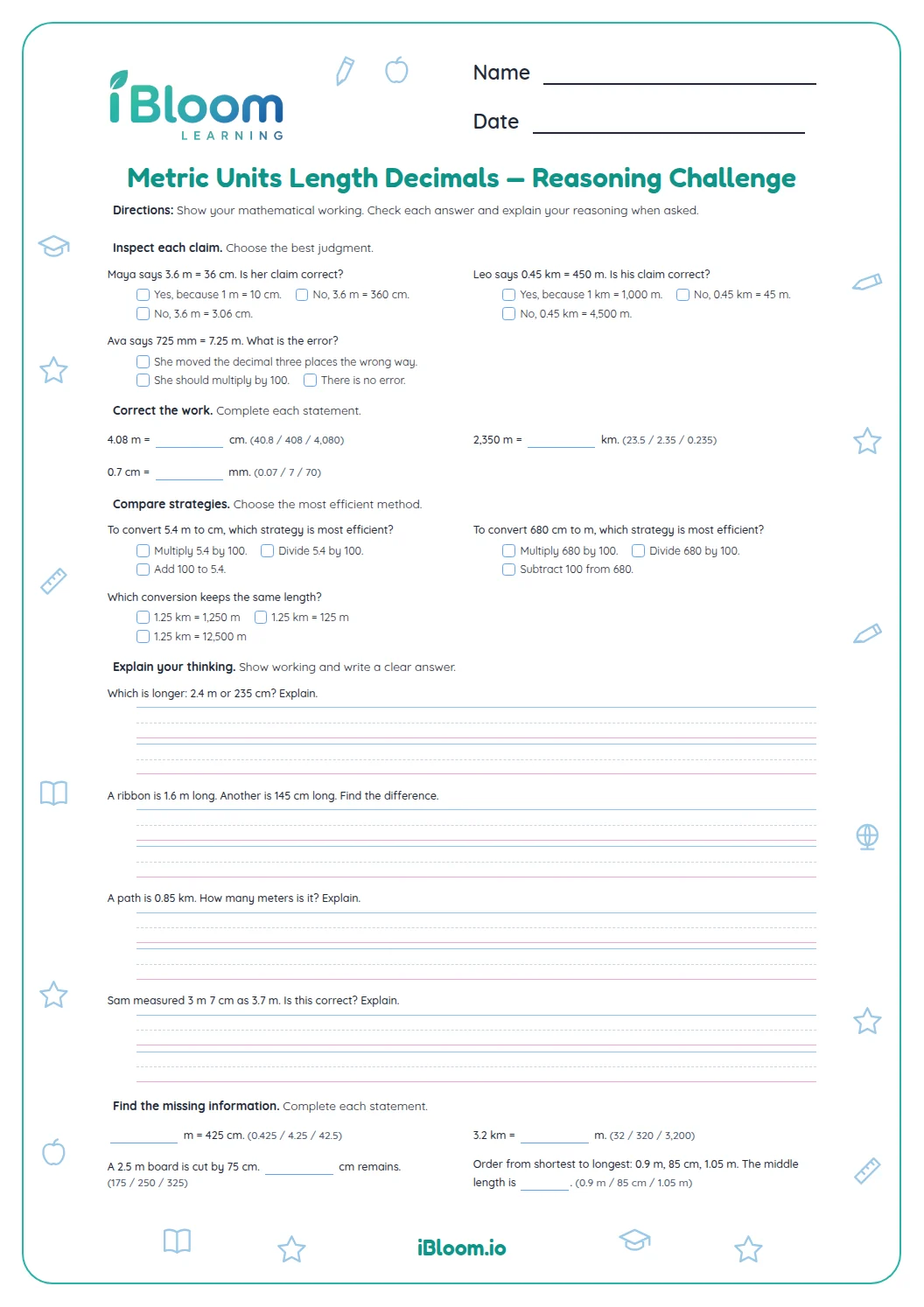
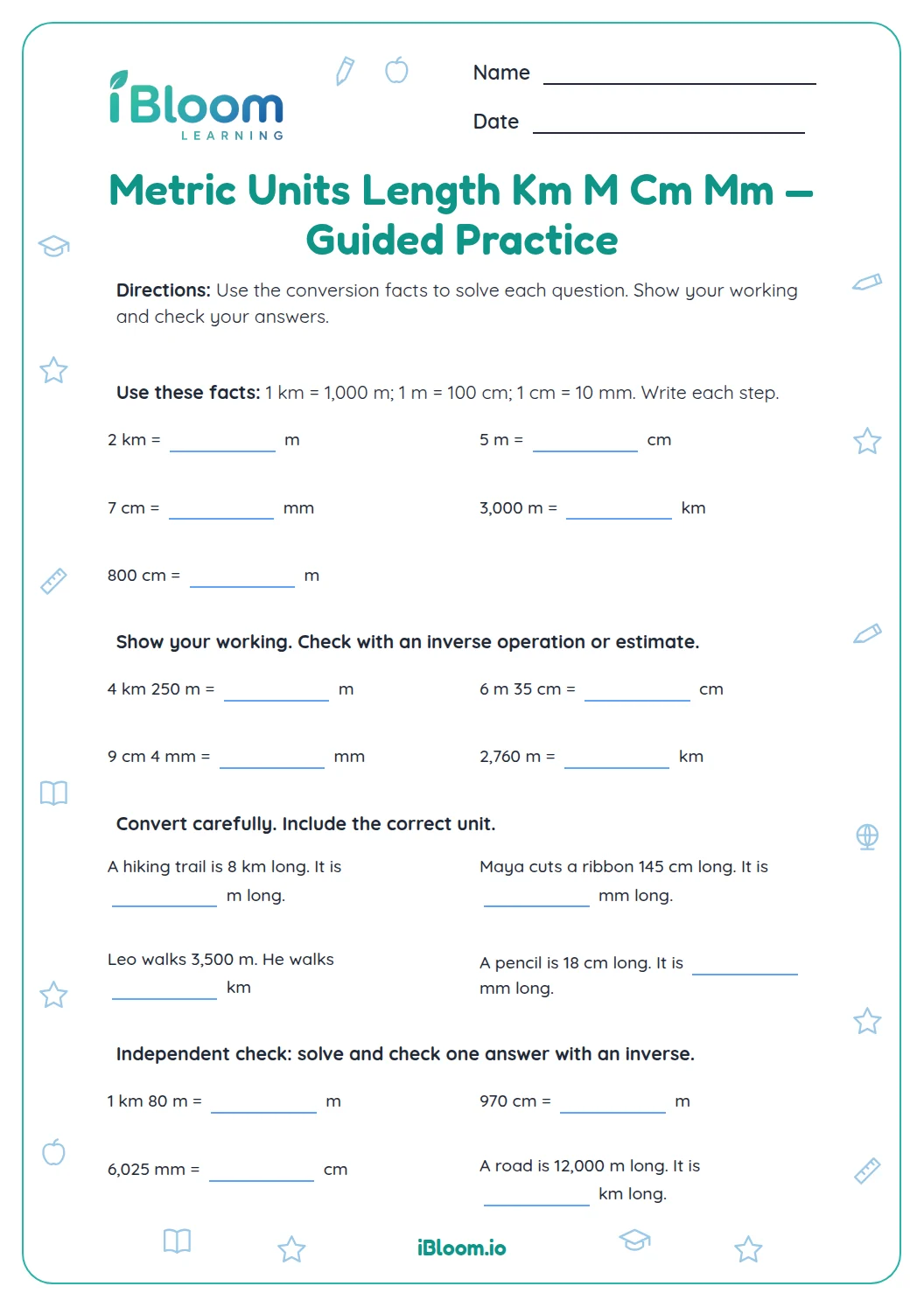
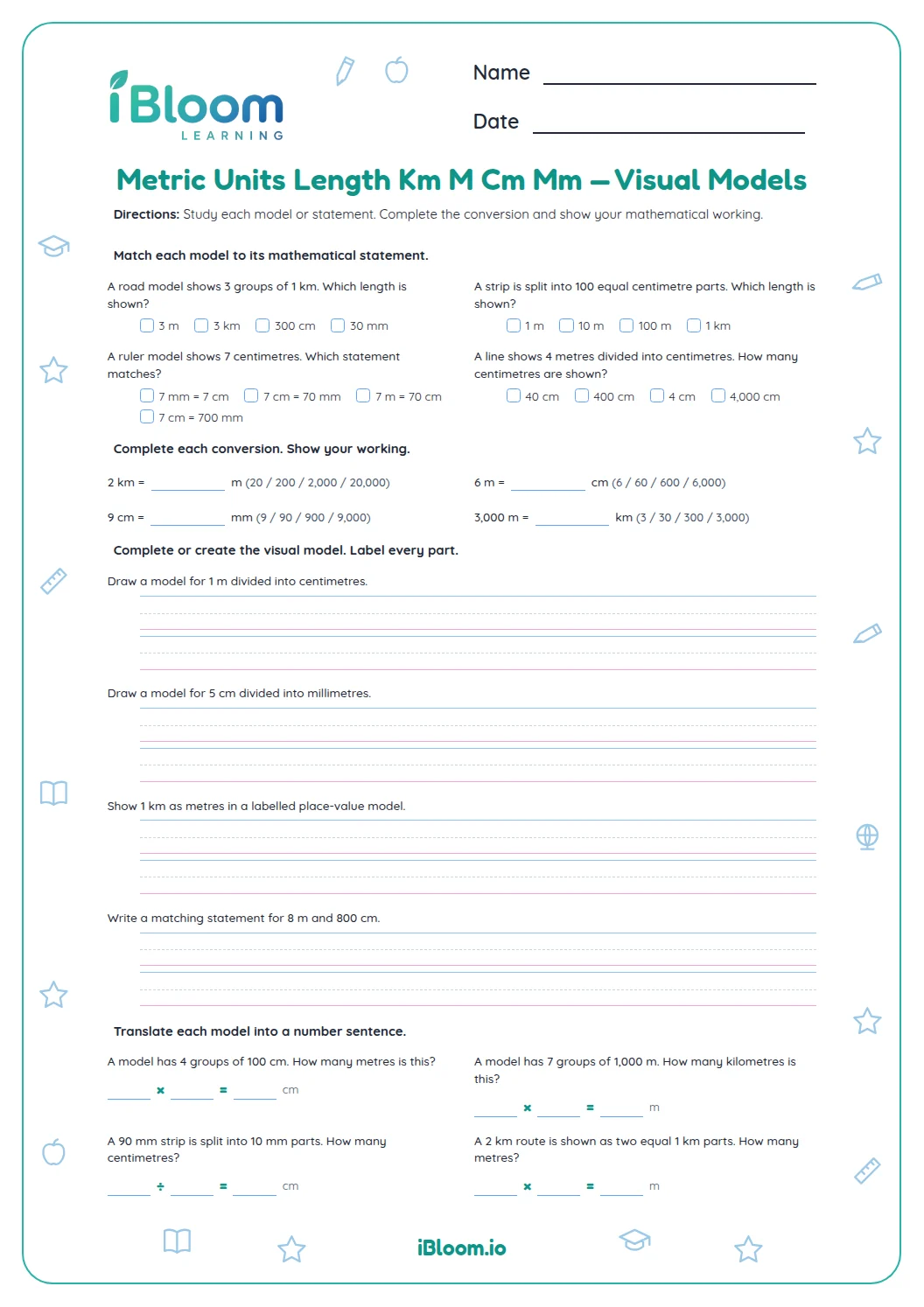
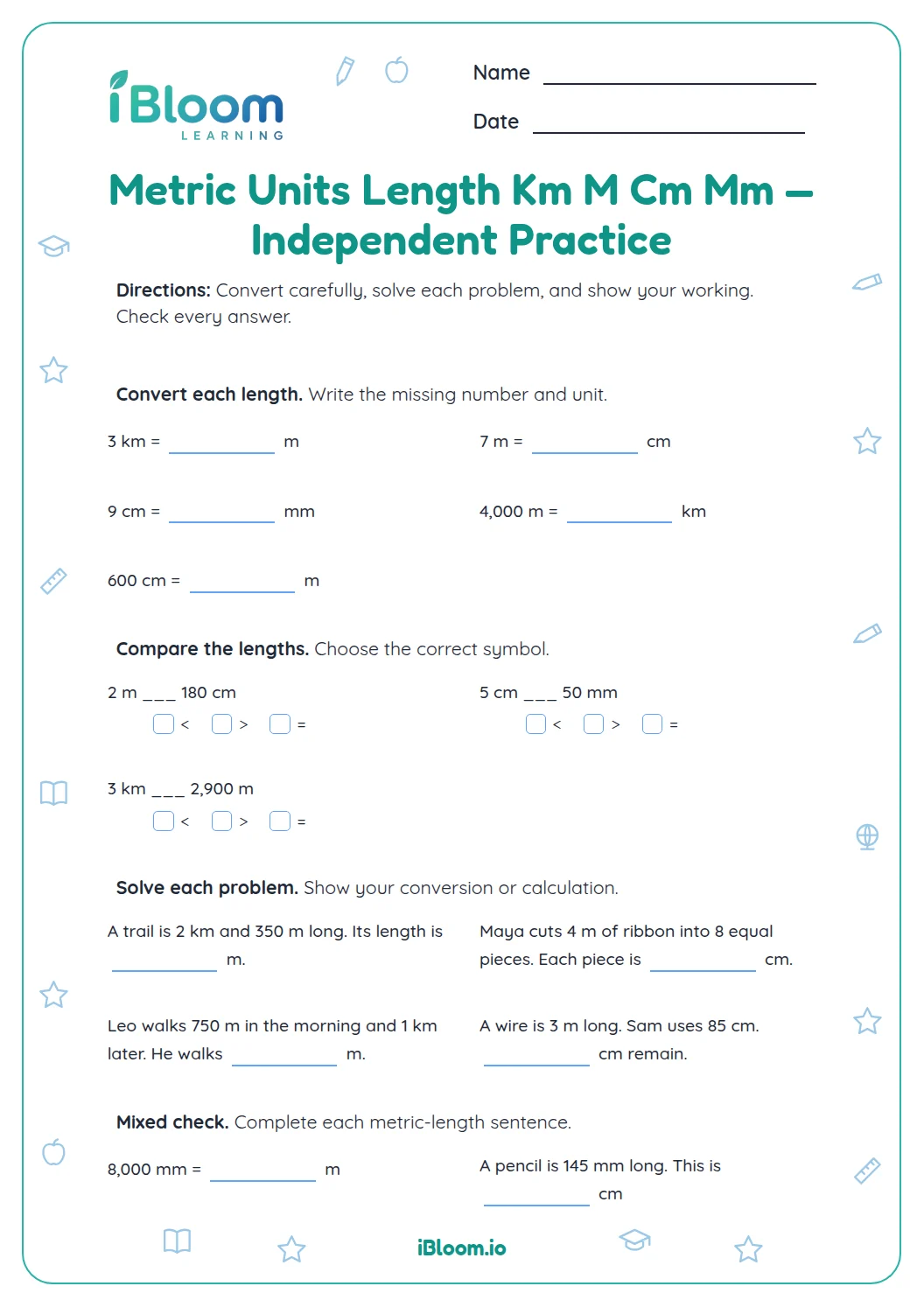
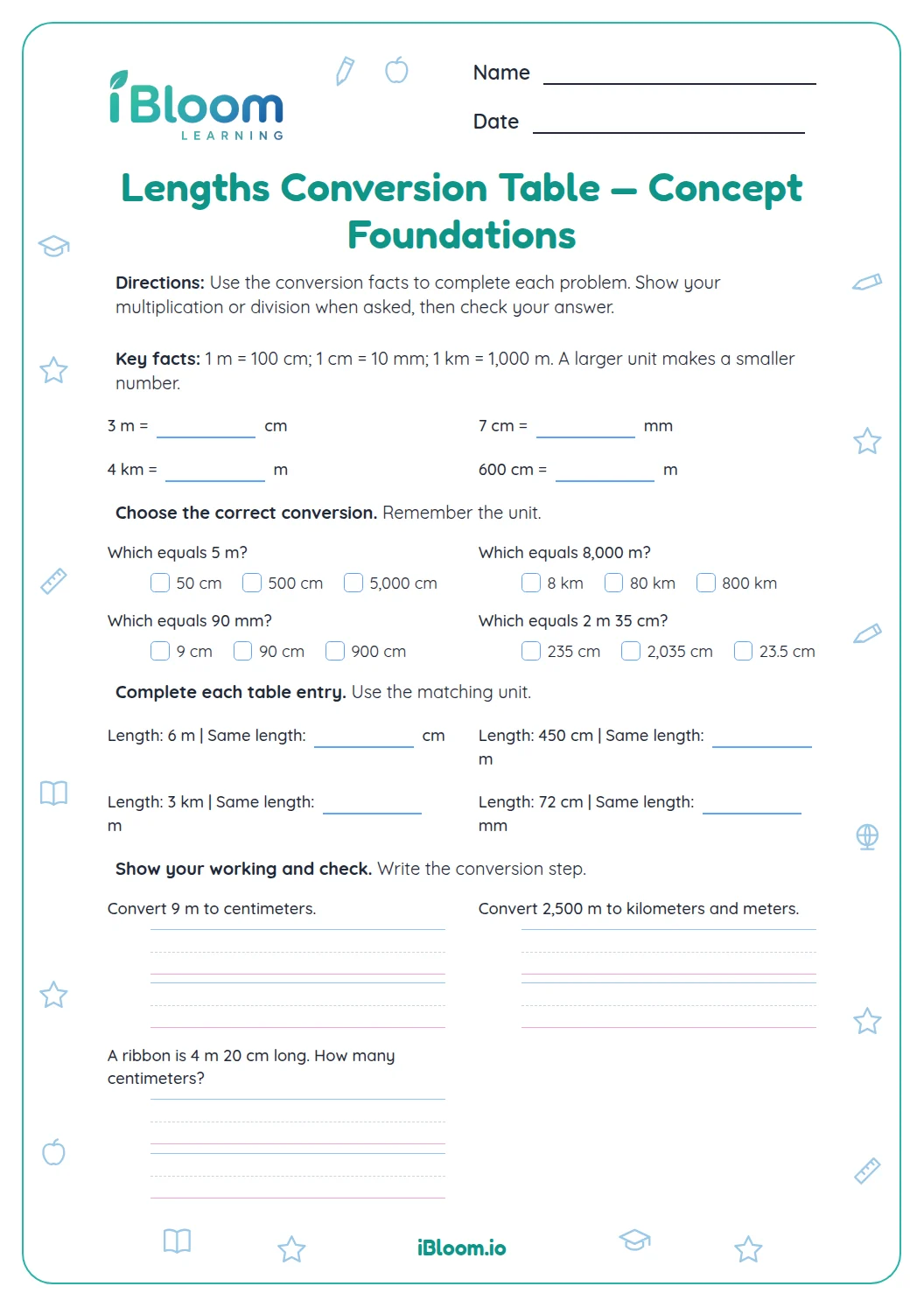
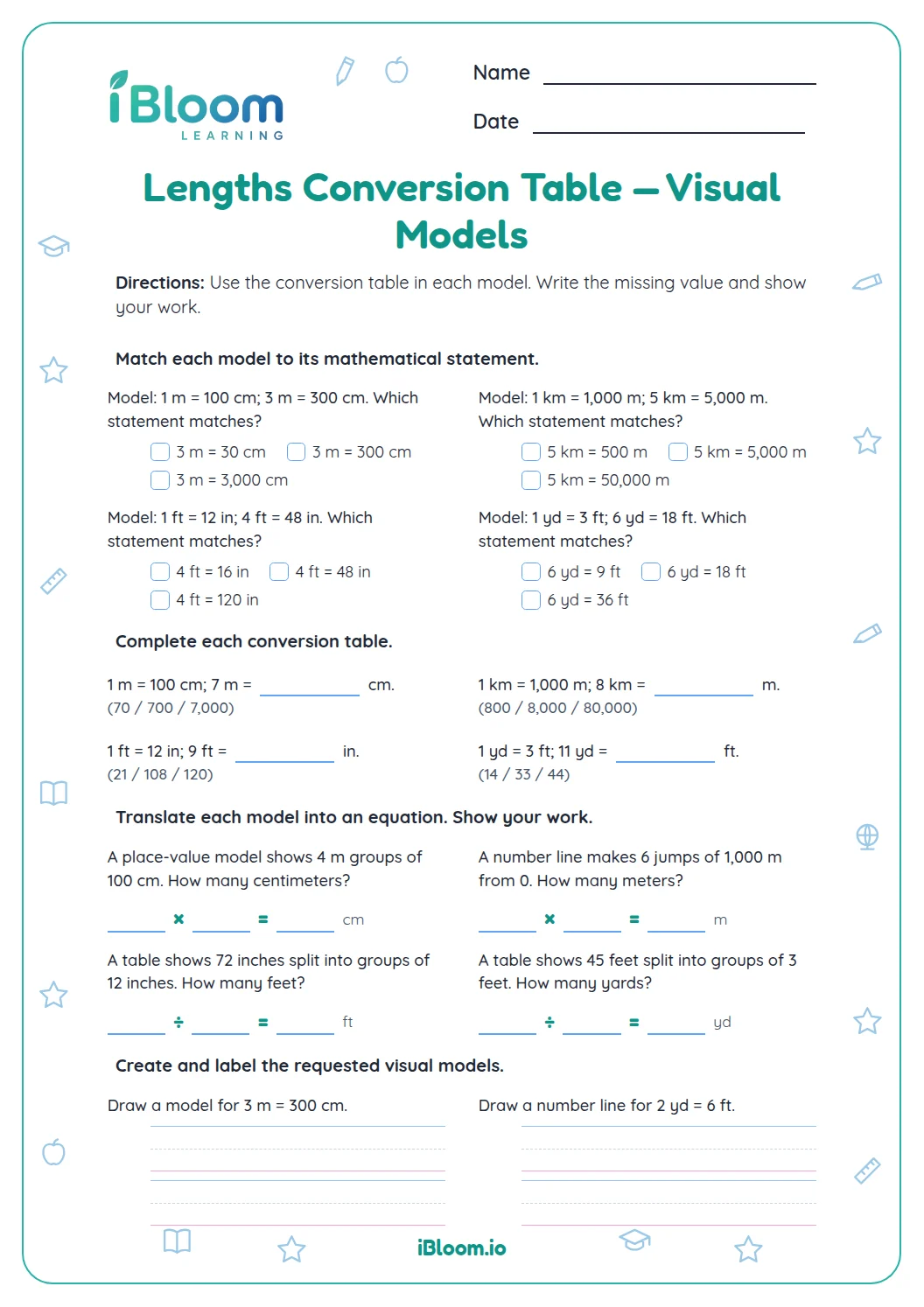
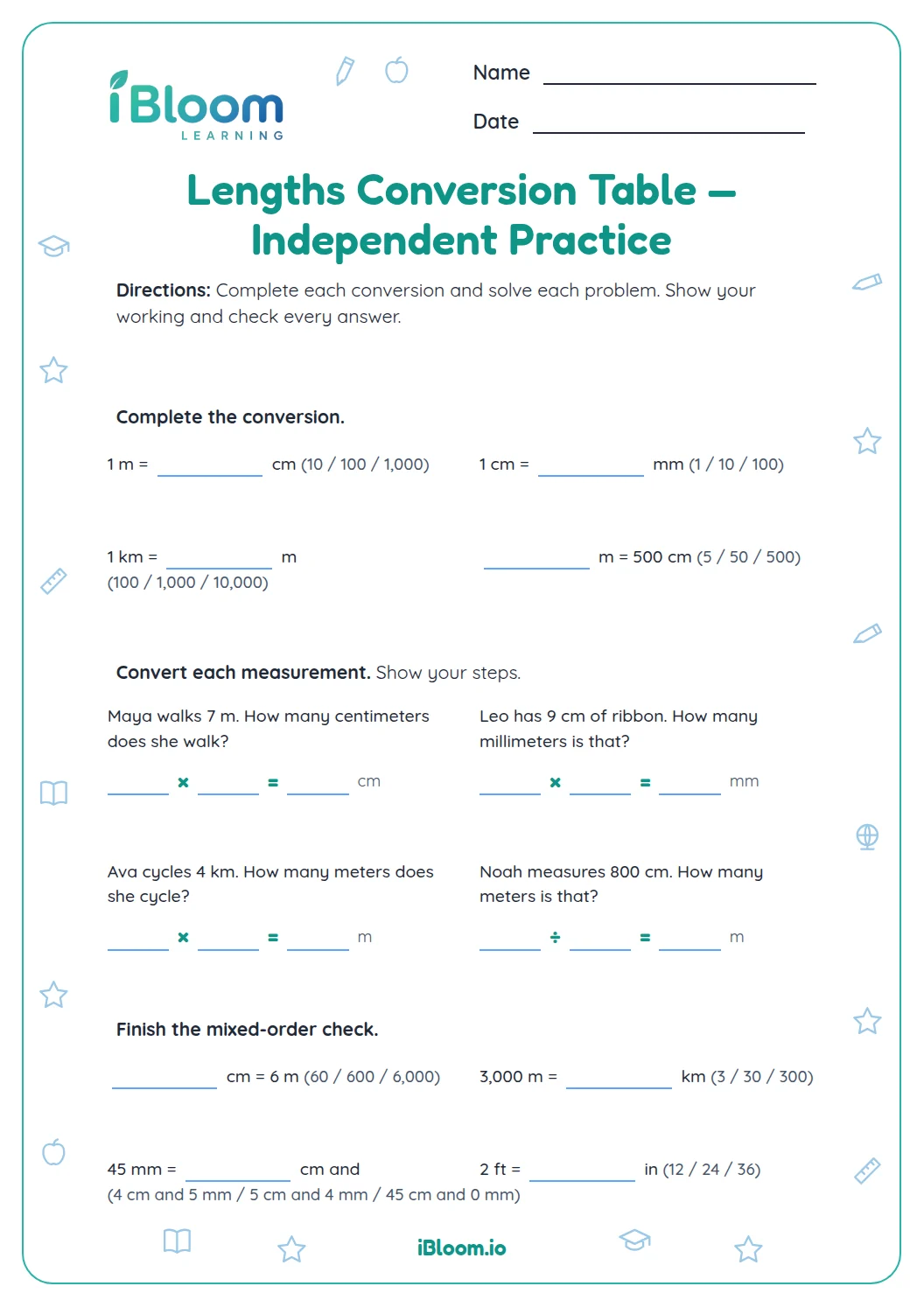
This Grade 5 worksheet gives 16 problems on converting millimeters, centimeters, meters, and kilometers with decimals. Learners also add, subtract, compare, and order lengths. The work practices Common Core 5.MD.A.1 by using metric conversions in measurement problems.
Aligned to 5.MD.A.1
How do you convert before comparing?
Use the relationship between the units to move the decimal place value. For example, 1.48 m equals 148 cm; compare 148 cm with 152 cm to see that the shelf is 4 cm longer.
For addition or subtraction, first check that both measurements use the same unit. Then line up decimal points and keep the unit in the answer.
How can equal lengths be found?
For the 3 m cord cut into four equal lengths, divide 3 by 4. Each piece is 0.75 m. Check by multiplying 0.75 m by 4 to return to 3 m.
How to work through the sheet
- 1Read the direction at the start of each part.
- 2Work from the first example in the part and keep units or place value visible.
- 3Pause after each answer to check whether it fits the question.
- 4Use the answer key after finishing a part, then correct any missed step.
Check units and place value
The mistake
Treating 425 cm as 42.5 m.
The fix
Since 100 centimeters make 1 meter, divide 425 by 100 to get 4.25 m.
The mistake
Comparing 1.48 m directly with 152 cm.
The fix
Convert one measurement so both use centimeters or meters.
The mistake
Dropping the unit after a decimal calculation.
The fix
Carry the measurement unit through the calculation and include it in the answer.
Curriculum alignment
This sheet practices metric unit conversions and uses them to solve measurement problems.
Convert between metric length units and use those conversions in calculations and comparisons.
On this sheet: The problems move from direct practice to applying the same skill in context.
Show the official wordingHide the official wording
Convert among different-sized standard measurement units within a given measurement system (e.g., convert 5 cm to 0.05 m), and use these conversions in solving multi-step, real world problems.
What to practice next
Make more practice
Further reading
Questions parents and teachers ask
How many problems are on this worksheet?
There are 16 problems, beginning with metric conversions and moving into decimal calculations and comparisons. Learners work with millimeters, centimeters, meters, and kilometers. The answer key gives a result with the matching unit so a parent or teacher can review the work.
What is a good first step for a mixed-unit comparison?
Rewrite both measurements in the same unit before deciding which is longer. For example, change 1.48 meters to 148 centimeters, then compare 148 centimeters with 152 centimeters. That makes the size difference clear and keeps the units consistent.
Does the sheet include decimal addition and subtraction?
Yes. Several word problems require adding or subtracting lengths written with decimals, including a ribbon total and a trail distance. Learners also divide a length into equal pieces. Each item keeps the quantities in matching units or asks the learner to convert first.
How should learners check a conversion?
Use the reverse conversion to see whether the original amount returns. If 3.6 meters becomes 360 centimeters, divide 360 by 100 to get 3.6 meters again. Also check whether the converted value is a sensible size for the new unit.
What does the answer key show?
The separate key lists the result for every question, with units where needed. For comparison questions, it identifies the longer measurement or gives the ordered list. Ask the learner to explain one conversion before checking the key to make the place-value reasoning visible.