
About this worksheet
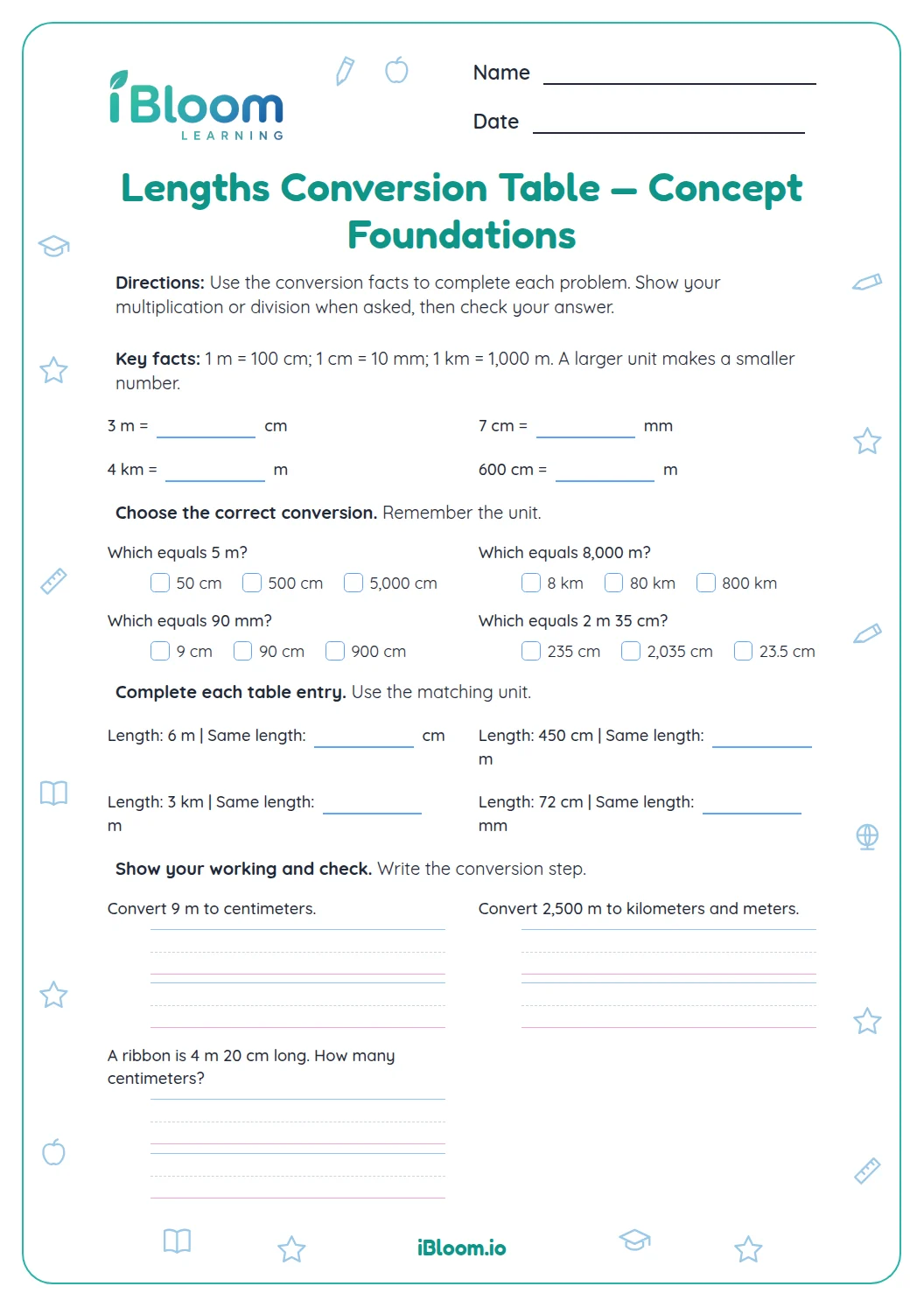
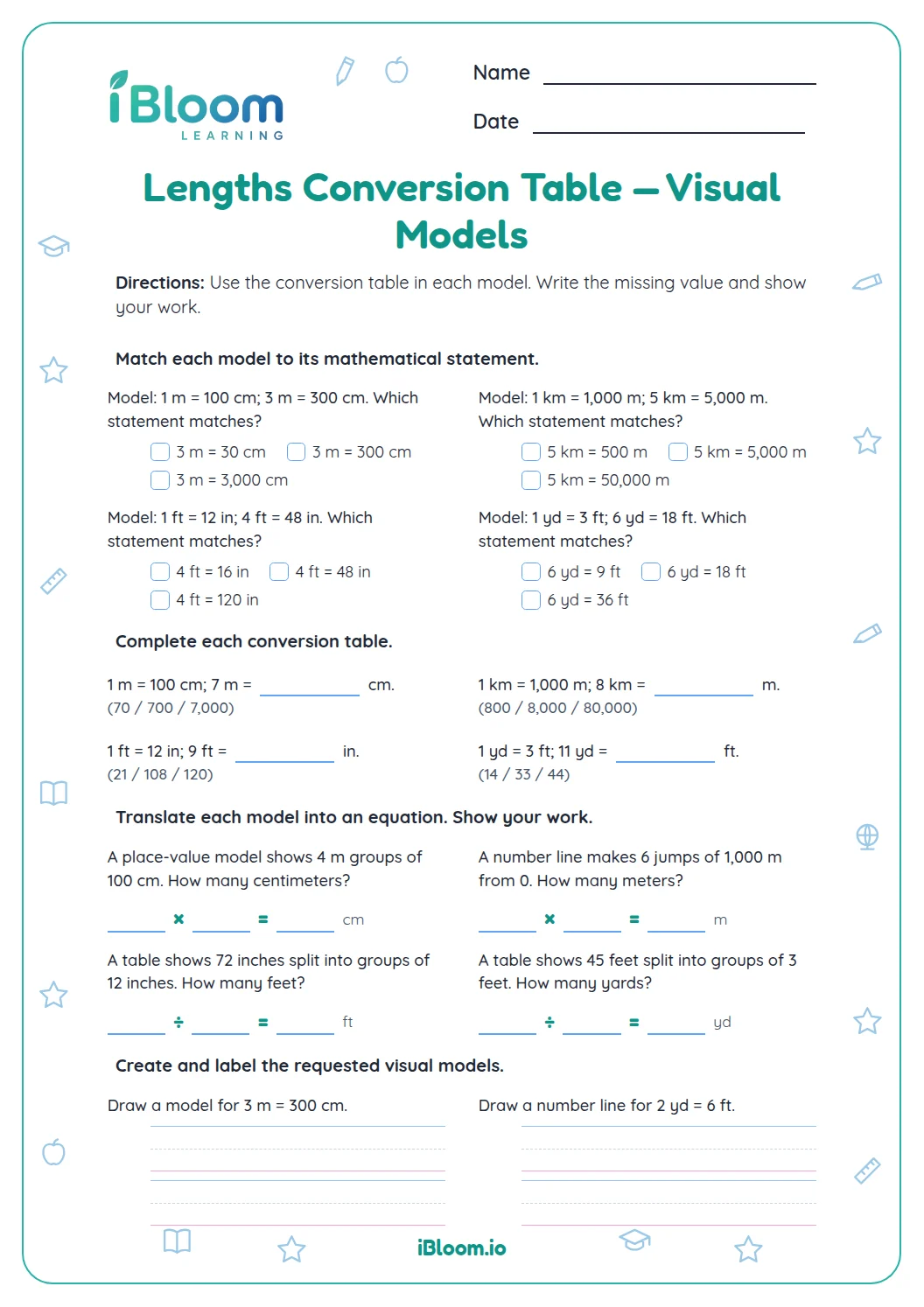
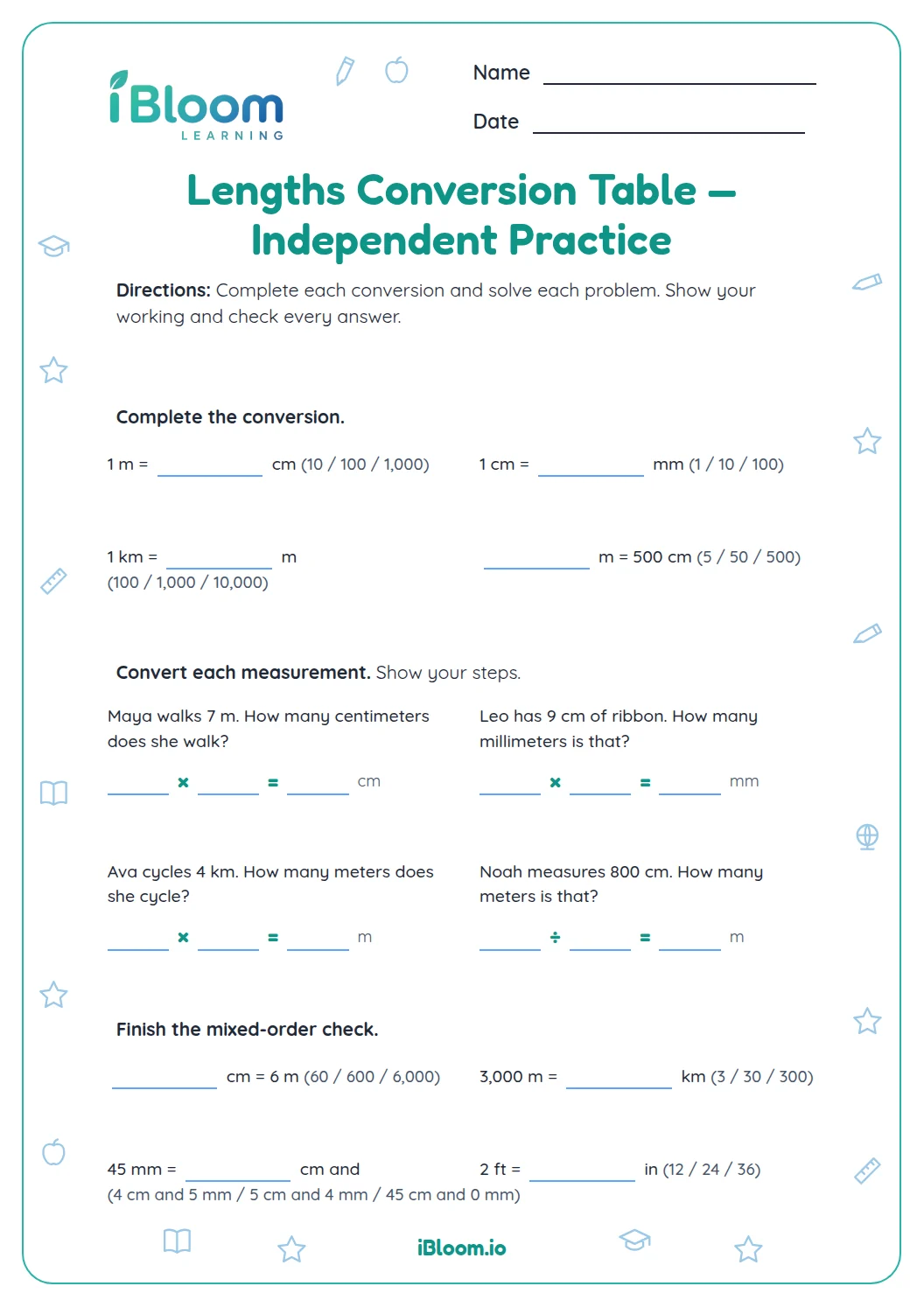
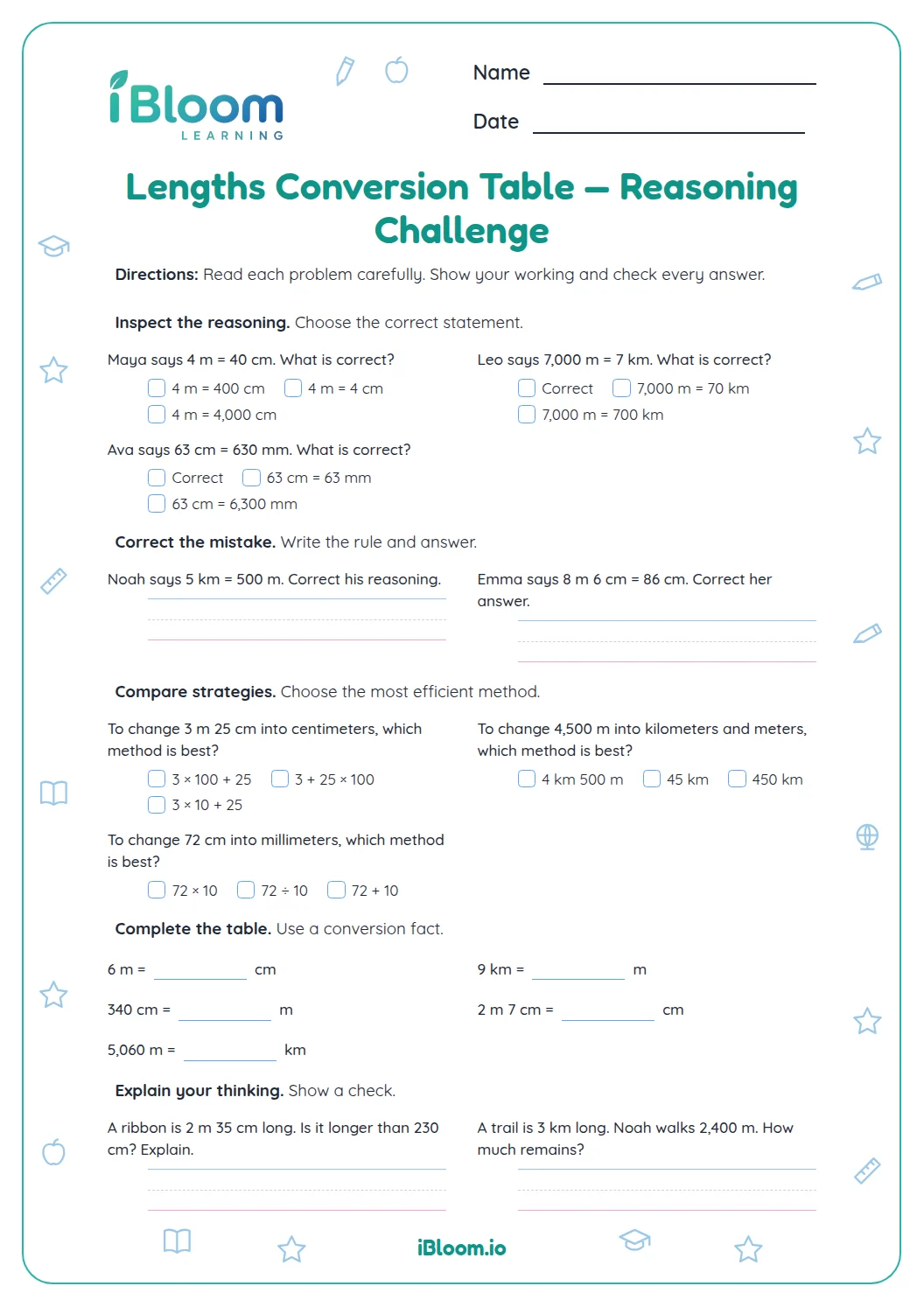
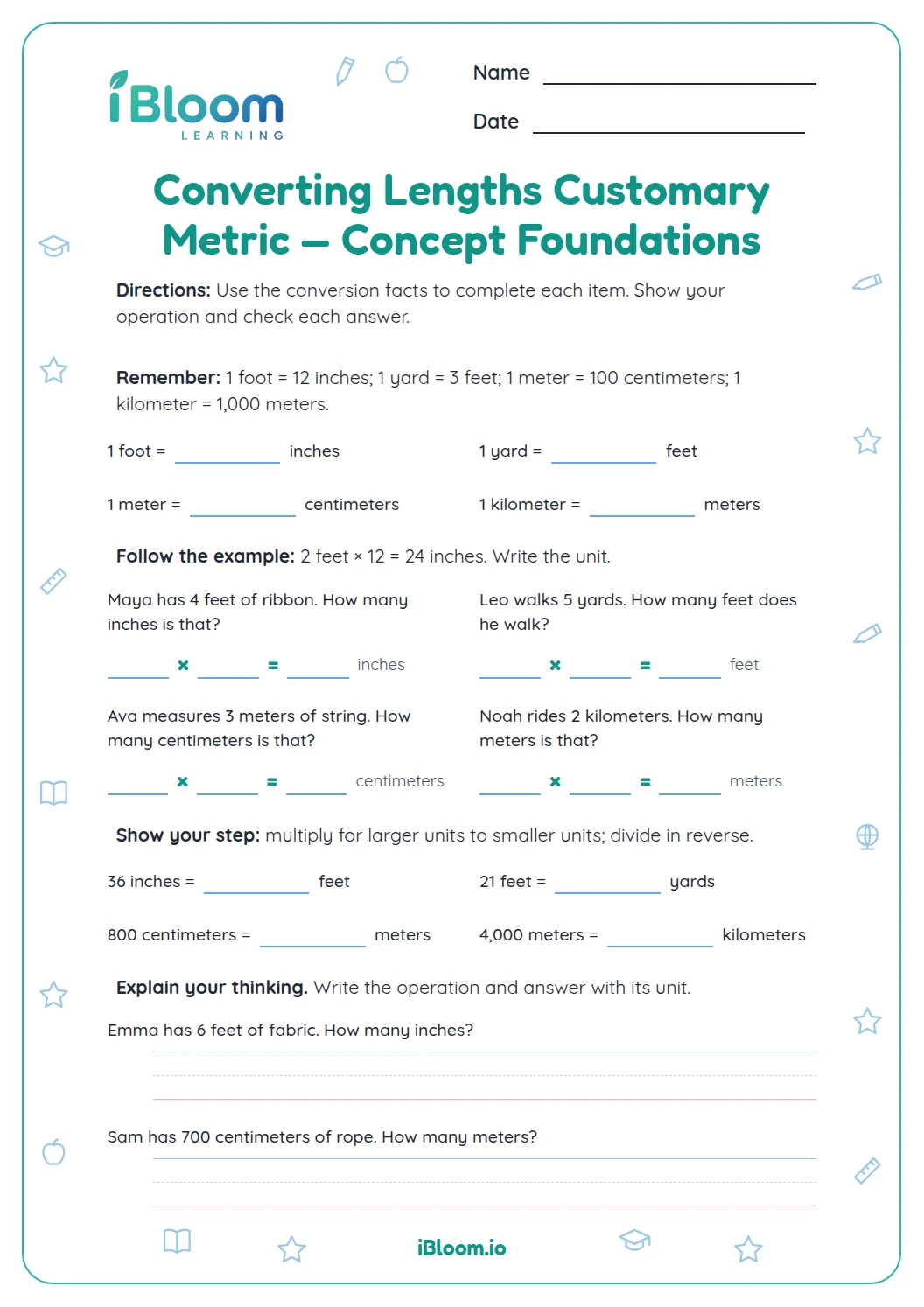
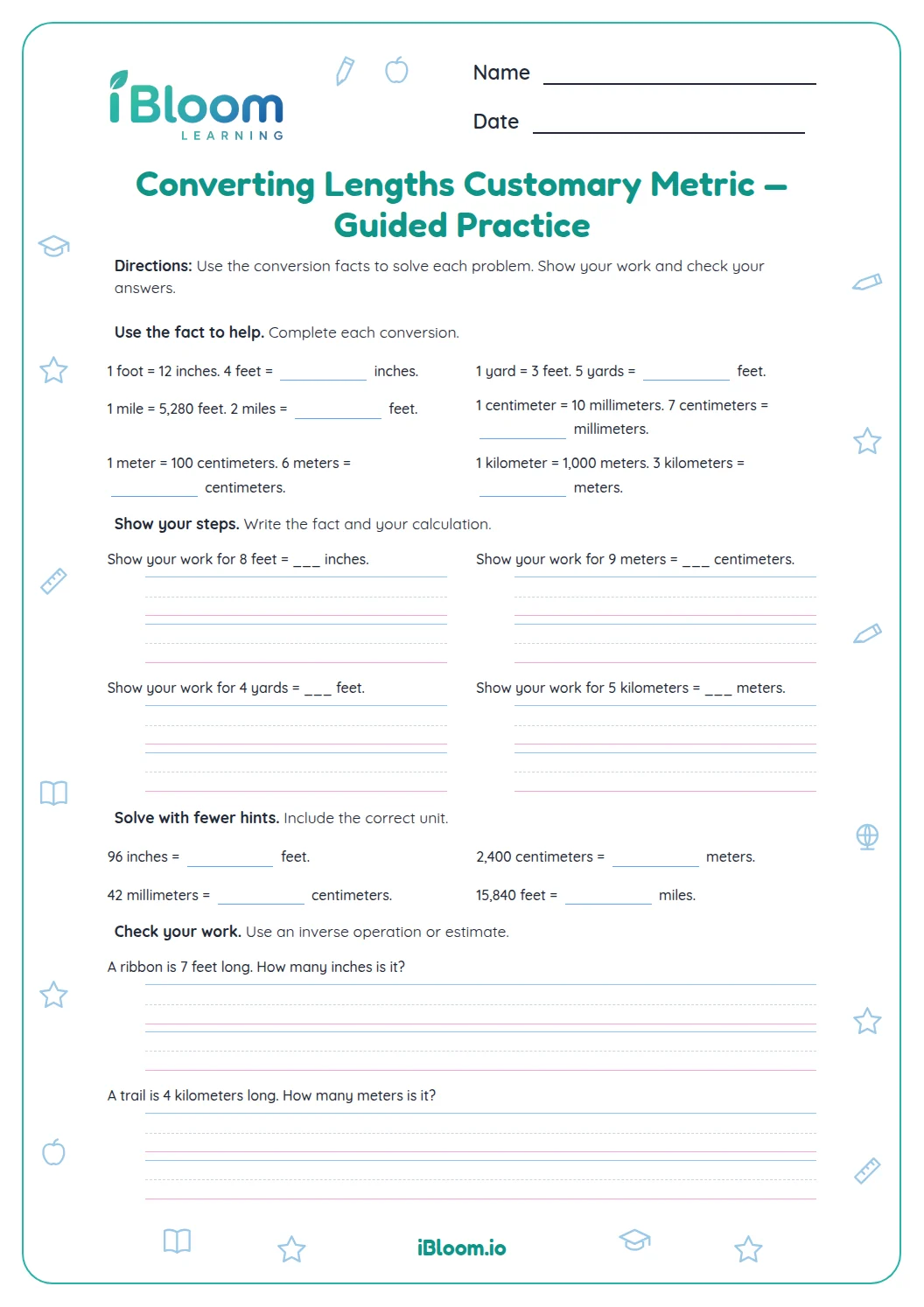
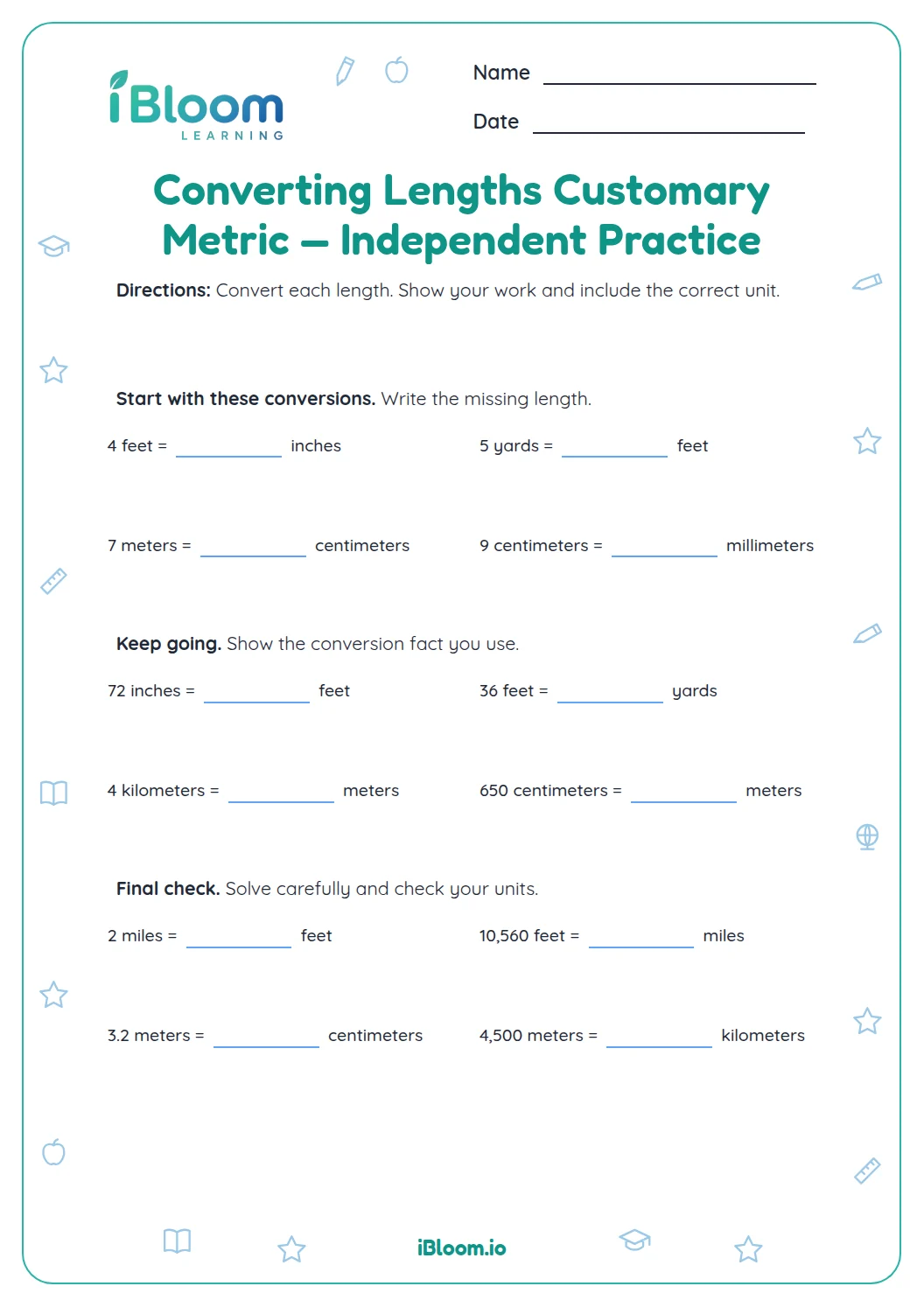
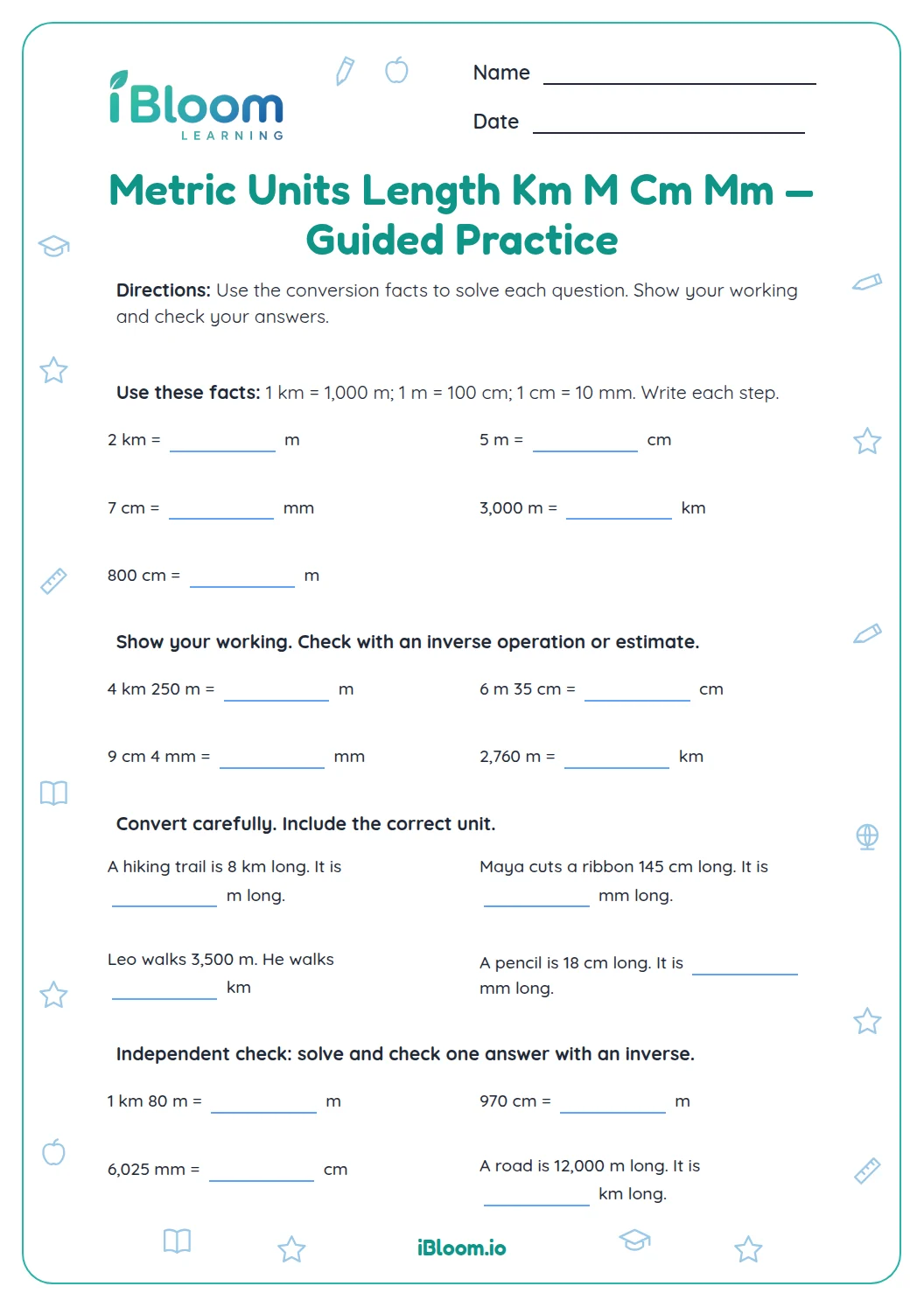
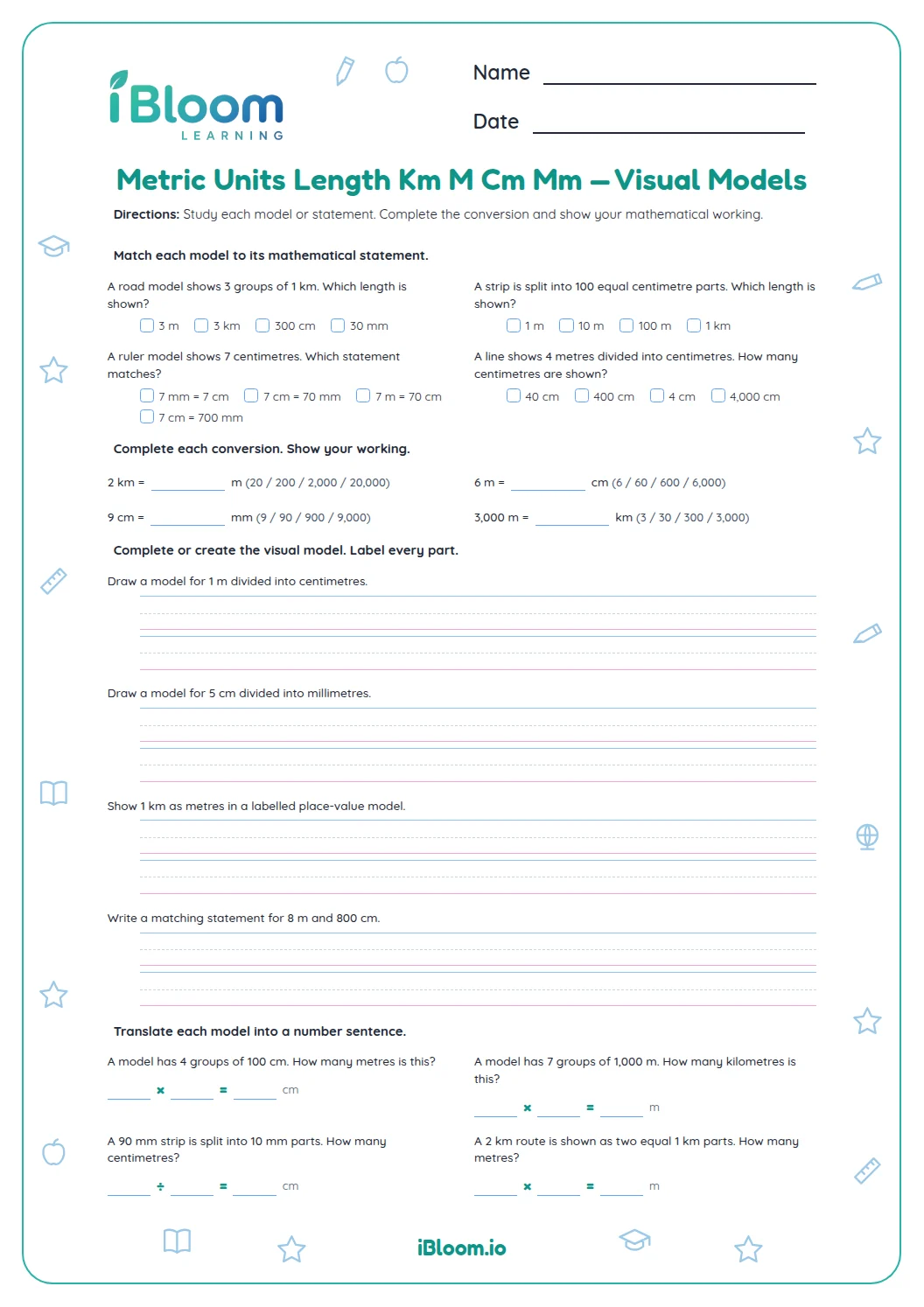
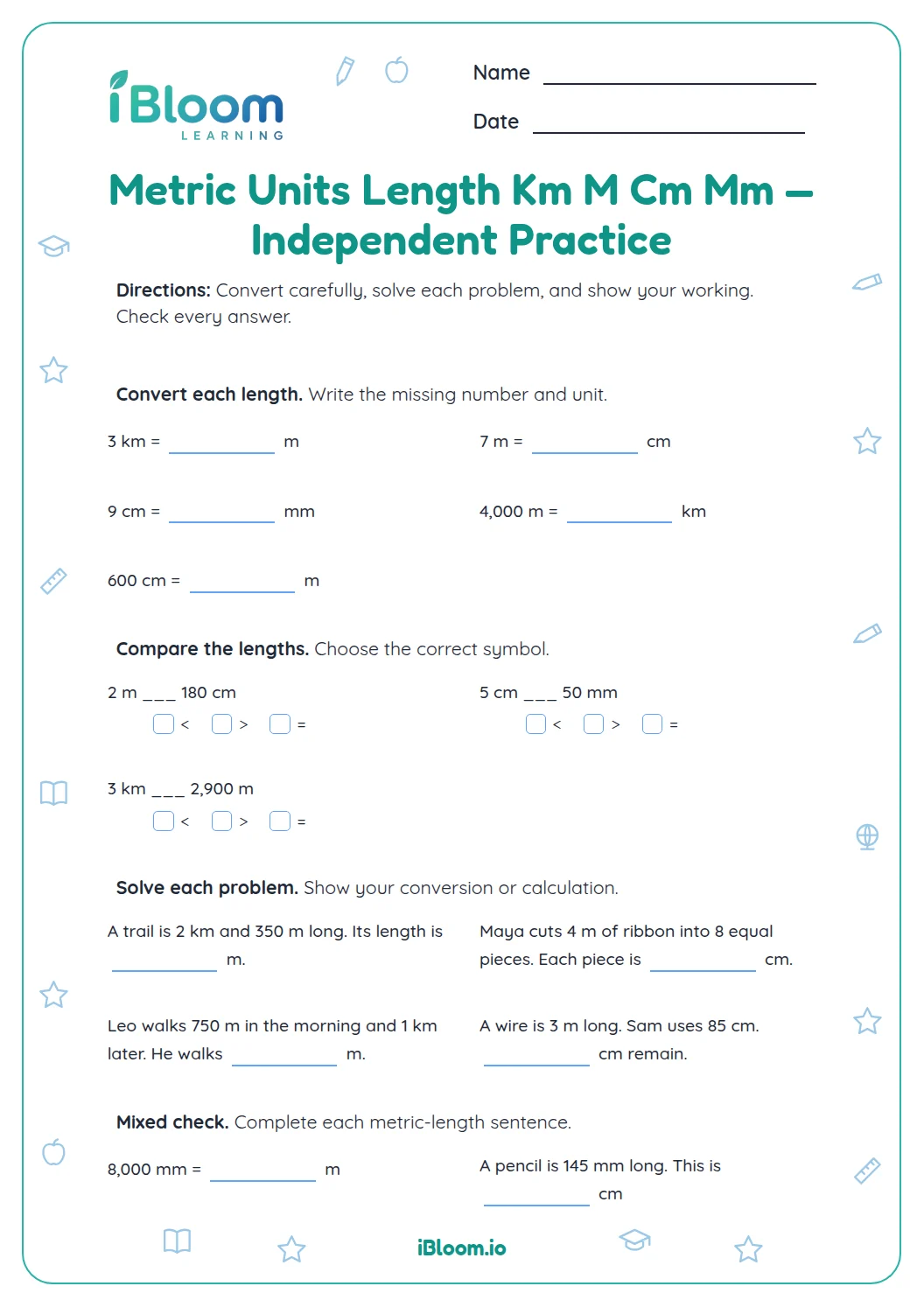
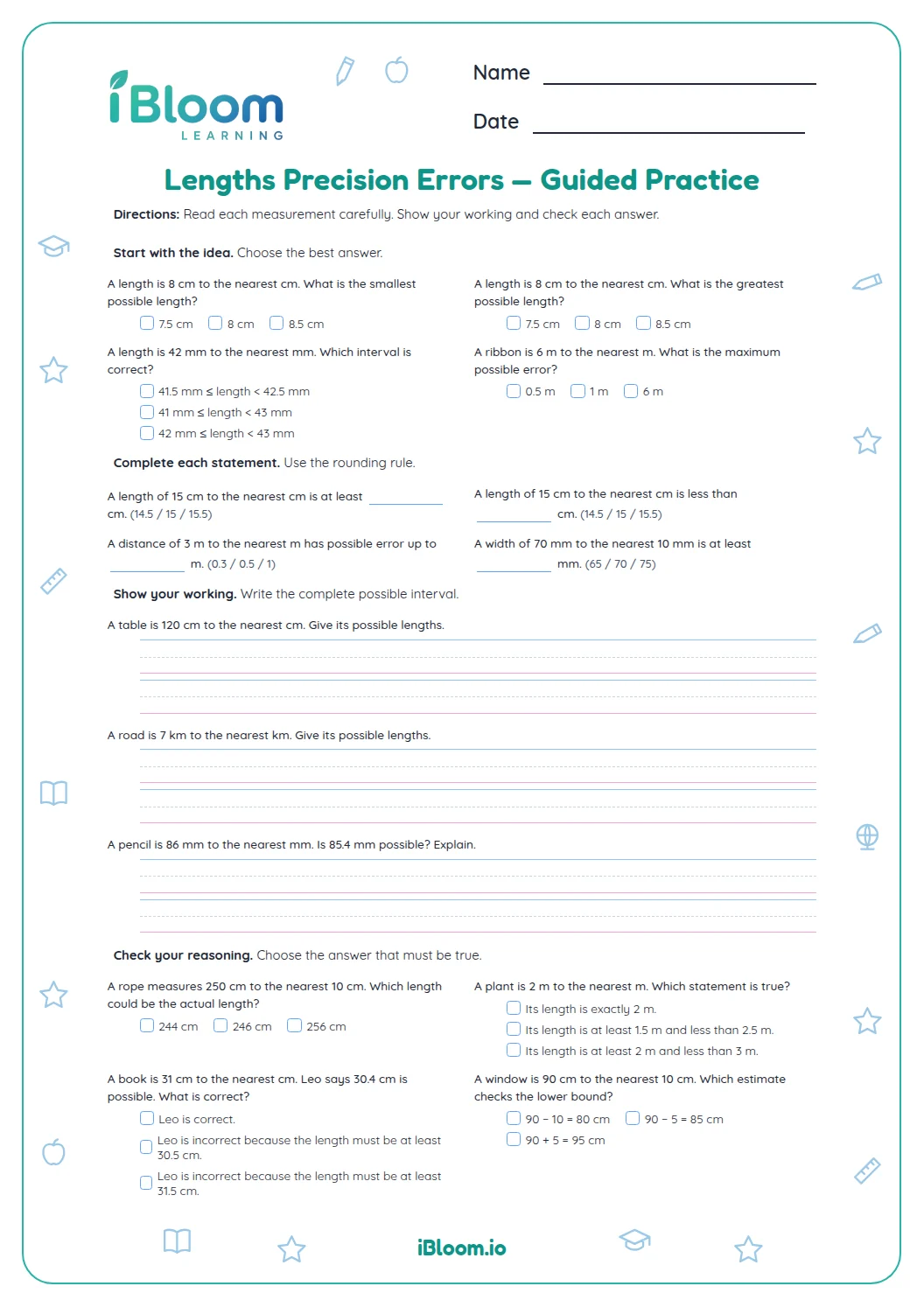
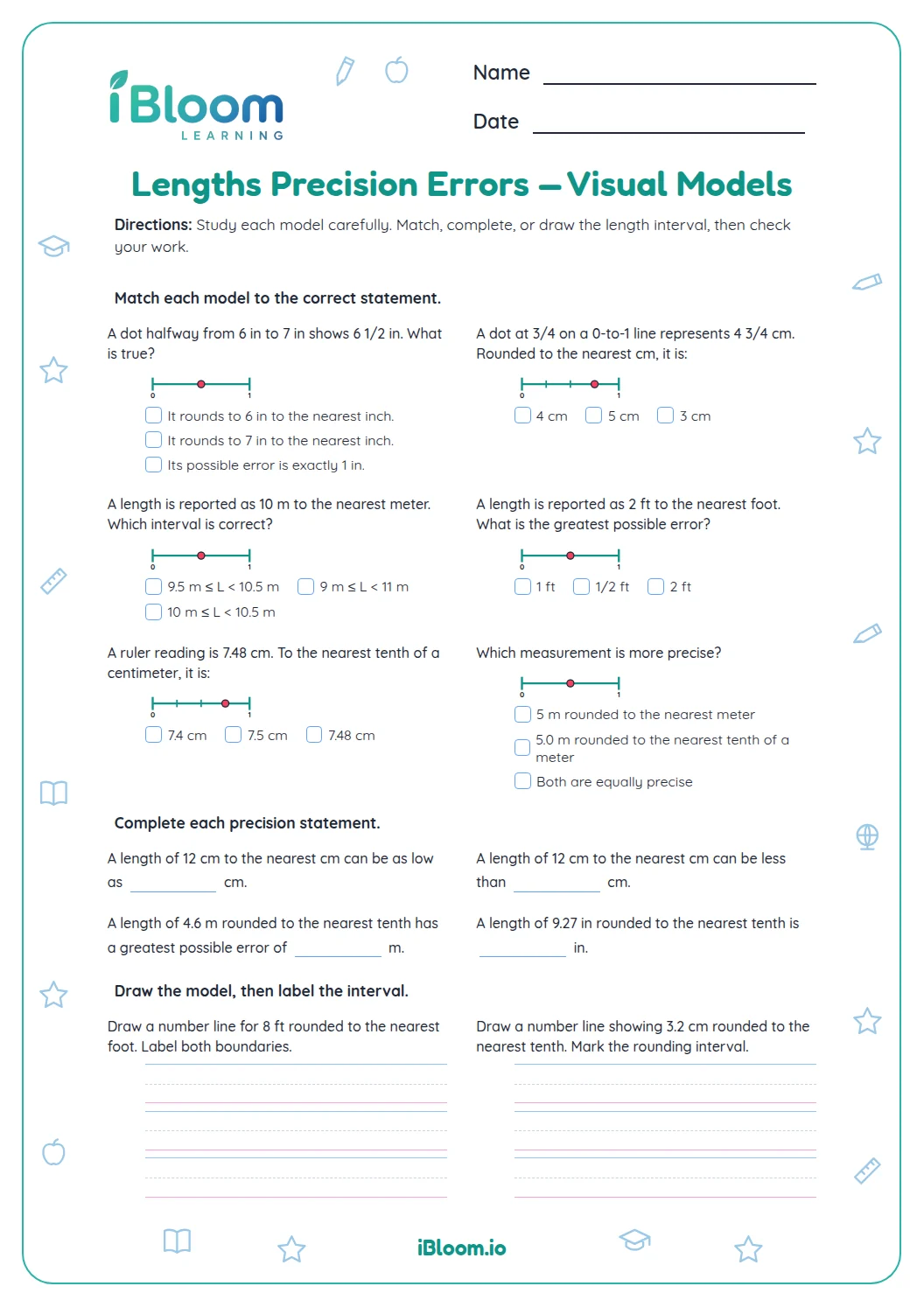
This Grade 5 worksheet practices metric length conversions among kilometers, meters, centimeters, and millimeters. Students complete tables, convert measurements, and solve multistep length problems across two pages, with a matching answer key.
Aligned to 5.MD.A.1
How do the tables show a conversion?
Each row uses a metric relationship to build an equivalent length. In question 1, 1 kilometer is 1,000 meters, so 3 kilometers is 3,000 meters.
When should you multiply or divide?
Moving to a smaller unit makes the number larger; moving to a larger unit makes it smaller. For example, 800 centimeters ÷ 100 = 8 meters.
How do you solve a two-step length problem?
Convert each part to a common unit before combining. Question 13 changes 2 kilometers to 2,000 meters, then adds 350 meters to get 2,350 meters.
How to work through this page
- 1Write the given amount and unit.
- 2Choose a conversion relationship from the table.
- 3Multiply for smaller units and divide for larger units.
- 4Convert both lengths to the same unit before combining.
- 5Check that the final unit matches the question.
Check these details
The mistake
Multiplying when changing to a larger unit.
The fix
Use division when fewer larger units fit the same length.
The mistake
Adding lengths with different units.
The fix
Convert both amounts to one unit first.
The mistake
Leaving off a unit in a word problem.
The fix
Write the unit the question asks for.
Common Core alignment
Convert metric length units and use conversions in multistep problems.
On this sheet:
Show the official wordingHide the official wording
Convert among different-sized standard measurement units within a given measurement system (e.g., convert 5 cm to 0.05 m), and use these conversions in solving multi-step, real world problems.
What to practice next
Make more practice
Further reading
Questions parents and teachers ask
Which metric units appear?
The worksheet uses kilometers, meters, centimeters, and millimeters. The tables show relationships such as 1 kilometer = 1,000 meters and 1 meter = 100 centimeters. Later questions combine those facts in single-step and multistep problems. Students also use 1 centimeter = 10 millimeters when switching to the smallest unit on the page.
When should a child multiply during a conversion?
Multiply when changing to a smaller unit, because more of those units fit into the same length. For example, 3 meters is 300 centimeters. When changing centimeters to meters, divide by 100 because a meter is the larger unit.
How do the tables help?
A conversion table displays equivalent lengths in two units. Students can use a known row to see the scale factor, then apply it to another amount. The first four questions use tables for kilometers, meters, centimeters, and millimeters.
How do you combine kilometers and meters?
Convert the kilometers to meters, then add the meter amount. For question 13, 2 kilometers equals 2,000 meters, and 2,000 + 350 = 2,350 meters. Keeping one unit through the calculation makes the result easier to check. Write the unit after the final value so the answer is clear.
How many questions and pages are included?
The printable contains 20 questions on two worksheet pages, followed by a two-page answer key. Students complete conversion tables, convert single measurements, and solve short length problems using metric units. The questions progress from the displayed relationships to applying them independently in familiar contexts.