
About this worksheet
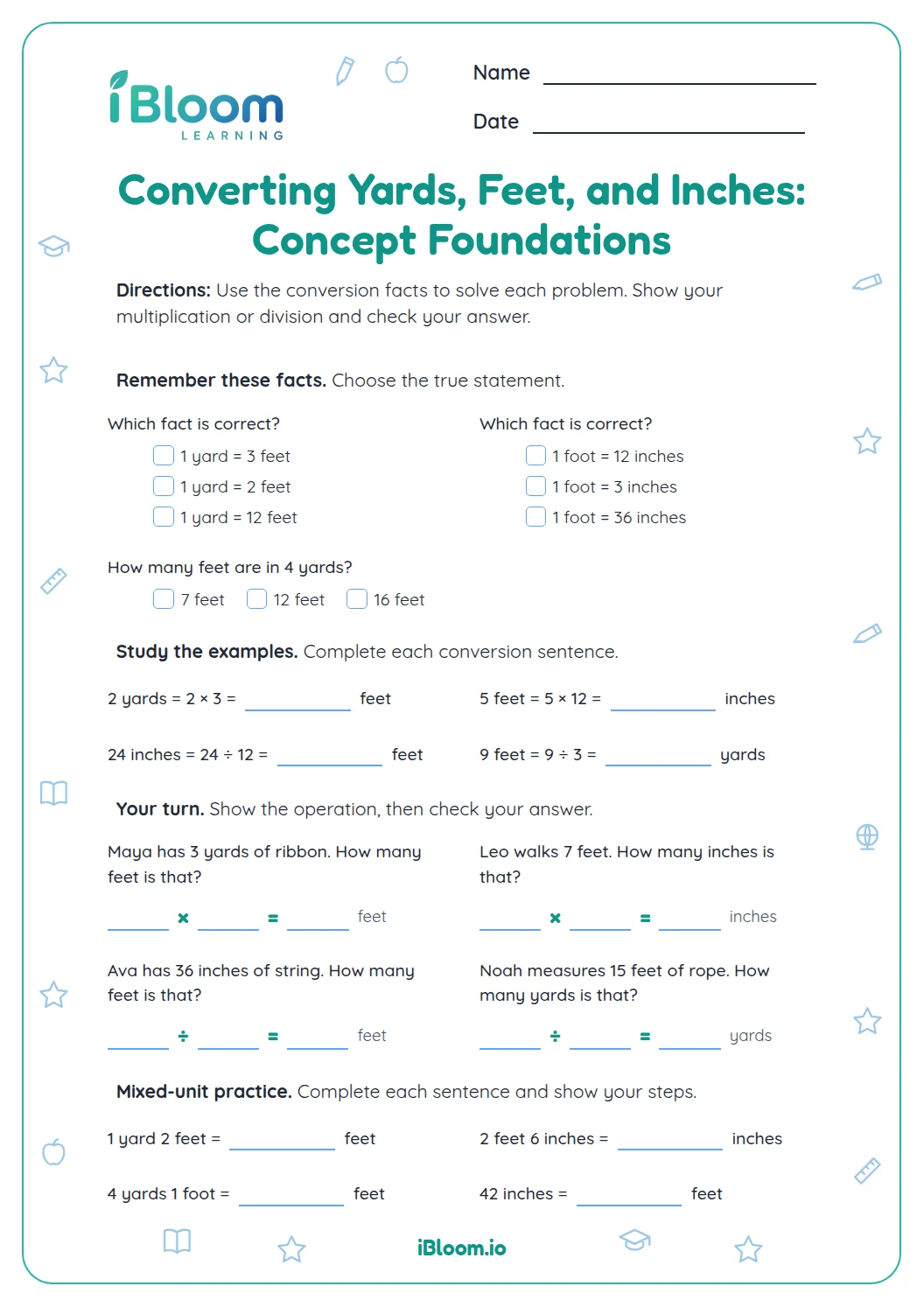
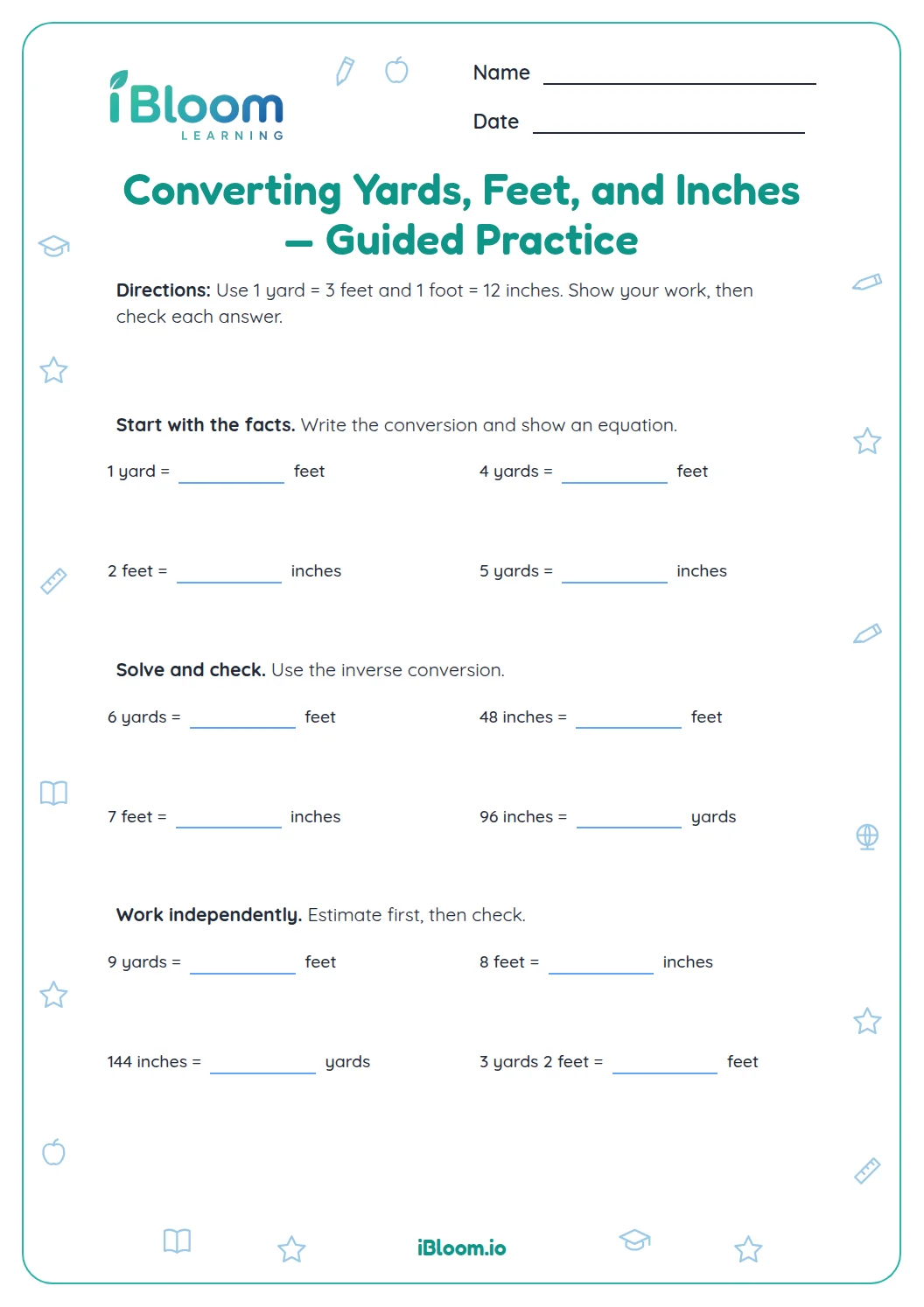
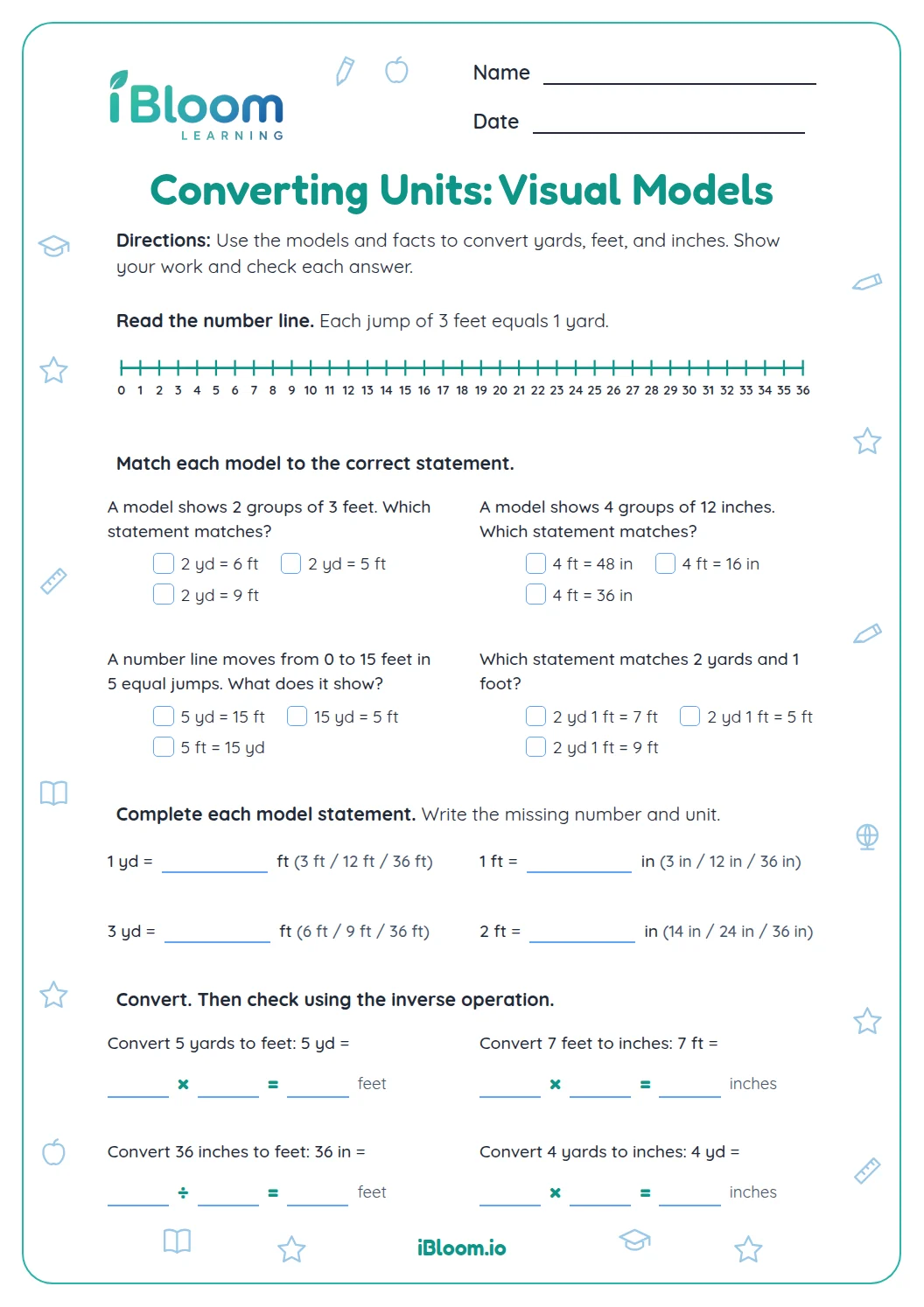
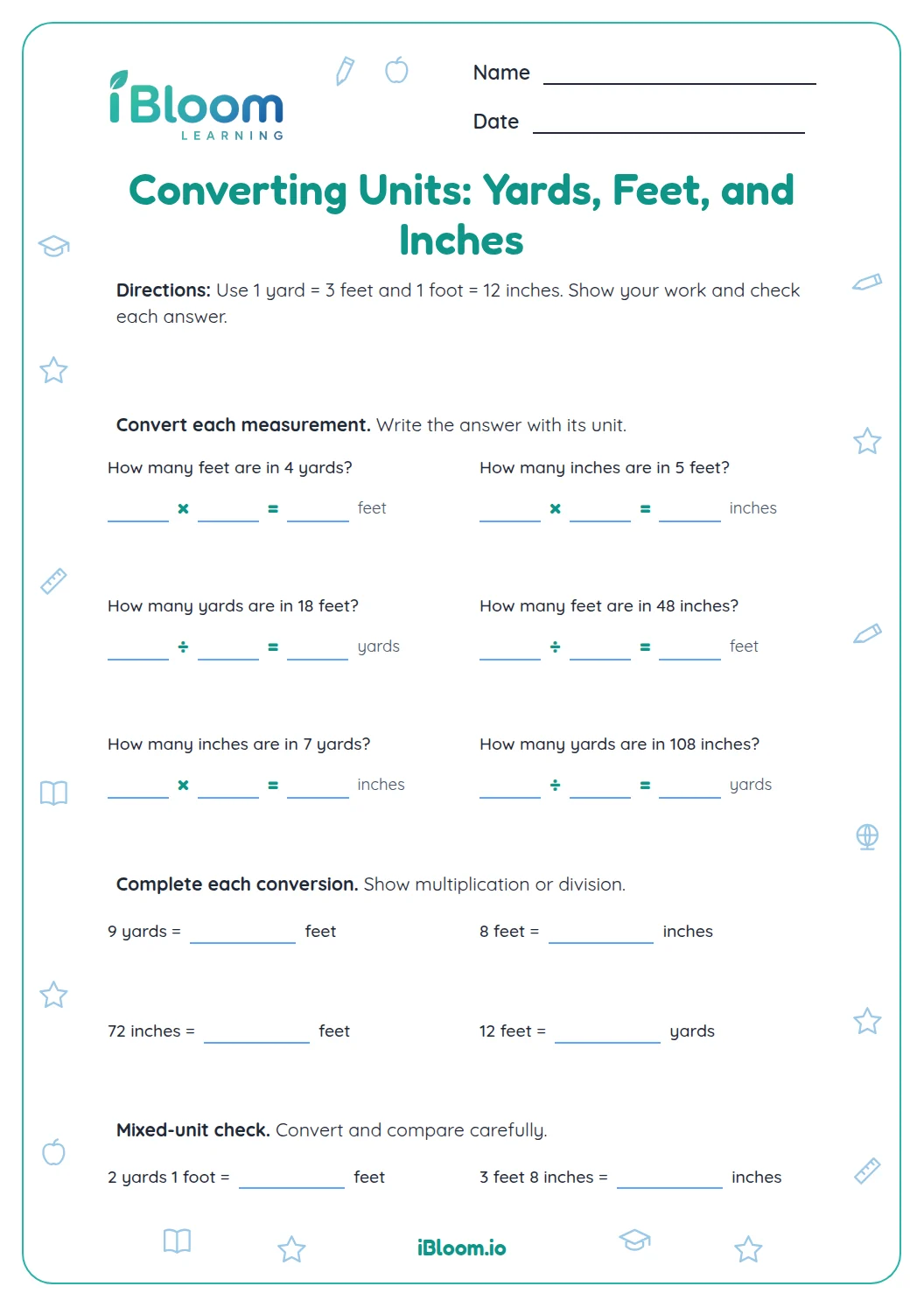
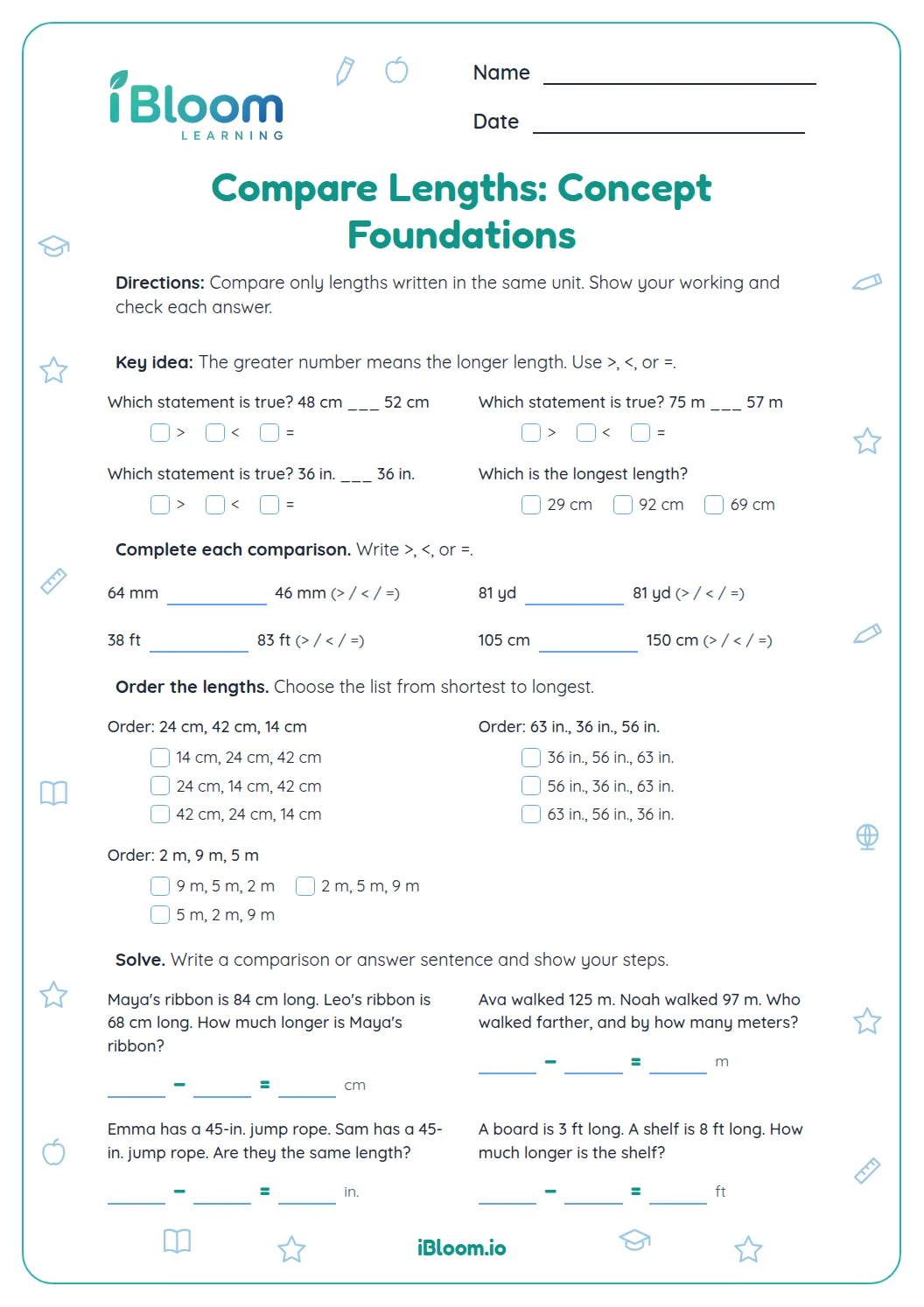
This free printable Grade 5 worksheet pairs length conversion practice with six real-world problems. Students complete eight rows of equivalent measurements, using meters and centimeters in Part A and yards and feet in Part B. Part C applies those conversions to ribbon, strips, rope, banner trim, and a jump rope. Each problem combines a conversion with addition, subtraction, or multiplication, practicing Common Core 5.MD.A.1. The separate answer key supplies every missing value and the final measurements for the word problems.
Aligned to 5.MD.A.1
What do the conversion rows record?
Each row pairs two measurements of the same length. Part A uses 1 meter = 100 centimeters. Part B uses 1 yard = 3 feet. The quantities change across the rows, but the conversion factor stays the same.
The rows include 0.75 meter, 2.4 meters, 2.5 yards, and 6.5 yards so that students also practice conversions with decimals.
How do I solve the ribbon problem?
Question 9 gives the starting length in meters and the cut piece in centimeters. Convert the starting length before subtracting. The remaining ribbon must be shorter than 240 centimeters.
- 12.4 × 100 = 240 cm
- 2240 − 65 = 175 cm
- 3Check: 175 + 65 = 240 cm = 2.4 m
How can students check the units and the answer?
A smaller unit requires more units to describe the same length: 2.5 yards is 7.5 feet. The rope is not longer after conversion; its measurement uses smaller pieces.
In Part C, underline the requested unit before calculating. The banner problem uses two equal lengths, so convert one banner to feet and then double it, or double the yards first and then convert.
How to use this worksheet
- 1Read the two conversion facts in the Part A and Part B directions.
- 2Complete each row by multiplying meters by 100 or yards by 3.
- 3Underline the unit requested in each word problem.
- 4Write a conversion and a second operation in the working space.
- 5Check the result against the context, then compare with the answer key.
Mistakes to check and ways to help
The mistake
Subtracting 65 directly from 2.4 in the ribbon problem.
The fix
Convert 2.4 m to 240 cm first so both numbers describe centimeters.
The mistake
Writing 2.5 yd = 2.5 ft.
The fix
Each yard contains 3 feet, so multiply 2.5 by 3 to get 7.5 ft.
The mistake
Giving 7.5 ft for the two banners.
The fix
That covers one banner. Multiply by 2 to include one long edge of each banner.
Common Core alignment
Convert lengths, then combine or subtract measurements in real-world problems.
On this sheet: Conversion rows establish equivalent lengths; four word problems use conversions and another operation.
Show the official wordingHide the official wording
Convert among different-sized standard measurement units within a given measurement system (e.g., convert 5 cm to 0.05 m), and use these conversions in solving multi-step, real world problems.
What to practice next
Make more practice
Further reading
Questions parents and teachers ask
Which conversions are printed on this worksheet?
The worksheet prints 1 meter = 100 centimeters and 1 yard = 3 feet in the section directions. Students complete four rows for each relationship. The same converted lengths appear in the real-world problems, so the completed rows become a useful reference while solving.
Does my child need to memorize conversion factors first?
No, both conversion factors are supplied on the worksheet. The task is to apply each relationship consistently, including to decimal quantities. Ask your child to explain why meters become a larger number of centimeters and yards become a larger number of feet before starting the word problems.
Why does 0.75 meter become 75 centimeters?
One meter contains 100 centimeters, so 0.75 of a meter contains 0.75 × 100, or 75, centimeters. In question 10, that converted length is joined to another 45 centimeters. Adding the two lengths gives 120 centimeters because the strips meet without overlapping.
What work should students show for the rope problem?
Students should show 6.5 × 3 = 19.5 feet, followed by 19.5 − 7 = 12.5 feet. The first step changes yards to feet, and the second finds the leftover length. They can check by adding the cut piece back to the leftover piece.
Does the key include answers for the word problems?
Yes, the separate key gives the four final measurements as well as all eight conversion values. Students should still use the working grids to show their own calculations. When checking, look for matching units before the operation and the correct unit beside the final answer.