
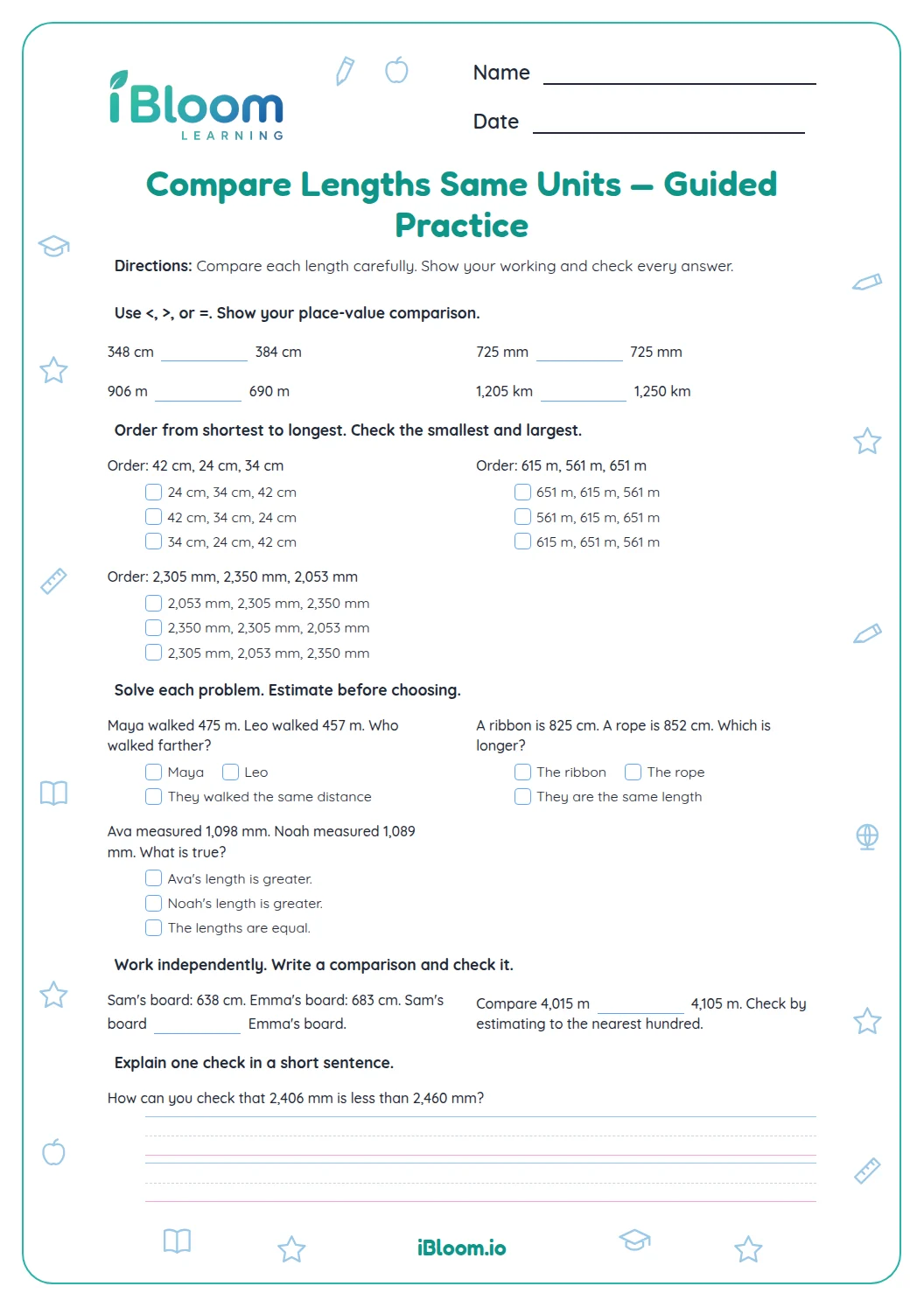
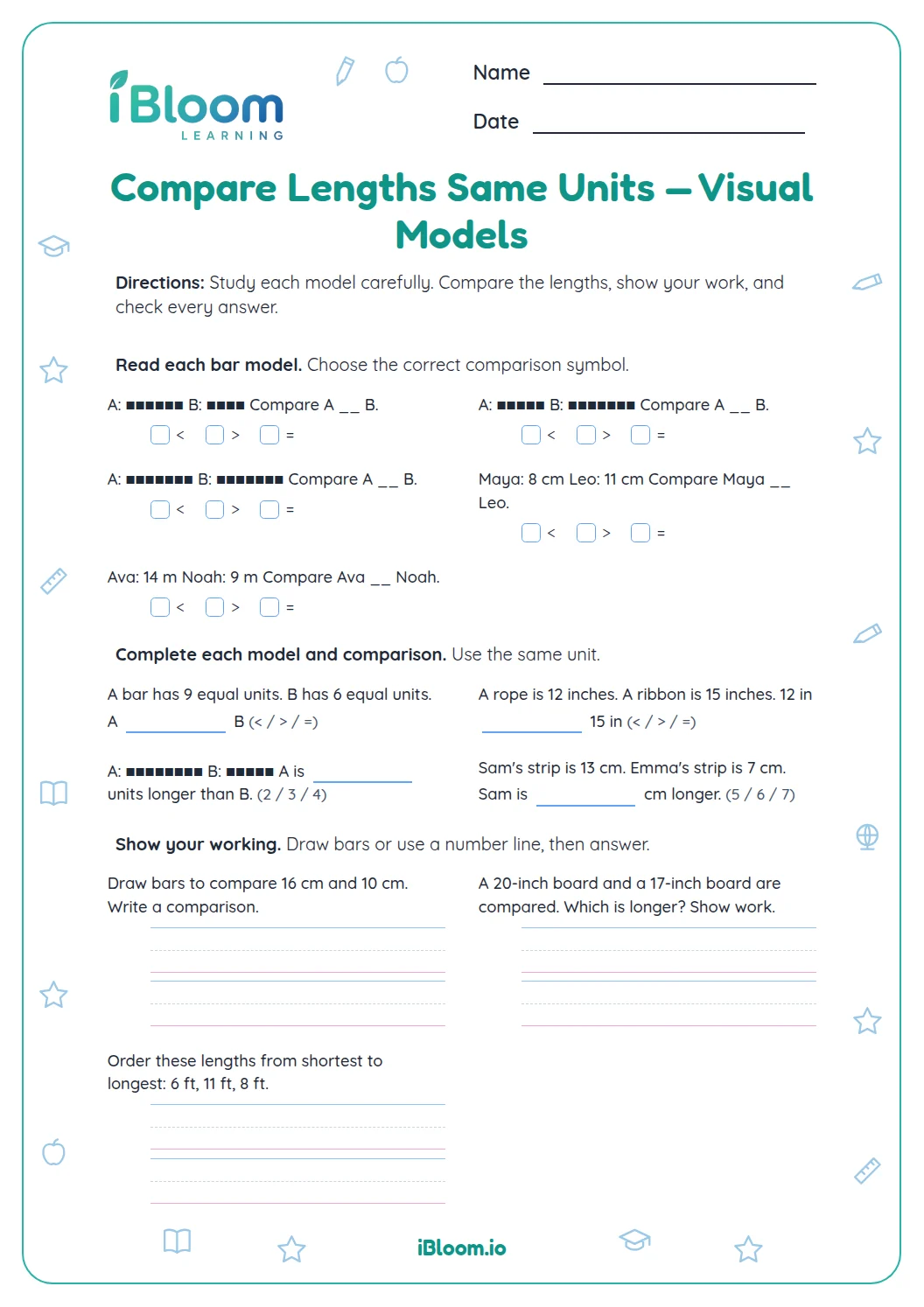
About this worksheet
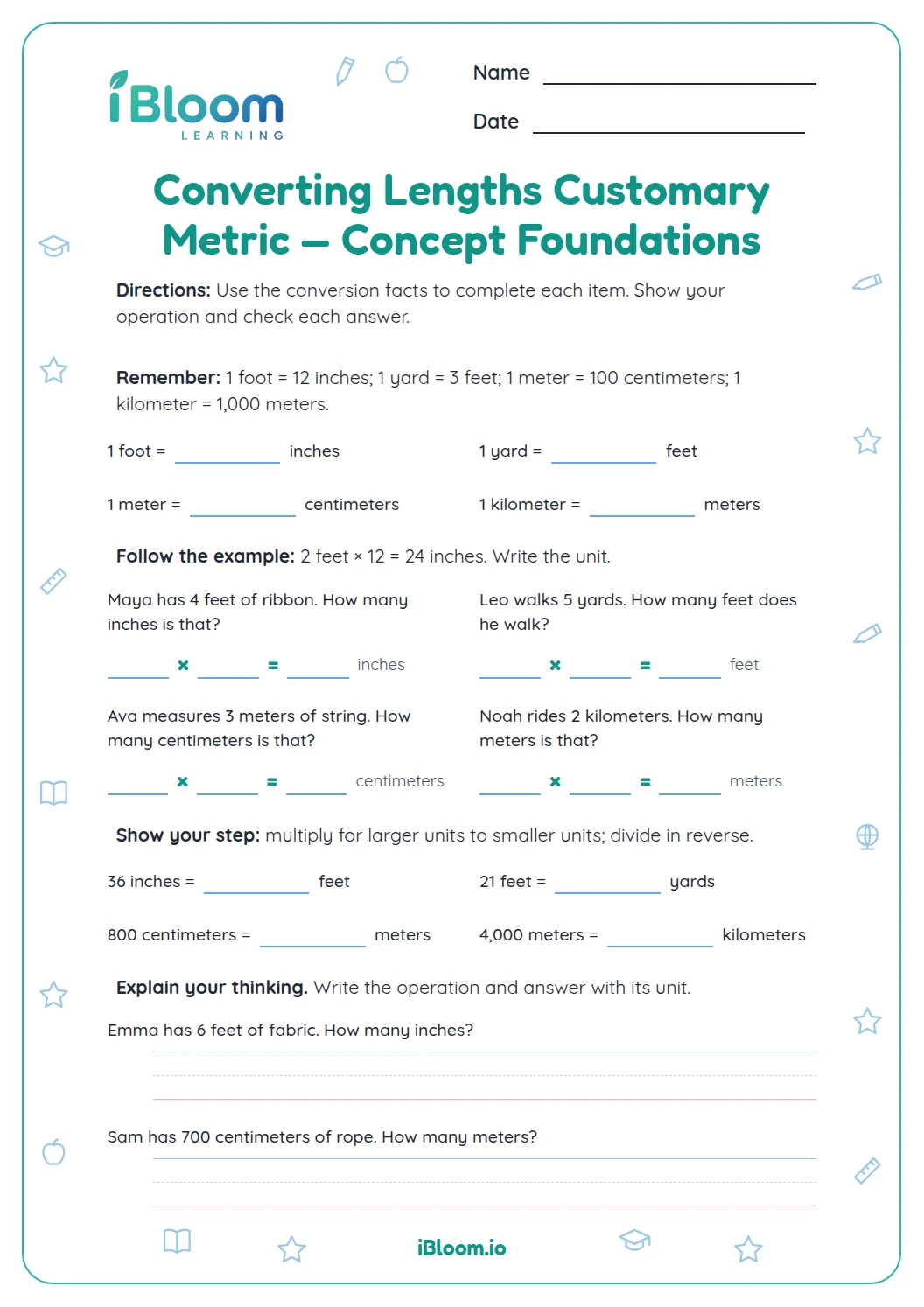
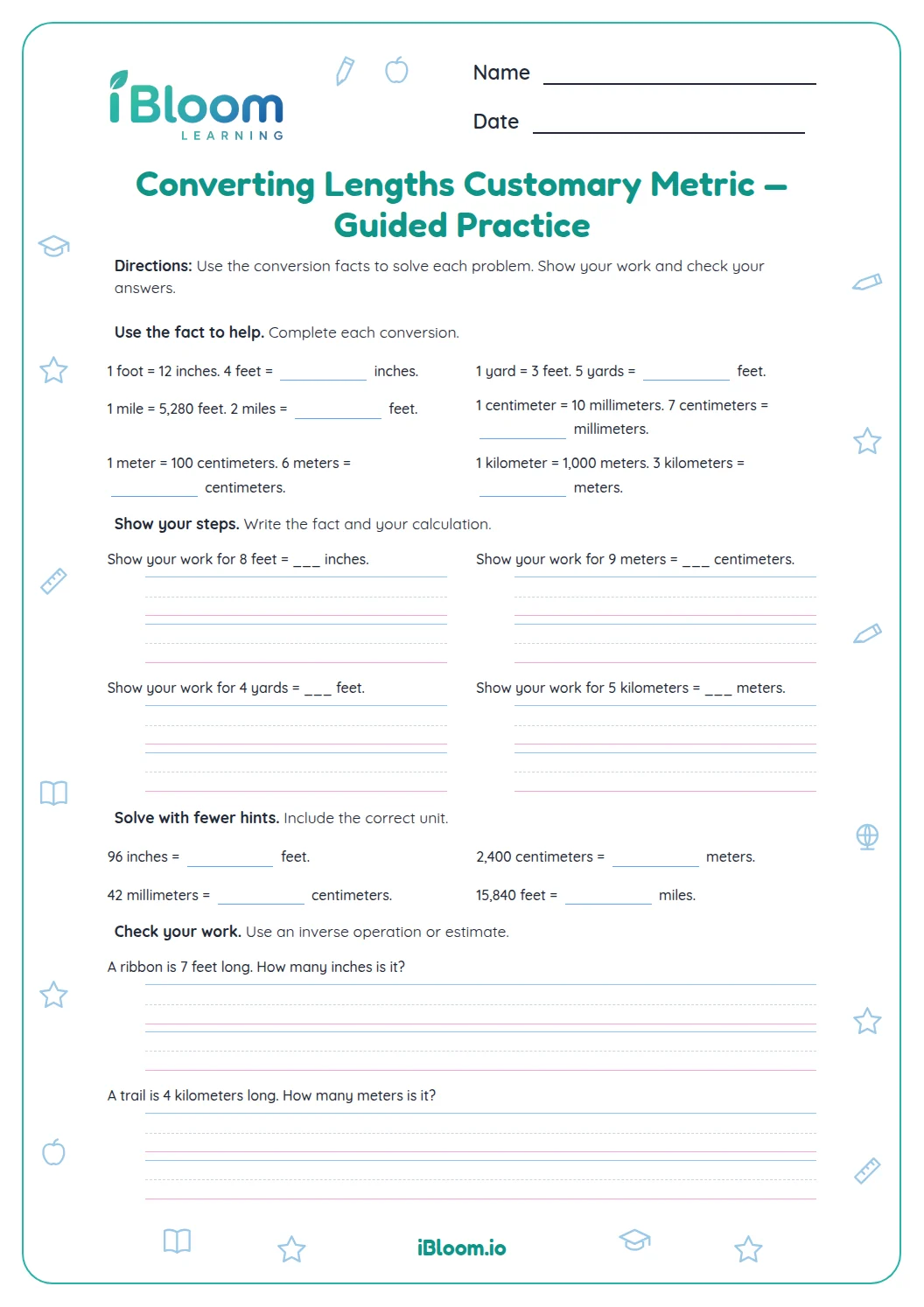
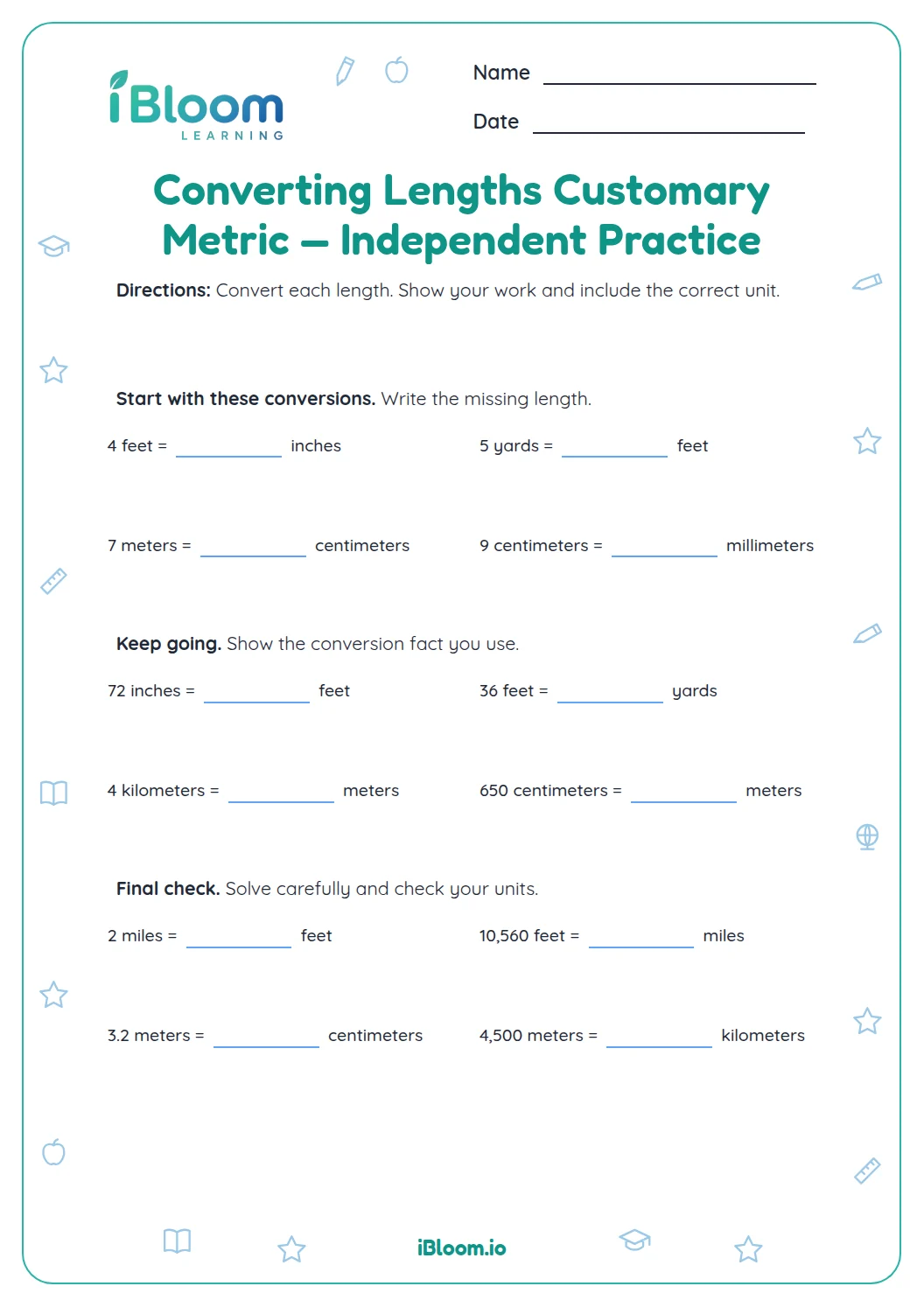
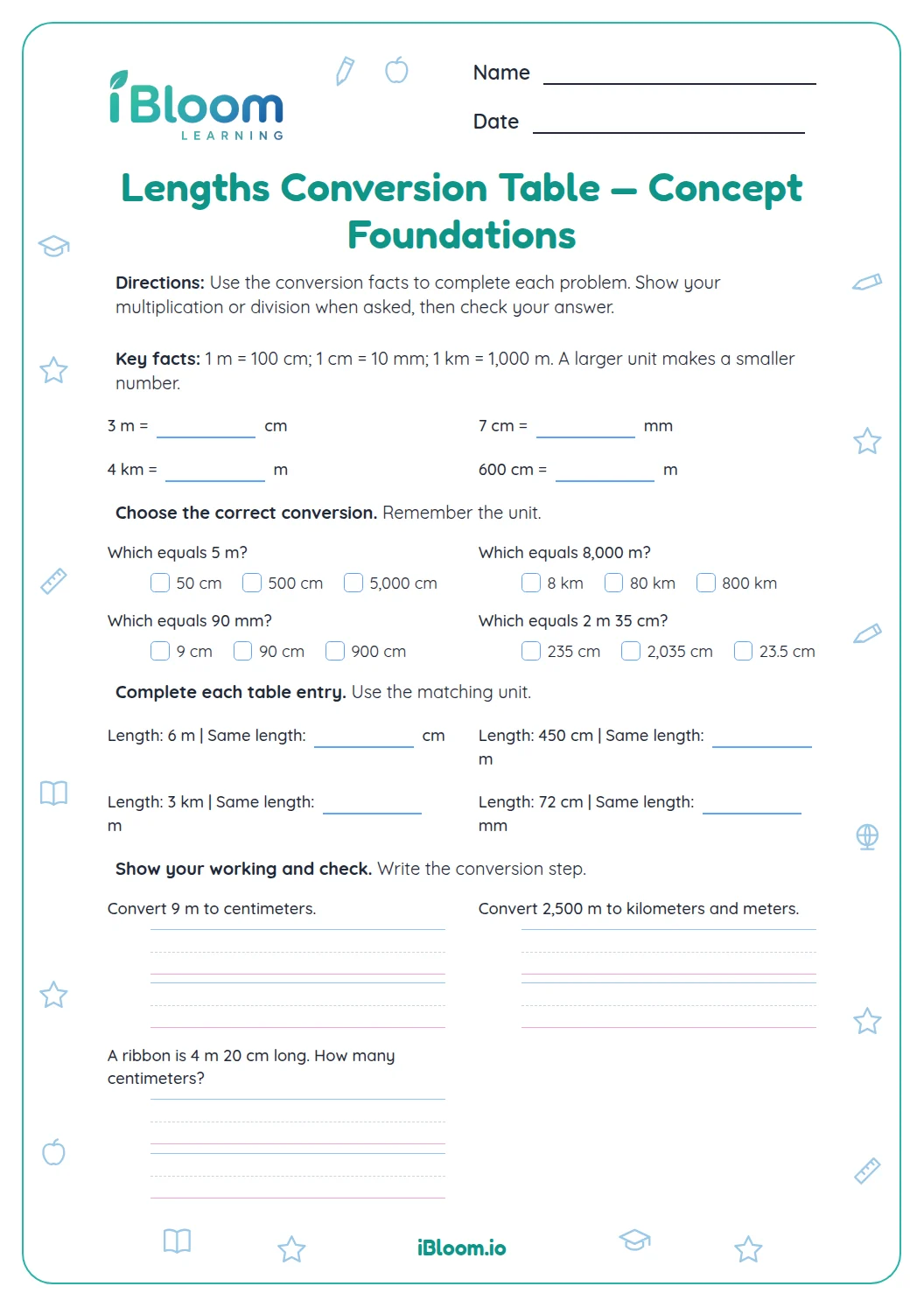
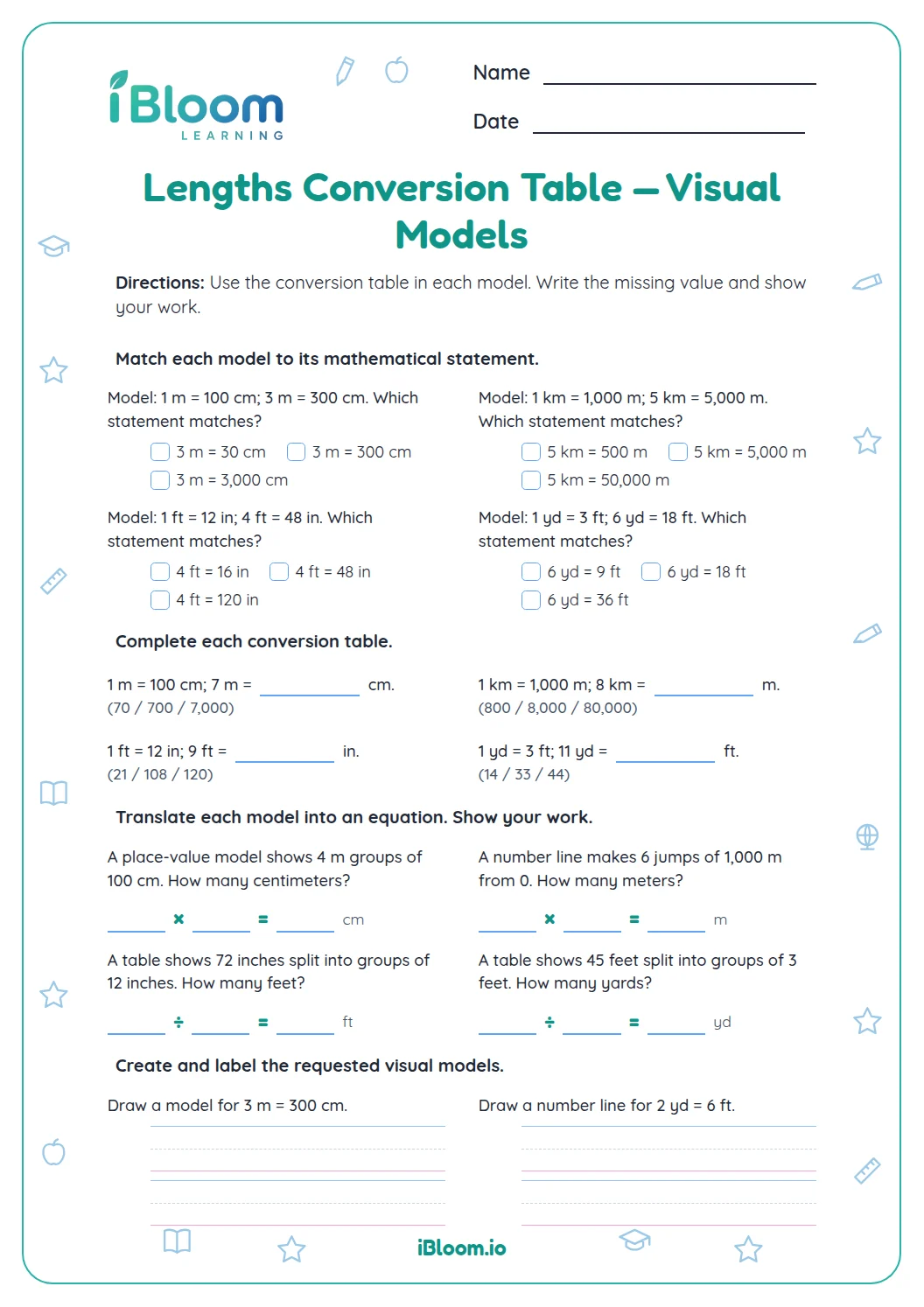
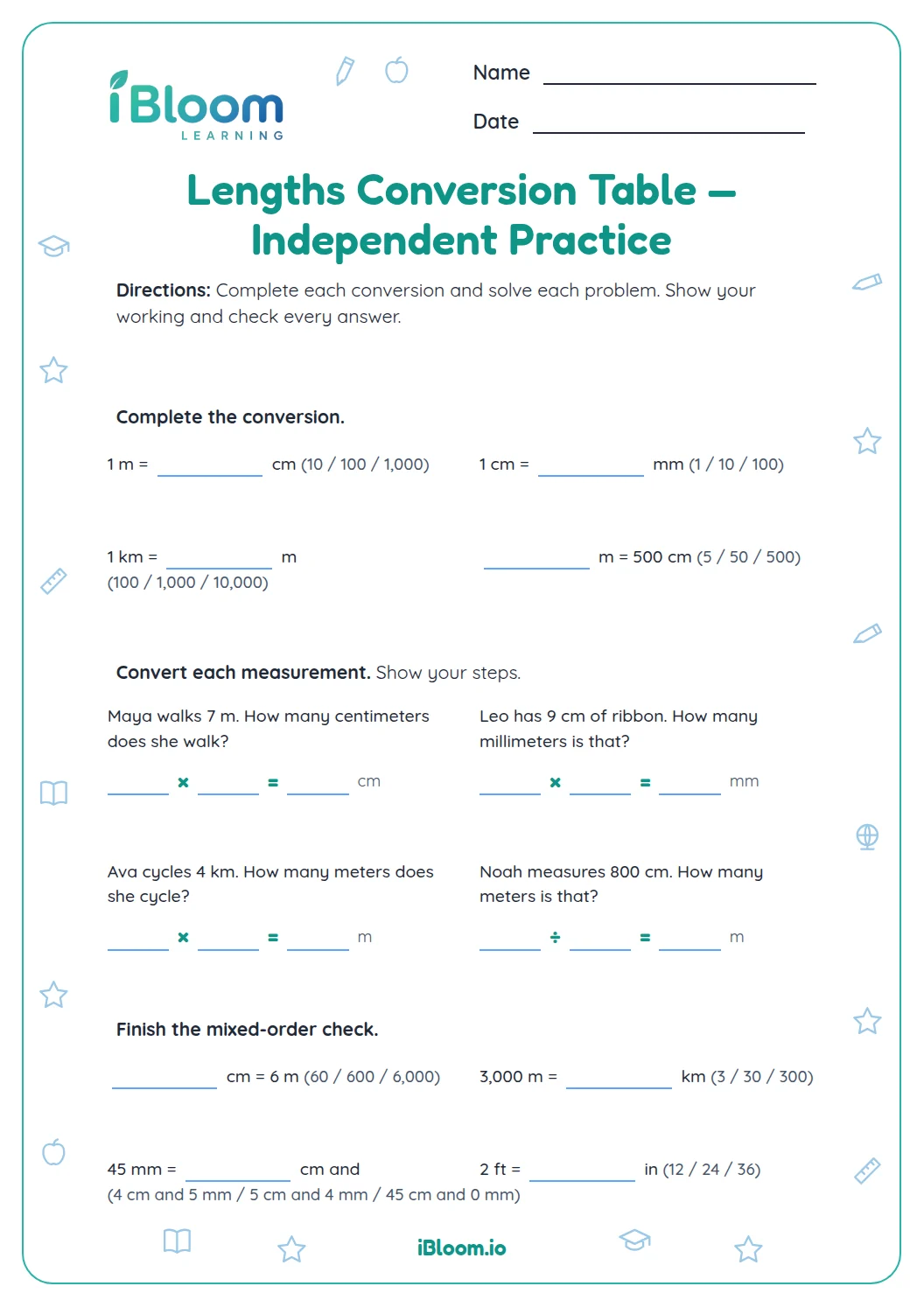
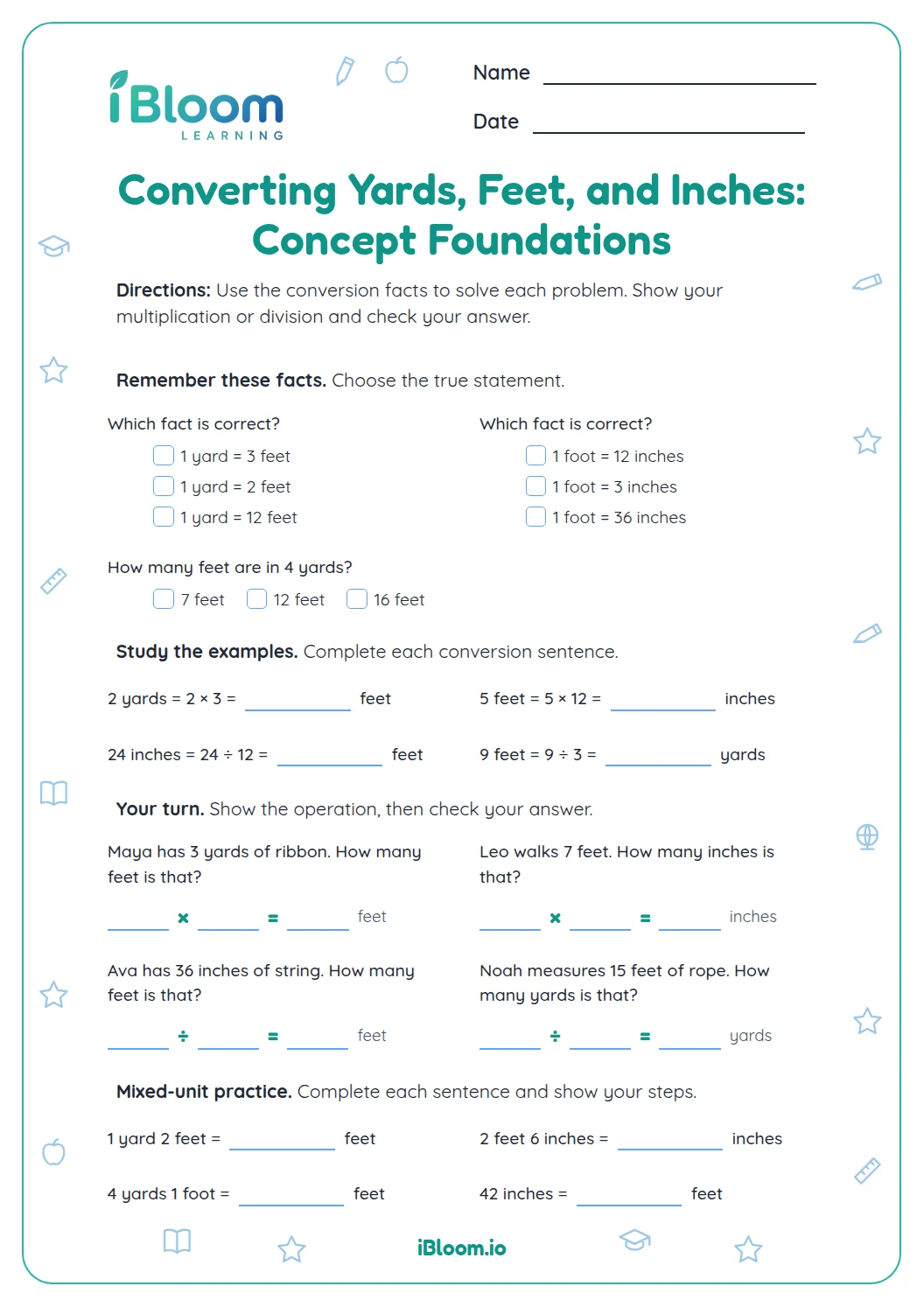
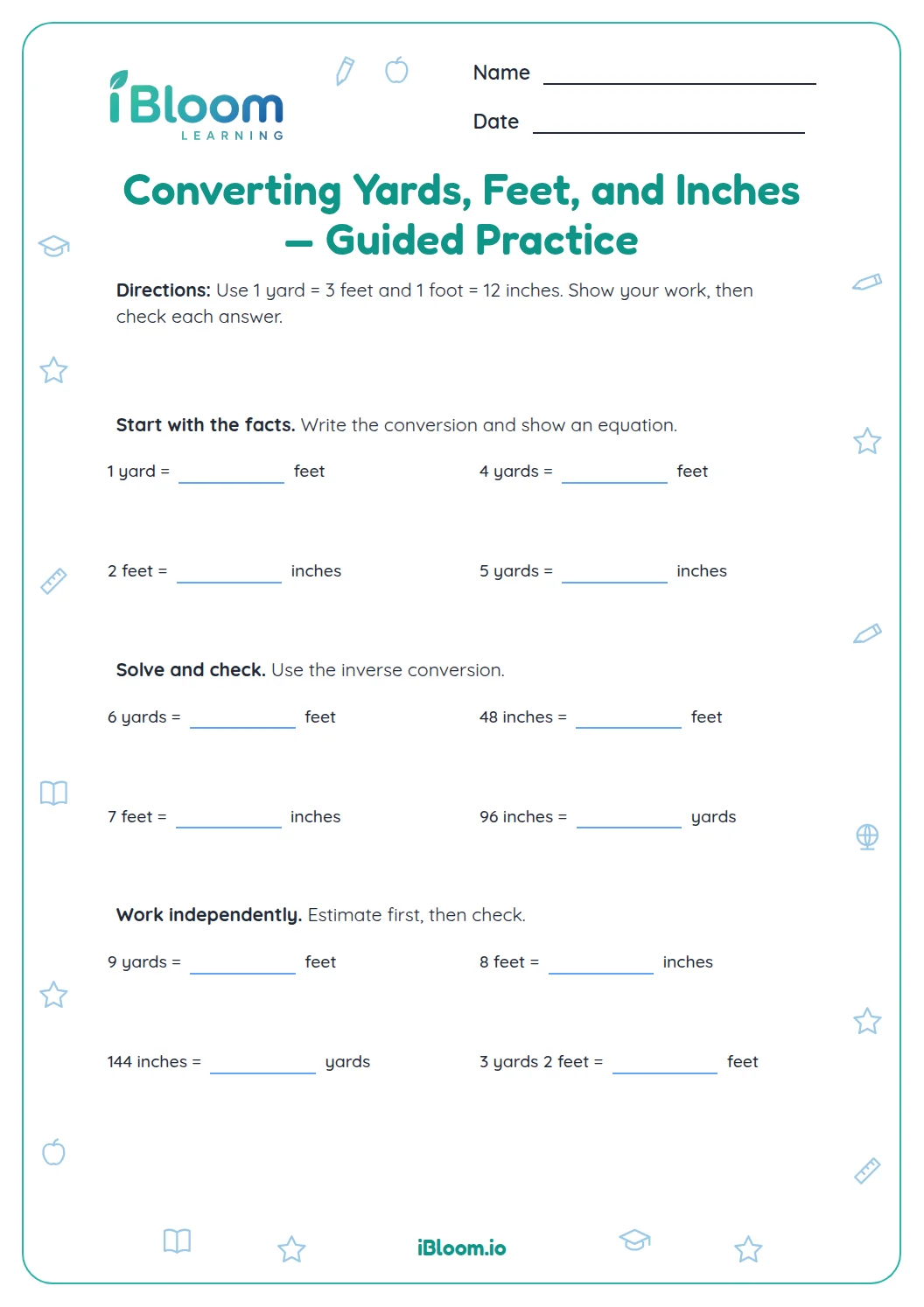
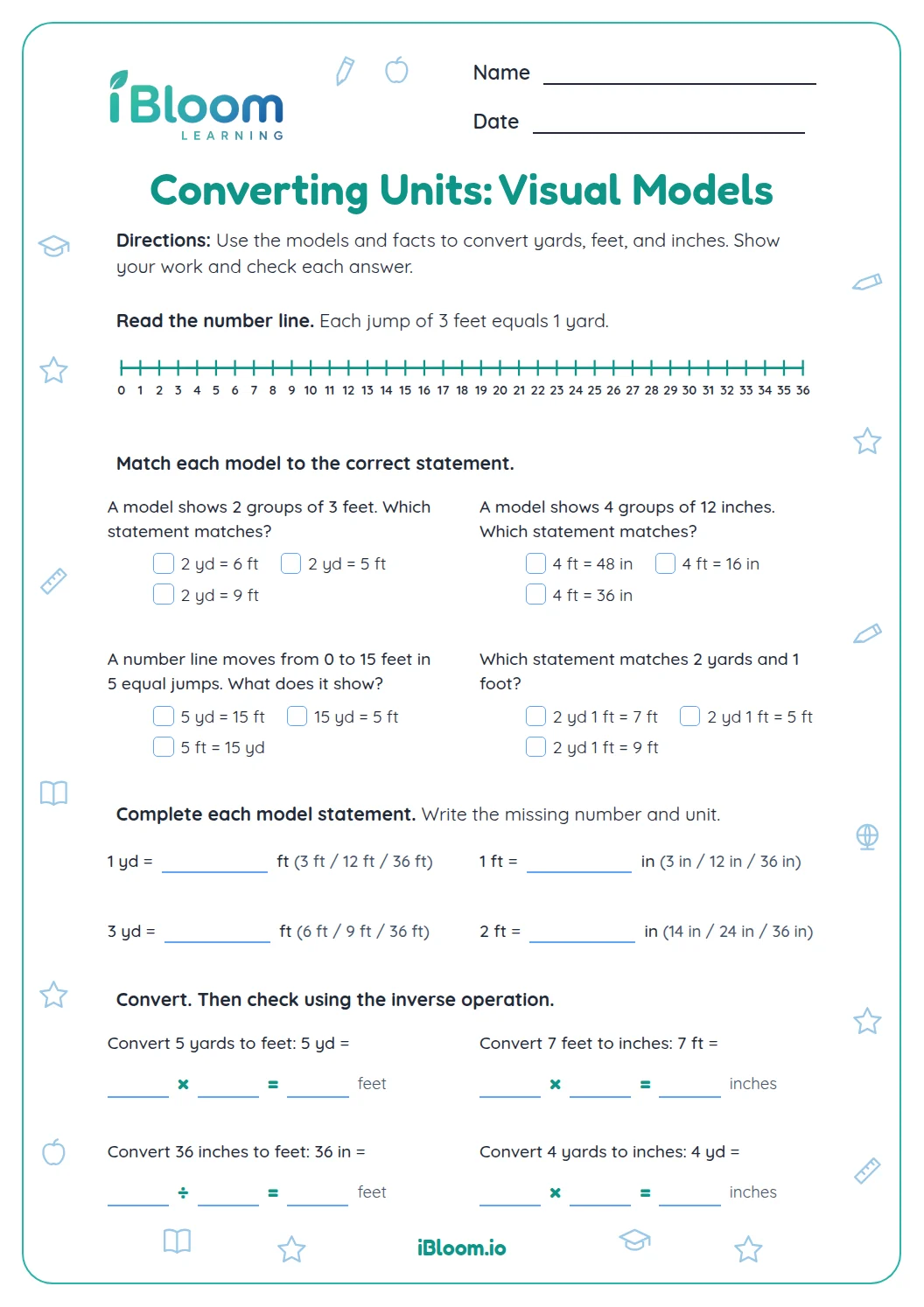
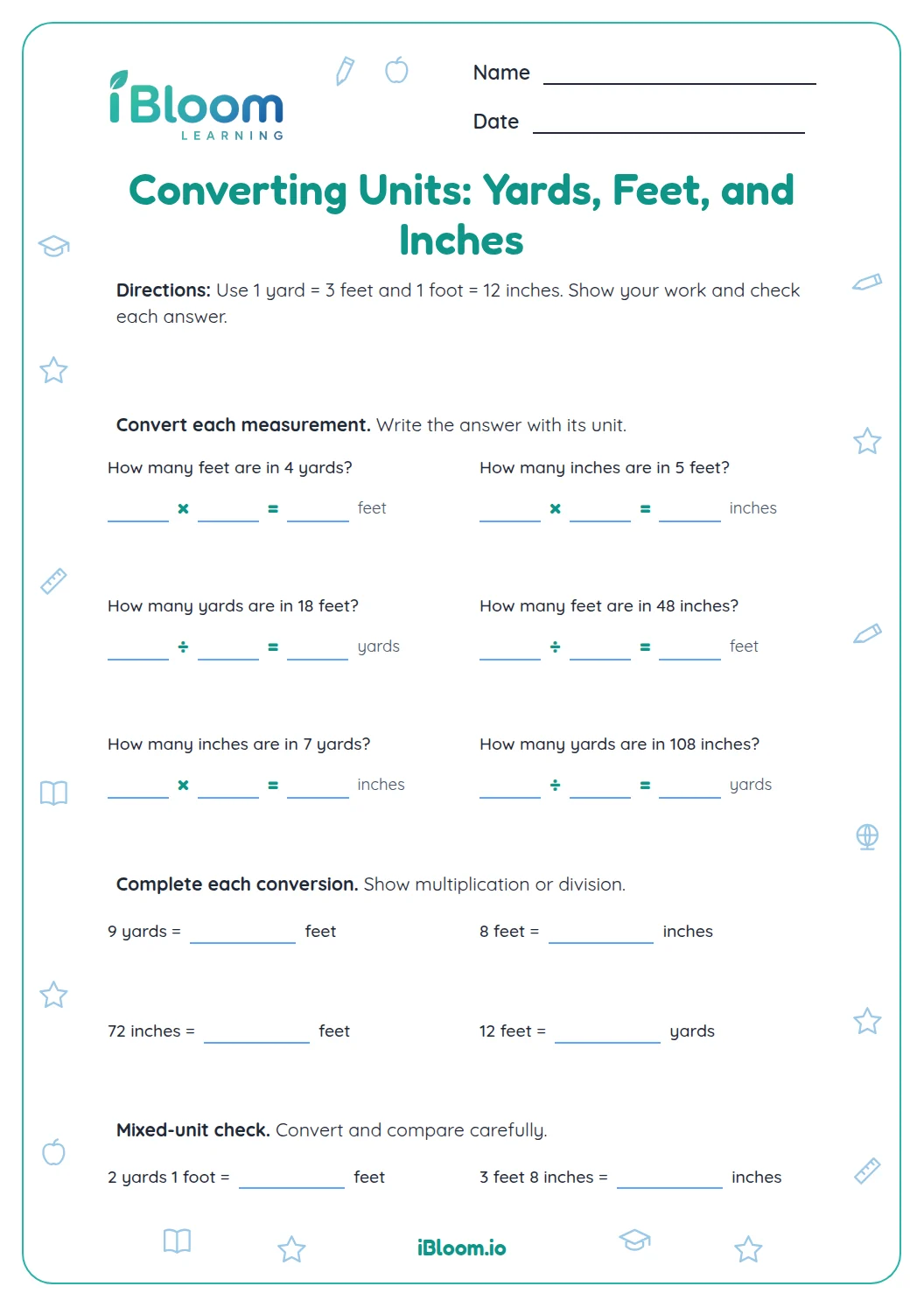
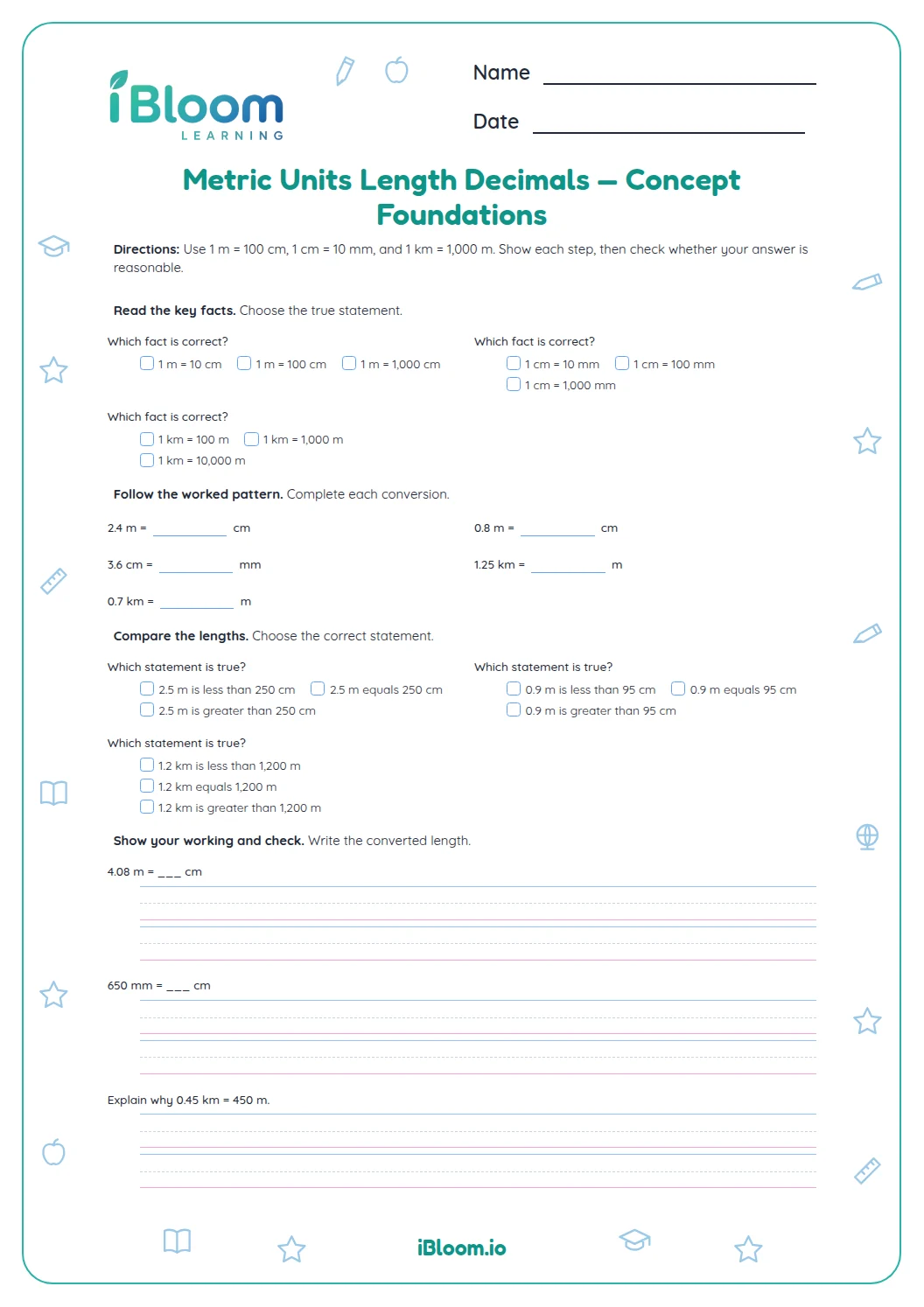
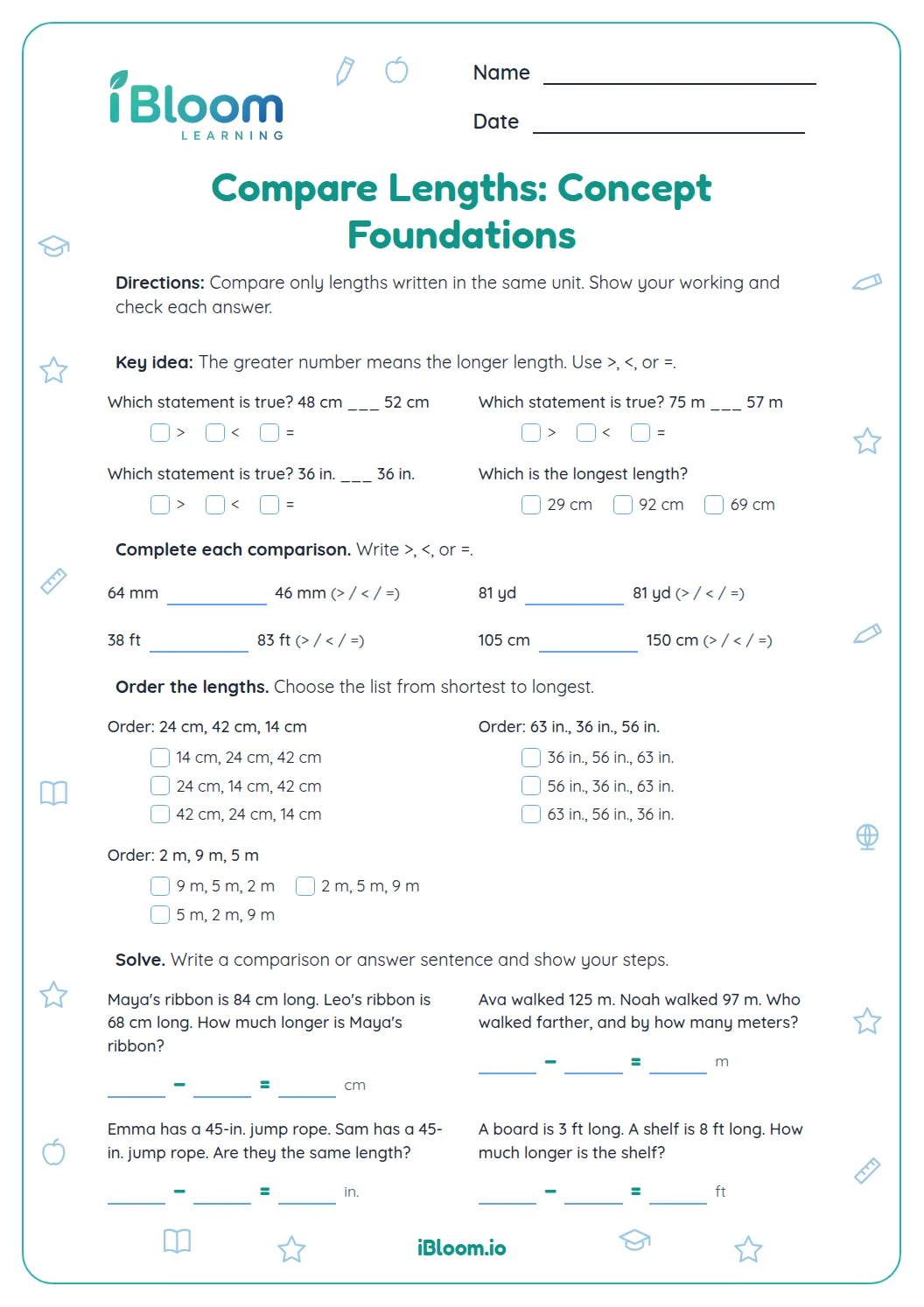
This free Grade 5 worksheet uses visual models to convert lengths within the customary and metric systems. Part A has four shaded bars; Part B has four number lines. Part C applies unit facts to two problems with more than one step. In Part D, students draw two models of their own. The 11 tasks practice Common Core 5.MD.A.1. Facts such as 1 foot = 12 inches and 1 kilometer = 1,000 meters stay visible, and the separate key gives answers and describes the expected drawings.
Aligned to 5.MD.A.1
What does one whole bar stand for?
The fact beneath each model names one whole bar. It can stand for one foot, one yard, one meter, or one kilometer. Equal parts of that bar represent equal lengths. Count every colored part, including a completely colored bar in question 4.
- 1One yard equals 3 feet.
- 2The bar has 3 equal parts, so each part is 1 foot.
- 3Two parts are colored: 2 × 1 = 2 feet.
How do students read and convert a number-line point?
Read the unit named in the prompt, then use the endpoints and equal intervals to find the dot. Question 5 places a dot at 48 inches. Each foot contains 12 inches, so 48 ÷ 12 = 4 feet.
Questions 7 and 8 go from smaller units to larger ones. For question 7, the line runs from 0 to 300 centimeters in three equal steps. The dot is at 200 centimeters, which makes 2 groups of 100 centimeters, or 2 meters.
When should students multiply or divide?
To express a length in smaller units, multiply by the number of smaller units in one larger unit. To find how many larger units fit, divide. The length stays the same even though the number changes.
In question 9, convert 7 feet to 84 inches before subtracting the 12-inch cut: 84 − 12 = 72 inches. In question 10, convert 1 kilometer to 1,000 meters, then add 250 meters to get 1,250 meters.
What should the two drawings show?
Question 11 asks for two models. First, draw two yard bars with three equal foot sections in each: 2 yards = 6 feet. Then draw three meter bars labeled 100 centimeters each: 3 meters = 300 centimeters.
The drawings show unit relationships, so the bars do not need to be life-size. Check that equal units have equal-sized parts and that each model includes its total and unit.
How to use this worksheet
- 1Name the length represented by one whole bar.
- 2Find one equal part, then count all colored parts.
- 3Read each number-line dot in the unit named beneath it.
- 4Use the printed fact to multiply or divide and change units.
- 5In Part C, convert before adding or subtracting lengths.
- 6Draw and label the Part D models, then check each answer and unit.
Mistakes to notice and fix
The mistake
Calling two-thirds of a yard 2 inches.
The fix
Each of the three parts represents a foot, so two parts represent 2 feet.
The mistake
Multiplying 200 centimeters by 100 to find meters.
The fix
Group the centimeters into hundreds: 200 ÷ 100 = 2 meters.
The mistake
Subtracting 12 inches directly from 7 feet.
The fix
First write 7 feet as 84 inches. Then 84 − 12 = 72 inches.
Common Core alignment
Convert customary and metric lengths and use conversions in multi-step problems.
On this sheet: Students convert within each system, then convert before subtracting or adding lengths in questions 9 and 10.
Show the official wordingHide the official wording
Convert among different-sized standard measurement units within a given measurement system (e.g., convert 5 cm to 0.05 m), and use these conversions in solving multi-step, real world problems.
What to practice next
Make more practice
Further reading
Questions parents and teachers ask
Which units are practiced?
The worksheet uses inches, feet, yards, centimeters, meters, and kilometers. It converts feet to inches, yards to feet, meters to centimeters, and kilometers to meters, with some questions reversing those directions. The printed unit facts help students connect the bars and number lines to each calculation.
Do children measure the printed bars with a ruler?
No, children use the labeled values to interpret each model. A whole bar stands for the length named in its prompt, regardless of its printed size. Read the equal parts or the number-line scale, then calculate the equivalent length using the unit fact supplied.
Why does question 4 have two bars?
Question 4 shows one whole kilometer and half of another kilometer. The whole bar represents 1,000 meters, and the half bar represents 500 meters. Students add both colored amounts to get 1,500 meters. Counting only the partly colored bar would leave out the first whole kilometer.
How should I check the two multi-step problems?
Check the conversion before the final operation. Question 9 starts with 7 feet, or 84 inches, and removes 12 inches to leave 72 inches. Question 10 combines 1,000 meters with 250 meters to make 1,250 meters. Ask students to keep the same unit throughout each addition or subtraction.
What counts as a correct drawing in Part D?
A correct drawing shows the groups and labels both totals in the requested units. The yard model needs two groups of three feet, totaling six feet. The meter model needs three groups of 100 centimeters, totaling 300 centimeters. Accept different bar sizes when equal parts and labels communicate those relationships.