

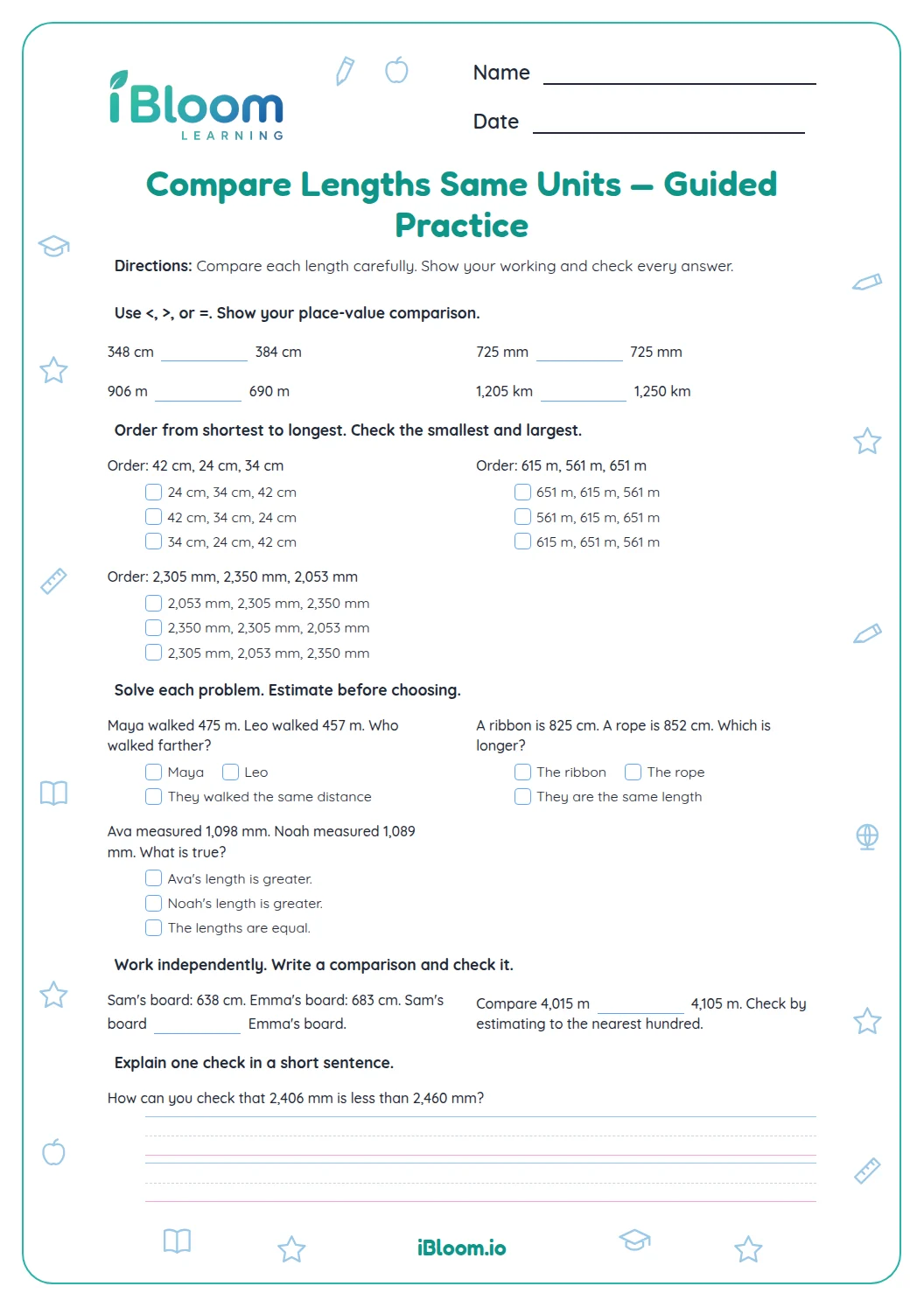
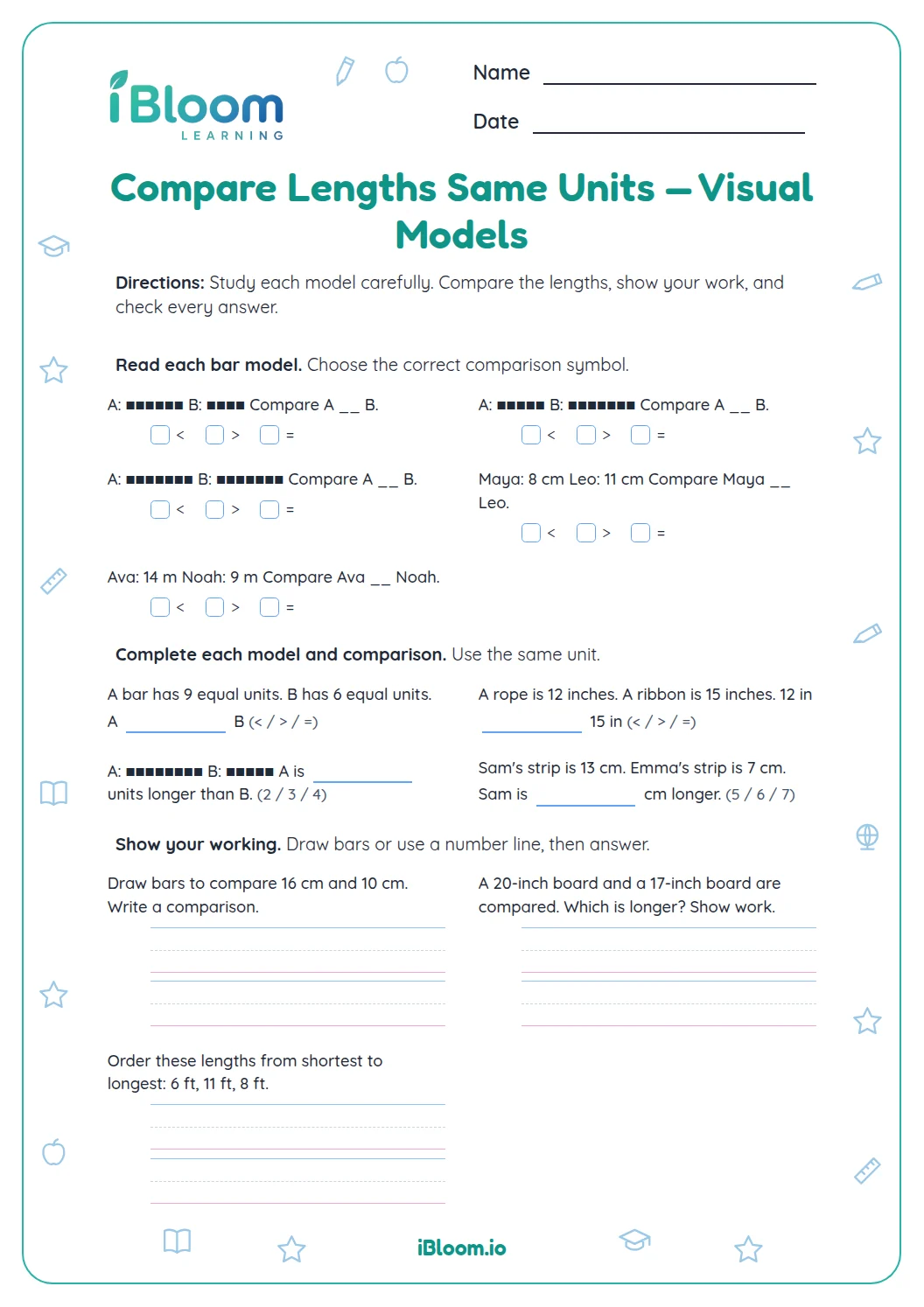
About this worksheet
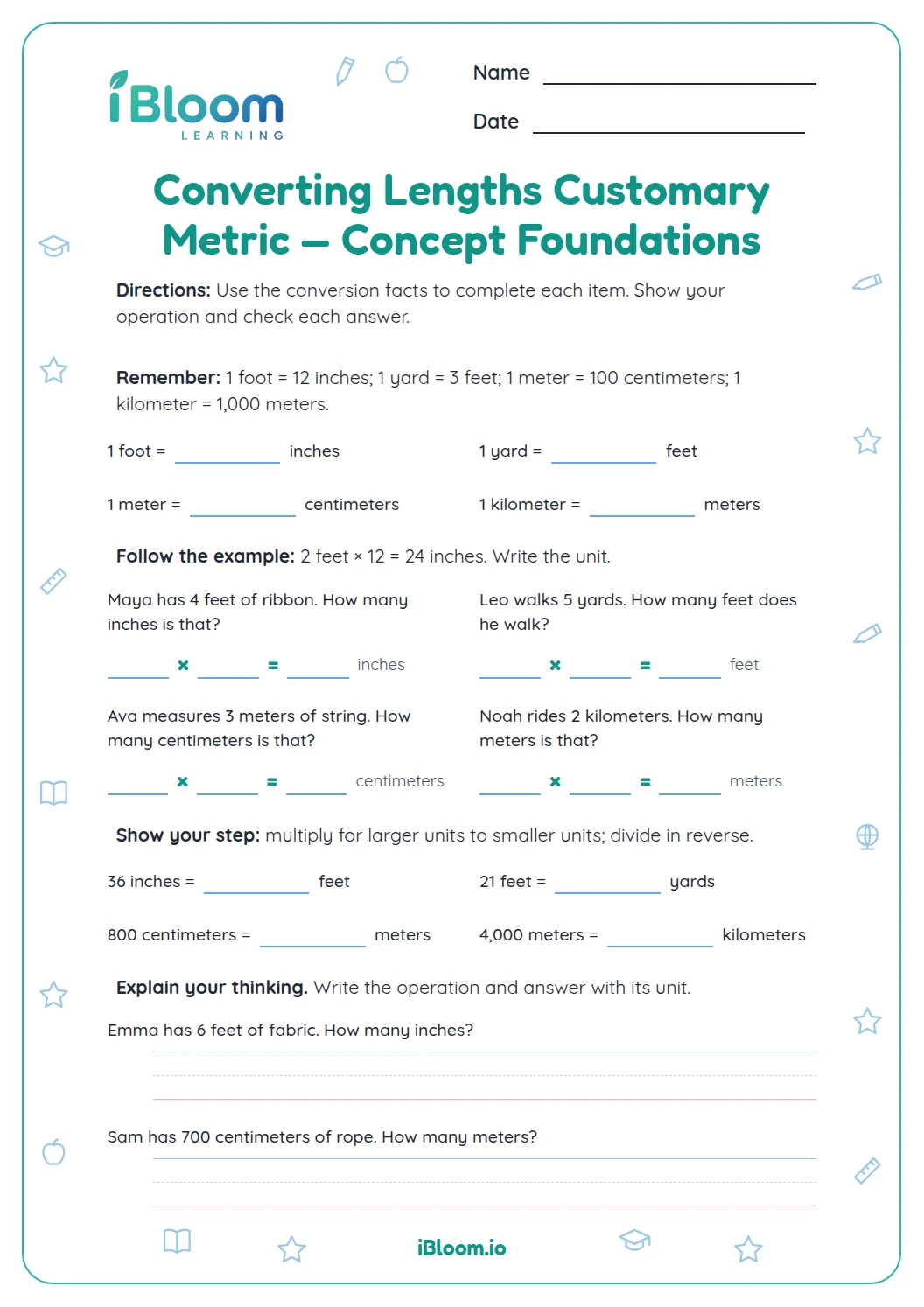
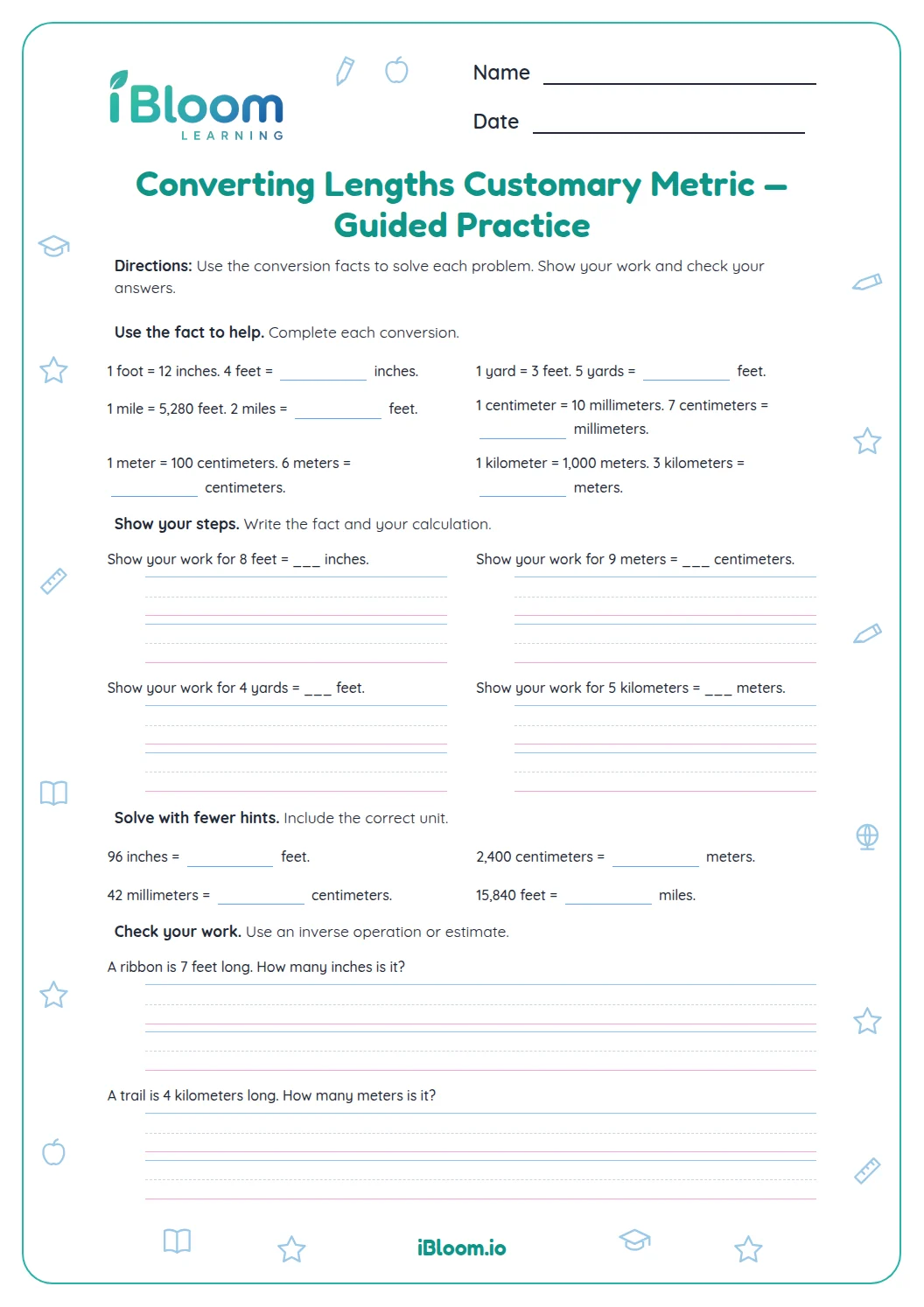
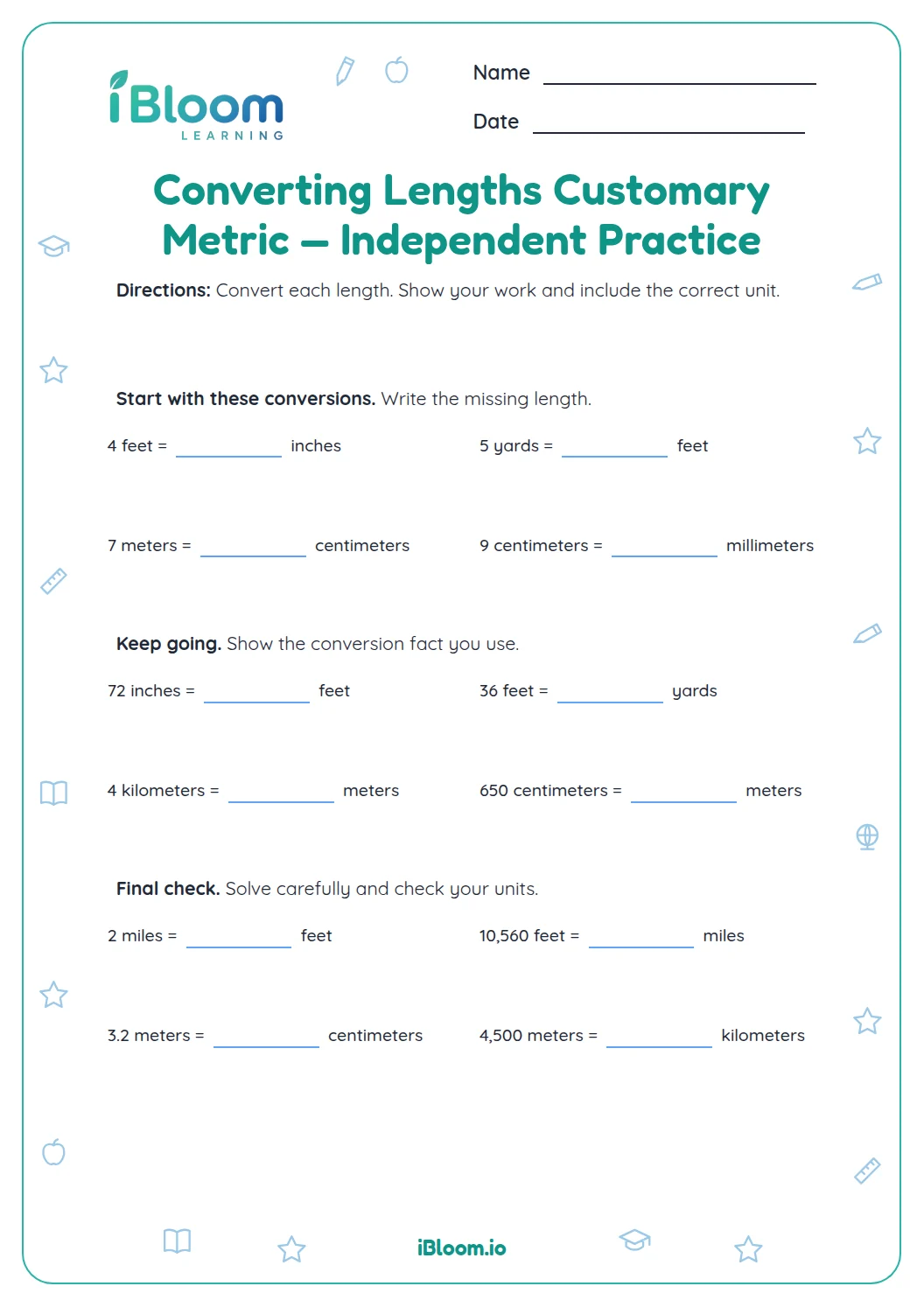
This Grade 5 printable gives children 18 questions on customary and metric length conversions. They practice direct conversions, compare measurements, and solve short problems by converting before calculating. It includes a separate answer key and aligns with CCSS 5.MD.A.1 for converting standard units and applying conversions in real-world problems.
Aligned to 5.MD.A.1
Which unit relationships should students use?
Remember the conversion facts before choosing an operation: 12 inches = 1 foot, 3 feet = 1 yard, 10 millimeters = 1 centimeter, and 100 centimeters = 1 meter. In question 1, multiply 3 feet by 12 to get 36 inches.
In question 1, multiply 3 feet by 12 inches per foot: 3 × 12 = 36 inches.
- 13 ft × 12 in per ft = 36 in
When should you convert before solving?
Convert before comparing measurements or adding different units. In question 14, change 3 yards to 9 feet, then add 2 feet to get 11 feet. Keeping both lengths in feet makes the addition clear.
How can you check whether a conversion makes sense?
A smaller unit usually needs a larger number to describe the same length: 1 meter is 100 centimeters. A larger unit uses a smaller number: 36 inches is 3 feet. Check both the arithmetic and the unit in each answer.
How to use this worksheet
- 1Write the conversion fact you need beside the problem.
- 2Decide whether to multiply or divide based on the size of the new unit.
- 3Convert each length to the same unit before adding or comparing.
- 4Keep the unit attached to each number through the calculation.
- 5Use the answer key to check both the number and unit.
Common mistakes and quick fixes
The mistake
Multiplying when changing to a larger unit.
The fix
Ask whether the new unit is larger; the number should usually get smaller.
The mistake
Adding feet directly to yards.
The fix
Convert both lengths to feet before adding.
The mistake
Writing a correct number with the wrong unit.
The fix
Label the final answer with the unit the question asks for.
Common Core alignment
The worksheet converts standard length units and uses conversions in practical problems.
Convert customary and metric lengths within each system.
On this sheet: The practice converts inches, feet, yards, millimeters, centimeters, and meters, then uses conversions in problems.
Show the official wordingHide the official wording
Convert among different-sized standard measurement units within a given measurement system (e.g., convert 5 cm to 0.05 m), and use these conversions in solving multi-step, real world problems.
What to practice next
Make more practice
Further reading
Questions parents and teachers ask
Which length units appear?
The sheet uses inches, feet, and yards in customary conversions and millimeters, centimeters, and meters in metric conversions. Each question names the units, and the answer key gives the converted amount. Have the learner write the conversion fact beside the calculation and keep the target unit in view.
How do I convert feet to inches?
Multiply the number of feet by 12 because one foot equals 12 inches. For example, 3 feet equals 36 inches. The worksheet also asks students to reverse conversions and solve problems with more than one step. Ask whether the new unit is smaller or larger before deciding to multiply or divide.
Does the sheet mix customary and metric units in one conversion?
The conversion practice stays within each measurement system. Students convert customary lengths to other customary lengths and metric lengths to other metric lengths, then apply the results to practical situations. The result should describe the same length even when its numerical value changes.
How many questions are on the worksheet?
There are 18 questions in three parts: direct customary conversions, metric conversions, and applied length problems. The answer key is a separate page for checking each result. Keep the unit attached to each number so the final measurement is clear.
How can I check a conversion?
Use a known relationship such as 12 inches = 1 foot or 100 centimeters = 1 meter. Multiply or divide by the conversion factor, then check whether the new unit is smaller or larger. Check the answer by converting it back to the starting unit.
What does the word “convert” mean here?
Convert means express the same length in a different unit. A length of 4 feet and 48 inches describes the same distance, even though the number changes when the unit changes. Read the requested unit again before recording the converted measurement.