

About this worksheet
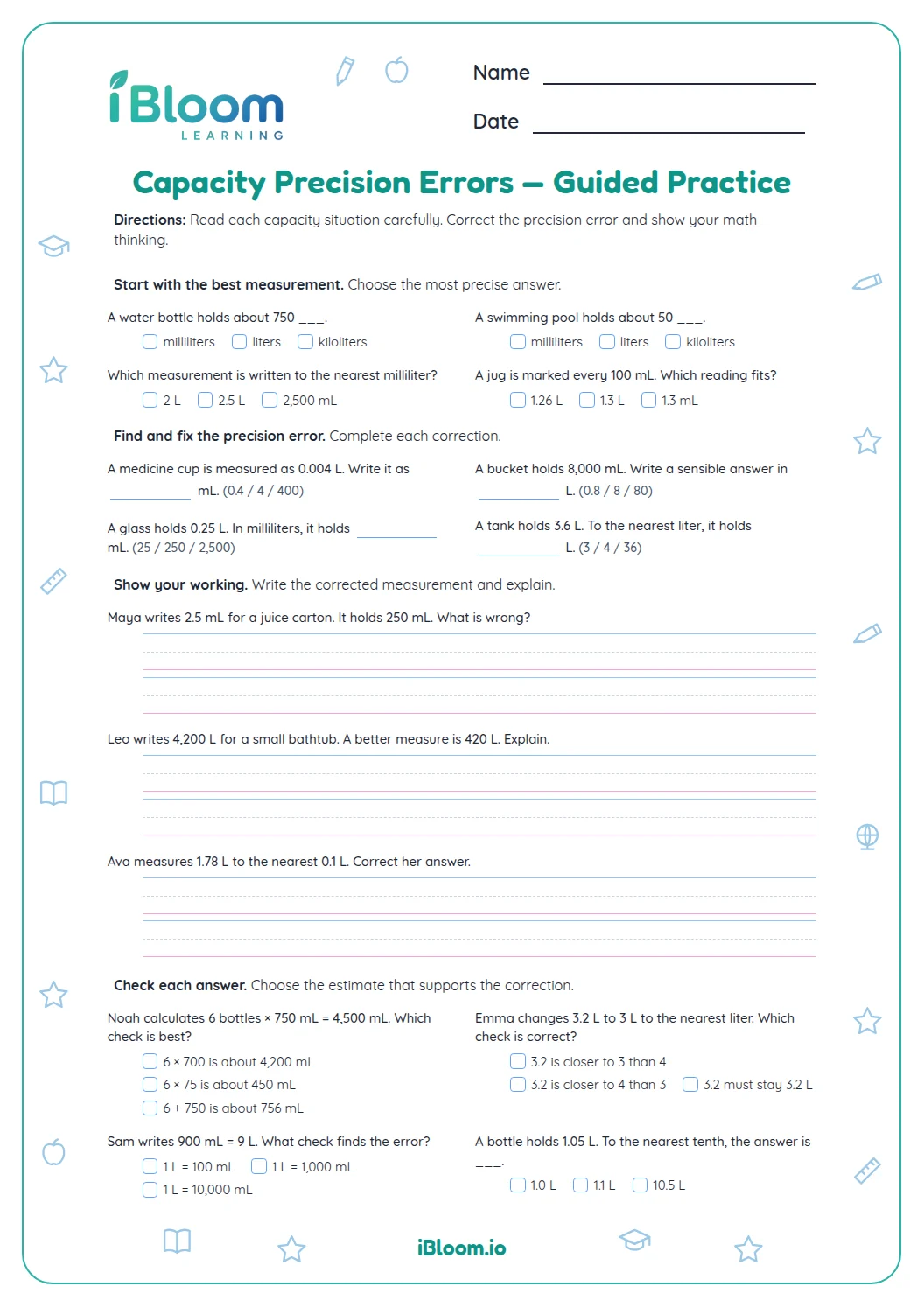
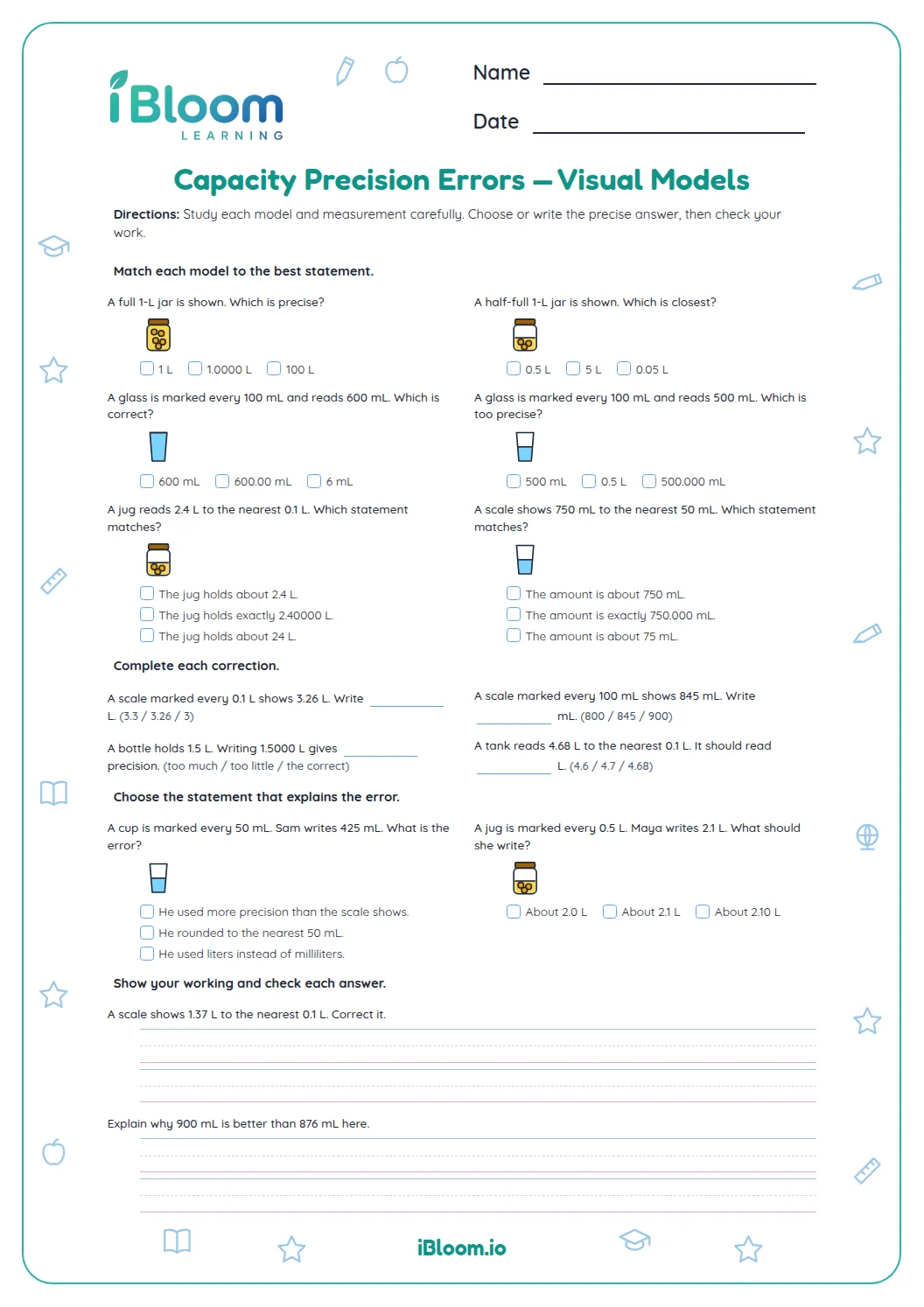
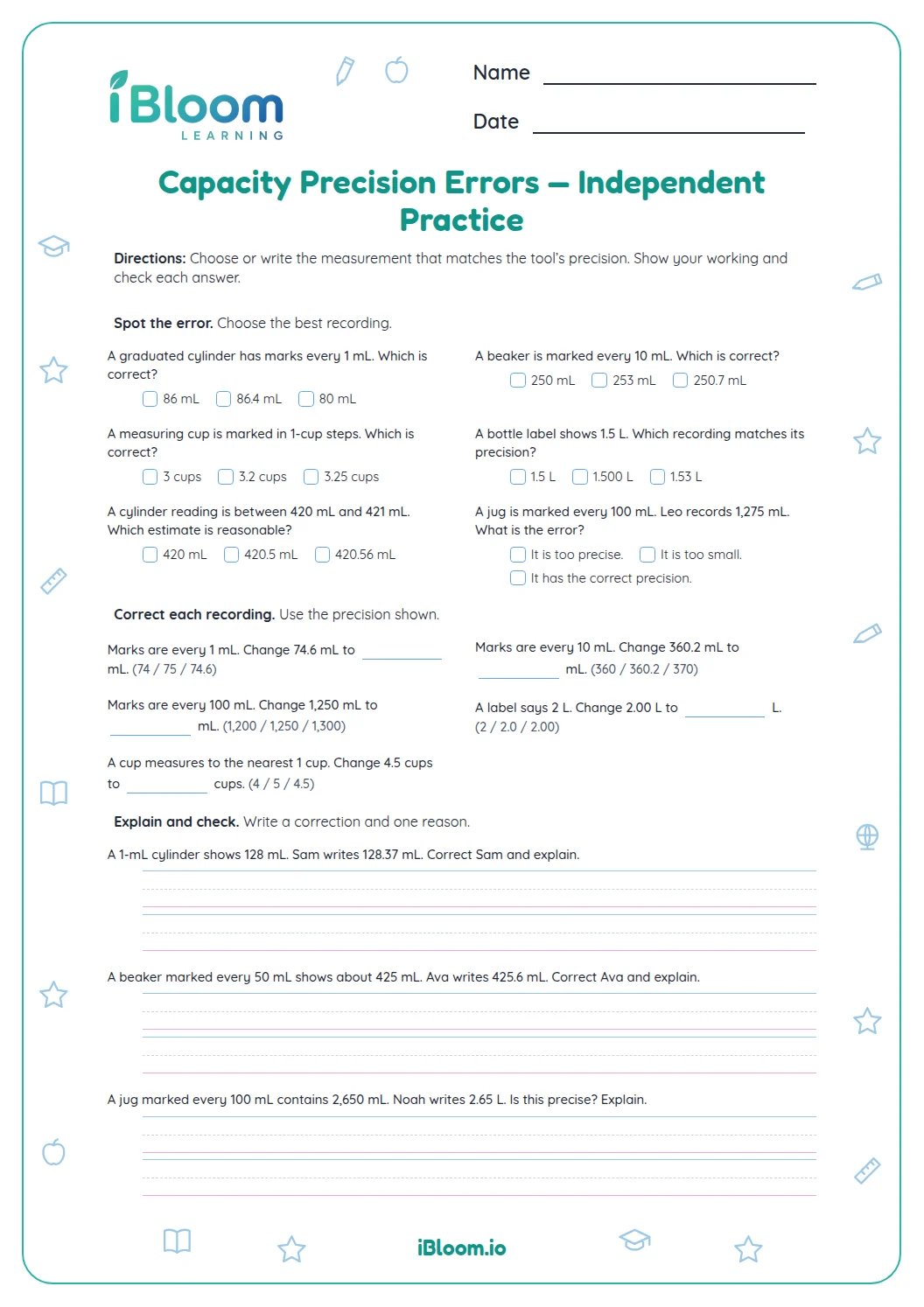
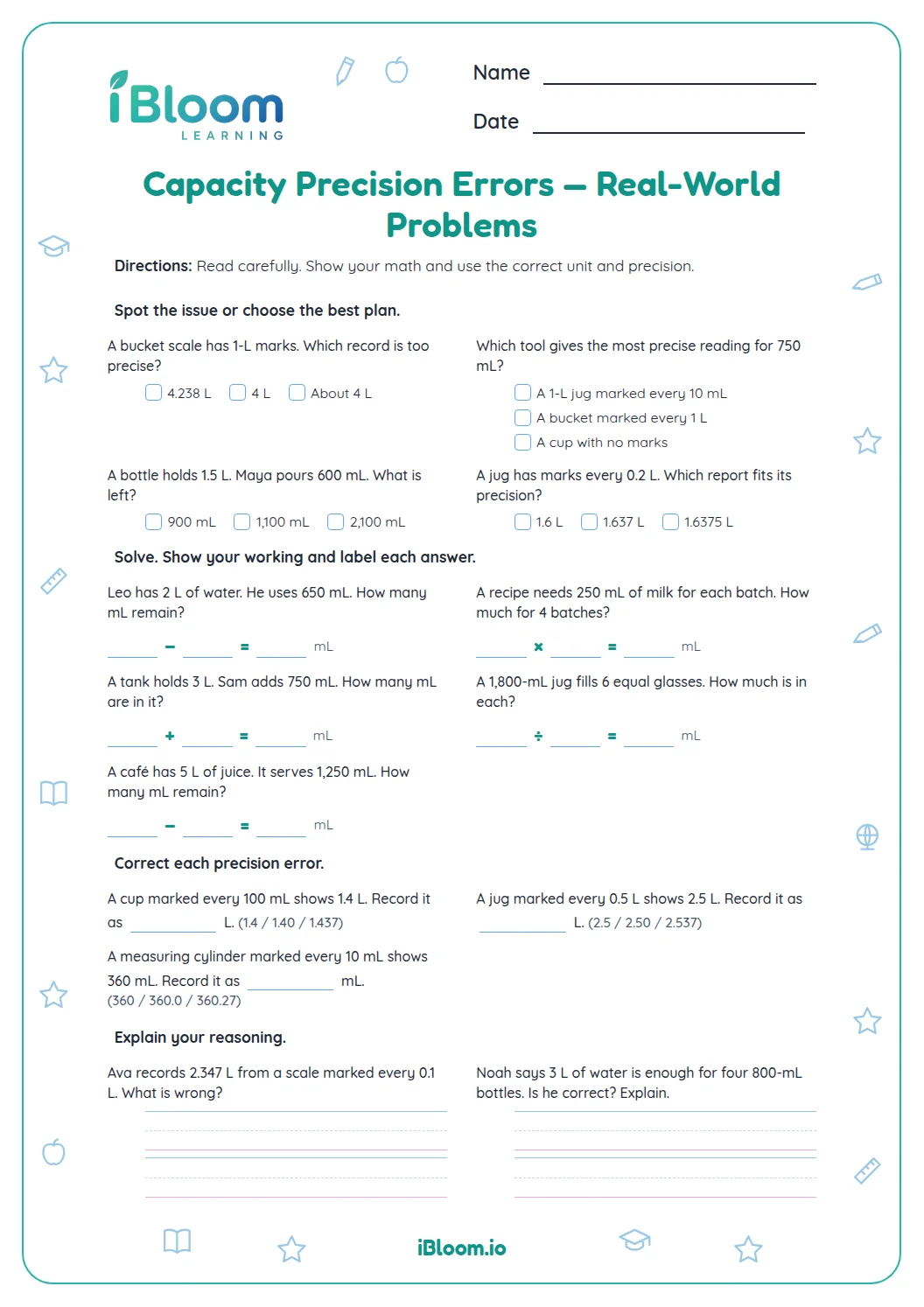
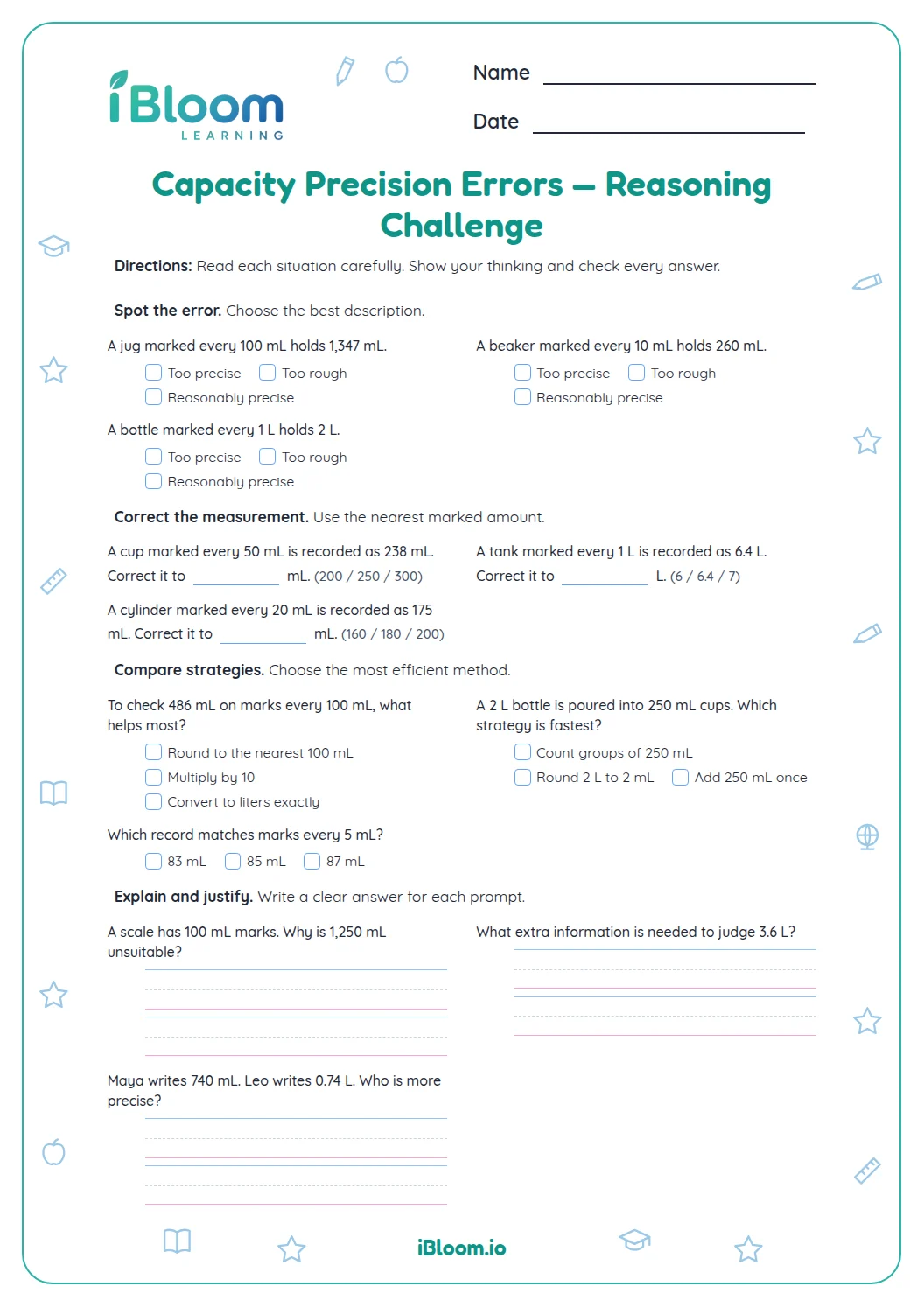
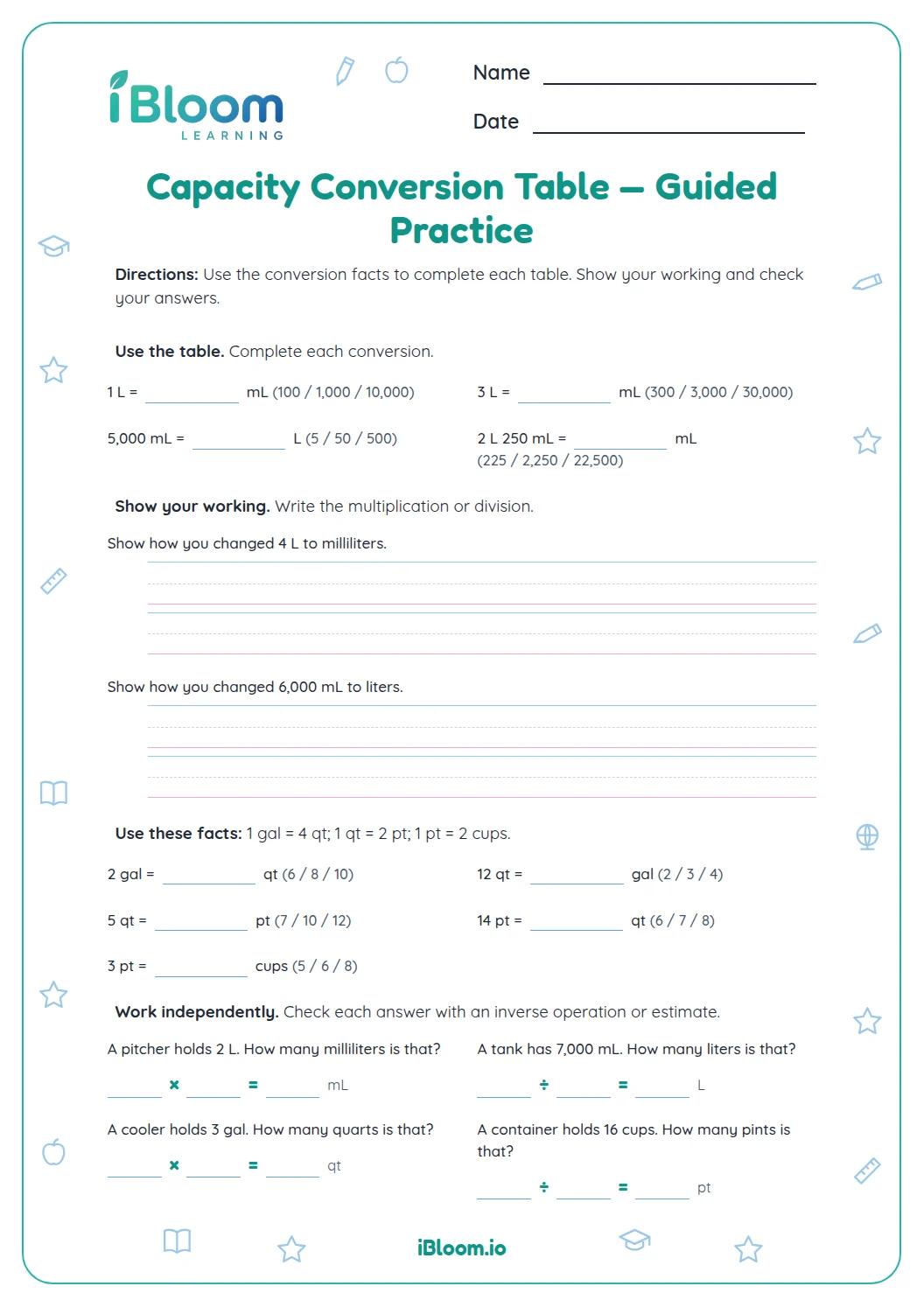
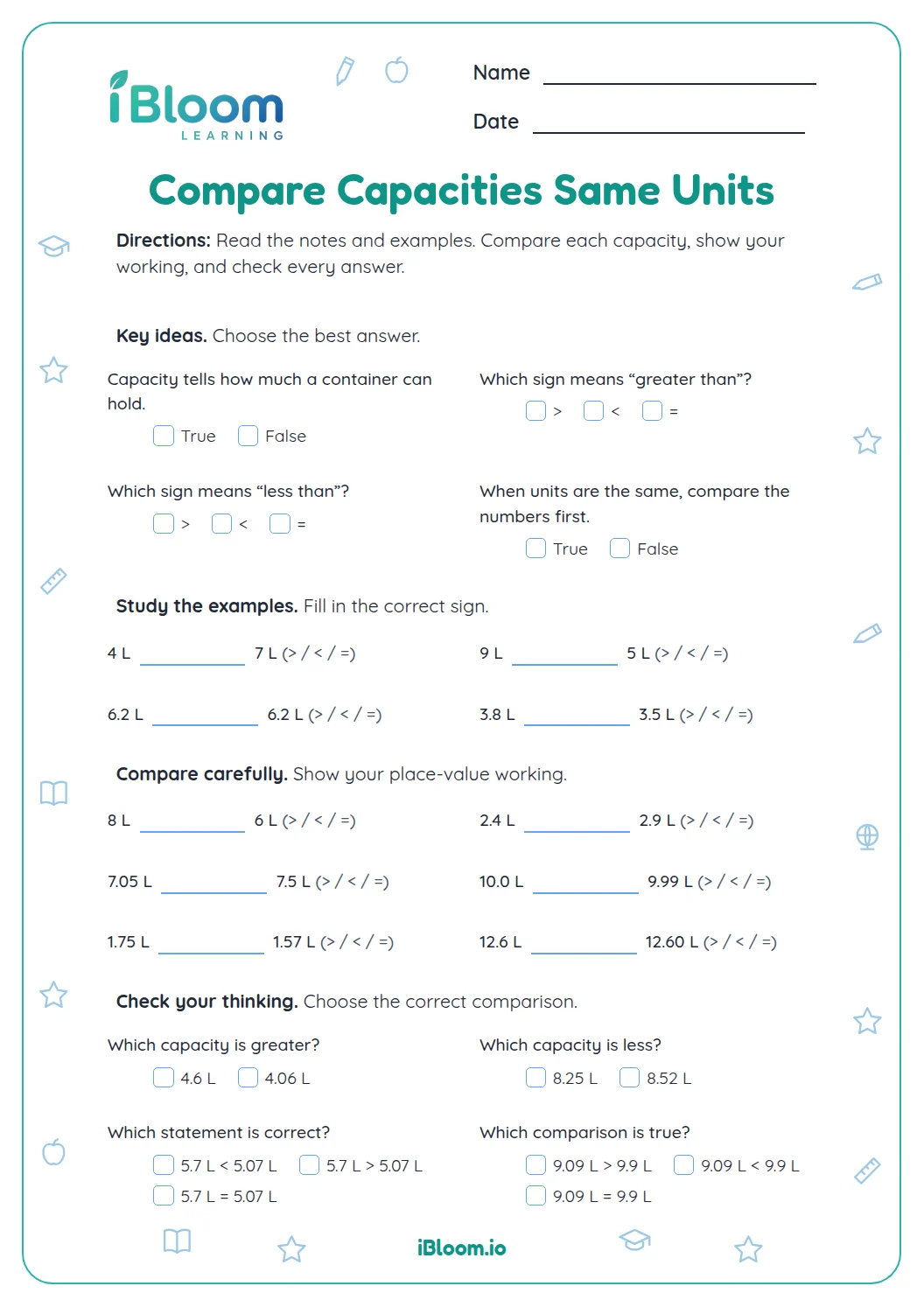
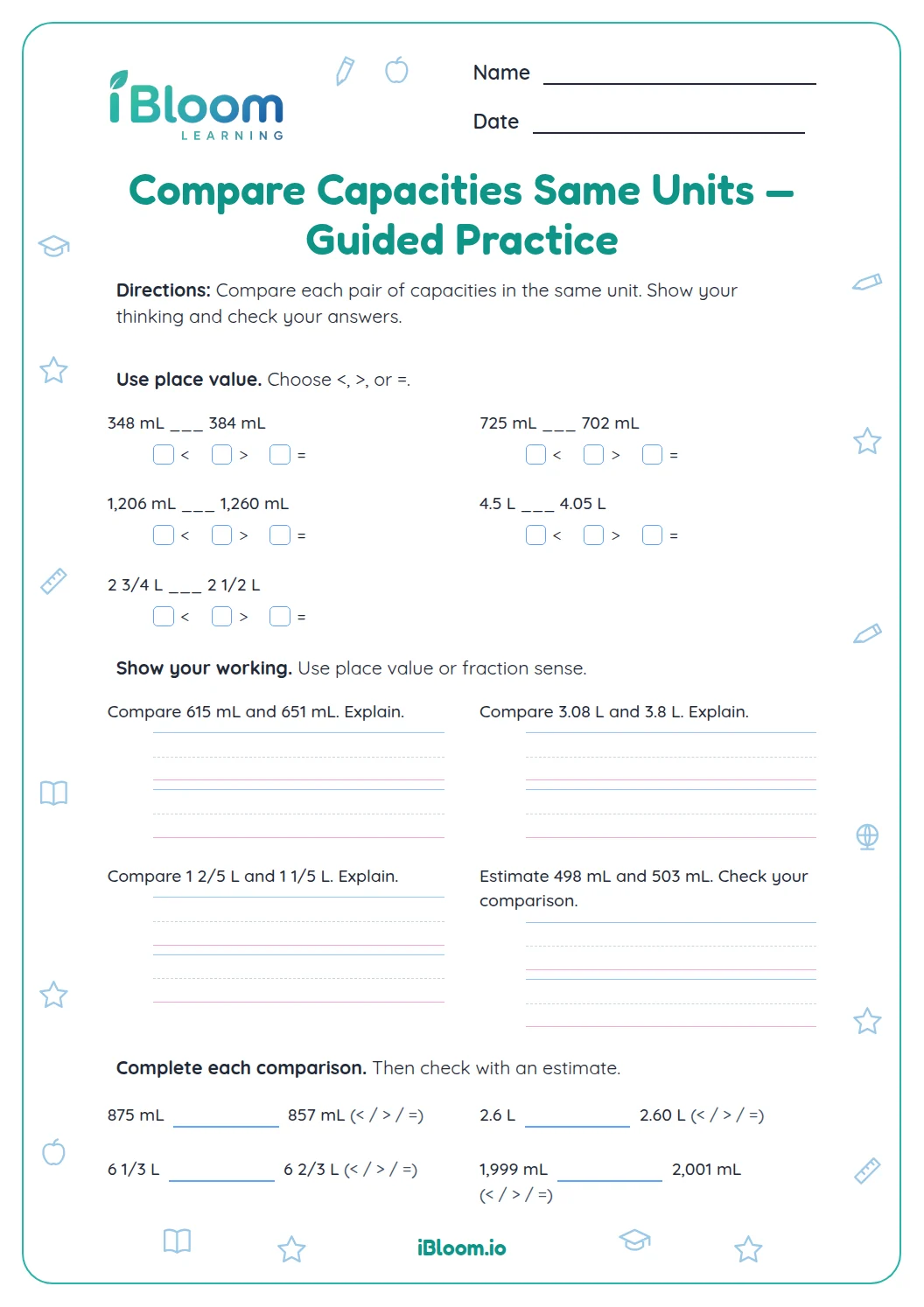
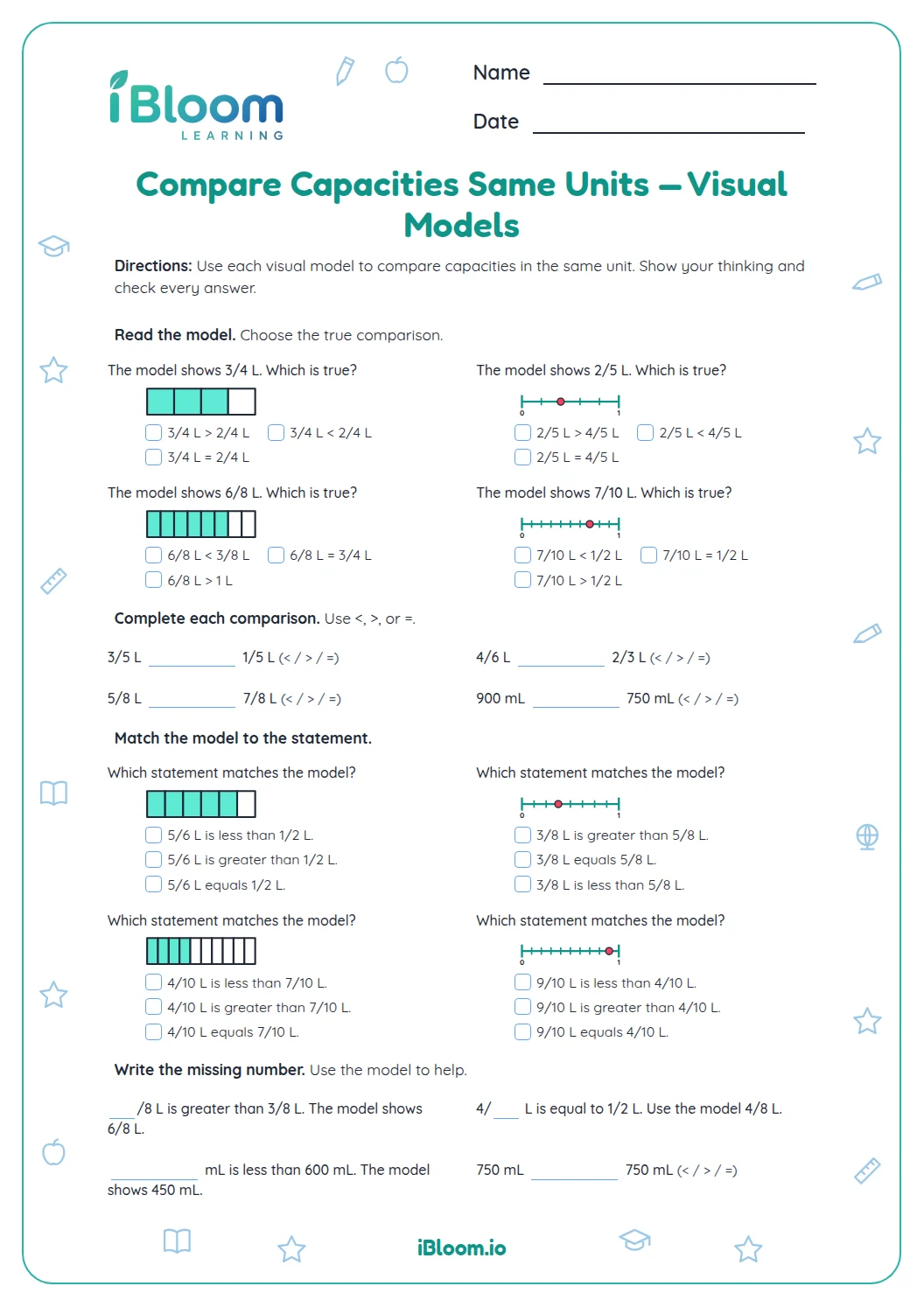
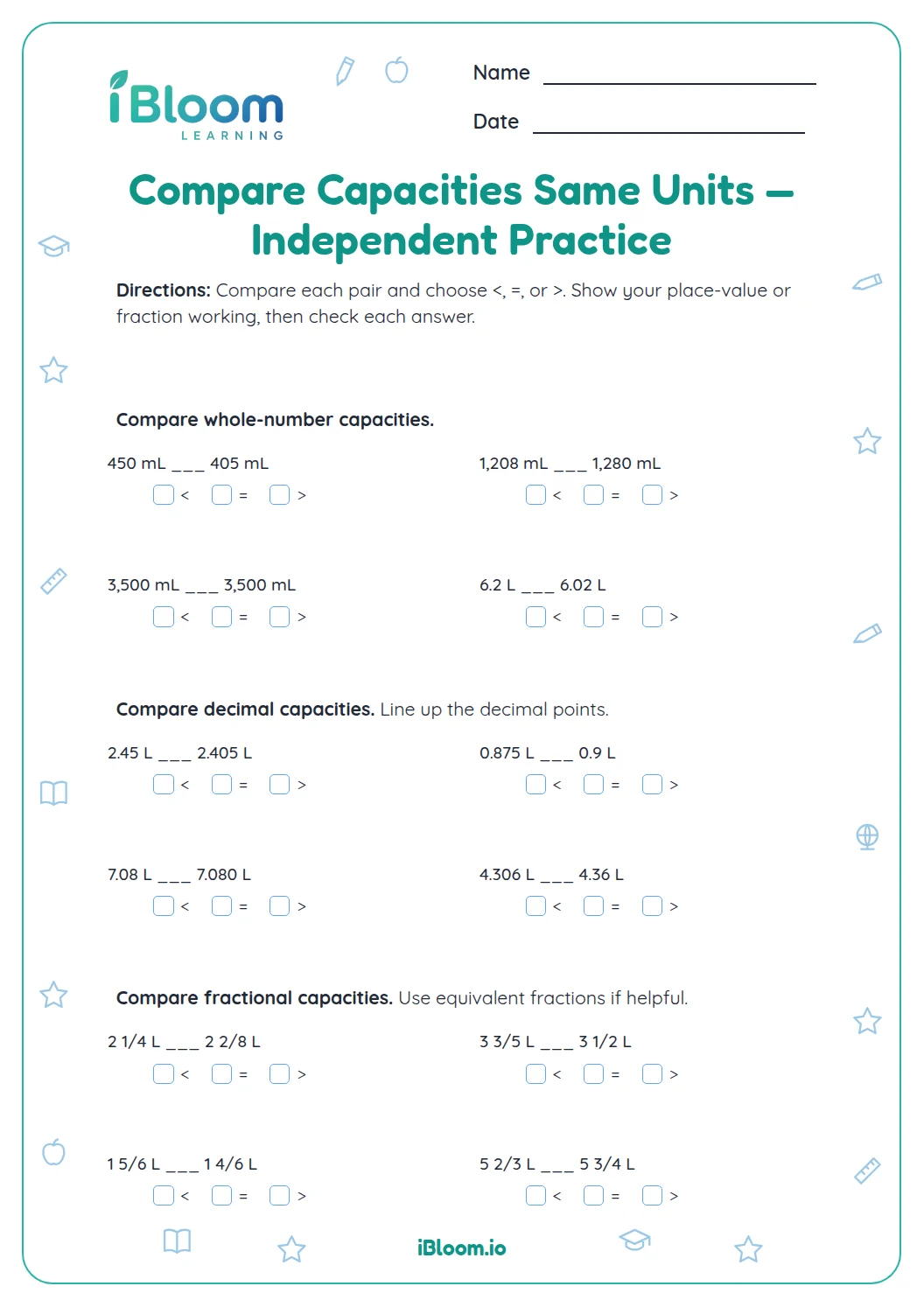
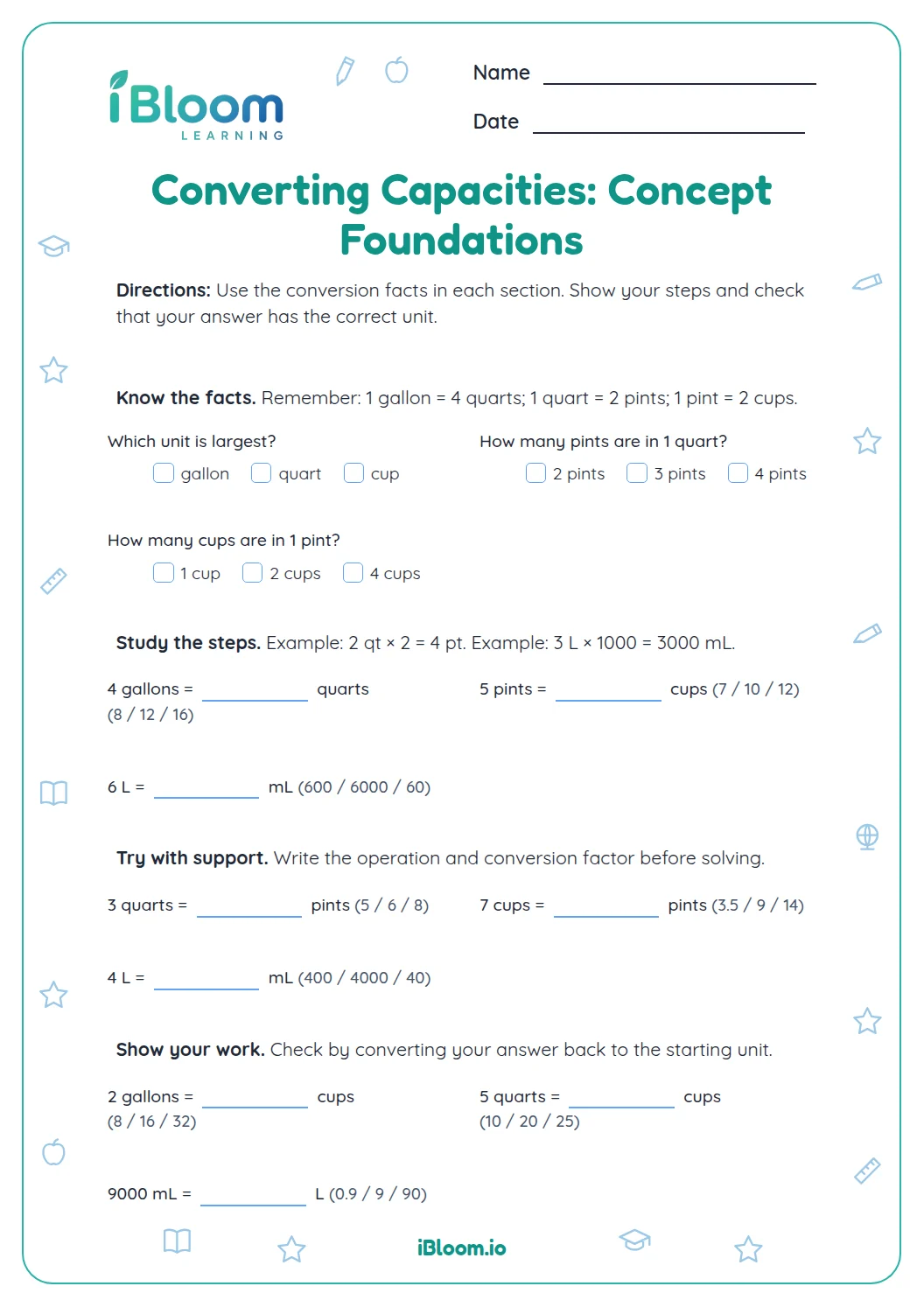
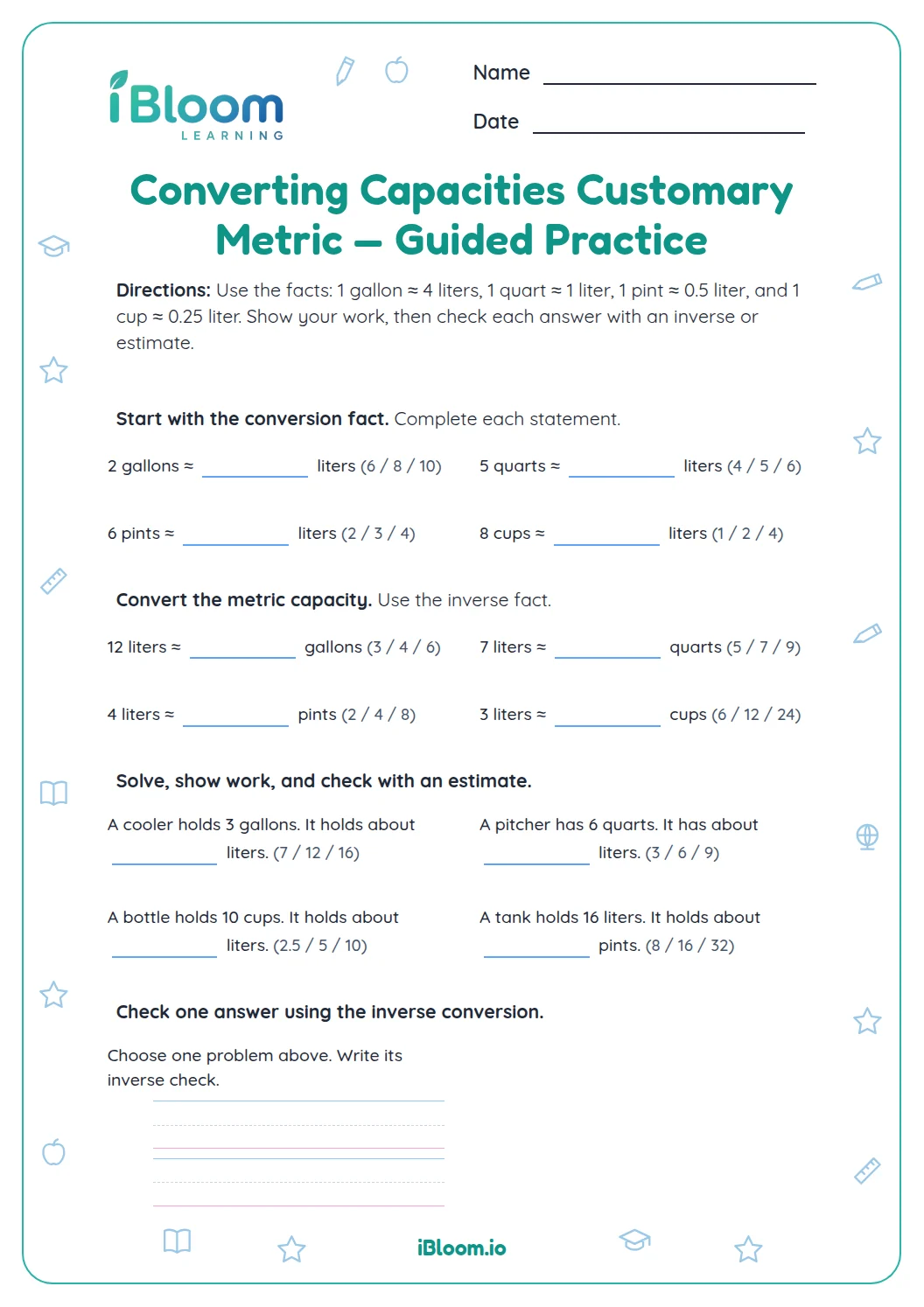
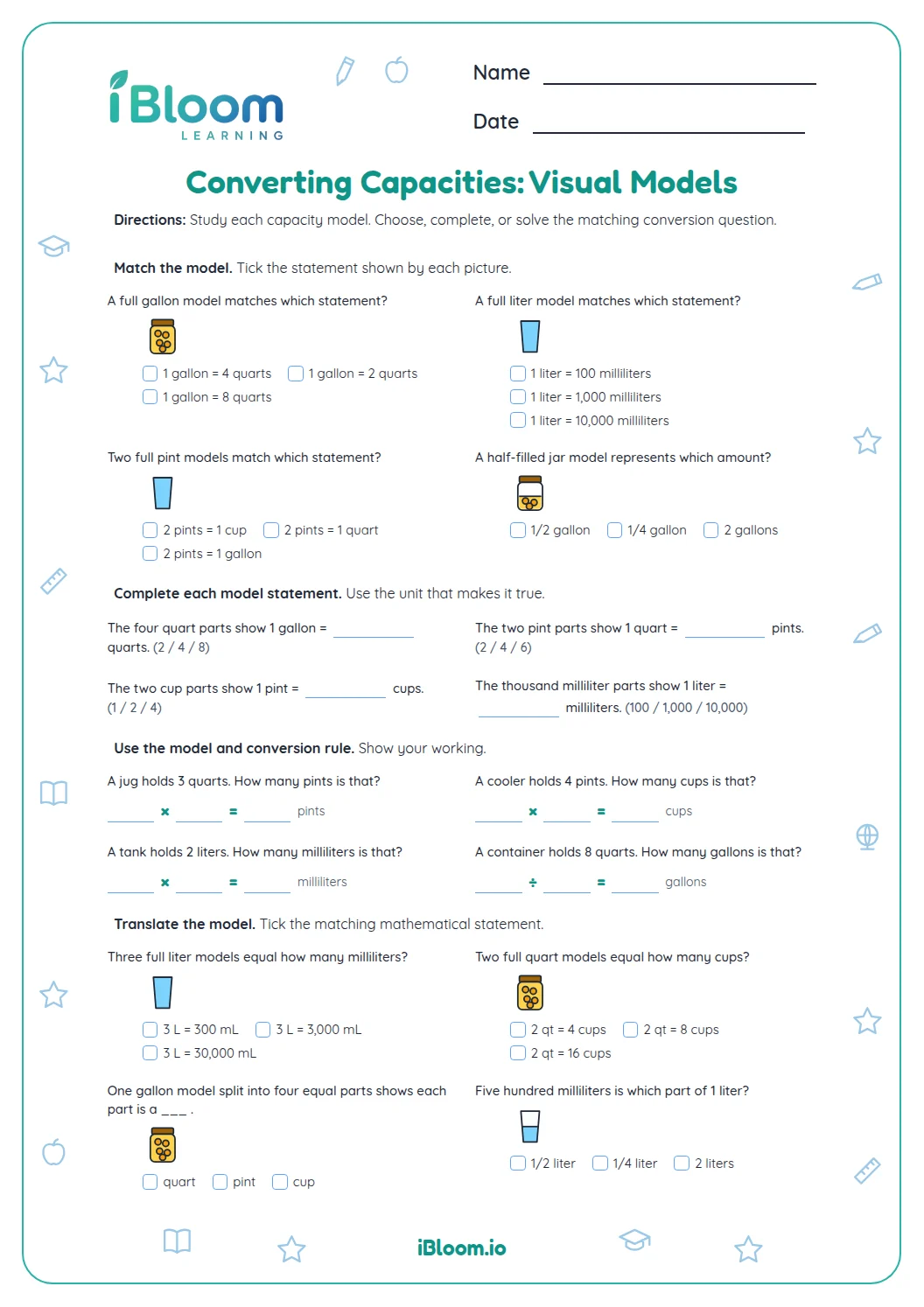
This printable Grade 5 math page practices capacity conversions between liters and milliliters, with attention to decimal place value and common conversion slips. Children choose equivalent amounts, complete conversions, correct two errors, compare capacities, and solve short problems. The work aligns with Common Core 5.MD.A.1, which includes converting units and using those conversions in real-world problems. A separate answer key is included.
Aligned to 5.MD.A.1
What should children notice first?
A liter contains 1,000 milliliters, so 1.35 L is 1,350 mL.
How can one example be worked out?
For question 5, 3.06 L × 1,000 = 3,060 mL. The decimal shifts three places because each liter represents 1,000 milliliters. Check the result by noting that milliliters are smaller units, so the numeral grows when converting from liters.
- 1For question 5, 3.06 L × 1,000 = 3,060 mL. The decimal shifts three places because each liter represents 1,000 milliliters. Check the result by noting that milliliters are smaller units, so the numeral grows when converting from liters.
How does the page build practice?
The page starts with direct equivalents, then asks learners to diagnose decimal errors and apply conversions in contexts.
How to use this worksheet
- 1Read the unit in the prompt.
- 2Choose one unit for both amounts.
- 3Multiply or divide by 1,000.
- 4Check the size of the converted number.
- 5Write the unit with each final answer.
Common mistakes and quick fixes
The mistake
When converting liters to milliliters, multiplying by 100 instead of 1,000 leaves the value too small.
The fix
Check by asking whether the number of milliliters should be larger.
The mistake
When converting milliliters to liters, moving the decimal the wrong way makes the liter amount too large.
The fix
Divide by 1,000 and check that liters are fewer units.
The mistake
Comparing 1.08 L with 980 mL without converting can hide the difference.
The fix
Rewrite 1.08 L as 1,080 mL first.
This worksheet practices the following Common Core skill.
Multiply liters by 1,000 to get milliliters; divide milliliters by 1,000 to get liters.
On this sheet:
Show the official wordingHide the official wording
Convert among different-sized standard measurement units within a given measurement system (e.g., convert 5 cm to 0.05 m), and use these conversions in solving multi-step, real world problems.
What to practice next
Make more practice
Further reading
Questions parents and teachers ask
Why convert both amounts to the same unit?
A comparison is clear only when both quantities use the same-sized unit. For example, rewrite 1.08 L as 1,080 mL before comparing it with 980 mL. Then the difference is easy to see: 1,080 mL is 100 mL greater. That comparison keeps the larger-unit amount from looking deceptively smaller.
What does the decimal in 3.06 L mean?
It means 3 liters and 6 hundredths of a liter. Since each liter equals 1,000 milliliters, 3.06 L equals 3,060 mL. The zero in the tenths place matters: 3.6 L would be 3,600 mL. This place-value check prevents confusing 3.06 L with 3.6 L.
How can a child check a conversion?
Estimate the size before calculating. Liters are larger units than milliliters, so a quantity written in milliliters should have a larger numeral. Converting 4,250 mL to 4.25 L makes sense because the number becomes smaller when the unit becomes larger.
What is the common mistake in converting 0.8 L?
The likely slip is using 100 instead of 1,000. Since 1 L is 1,000 mL, 0.8 L is 800 mL. The place-value check helps: eight tenths of a liter is close to one liter, so 80 mL would be far too little.
Does the answer key come with the page?
Yes. The printable includes a separate answer key with the equivalent capacities, corrected place-value errors, comparisons, and word-problem results. Children can complete the worksheet first, then use the key with a parent or teacher to review the conversion steps. The key can also help an adult talk through any missed item.