

About this worksheet
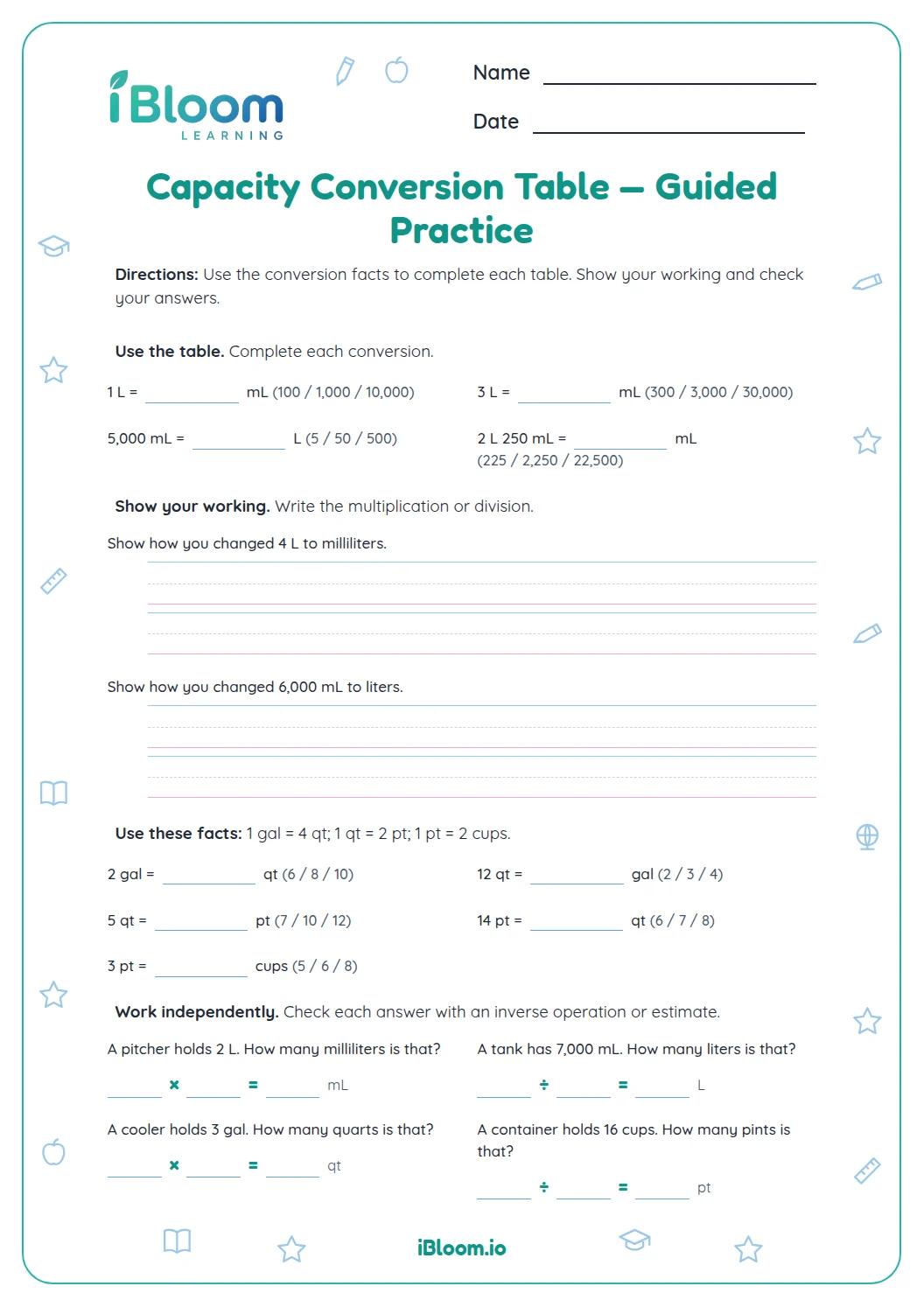
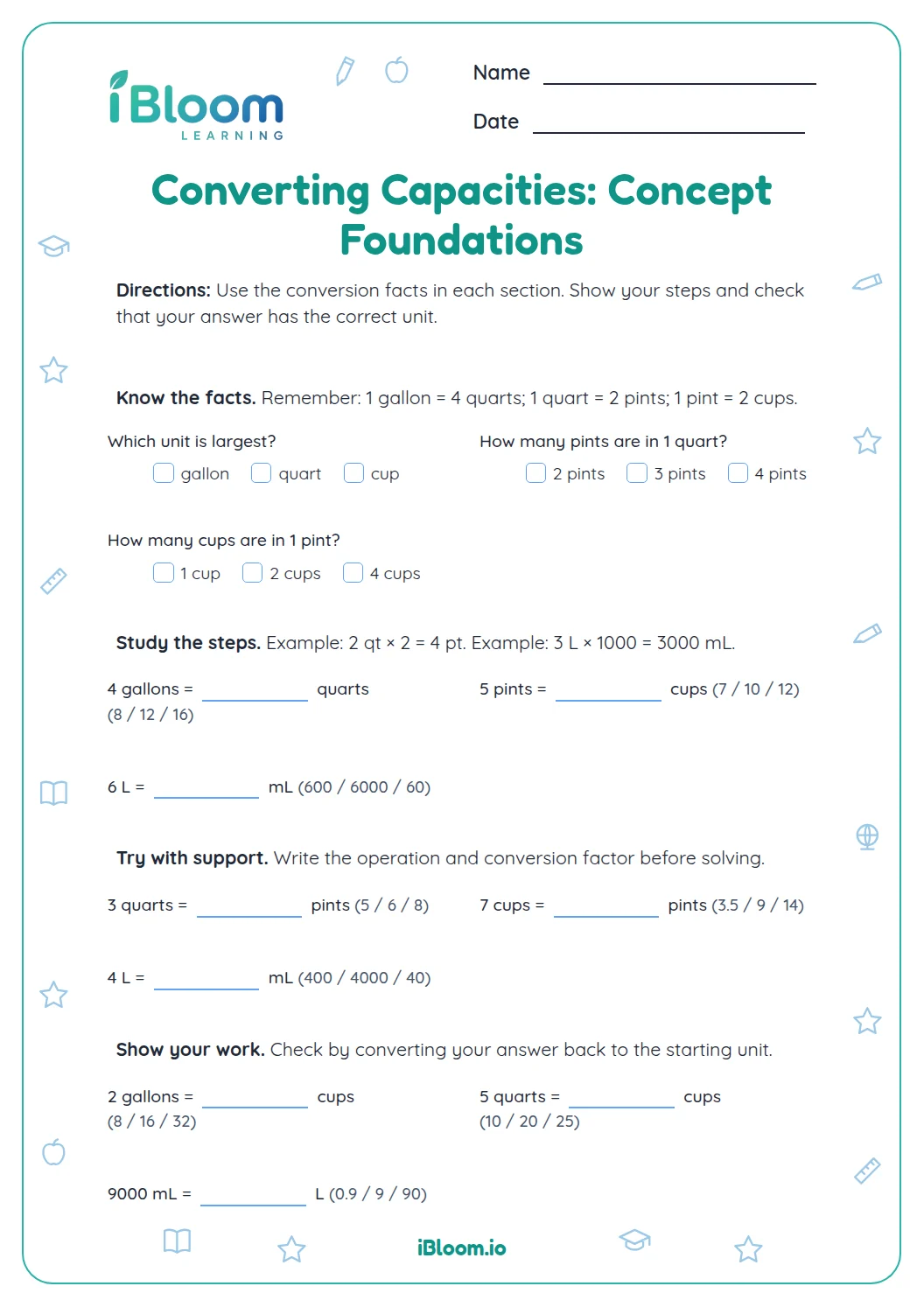
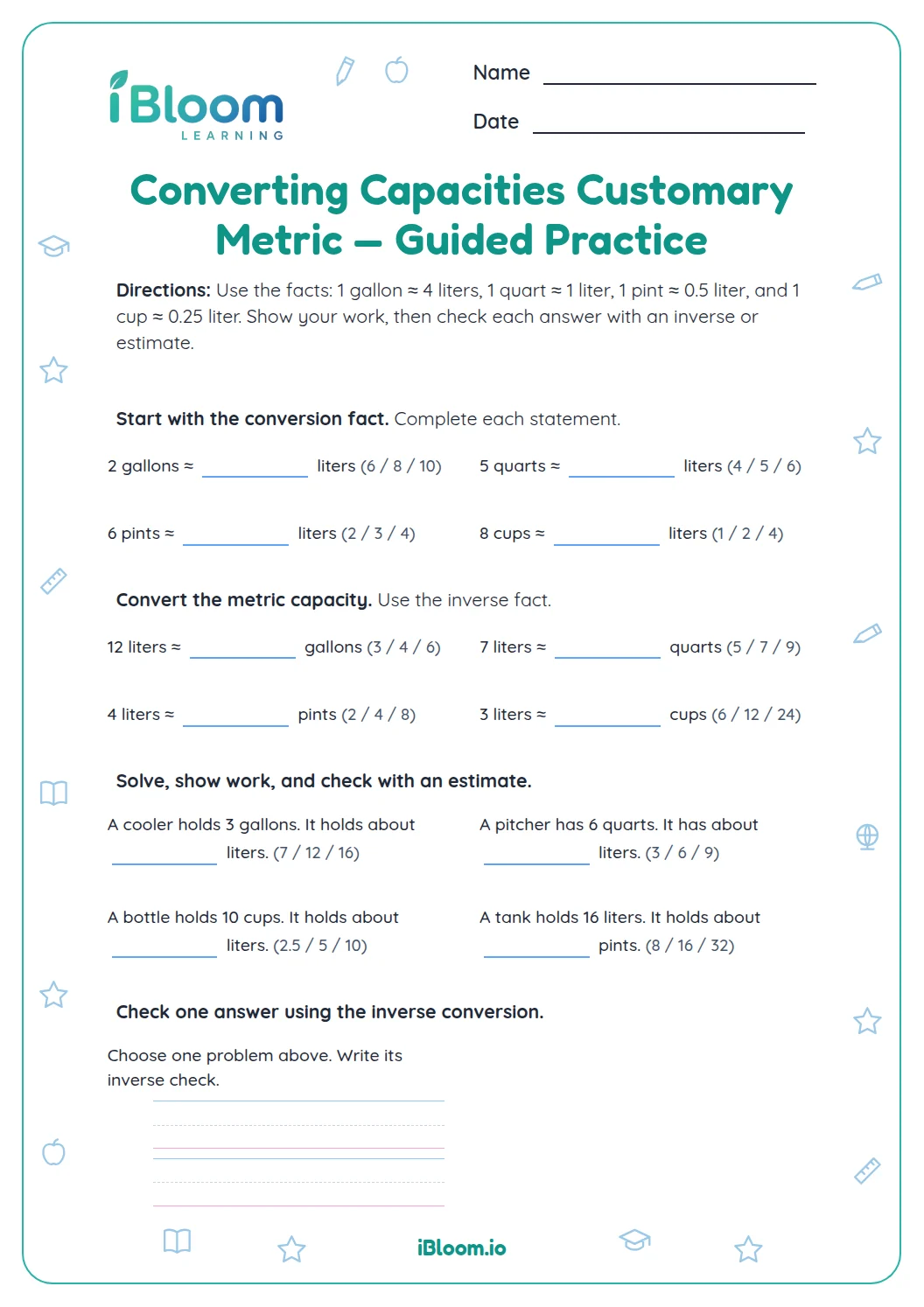
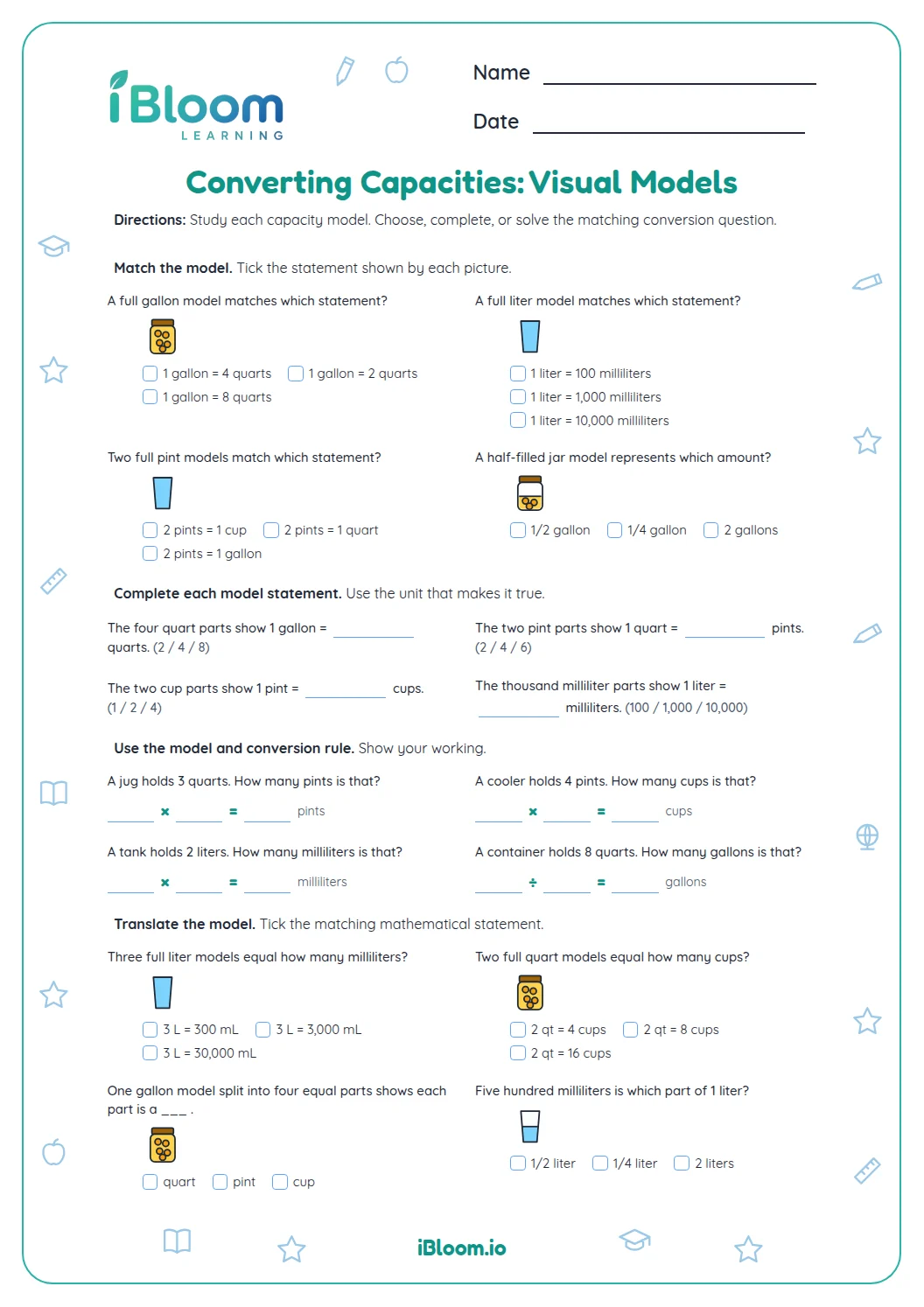
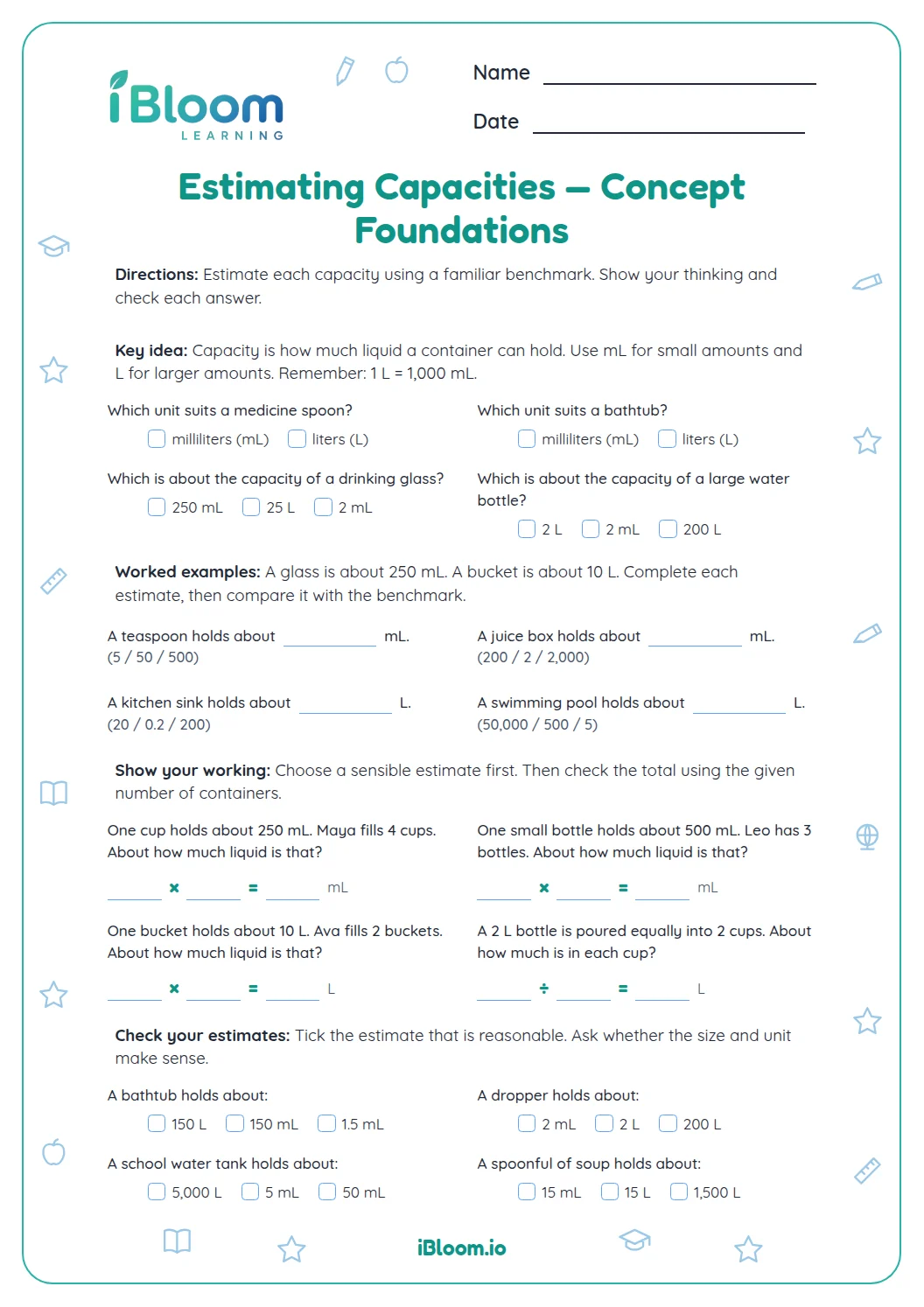
This free printable worksheet introduces Grade 5 students to the capacity conversion table, the short list of facts that links one unit to the next: 1 gallon = 4 quarts, 1 quart = 2 pints, 1 pint = 2 cups, and 1 liter = 1,000 milliliters. Students read the table, fill in missing conversions, use it to solve three container problems, and check which conversion is correct. It practices Common Core 5.MD.A.1, converting among units of measure within one system and using those conversions to solve real-world problems. A two-page answer key shows every answer.
Aligned to 5.MD.A.1
What is a capacity conversion table?
Capacity is how much a container can hold. A conversion table lists how many of a smaller unit make one of a larger unit. In the US customary system the units are gallons, quarts, pints and cups, and each step down the table is a doubling or a fourfold change. In the metric system, 1 liter holds 1,000 milliliters.
The table is printed in the instructions at the top of the sheet, so students use it as a reference the way they would in a classroom. The work is choosing the right fact and the right operation, not memorizing.
When do you multiply and when do you divide?
Think about the size of the unit. A gallon is larger than a quart, so it takes more quarts than gallons to hold the same amount. Going from a larger unit to a smaller unit means more units, so multiply. Going from a smaller unit to a larger one means fewer units, so divide.
In Part C students apply this to cooler, pitcher and jug problems. The answer should also be a sensible size: a gallon is bigger than a quart, so 5 gallons must be more than 5 quarts.
- 1A cooler holds 5 gal of water. How many quarts is that?
- 2The table says 1 gal = 4 qt.
- 3Gallons are larger than quarts, so multiply: 5 × 4 = 20.
- 4Answer: 20 qt
What is on this worksheet?
Part A has four multiple-choice questions that read the table: which unit holds the most, how many pints are in a quart, how many milliliters are in a liter, and which operation turns gallons into quarts. Part B has six conversions to fill in, such as 5 qt = ___ pt and 9,000 mL = ___ liters. Four multiply to a smaller unit and two divide to a larger one.
Part C has three container problems that ask for a number sentence and a unit. Part D finishes with two checks: which conversion for 6 liters is correct, and whether 2 liters or 1,500 milliliters is greater.
- Part A: 4 questions that read the table
- Part B: 6 conversions to fill in, 4 multiplied and 2 divided
- Part C: 3 container problems with a number sentence
- Part D: 2 checks of a conversion or a comparison
How can students tell if a conversion makes sense?
Before writing the answer, students can say whether the number should get bigger or smaller. Question 14 asks which of 600, 6,000 and 60,000 milliliters equals 6 liters. Each liter holds 1,000 milliliters, so 6 liters is exactly 6,000 milliliters. An answer with too few or too many zeros is a sign of a slip.
Question 15 compares 2 liters and 1,500 milliliters. Writing 2 liters as 2,000 milliliters makes the comparison easy, because both are in the same unit.
How to use this worksheet at home or in class
- 1Read the table at the top together and say each fact aloud: one gallon is four quarts.
- 2Have your student do Part A and explain why a gallon holds more than a quart.
- 3In Part B, ask for the operation before each answer: multiply or divide?
- 4For Part C, write the number sentence first, then the answer with its unit.
- 5Check Part D by writing both amounts in the same unit before comparing.
- 6Use the answer key and ask your student to explain one answer they got right.
Common mistakes and quick fixes
The mistake
Dividing when going to a smaller unit, such as writing 5 gal = 5 ÷ 4 qt.
The fix
Ask which unit is larger. A gallon is larger, so there are more quarts than gallons, and the number should grow. Multiply.
The mistake
Using the wrong table fact, such as multiplying by 2 for gallons to quarts because 1 qt = 2 pt.
The fix
Have your student point to the exact row in the table. The gallon row says 4 quarts, so gallons to quarts uses 4.
The mistake
Writing 600 mL for 6 liters because a zero was missed.
The fix
Say it aloud: one liter is one thousand milliliters, so six liters is six thousand. Count the three zeros.
Common Core alignment
Convert between units in one system, such as 5 gal to quarts or 2 L to mL.
On this sheet: Parts B and C convert gallons, quarts, pints, cups, liters and milliliters, and Part C puts them in real containers.
Show the official wordingHide the official wording
Convert among different-sized standard measurement units within a given measurement system (e.g., convert 5 cm to 0.05 m), and use these conversions in solving multi-step, real world problems.
What to practice next
Make more practice
Further reading
Questions parents and teachers ask
What is a capacity conversion table?
It is a short list of facts that tells how many of one unit make another, such as 1 gallon = 4 quarts or 1 liter = 1,000 milliliters. Students look up the row, then multiply or divide. This sheet prints the table in the instructions so students can use it while they work.
Why does the sheet use both customary and metric units?
Students in the US meet both systems: gallons and cups at home, liters and milliliters on bottles and in science class. Standard 5.MD.A.1 asks for conversions within one system at a time, so each question stays in one. Mixing the two systems comes later in other sheets.
What are the answers for Part B?
The six answers are 12, 10, 2, 8, 7,000 and 9. For example, 3 gal = 12 qt because 3 × 4 = 12, and 9,000 mL = 9 liters because 9,000 ÷ 1,000 = 9. Four are multiplied, while 8 qt = 2 gal and 9,000 mL = 9 liters are divided.
How can I help a student who forgets to multiply or divide?
Ask whether the answer should be a bigger or smaller number. A smaller unit needs more of them, so the number grows and the student multiplies. A larger unit needs fewer, so the number shrinks and the student divides. A quick drawing of a gallon jug next to quarts helps many students.
Is 1,500 mL more than 2 L?
No, 2 liters is greater. Two liters is 2,000 milliliters, and 2,000 is more than 1,500. Question 15 asks students to write both amounts in the same unit before comparing. The number 1,500 looks bigger than 2 at first glance, so changing to one unit first keeps students from picking the wrong amount.
Is there an answer key, and how long does the sheet take?
Yes. The two-page answer key shows every correct choice, conversion and container answer with its unit. Plan on about 25 minutes. The sheet has two pages, so you can stop after Part B, check those answers, and do Parts C and D later or on another day.