

About this worksheet
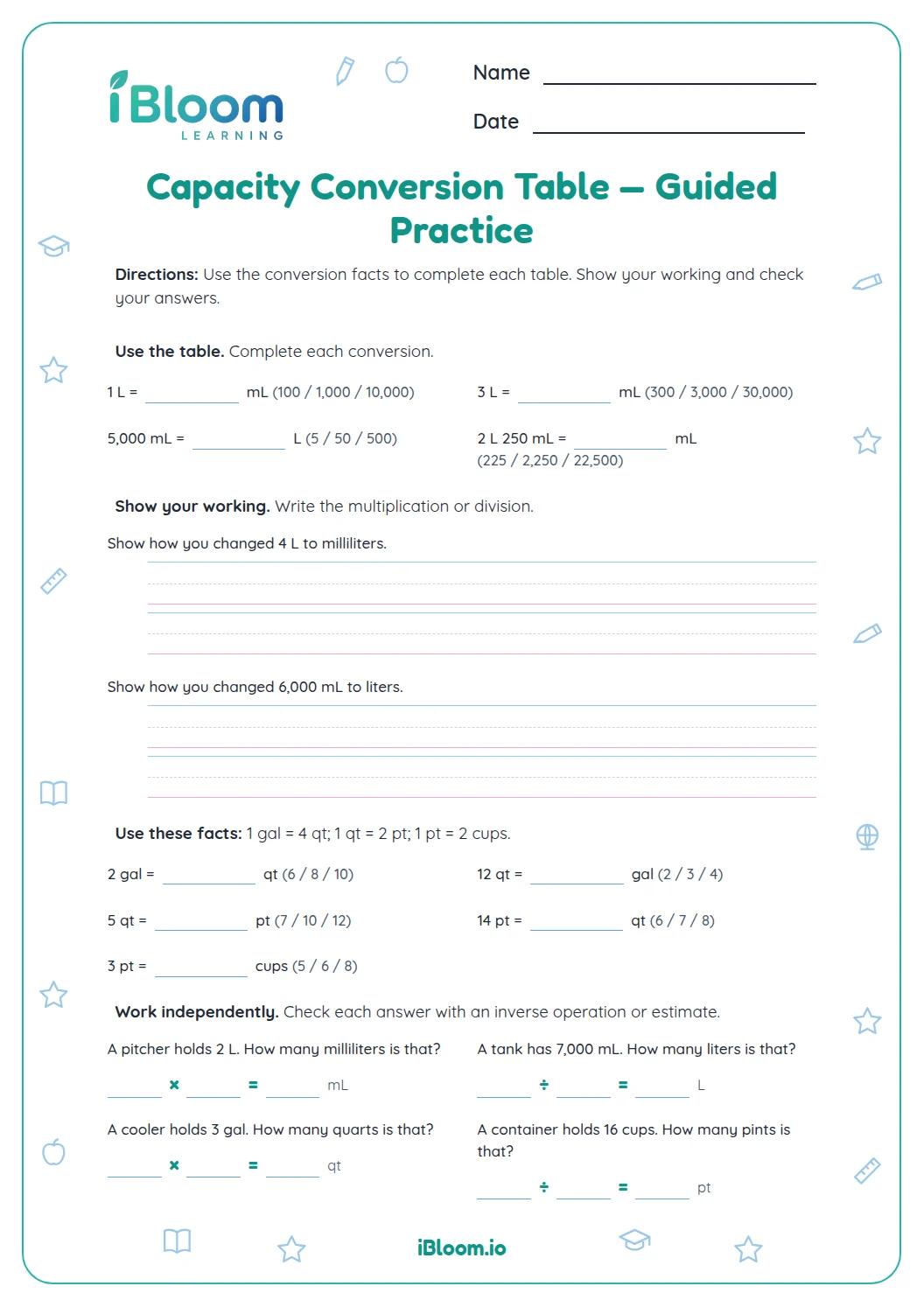
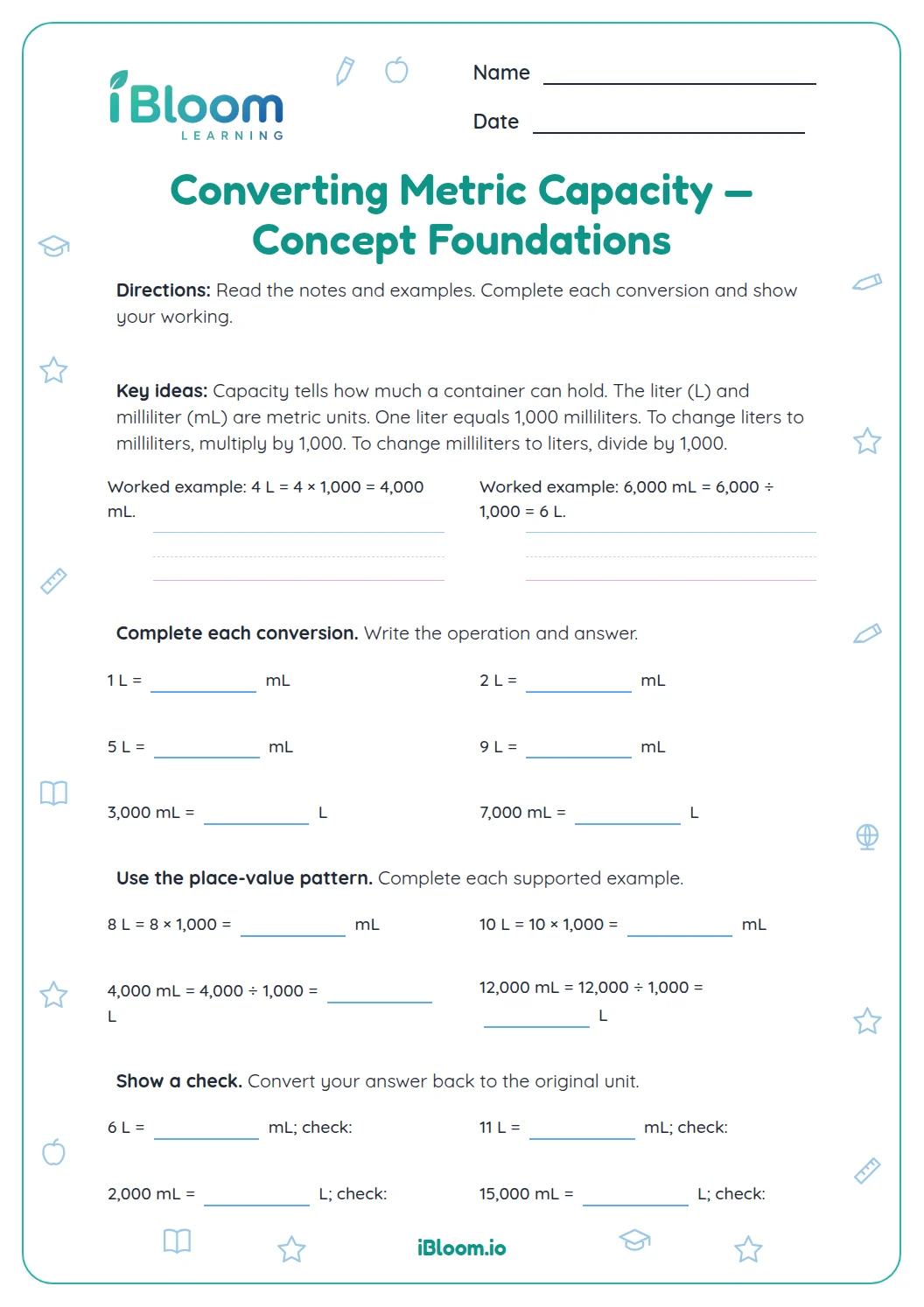
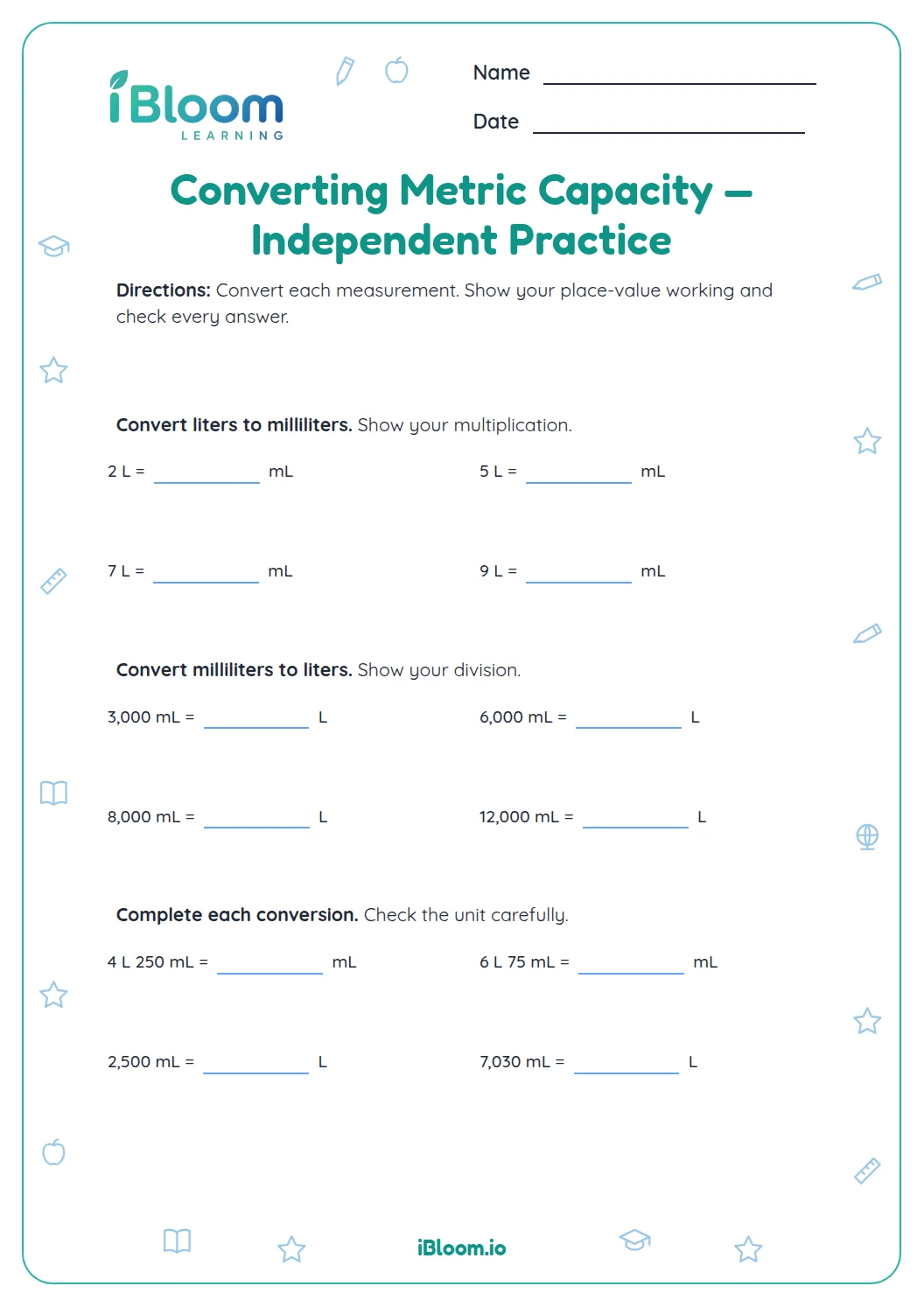
This Grade 5 worksheet builds fluency with metric capacity conversions. Students use the relationship 1 liter = 1,000 milliliters in a table, direct conversions, error checks, and short problems that combine units. The 16 items are grouped into three parts, and an answer key follows the worksheet.
Aligned to 5.MD.A.1
How does the capacity conversion table work?
Use the known pair 1 L = 1,000 mL.
Multiply liters by 1,000 to find milliliters.
Divide milliliters by 1,000 to find liters.
- 15 L = ___ mL
- 25 × 1,000 = 5,000
- 3So, 5 L = 5,000 mL
What is on this worksheet?
The worksheet has 16 questions in three parts, followed by a separate answer key.
- Part A: complete a conversion table and convert units
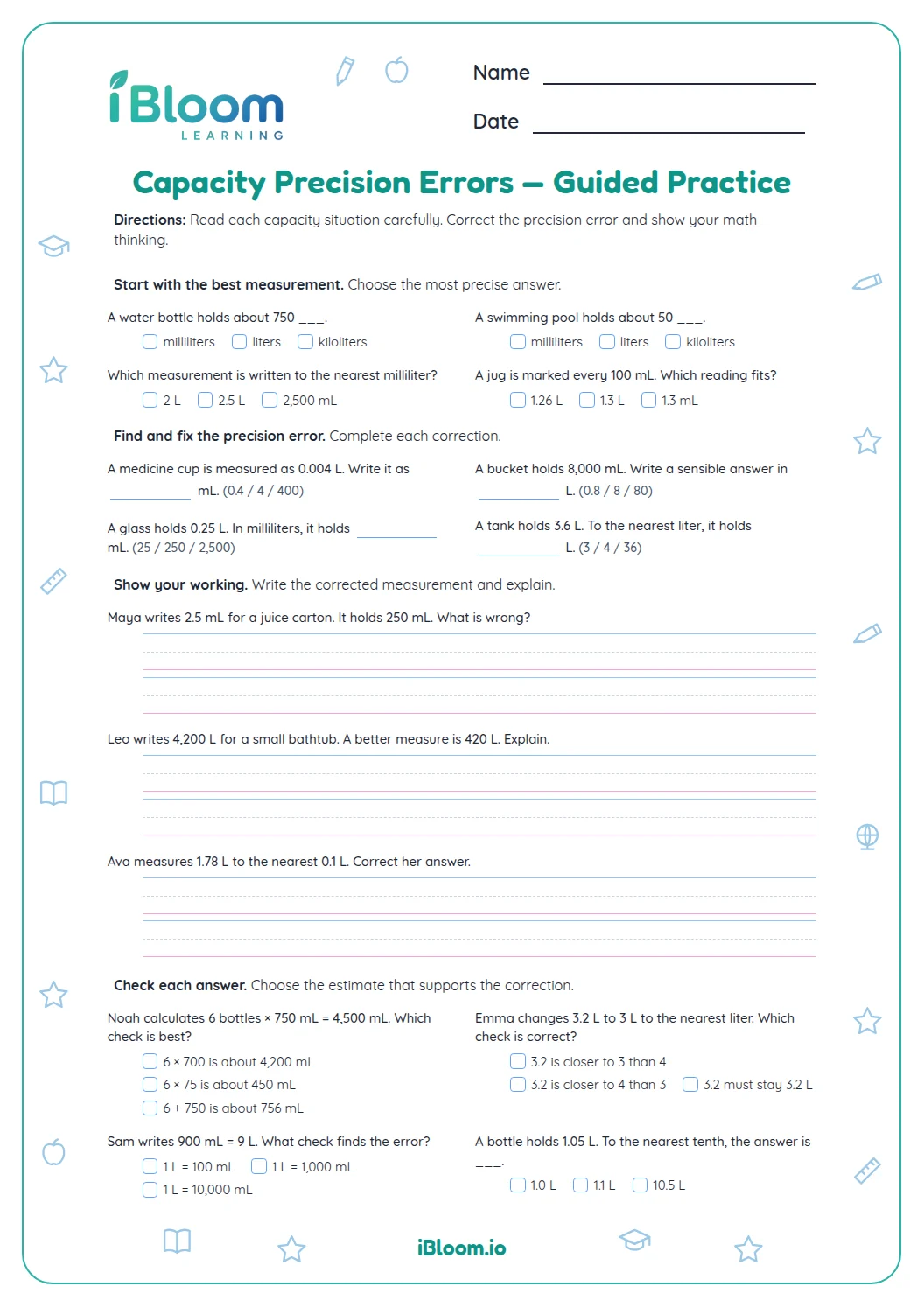
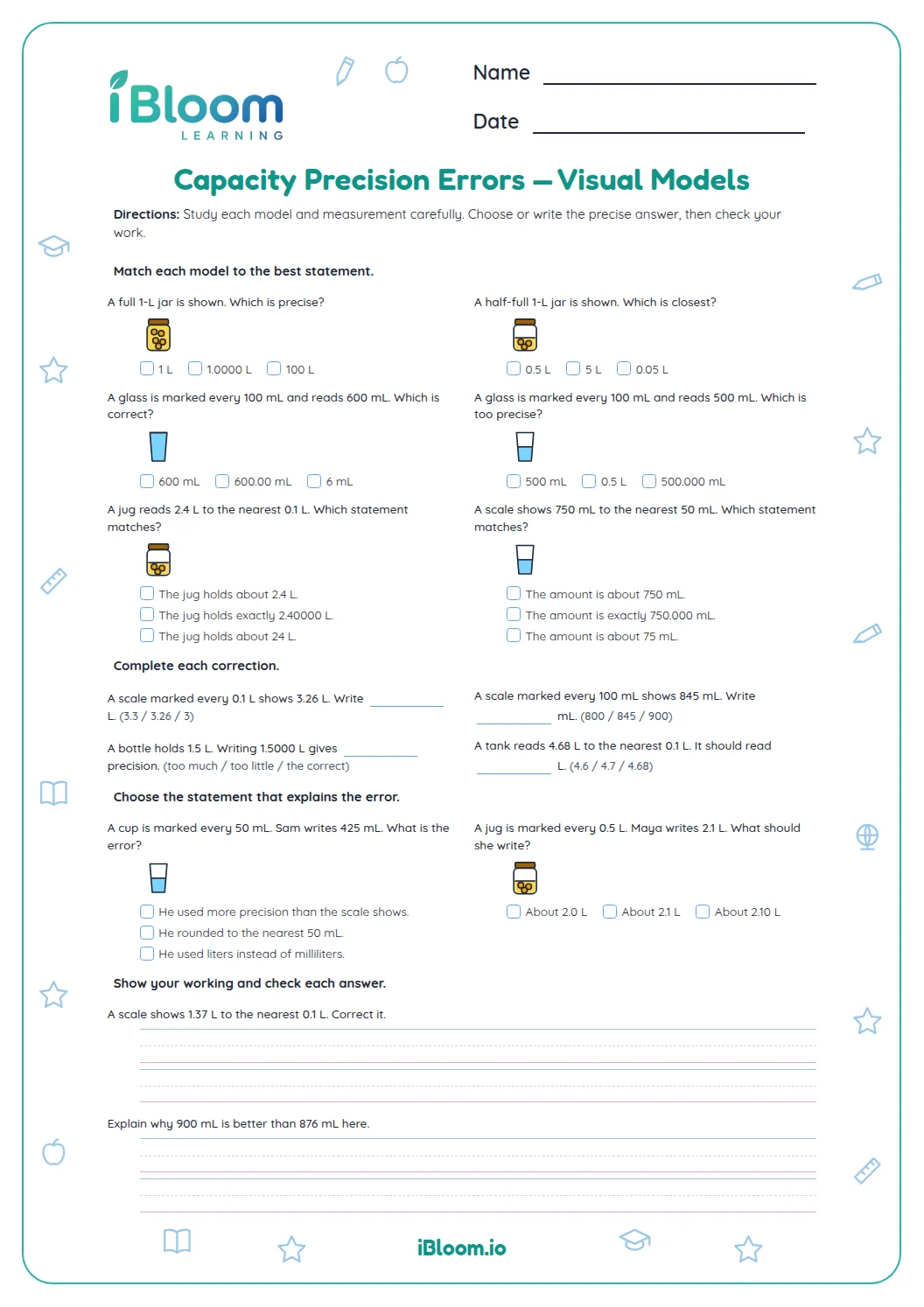
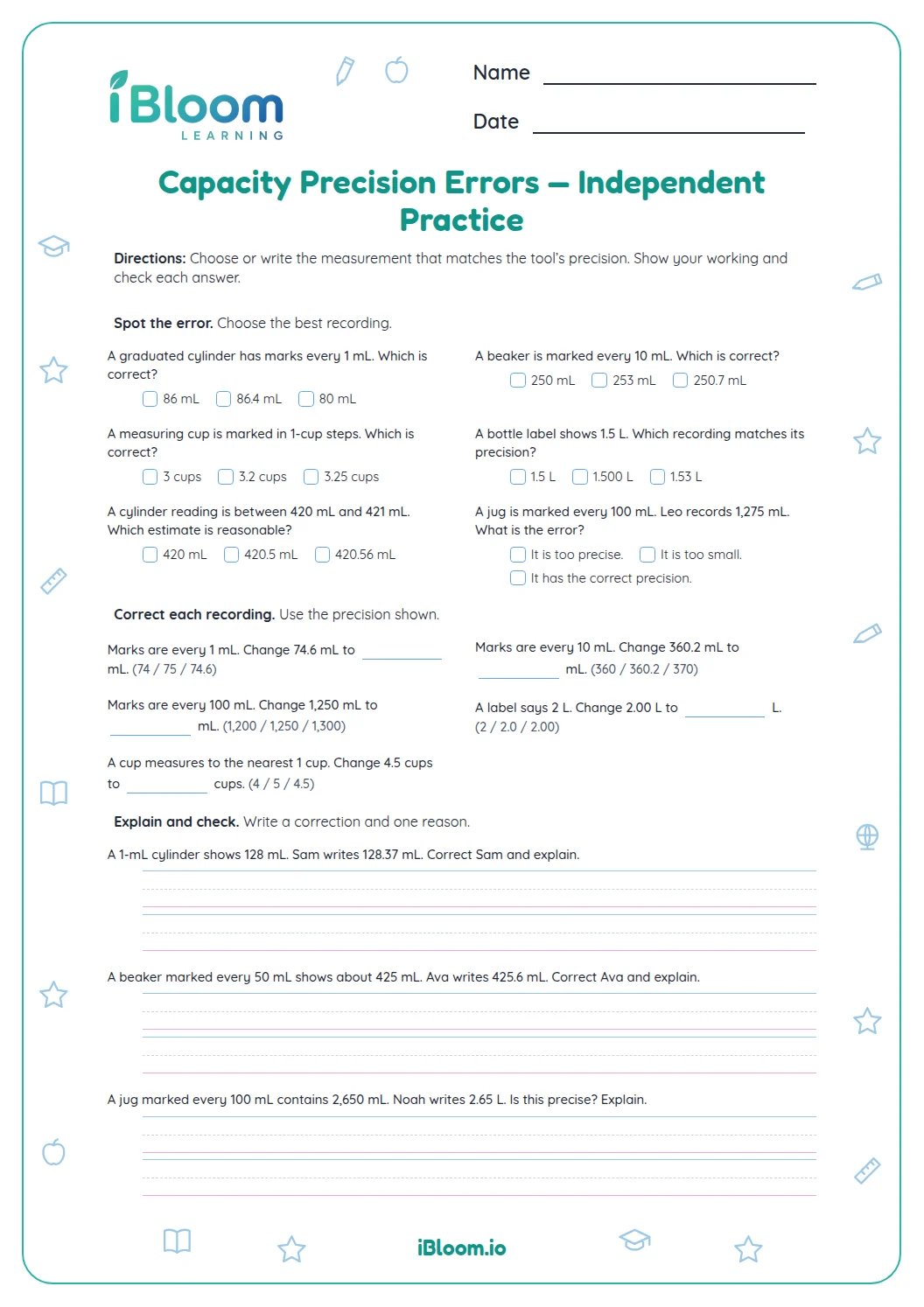
- Part B: inspect incorrect capacity conversions
- Part C: solve problems involving liters and milliliters
How to use this worksheet
- 1Read the directions and try the first question carefully.
- 2Complete each part in order, showing a calculation or clue when it helps.
- 3Return to the prompt to check that the answer fits.
- 4Use the separate key to review any missed item.
Common mistakes and quick checks
The mistake
Multiplying when converting milliliters to liters.
The fix
Since milliliters are smaller units, divide by 1,000 to find liters.
The mistake
Moving the decimal only two places.
The fix
Use three places because 1 L equals 1,000 mL.
The mistake
Combining quantities with different units.
The fix
Convert both amounts to liters or both to milliliters first.
Common Core alignment
This worksheet practices the grade-level skill named below.
Convert standard units within one measurement system and use conversions in problems.
On this sheet: Students convert between liters and milliliters and use those conversions in multi-step capacity problems.
Show the official wordingHide the official wording
Convert among different-sized standard measurement units within a given measurement system (e.g., convert 5 cm to 0.05 m), and use these conversions in solving multi-step, real-world problems.
What to practice next
Make more practice
Questions parents and teachers ask
How many milliliters are in a liter?
There are 1,000 milliliters in 1 liter. To change liters to milliliters, multiply by 1,000; to change milliliters to liters, divide by 1,000. The table and conversion questions practice both directions using whole numbers and decimals, including amounts greater than one liter.
What does the conversion table ask students to do?
The table lists liters beside milliliters and leaves two entries blank. Students use the known pair, 1 L = 1,000 mL, to fill in 2,000 mL and 4,000 mL. They then apply the relationship to other values in the direct-conversion section.
How can students check a conversion?
Convert the answer back to the starting unit. For example, 7.5 L becomes 7,500 mL because 7.5 × 1,000 is 7,500; dividing 7,500 by 1,000 returns 7.5 L. This inverse check works for decimal amounts too and can reveal a misplaced decimal point.
Are there word problems on the worksheet?
Yes. The final section has six capacity problems about a tank, recipe, cups, juice, bottles, and a container. Students convert to the same unit before adding or subtracting amounts, then label each answer with its unit. Some questions use more than one step.
Is there an answer key?
Yes. The answer key follows the worksheet pages and lists table entries, conversions, reasoning corrections, and capacity problem answers with units. Students can use it to review both the calculation and the conversion relationship behind each answer, not just check the final number.