




About this worksheet
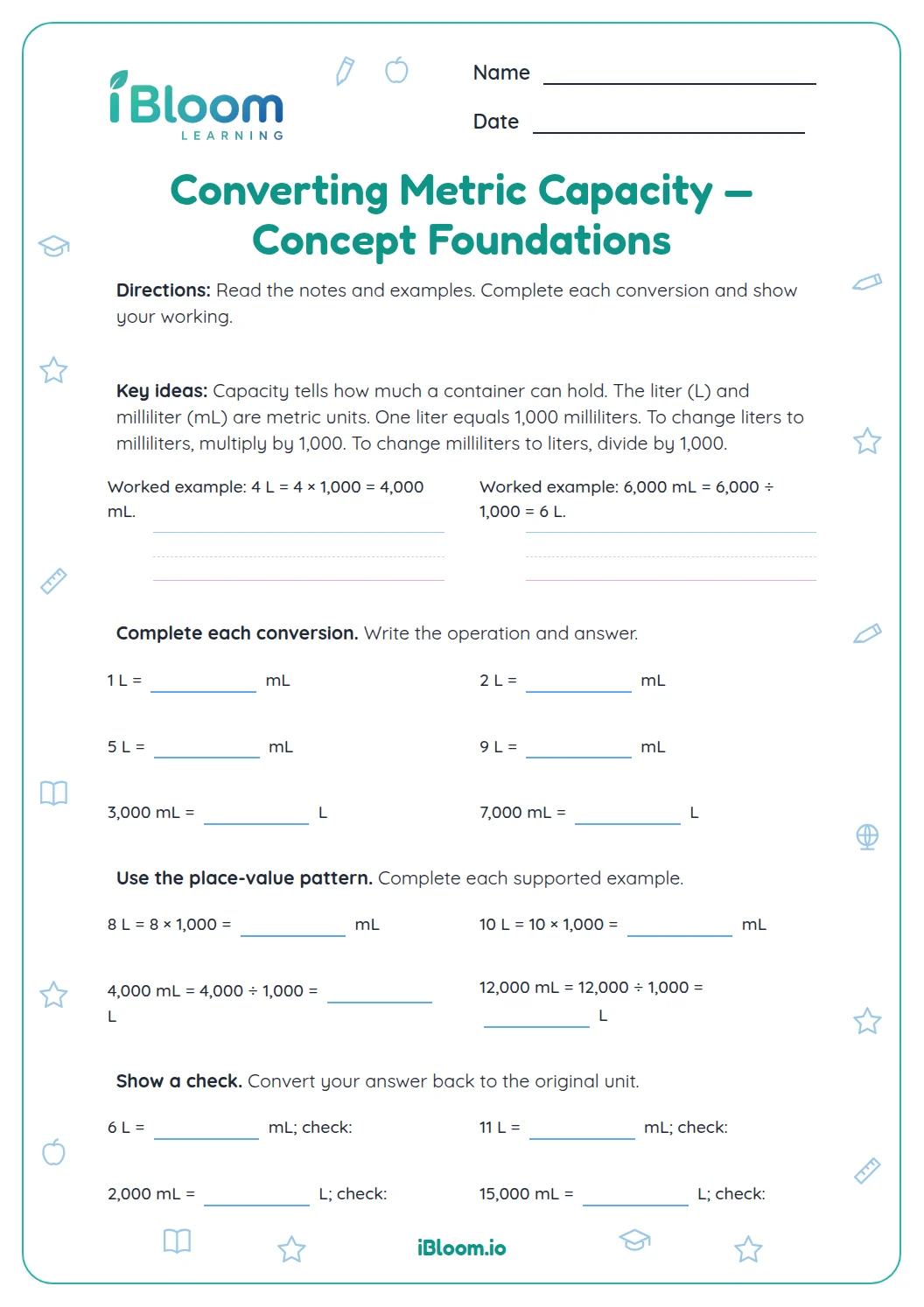
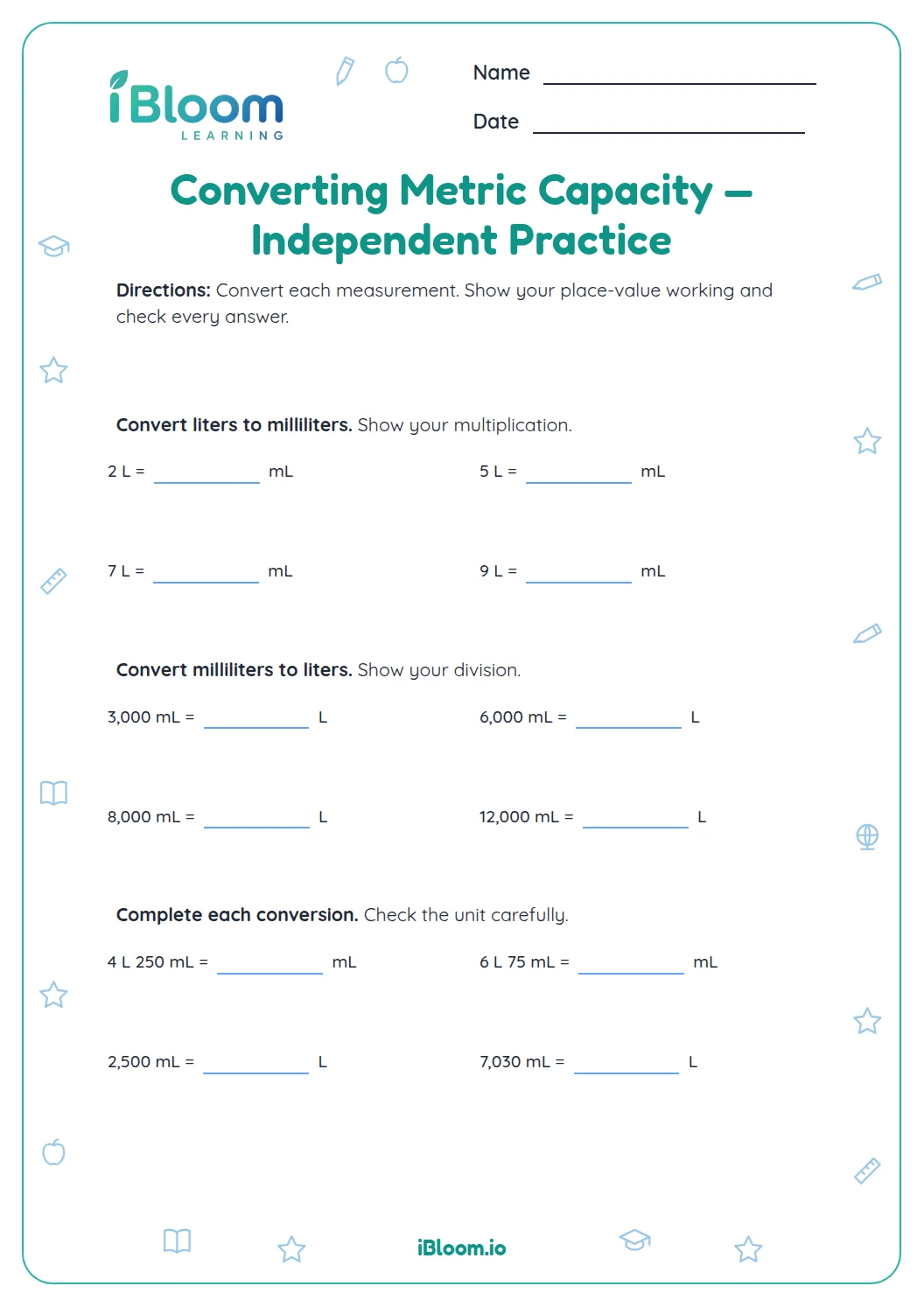
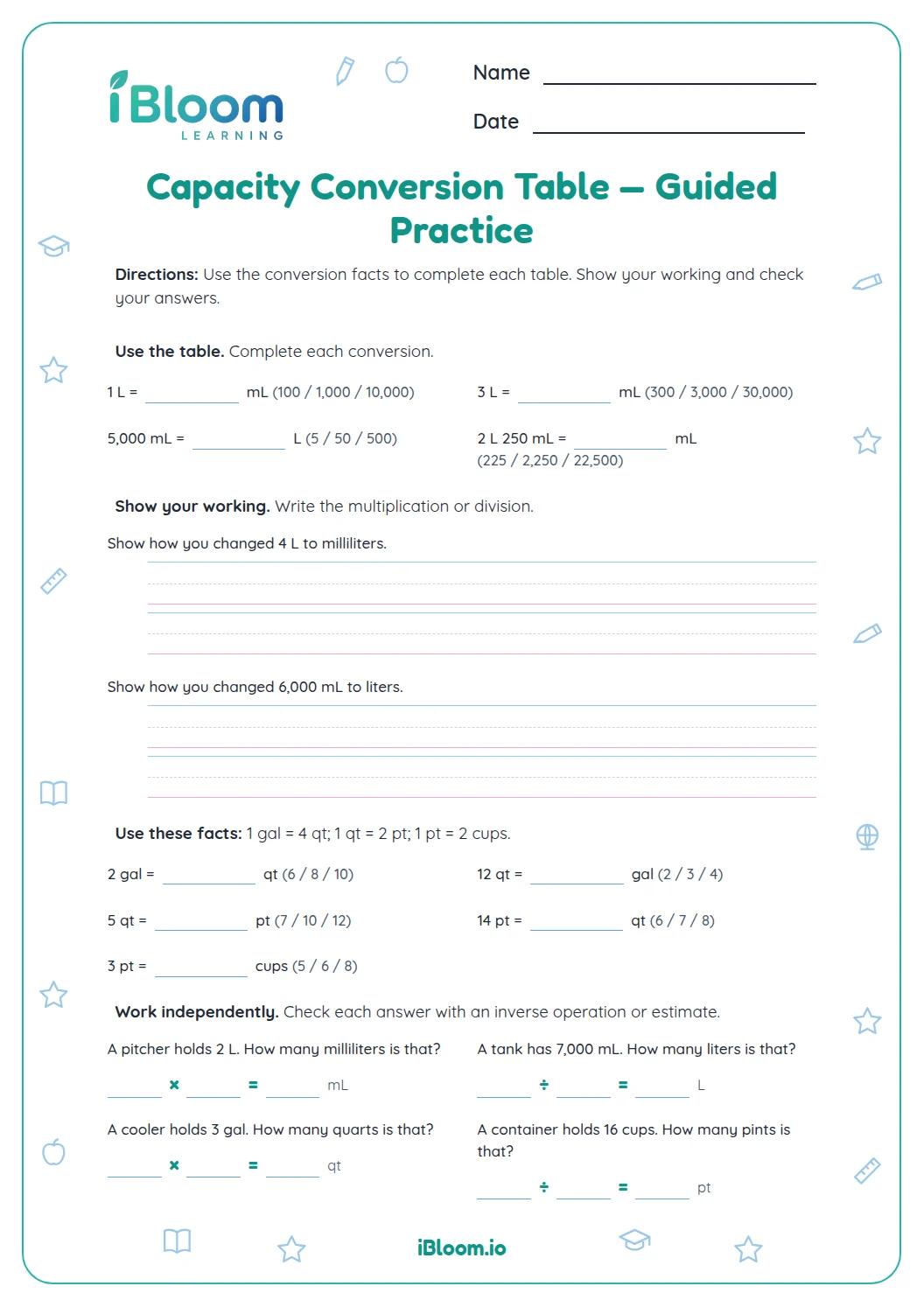
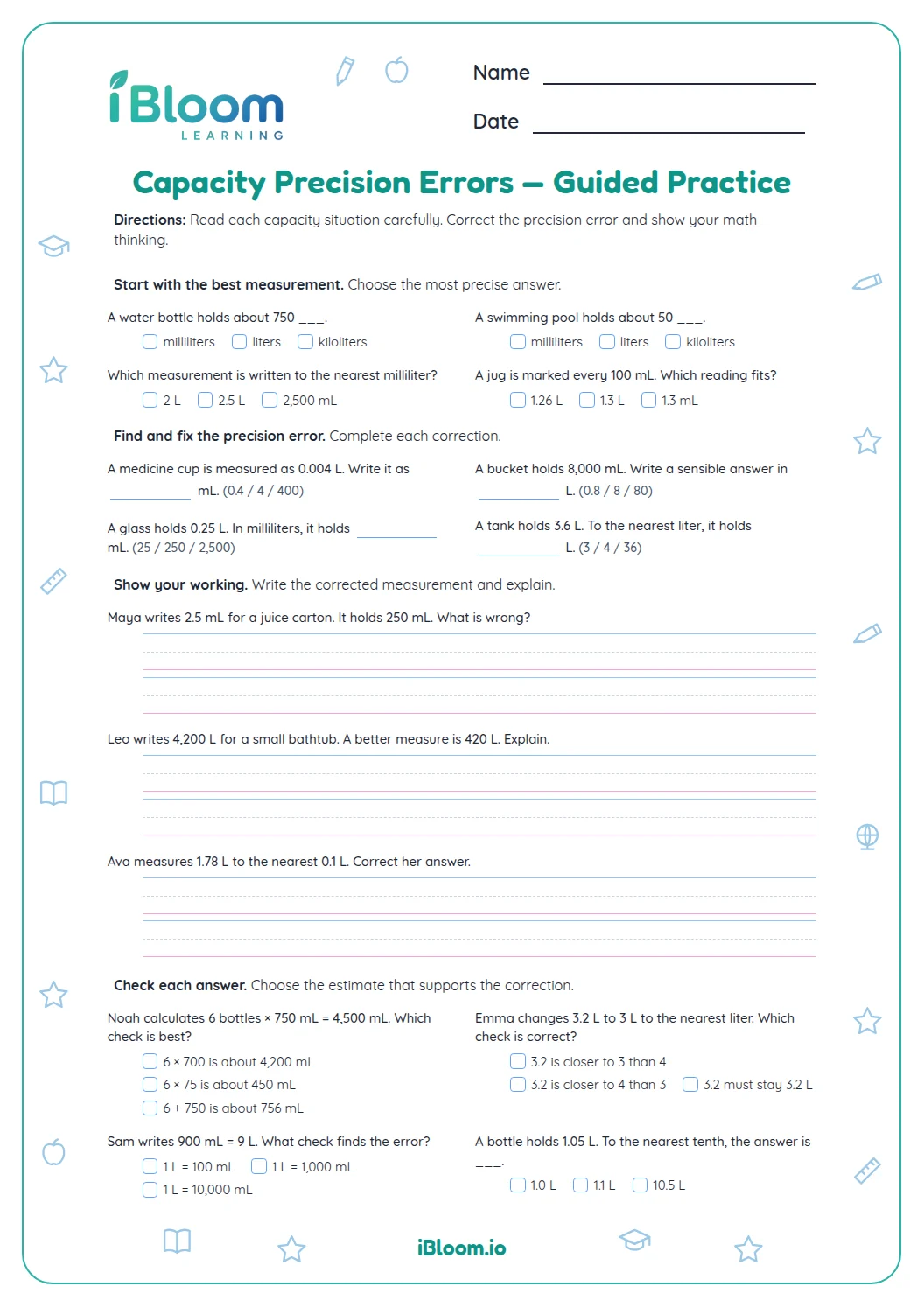
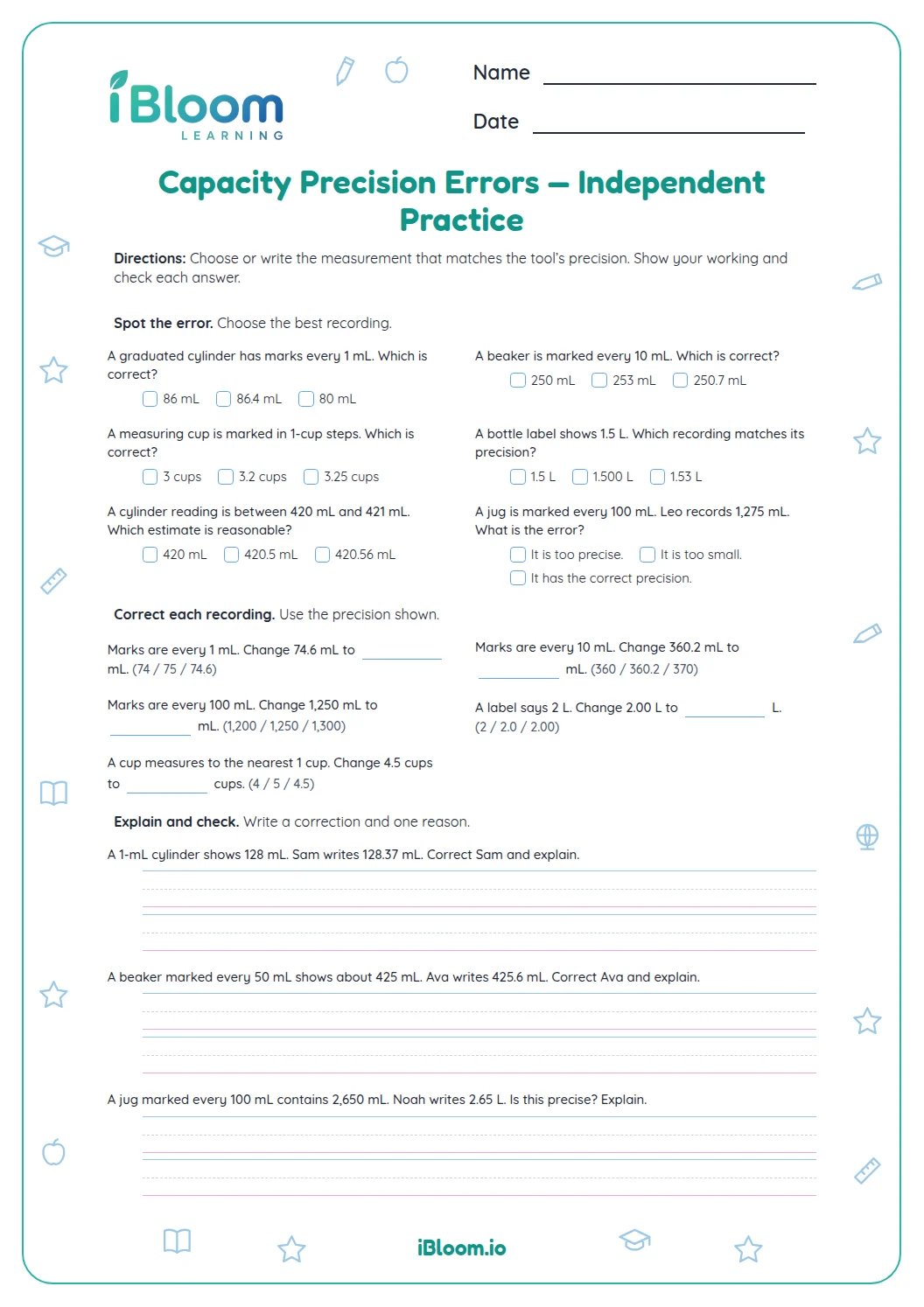
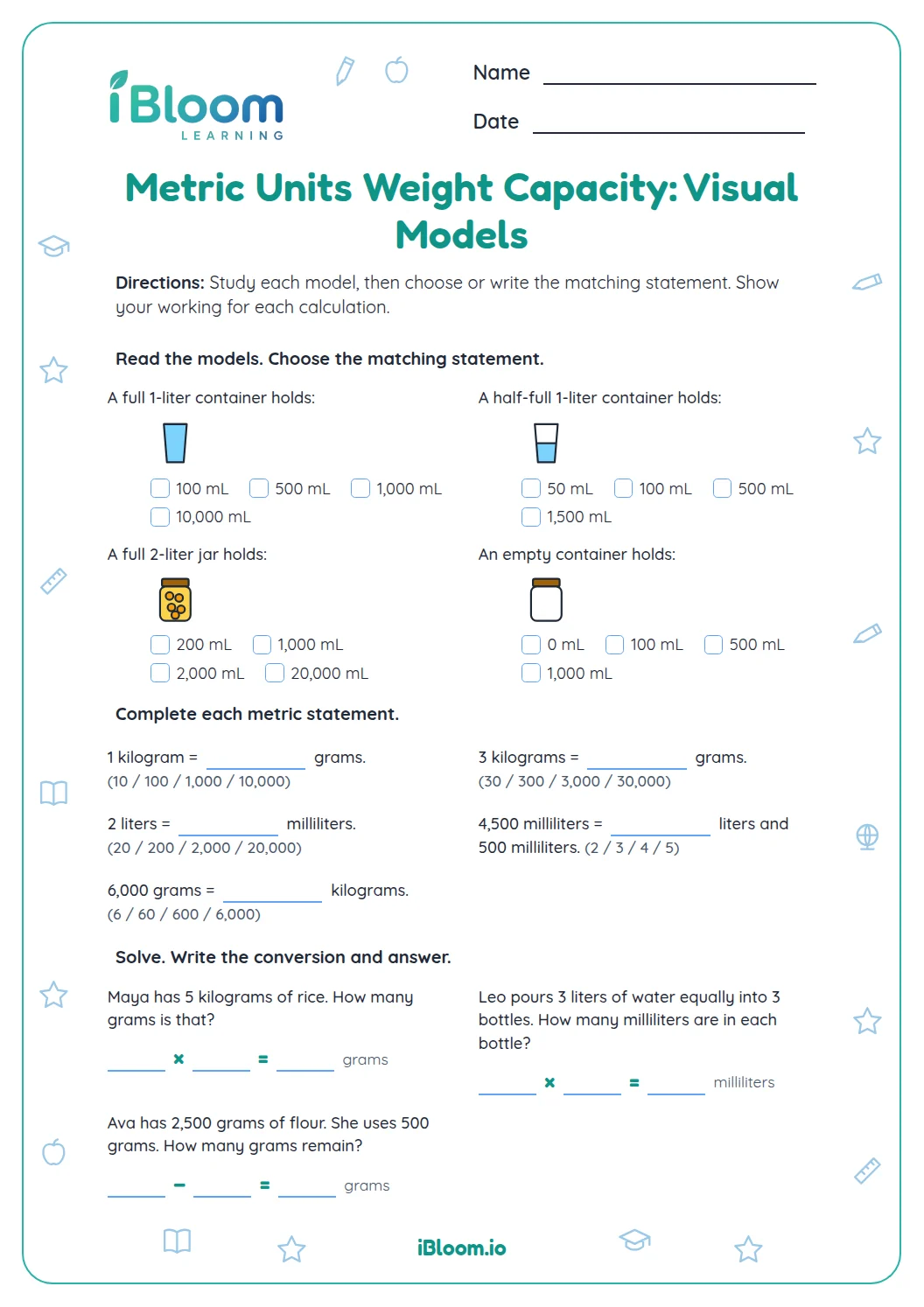
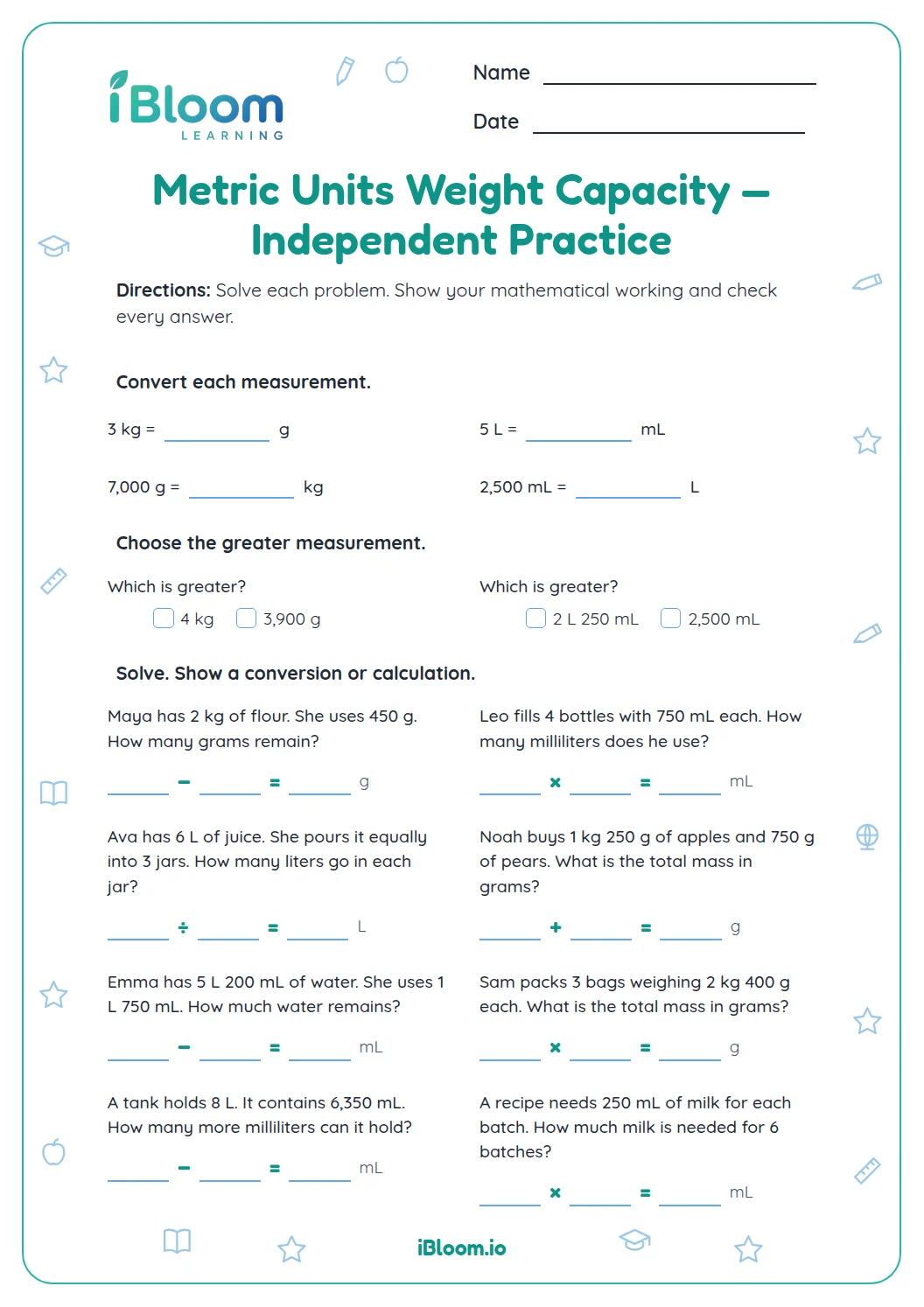
This two-page Grade 5 worksheet gives 16 questions on converting liters and milliliters. Learners convert whole and mixed amounts, then use 1 L = 1,000 mL in four short capacity stories. A separate answer key is included.
How many milliliters are in a liter?
The conversion fact is 1 L = 1,000 mL. For example, 3 L = 3 × 1,000 = 3,000 mL.
How do mixed amounts convert?
Convert the liters first, then add the remaining milliliters. For 4 L 250 mL, 4 × 1,000 + 250 = 4,250 mL.
How can I check a conversion?
Convert the answer back to the starting unit. If 6,500 mL becomes 6 L 500 mL, then 6,000 + 500 returns 6,500 mL.
How to use this worksheet
- 1Write the fact 1 L = 1,000 mL where you can see it.
- 2For liters to milliliters, multiply the number of liters by 1,000.
- 3For milliliters to mixed units, separate whole thousands from the remainder.
- 4Write the unit beside every answer.
- 5Check by converting back.
Common mistakes and quick fixes
The mistake
Writing 300 mL for 3 L.
The fix
Each liter is 1,000 milliliters, so multiply 3 by 1,000.
The mistake
Calling 2,080 mL 2 L 800 mL.
The fix
After 2,000 mL, 80 mL remains.
The mistake
Dropping the leftover milliliters.
The fix
Keep the remainder when making liters and milliliters.
What to practice next
Make more practice
Questions parents and teachers ask
What fact connects liters and milliliters?
One liter equals 1,000 milliliters. Multiply the number of liters by 1,000 to convert to milliliters, or group milliliters into thousands to convert back to liters and any leftover milliliters. It also reminds learners to include units and to check each result by converting back to the starting unit.
How many milliliters are in 6 liters?
There are 6,000 milliliters in 6 liters. Multiply 6 by 1,000 because each liter contains 1,000 milliliters, then label the result in milliliters. This worksheet uses the relationship in both directions and in mixed-unit conversion questions for extra practice.
How do I write 5,600 mL as liters and milliliters?
Write 5,600 mL as 5 L 600 mL. Five groups of 1,000 mL make 5 L, and the remaining 600 mL stays as milliliters. This worksheet also turns mixed liter-and-milliliter amounts into milliliters for added conversion practice today.
How can I check a capacity conversion?
Convert the answer back to the original unit to check it. For example, 2 L 350 mL is 2,350 mL because 2,000 plus 350 equals 2,350. The four story problems apply these same conversions to familiar containers and amounts of liquid.
Does this worksheet include an answer key?
Yes. The separate answer key covers all 16 questions: whole-unit conversions, mixed amounts, and four capacity stories. The worksheet spans two pages, and the answer key is provided on separate pages so students can check their work after finishing.