


About this worksheet
This Grade 5 math printable practices converting between liters and milliliters and using those conversions to compare and solve capacity problems. Across 15 questions, students convert whole and decimal liters, combine liters with milliliters, and reason about amounts in containers. The separate answer key shows the expected units and values.
Aligned to CCSS.MATH.CONTENT.5.MD.A.1
How are liters and milliliters related?
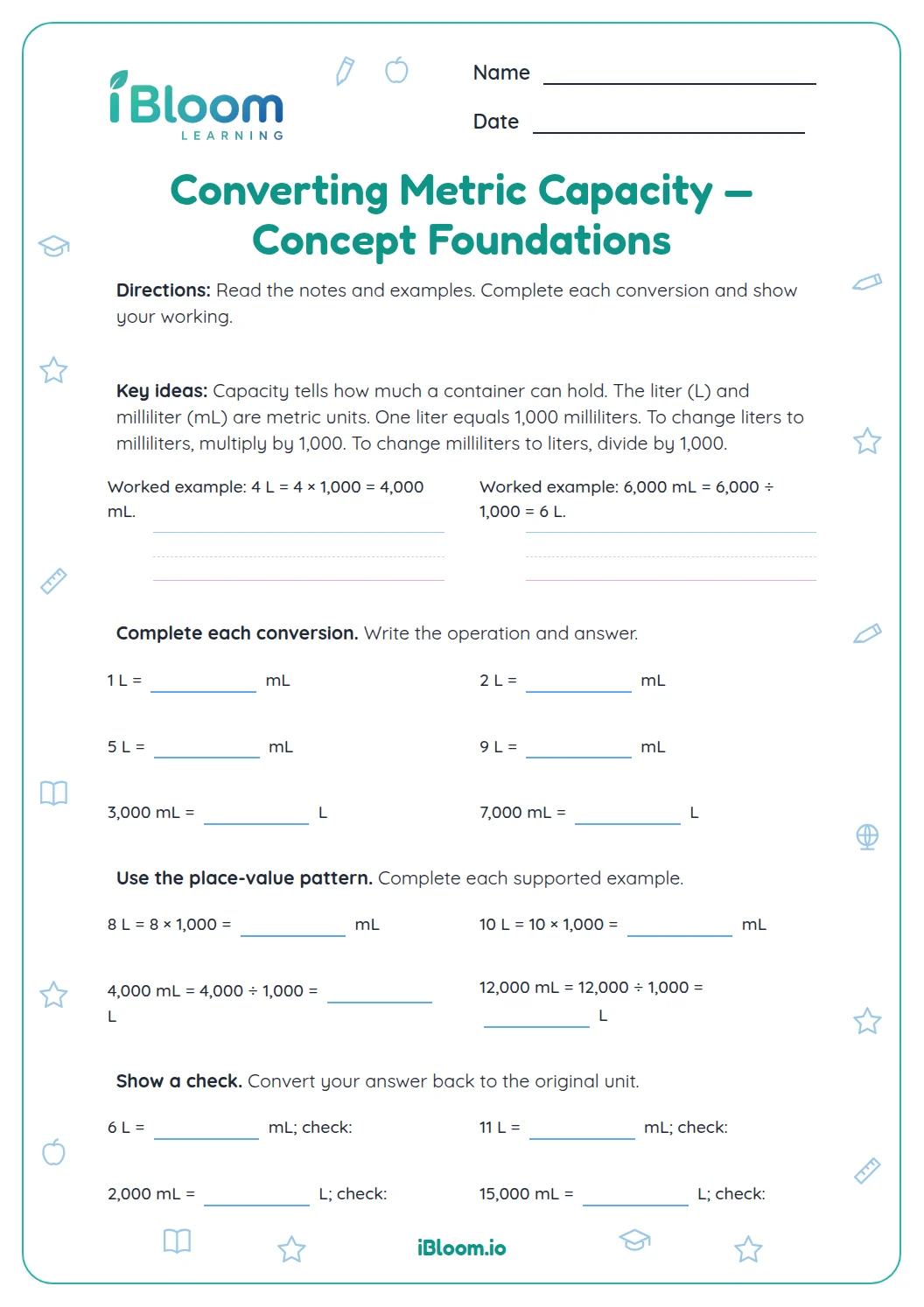
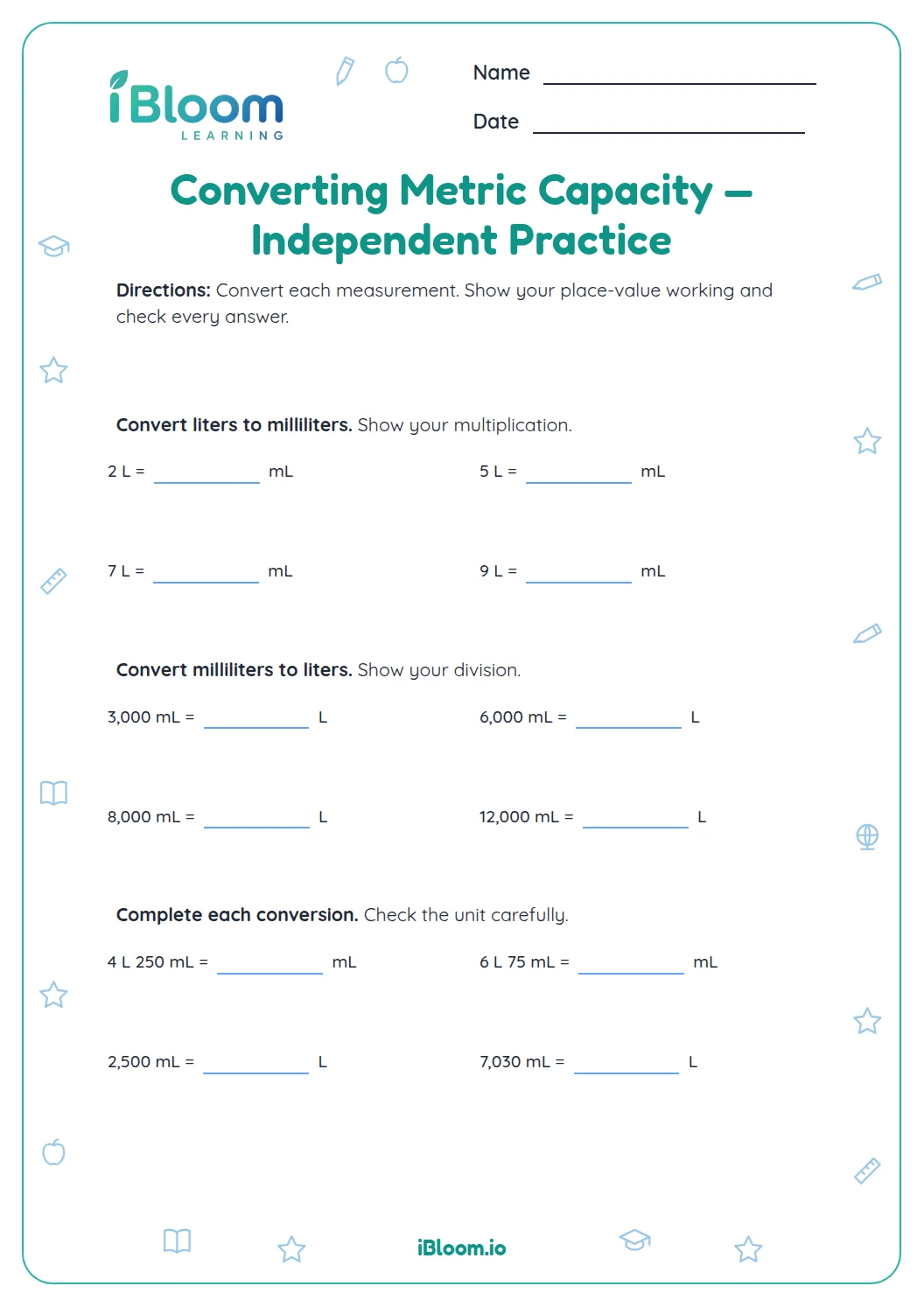
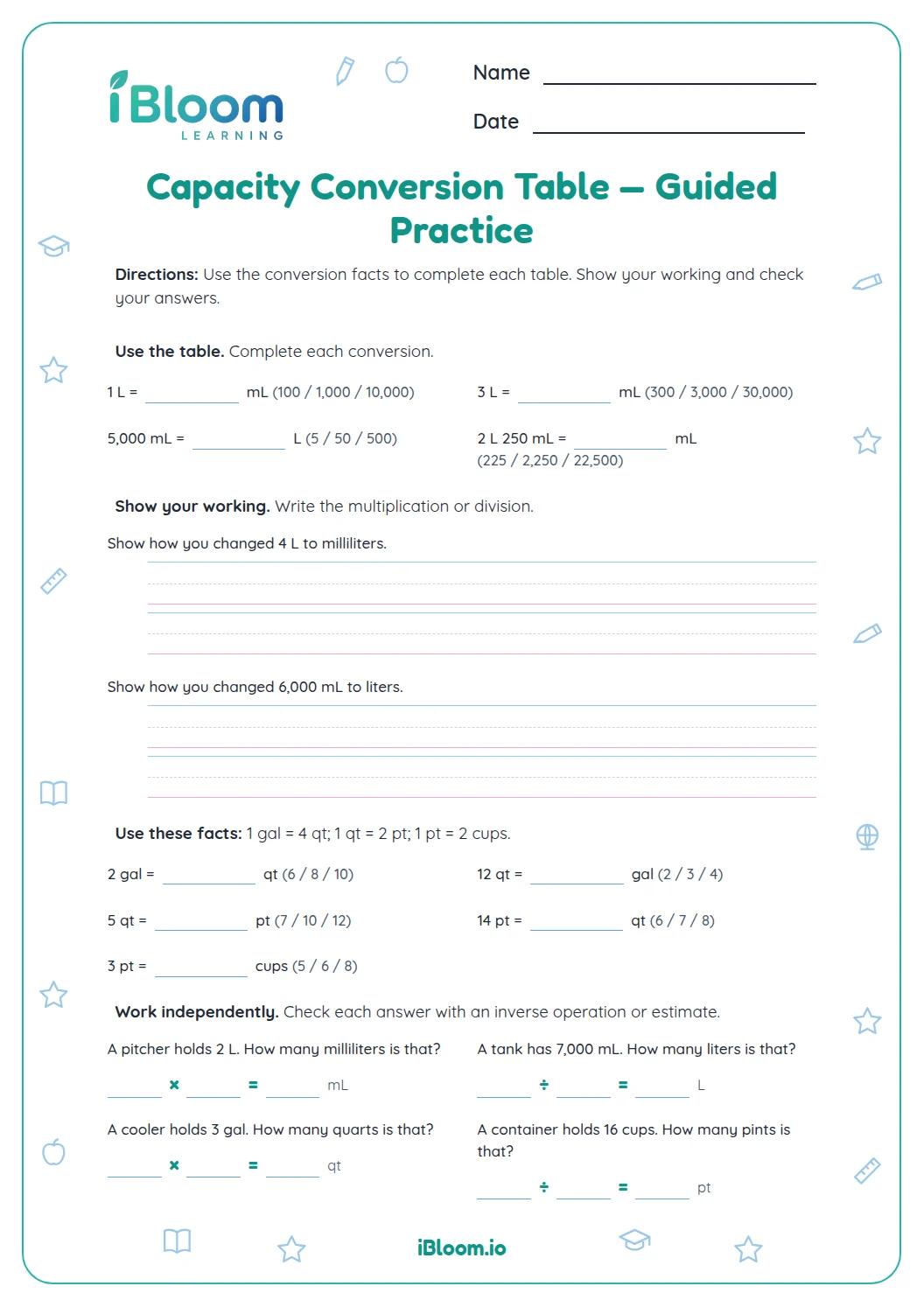
One liter equals 1,000 milliliters. To convert liters to milliliters, multiply by 1,000: 3 L = 3,000 mL. To convert milliliters to liters, divide by 1,000: 4,500 mL = 4.5 L.
How can students compare different units?
First express both quantities in the same unit. For 2.4 L and 2,350 mL, convert 2.4 L to 2,400 mL. Since 2,400 mL is greater than 2,350 mL, 2.4 L is greater.
Where do conversions help solve a capacity problem?
For the 5 L jug problem, convert 5 L to 5,000 mL, then subtract 1,750 mL. The remaining amount is 3,250 mL. Writing the unit after each step helps keep the quantities aligned.
How to work through the page
- 1Write the conversion fact: 1 L = 1,000 mL.
- 2Choose whether to multiply or divide by 1,000.
- 3Keep the target unit visible in the answer.
- 4For a comparison, convert both values to the same unit first.
- 5For a two-step problem, convert before adding or subtracting.
- 6Check that the final amount is reasonable for the container.
Common slips and fixes
The mistake
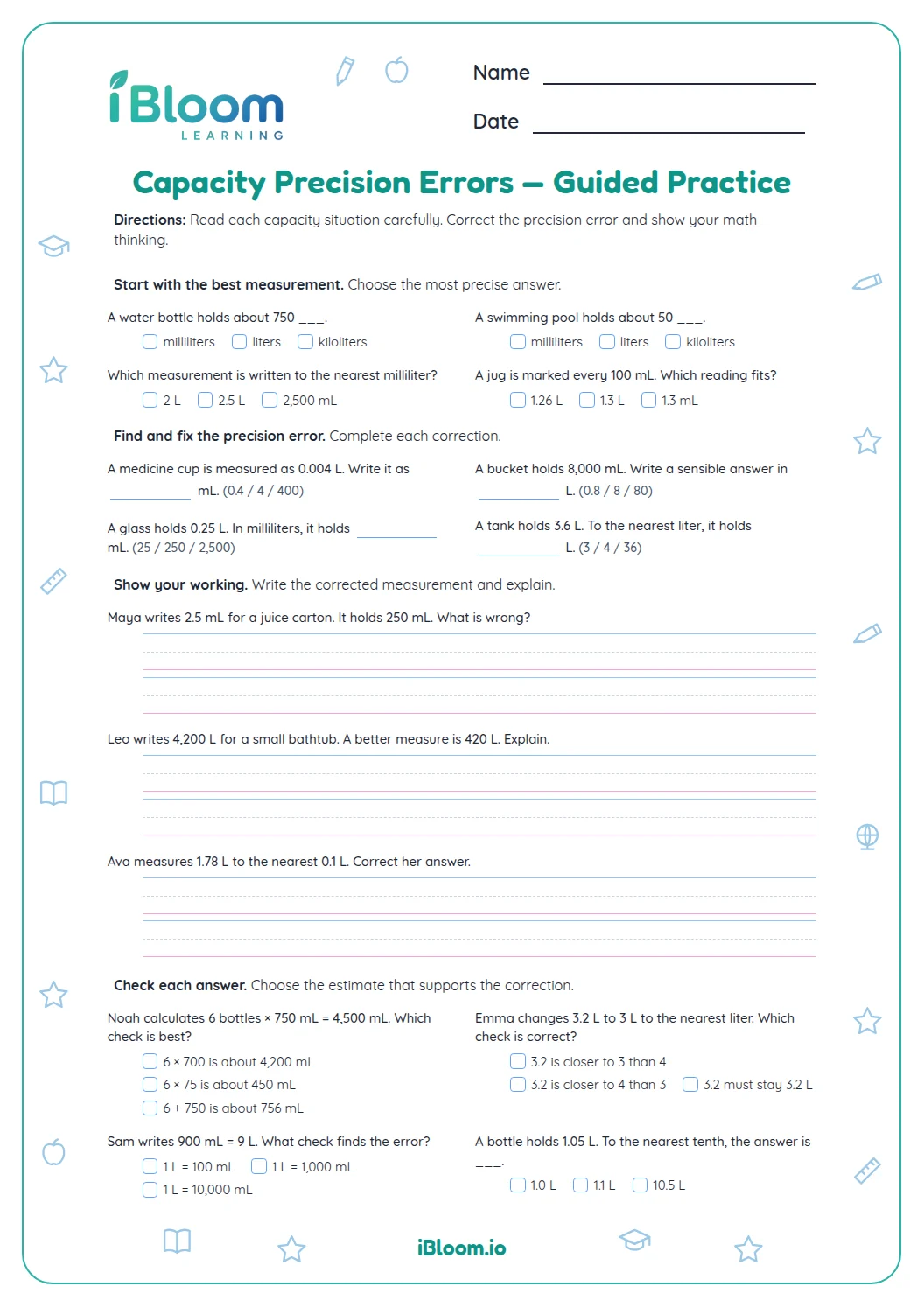
Moving the decimal in the wrong direction
The fix
Liters are larger units, so the number of milliliters is 1,000 times larger.
The mistake
Comparing a liter value directly with a milliliter value
The fix
Convert one amount so both numbers use the same unit.
The mistake
Forgetting milliliters after a blank
The fix
Read the unit printed after the blank and put only the number in it.
Curriculum alignment
Students convert liters and milliliters, then use those conversions in capacity problems.
On this sheet:
Show the official wordingHide the official wording
Convert among different-sized standard measurement units within a given measurement system (e.g., convert 5 cm to 0.05 m), and use these conversions in solving multi-step, real world problems.
What to practice next
Make more practice
Further reading
Questions parents and teachers ask
What conversion fact should students use?
The worksheet uses 1 liter = 1,000 milliliters. Multiplying a liter amount by 1,000 gives milliliters; dividing milliliters by 1,000 gives liters. Students can write the unit beside each step to keep the direction of the conversion clear. These equivalents use the same capacity.
How many problems are on the page?
There are 15 problems in four parts. Students first convert liters and milliliters, then compare capacities and solve situations involving amounts poured, combined, or remaining. The answer key follows the worksheet and includes the requested units when the prompt asks for them. The key also helps check the unit beside each result.
How should students compare liters and milliliters?
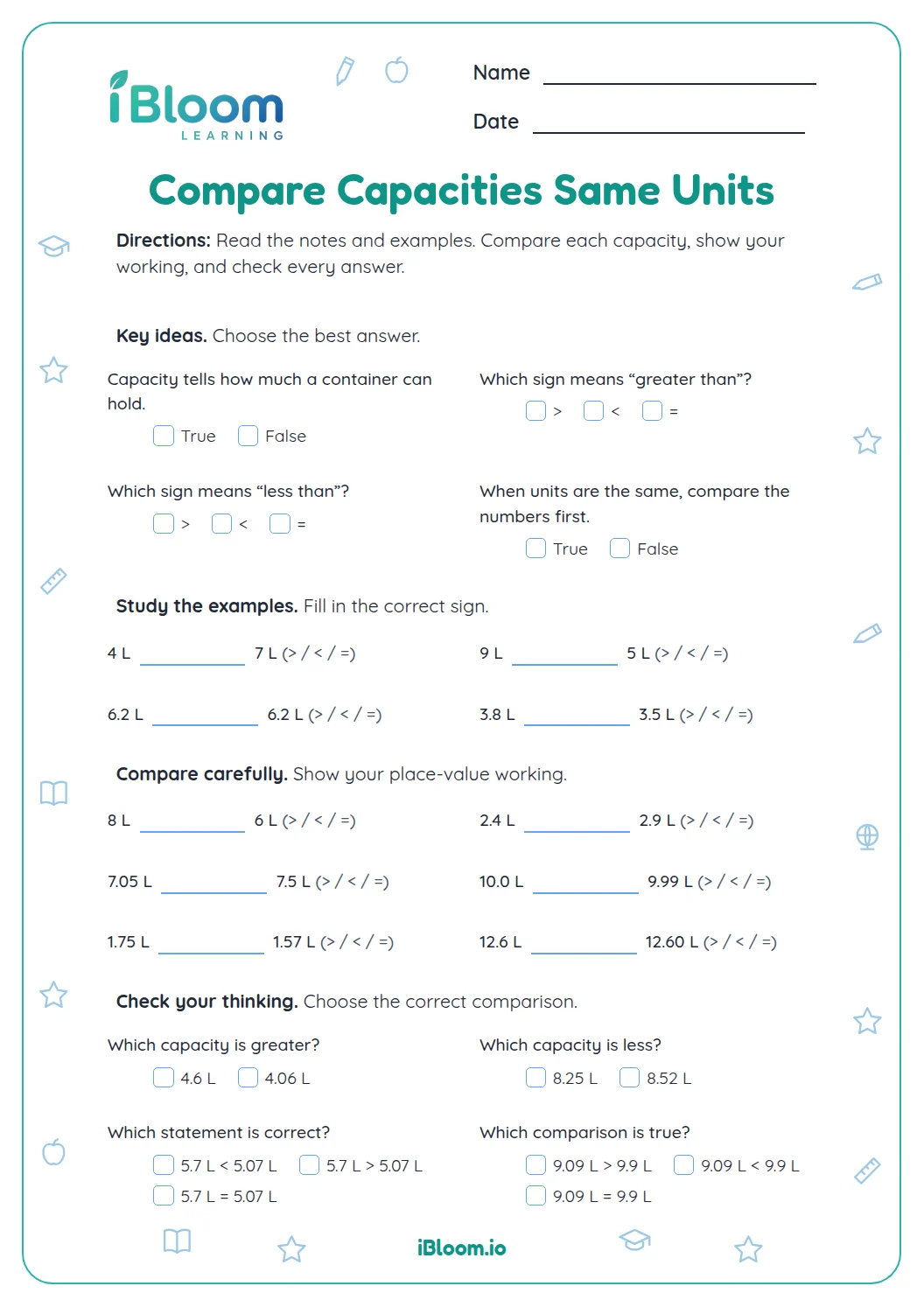
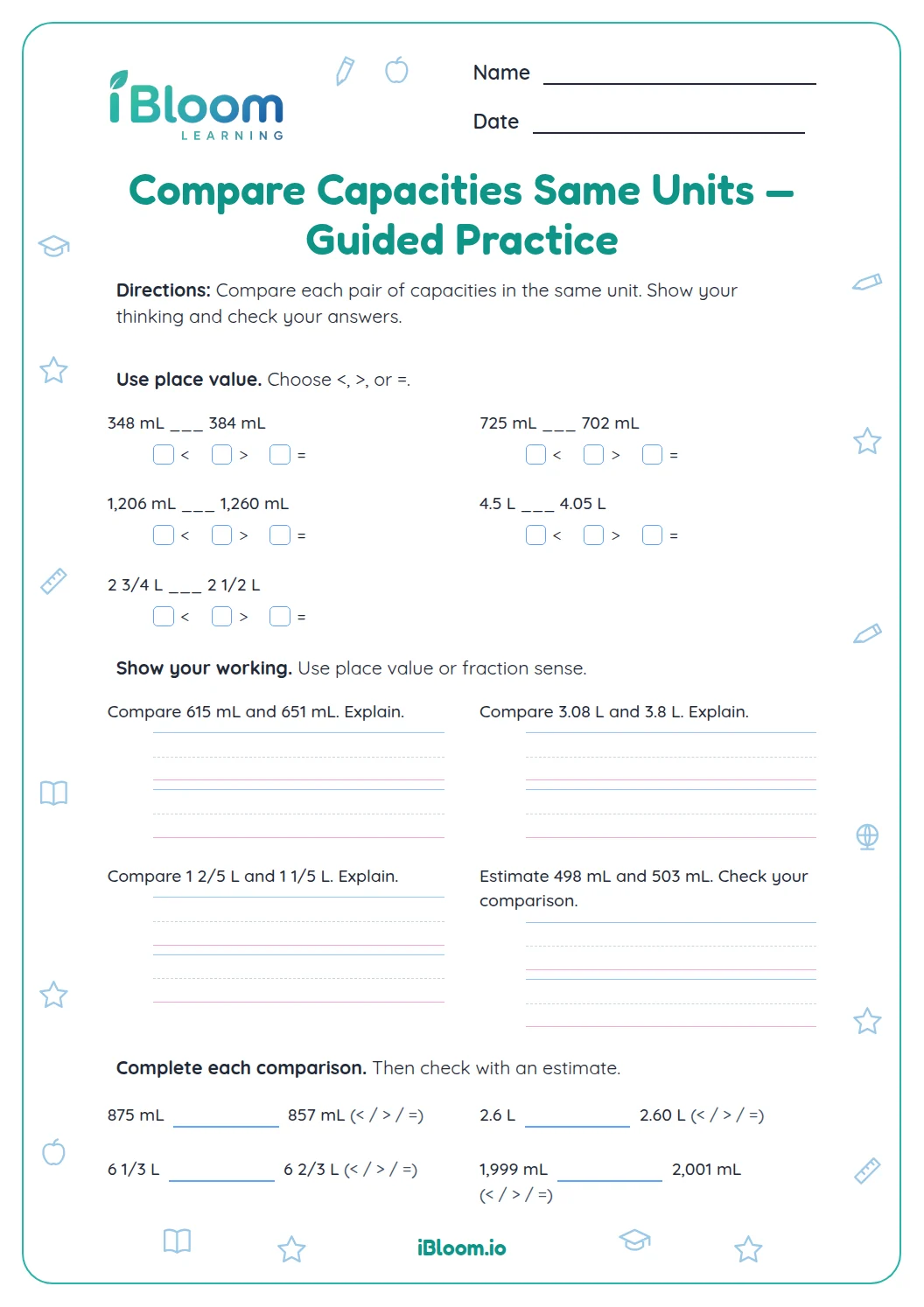
Convert both capacities to the same unit before comparing. For example, 2.4 L becomes 2,400 mL, which can be compared directly with 2,350 mL. Keeping the units the same prevents a smaller-looking number from being mistaken for a smaller capacity.
How does the worksheet handle decimal liters?
Several items use decimal liters, such as 0.8 L or 1.25 L. Students multiply by 1,000 to find the equivalent milliliters. Other questions ask them to combine or compare decimal-liter amounts after converting the milliliter quantity. Check that the answer unit matches the question.
Does the answer key include units?
The key gives units for word problems and comparison answers when the prompt asks for a capacity. For fill-in-the-blank questions where the unit is already printed after the blank, the answer is the number alone. Students should check the prompt before writing a unit twice.