

About this worksheet
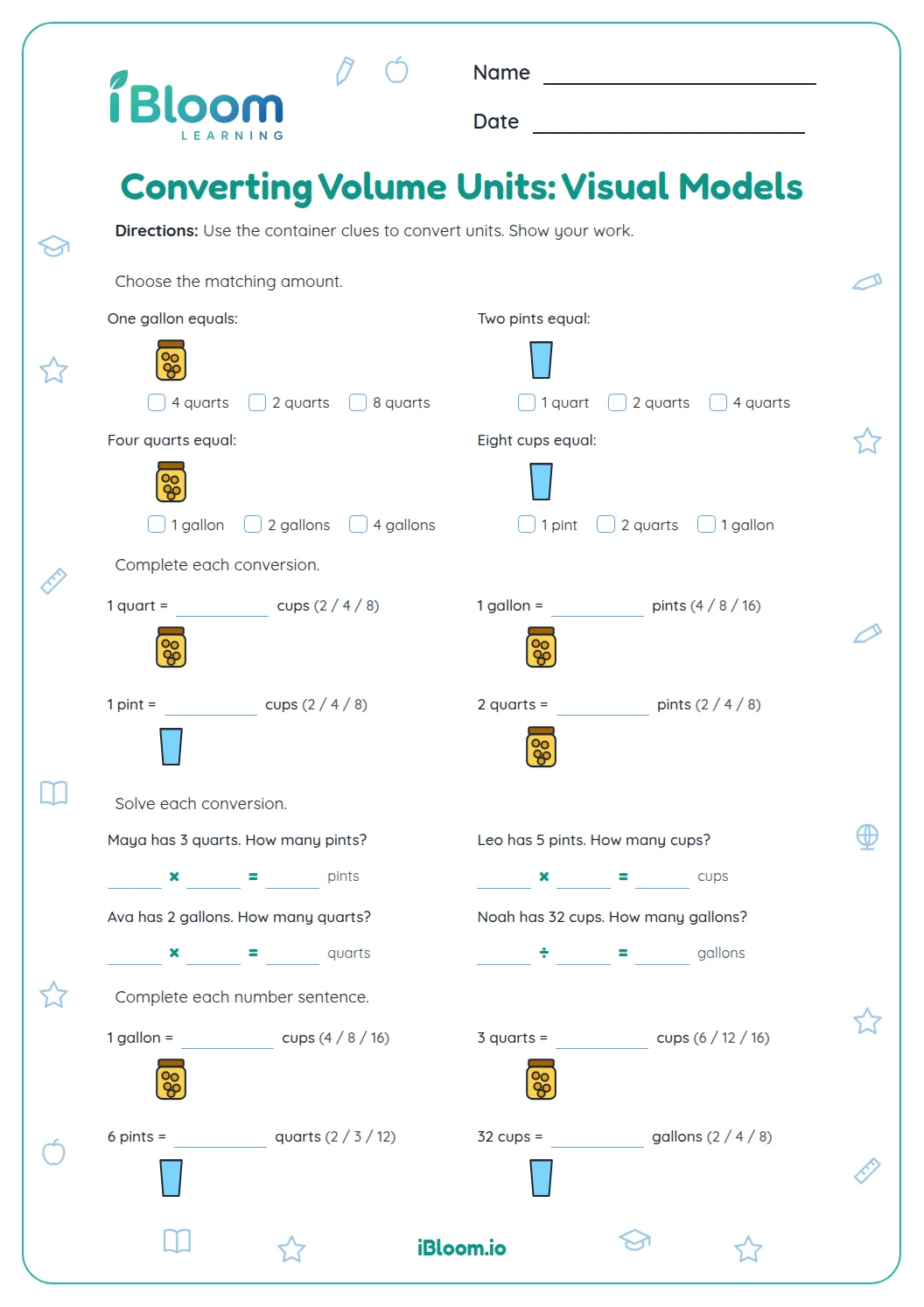
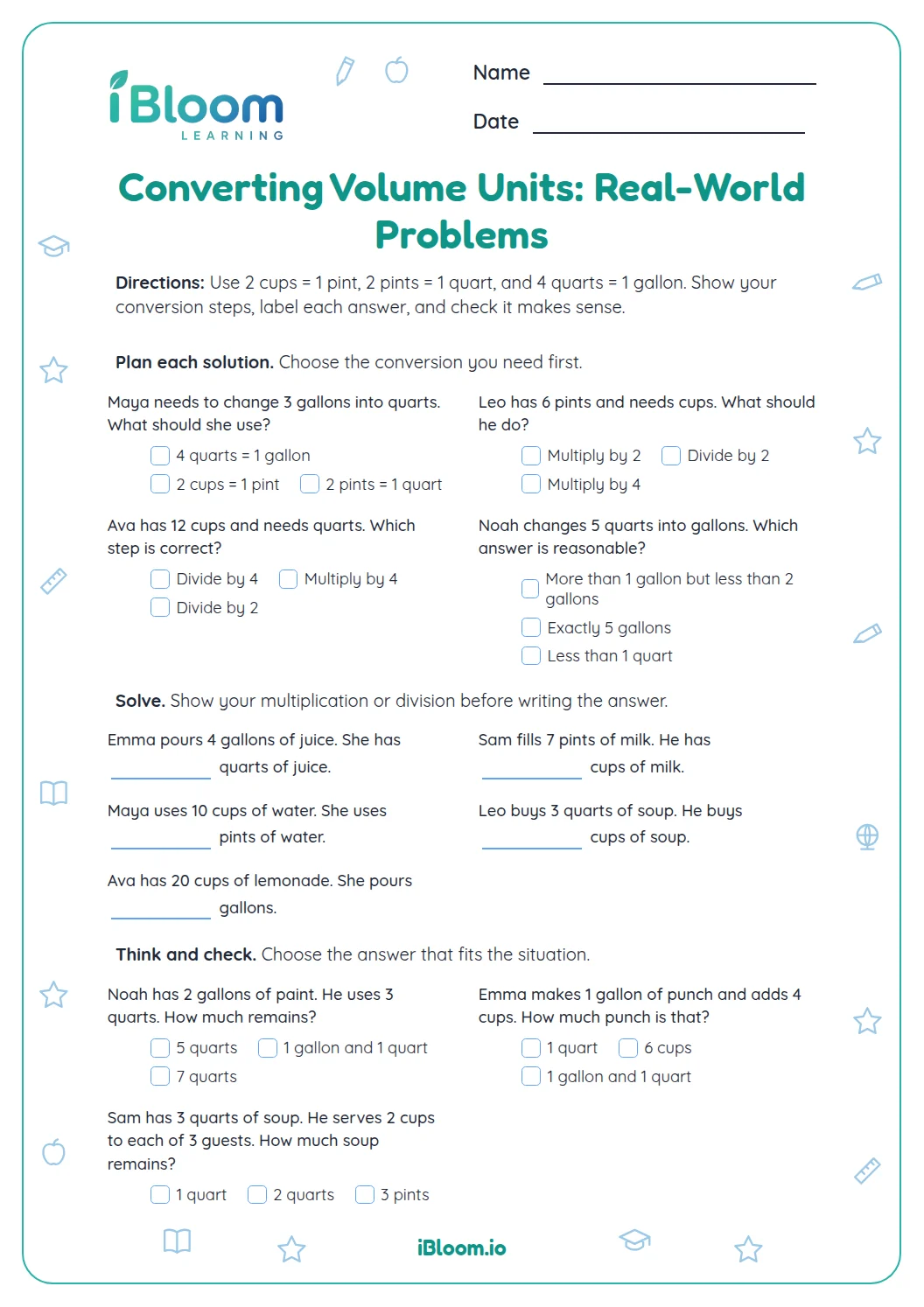
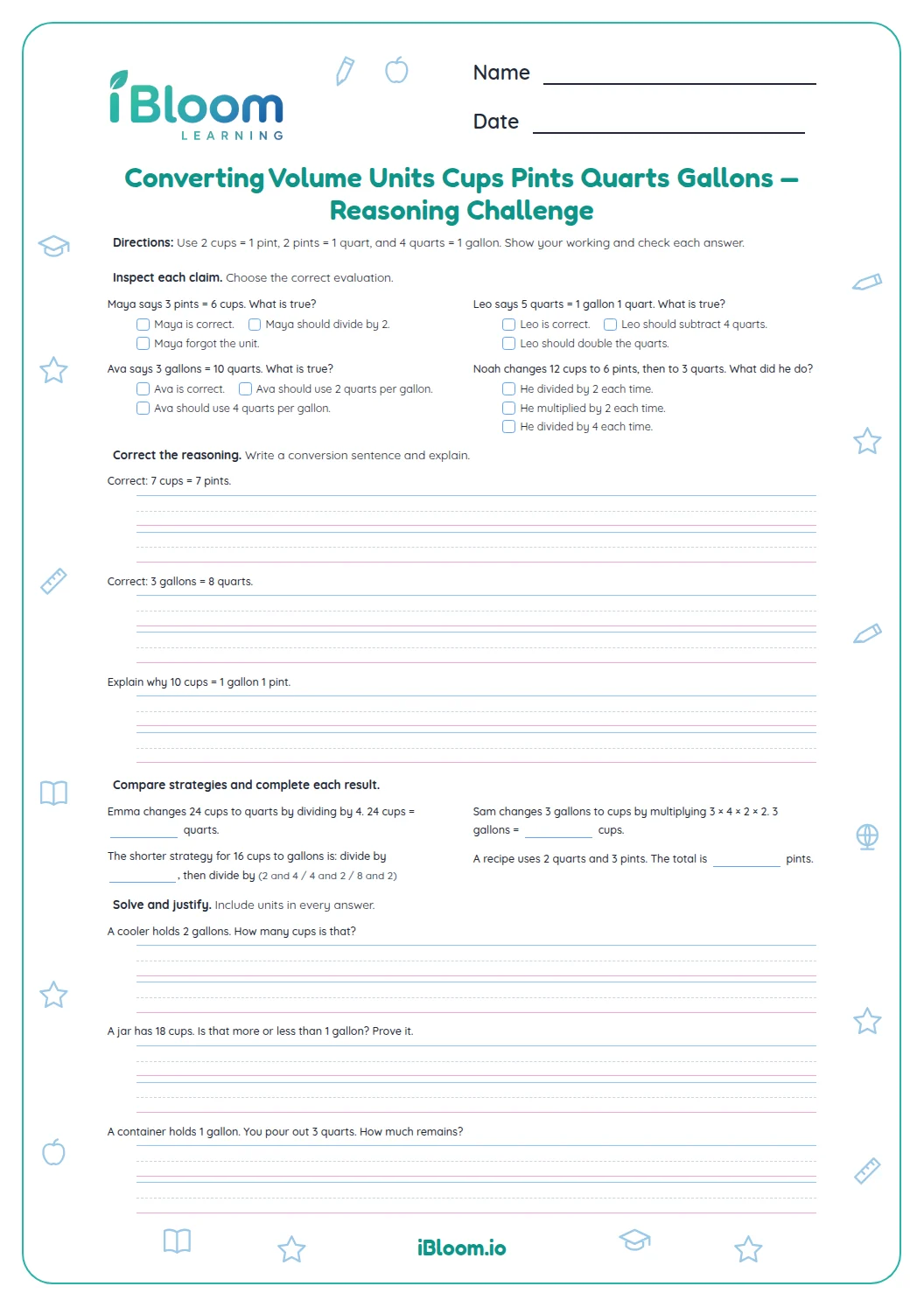
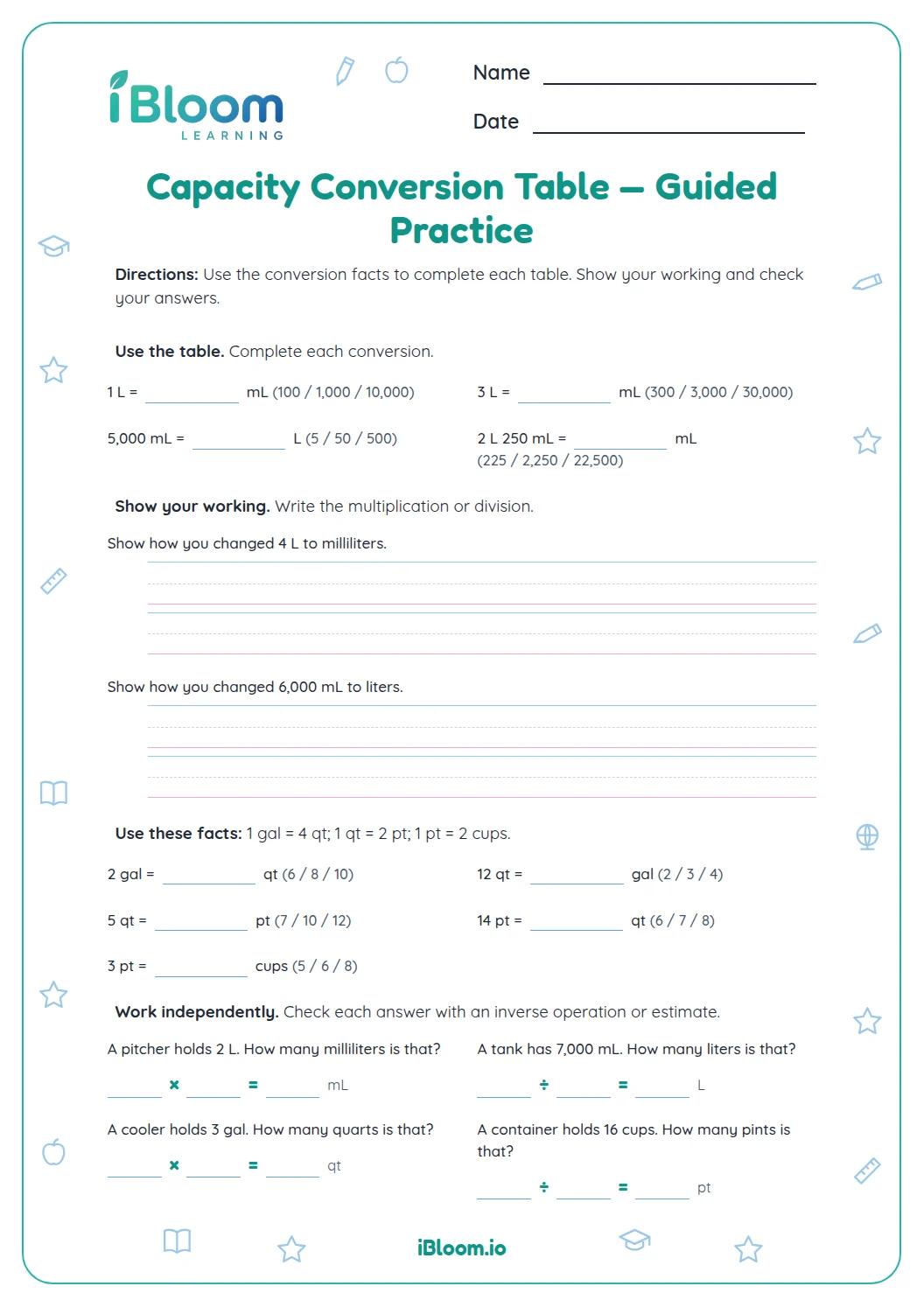
This independent practice page builds fluency with the customary capacity relationships 2 cups = 1 pint, 2 pints = 1 quart, and 4 quarts = 1 gallon. Part A converts between neighboring units. Part B combines the relationships and applies them to familiar amounts such as juice, broth, and bottles. All answers use whole numbers, and each context gives the quantity and unit needed to solve it.
Aligned to 5.MD.A.1
How are the volume units related?
The customary units on this sheet are cups, pints, quarts, and gallons. Two cups equal one pint, two pints equal one quart, and four quarts equal one gallon. You can use these facts one step at a time. For example, 3 quarts equal 6 pints, and each pint equals 2 cups, so 3 quarts equal 12 cups.
When converting to a smaller unit, the number gets larger because more small units fit in the same amount. When converting to a larger unit, the number gets smaller. Keeping the unit labels in your equation helps you choose the right operation.
What does this worksheet cover?
Part A practices direct conversions, such as pints to cups and gallons to quarts. Part B uses longer conversion chains and short situations. Students may write a multiplication or division equation before recording the converted amount.
The worksheet uses whole-number amounts and checks the full set of relationships across all four units. The key includes units for context questions.
How to use this worksheet
- 1Write the three unit facts at the top of the page.
- 2For each question, trace a path from the starting unit to the target unit.
- 3Multiply when converting to a smaller unit and divide when converting to a larger one.
- 4Keep unit labels beside intermediate values, especially in multi-step conversions.
- 5Check a conversion by changing the answer back to the starting unit.
Common mistakes and quick fixes
The mistake
Using 4 cups for a pint instead of for a quart.
The fix
Repeat the chain: 2 cups per pint, then 2 pints per quart.
The mistake
Multiplying when converting to a larger unit.
The fix
Ask how many larger units fit into the amount; the answer should be smaller.
The mistake
Stopping after one step in a gallons-to-cups conversion.
The fix
Convert gallons to quarts, quarts to pints, and pints to cups.
Common Core alignment
This page connects the worksheet practice to the stated Common Core skill.
Convert like measurement units within a given measurement system.
On this sheet: The problems convert customary capacity units within one system and include multi-step contexts.
Show the official wordingHide the official wording
Convert among different-sized standard measurement units within a given measurement system (e.g., convert 5 cm to 0.05 m), and use these conversions in solving multi-step, real world problems.
What to practice next
Further reading
Questions parents and teachers ask
How many cups are in one gallon?
One gallon equals four quarts. Each quart equals two pints, and each pint equals two cups. Multiplying the relationships gives sixteen cups in one gallon. Students can also convert step by step, keeping the unit labels visible through each calculation.
How do you decide whether to multiply or divide?
When converting to a smaller unit, multiply because more of those smaller units fit the same volume. When converting to a larger unit, divide because fewer larger units fit. Follow the unit chain one step at a time and check that the result makes sense.
Which customary volume relationships are used here?
The worksheet uses two cups per pint, two pints per quart, and four quarts per gallon. From these facts, students can find other equivalent amounts, such as four cups per quart or eight pints per gallon, without memorizing a separate rule for every pair.
Why do some questions need more than one conversion step?
A conversion from gallons to cups passes through quarts and pints. Writing each step with its unit helps prevent mixing up the relationships. For example, convert gallons to quarts first, then quarts to pints, then pints to cups.
Which capacity relationships are printed on the sheet?
The directions give three relationships: 2 cups make 1 pint, 2 pints make 1 quart, and 4 quarts make 1 gallon. Students can use those steps in either direction to convert between the four customary units. The answer key includes each converted amount with its unit.