


About this worksheet
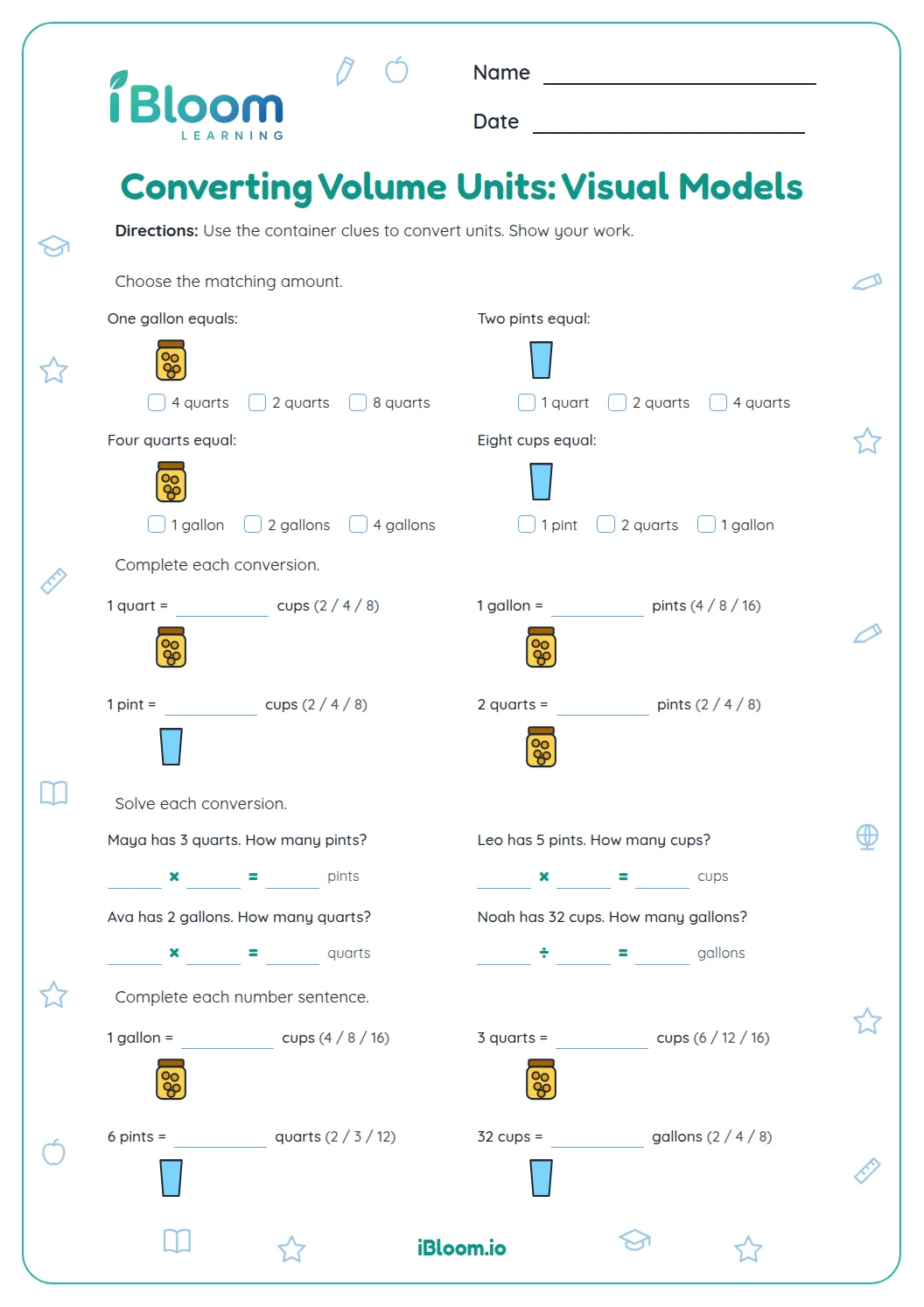
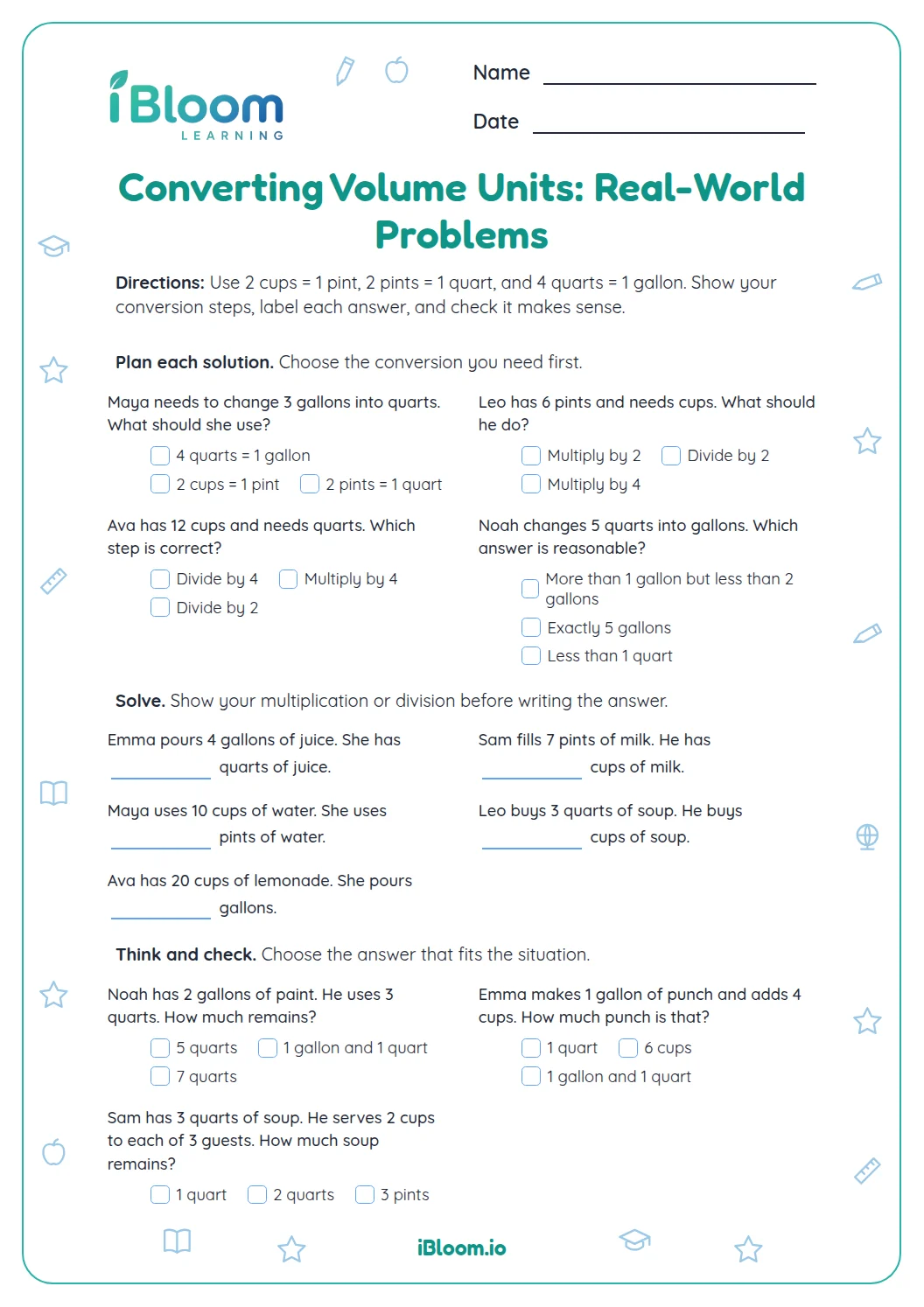
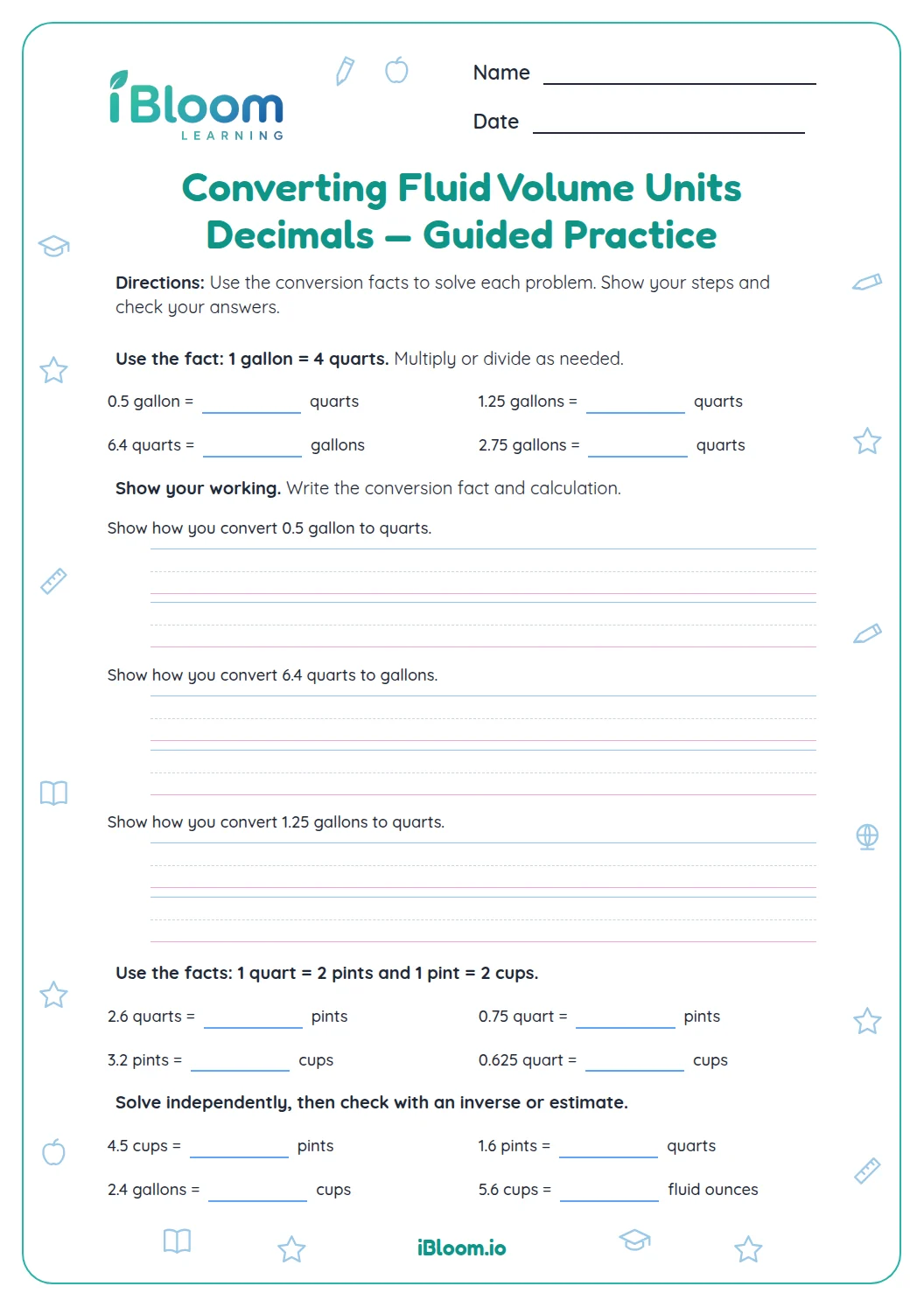
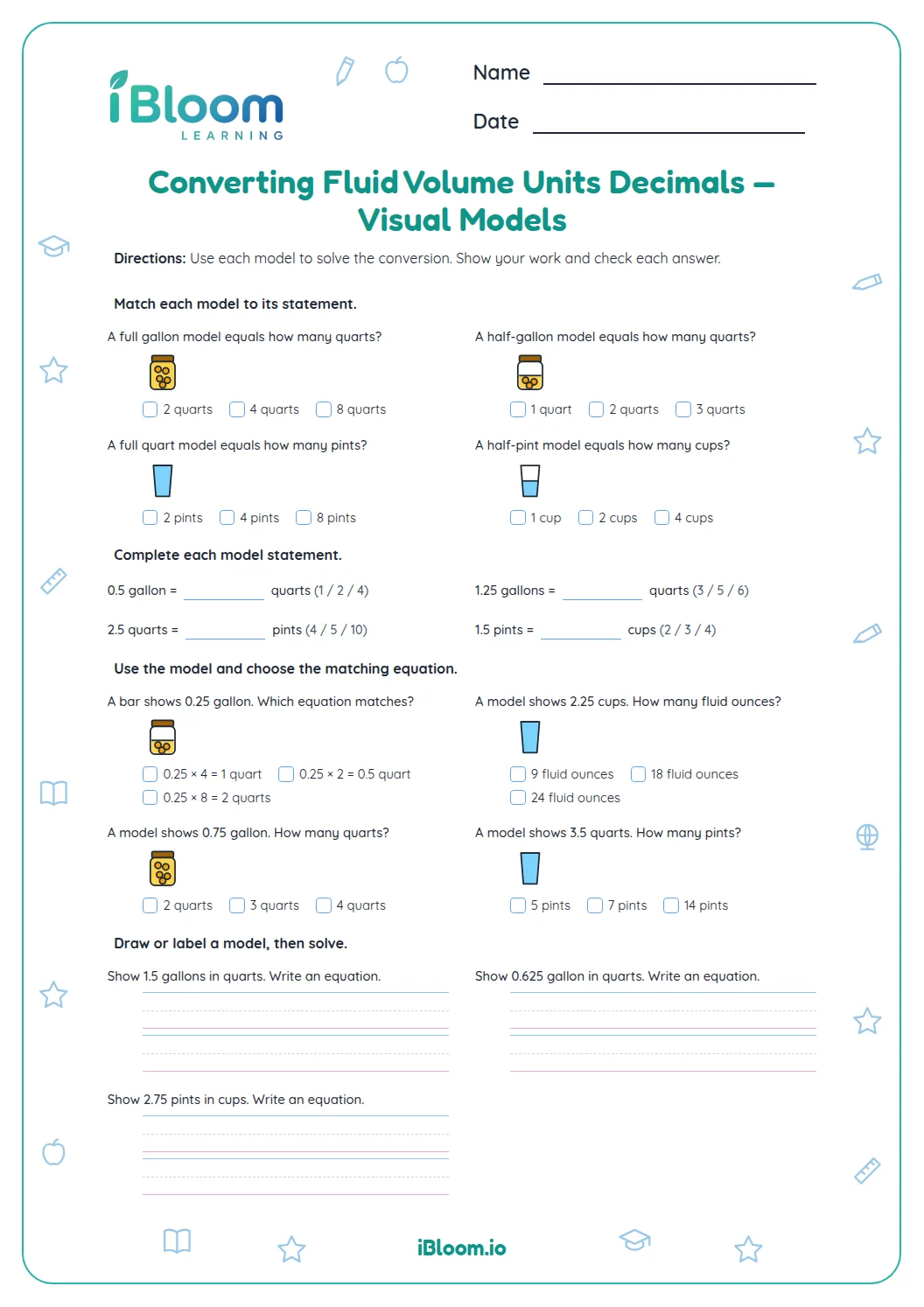
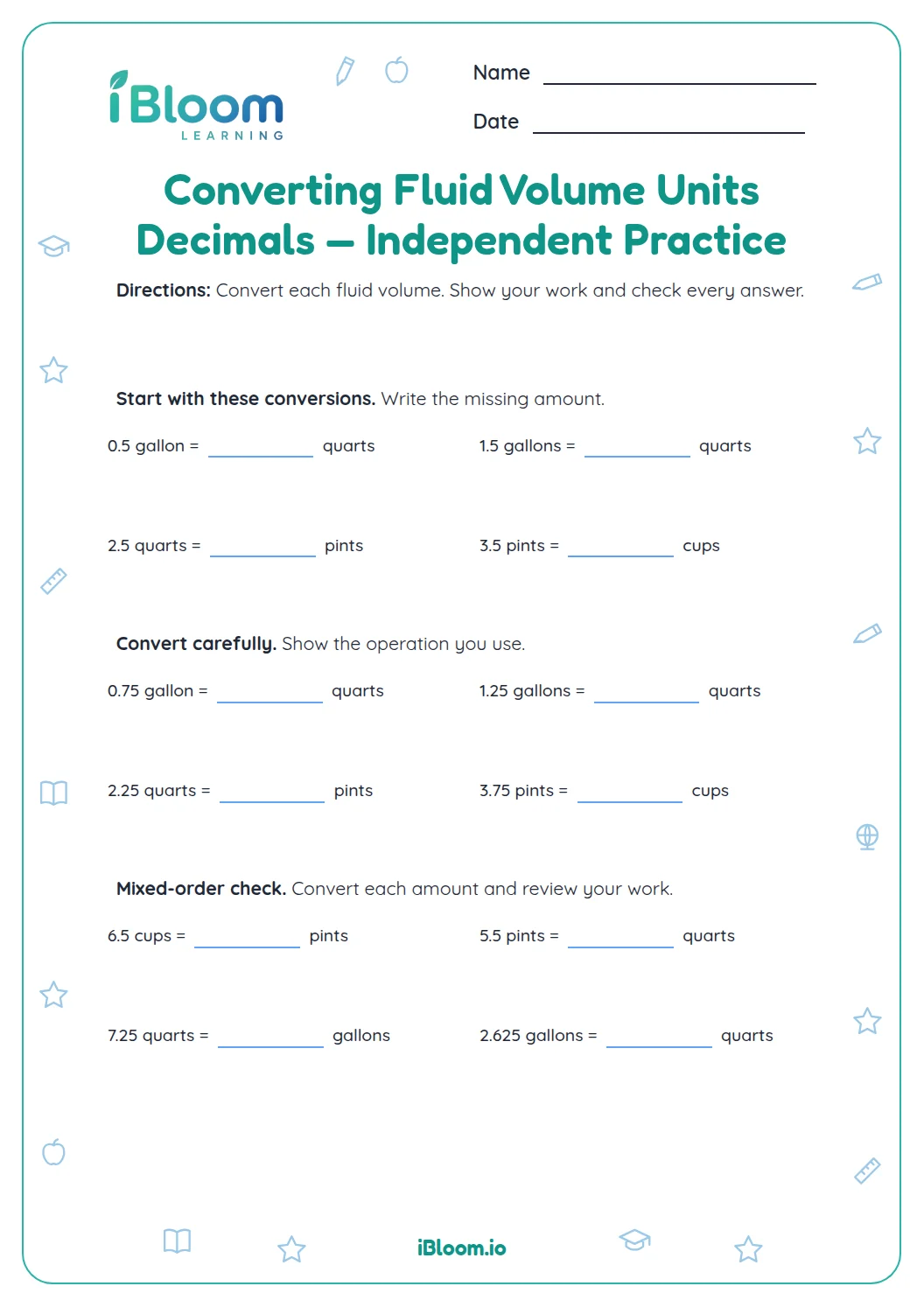
This free Grade 5 worksheet builds a connected picture of customary capacity units: 2 cups in a pint, 2 pints in a quart, and 4 quarts in a gallon. Students begin with those facts, use them to convert larger amounts, then apply the relationships to two short situations. The practice aligns with CCSS 5.MD.A.1, which asks students to convert units within a measurement system and use conversions in problems. A separate answer key shows the expected amount for every question.
Aligned to 5.MD.A.1
Which capacity facts connect the units?
Part A starts with the relationships students will reuse: 2 cups make a pint, 2 pints make a quart, and 4 quarts make a gallon. Students then combine these facts to move between units that are farther apart.
- 11 gallon = 4 quarts
- 21 gallon = 4 × 2 × 2 = 16 cups
How can you choose whether to multiply or divide?
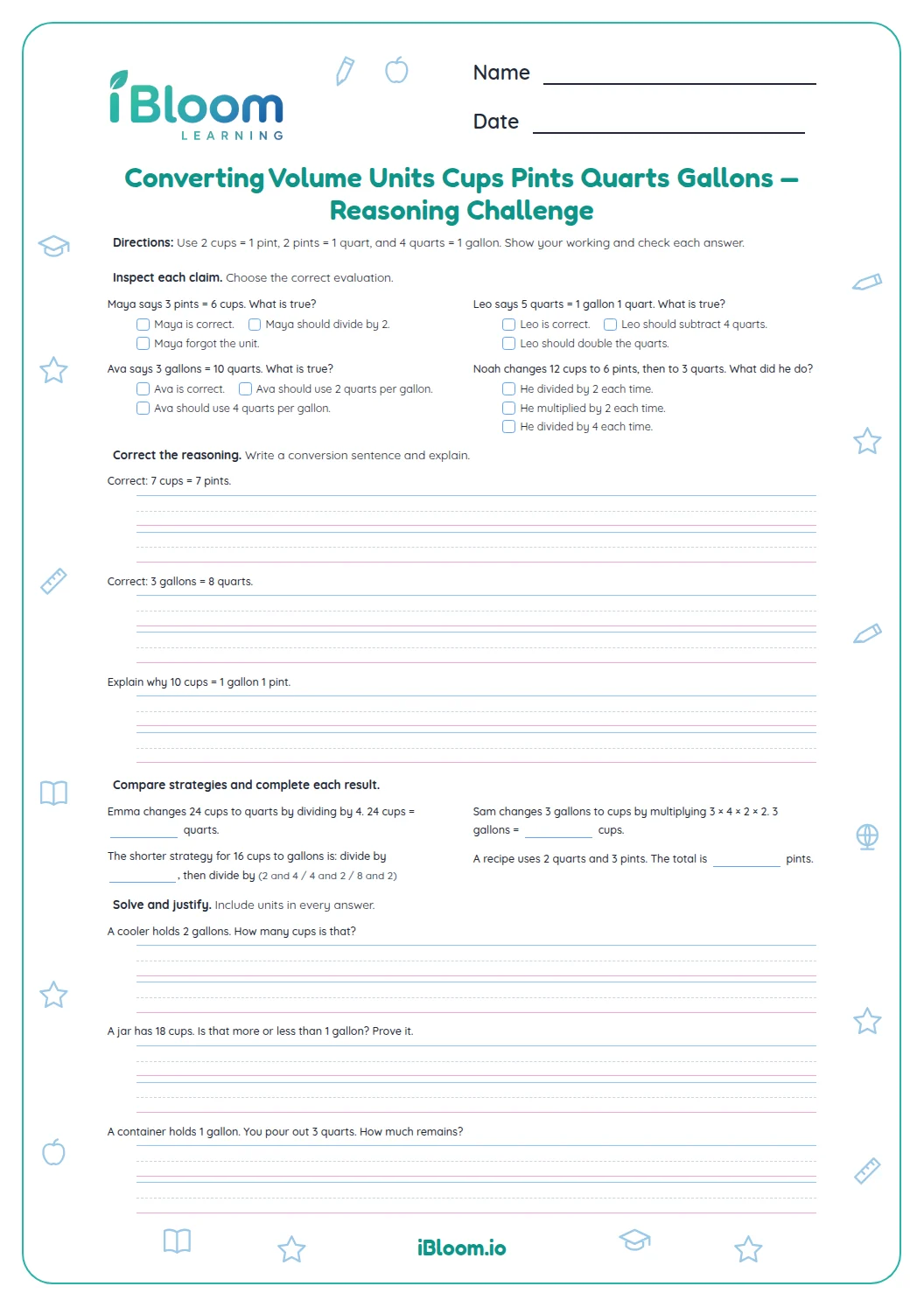
For a larger unit expressed in smaller units, multiply by the number of smaller units in each larger one. For a smaller amount expressed in larger units, divide. Questions 8 and 12 ask students to group cups into whole quarts or pints.
- Multiply when converting to smaller units.
- Divide when converting to larger units.
How do conversions help with mixed amounts and recipes?
Part C combines unit facts in a mixed amount and in short contexts. For “2 gallons 1 quart,” first rewrite each part in quarts, then add: 8 quarts + 1 quart = 9 quarts. For the recipe, 6 cups make 3 pints.
How to use this worksheet
- 1Review the three unit relationships at the top of Part A.
- 2For each conversion, identify whether the target unit is smaller or larger.
- 3Multiply or divide by the correct unit relationship, and keep the requested unit in mind.
- 4For a mixed amount, convert each part to one unit before adding.
- 5Check by converting your answer back to the starting unit.
Common mistakes and quick fixes
The mistake
Using 4 cups for 1 gallon.
The fix
Count each step in the chain: 1 gallon is 4 quarts, each quart is 2 pints, and each pint is 2 cups.
The mistake
Dividing when converting gallons into quarts.
The fix
Quarts are smaller than gallons, so one gallon contains several quarts; multiply by 4.
The mistake
Writing only a number for a word problem.
The fix
Include the unit requested, such as “8 quarts,” so the amount is clear.
Common Core alignment
This worksheet practices converting capacity units and applying those conversions in short situations.
Convert customary capacity units and use conversions in a situation.
On this sheet: The conversion equations and final two situations use customary capacity relationships.
Show the official wordingHide the official wording
Convert among different-sized standard measurement units within a given measurement system (e.g., convert 5 cm to 0.05 m), and use these conversions in solving multi-step, real world problems.
What to practice next
Make more practice
Further reading
Questions parents and teachers ask
How many cups are in a gallon?
There are 16 cups in 1 gallon. Follow the unit chain: 1 gallon is 4 quarts, each quart is 2 pints, and each pint is 2 cups. Multiplying 4 × 2 × 2 gives 16 cups, a useful check for questions that convert between gallons and cups.
Should I multiply or divide when converting units?
Multiply when changing a larger unit into smaller units, such as gallons to quarts. Divide when changing smaller units into larger units, such as cups to pints. The worksheet includes both directions so students can decide from the units instead of memorizing one operation.
How many questions are on the worksheet?
There are 16 questions across two worksheet pages, followed by a separate answer key. The first part reviews unit facts; later questions convert amounts, combine mixed amounts, and apply the relationships in a cooler and recipe situation. Convert through the middle units to check the gallon and cup relationship.
What is the answer to the cooler question?
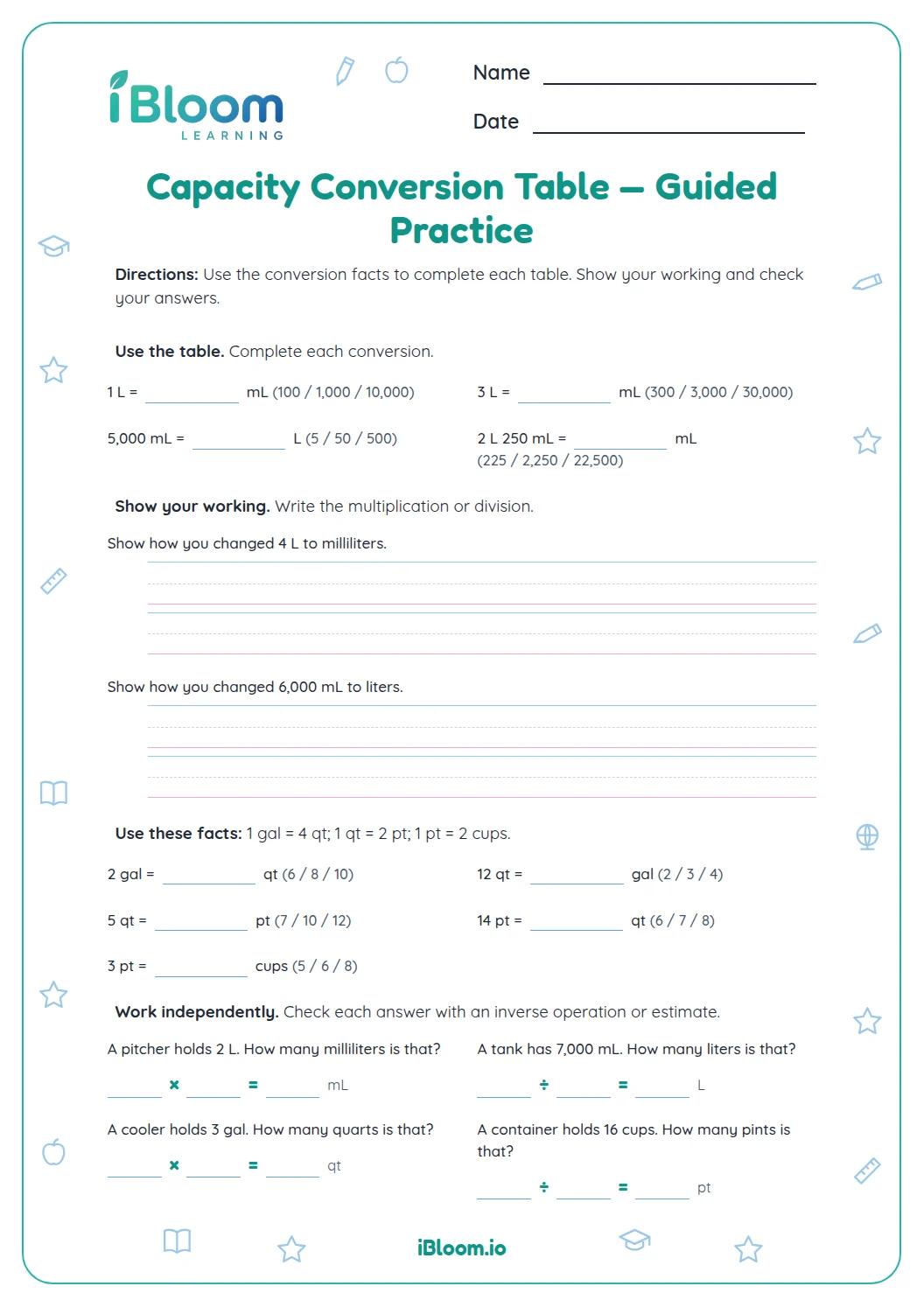
Two gallons equal 8 quarts because each gallon contains 4 quarts. Students can multiply 2 × 4, then include the unit in the response. The same conversion chain supports the other situations and helps make the answer checkable. The unit label keeps the final capacity amount clear to the reader.
Can this worksheet be used before metric conversions?
Yes. The page focuses on customary capacity units used in the United States: cups, pints, quarts, and gallons. Students can first connect these units, then use a separate metric-capacity page to practice liters and milliliters. Each answer still names a customary unit, so the units stay consistent.
What should students try next?
The Capacity Conversion Table page offers another way to organize unit relationships. Students can follow it with capacity comparison and precision-error practice, where they use conversions to compare amounts or catch an unreasonable result. A comparison is easier after both amounts use one shared unit.