



About this worksheet
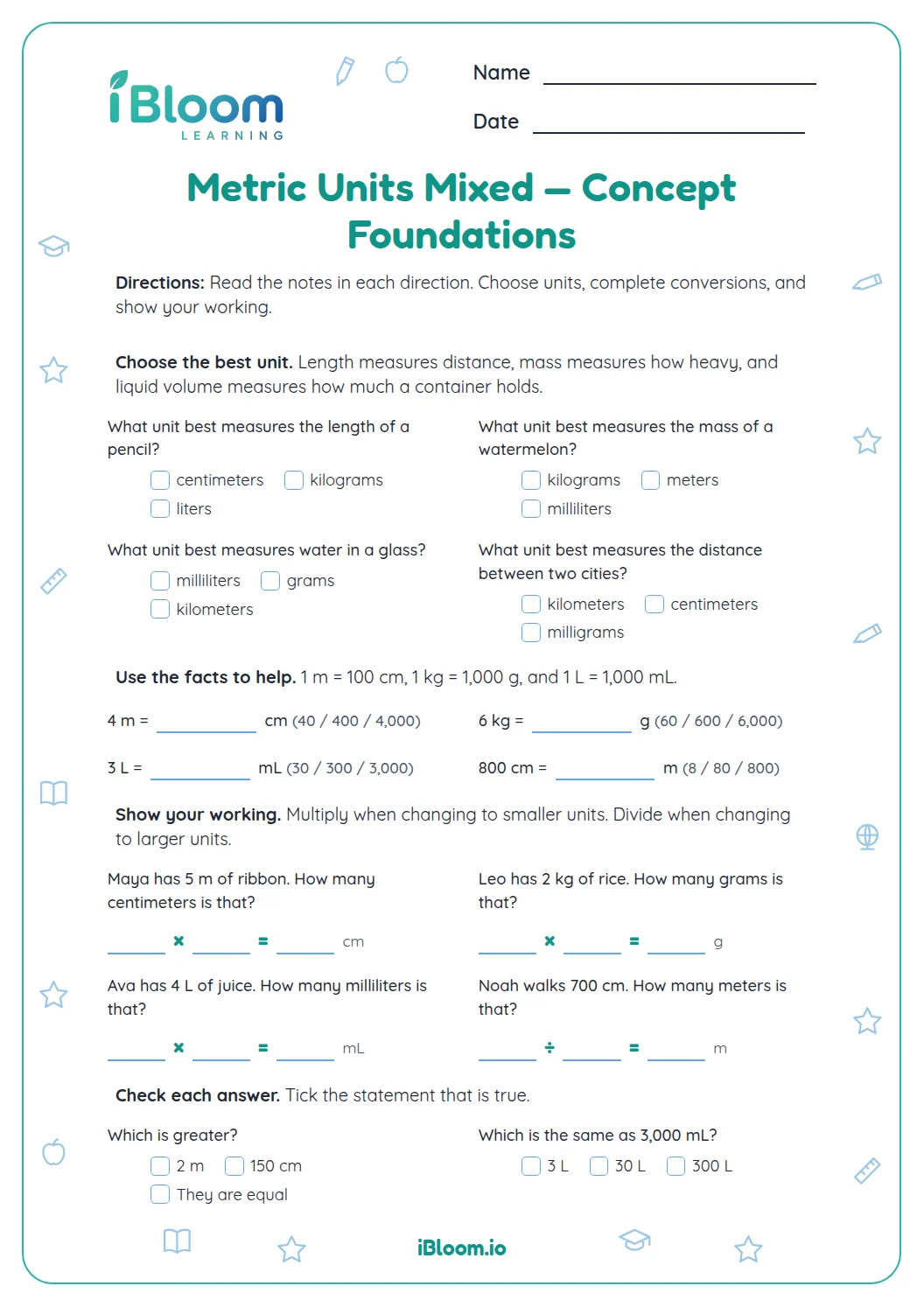
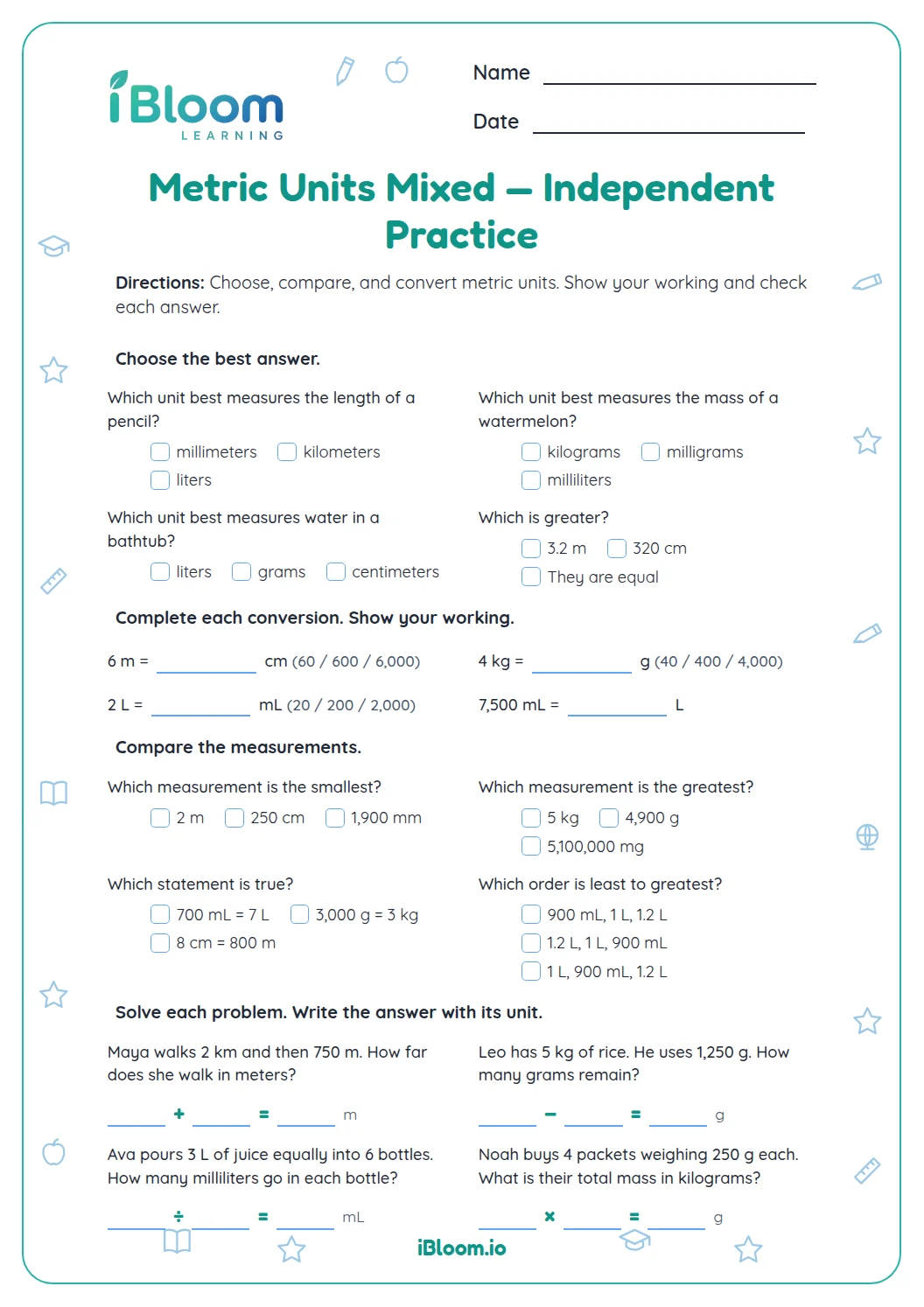
Fourteen questions practice metric length, capacity, and mass conversions, including decimal measures and mixed units. The old sheet also mixed comparisons, conversions, and real-world problems; those strands remain in the new guided sequence. CCSS 5.MD.A.1 supports converting among standard measurement units within one system.
Aligned to 5.MD.A.1
What will learners practice?
Convert between metric units using powers of ten, decimals, and mixed-unit contexts.
The parts progress from direct recognition or conversion to applying the skill in a story, comparison, or written response.
How can a learner solve one question?
Read exactly what the prompt asks, identify the useful detail or relationship, and show the matching reasoning before checking the answer.
- 1Students convert meters, centimeters, liters, milliliters, kilograms, and grams, then use conversions in short situations. For example, 2 m 35 cm equals 235 cm.
How can families use the answer key?
Check the result and the reasoning together. For open responses, treat the key as a model: another answer is acceptable when it meets the prompt and is supported by the worksheet.
How to convert metric units
- 1Identify the unit you have and the unit the question asks for.
- 2Use 100 cm per meter or 1,000 mL per liter and grams per kilogram.
- 3Multiply when converting to a smaller unit; divide when converting to a larger unit.
- 4For mixed measures, convert each part to the same unit before combining.
- 5Check that the size of the answer makes sense.
Common conversion mistakes and fixes
The mistake
Moving the decimal in the wrong direction.
The fix
A smaller unit takes more units, so its number is larger.
The mistake
Combining meters and centimeters before converting.
The fix
Rewrite both lengths in centimeters first.
The mistake
Dropping a zero in a thousand-unit conversion.
The fix
Use the stated relationship, then check the decimal place or multiply-back.
This worksheet gives students direct practice with the listed Common Core skill.
Mixed metric unit conversions.
On this sheet:
Show the official wordingHide the official wording
Convert among different-sized standard measurement units within a given measurement system (e.g., convert 5 cm to 0.05 m), and use these conversions in solving multi-step, real world problems.
What to practice next
Make more practice
Further reading
Questions parents and teachers ask
Which units are included?
The practice covers meters and centimeters, liters and milliliters, and kilograms and grams. The first section converts single measures; the later section applies the same relationships to ribbons, liquid, rice, and a comparison. The prompt and answer key make this check straightforward.
How do metric conversions work?
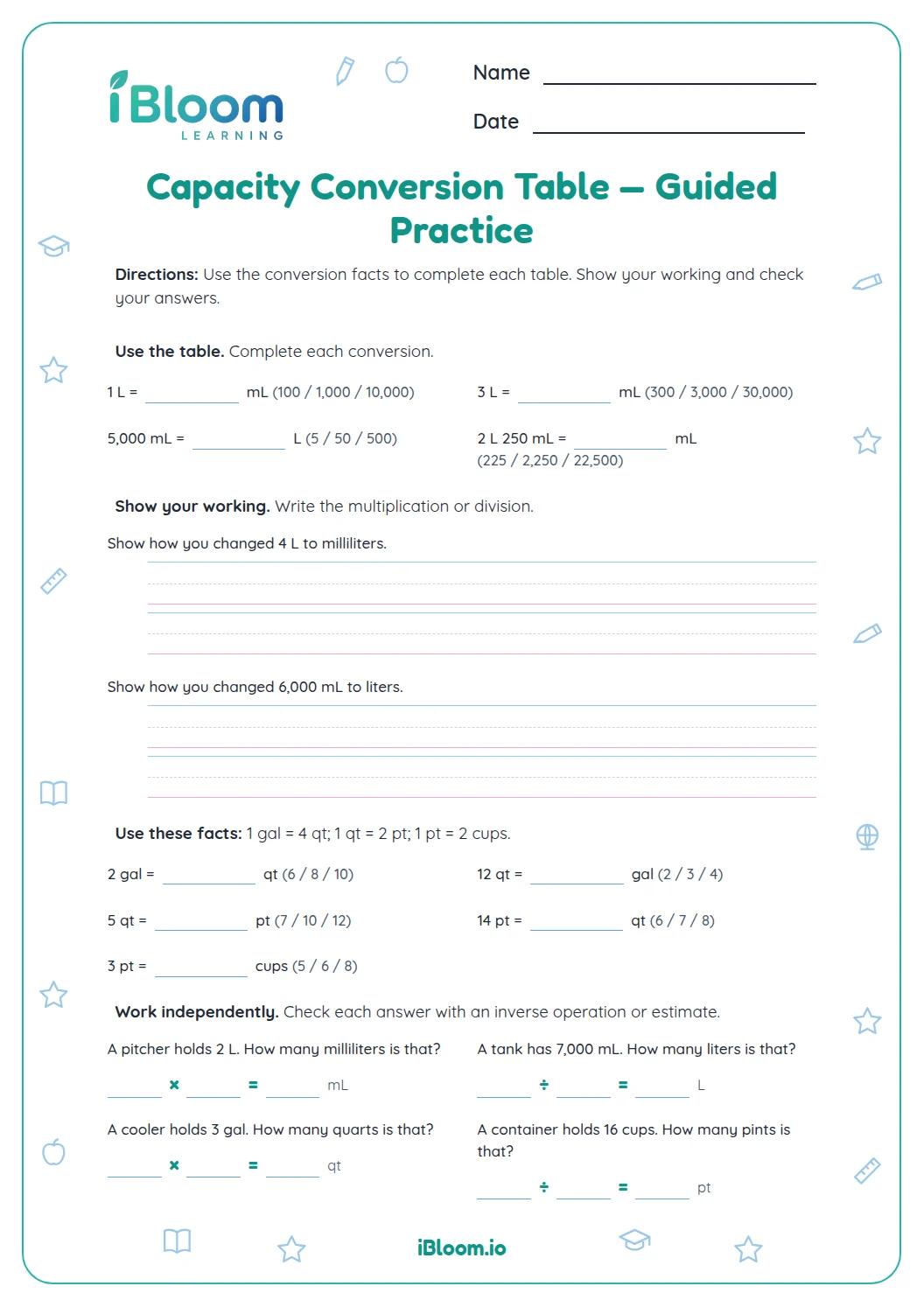
Use the relationship between the units. One meter is 100 centimeters, one liter is 1,000 milliliters, and one kilogram is 1,000 grams. Converting to a smaller unit increases the number; converting to a larger unit decreases it. The prompt and answer key make this check straightforward.
How do you solve the ribbon question?
Question 11 asks for 2 m 35 cm in centimeters. Convert 2 meters to 200 centimeters, then add the extra 35 centimeters: 200 + 35 = 235 centimeters. The prompt and answer key make this check straightforward. The prompt and answer key make this check straightforward.
Why are decimal answers included?
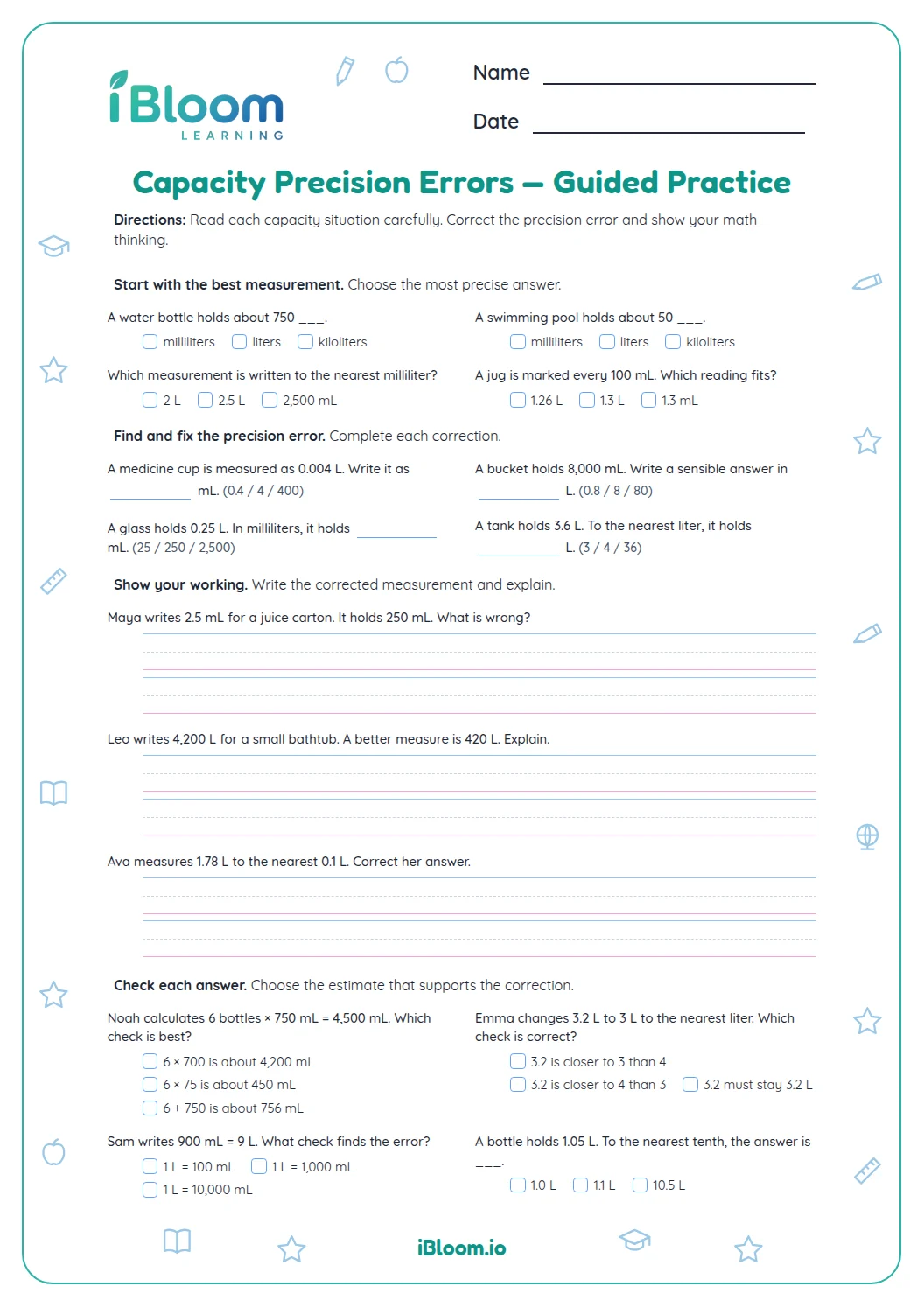
Decimal measures let children practice the same unit relationships when the starting number is not whole. For example, 1.25 meters is 125 centimeters, and 375 centimeters is 3.75 meters. The prompt and answer key make this check straightforward. The prompt and answer key make this check straightforward.
How many questions are included?
There are 14 questions across two worksheet pages and a separate two-page key. The sequence begins with direct conversions and ends with mixed-unit situations and a comparison. The prompt and answer key make this check straightforward. The prompt and answer key make this check straightforward.