



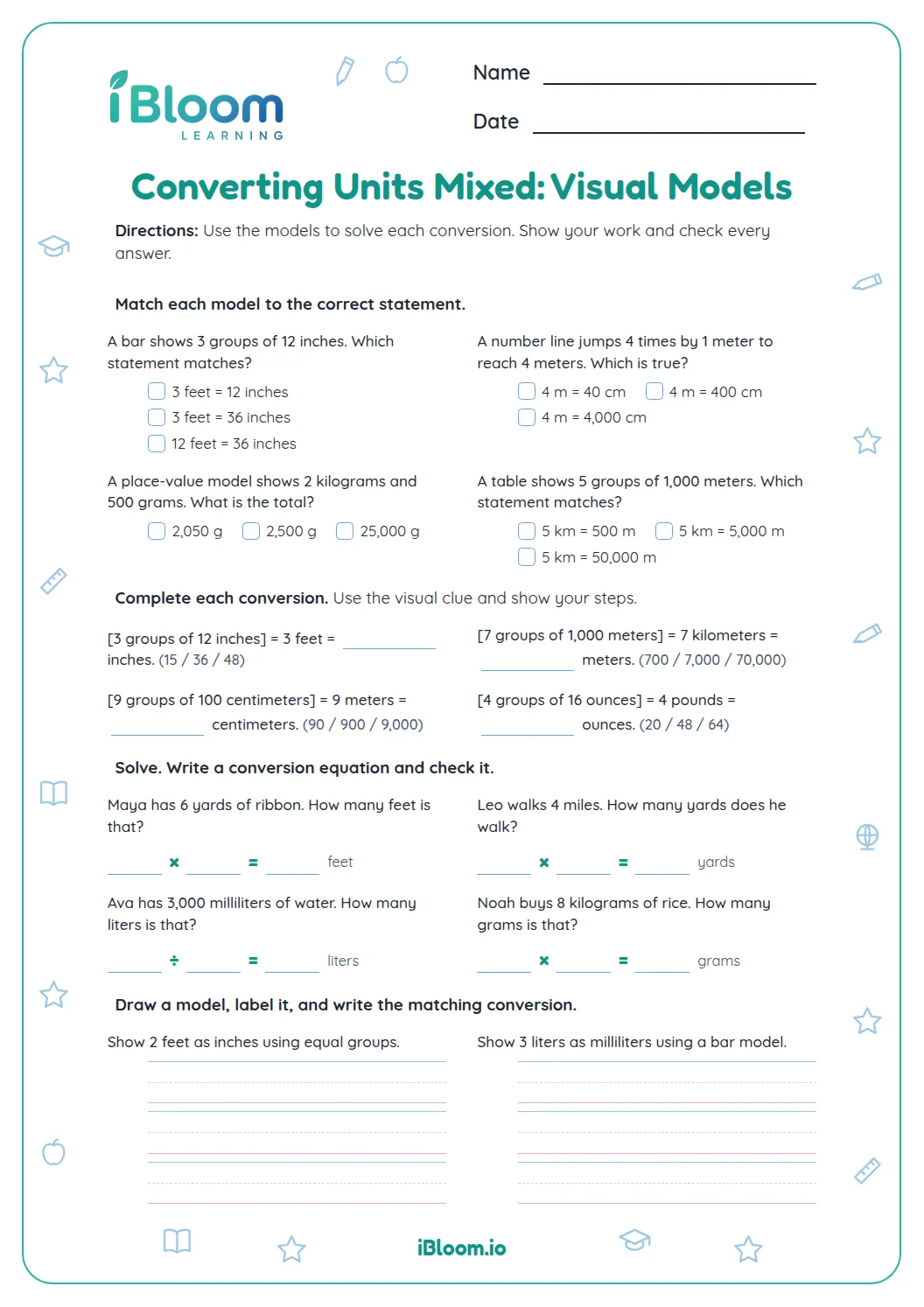
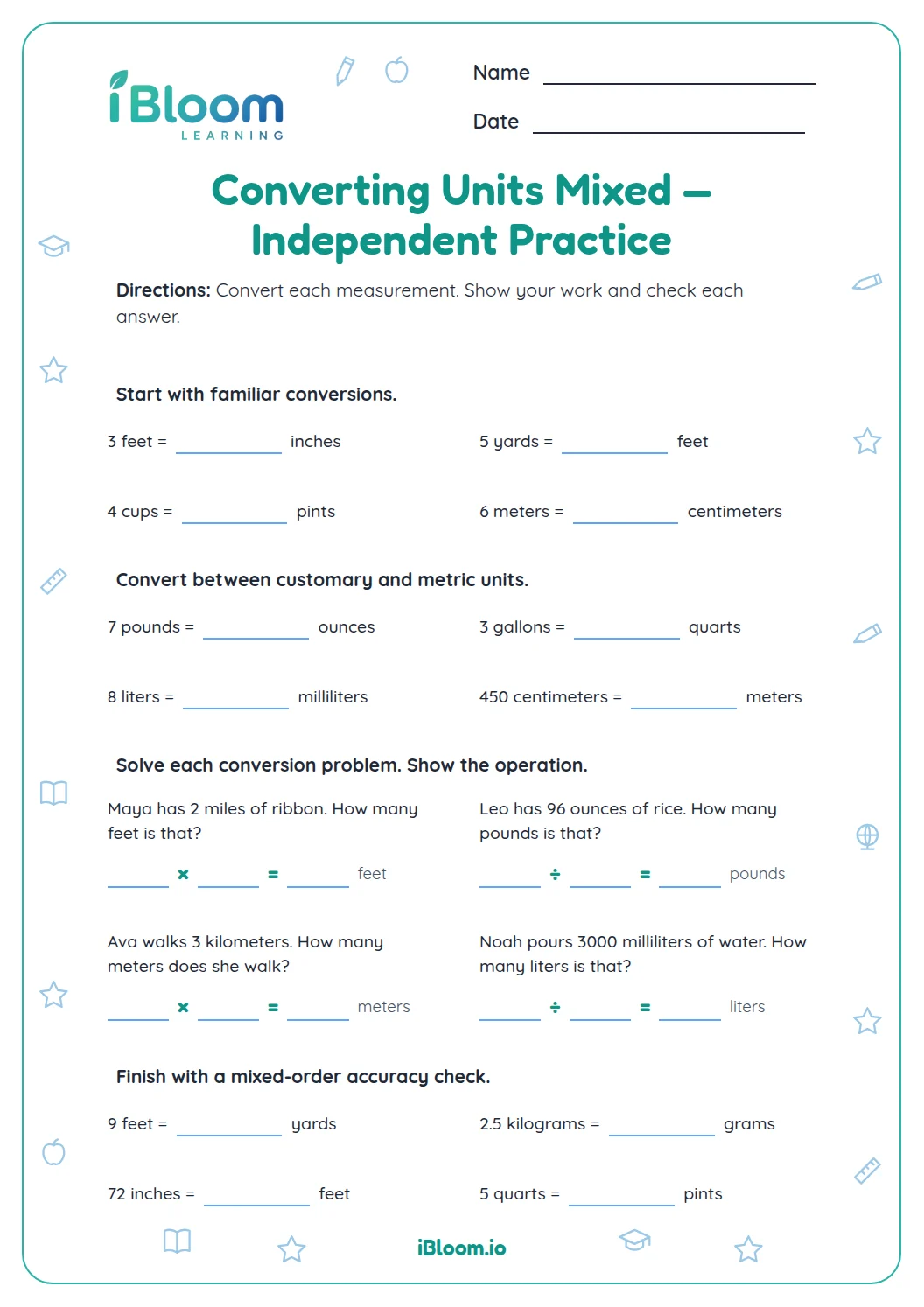
About this worksheet
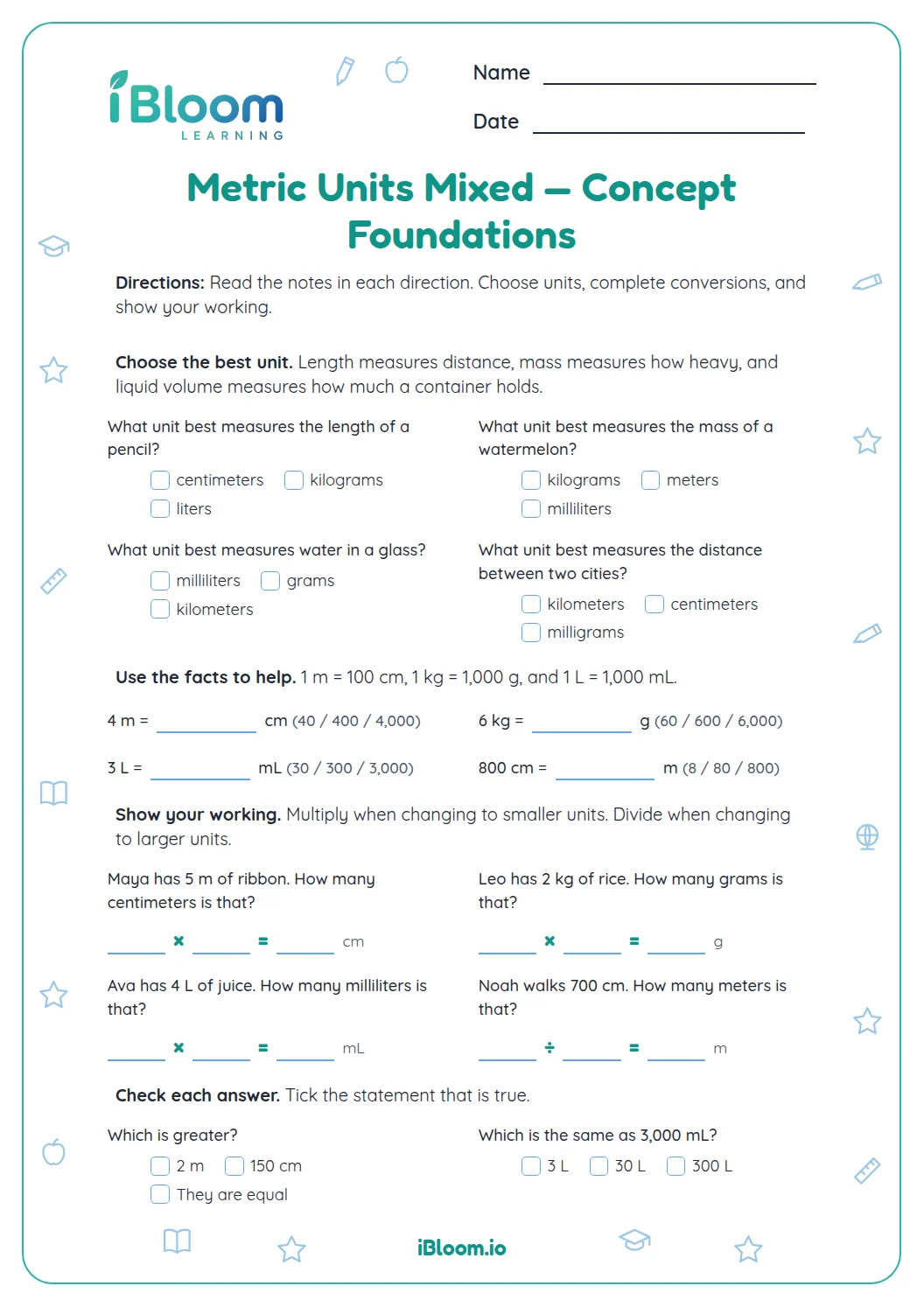
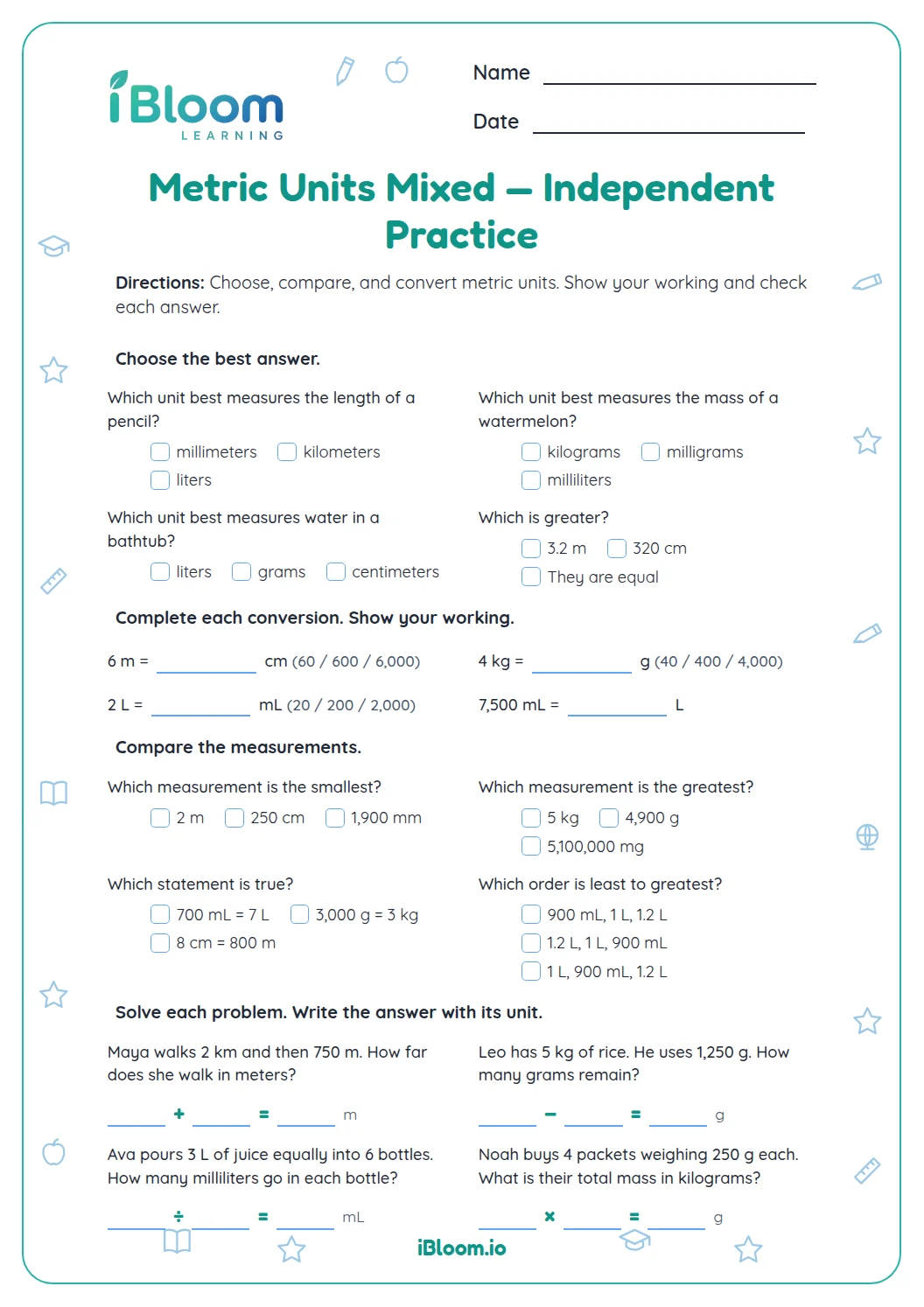
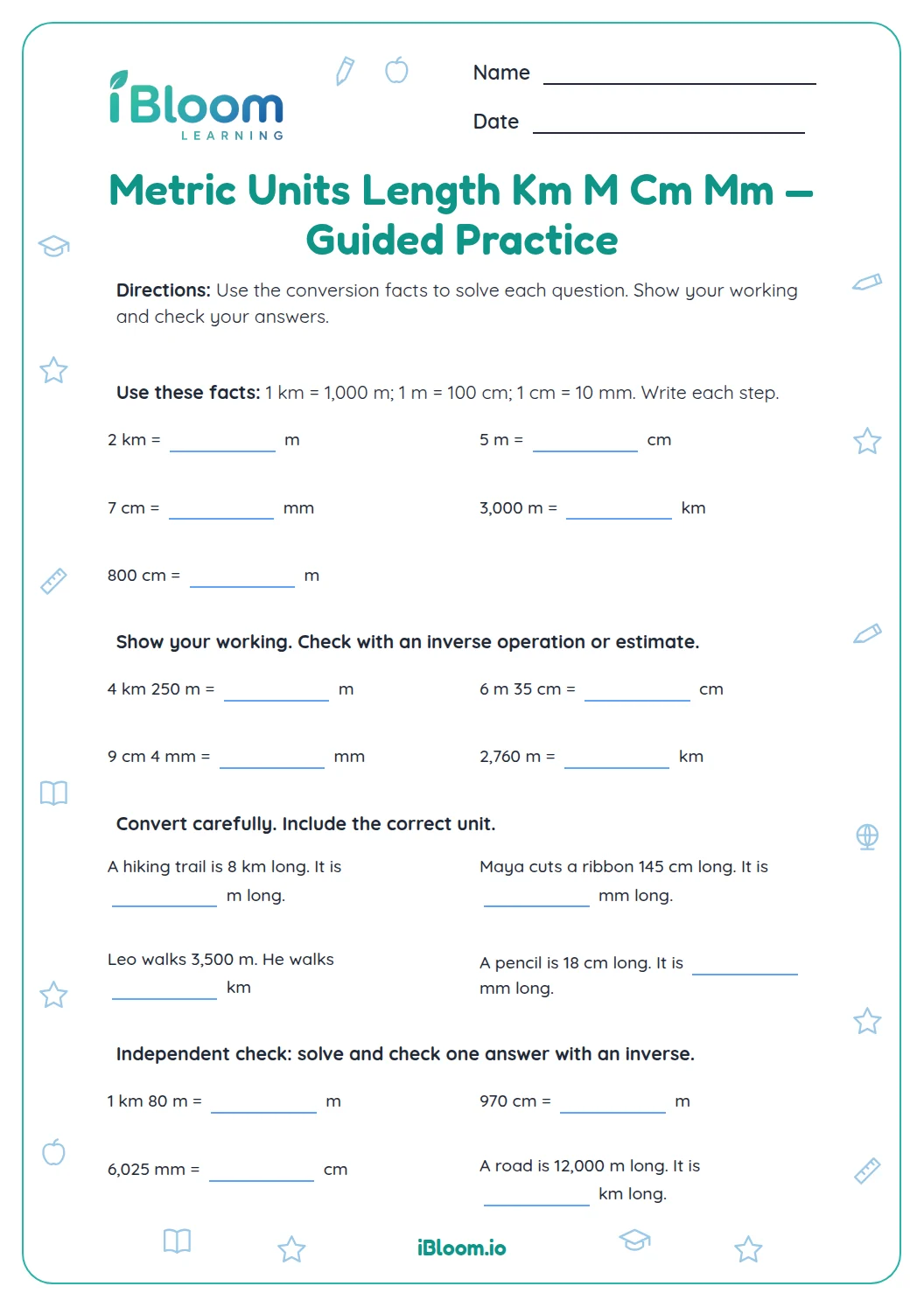
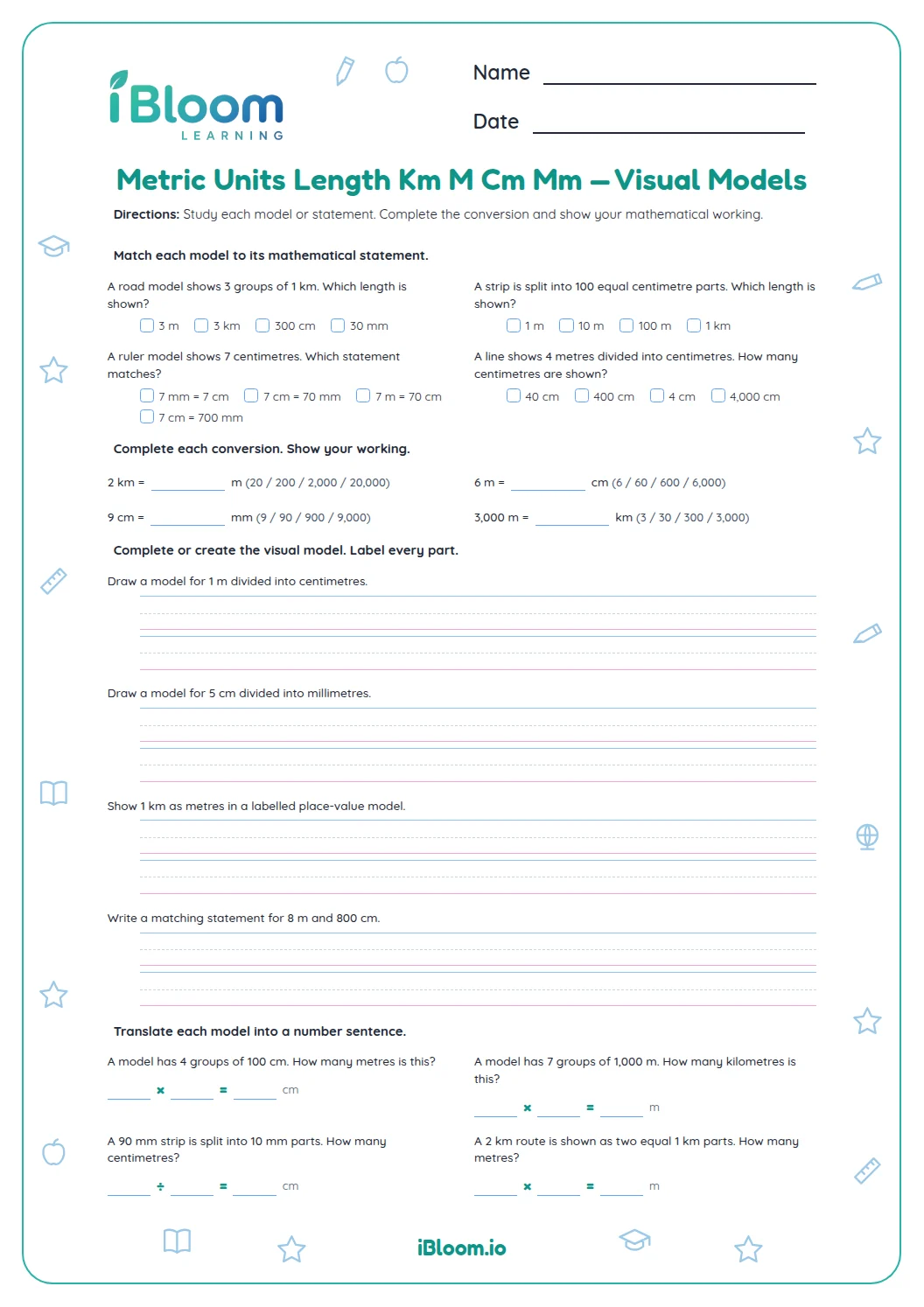
This free Grade 5 worksheet brings metric length, mass, and capacity into one reasoning set. Students correct conversion errors, move between larger and smaller metric units, compare measurements after converting, and solve addition and subtraction situations with mixed units. The work supports CCSS 5.MD.A.1, which asks students to convert among standard measurement units within a measurement system and use those conversions to solve problems. A separate answer key shows corrected values and sample explanations.
Aligned to 5.MD.A.1
How can you spot a metric conversion error?
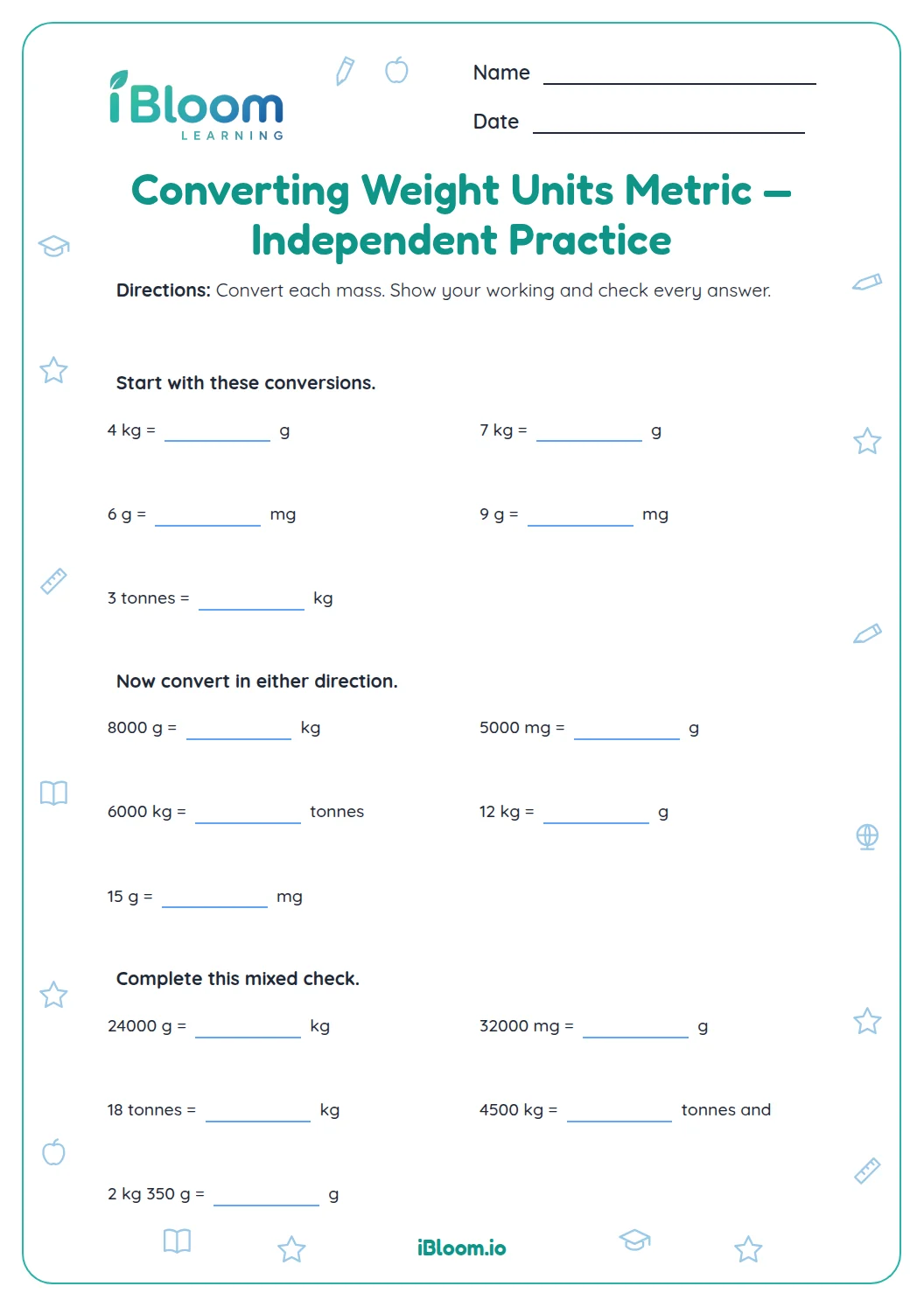
Check both the direction and size of the unit. Since 1 meter is 100 centimeters, changing meters to centimeters means multiplying by 100. A mixed mass converted to grams includes the kilogram amount and the remaining grams.
- 1Question 2: 4 kg 250 g = 4,250 g, not 4,250 kg.
How do you convert a mixed measurement?
Convert each larger unit to the smaller unit, then add the remaining smaller units. For 6 m 8 cm, first convert 6 meters to 600 centimeters, then add 8 centimeters to get 608 centimeters.
Why convert before comparing or solving?
Measurements must use matching units before they can be compared or added. Convert both quantities to grams, centimeters, or milliliters as needed, calculate, then express the result in a sensible unit.
How to use this worksheet
- 1Underline the unit named in the question.
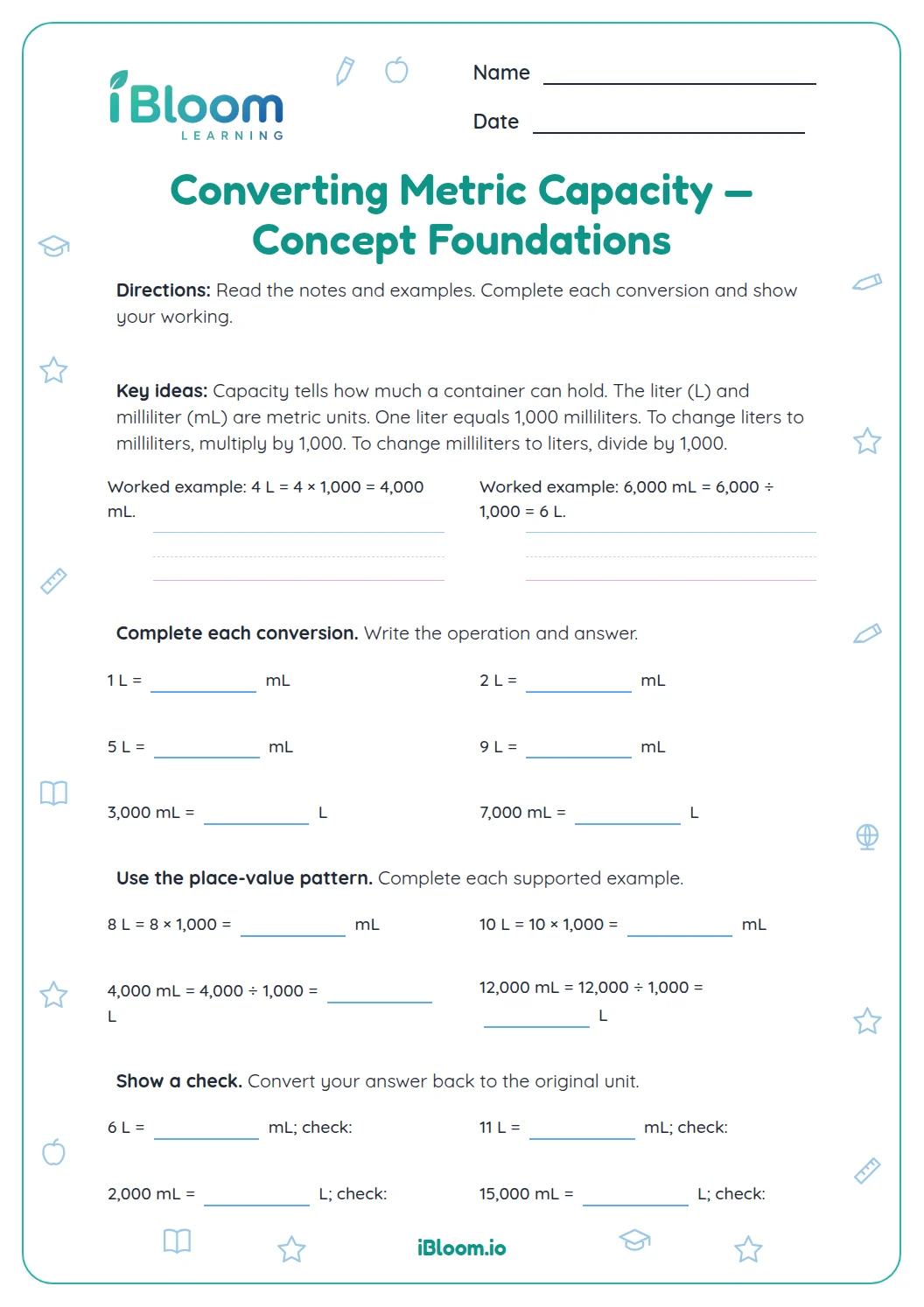
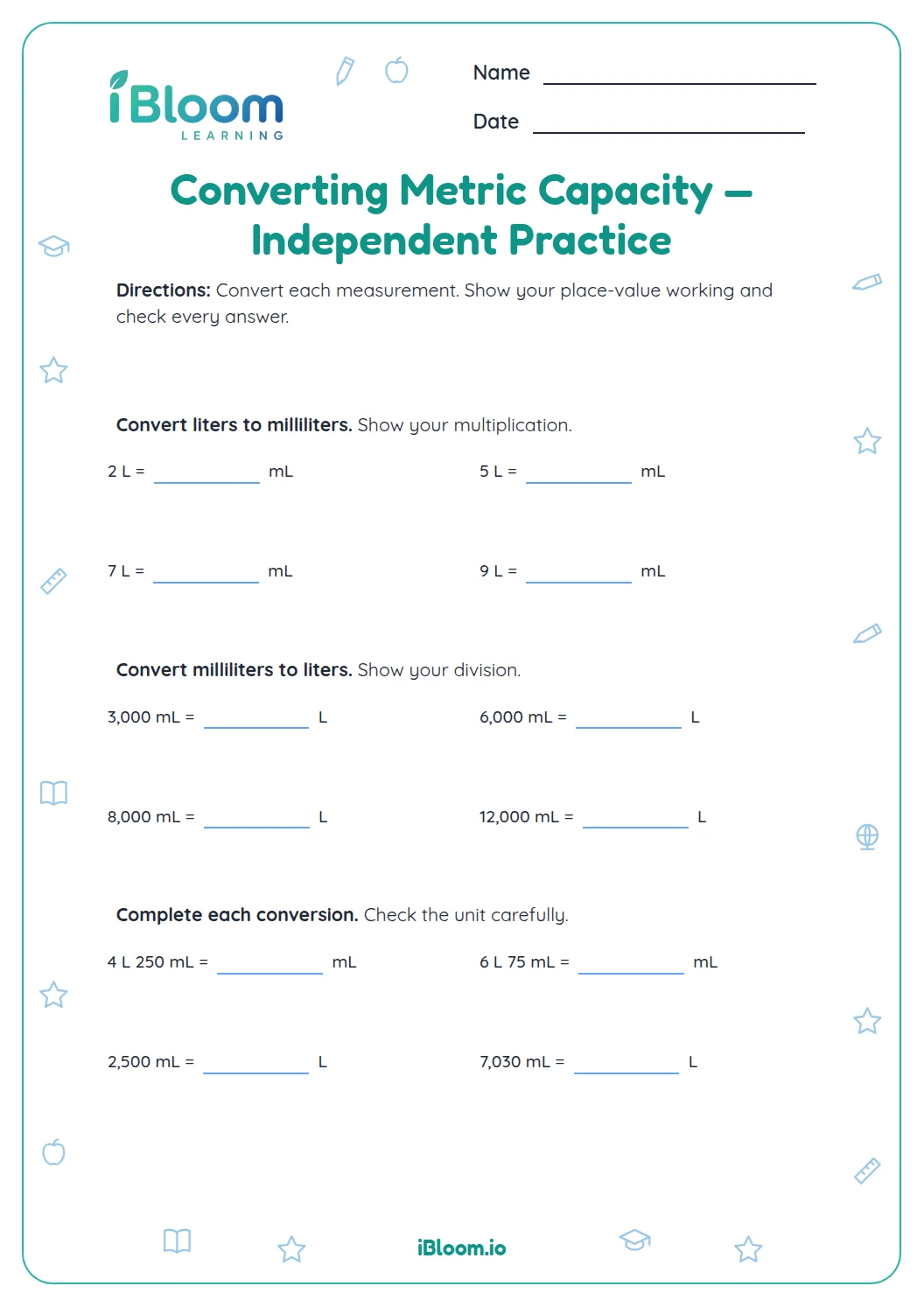
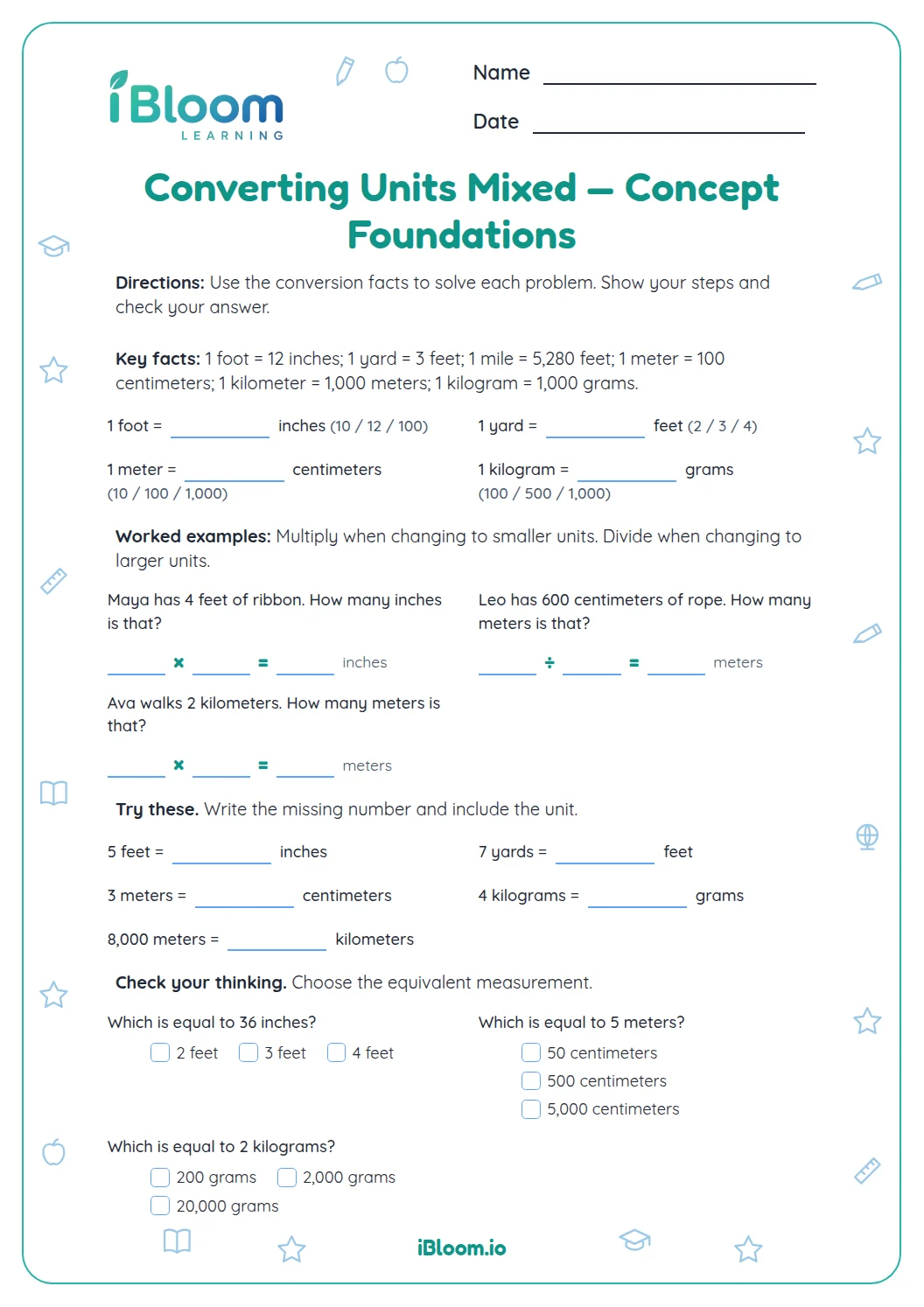
- 2Write the conversion relationship you need: 1 m = 100 cm, 1 kg = 1,000 g, or 1 L = 1,000 mL.
- 3Convert both quantities to one unit before comparing.
- 4For addition or subtraction, convert everything to the smaller unit or regroup carefully.
- 5Check that the answer’s size and unit make sense.
Common mix-ups and quick fixes
The mistake
Keeping the larger unit label after converting to a smaller unit.
The fix
After converting 4 kg 250 g to 4,250, label the result in grams.
The mistake
Dropping the leftover smaller unit in a mixed measure.
The fix
Convert the larger unit and add the centimeters, grams, or milliliters already given.
The mistake
Comparing 2 kg 300 g directly with 2,250 g.
The fix
Convert 2 kg 300 g to 2,300 g first; then compare 2,300 and 2,250.
Common Core alignment
Convert metric units and use the conversions to solve measurement problems.
On this sheet: The worksheet converts metric length, mass, and capacity, then applies conversions in comparisons and word problems.
Show the official wordingHide the official wording
Convert among different-sized standard measurement units within a given measurement system (e.g., convert 5 cm to 0.05 m), and use these conversions in solving multi-step, real world problems.
What to practice next
Make more practice
Further reading
Questions parents and teachers ask
Which metric units appear on this page?
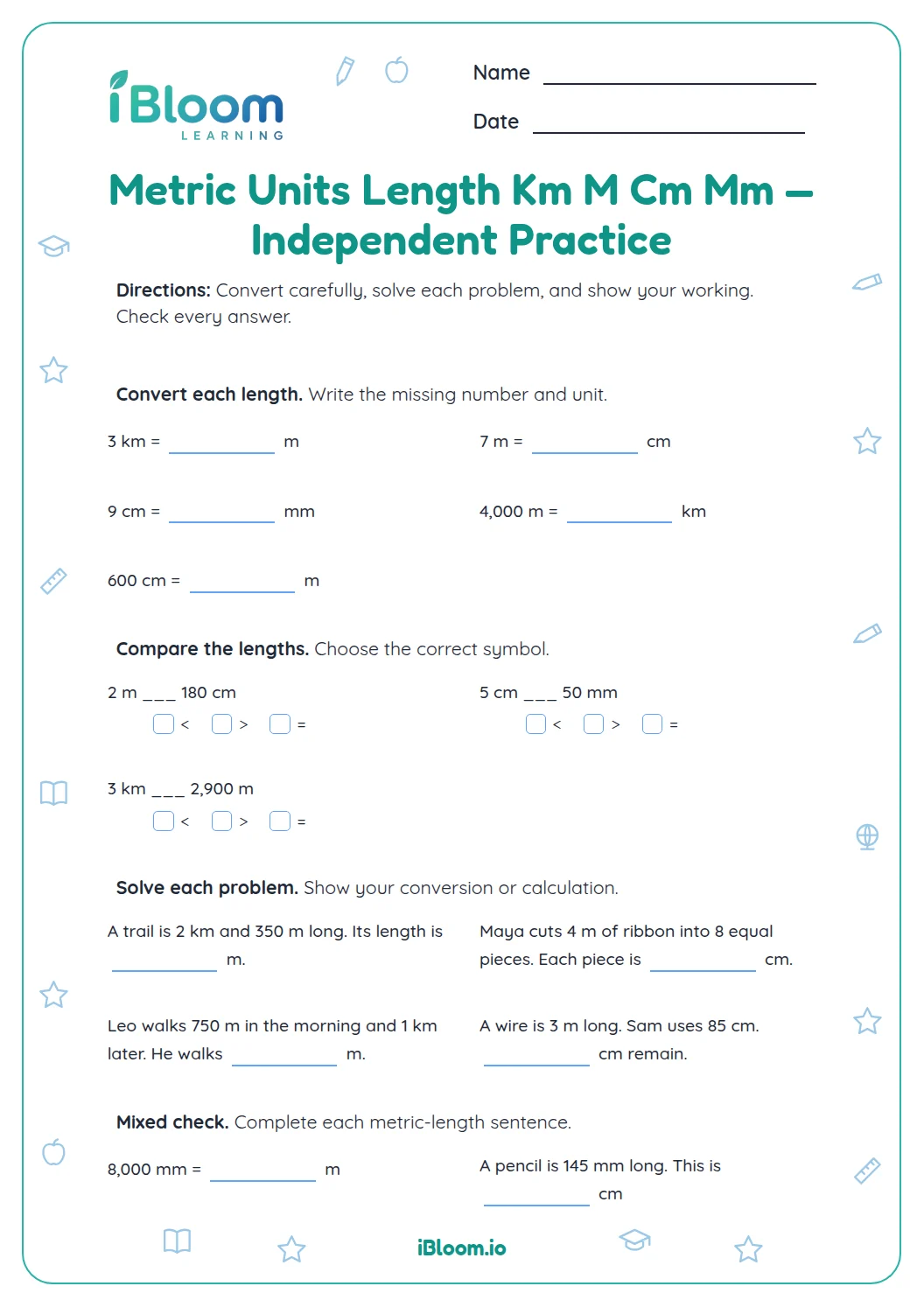
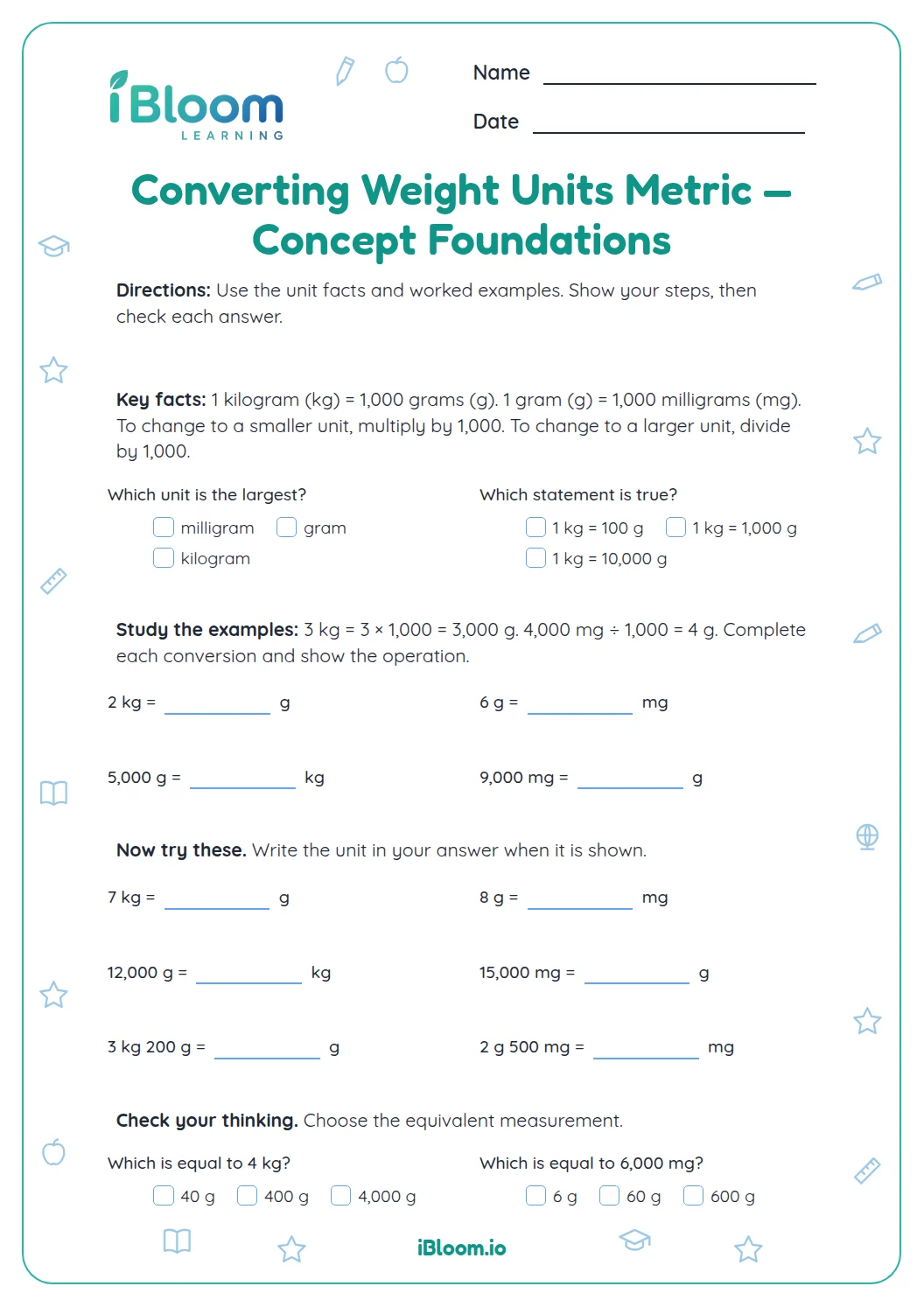
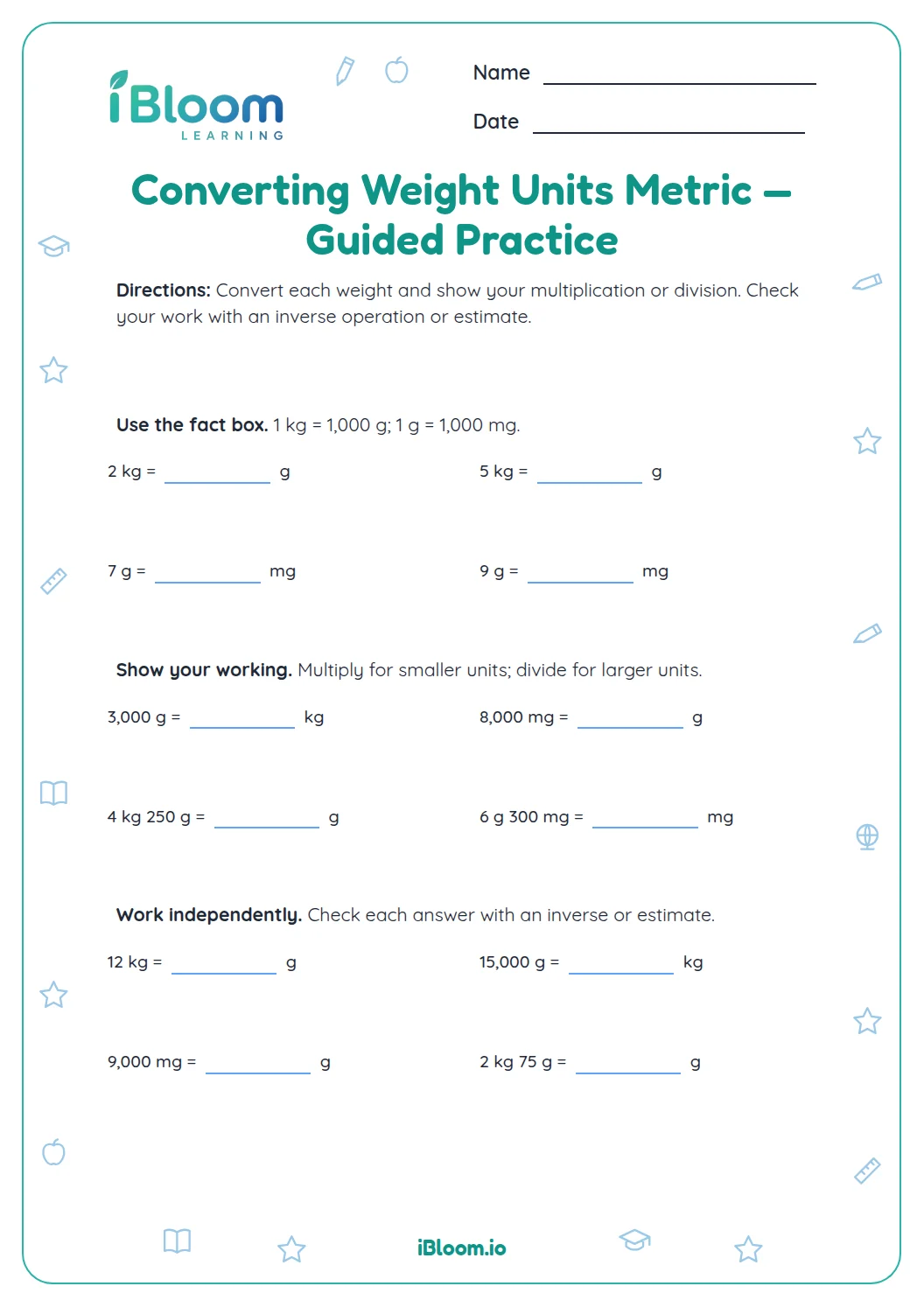
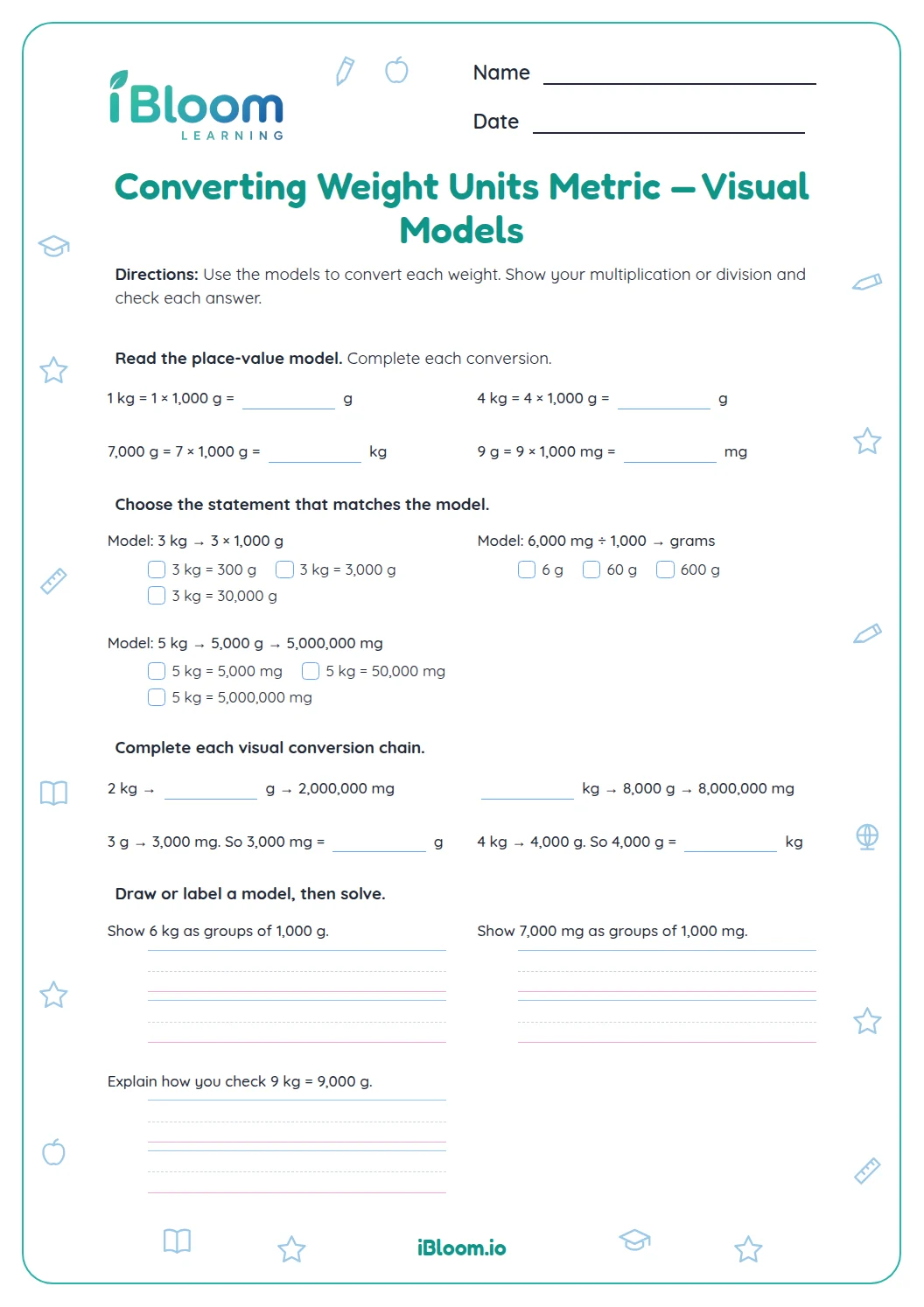
The questions use meters and centimeters for length, kilograms and grams for mass, and liters and milliliters for capacity. Students convert mixed measurements and decimal quantities, then use equivalents in problem solving. The contexts include ribbons, a tank, rice, and a board. Together they use all three metric quantities.
Does the worksheet include error analysis?
Yes. Three questions ask students to inspect a stated conversion and identify the corrected value or unit. These items make place value and conversion direction part of the reasoning. The answer key shows why each selected value is correct. Reviewing the unit helps students spot a power-of-ten slip.
Why convert both measurements before comparing?
A comparison is clearest when both quantities use the same unit. For example, convert 2 kg 300 g to 2,300 g before comparing it with 2,250 g. Then the difference is easy to find in grams. Sam’s amount exceeds Emma’s by 50 grams.
Are there word problems as well as conversion facts?
Yes. Students solve situations about ribbons, a tank, rice, a recipe, and equal board pieces. Each problem asks for a unit-labeled result after conversion and calculation. Some require addition or subtraction after the conversion. Students should include the resulting metric unit.
What does the answer key provide?
The answer key gives equivalent measurements, corrected conversions, and word-problem results. Written comparison answers include a sample explanation showing the conversion used. Unit labels help adults check whether each response is complete. The key also gives a sample comparison explanation.