
About this worksheet
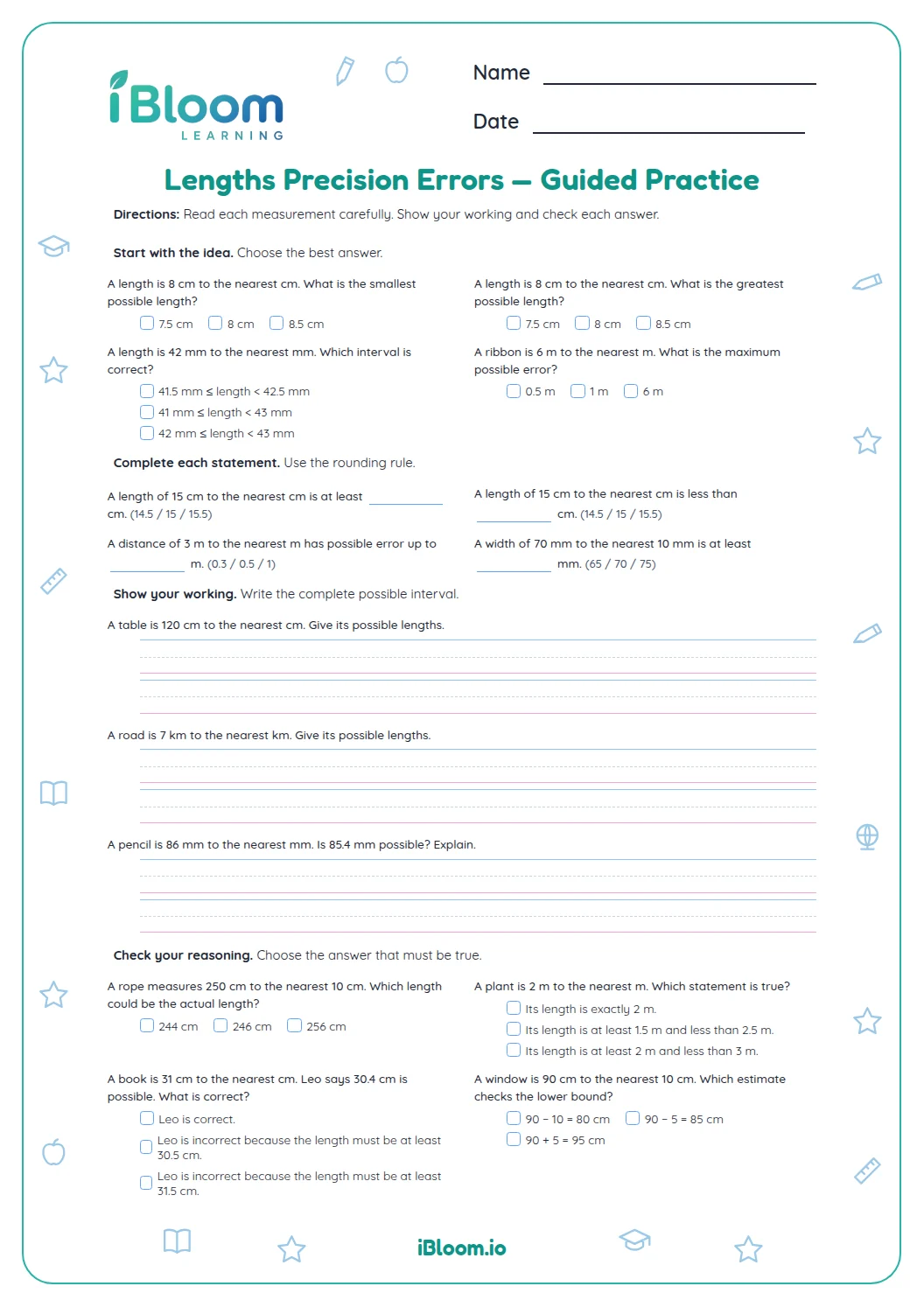
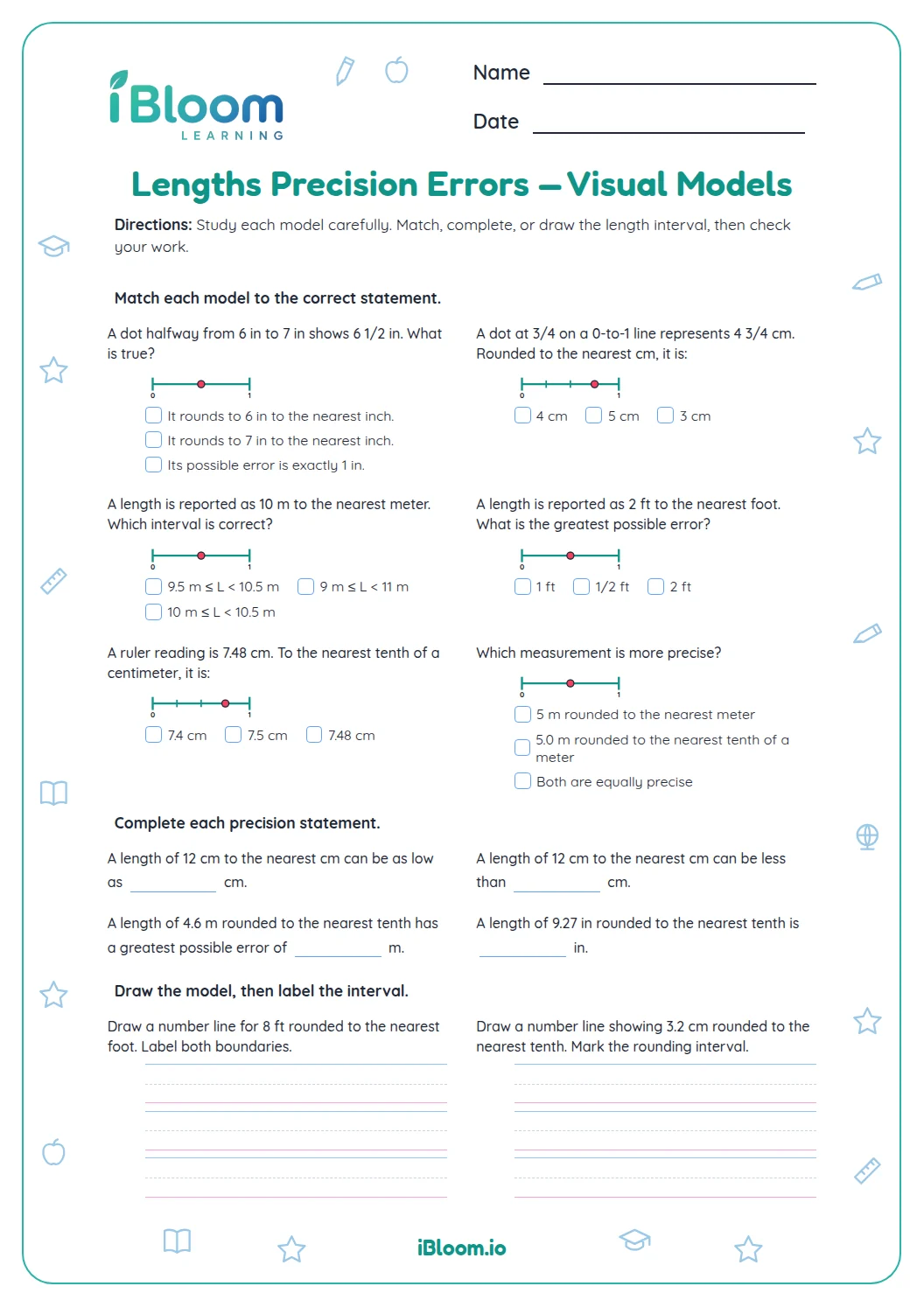
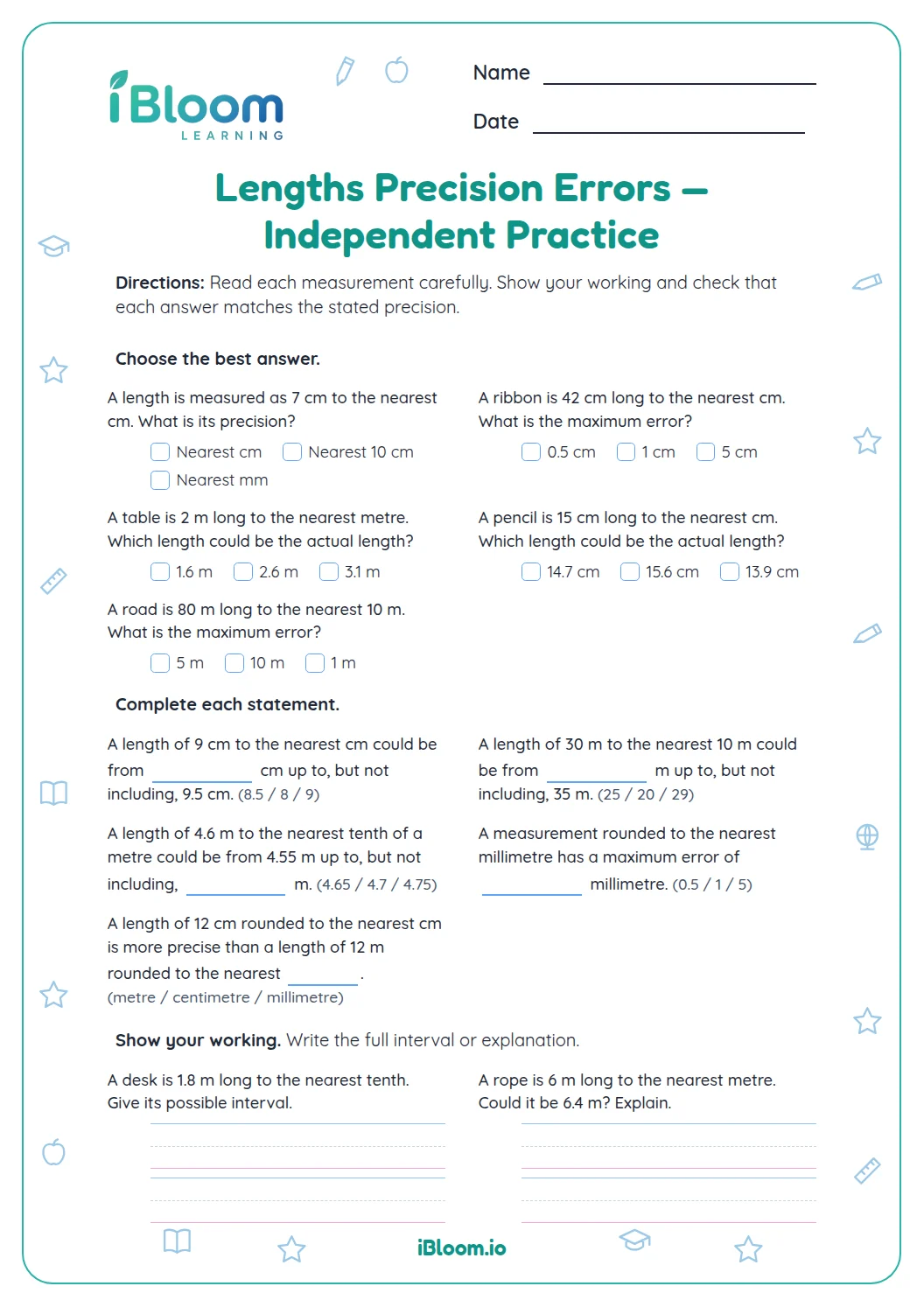
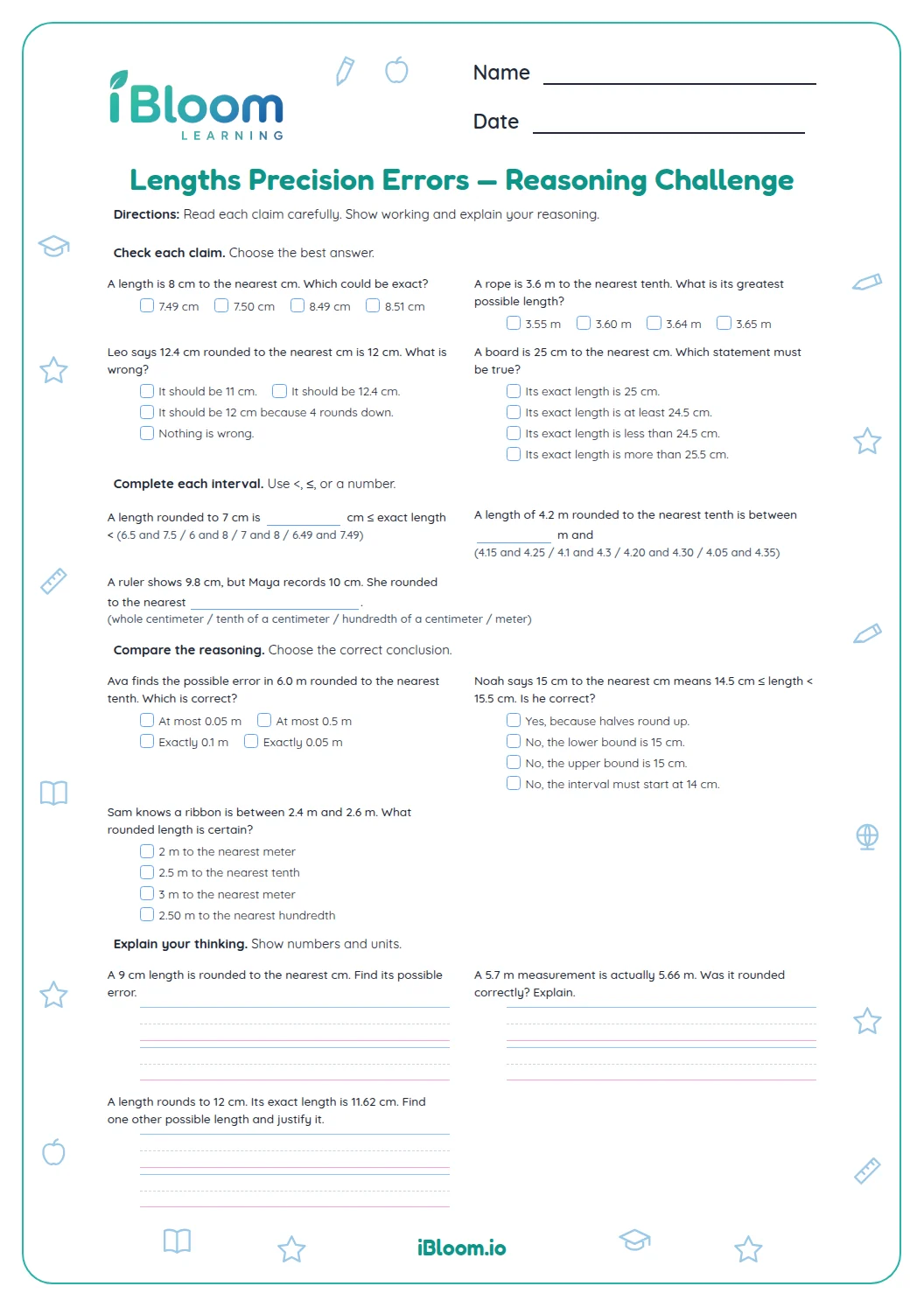
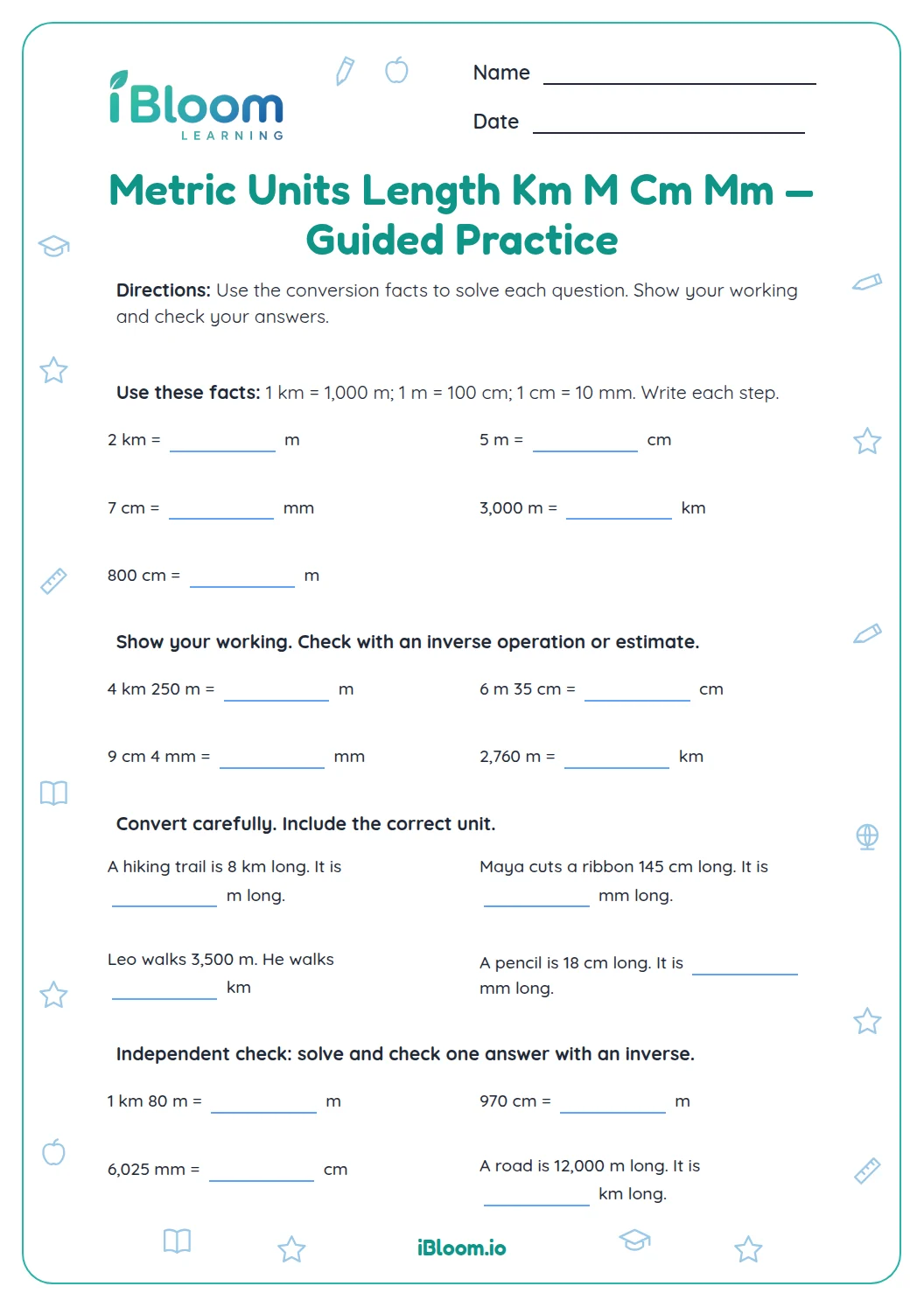
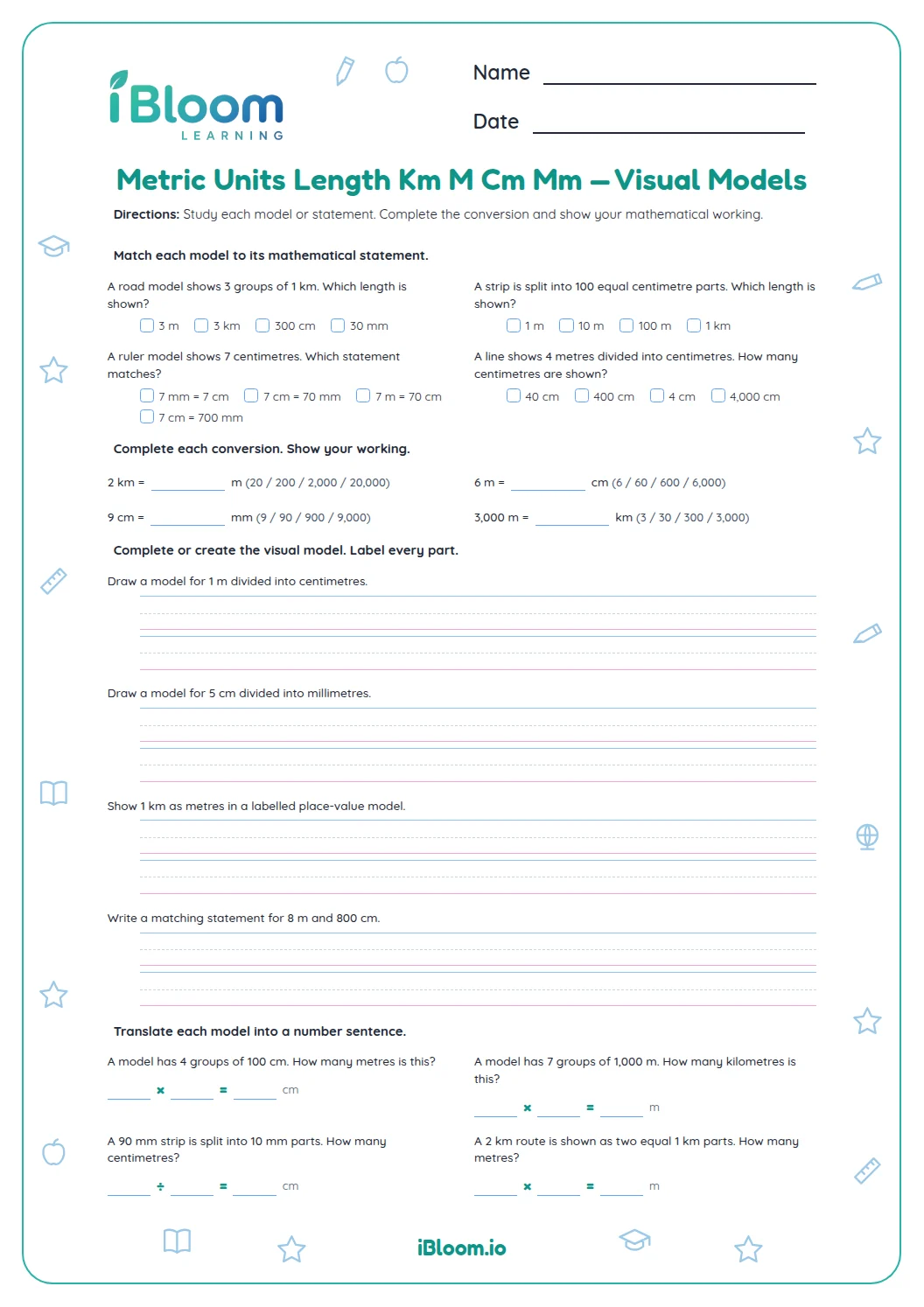
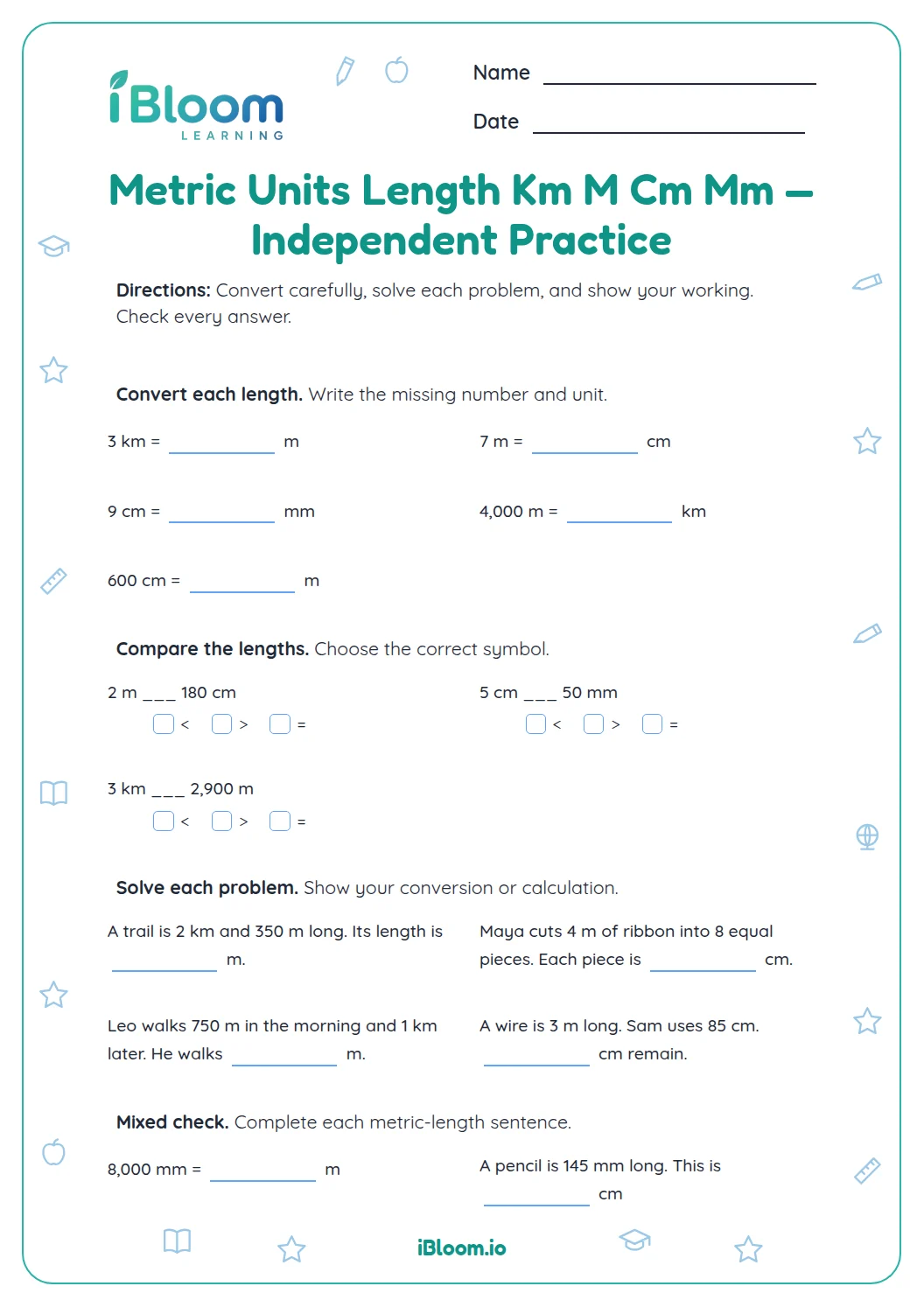
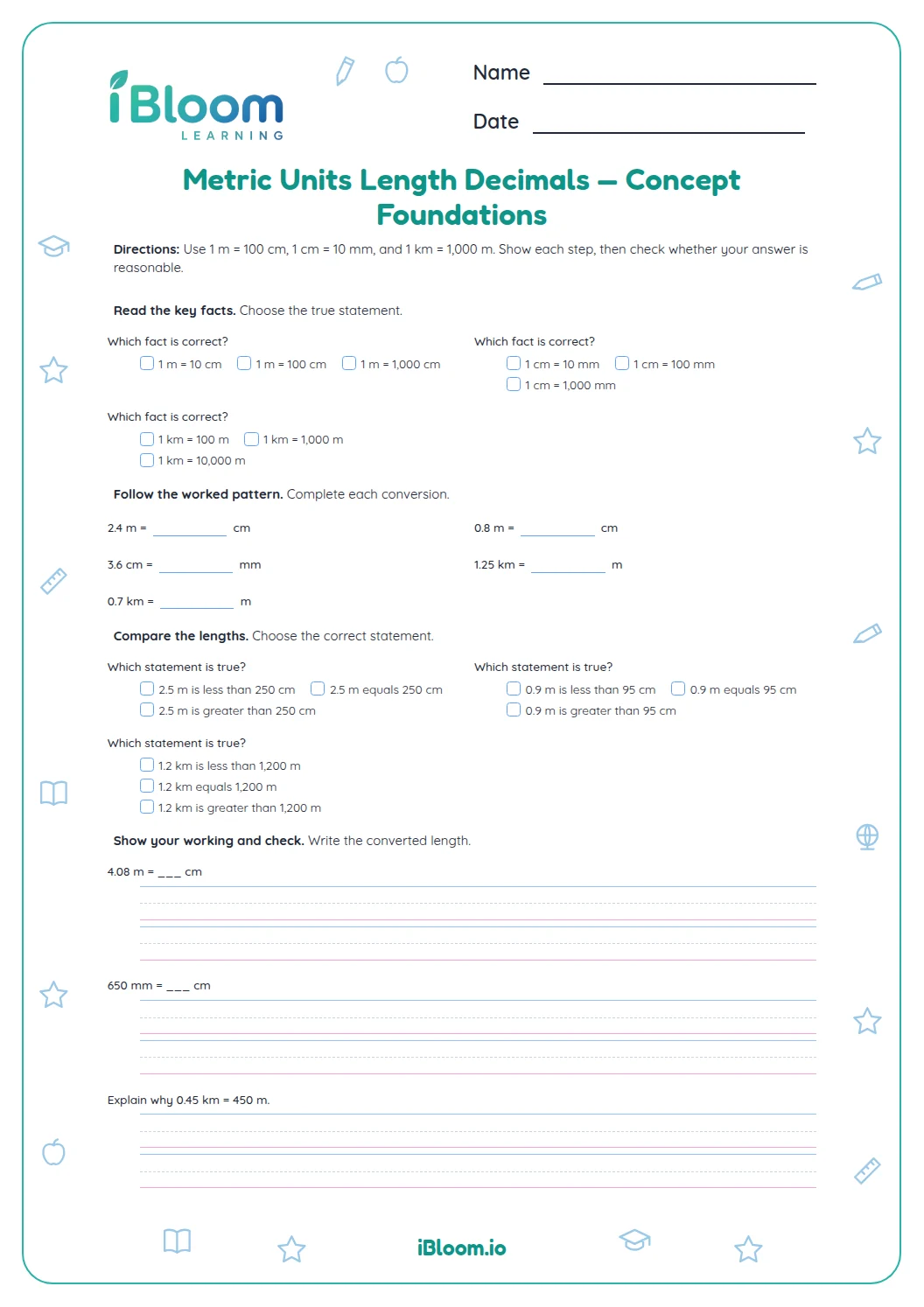
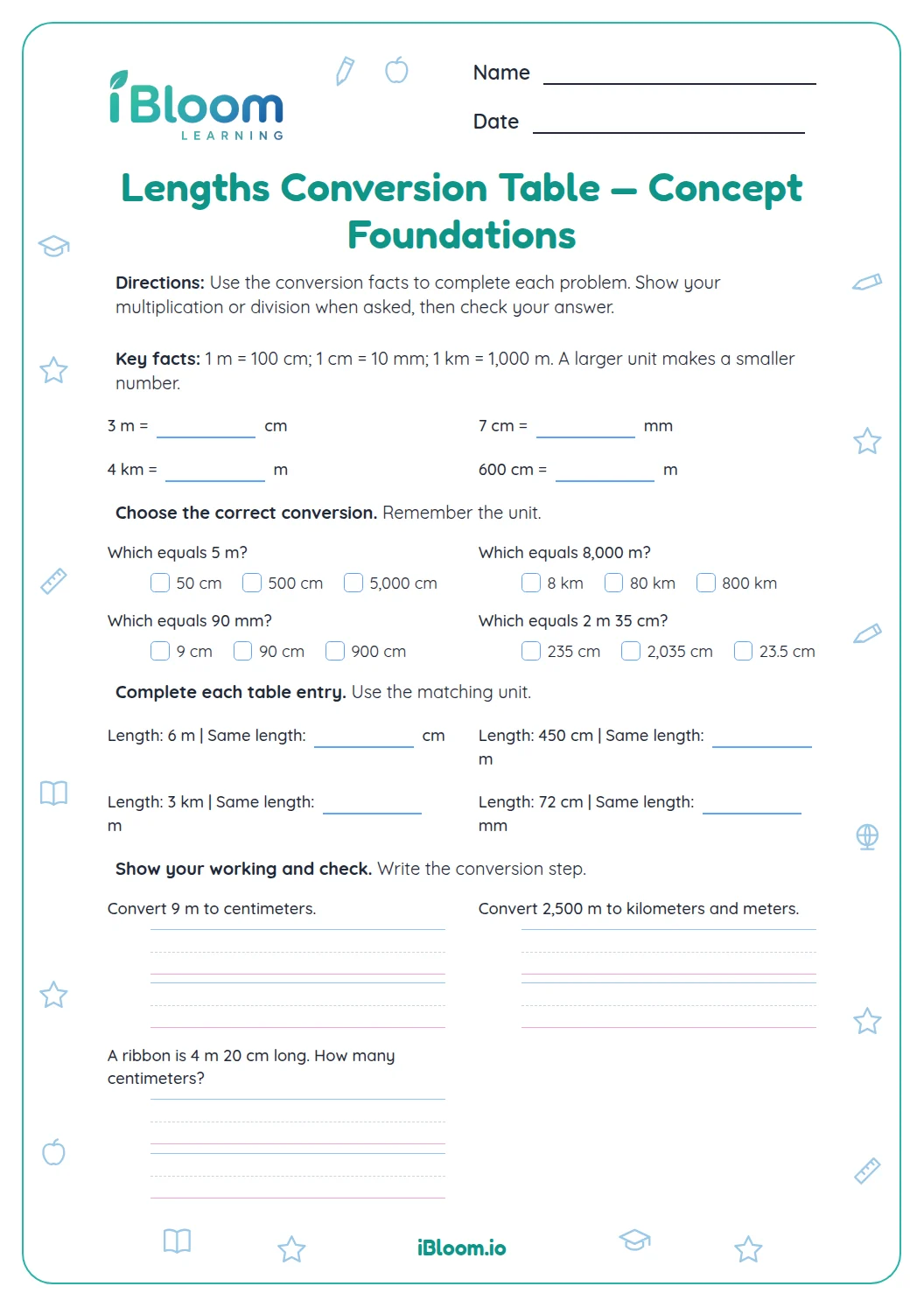
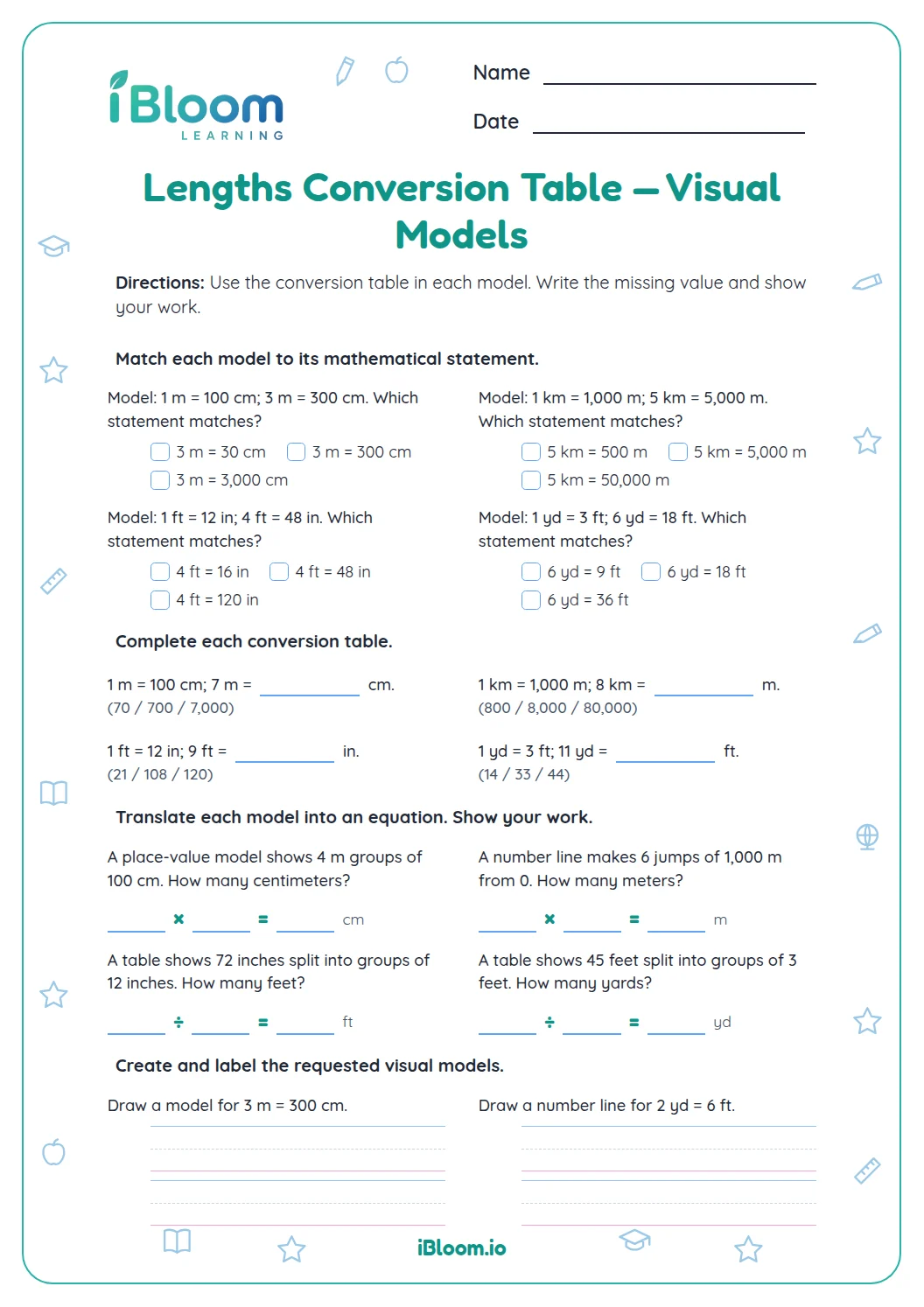
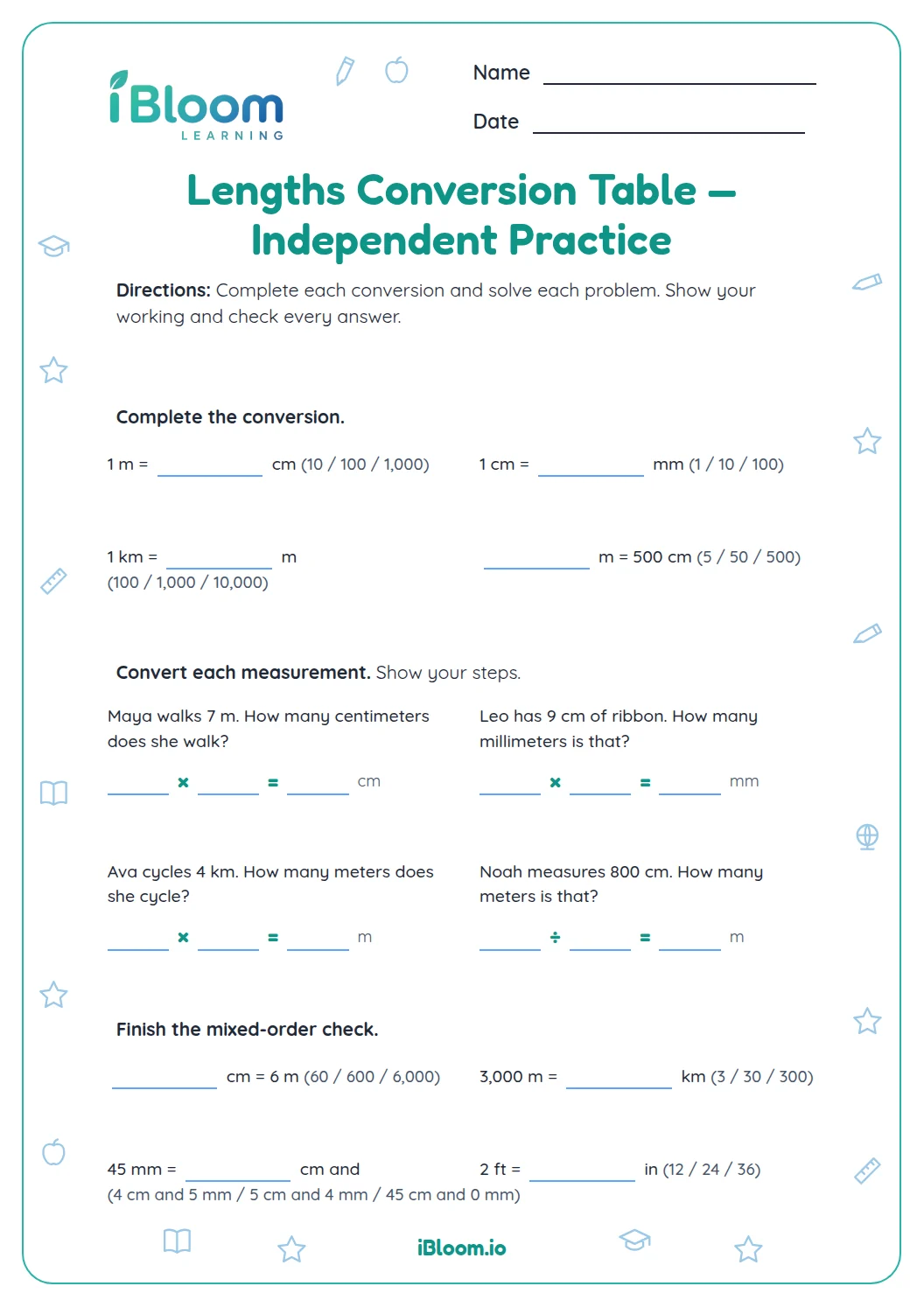
This free printable Grade 5 math worksheet practices metric length conversions and measurement precision. Across 16 questions, students convert kilometers, meters, centimeters, and millimeters; check equivalent records such as 450 cm and 4.5 m; and identify the interval represented by a rounded measurement. The answer key marks each result. The conversion questions practice Common Core 5.MD.A.1 with real-world lengths.
Aligned to 5.MD.A.1
How can a unit reveal a measurement error?
Think about the object before accepting a number. A room is measured in meters, while a pencil is measured in centimeters or millimeters.
- 1A desk at 125 cm is not 125 m long; the sensible unit is centimeters.
When are two length records equivalent?
When a measurement is rounded, the recorded value stands for a range. For example, a length rounded to 2.6 m to the nearest tenth is at least 2.55 m and less than 2.65 m.
- 12.6 m rounded to the nearest tenth means 2.55 m ≤ exact length < 2.65 m.
How should students correct an error?
Name a sensible unit, make the conversion if needed, and state the corrected value. Several questions ask whether the original value is already equivalent.
How to use this worksheet
- 1Read the object and its recorded length.
- 2Decide which metric unit suits that object.
- 3Convert units when two records need to be compared.
- 4Write a corrected value or explain why the measurement is equivalent.
Common mistakes and quick fixes
The mistake
Choosing a unit without thinking about object size.
The fix
Compare the length with familiar objects before choosing mm, cm, m, or km.
The mistake
Moving the decimal the wrong way.
The fix
Use 100 cm = 1 m and 1,000 m = 1 km to check conversions.
The mistake
Calling equivalent measurements errors.
The fix
Rewrite both values in the same unit before deciding.
Common Core alignment
This page practices 5.MD.A.1 through its worksheet questions.
Convert metric lengths to solve real-world measurement problems.
On this sheet: Questions convert between mm, cm, m, and km to correct or confirm real-world length records.
Show the official wordingHide the official wording
Convert among different-sized standard measurement units within a given measurement system (e.g., convert 5 cm to 0.05 m), and use these conversions in solving multi-step, real world problems.
What to practice next
Make more practice
Further reading
Questions parents and teachers ask
What kinds of length problems are on the sheet?
The 16 questions combine metric conversions, equivalent measurements, and rounding precision. Children convert examples such as 3 km to meters, decide whether 450 cm equals 4.5 m, and choose intervals represented by rounded lengths. The correct results appear in the answer key.
What does “nearest tenth” mean in these questions?
A length rounded to the nearest tenth represents an interval of possible exact lengths. For example, 2.6 m to the nearest tenth means at least 2.55 m but less than 2.65 m. The worksheet asks students to choose the matching interval.
How can students check a metric conversion?
Rewrite the measurement in the requested unit and use the relationship between the units. One kilometer equals 1,000 meters, and one meter equals 100 centimeters. Those facts show that 4 km is 4,000 m and 6 m is 600 cm.
Does the answer key include the intervals?
Yes. The key marks the correct conversion or interval for every question. For the item rounding to 12.0 cm at the nearest tenth, it selects 11.95 ≤ x < 12.05 cm, which includes the lower boundary and excludes the upper one. It also marks the boundary at each end.
Can students use the page to practice error checks?
Yes. Several items ask students to compare two records or convert a length into another metric unit. They can use the conversions to catch scale errors, such as confusing millimeters with centimeters or writing meters where centimeters are intended. Use the conversions to verify the recorded unit.