


About this worksheet
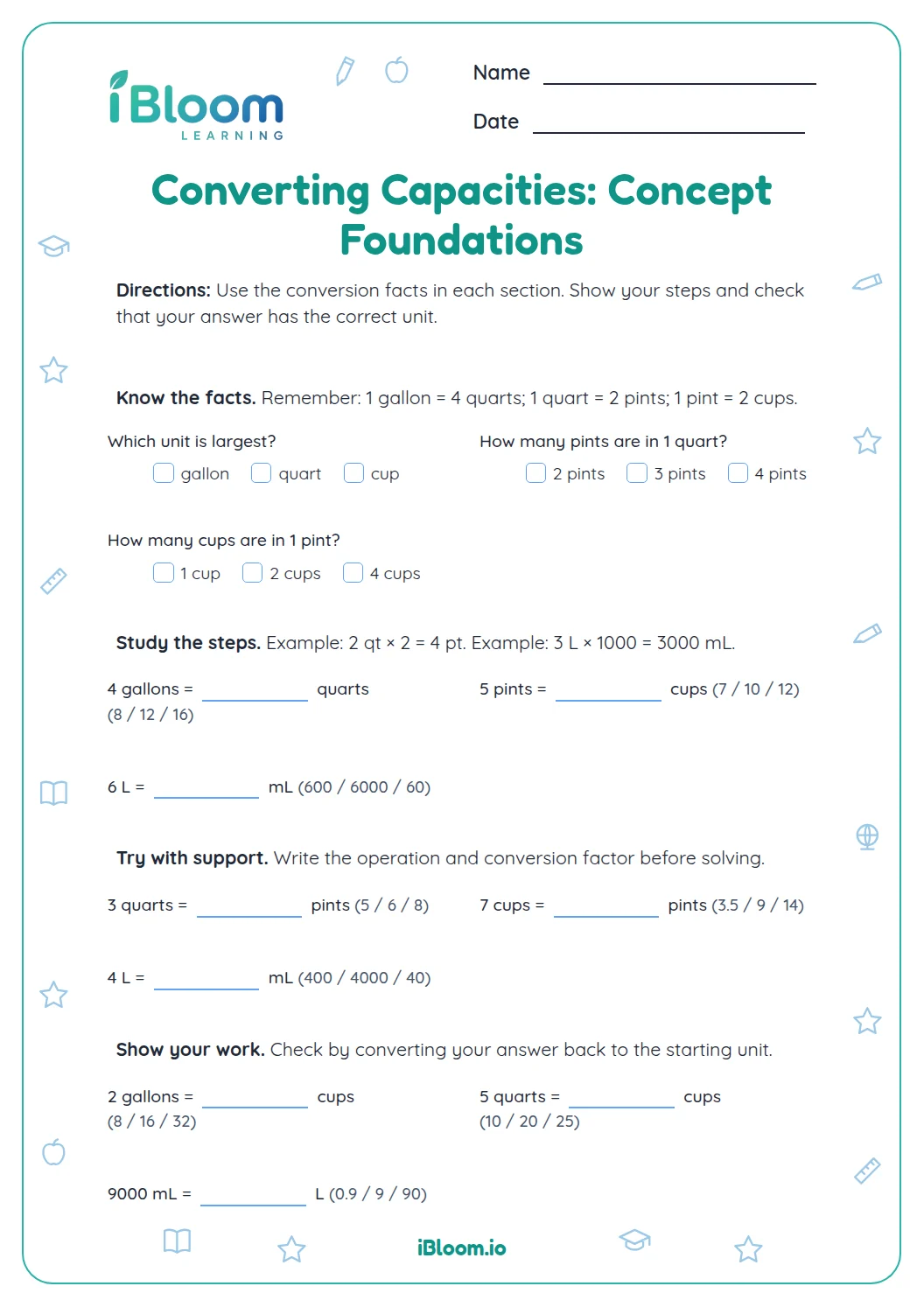
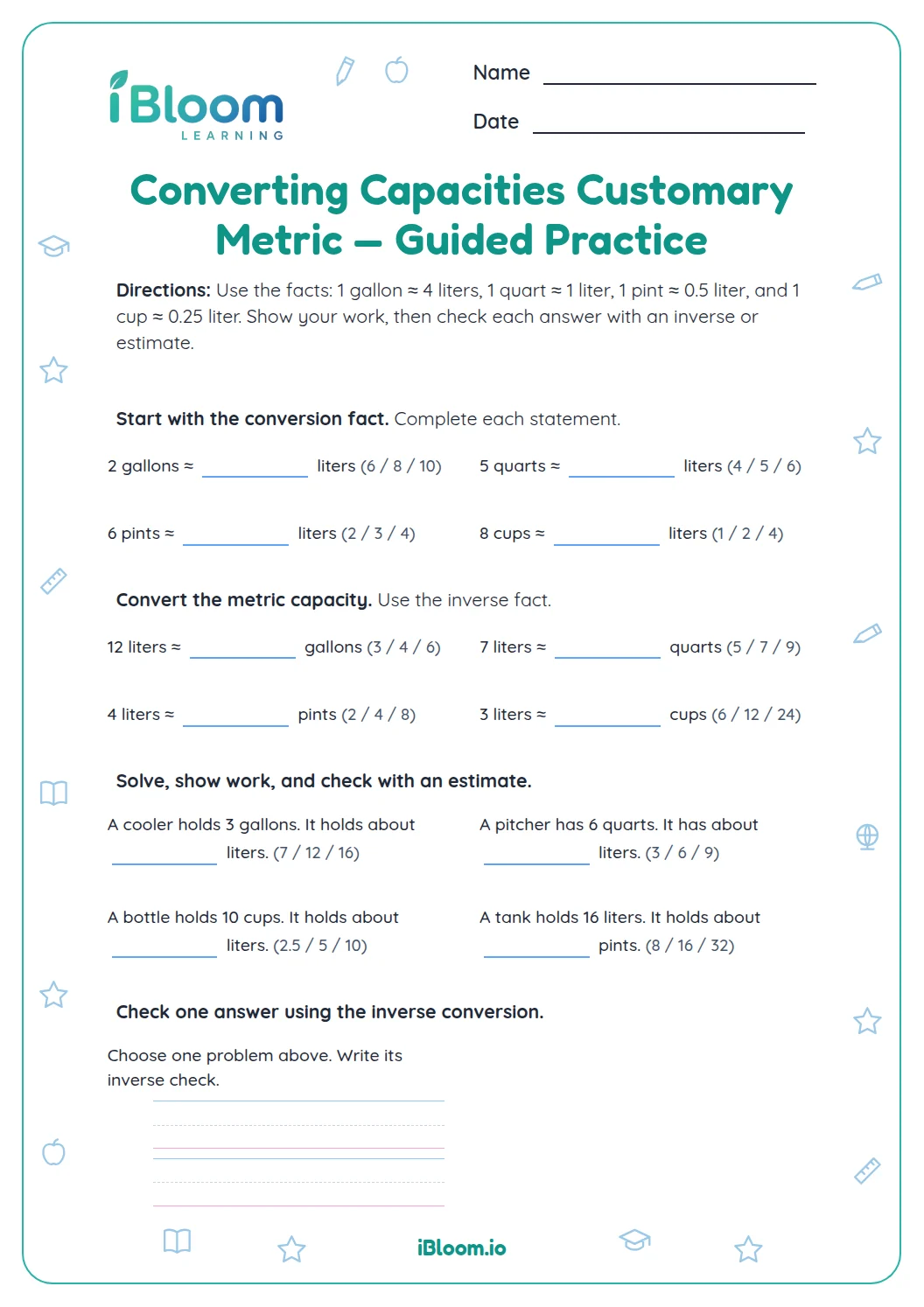
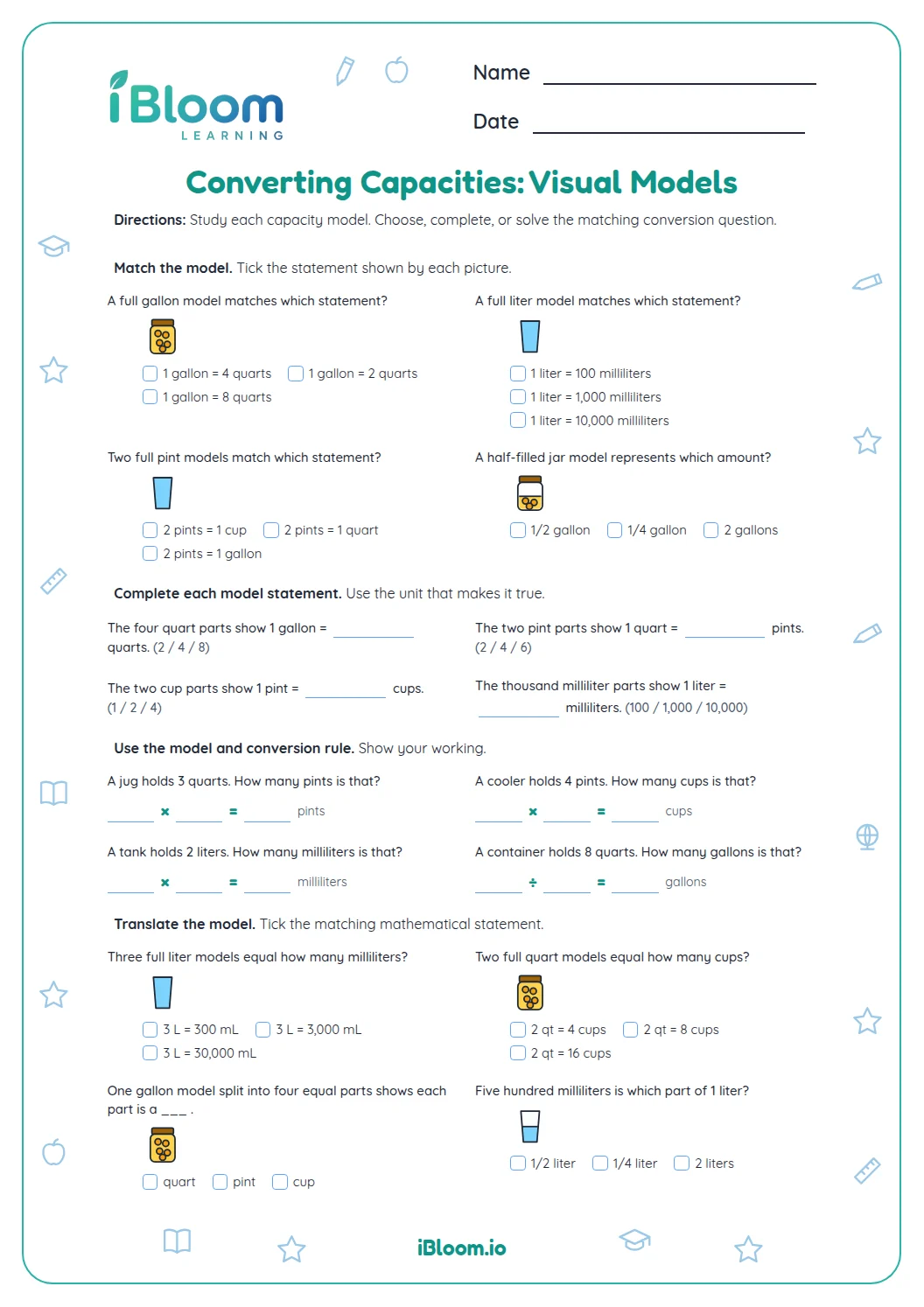
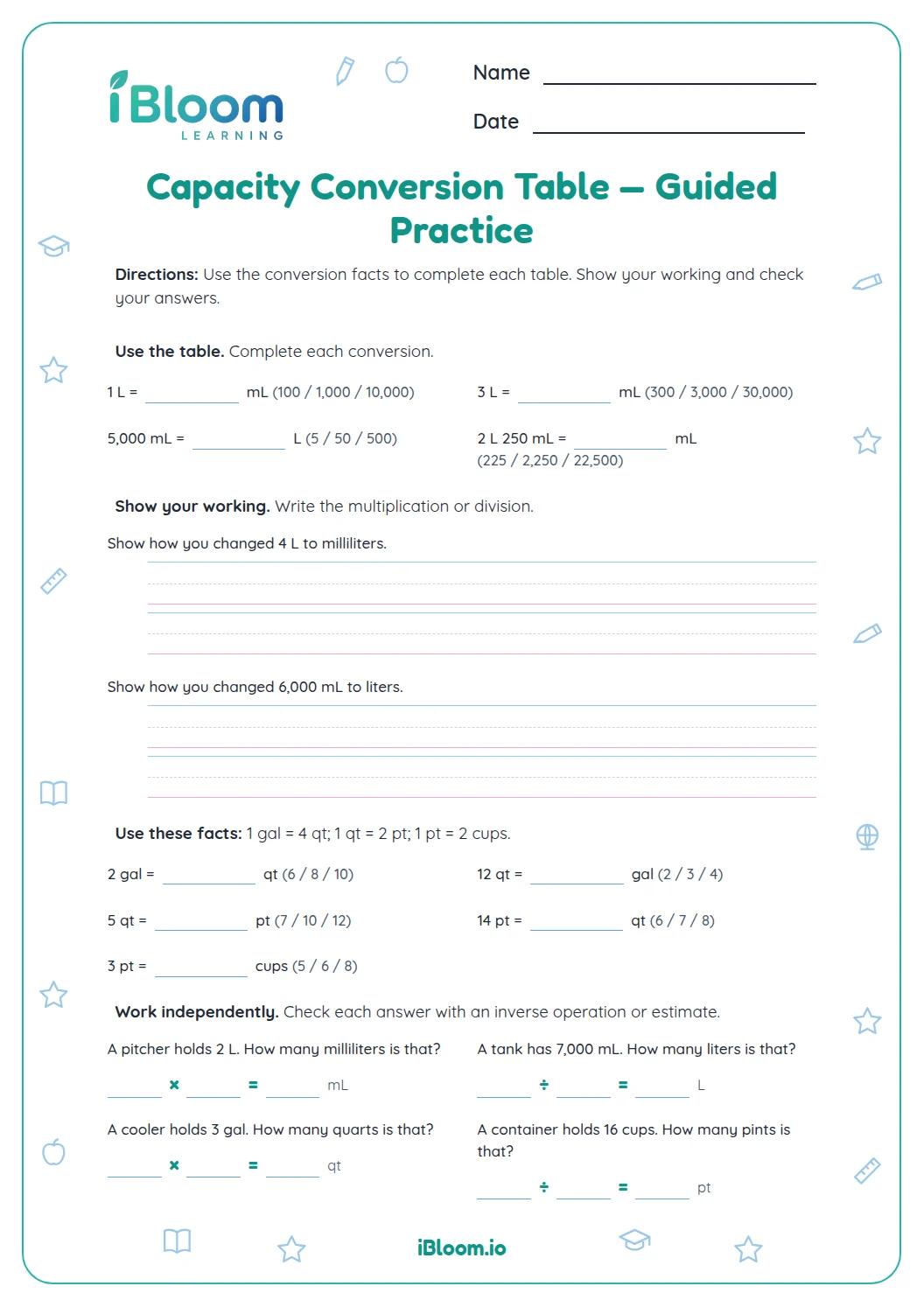
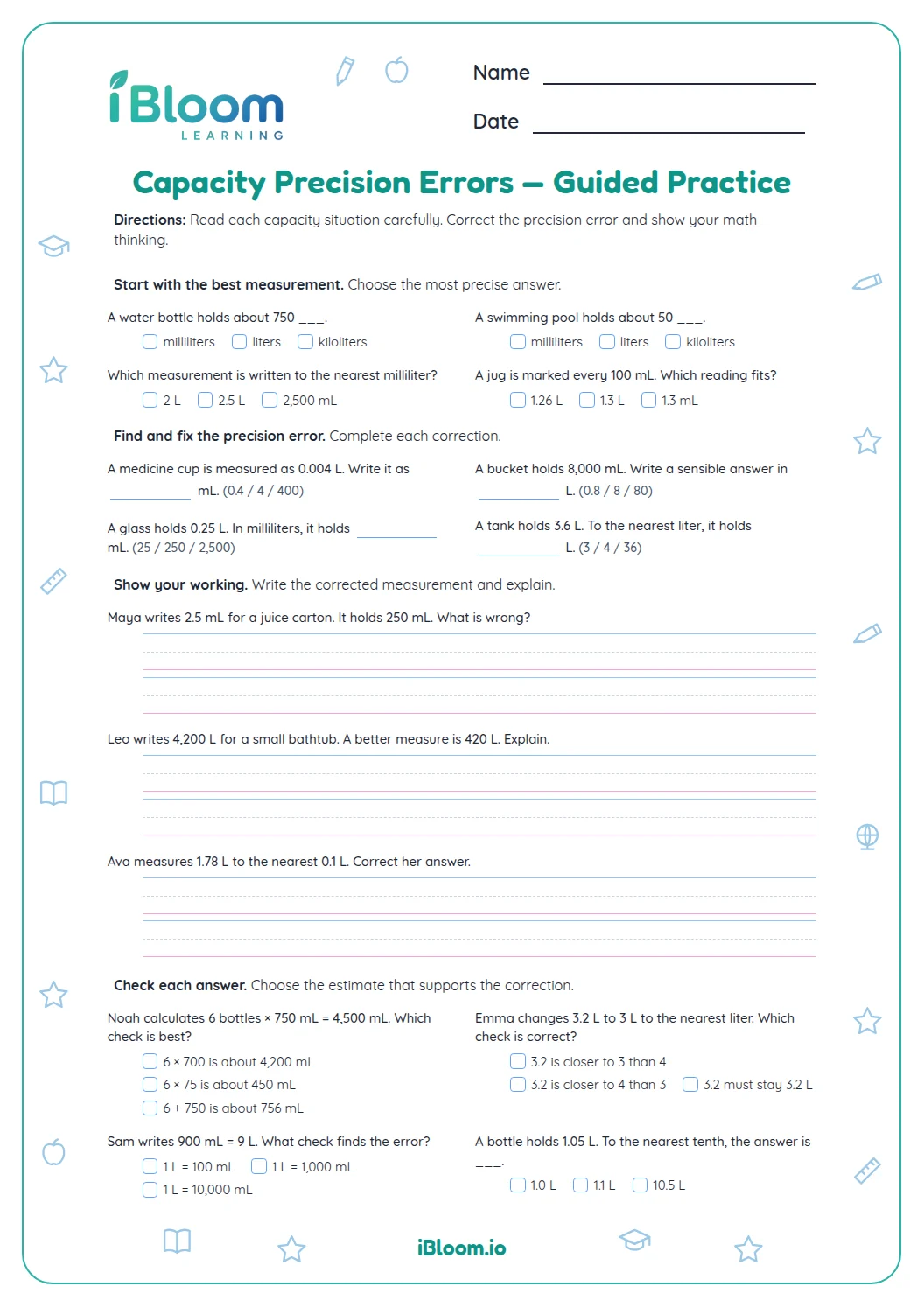
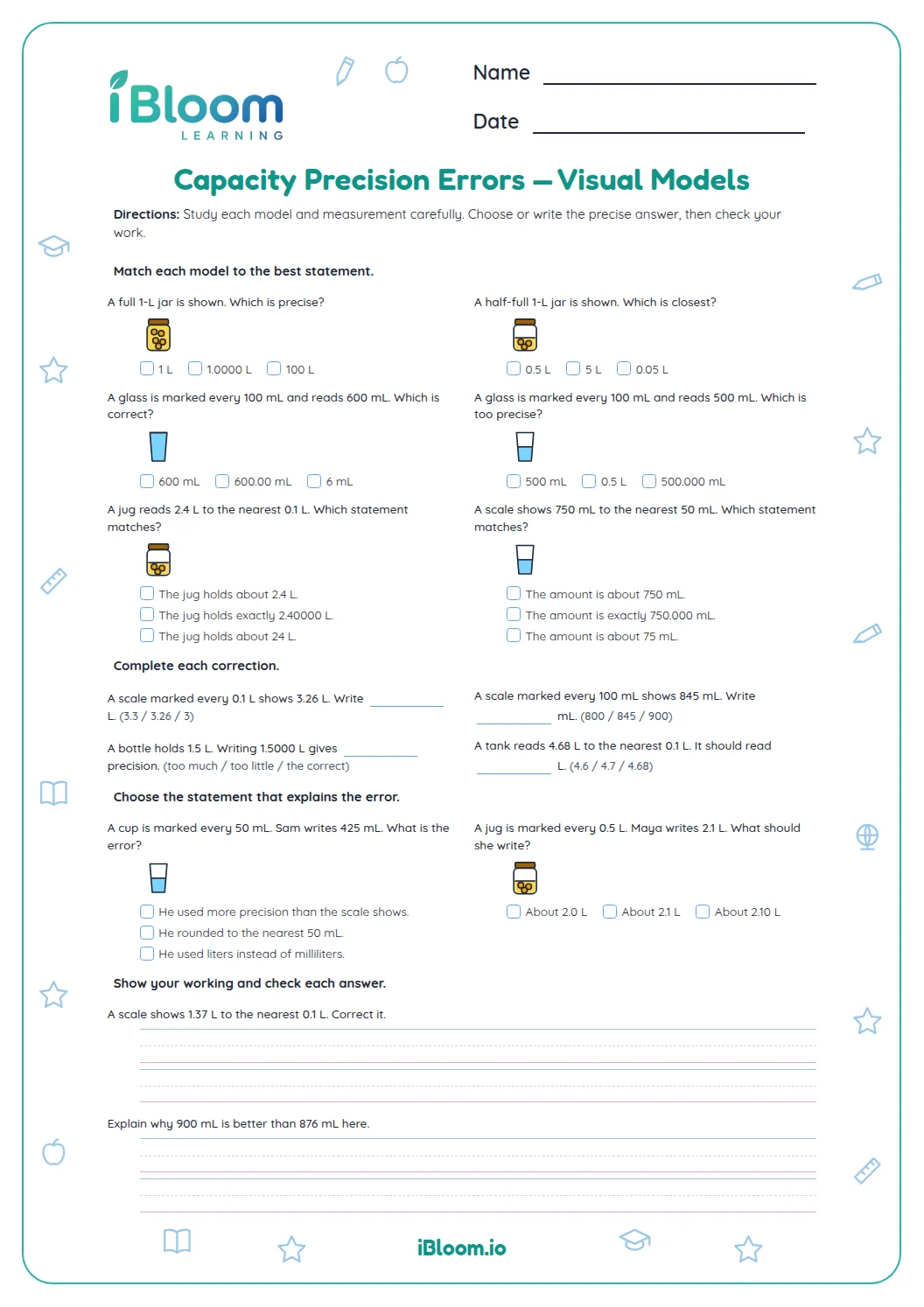
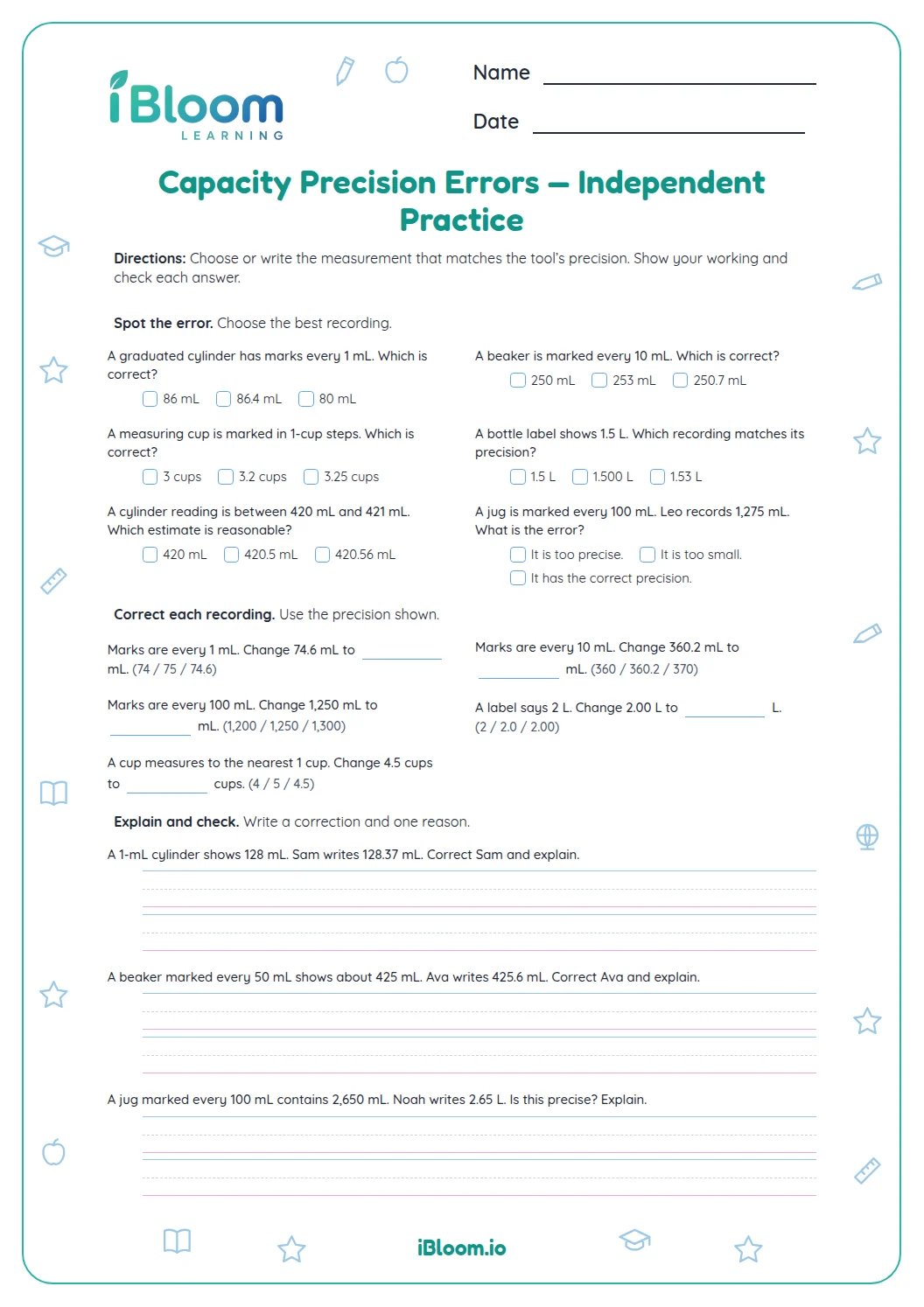
This Grade 5 worksheet has 14 capacity problems using liters, milliliters, cups, and gallons. Students convert within metric units, use stated approximate relationships between customary and metric capacity, and solve short capacity situations. The separate answer key gives the conversions and comparisons. It practices CCSS 5.MD.A.1.
Aligned to 5.MD.A.1
How do you convert between liters and milliliters?
One liter equals 1,000 milliliters. Multiply liters by 1,000 to find milliliters; divide milliliters by 1,000 to find liters.
For example, 4,500 mL ÷ 1,000 = 4.5 L. For customary comparisons, use the approximate relationship stated in the item, such as 1 gallon ≈ 3.8 L.
How to use this worksheet
- 1Check which unit the answer needs.
- 2For liters and milliliters, use 1 L = 1,000 mL.
- 3For approximate customary conversions, use the stated benchmark and label your estimate.
Common mistakes and quick fixes
The mistake
Moving the decimal in the wrong direction when changing mL to L.
The fix
Divide milliliters by 1,000 to get fewer, larger units.
The mistake
Treating an approximate customary relationship as exact.
The fix
Keep “about” in the answer when using the stated estimate.
The mistake
Multiplying when the question asks how many smaller units fit.
The fix
Convert both capacities to the same unit before comparing or dividing.
Curriculum alignment
This worksheet practices the skill named below.
Convert measurements among units in one measurement system.
On this sheet: The sheet practices metric capacity conversions exactly and uses customary-to-metric benchmark estimates stated in each problem.
Show the official wordingHide the official wording
Convert among different-sized standard measurement units within a given measurement system (e.g., convert 5 cm to 0.05 m), and use these conversions in solving multi-step, real-world problems.
What to practice next
Questions parents and teachers ask
Which capacity units appear?
The worksheet uses liters and milliliters for metric conversions, plus cups and gallons in situations that state an approximate relationship to liters. Read each item’s unit carefully and use the exact conversion or estimate supplied in that question.
Is one gallon exactly 3.8 liters?
No. The worksheet states that a gallon is about 3.8 liters, so answers using this relationship are estimates. Keep the word “about” in mind when comparing quantities or finding the approximate capacity of several gallons. Metric conversions such as liters to milliliters are exact.
How do you change milliliters to liters?
Divide the number of milliliters by 1,000 because 1,000 mL equals 1 L. For example, 4,500 mL is 4.5 L. To change liters to milliliters, multiply by 1,000 instead. The worksheet practices converting in both directions and checking the unit label in the result.
How many questions are included?
There are 14 questions in three parts: selecting correct conversions, comparing efficient strategies, and completing capacity statements or situations. The answer key is provided separately so students can finish the practice first. The worksheet itself takes two pages.
Why do some answers say “about”?
The customary-to-metric relationships in those questions are rounded estimates, such as 1 gallon ≈ 3.8 L and 1 cup ≈ 0.24 L. Products based on them are approximate too. Metric conversions such as liters to milliliters use the exact relationship of 1 L = 1,000 mL.