



About this worksheet
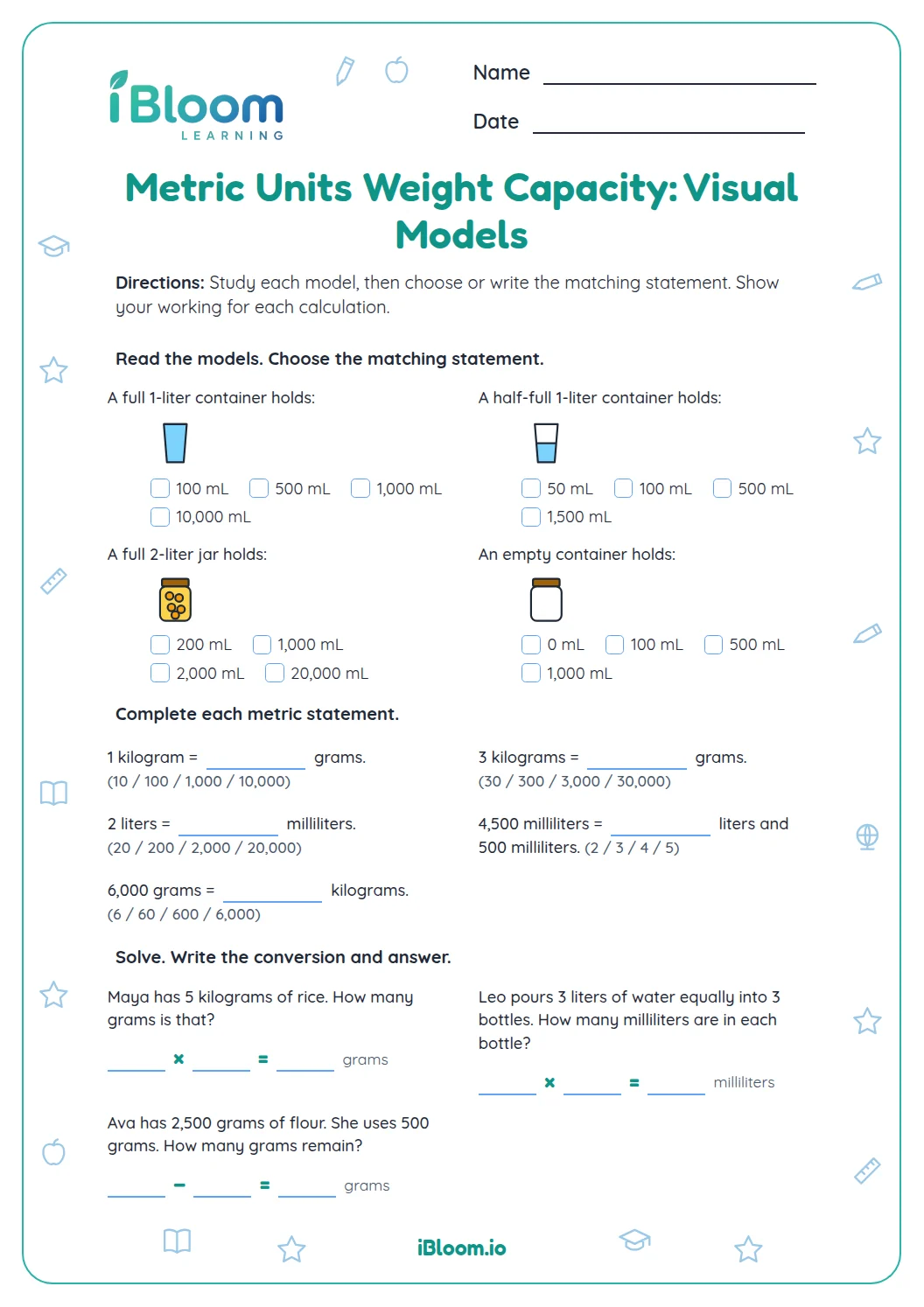
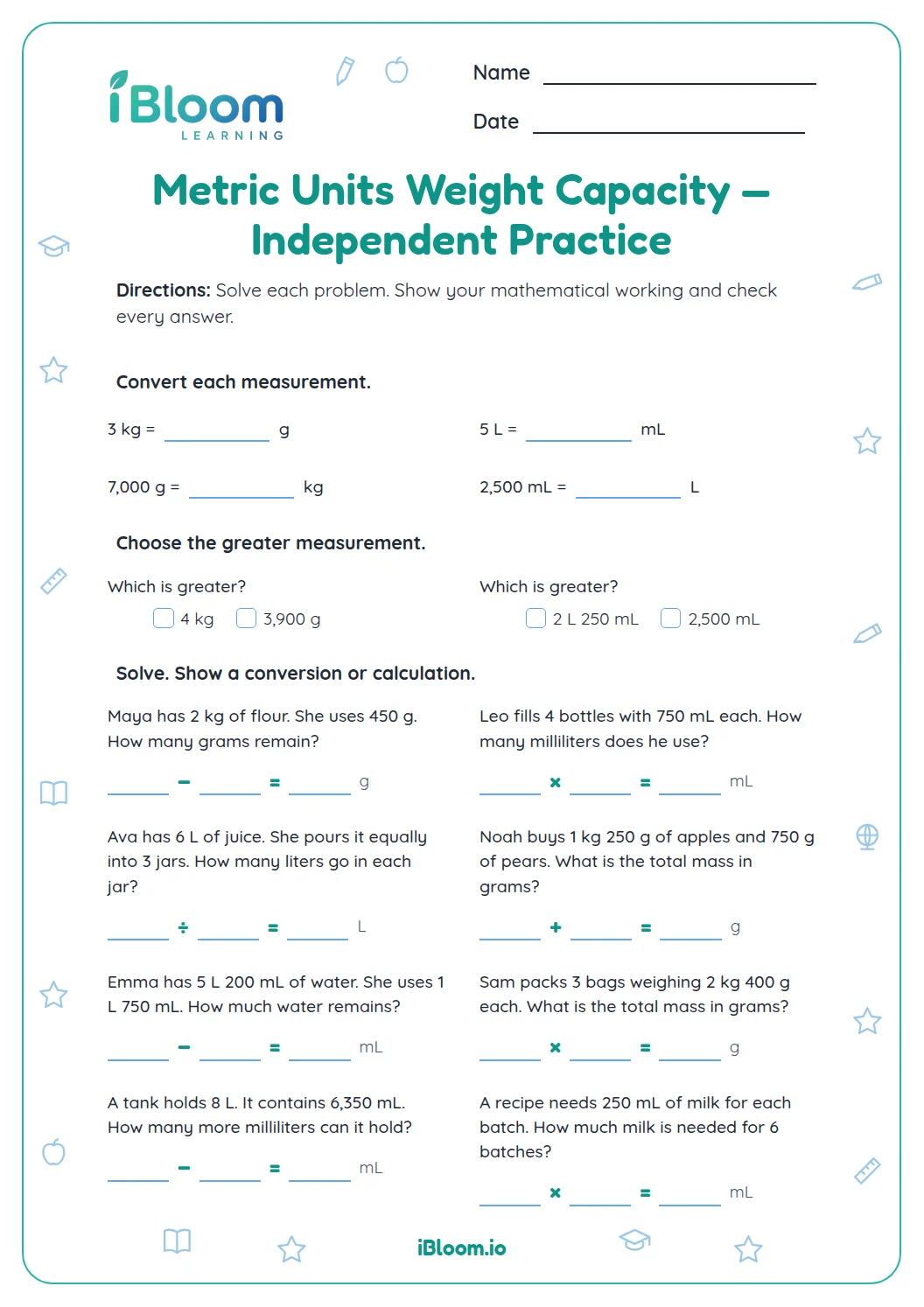
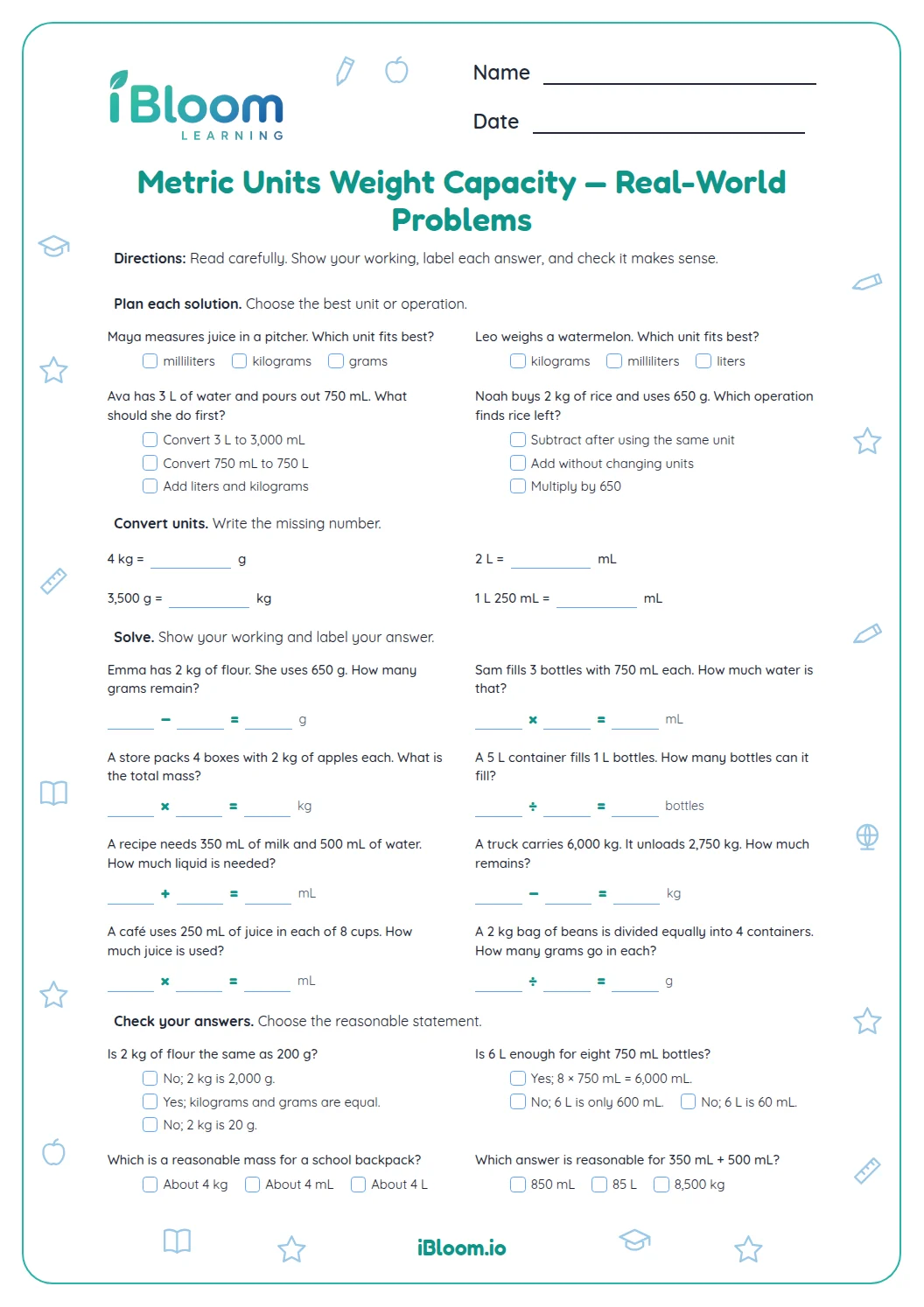
This Grade 5 worksheet connects metric conversions to decisions about weight and capacity. Six Part A questions check conversions and comparisons. Six Part B problems use kilograms and grams or liters and milliliters to work out leftovers, equal shares, and available space. Two Part C questions ask students to explain a conversion error and a capacity decision. The sheet practices Common Core 5.MD.A.1 through conversions within one measurement system and multistep problems. The answer key supplies exact quantities and short model explanations. The printed reminders are 1 kg = 1,000 g and 1 L = 1,000 mL.
Aligned to 5.MD.A.1
Which unit relationships do students need?
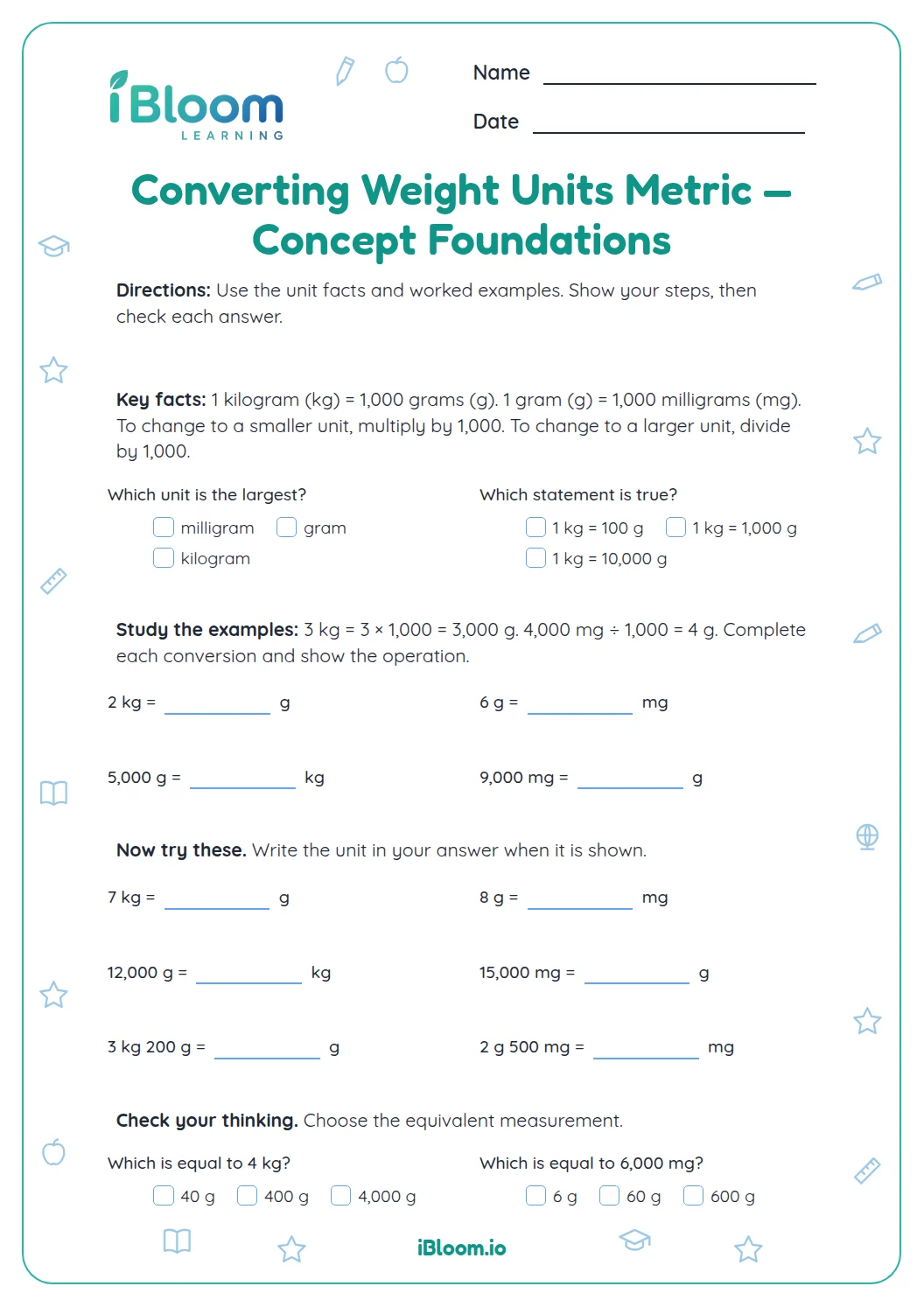
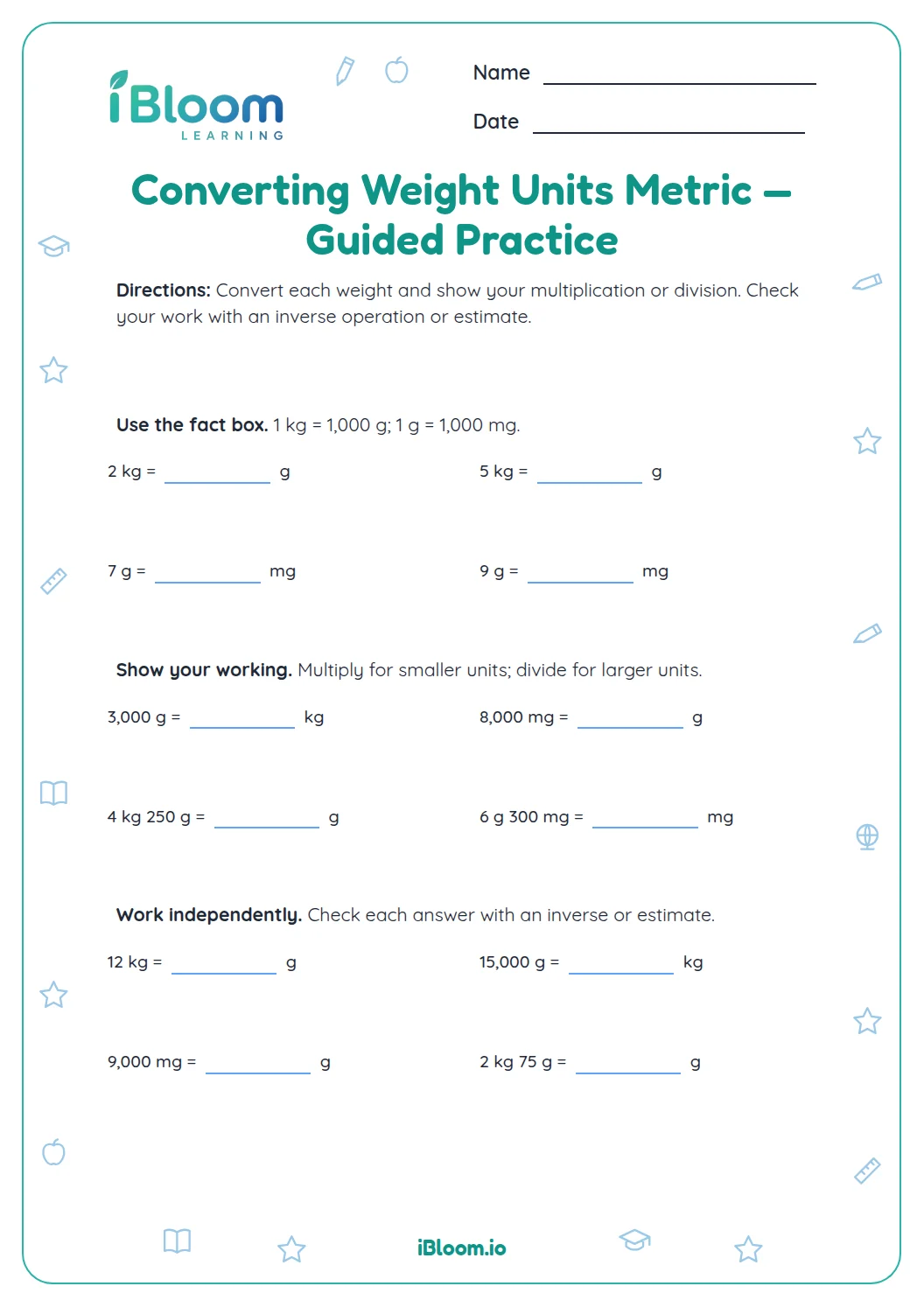
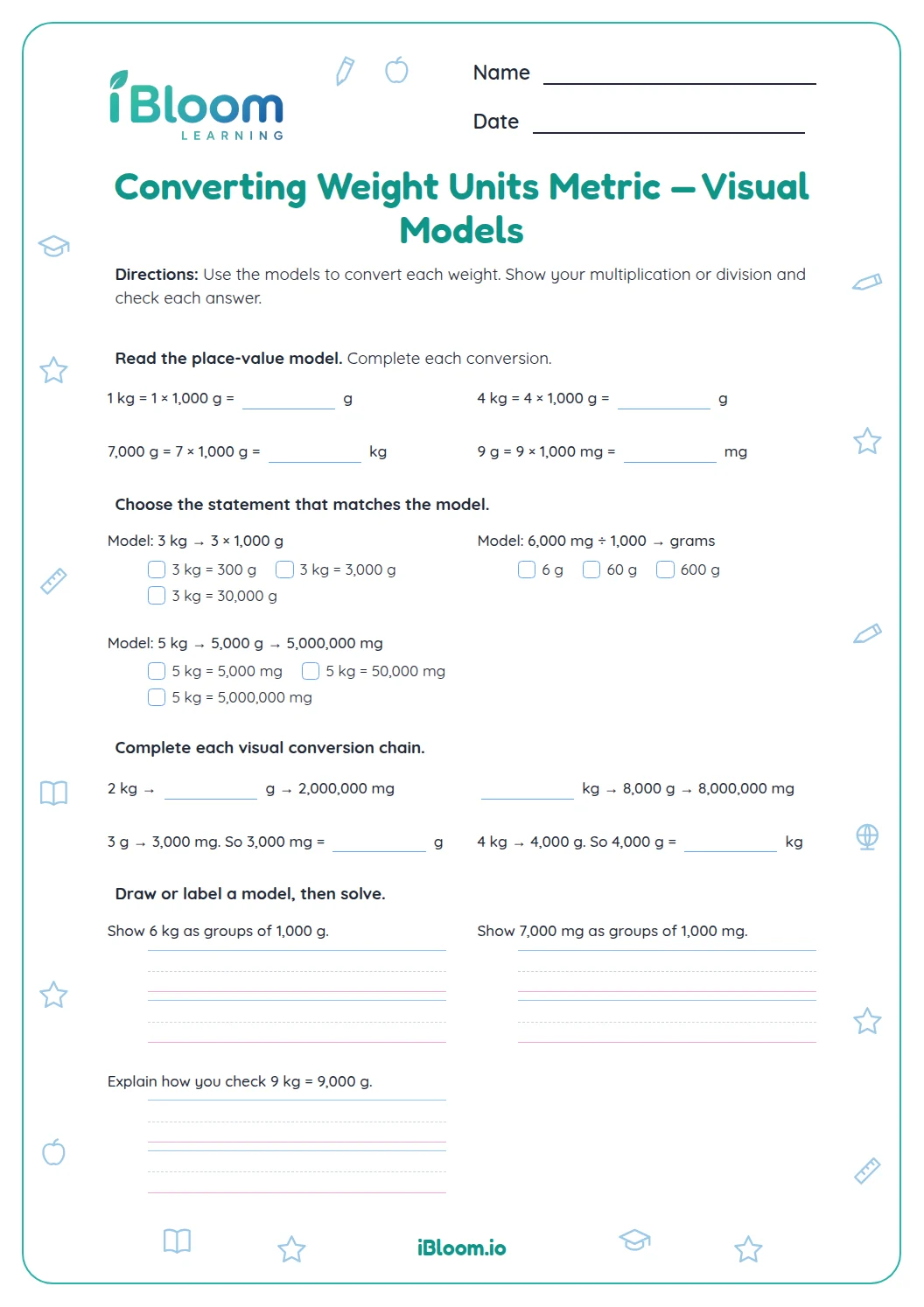
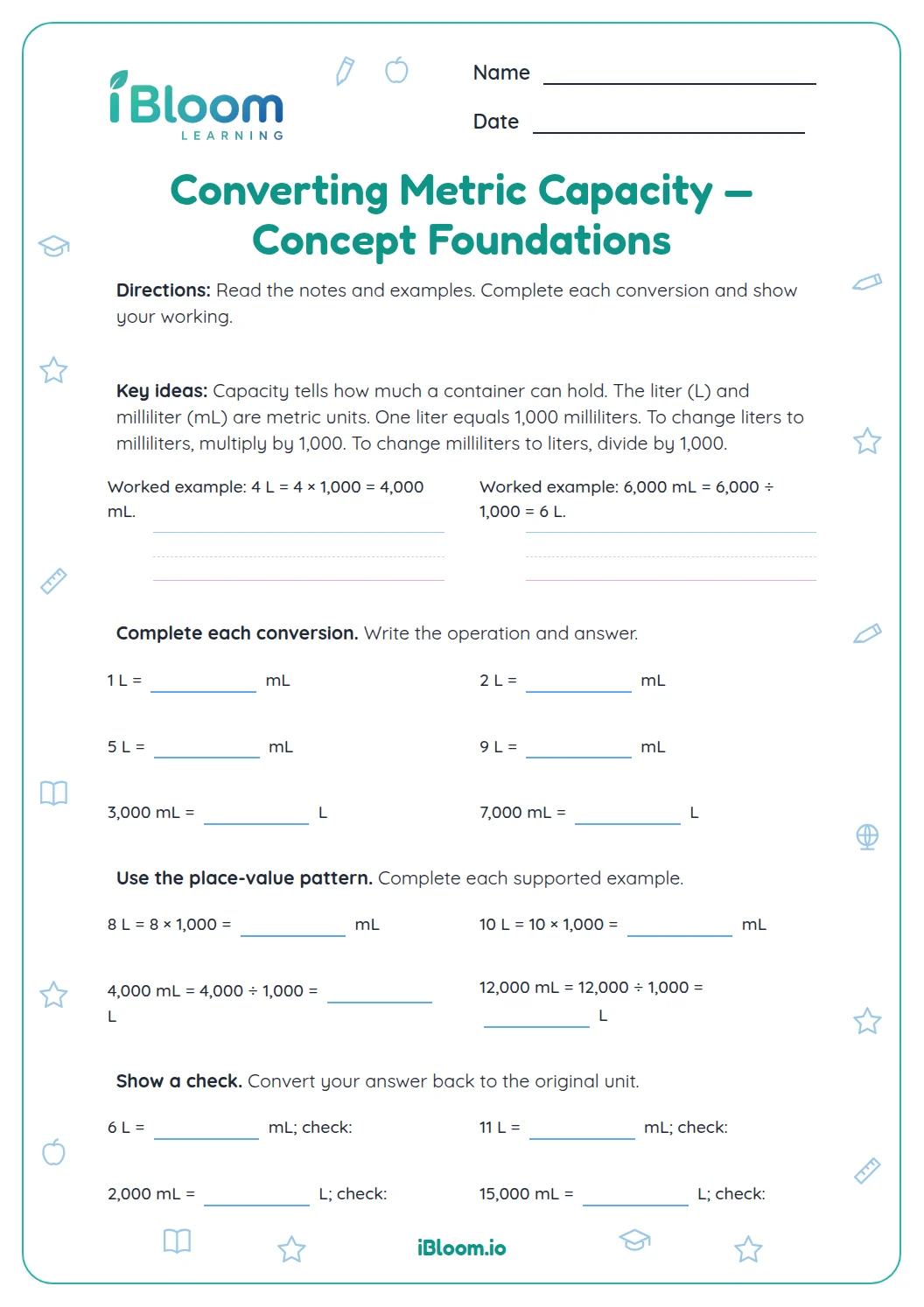
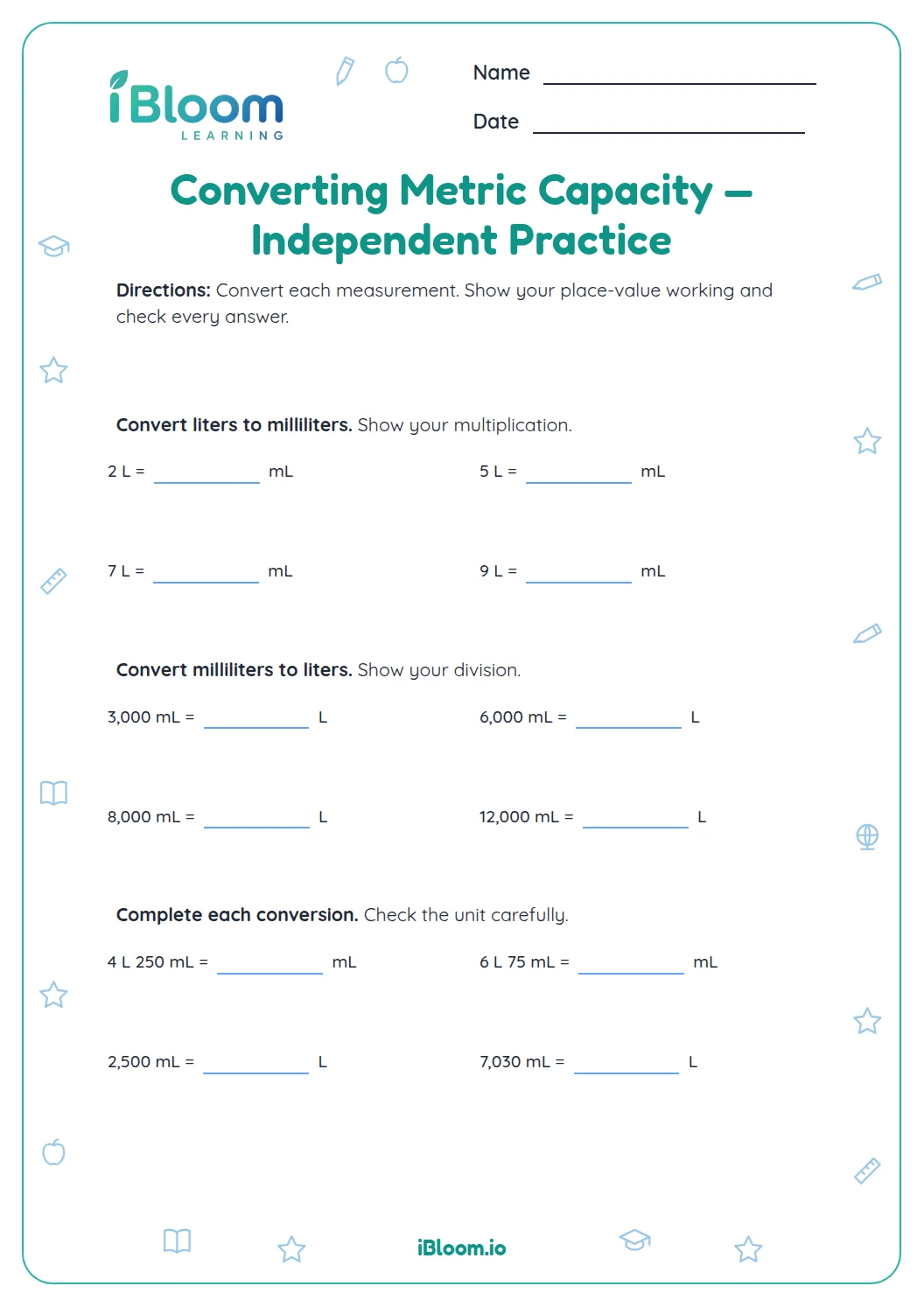
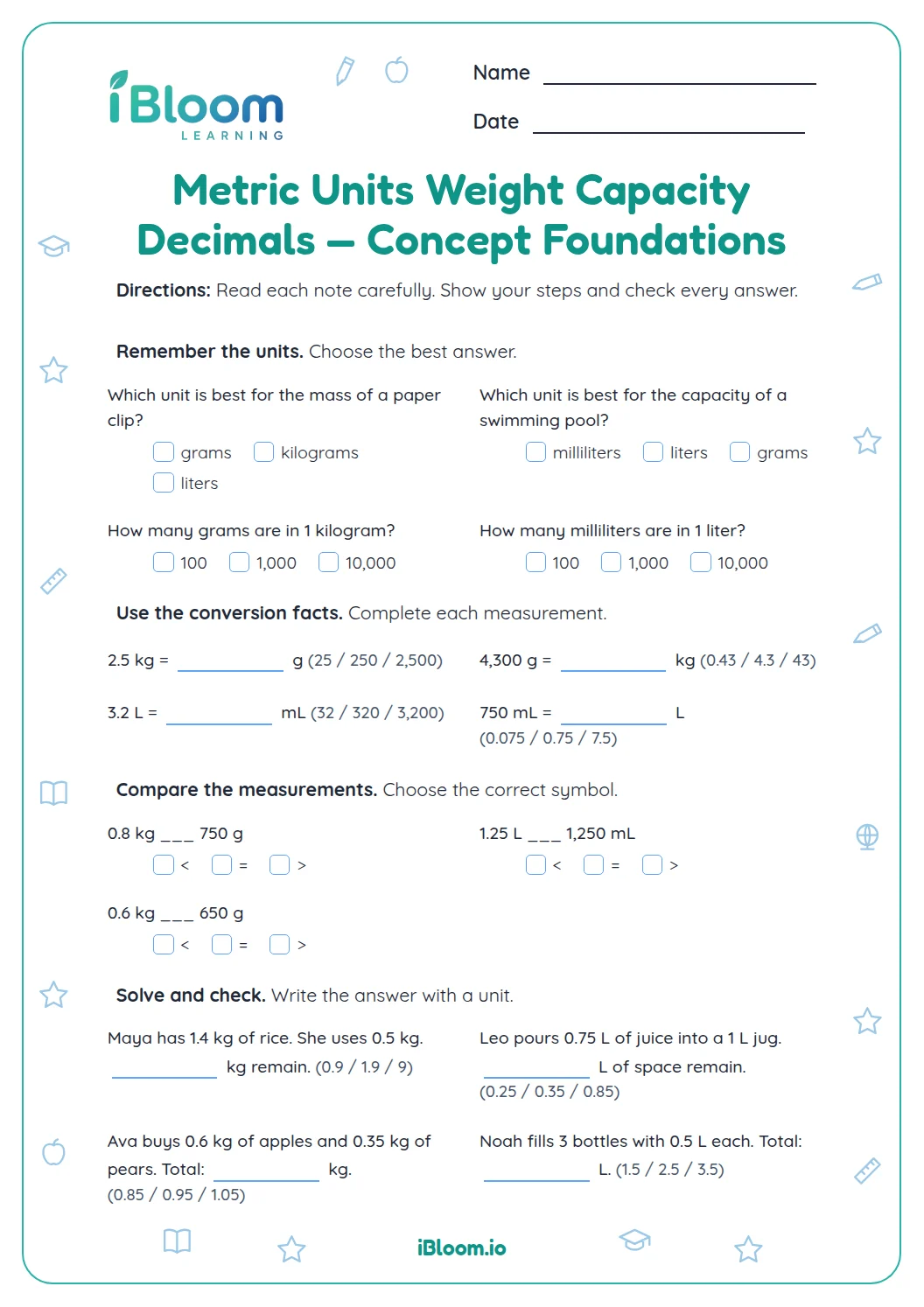
The two printed relationships are 1 kg = 1,000 g and 1 L = 1,000 mL. A kilogram contains a thousand grams; a liter contains a thousand milliliters. Use the weight pair for flour, rice, and oats, and the capacity pair for juice, bottles, and cups.
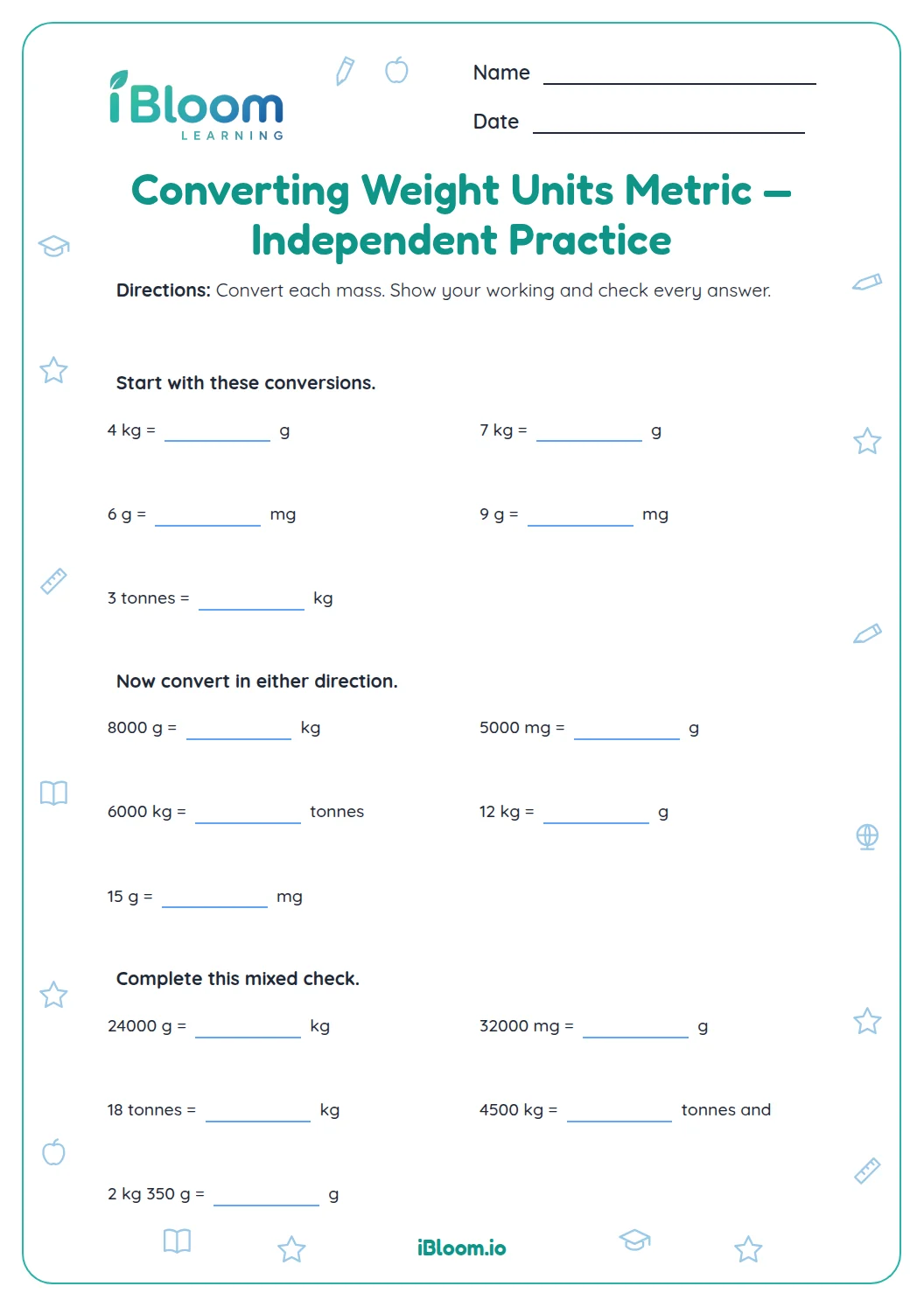
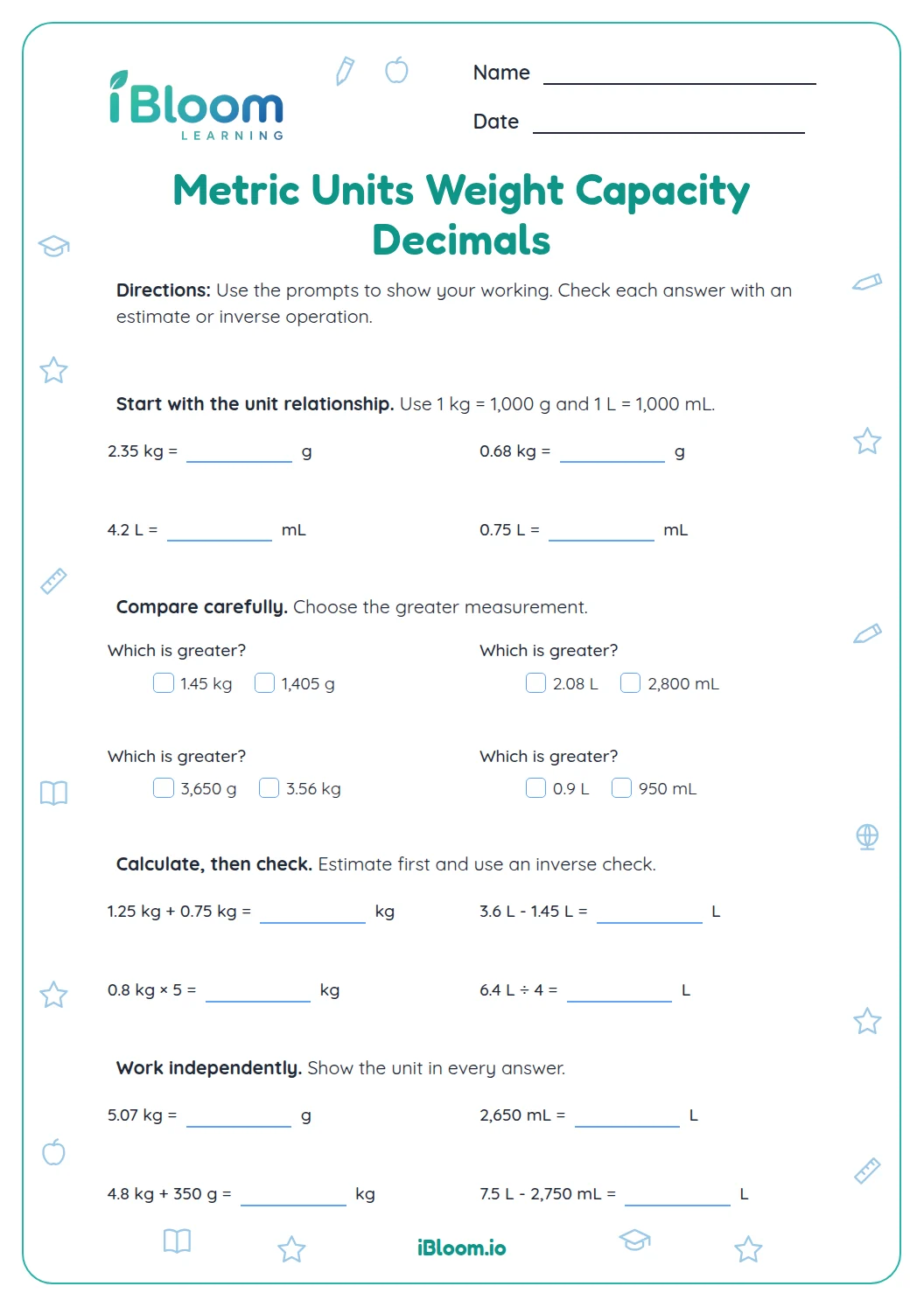
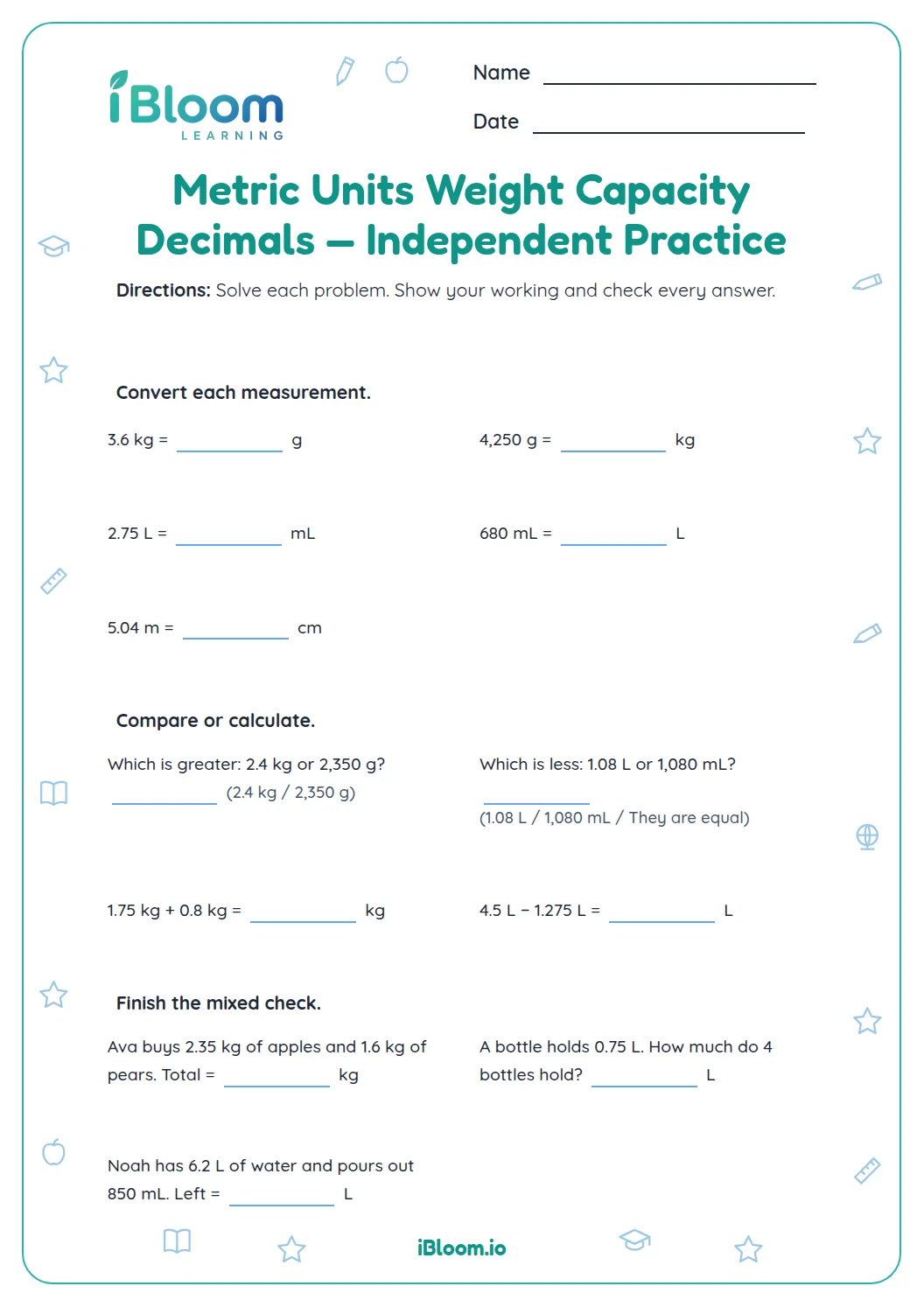
To change a quantity into the smaller unit, multiply its number by 1,000. To express it in the larger unit, divide by 1,000. The physical amount stays the same even though the number changes.
How do conversions help with a multistep problem?
Question 12 combines a starting quantity in kilograms with five portions measured in grams. Convert the starting amount first, multiply to find the packed amount, then subtract to find what remains. Record the result in the blank marked g.
- 13 kg = 3,000 g
- 25 × 450 g = 2,250 g
- 33,000 g − 2,250 g = 750 g remaining
What counts as a useful explanation?
A useful explanation includes the conversion relationship and a numerical check. In question 13, writing 4 L gives the corrected value; saying that 4,000 is divided by 1,000 explains why.
For question 14, calculate how much juice the five cups need and compare that total with the amount in the jug. The 250 mL shortage supports the decision that the jug cannot fill every cup to 450 mL.
Use the worksheet step by step
- 1Read the two conversion facts in Part A aloud.
- 2For each choice, rewrite quantities in one common unit before comparing.
- 3In Part B, mark the unit requested in the question.
- 4Convert to matching units, calculate, and fill the blank beside the printed unit.
- 5In Part C, include a numerical reason and use the key to check both the decision and the evidence.
Mistakes to check and how to fix them
The mistake
Changing 3.5 kg to 350 g.
The fix
Multiply by 1,000: 3.5 × 1,000 = 3,500, so the amount is 3,500 g.
The mistake
Comparing 750 and 1 without reading g and kg.
The fix
Rewrite 1 kg as 1,000 g; now 750 g is visibly smaller.
The mistake
Subtracting 450 g only once in the oats problem.
The fix
Five bags use 5 × 450 g = 2,250 g; subtract that total from 3,000 g.
Common Core alignment
Convert metric weight and capacity units to compare quantities and solve multistep problems.
On this sheet: Students convert kg to g and L to mL, then calculate differences, totals, and equal shares.
Show the official wordingHide the official wording
Convert among different-sized standard measurement units within a given measurement system (e.g., convert 5 cm to 0.05 m), and use these conversions in solving multi-step, real world problems.
What to practice next
Make more practice
Further reading
Questions parents and teachers ask
Which metric units appear on the worksheet?
The sheet uses kilograms and grams for weight, and liters and milliliters for capacity. Both pairs have a factor of 1,000. Students use those relationships in six multiple-choice questions, six calculation problems, and two written explanations that require a numerical reason.
Do students need to memorize the conversion facts?
The two conversion facts are printed under Part A, so students can refer to them while working. Ask them to explain which unit is larger before calculating. That helps connect multiplication or division by 1,000 to the size of the unit instead of a memorized direction.
Why is 4 kg 75 g equal to 4,075 g?
Four kilograms equal 4,000 grams, and the extra 75 grams must be added to that amount. The total is 4,075 grams. Writing the two quantities as an addition helps students avoid treating the unit labels as separators between digits and accidentally writing 475 or 4,750.
What makes the last two questions reasoning challenges?
The final two questions require an explanation supported by a calculation. Students correct a mistaken conversion in question 13, then decide whether a jug can fill five cups in question 14. A bare yes or no is incomplete because the requested reasoning must show the quantities being compared.
Can the written answers differ from the key?
Yes, students can explain the same reasoning in their own words. For question 13, the response must establish that 4,000 mL equals 4 L. For question 14, it must show that 2,250 mL is needed but only 2,000 mL is available, leaving a 250 mL shortage.