
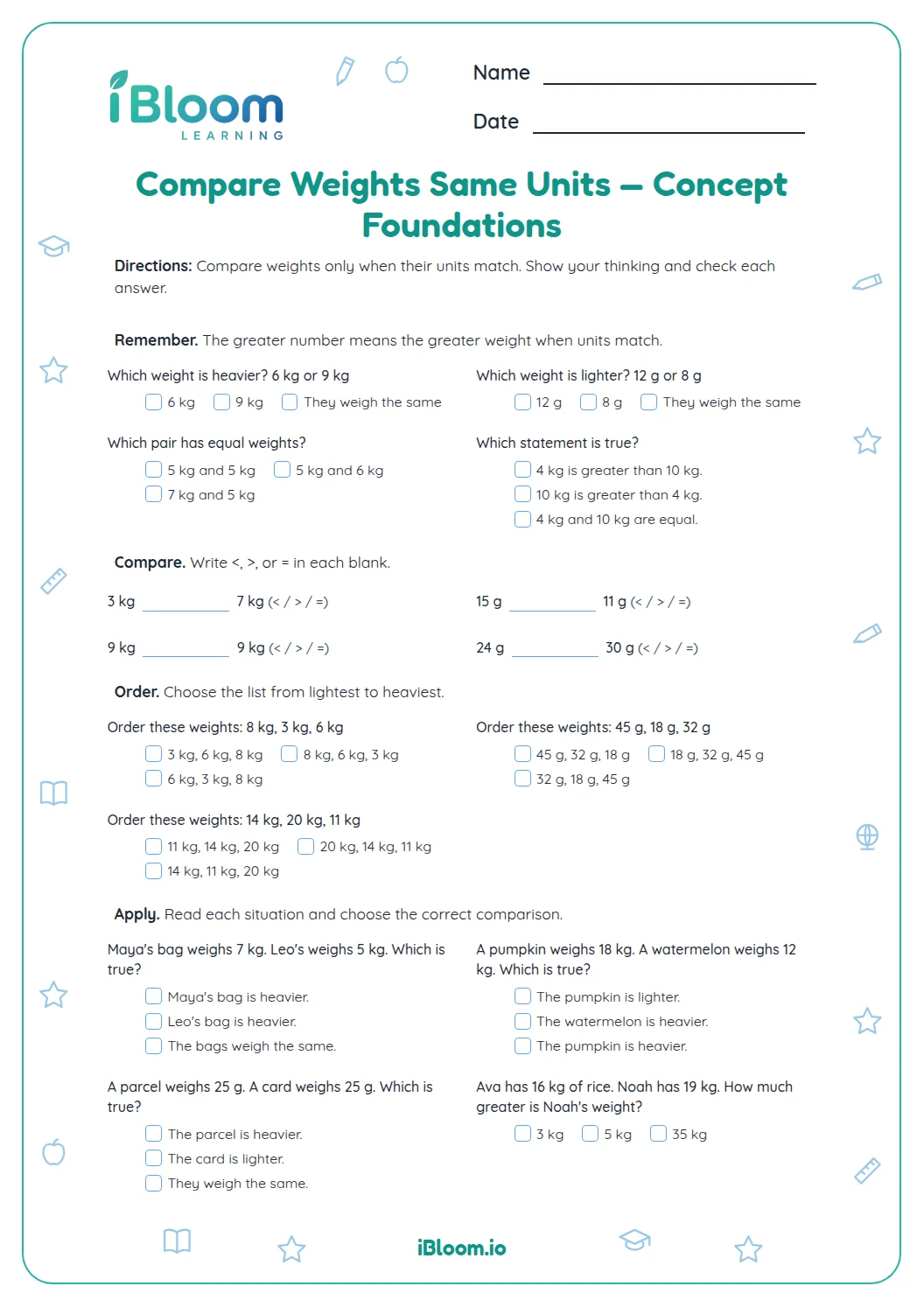
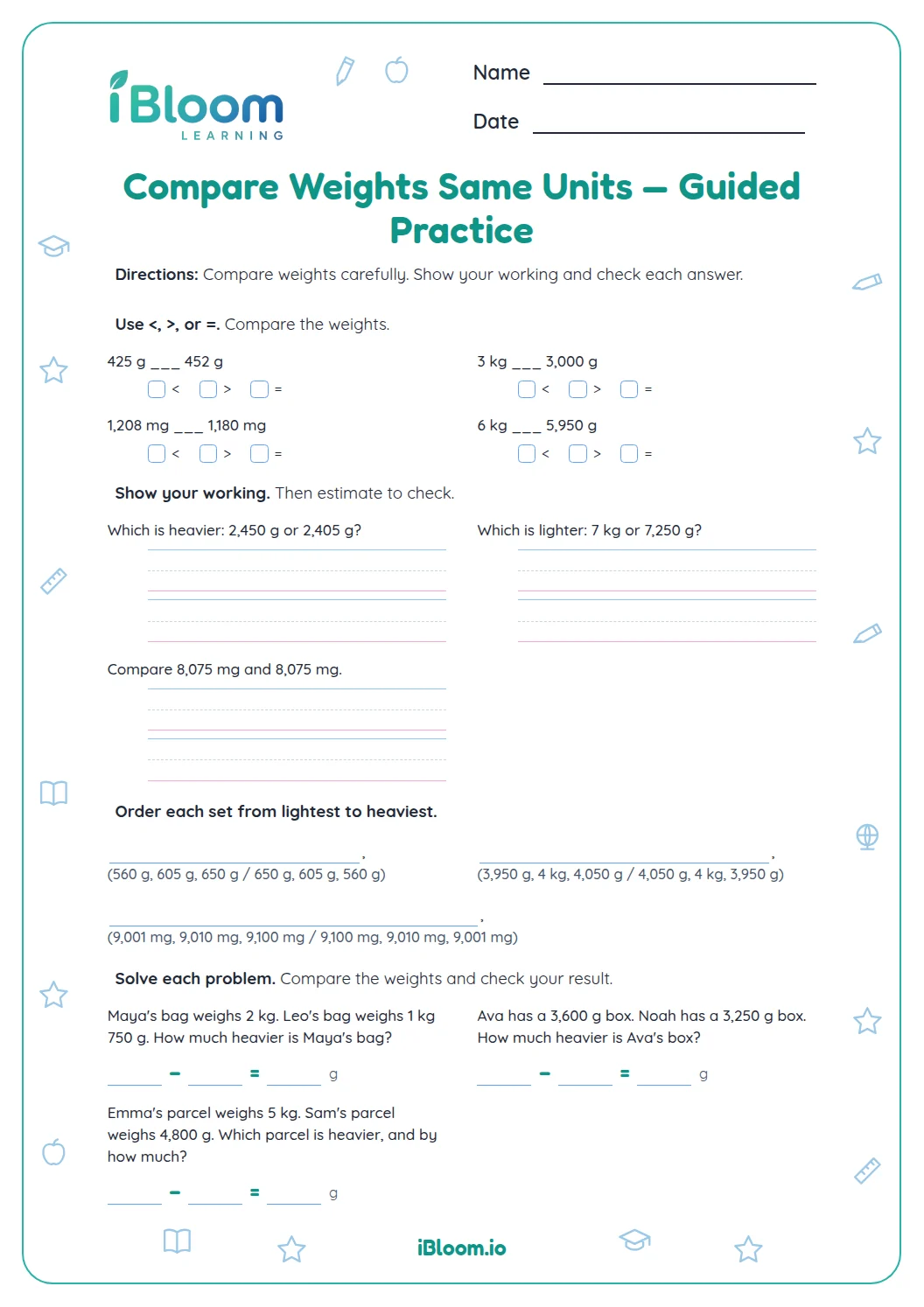
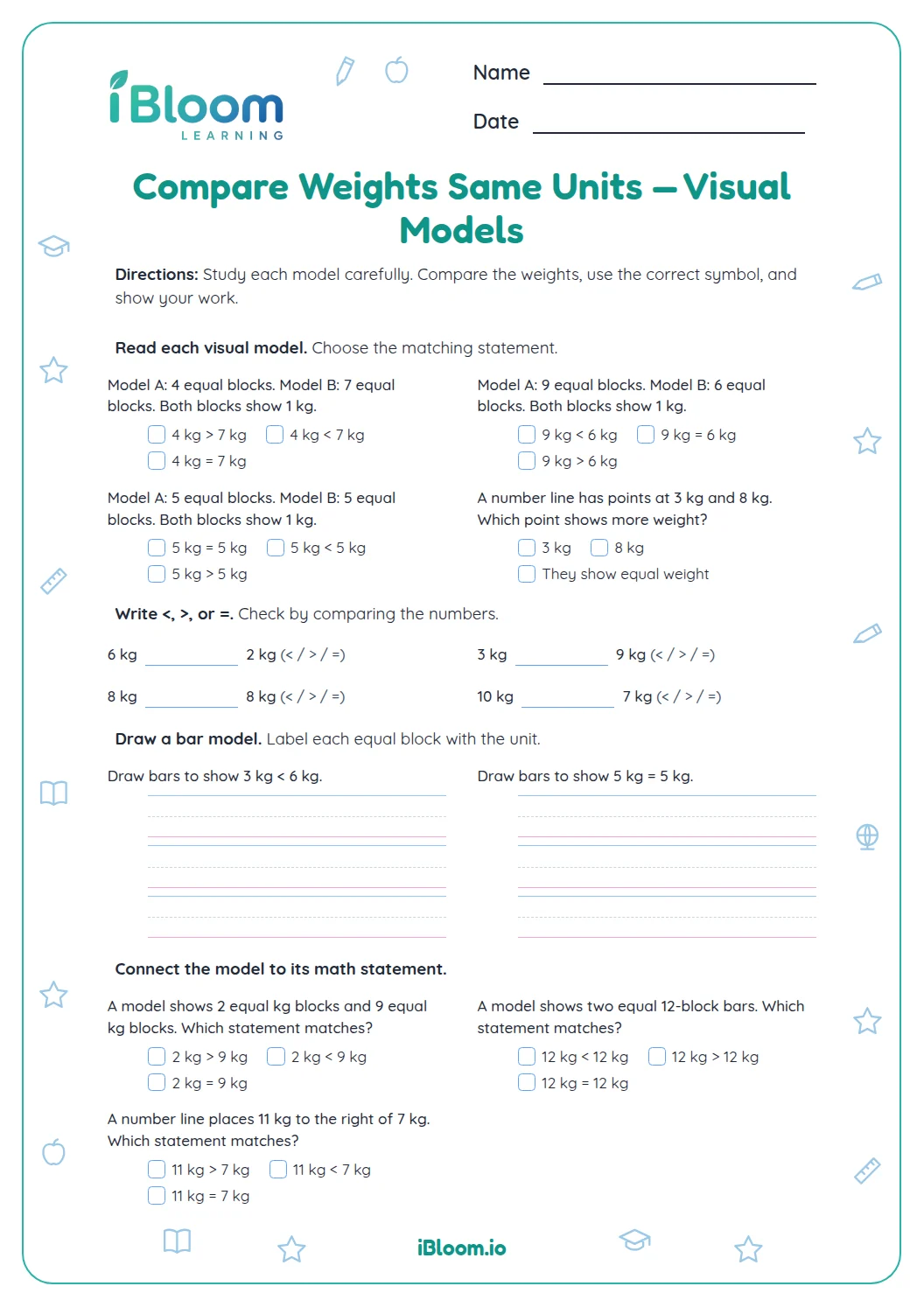
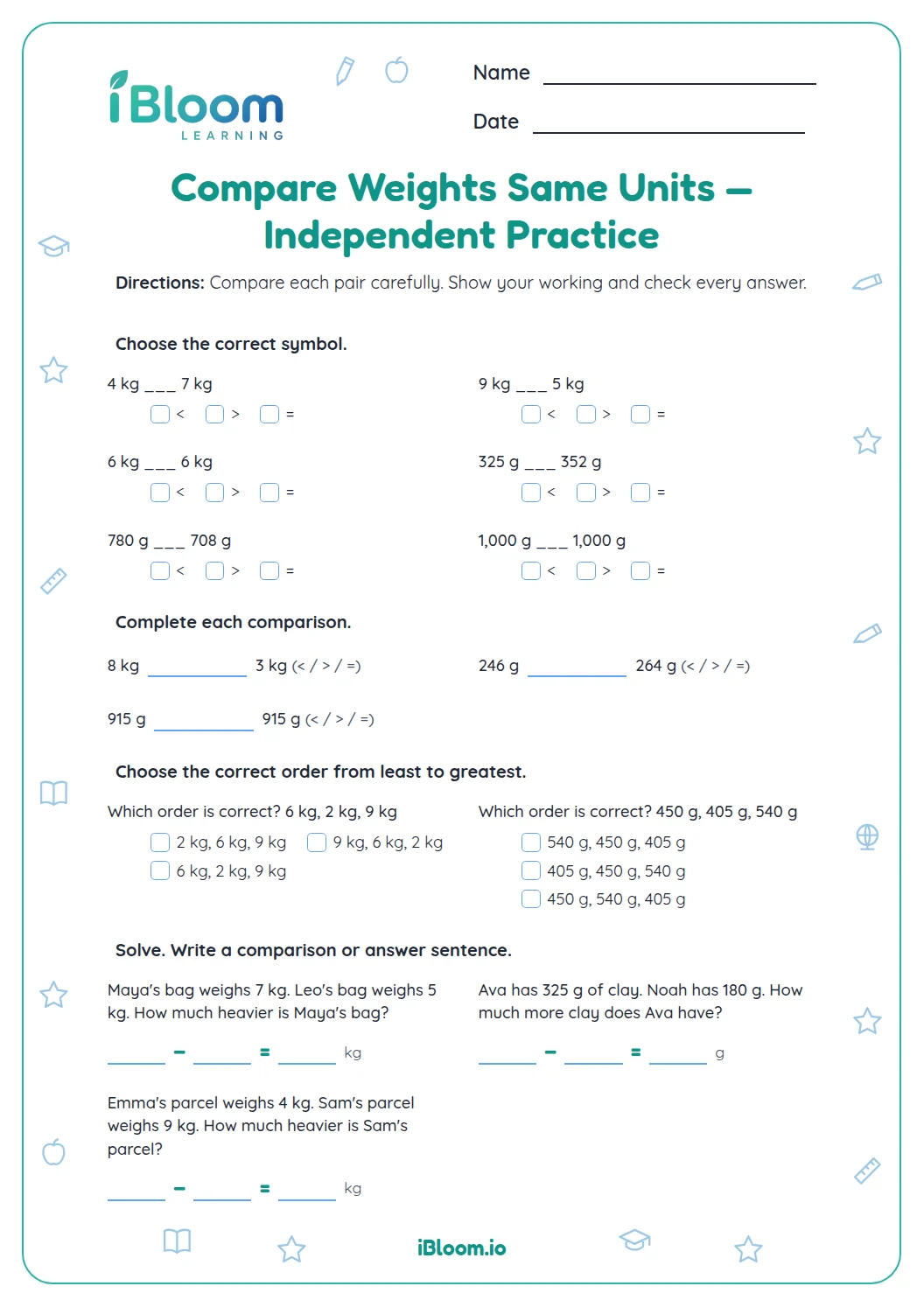
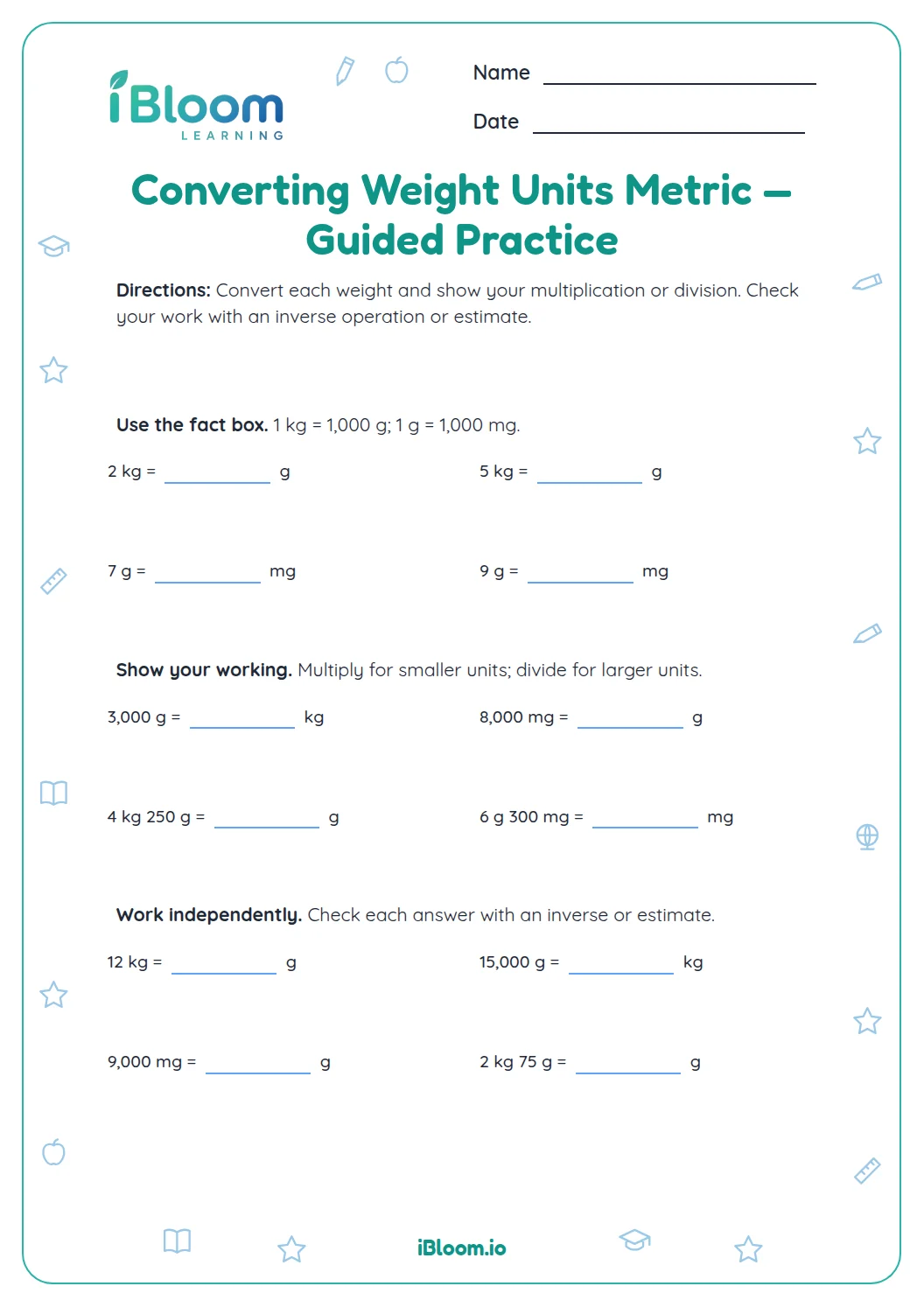
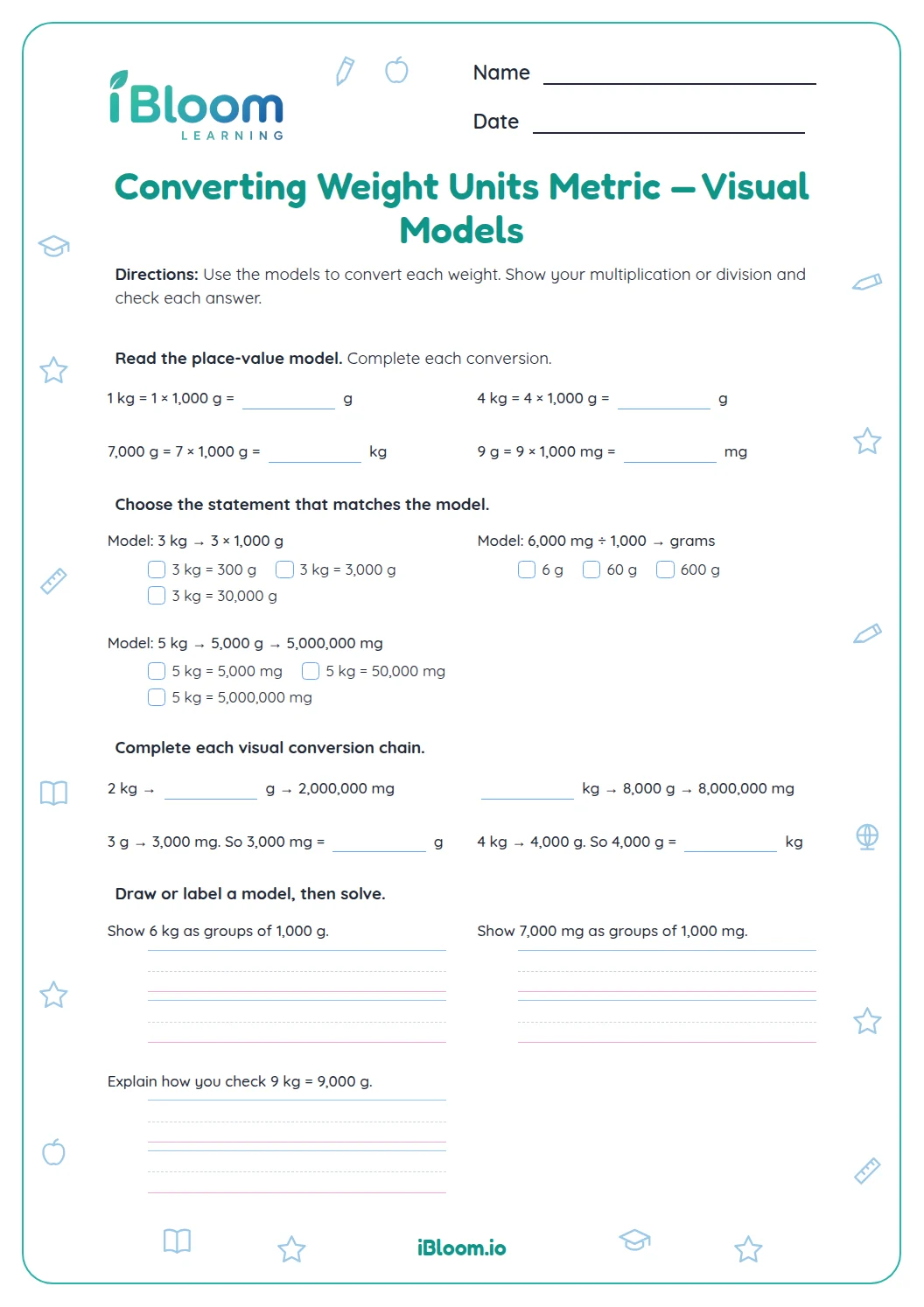
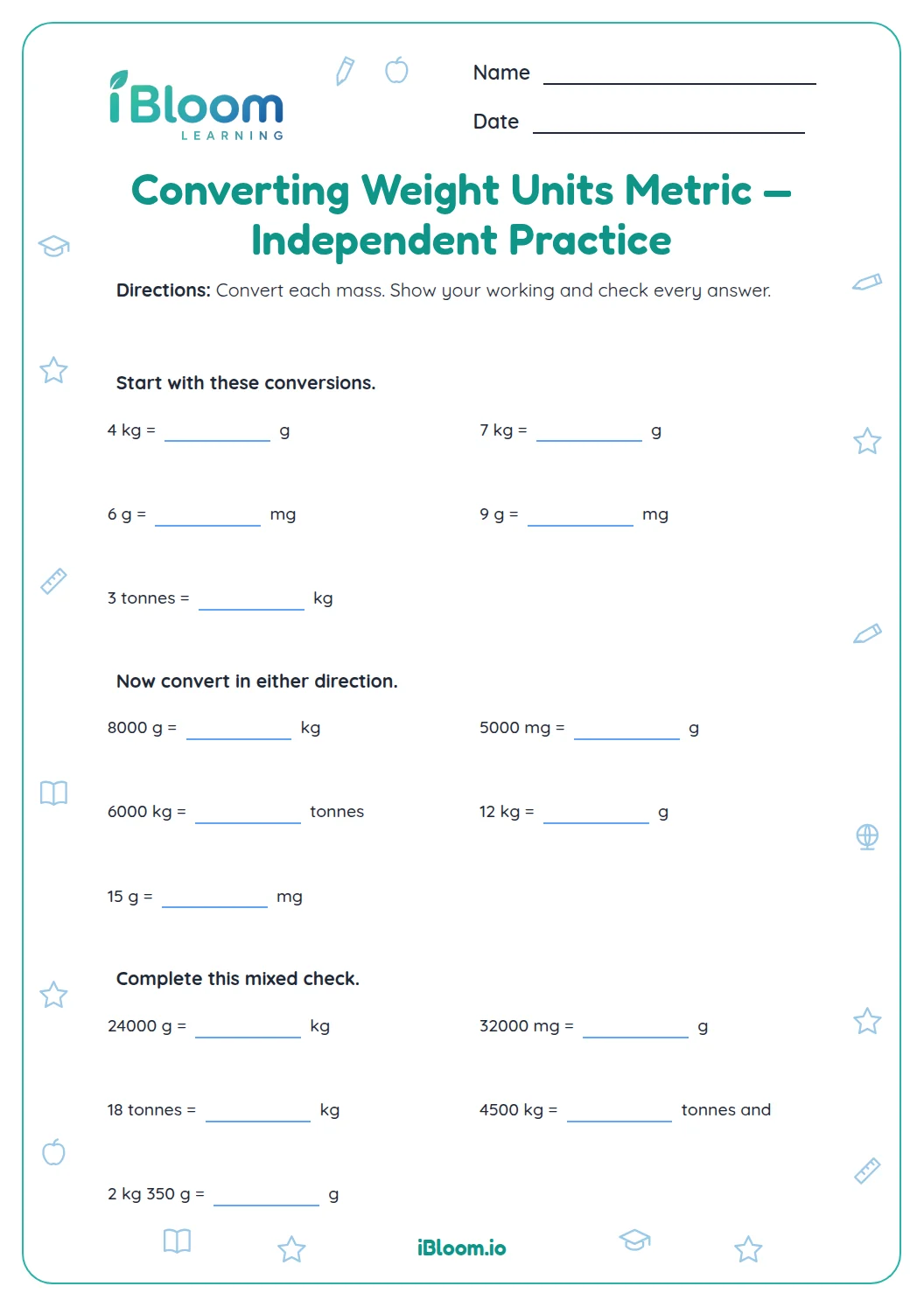
About this worksheet
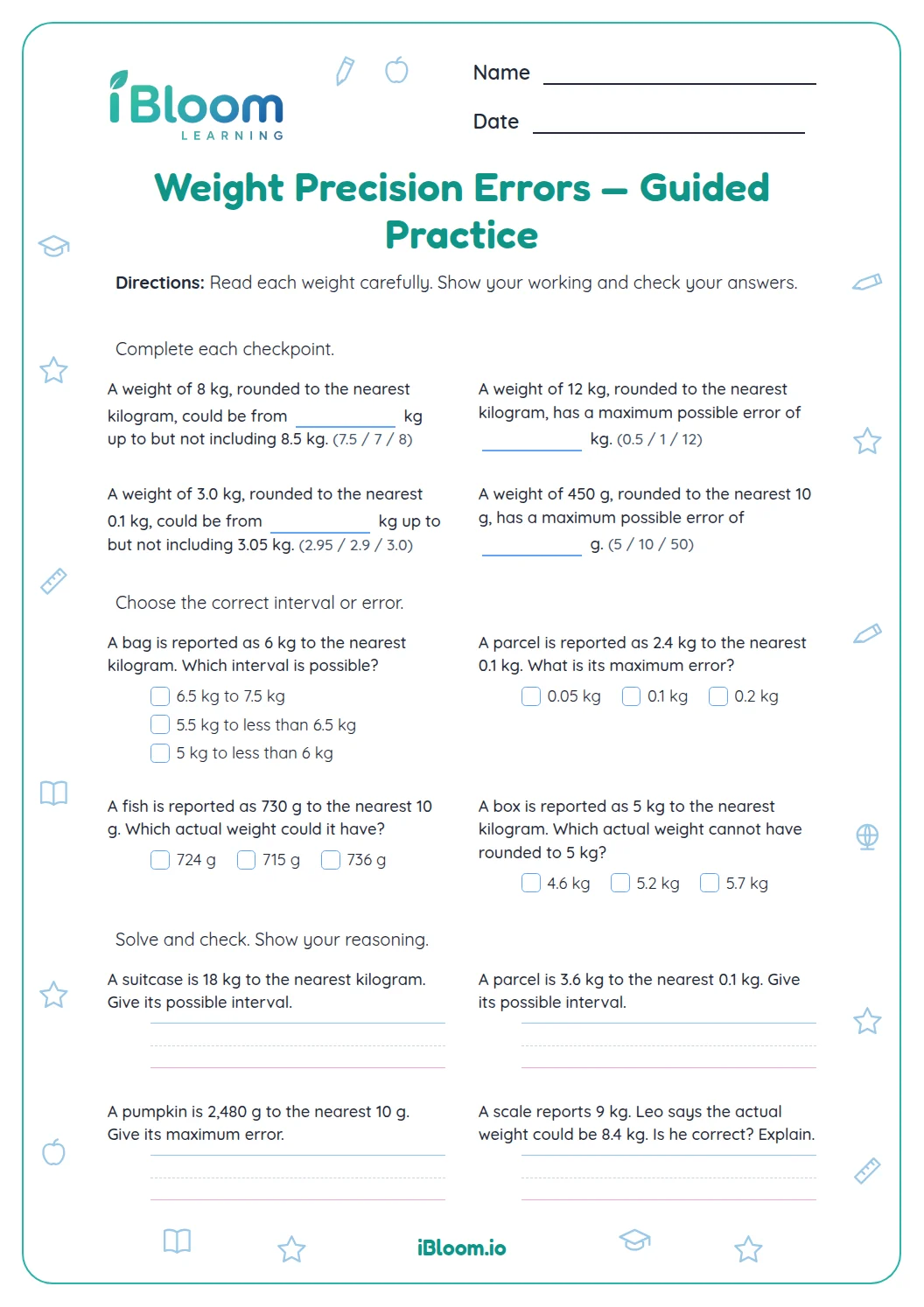
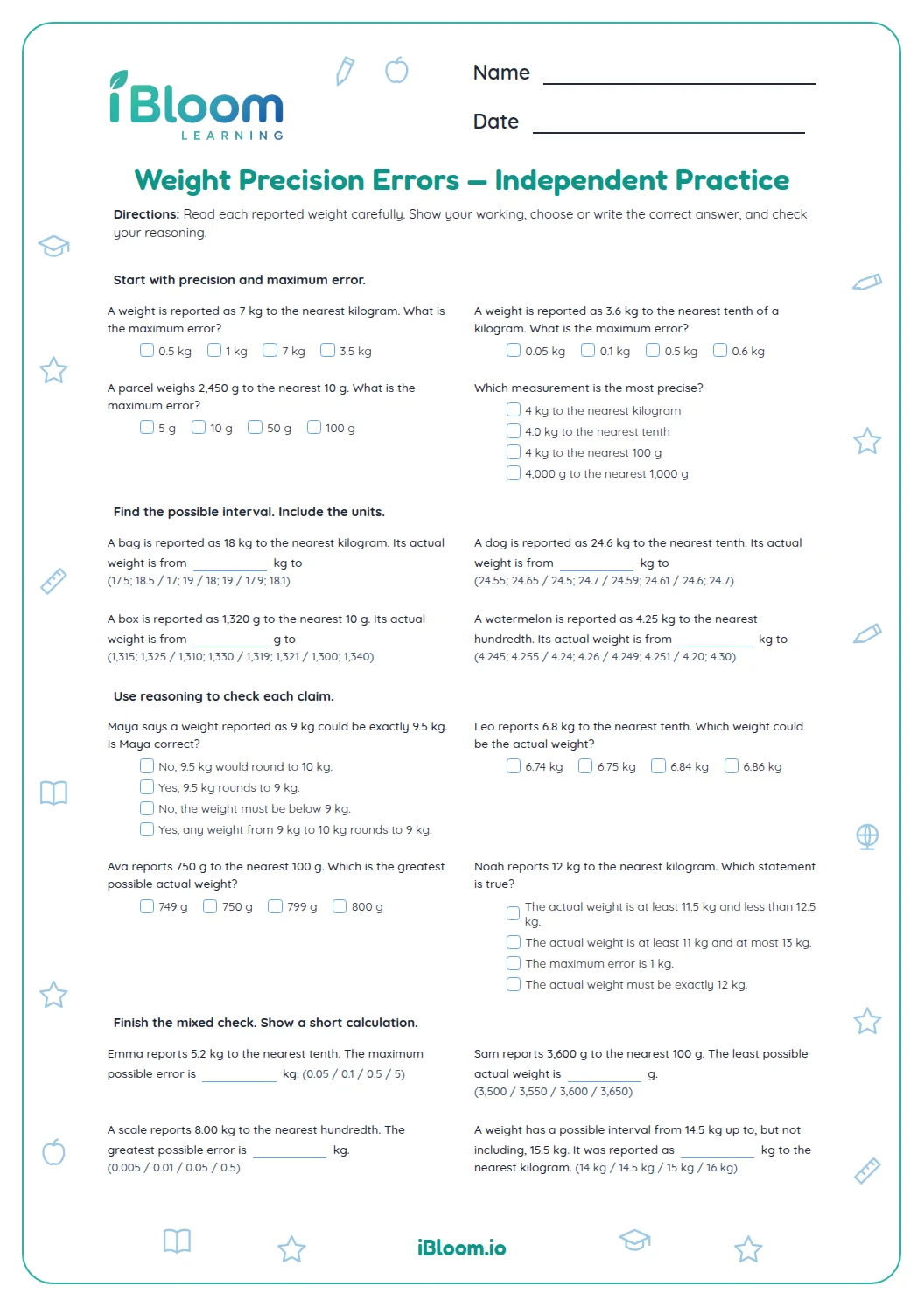
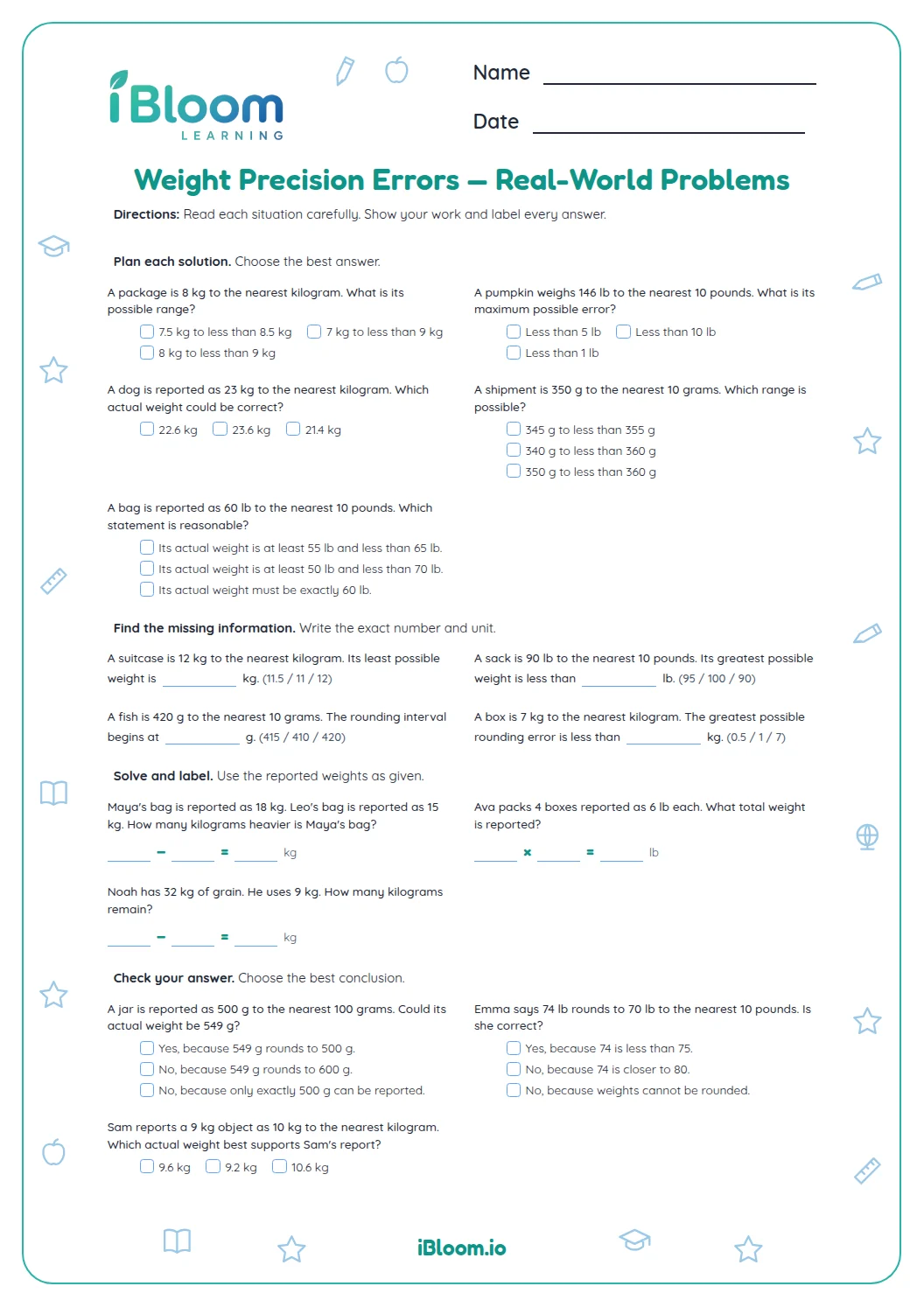
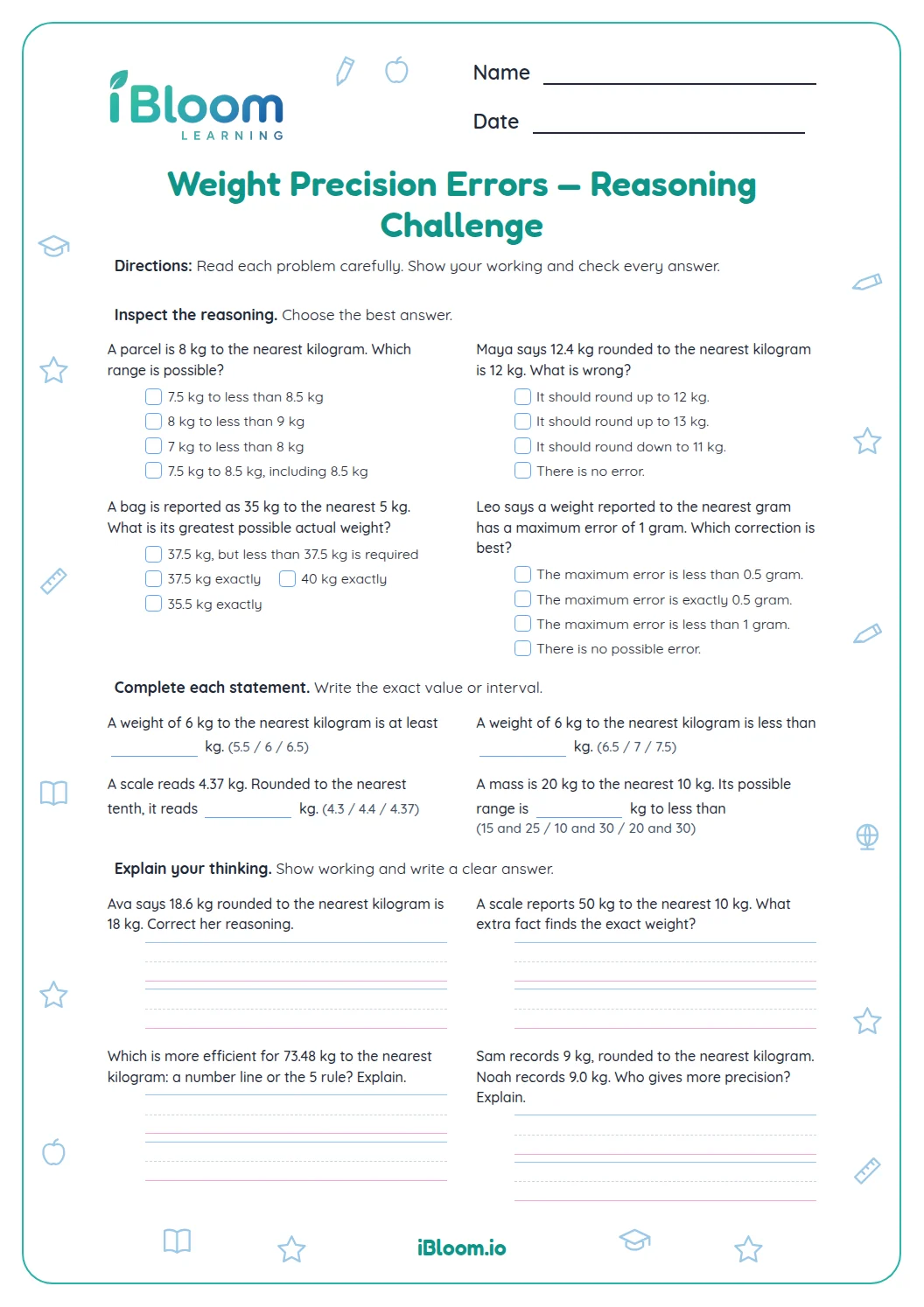
This Grade 5 worksheet practices rounding kilogram measurements and reading their precision. Students round to tenths or whole kilograms, identify supported place values, and spot unsupported digits. It includes 16 questions in two compact parts and a separate answer key.
How do you round a weight to tenths?
Round to the requested place by checking the digit immediately to its right. For 4.68 kg to the nearest tenth, the hundredths digit is 8, so the result is 4.7 kg.
- 1Hundredths digit: 8
- 2Increase the tenths digit
- 34.68 kg rounds to 4.7 kg
What does a measurement’s precision tell you?
The final place value shows the measurement’s precision. A scale marked in tenths supports tenths, while a scale marked in hundredths can support hundredths. Extra decimal places should not be reported unless the instrument measures them.
How to use this worksheet
- 1Read the unit and requested place value.
- 2For rounding, check the digit immediately to its right.
- 3Round up when that digit is 5 or greater; otherwise keep the target digit.
- 4For precision questions, compare the reported digits with the scale markings.
- 5Check each result with the answer key.
Common mistakes and quick fixes
The mistake
Rounding 4.68 kg to 4.6 kg.
The fix
Check the hundredths digit, 8, and round the tenths digit up to 7.
The mistake
Reporting 6.438 kg from a scale marked in tenths.
The fix
Report 6.4 kg because the scale supports tenths.
The mistake
Treating 8 kg and 8.2 kg as equally precise.
The fix
The tenths digit in 8.2 kg gives a finer measurement.
What to practice next
Make more practice
Questions parents and teachers ask
What does measurement precision mean?
Precision describes how finely a measurement is recorded. A scale marked in tenths supports a reading to the nearest tenth, while a scale marked in hundredths can show a finer increment. This worksheet asks students to connect the recorded digits to the scale markings.
Why does 8.2 kg give more detail than 8 kg?
The tenths digit records a smaller unit of measurement, so 8.2 kg communicates more detail than a whole-kilogram value. The extra digit is meaningful when the measuring tool supports it. Question 16 asks students to state this distinction in their own words.
How do I round a weight to the nearest tenth?
Look at the hundredths digit. If it is 5 or greater, increase the tenths digit by one; otherwise, keep it. Then report the value with the unit shown in the question. For example, 4.68 kg rounds to 4.7 kg.
What is wrong with reporting 6.438 kg from a tenths scale?
The scale cannot support hundredths or thousandths, so those digits suggest more precision than the tool provides. Match the report to the scale resolution: for a 6.438 kg reading on a tenths scale, report 6.4 kg. The worksheet asks students to spot this mismatch and correct it.
Does the worksheet include an answer key?
Yes. A separate answer key follows the practice pages. Use it to check rounding, compare precision in different measurements, and discuss why decimal places must match the scale markings. Each key response gives the rounded value or identifies the place value supported by the scale.