
About this worksheet
This Grade 5 printable starts with familiar objects so students can choose a sensible mass and unit, then applies the 1,000-grams-per-kilogram relationship. It includes seven estimate questions and seven conversion or comparison questions, with a separate answer key.
Aligned to 5.MD.A.1
How can students estimate an object’s mass?
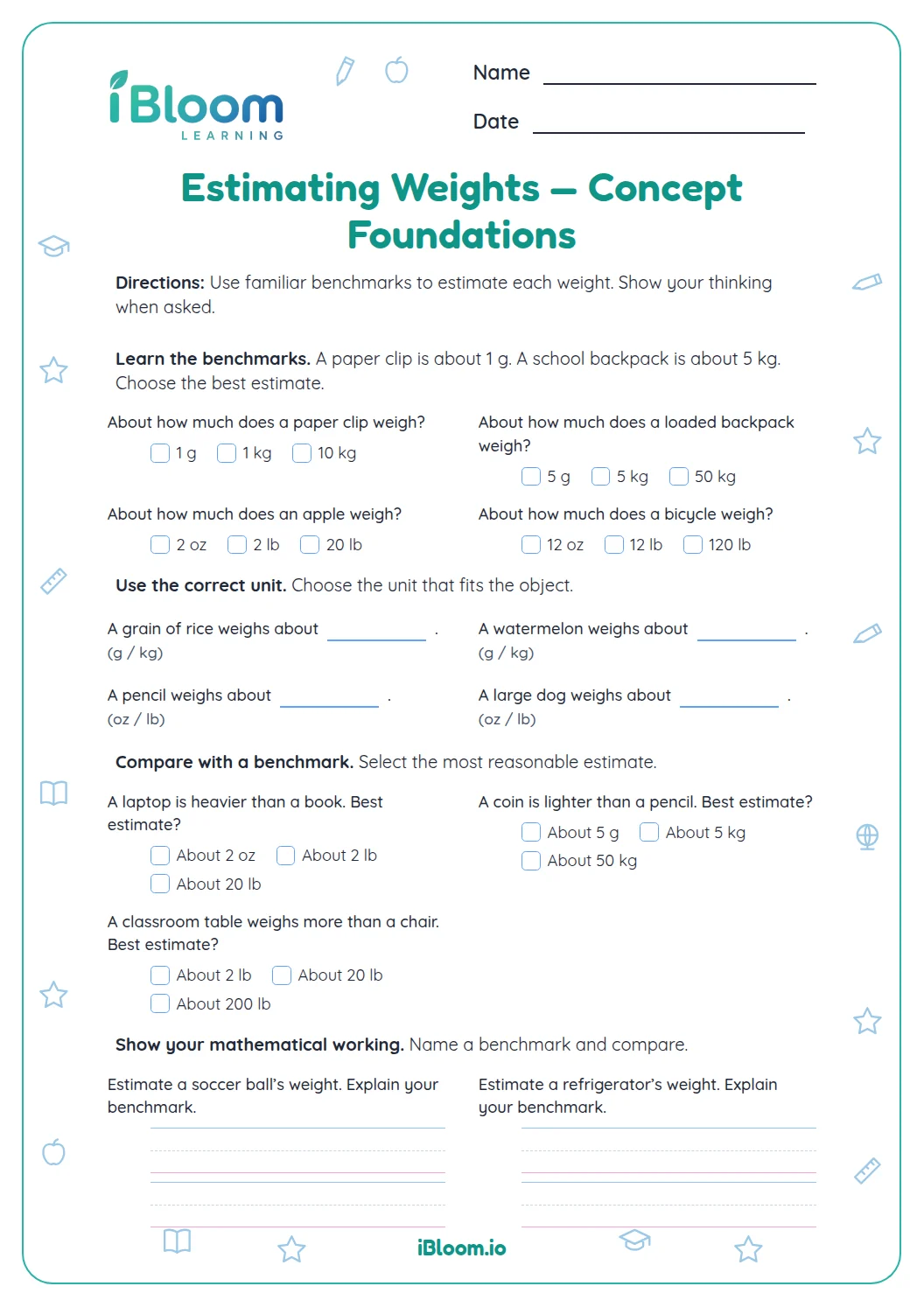
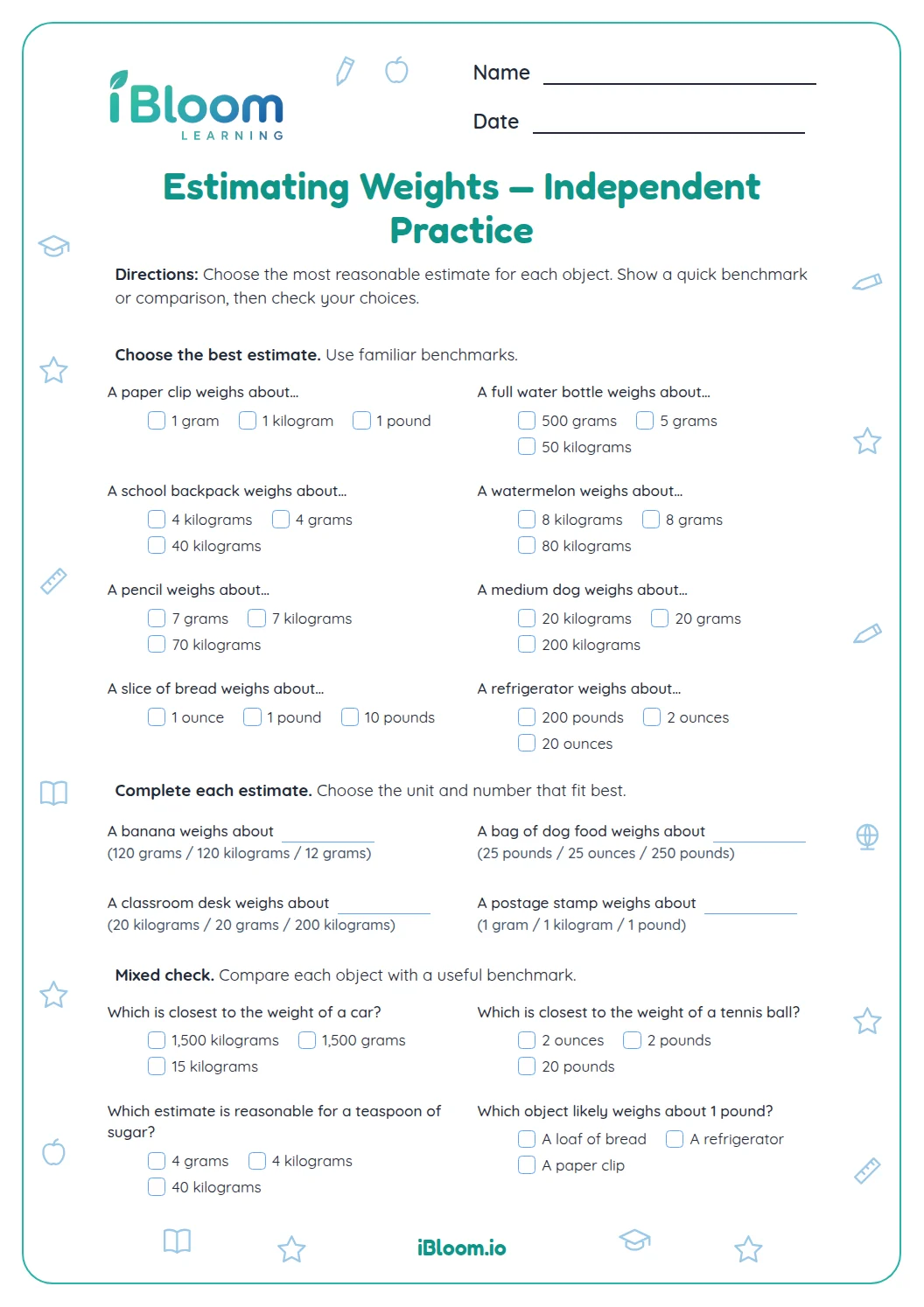
Use a familiar benchmark and decide whether grams or kilograms make sense. A paper clip is light and measured in grams; a loaded backpack is much heavier and can be estimated in kilograms. The first seven questions ask students to choose a reasonable estimate.
- 1A paper clip is very light.
- 21 gram is a more reasonable estimate than 1 kilogram or 1 pound.
How do grams and kilograms relate?
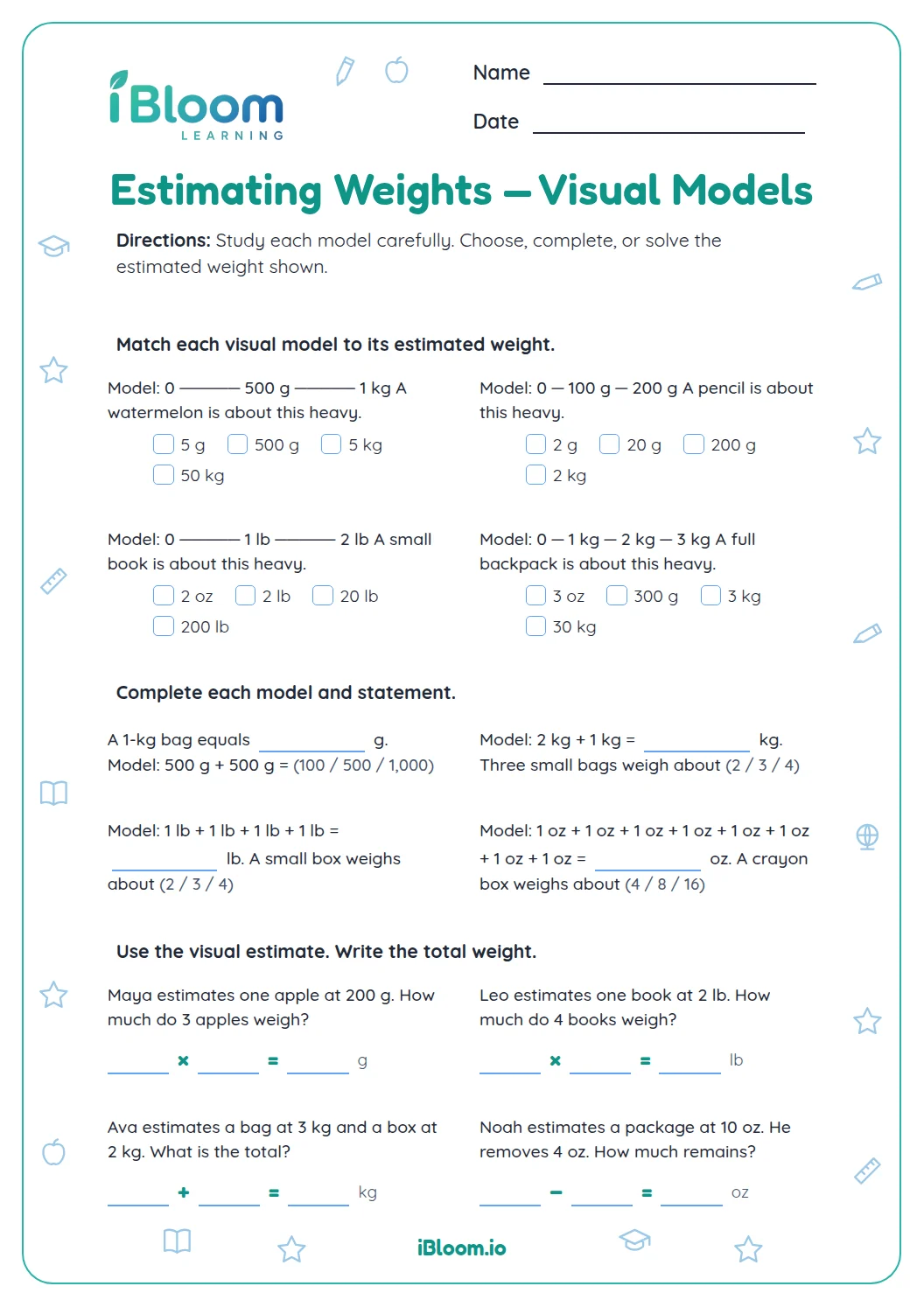
One kilogram equals 1,000 grams. Multiply kilograms by 1,000 to express them in grams; divide grams by 1,000 to express them in kilograms. For example, 2,500 g is 2 kg 500 g.
How can students compare masses?
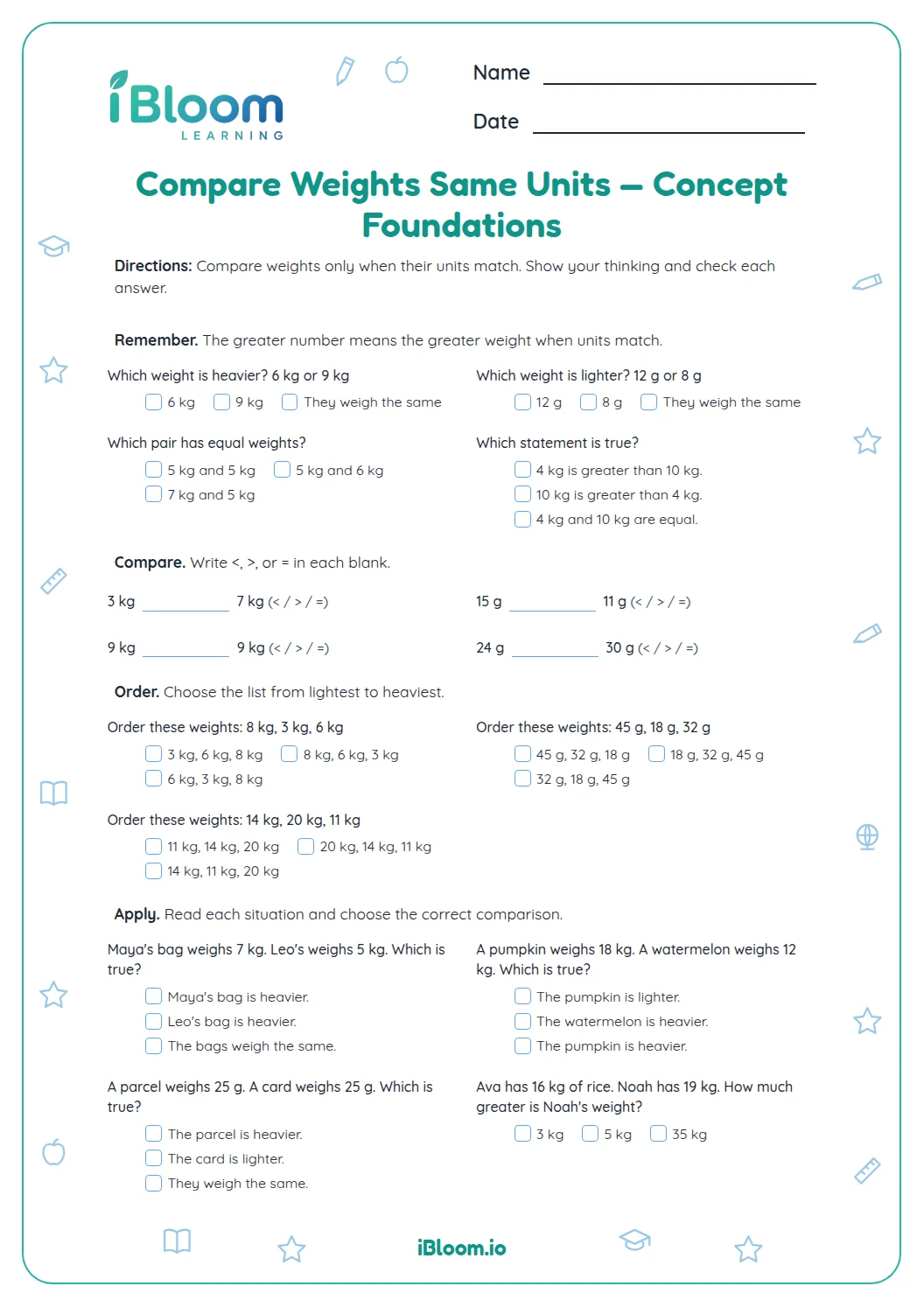
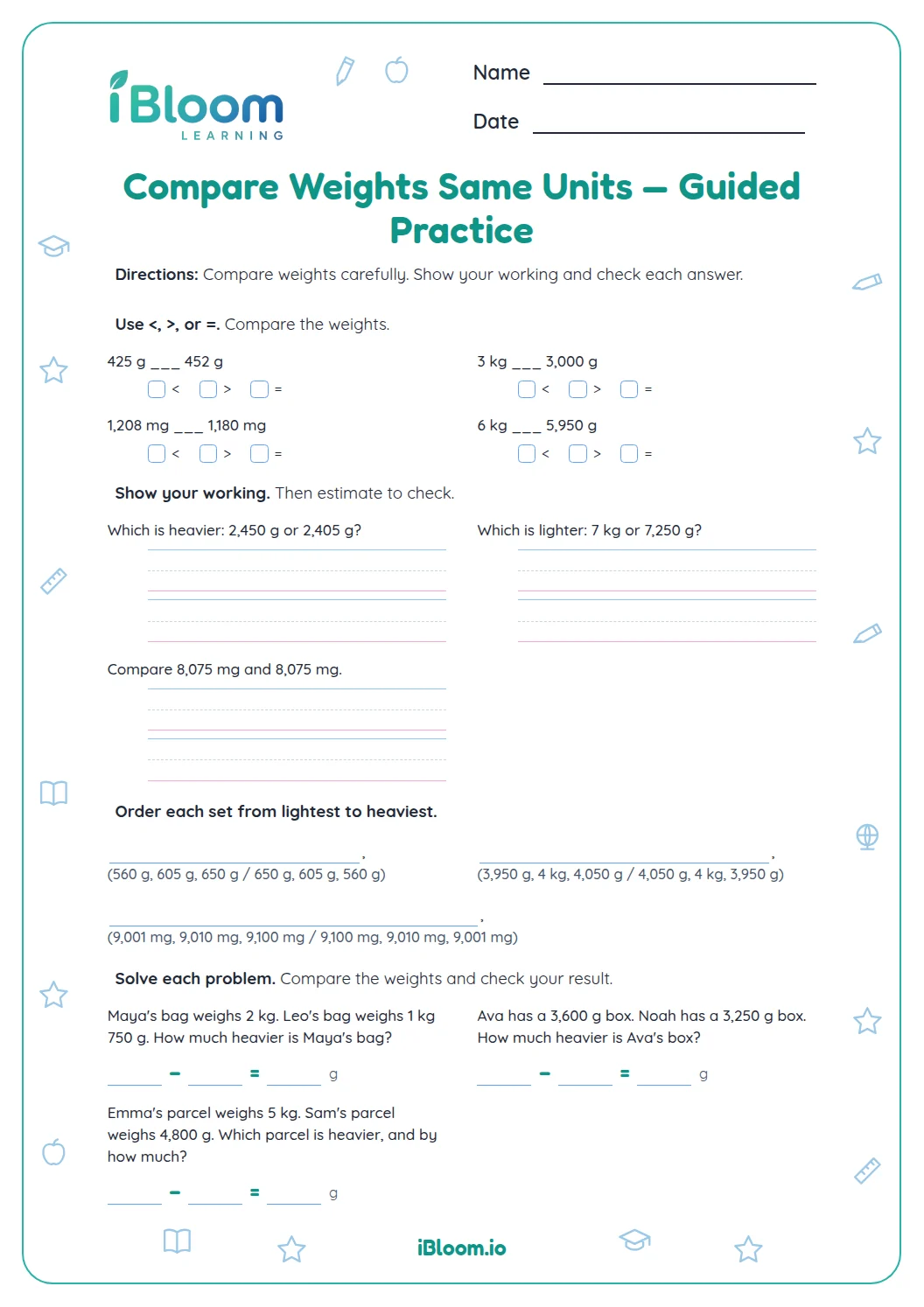
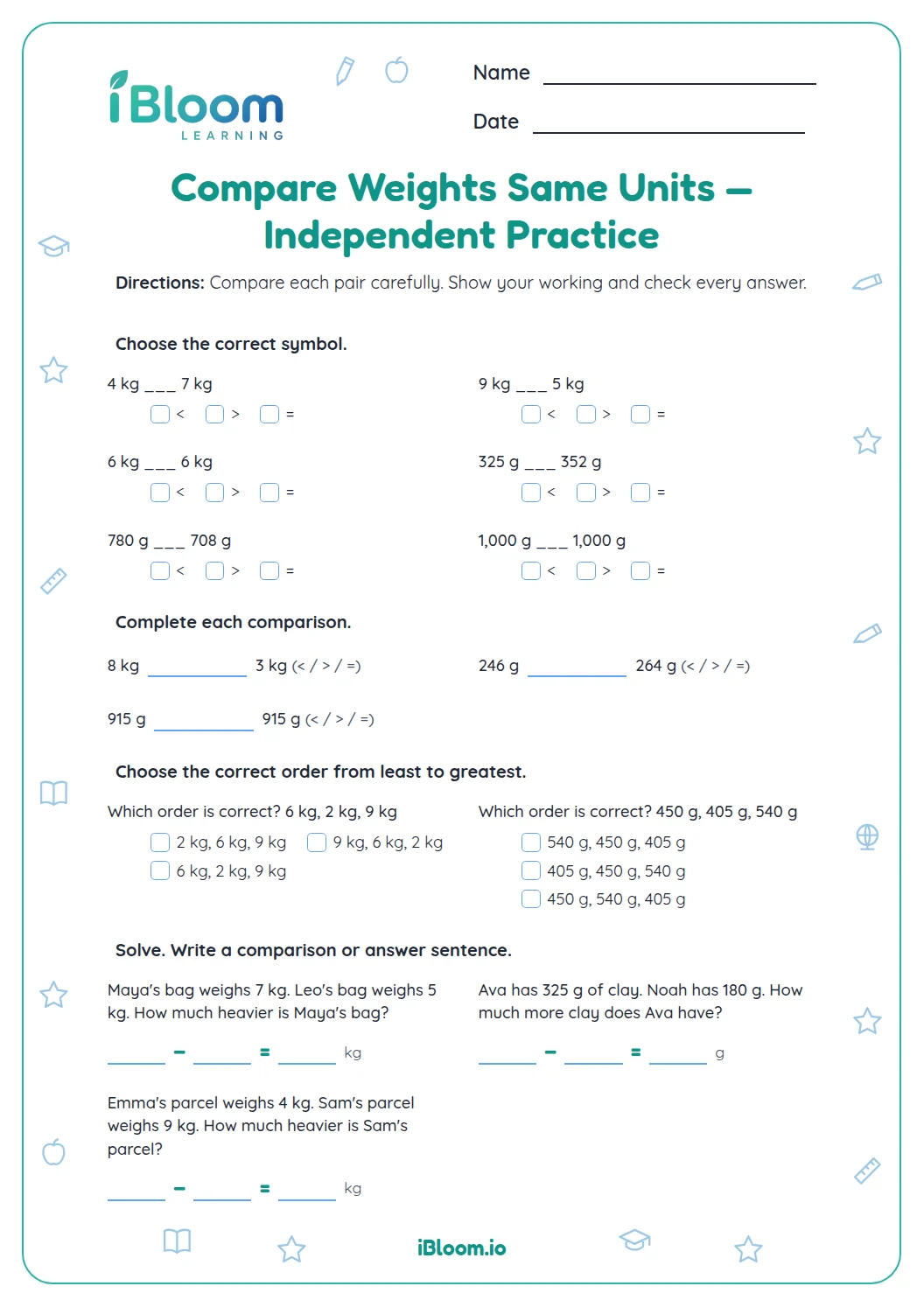
Write both measurements in the same unit before comparing. Since 1 kg equals 1,000 g, 1,200 g is heavier than 1 kg. The final questions combine estimation, conversion, and comparison using familiar objects.
How to use this worksheet
- 1Picture the object and recall a familiar mass.
- 2Choose grams for small objects and kilograms for heavier ones.
- 3Use 1,000 g = 1 kg.
- 4Multiply to convert kilograms to grams; divide to convert grams to kilograms.
- 5Convert both amounts to the same unit before comparing.
Mistakes to watch for
The mistake
Choosing kilograms for a paper clip.
The fix
Compare it with a light benchmark; a paper clip weighs only a small number of grams.
The mistake
Multiplying when changing grams to kilograms.
The fix
Divide the number of grams by 1,000.
The mistake
Reading 2,500 g as 2,500 kg.
The fix
Group the grams into thousands: 2,500 g = 2 kg 500 g.
Curriculum alignment
The conversion questions practice the Grade 5 measurement standard for converting units and solving real-world problems.
Convert between grams and kilograms and use the conversions in measurement problems.
On this sheet: Questions 8–14 convert or compare grams and kilograms in everyday contexts.
Show the official wordingHide the official wording
Convert among different-sized standard measurement units within a given measurement system (e.g., convert 5 cm to 0.05 m), and use these conversions in solving multi-step, real world problems.
What to practice next
Make more practice
Further reading
Questions parents and teachers ask
How many questions are included?
There are 14 questions. The first seven ask students to estimate familiar object masses, and the next seven ask them to convert or compare grams and kilograms. This sequence moves from judging a reasonable amount to using a precise unit relationship.
Which units appear on this worksheet?
The worksheet uses grams and kilograms for metric mass, and a few answer choices include customary units as distractors. One kilogram equals 1,000 grams. Grams fit lighter objects; kilograms are convenient for heavier objects such as a loaded backpack or a large dog.
How can a student estimate an unfamiliar object?
Compare the object with something whose mass is familiar, then choose a unit and amount that seem plausible. A paper clip is only a few grams, while a classroom textbook may weigh around a kilogram. Estimates can vary by the specific object.
Does an estimate have one exact answer?
An estimate is an approximation, and real objects can differ. The worksheet asks students to choose the most reasonable option from the choices provided. The key identifies the intended best estimate; an adult can discuss another plausible estimate using the object as a benchmark.
Why convert an estimate to another unit?
A conversion makes measurements easier to compare or lets students answer in a requested unit. For example, 3 kg equals 3,000 g because each kilogram contains 1,000 grams. Convert both amounts to the same unit before deciding which is heavier.
How does this connect to CCSS 5.MD.A.1?
CCSS 5.MD.A.1 asks students to convert between standard units within a measurement system and use conversions in real-world problems. Questions 8–14 apply that relationship to grams and kilograms through object masses, comparisons, and totals. The first seven questions practice estimates.