
About this worksheet
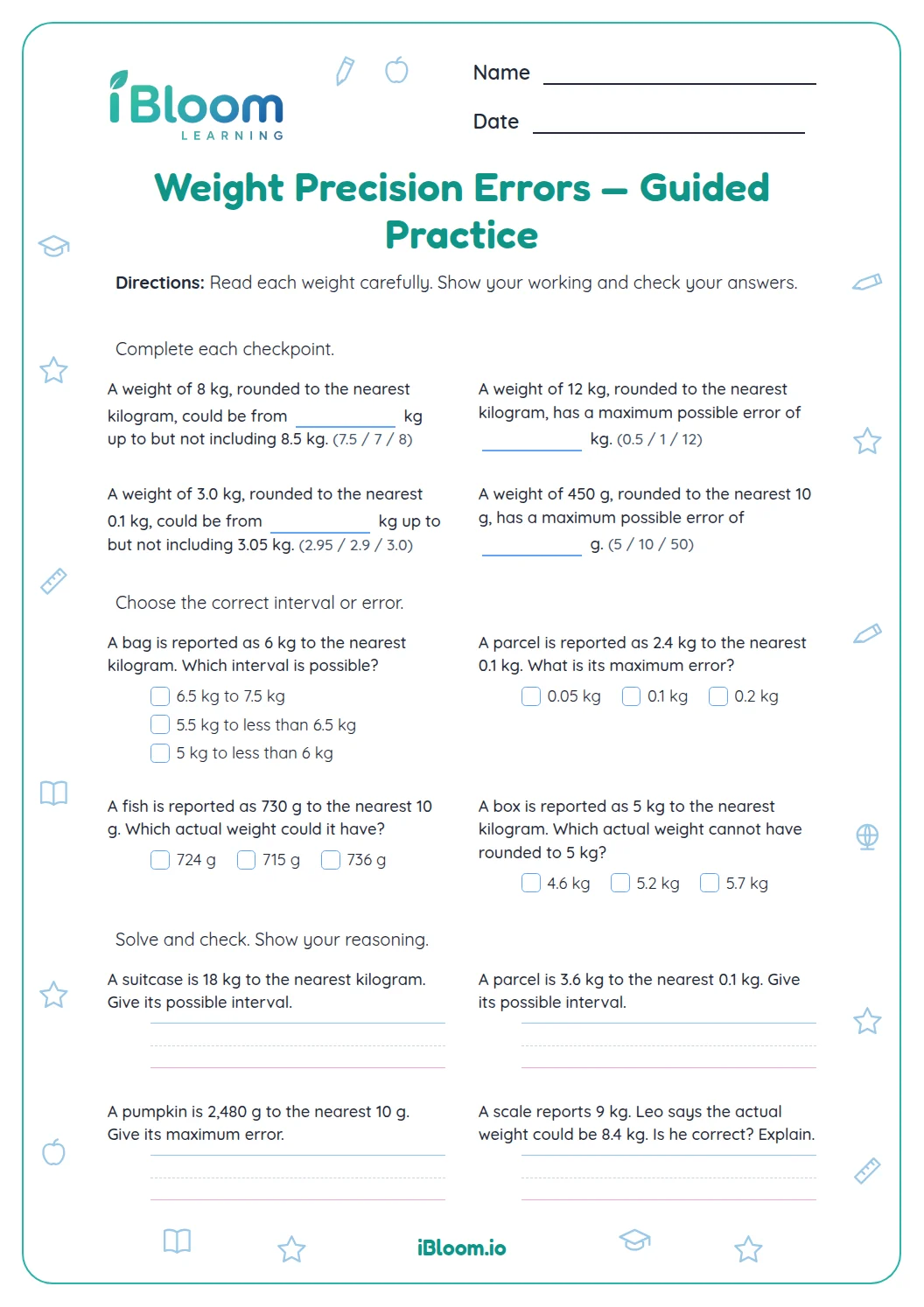
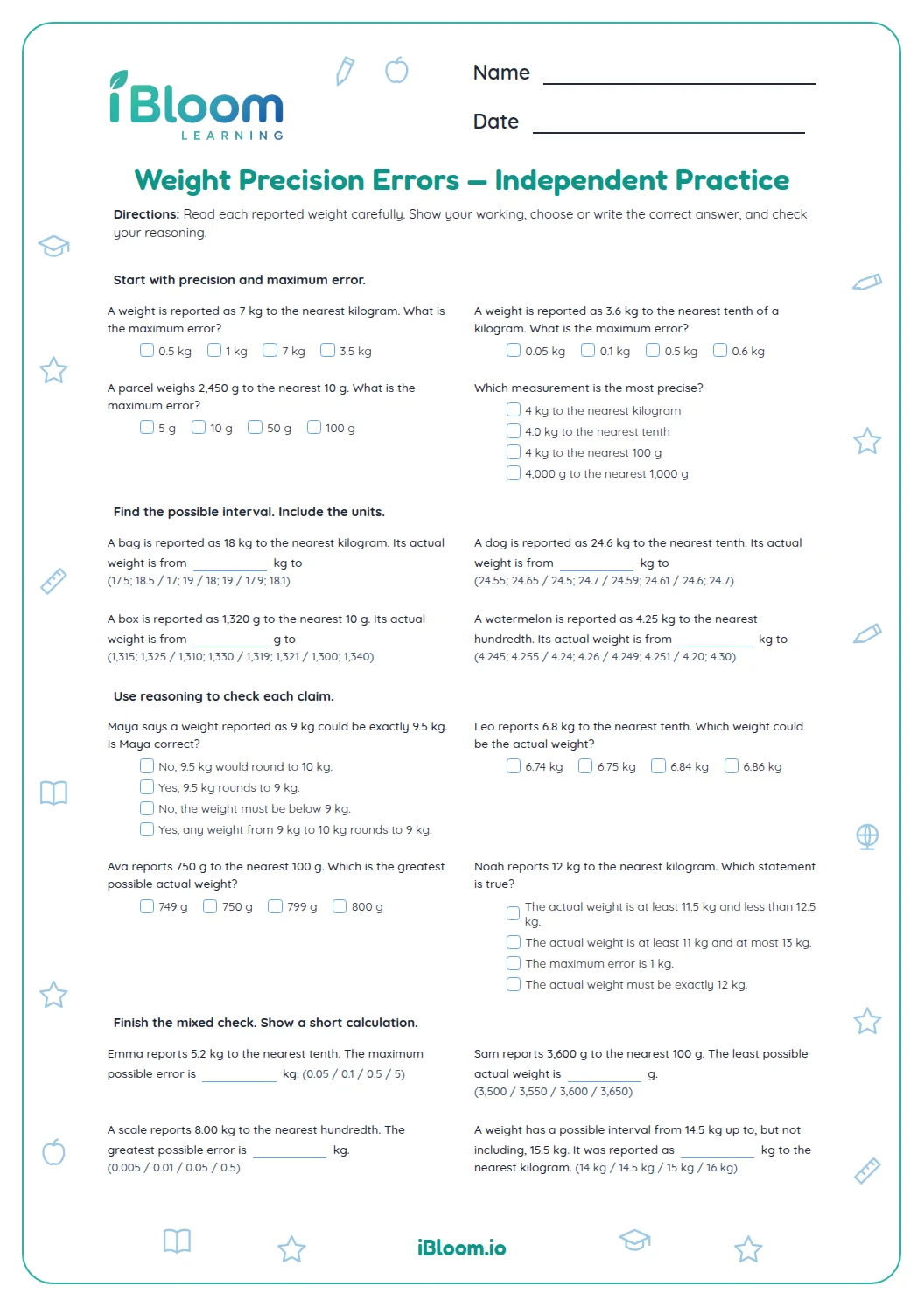
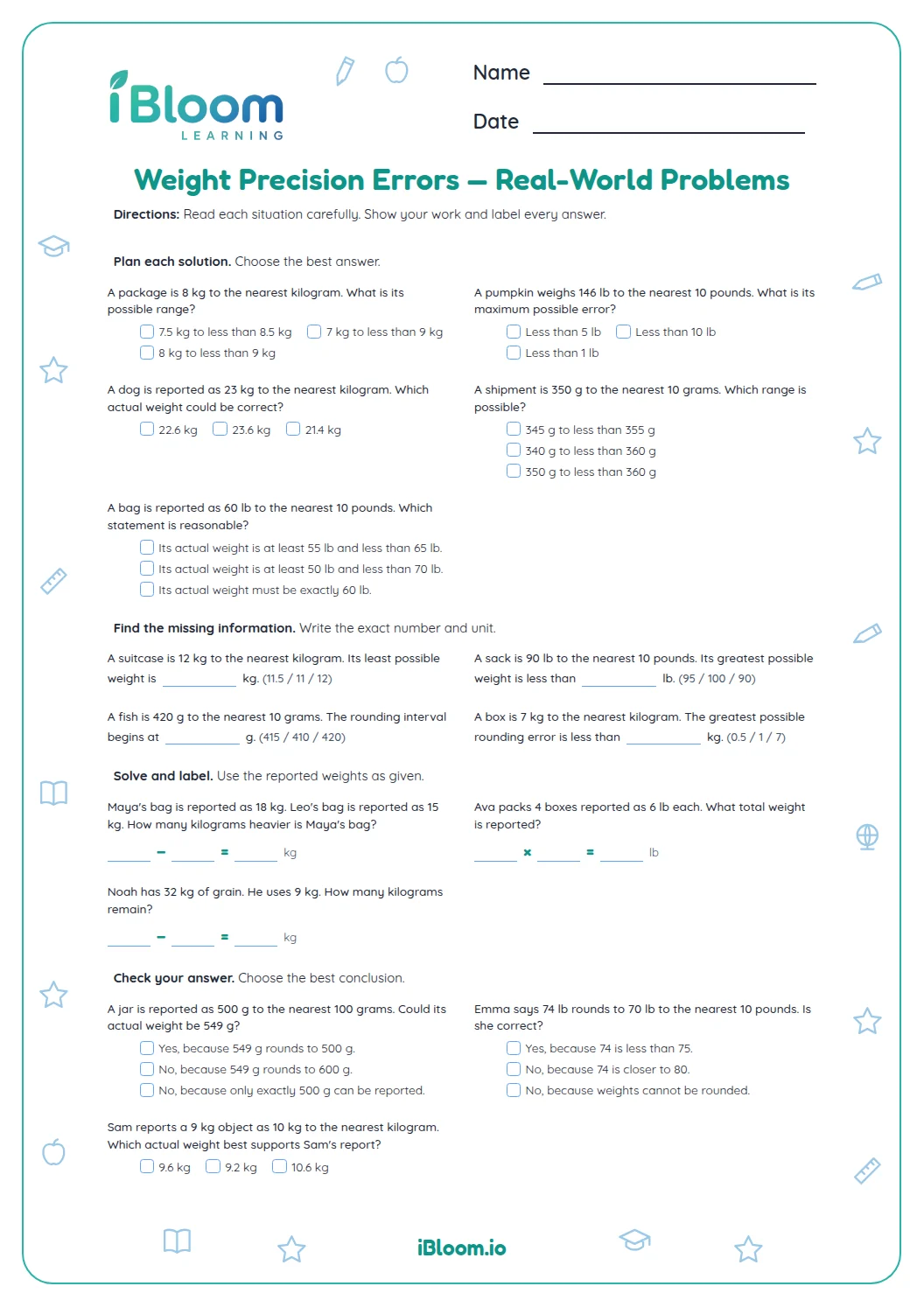
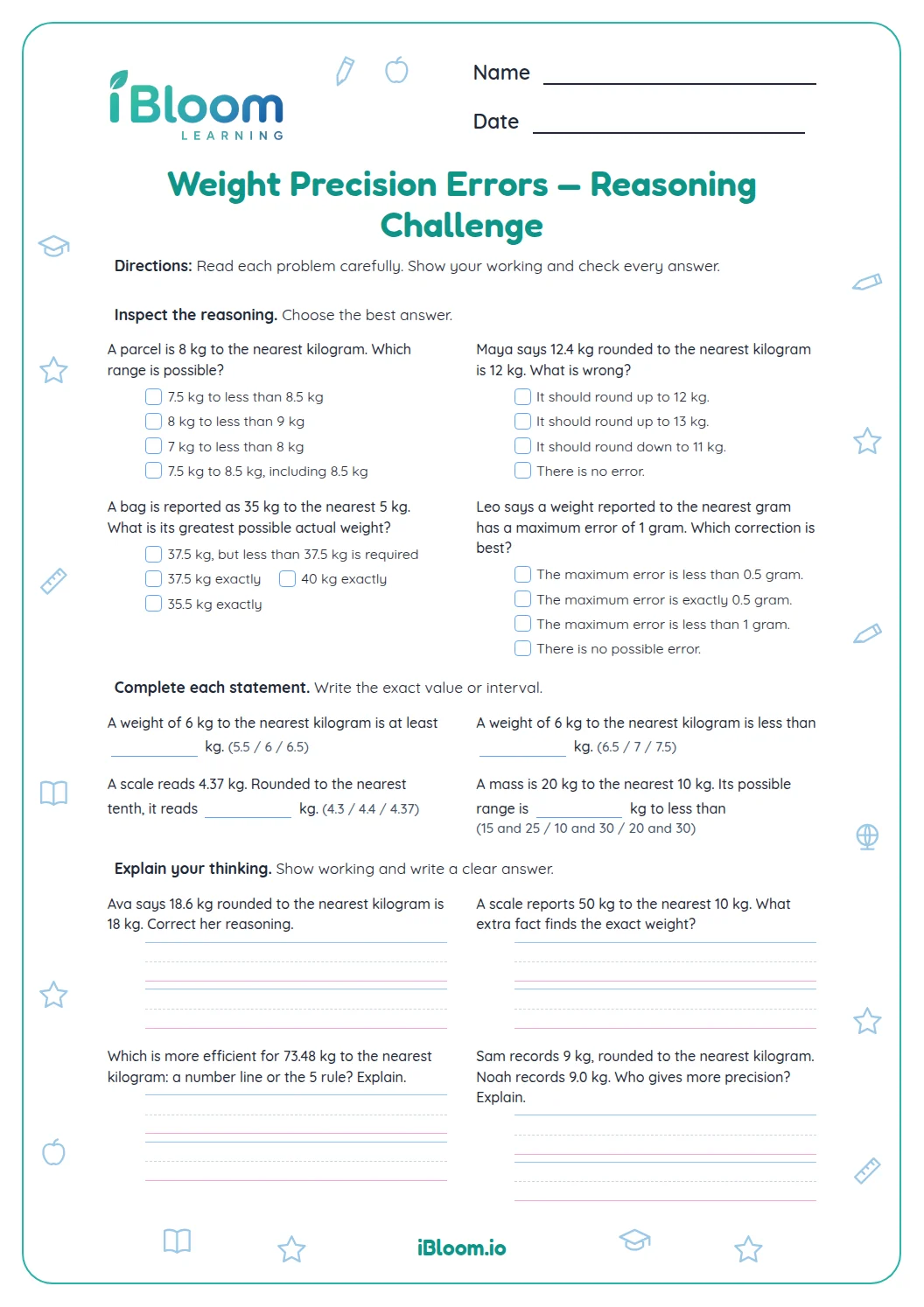
This Grade 5 sheet focuses on rounding weights to a stated place. Its number-line model helps students see why a rounded value represents an interval rather than one exact measurement. Across 14 questions, students identify interval bounds, calculate maximum error, and check a claim about a rounded weight. The answer key is included.
Find the interval?
Round a weight and read its interval bounds. Then use half the interval width to find the maximum error.
- 18 kg rounded to the nearest 1 kg: which interval?
- 2Answer: 7.5 ≤ w < 8.5
How do students find the maximum error?
Half the interval width is the greatest possible difference between the rounded value and the true value. The last two items check whether students can use intervals to reason about more than one possible measurement.
- 18 kg rounded to the nearest kilogram: maximum error?
- 2Answer: 0.5 kg
What does the final claim check?
The closing items connect a rounding interval to possible true readings and test a maximum-error claim.
- 1Is 0.2 kg the maximum error when 6.2 kg is rounded to the nearest 0.1 kg?
- 2Answer: No
How to use this worksheet
- 1Read the direction for find the interval.
- 2Work through each item and write one answer for each question.
- 3Use the model or number pattern to check the result.
- 4Finish the last part, then use the answer key to review.
Common mistakes and quick fixes
The mistake
Ignoring the key step in weight rounding intervals and maximum error.
The fix
Round a weight and read its interval bounds. Then use half the interval width to find the maximum error.
The mistake
Writing a result without its requested unit or form.
The fix
Reread the question and include the unit or comparison symbol it asks for.
The mistake
Checking only the final number.
The fix
Repeat the count, measurement, or addition step and compare it with the model.
What to practice next
Make more practice
Questions parents and teachers ask
What does this worksheet practice?
This sheet gives students 14 questions on weight rounding intervals and maximum error. The separate answer key matches each question and includes the correct result. Start with the first part together if the model or vocabulary is new, then let the student finish the remaining items before checking.
Does rounding identify one exact true weight?
No. For example, many measurements can round to 18.4 kg to the nearest 0.1 kg. The number line helps show the interval of possible readings around a rounded value. Students should attend to whether each endpoint is included based on the rounding convention stated in the worksheet.
What does maximum rounding error mean?
It is the greatest distance between the reported rounded value and a possible true measurement. For rounding to the nearest 0.1 kg, half a tenth is 0.05 kg. The last questions ask students to apply that relationship and spot an overestimated error.
How can I use the answer key?
Have the student finish one part before opening the answer key. Compare each response with the matching question and revisit any difference by naming the step that led to the answer. The key is a check; the student can still explain a correct method in their own words.
Can this be used at home or in class?
This printable works for a short classroom practice session or at home. A teacher can assign one part at a time, while a family can review the model and then check the work with the included key. The questions use the same skill throughout so students can focus on the strategy.