
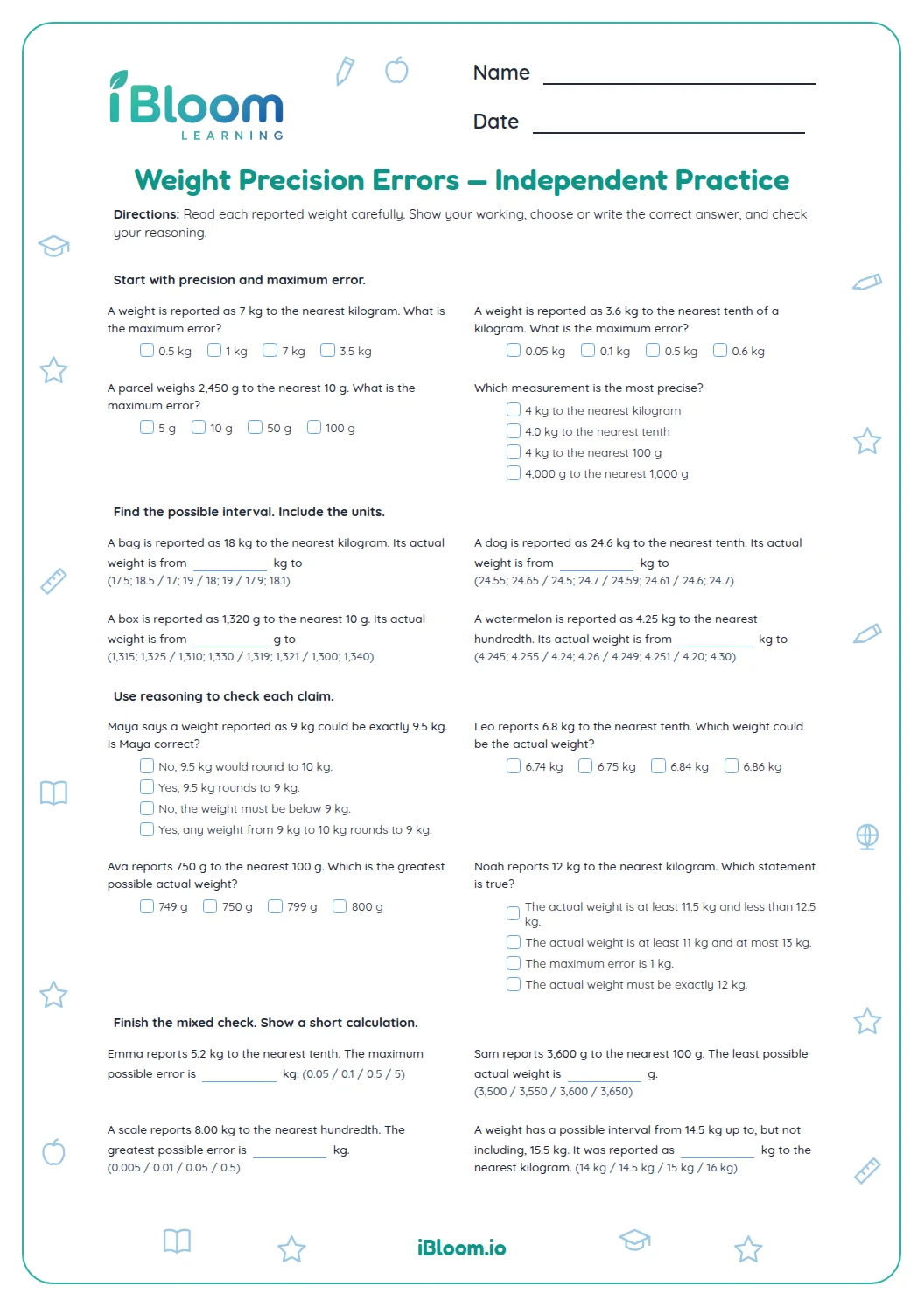
About this worksheet
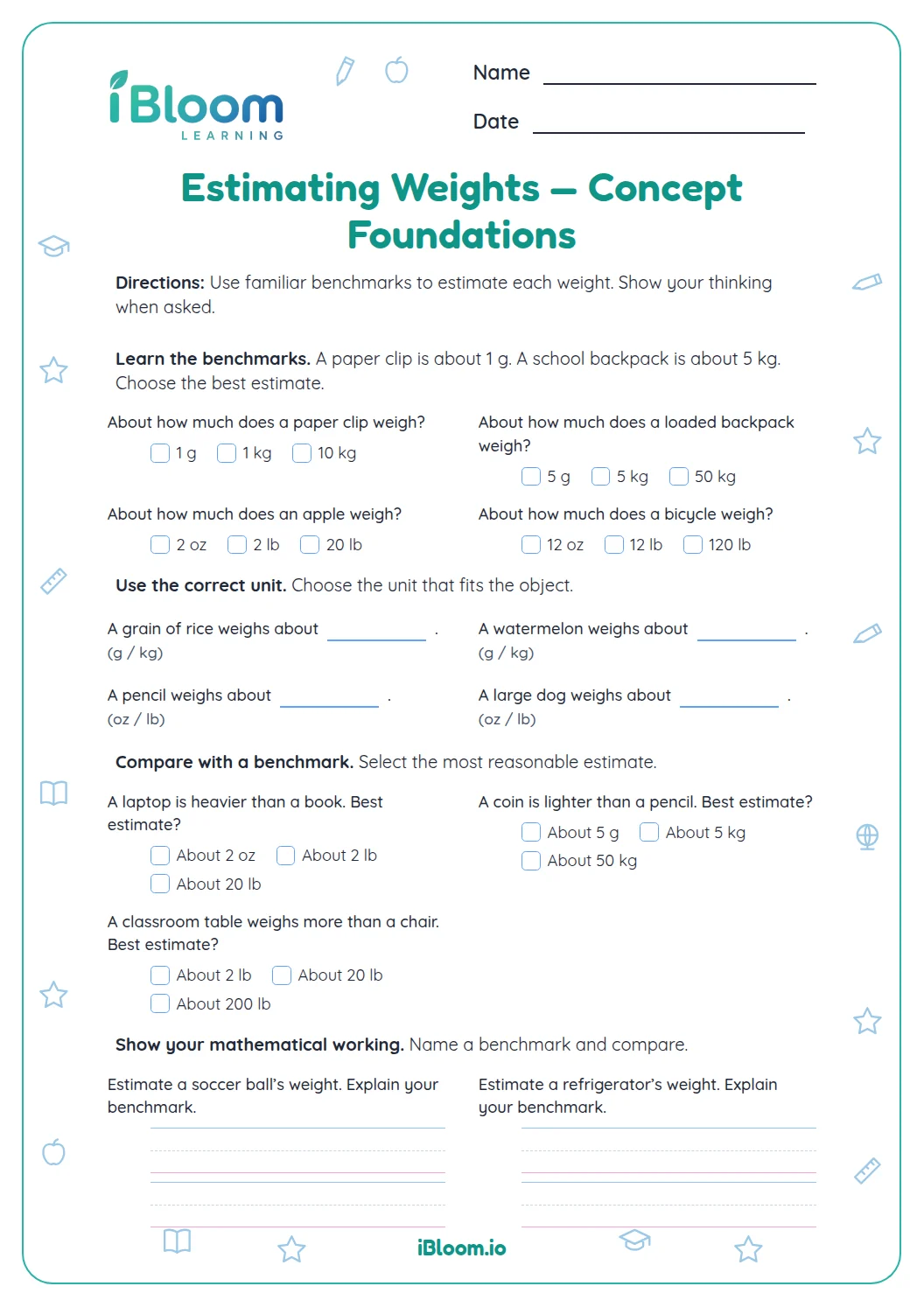
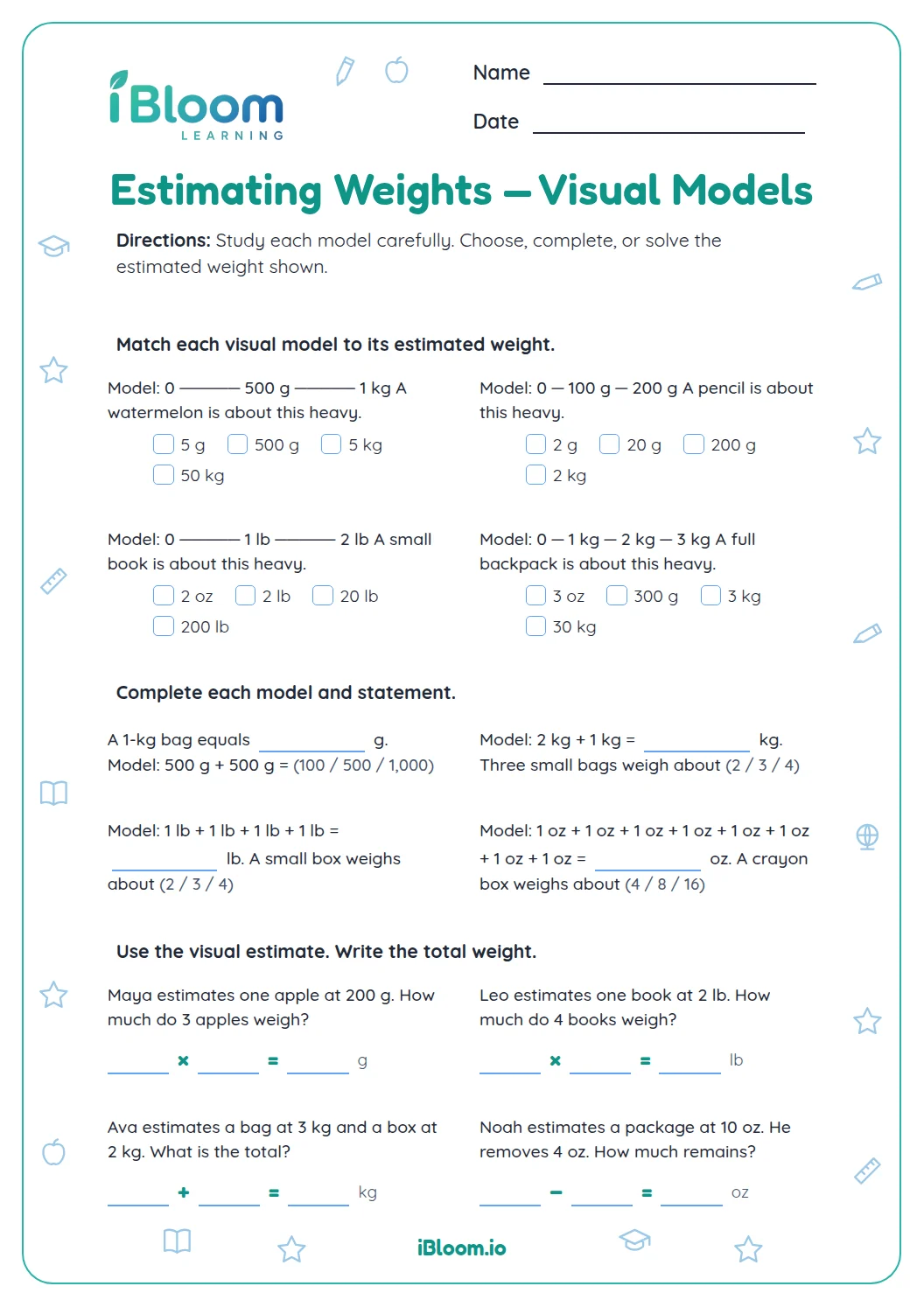
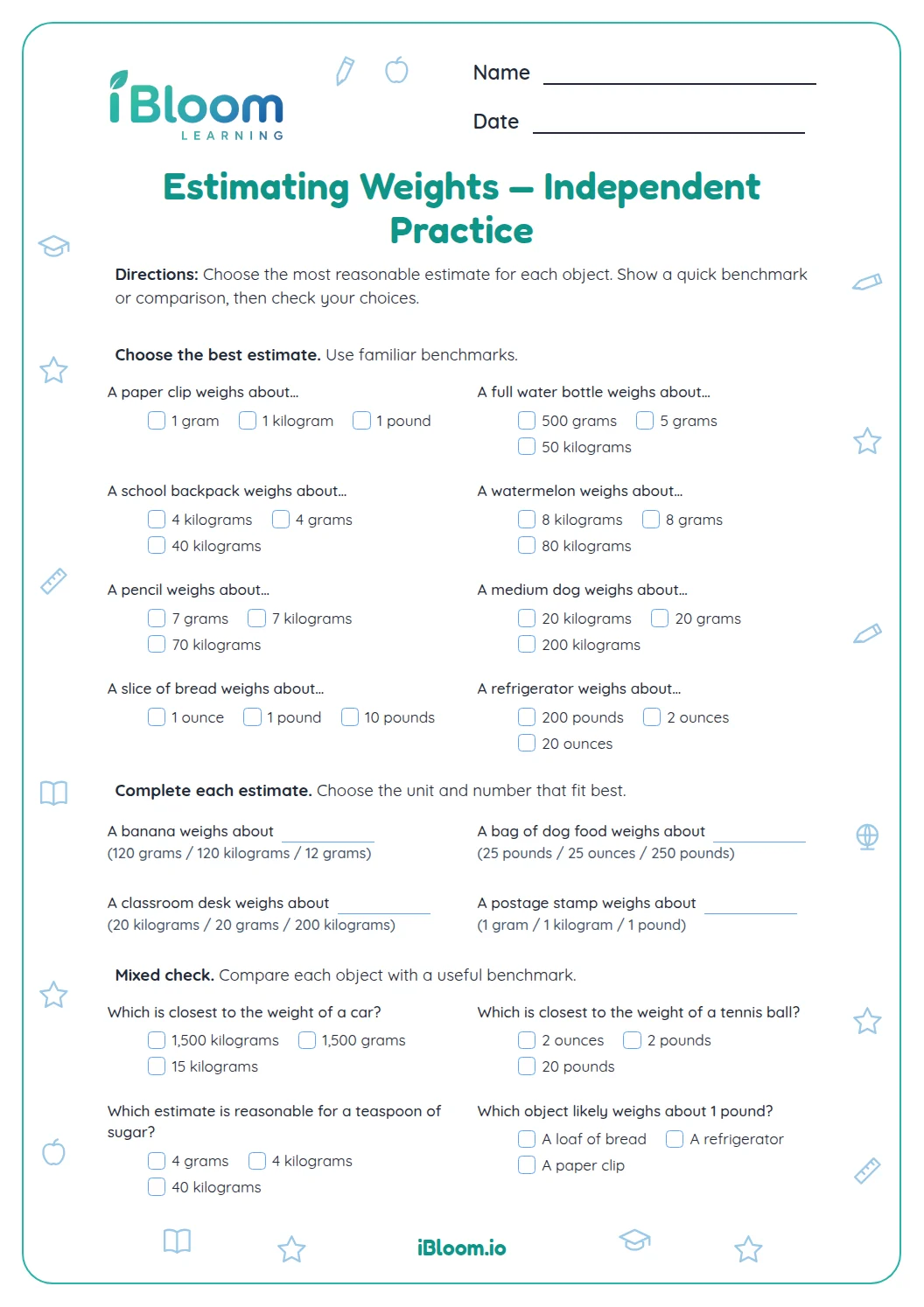
This free Grade 5 measurement worksheet gives students 15 questions about estimating and comparing weights. They use familiar benchmarks such as a paper clip, backpack, and car, compare grams with kilograms, and explain whether estimates are sensible. The answer key provides exact answers and sample reasoning for open responses. The activities focus on choosing useful units and making estimates that fit everyday objects.
Aligned to 5.MD.A.1
How do benchmarks help estimate weight?
A familiar object gives a reference point for an unfamiliar weight. A paper clip is light and measured in grams; a loaded backpack weighs several kilograms; a car weighs far more.
For a textbook, hundreds of grams is more plausible than hundreds of kilograms. The goal is a sensible estimate based on the object, not an exact measurement.
How do you compare grams and kilograms?
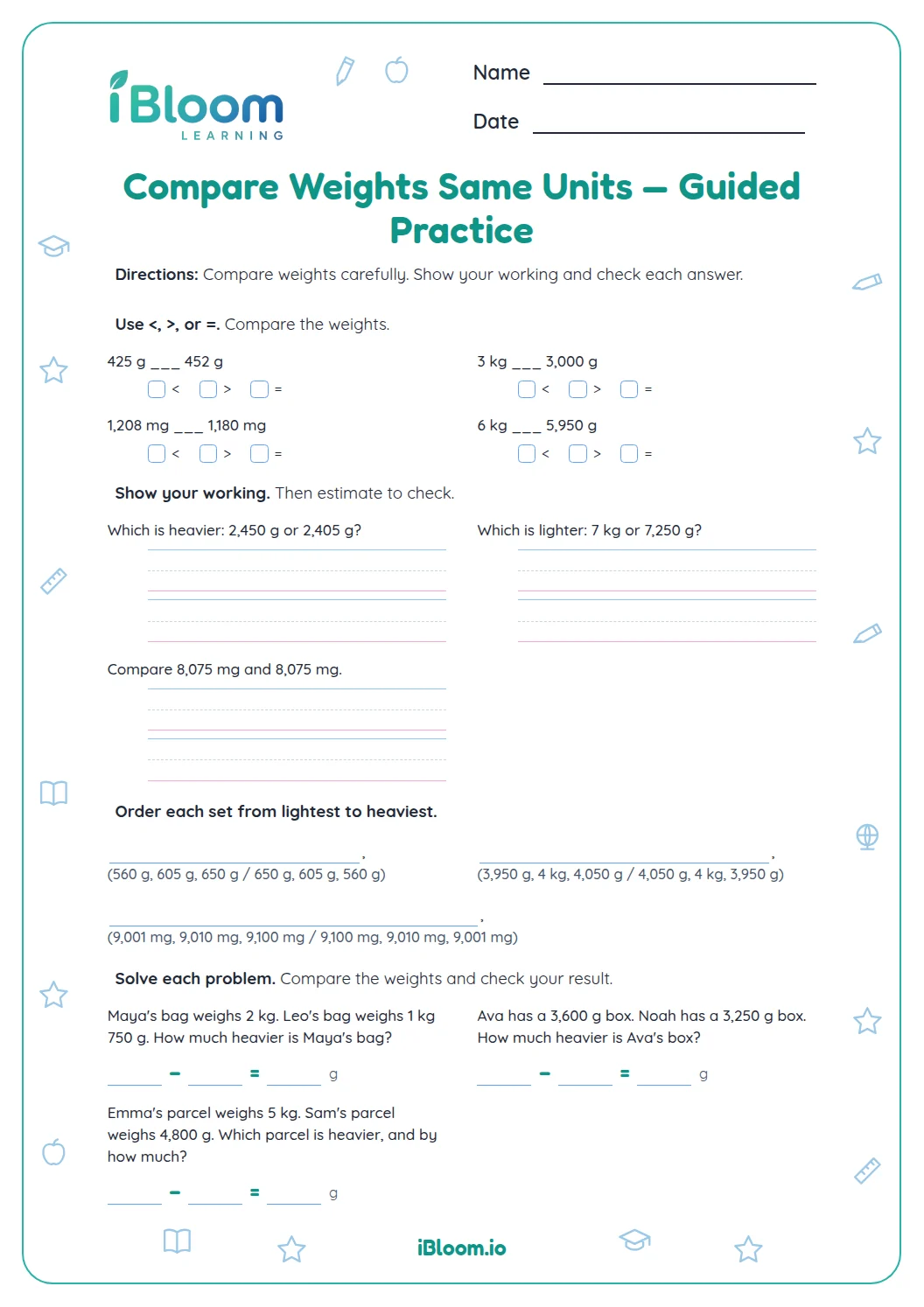
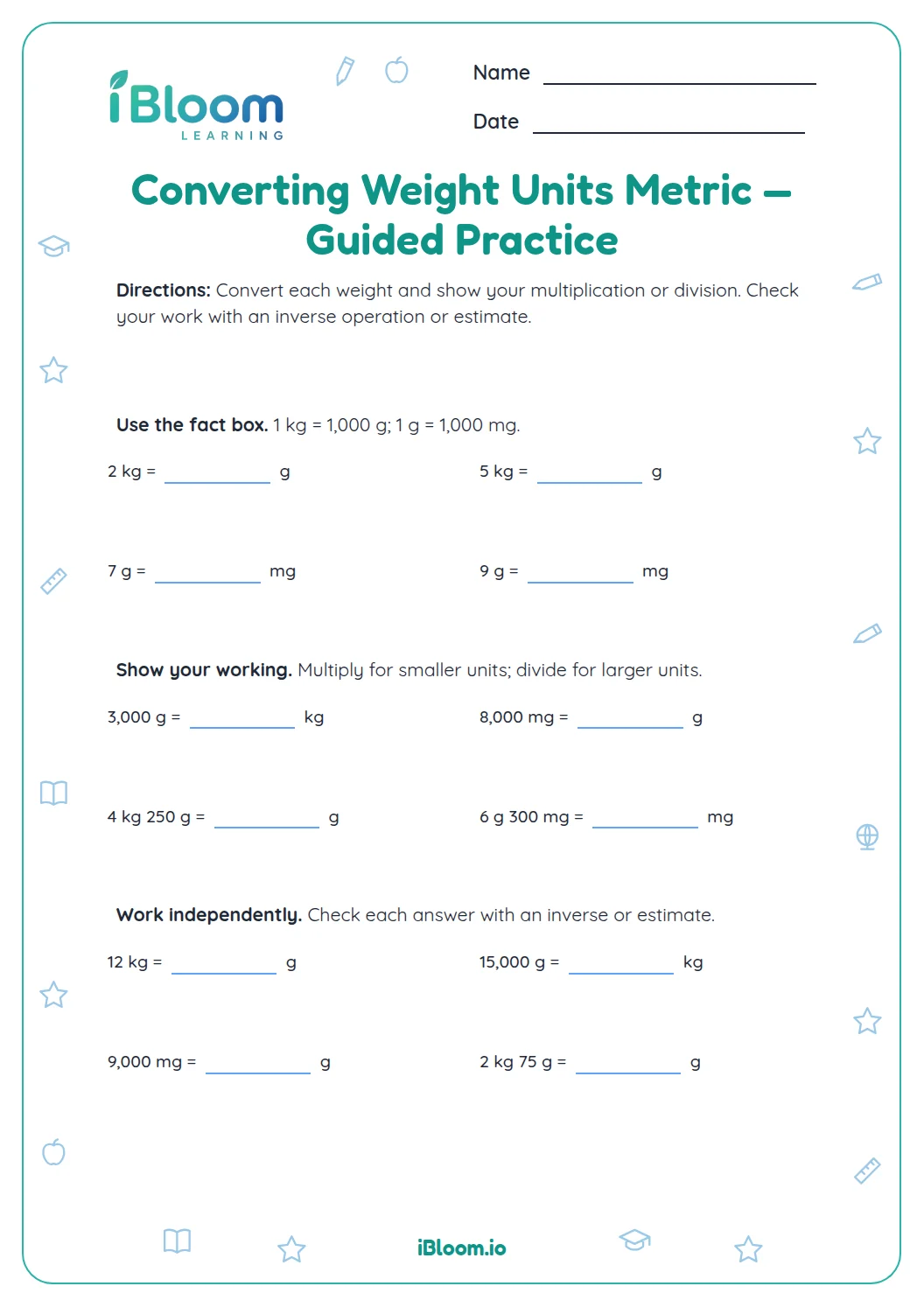
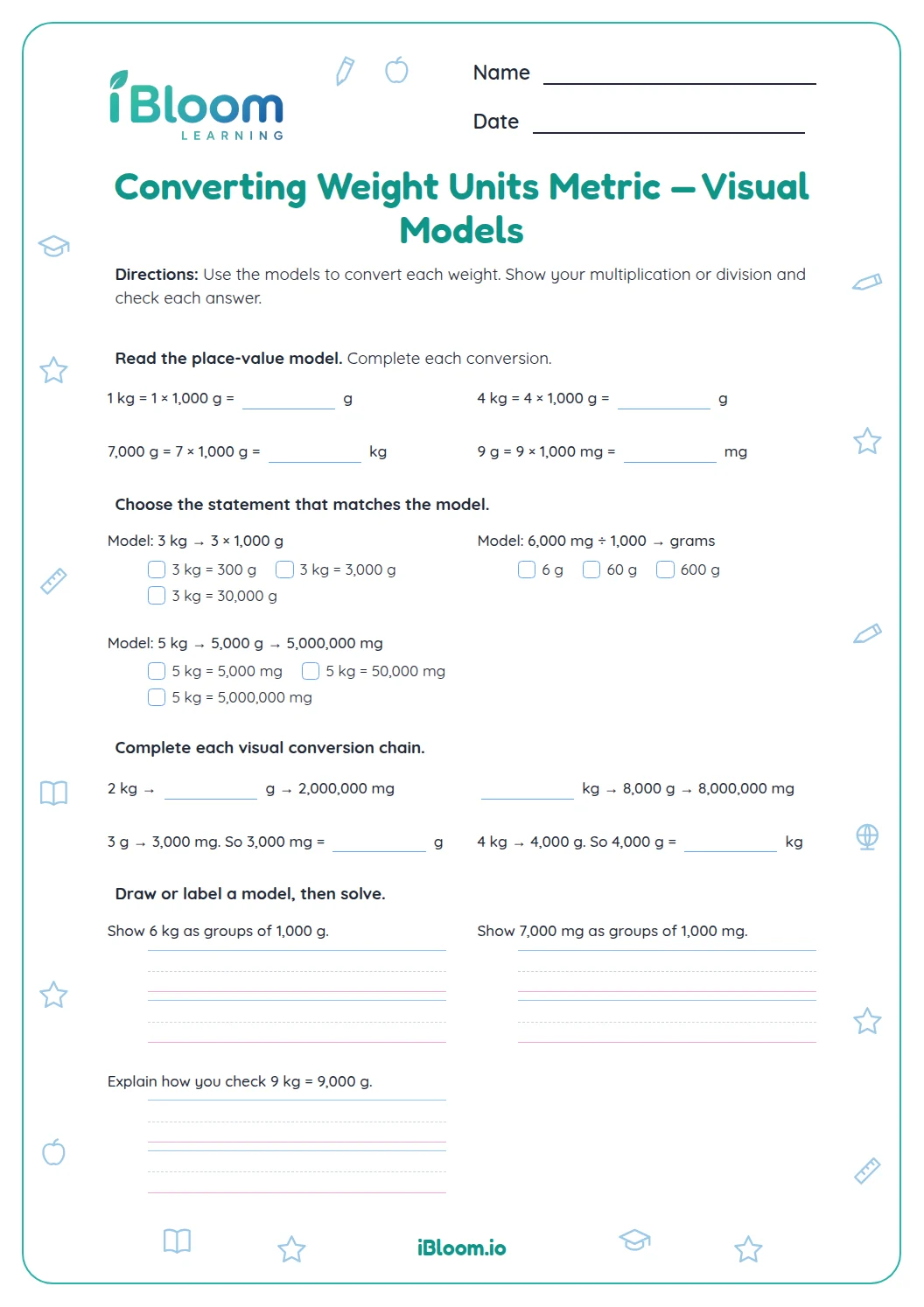
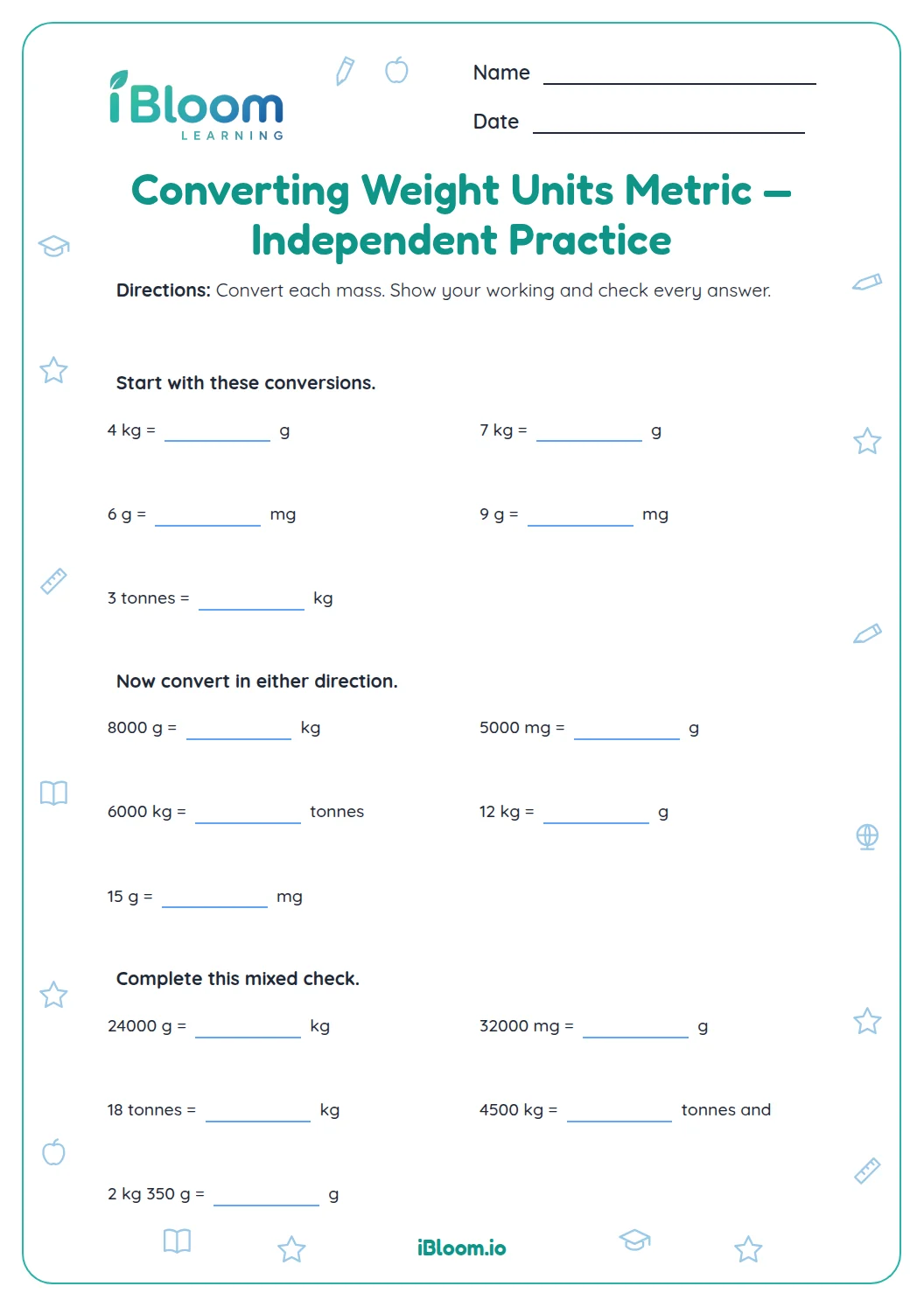
First use one unit for both amounts. Since 1 kilogram equals 1,000 grams, 900 grams is less than 1 kilogram.
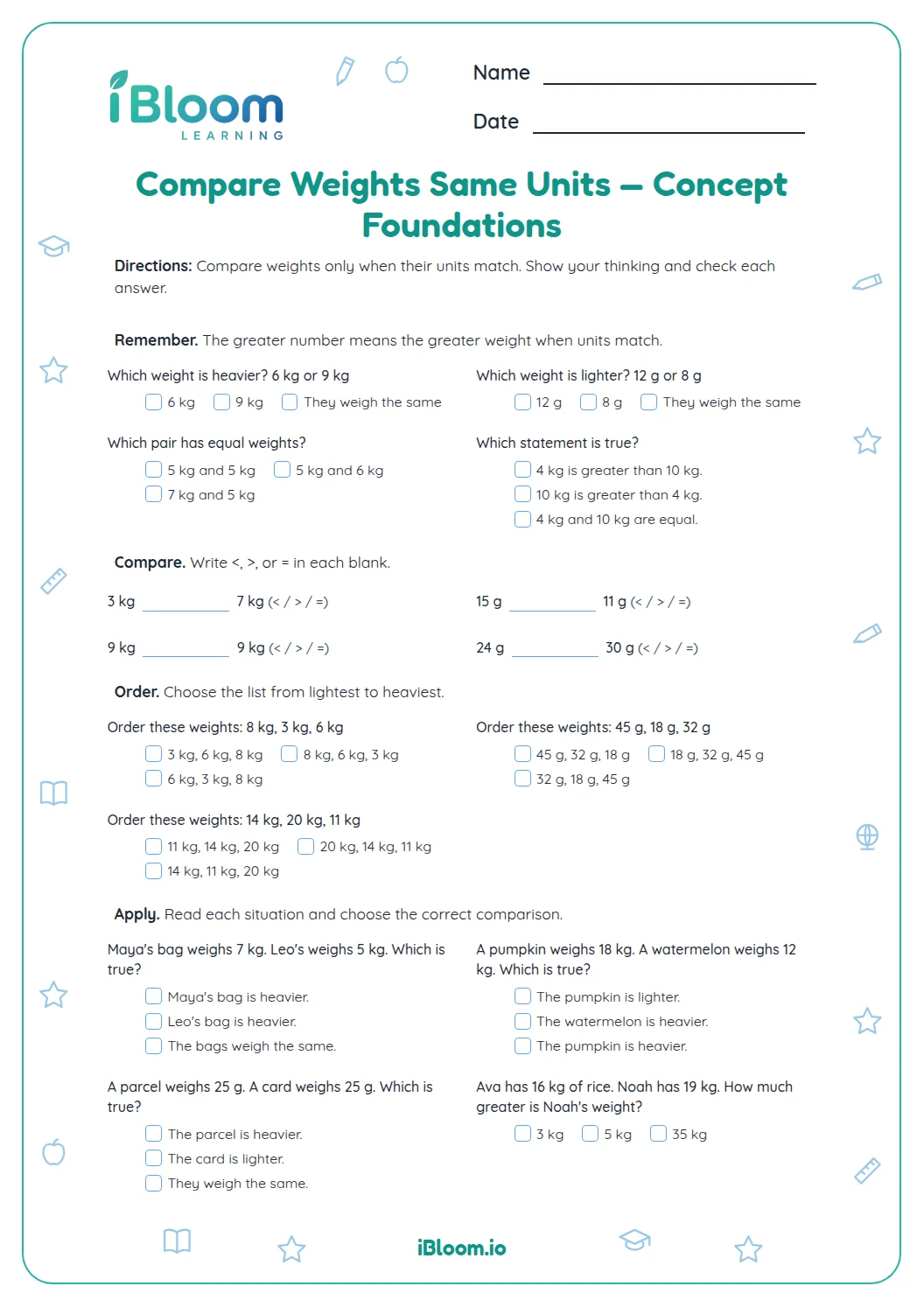
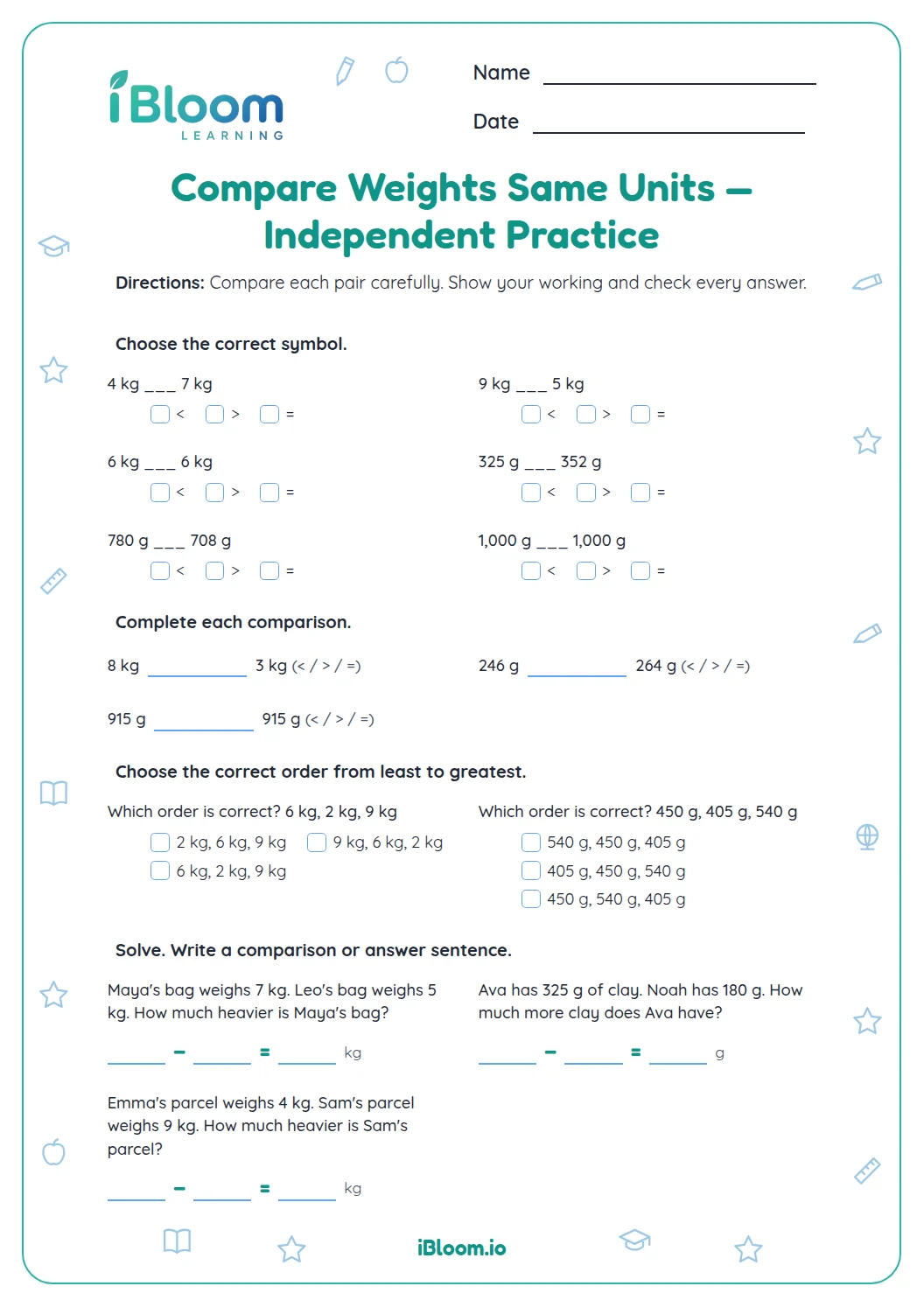
When the units already match, compare the numbers directly. When they differ, convert one quantity before deciding which is greater.
What does this worksheet practice?
The questions move from selecting benchmarks to comparing weights and explaining judgments. The final items invite more than one reasonable estimate when students name a suitable benchmark.
- Part A: choose useful benchmarks
- Part B: compare and calculate with grams and kilograms
- Part C: explain whether estimates make sense
How to work through the questions
- 1Name an object whose weight you know or can reasonably estimate.
- 2Check whether grams or kilograms fit the object.
- 3Convert to one unit before comparing unlike units.
- 4Estimate a total or equal group when a question asks for it.
- 5For open responses, name the benchmark and explain the comparison.
Common weight-estimation mistakes
The mistake
Choosing a unit that is far too small or large.
The fix
Compare the object with a familiar item before selecting grams or kilograms.
The mistake
Comparing 900 grams and 1 kilogram as if the numbers alone decide.
The fix
Rewrite 1 kilogram as 1,000 grams, then compare.
The mistake
Giving an estimate without naming a reference point.
The fix
State a benchmark, such as a loaded backpack, and explain how the object compares.
Common Core alignment
This worksheet practices the following Common Core skill.
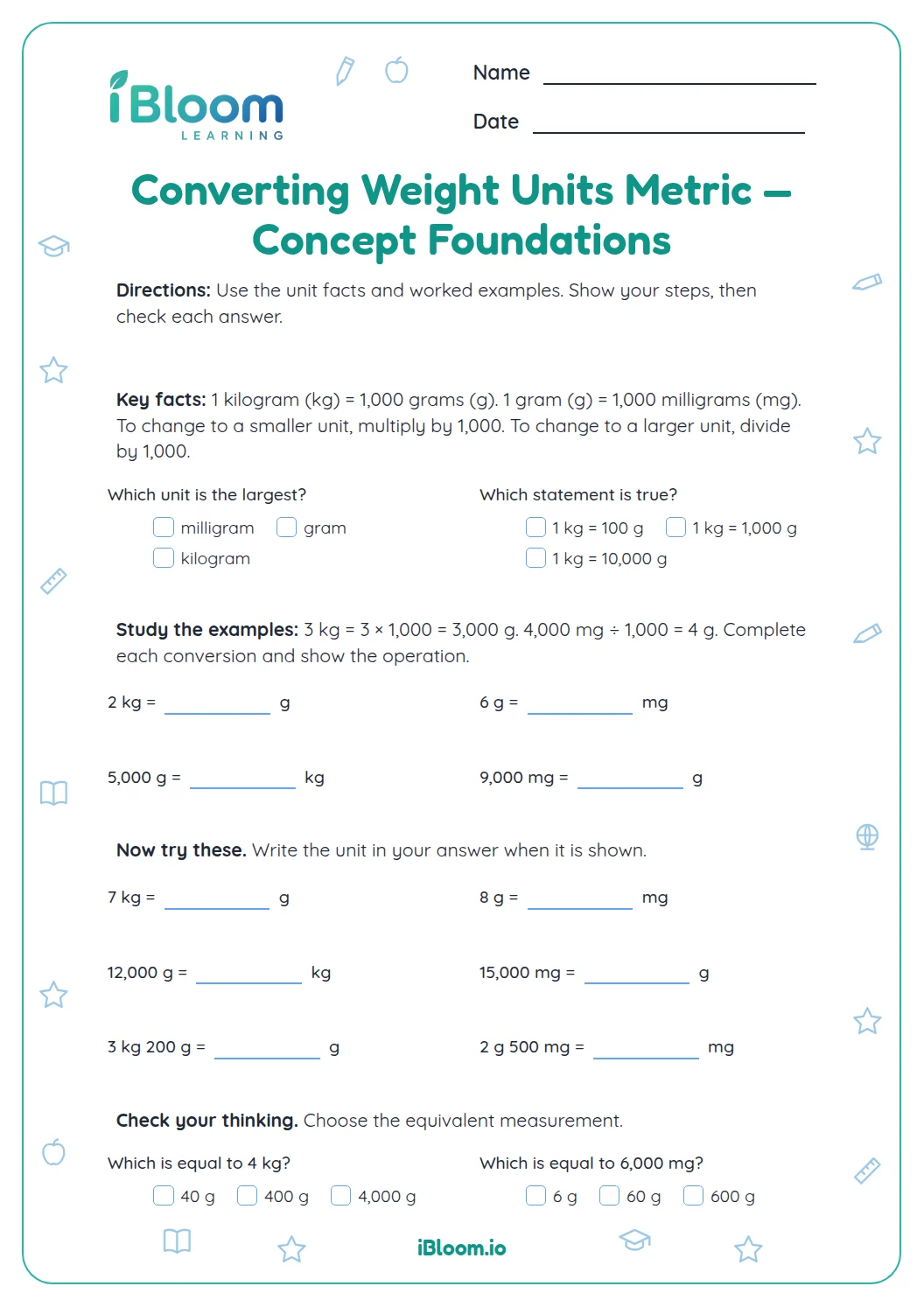
Students convert between kilograms and grams to compare weights in a common unit.
On this sheet: Students convert kilograms and grams to a common unit to compare given weights and solve measurement situations.
Show the official wordingHide the official wording
Convert among different-sized standard measurement units within a given measurement system (e.g., convert 5 cm to 0.05 m), and use these conversions in solving multi-step, real world problems.
What to practice next
Further reading
Questions parents and teachers ask
How many questions are included?
The worksheet includes 15 questions in three parts. Students select useful benchmarks, compare weights, solve simple weight situations, and explain estimates. The last questions allow reasonable estimates when students identify a familiar object and give a clear reason. A separate key shows sample thinking.
Which units appear?
The worksheet uses grams and kilograms. Students compare amounts in the same unit or use the relationship 1 kilogram = 1,000 grams to make a comparison. Everyday benchmarks help them decide whether a weight and unit are sensible for each familiar object.
Are the estimates exact measurements?
No. The estimate questions ask for a reasonable weight based on familiar objects, not a precise measurement. A written response can vary if its benchmark and estimate make sense together. Questions with stated amounts or conversions have specific answers in the key.
How should students compare different units?
Convert one measurement so both use the same unit. For example, 1 kilogram is 1,000 grams, so 900 grams is lighter than 1 kilogram. The worksheet asks students to use this comparison when judging familiar objects and solving a backpack-and-lunch-box problem.
What does the answer key show?
The key lists the correct choices and calculations, plus sample reasoning for open questions. Students can use different wording or a different reasonable estimate when they explain a fitting benchmark and comparison. For example, a grocery bag estimate can vary if its benchmark is sensible.