


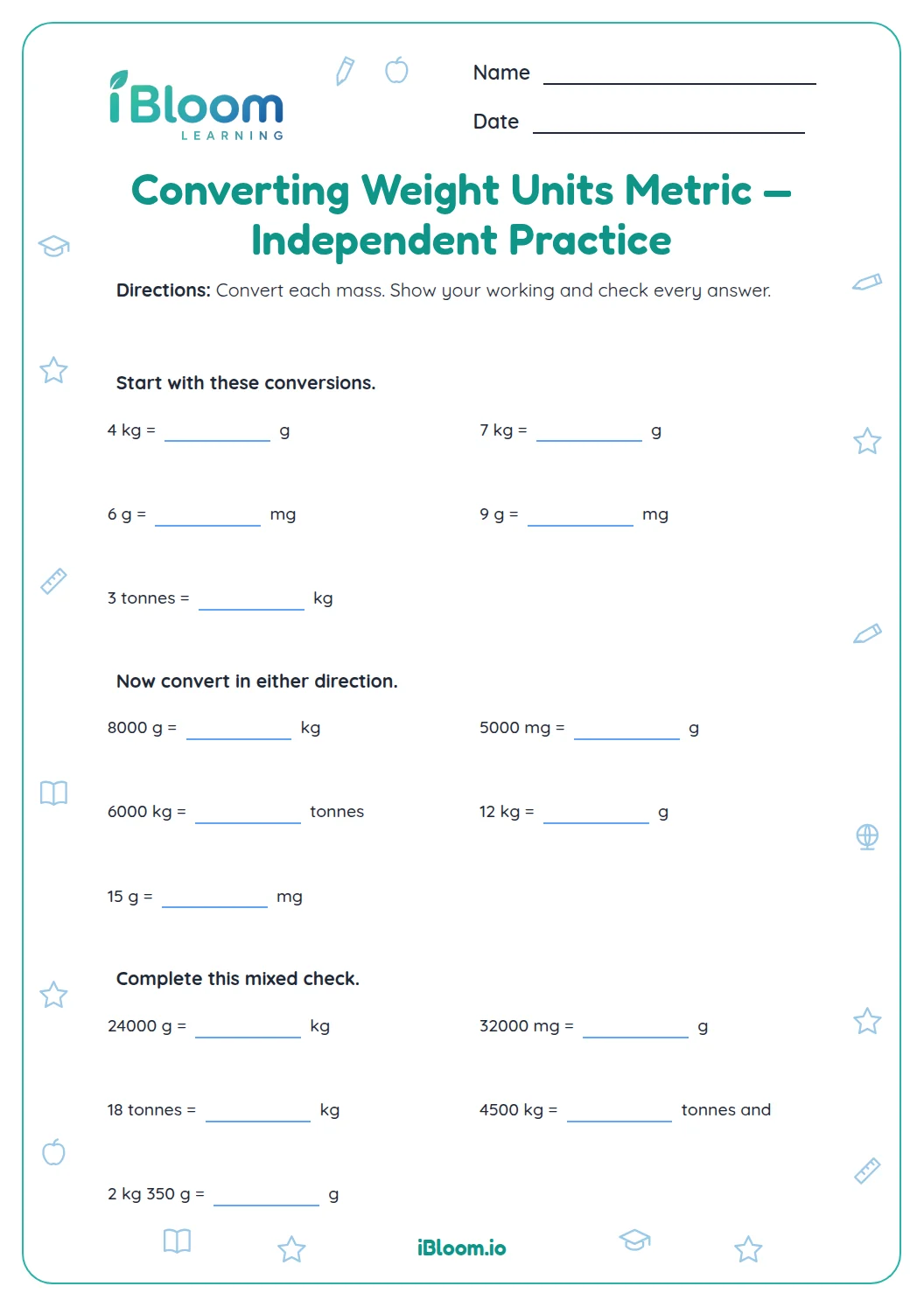
About this worksheet
This Grade 5 measurement worksheet connects everyday weight estimates with real-world calculations. Students choose reasonable weights for familiar objects, then find totals, differences, and equal shares in kilogram situations. The two parts move from quick benchmarks to missing-number problems. A separate key lists each estimate and calculation.
How do familiar objects help estimate weight?
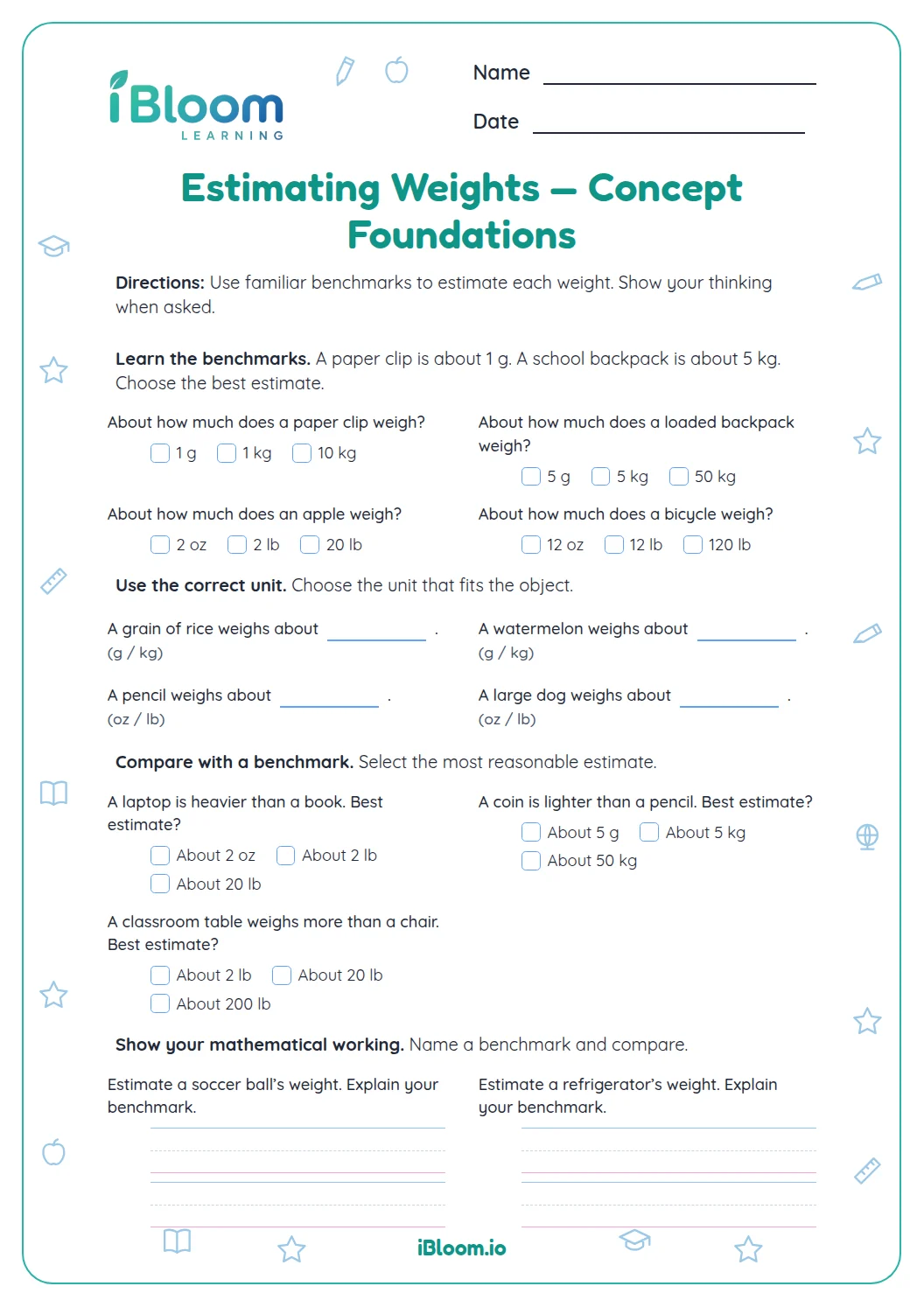
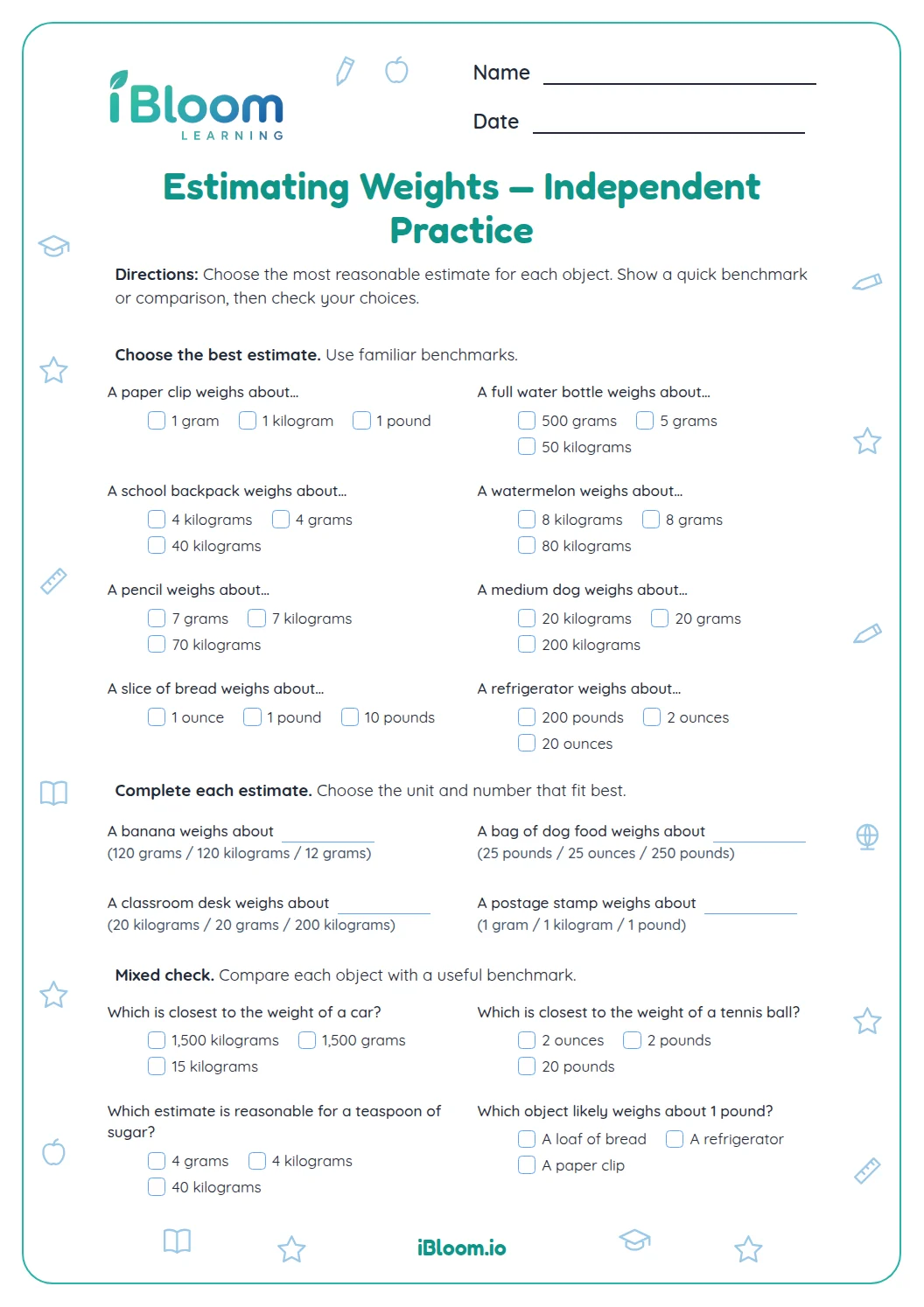
Benchmarks make estimates easier to judge. A paper clip is very light, an apple is much lighter than a backpack, and a car is far heavier than either. In Part A, students choose the amount and unit that best fit an everyday object.
- 11) School backpack with books → 4 kg
- 240 kg is much too heavy for a typical loaded backpack.
How do you calculate with weights?
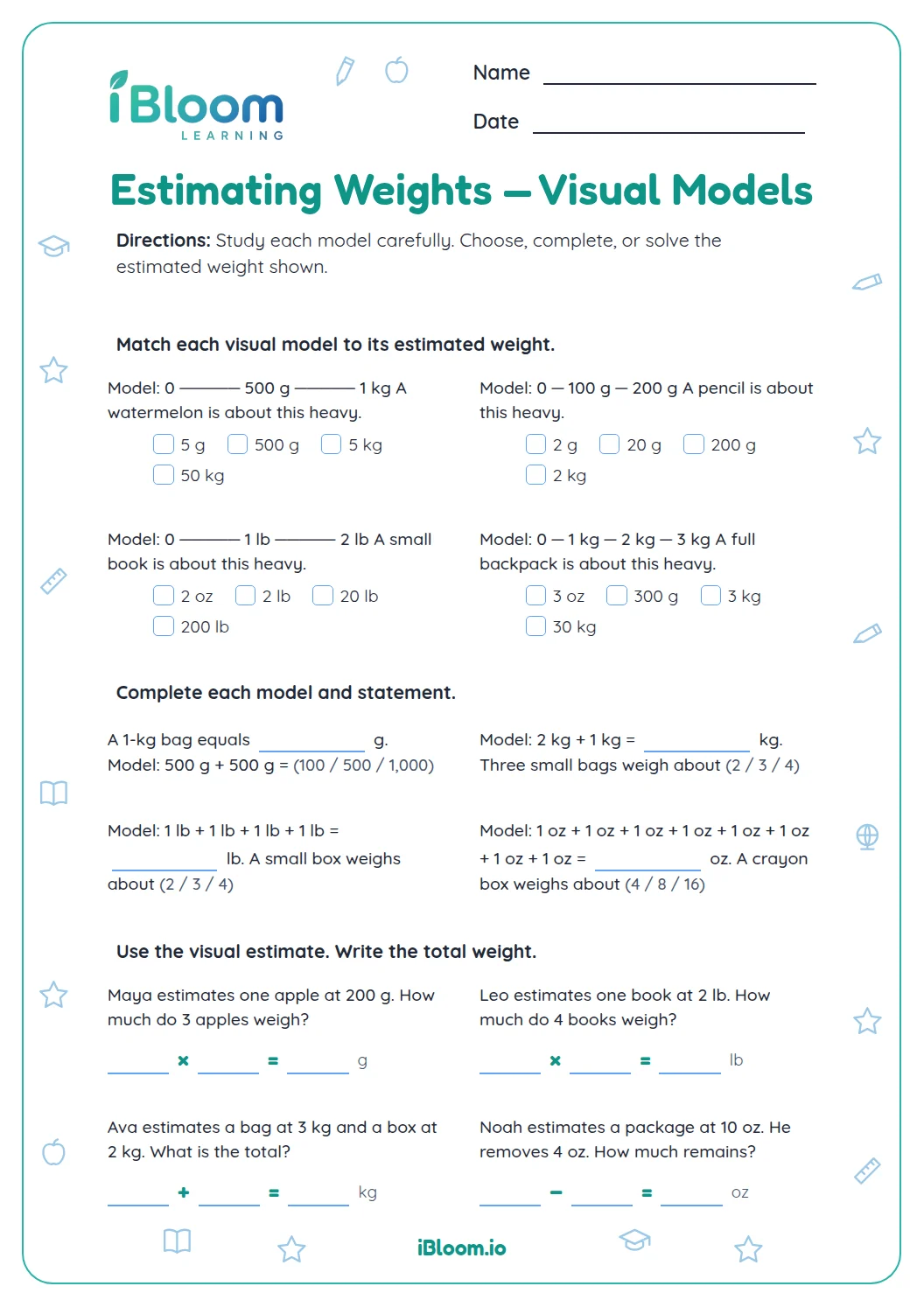
Keep the unit with the result and choose an operation that matches the story. Add weights that are packed together, subtract what is removed, multiply equal bags, or divide a shared amount evenly.
- 17) 4 kg + 1 kg = 5 kg
- 2The question combines the backpack and lunchbox weights.
How can you check an estimate?
Compare the proposed value with an object you know. Two kilograms is not a sensible refrigerator estimate, while one gram can fit a paper clip. A quick comparison catches a misplaced unit or an unreasonable amount.
How to use this worksheet
- 1Read the object and unit in each estimate choice.
- 2Compare the choice with a familiar weight benchmark.
- 3For a calculation, underline what is combined, removed, repeated, or shared.
- 4Write the operation and keep kg or g with the answer.
- 5Reread the final estimate to see whether it fits the object.
Common mistakes and quick fixes
The mistake
Choosing a number without checking the unit.
The fix
Compare both parts of the estimate: 150 g fits an apple better than 150 kg.
The mistake
Adding when an amount is shared equally.
The fix
Look for “equally among” and divide the total by the number of groups.
The mistake
Leaving the unit off a calculation.
The fix
Copy kg into the final answer when the story measures kilograms.
What to practice next
Make more practice
Questions parents and teachers ask
What is a reasonable weight for a backpack?
A backpack with books can reasonably weigh about 4 kilograms. The worksheet asks students to compare that estimate with choices that are much too heavy or too light. Using familiar objects helps students judge whether a number and unit make sense together.
Why does the answer need a unit?
A number alone does not say what is being measured. In Part B, each answer is in kilograms, such as 5 kg for a 4 kg backpack and 1 kg lunchbox together. Students write the unit so the result clearly describes a weight.
How do I solve the shared-crate problem?
The problem gives 18 kilograms of apples split equally among 3 crates. Divide 18 by 3 to find 6 kilograms in each crate. The written problem space invites students to show the operation before recording the unit. Ask students to write the division equation before they record the unit.
Can an estimate be different and still be reasonable?
An estimate may vary when the object or amount is not specified exactly. For the selected estimate questions, use the choices and familiar benchmarks; for the estimate checks, judge whether the proposed value fits the named object. The key identifies the intended reasonable choice.
How many questions are on this worksheet?
There are 14 questions in two parts: six everyday estimate choices and eight kilogram problems with a missing value. The answer key shows the intended estimate and each calculation. Students can explain how they chose a familiar benchmark or operation.
What should students do after finishing?
Ask students to explain one estimate using a familiar comparison, such as why 1 gram fits a paper clip but not a refrigerator. The missing-number problems practice addition, subtraction, equal groups, and sharing with kilograms. Invite them to check that each answer keeps the unit.