

About this worksheet
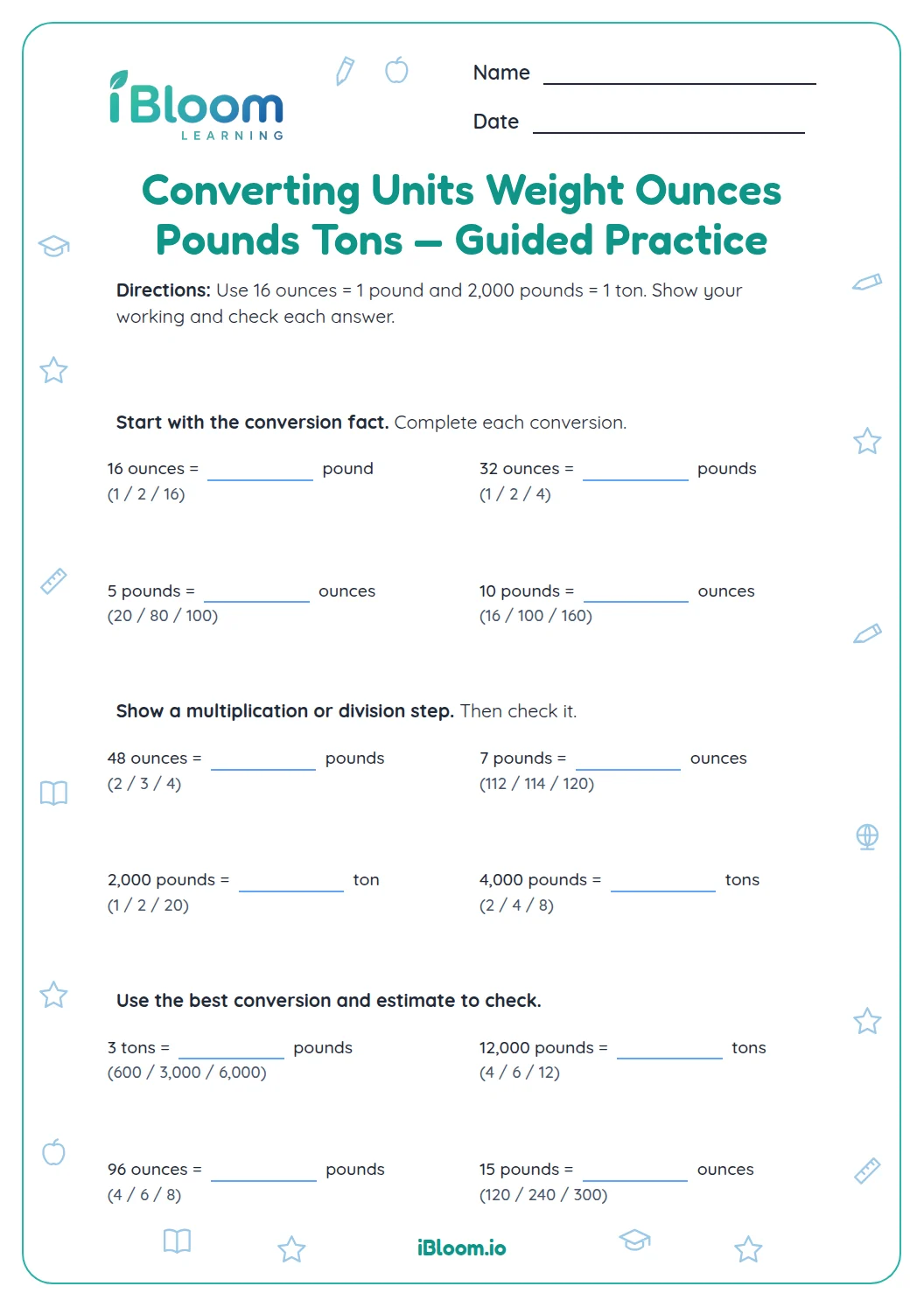
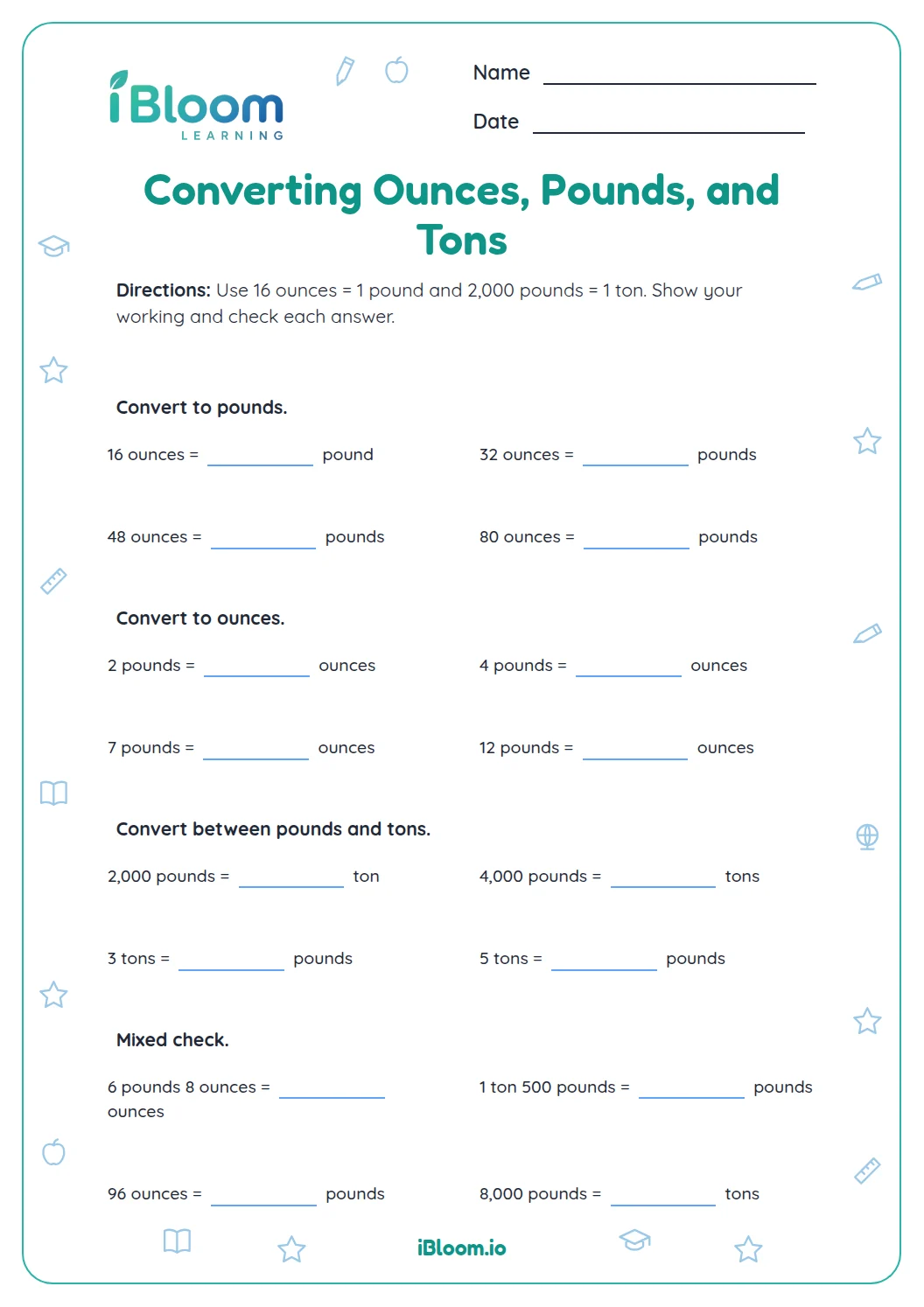
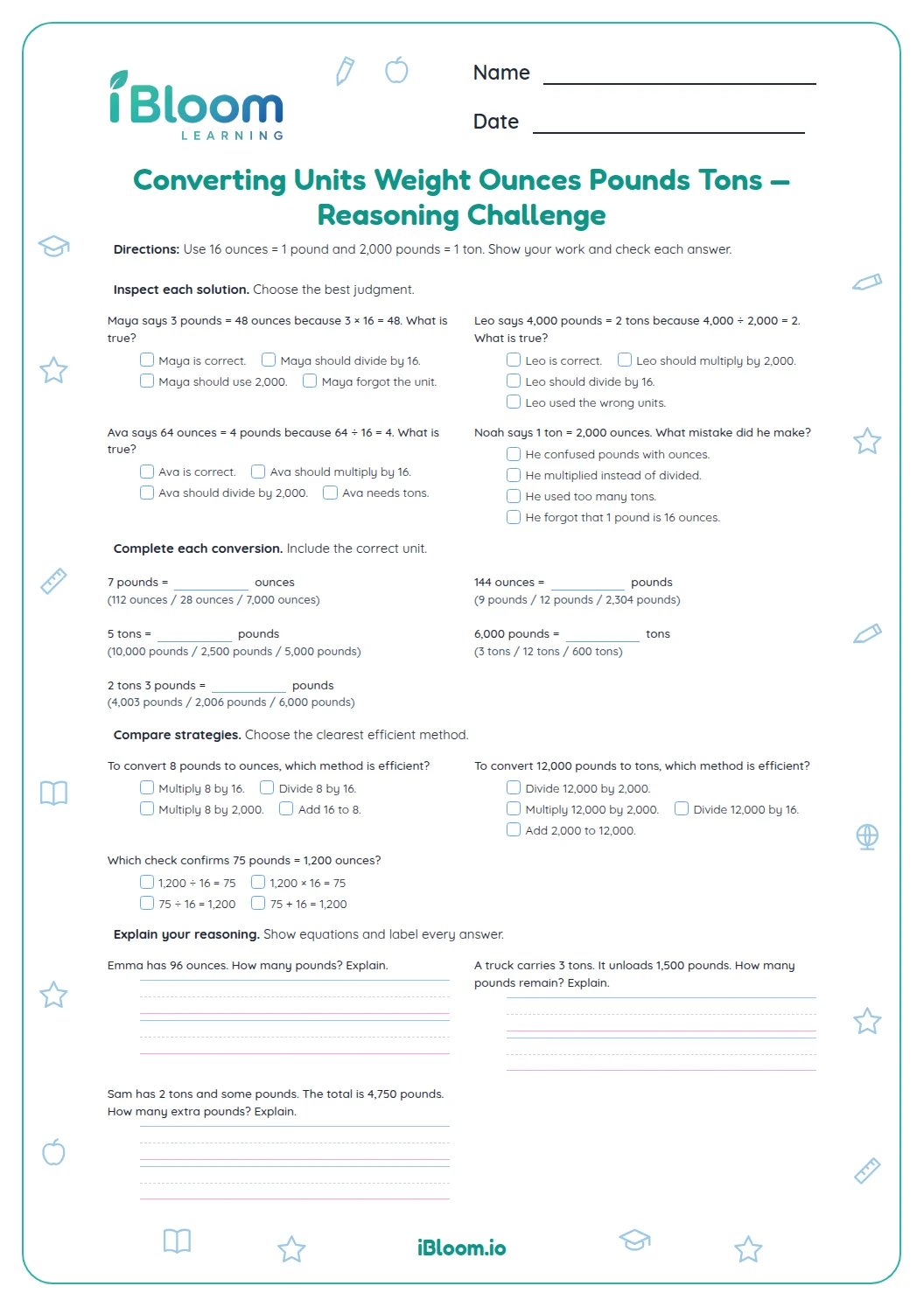
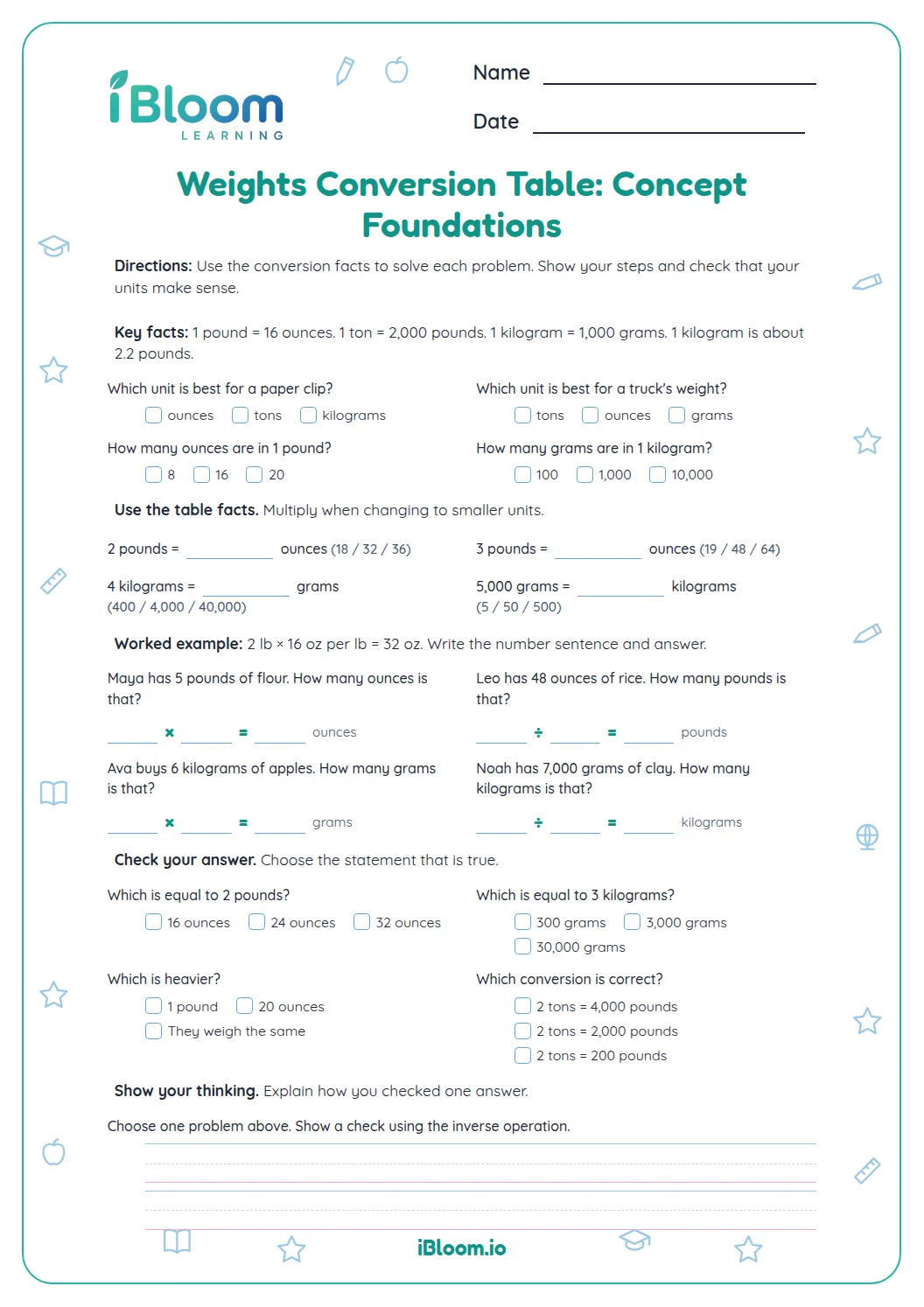
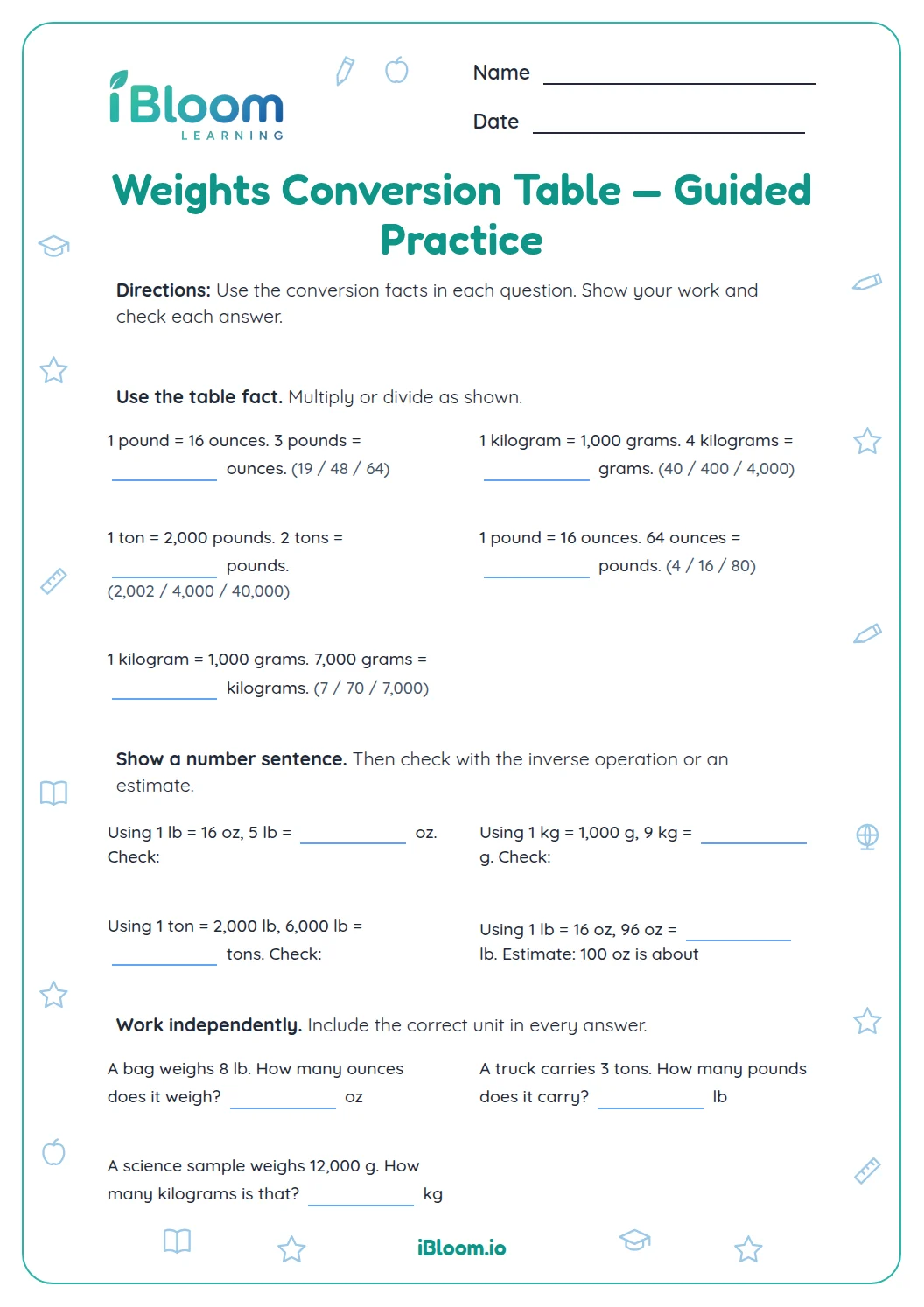
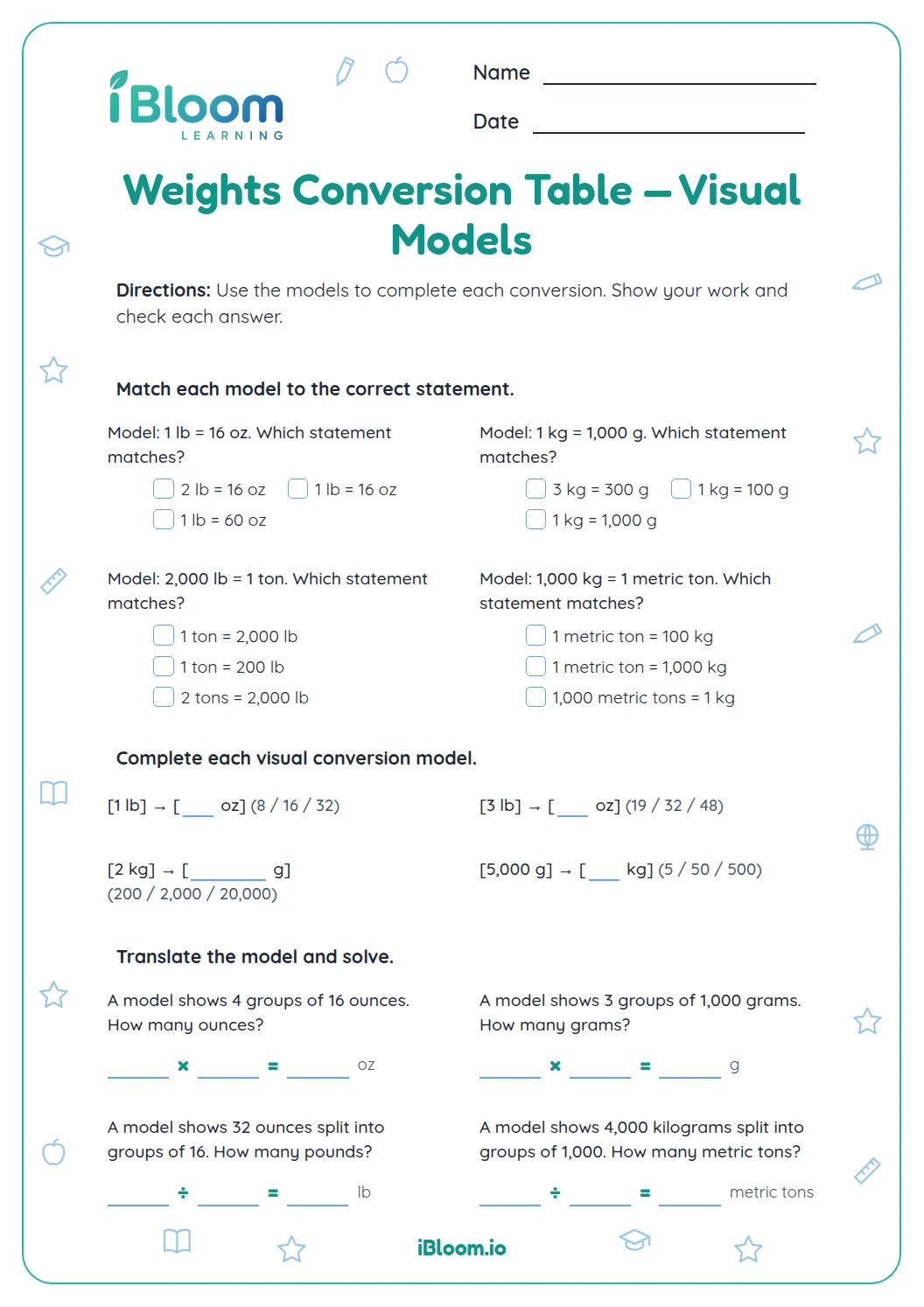
This Grade 5 printable practices customary weight conversions among ounces, pounds, and tons. Fourteen questions use a conversion table, matching equations, direct conversions, and real weight situations, including a mixed-unit problem. Students connect each relationship to multiplication or division. A separate answer key is included. It practices CCSS 5.MD.A.1.
Aligned to 5.MD.A.1
How do the ounce, pound, and ton relationships work?
For 2 lb 8 oz, convert 2 pounds to 32 ounces, then add 8 ounces: 32 + 8 = 40 oz.
- 1For 2 lb 8 oz, convert 2 pounds to 32 ounces, then add 8 ounces: 32 + 8 = 40 oz.
How is the practice organized?
Part A reads a table, Part B chooses conversion equations, Part C converts measurements, and Part D applies the relationships to weight situations.
How can the answer key support review?
After finishing, compare each response with the key. For a missed item, reread the prompt and use the relevant relationship or text detail to correct it.
How to use this worksheet
- 1Read the directions and look over the parts.
- 2Try the first item in each part slowly.
- 3Use the key idea to solve the remaining items.
- 4Check each result against the prompt.
- 5Use the answer key to review any missed items.
Common mistakes and quick fixes
The mistake
Multiplying ounces by 16 when changing ounces to pounds.
The fix
Use division for a smaller unit to a larger unit: 96 ÷ 16 = 6 lb.
The mistake
Using 16 for pounds to tons.
The fix
Remember that 1 ton is 2,000 lb; use the relationship that matches the units.
The mistake
Leaving off a unit in a story problem.
The fix
Write oz, lb, or tons after the number and compare it with the question.
Common Core alignment
This worksheet gives focused practice with the standards below.
Convert standard units within a measurement system and use conversions in real-world problems.
On this sheet: Convert standard units within a measurement system and use conversions in real-world problems.
Show the official wordingHide the official wording
Convert among different-sized standard measurement units within a given measurement system (e.g., convert 5 cm to 0.05 m), and use these conversions in solving multi-step, real world problems.
What to practice next
Make more practice
Further reading
Questions parents and teachers ask
Which weight units does this page use?
The worksheet uses ounces, pounds, and tons. It practices 16 ounces per pound and 2,000 pounds per ton through tables, direct conversions, and short situations. One item combines pounds and ounces, so learners convert the pounds first and then add the remaining ounces.
How many questions are included?
There are 14 questions in four parts. Learners read a conversion table, choose between conversion equations, convert values directly, and solve weight situations. The last group includes mixed pounds and ounces, so it asks learners to combine two unit relationships.
How can the answer key help?
The separate key gives the answer to each table, equation choice, conversion, and situation. For a missed item, check the units first, then decide whether the conversion moves from a larger unit to a smaller one or the reverse. This helps locate an incorrect operation.
What is a useful way to remember ounces and pounds?
Remember that 16 ounces make 1 pound. Multiply pounds by 16 to find ounces, and divide ounces by 16 to find pounds. For tons, use 2,000 pounds per ton. The conversion tables show the multiples before learners solve the situations.
How long should the worksheet take?
There are 16 questions in four parts. Learners read three conversion tables, choose between conversion equations, convert values directly, and solve weight situations. The last group includes a mixed pounds-and-ounces problem, so it asks learners to combine two unit relationships.