

About this worksheet
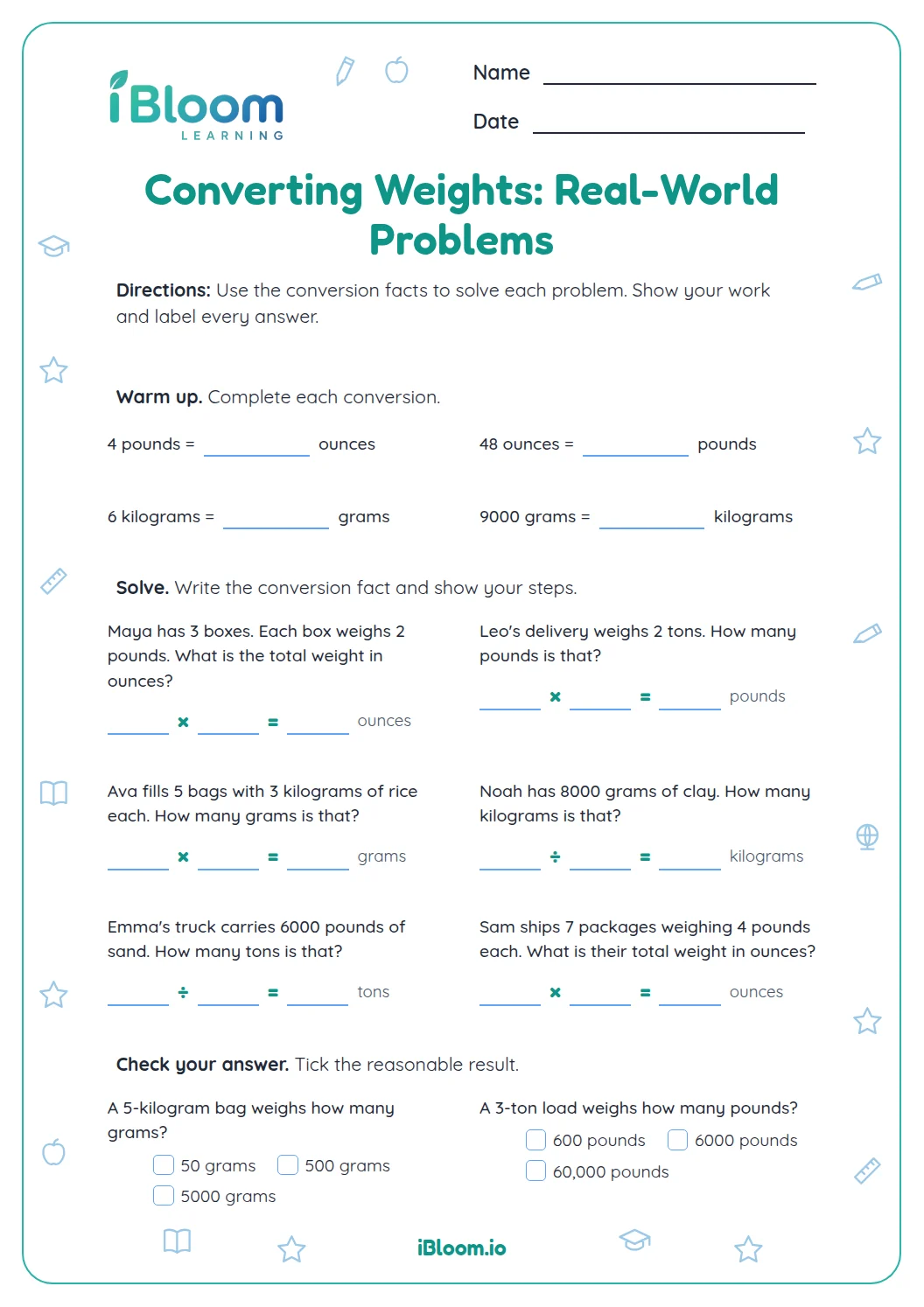
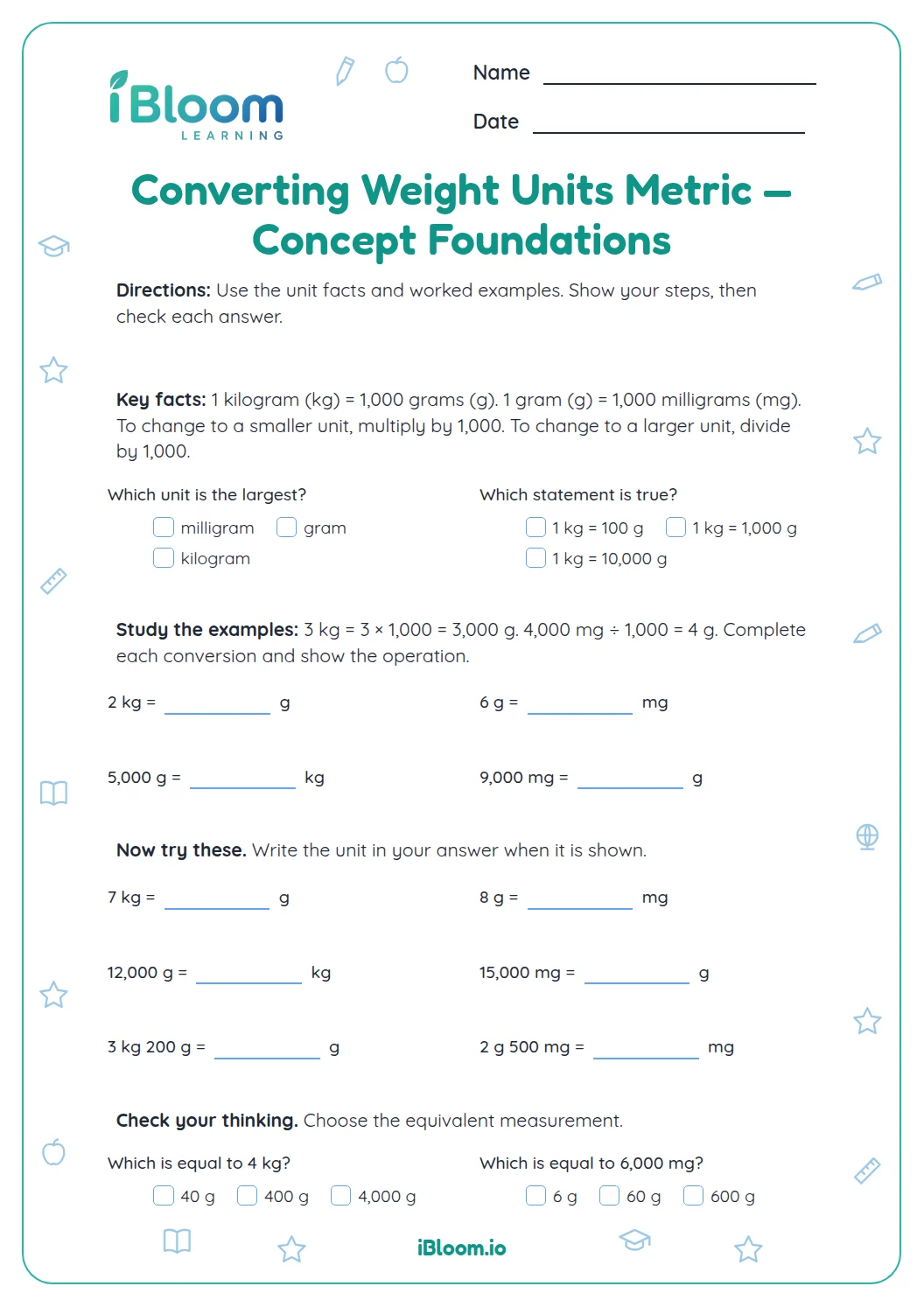
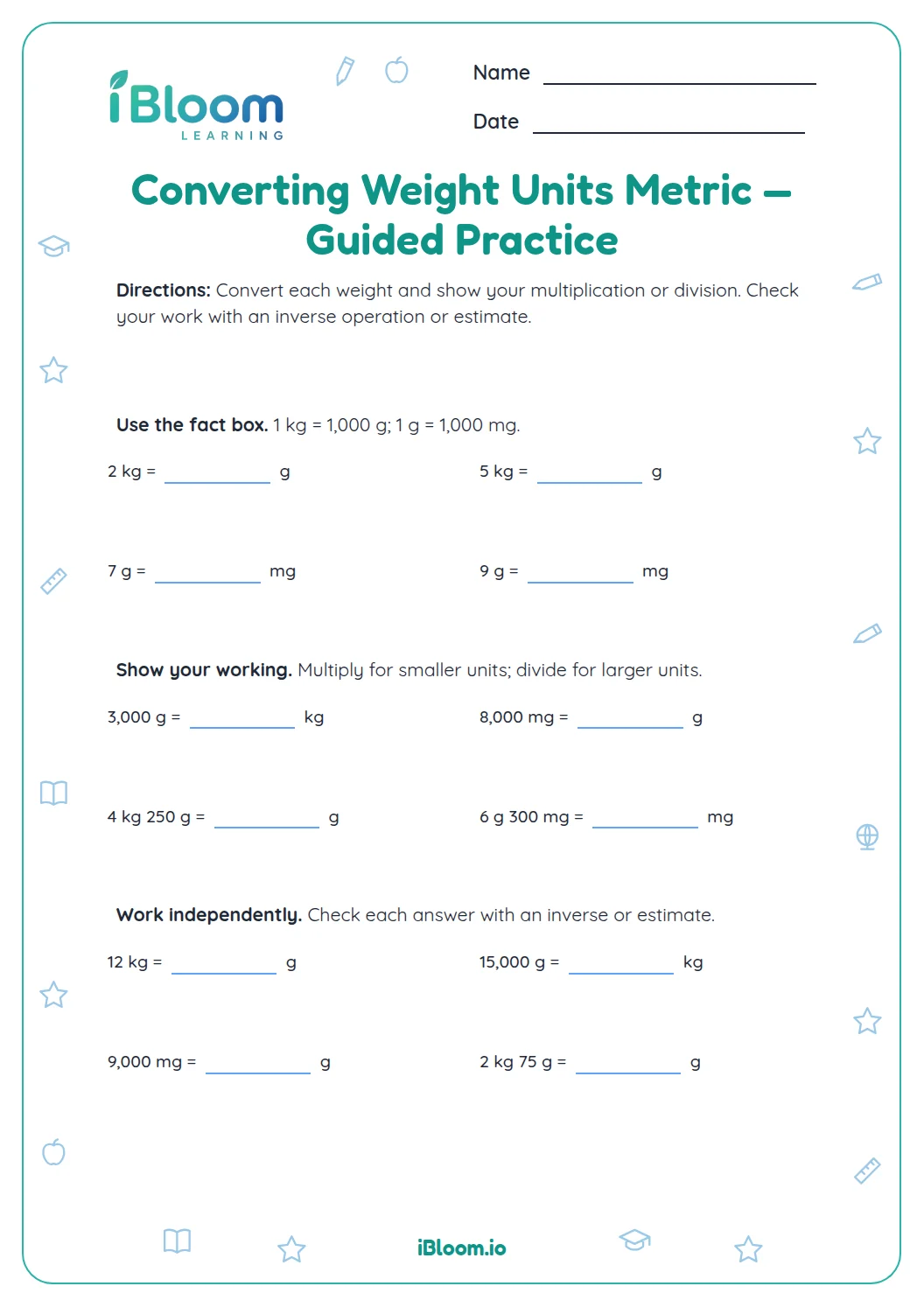
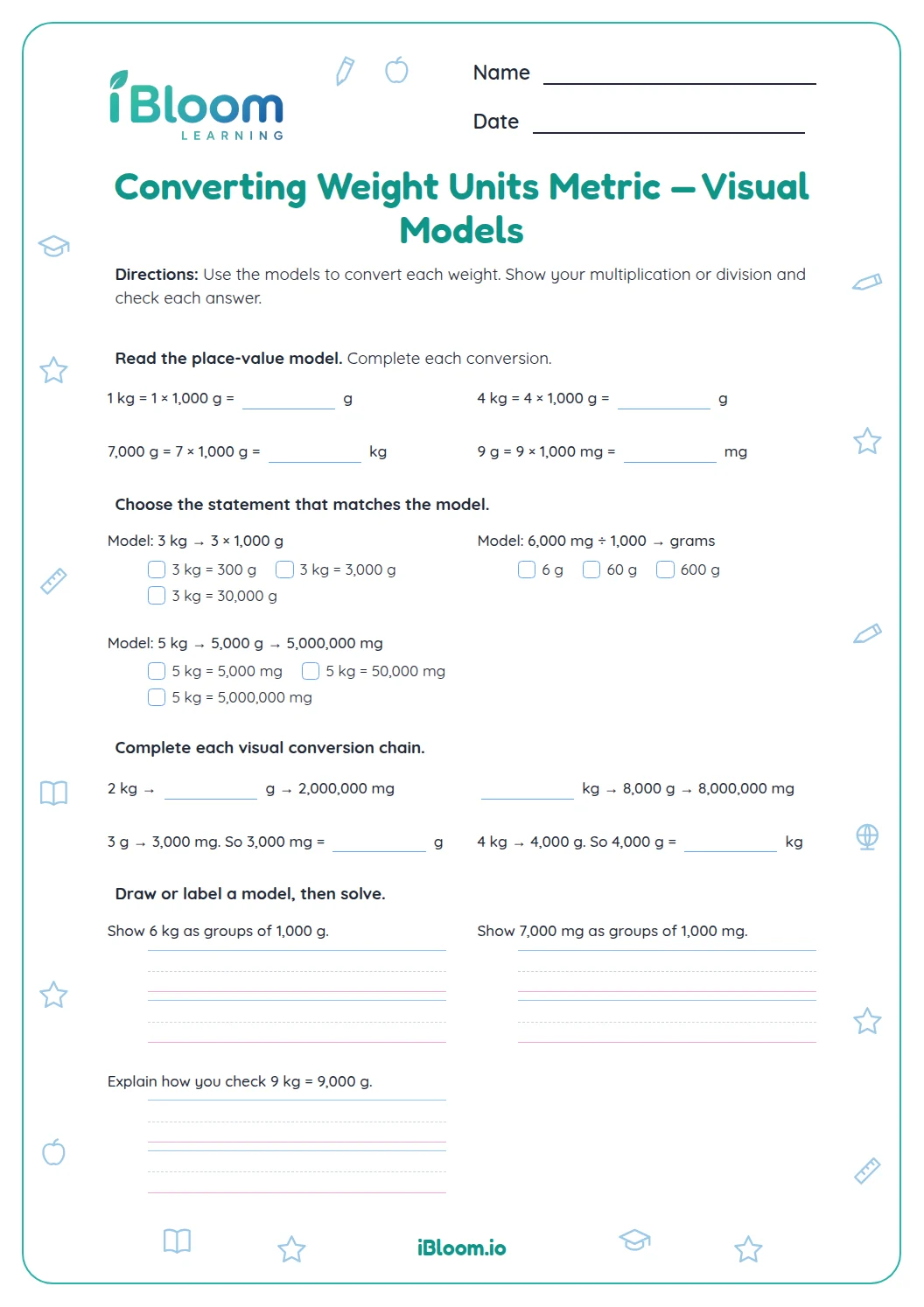
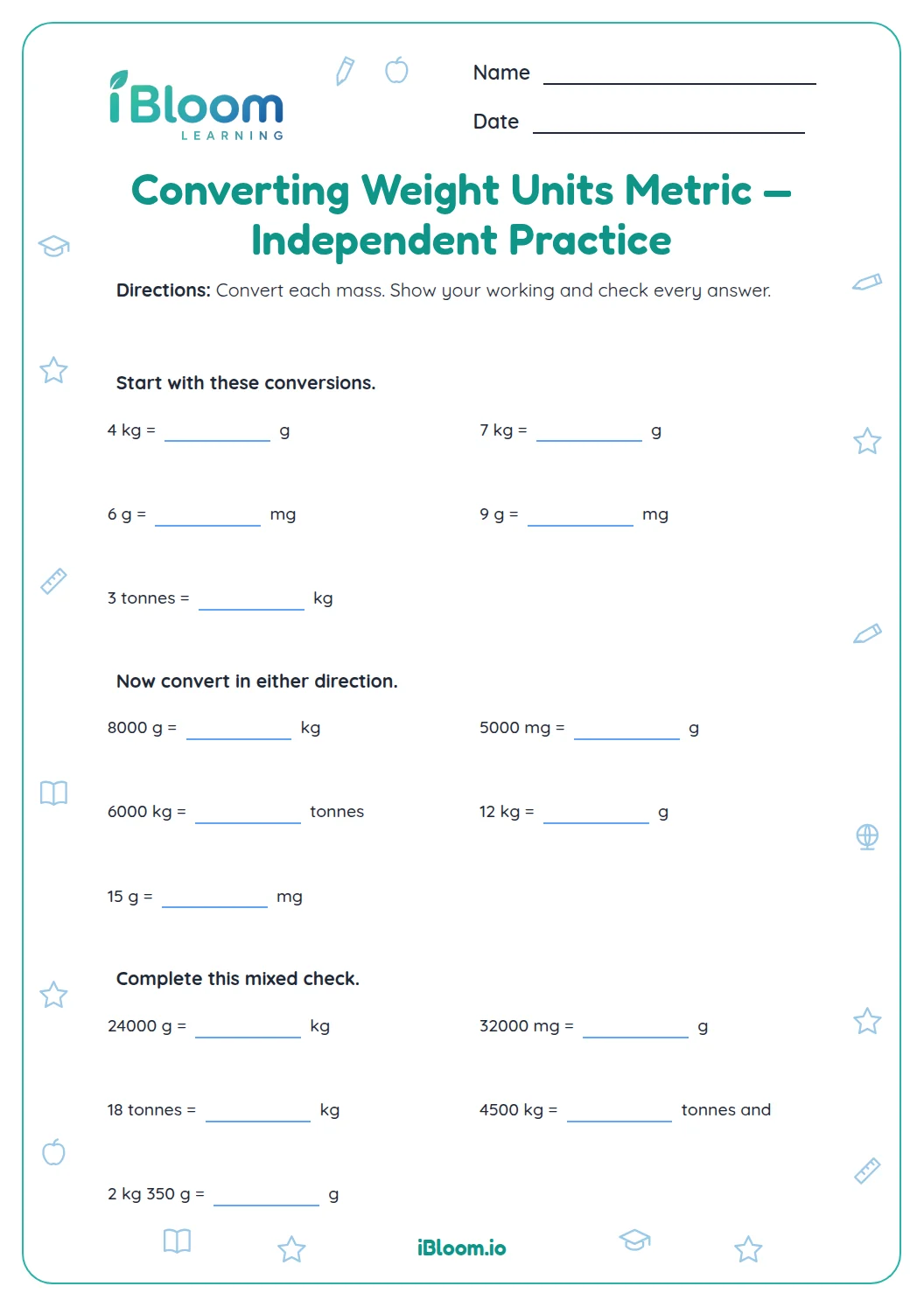
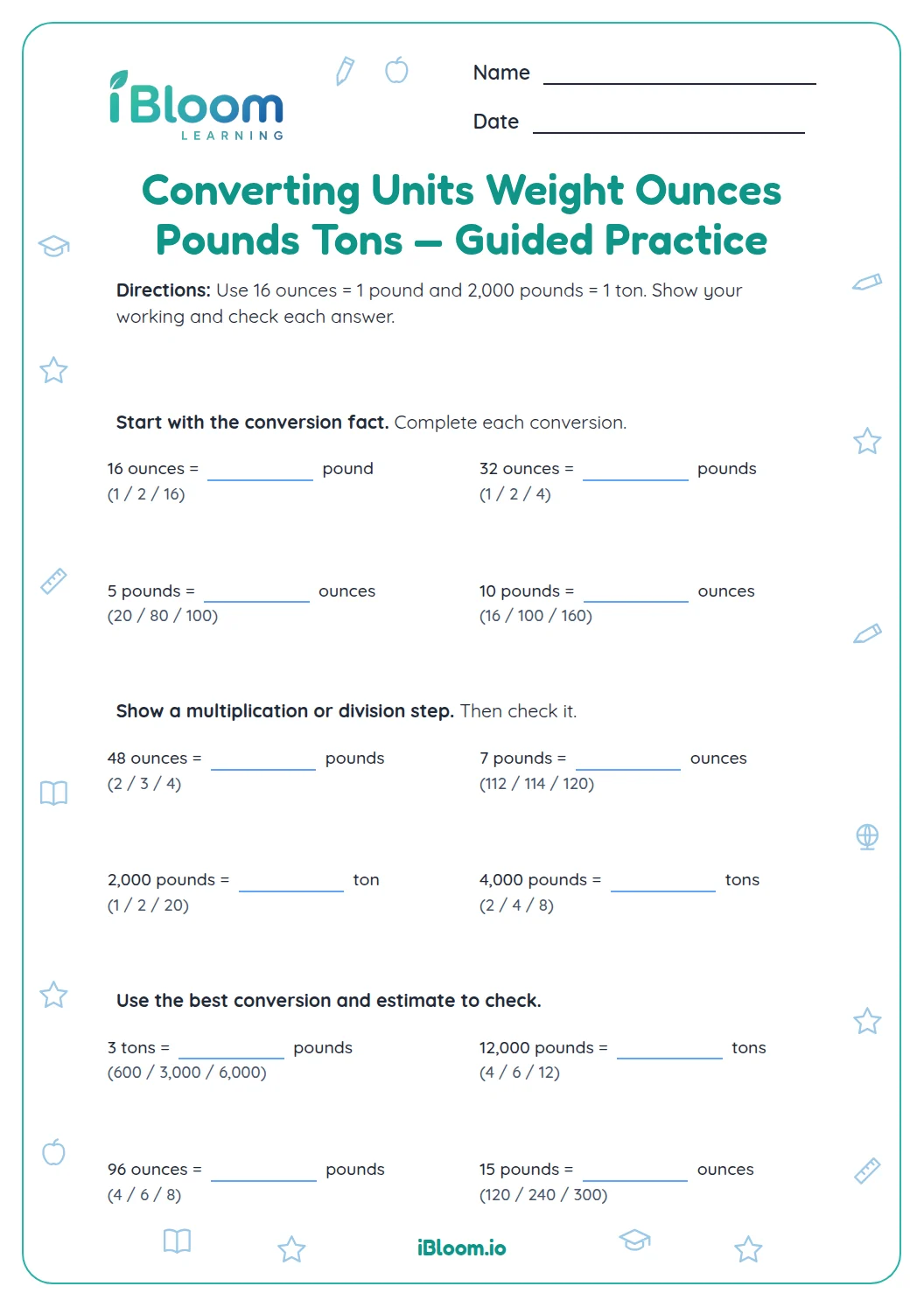
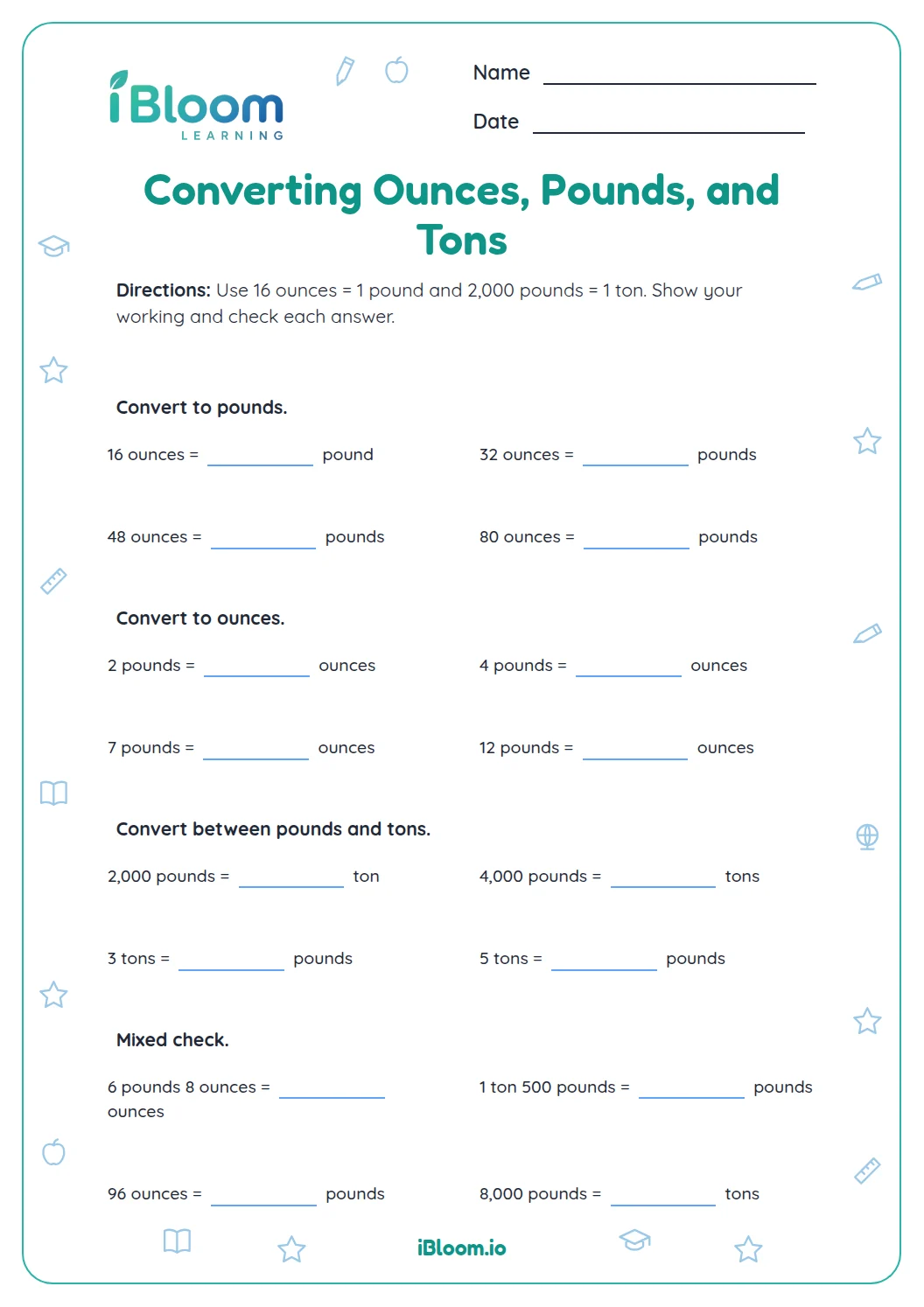
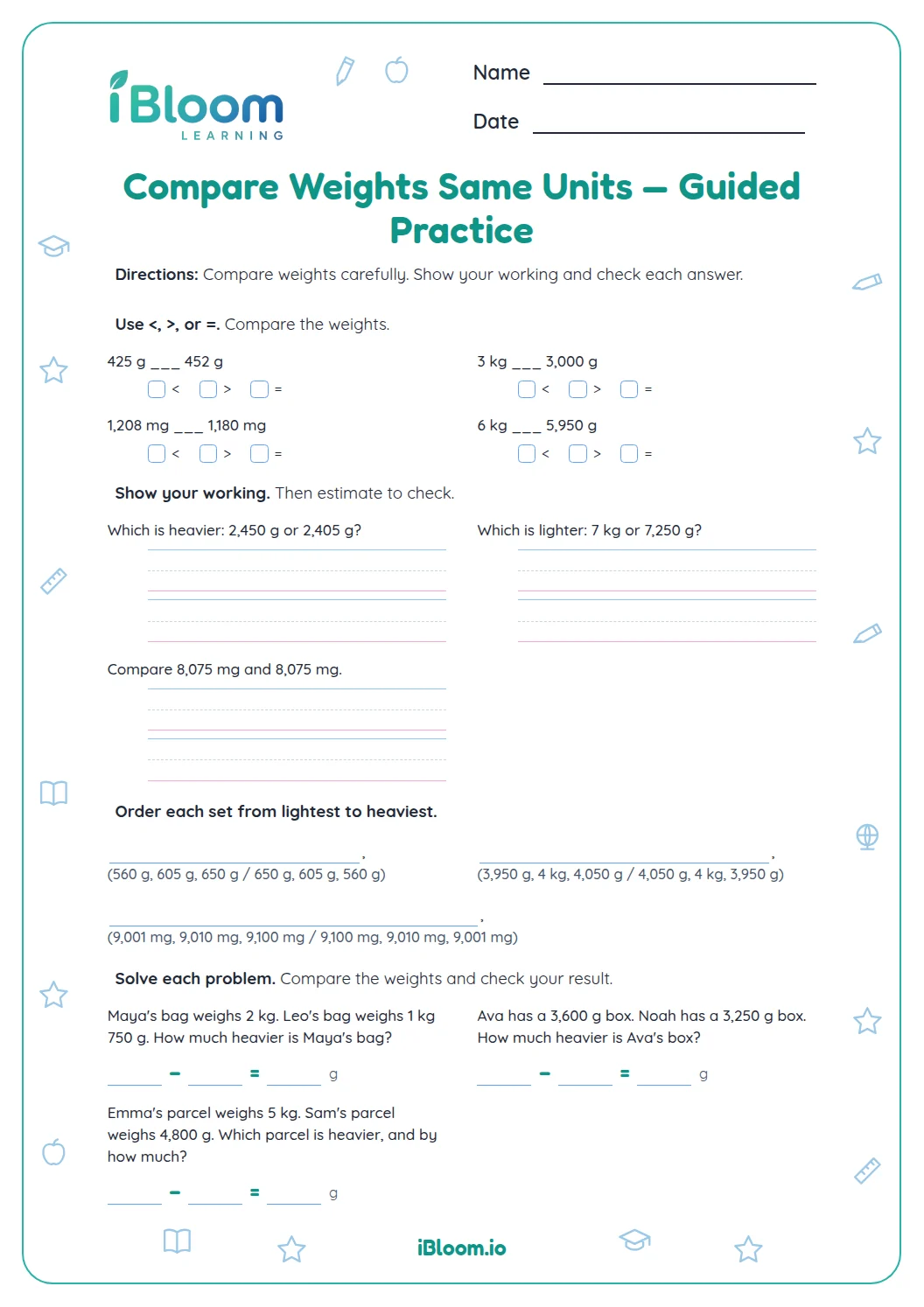
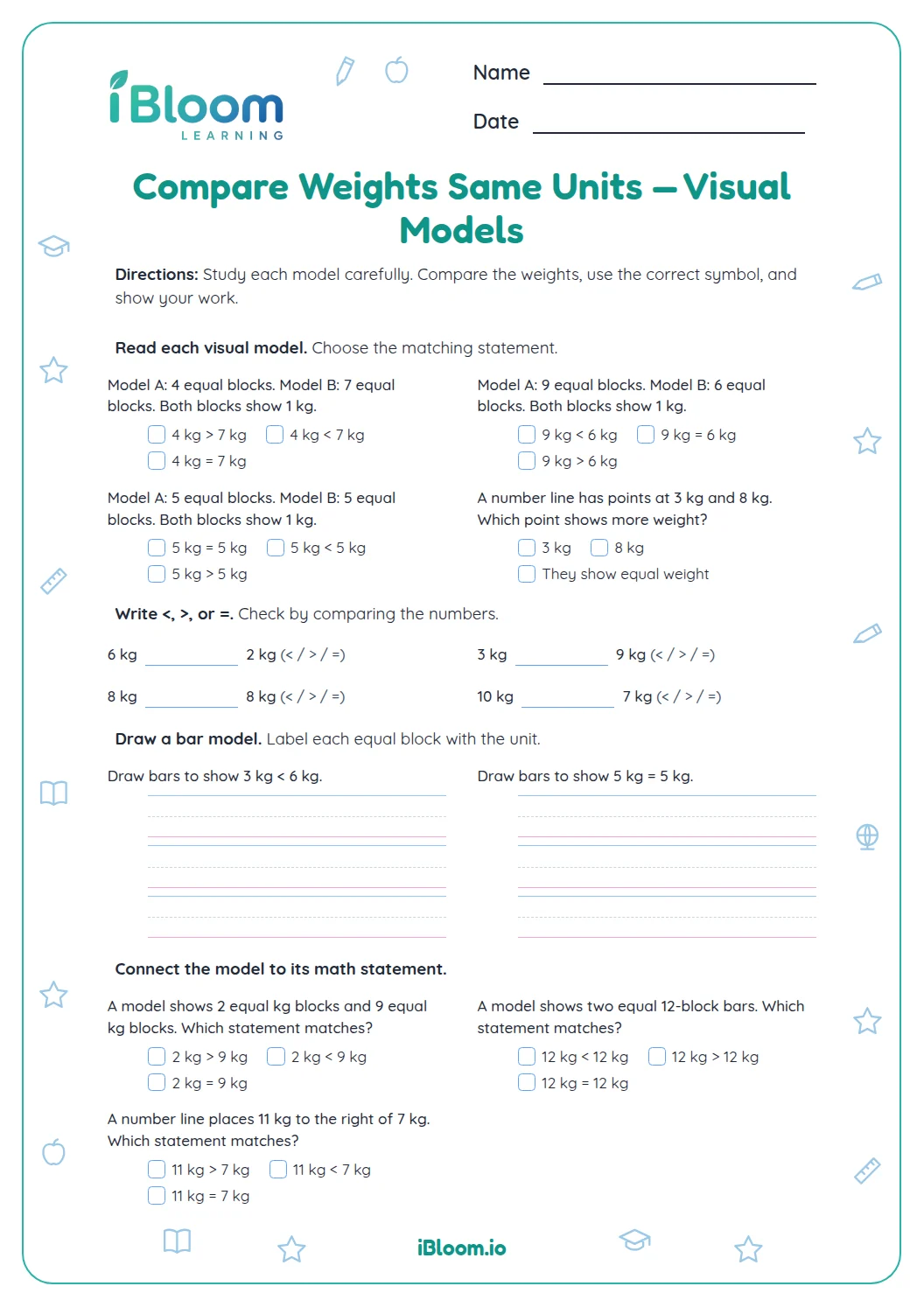
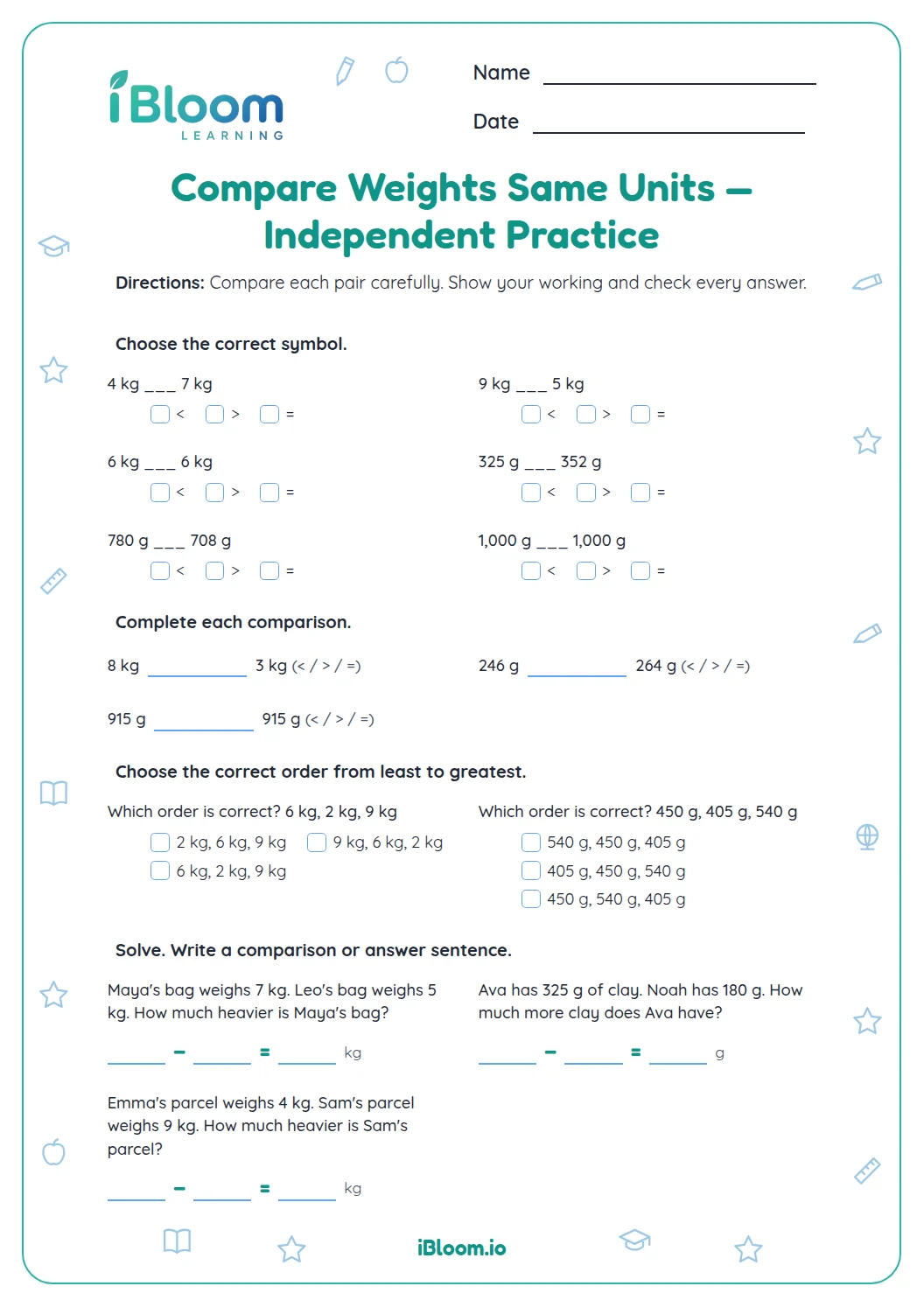
This Grade 5 worksheet practices converting weights within customary and metric systems. Students use 16 problems to convert pounds, ounces, tons, kilograms, and grams, including decimal and mixed-unit values. Short word problems ask students to apply the same relationships in context. The separate answer key includes units, and the practice connects to CCSS 5.MD.A.1.
Aligned to 5.MD.A.1
Which conversion facts does this page use?
Use 16 ounces = 1 pound, 2,000 pounds = 1 ton, and 1,000 grams = 1 kilogram. Multiply to change to a smaller unit; divide to change to a larger unit.
- 12 lb × 16 = 32 oz
How do you convert a mixed weight?
Convert each part to the same unit, then combine. For 3 lb 8 oz, change 3 pounds to 48 ounces and add 8 ounces to get 56 ounces.
- 13 lb 8 oz = 3 × 16 oz + 8 oz = 56 oz
How to use this worksheet
- 1Underline the starting unit and the unit requested.
- 2Choose the matching conversion fact.
- 3Multiply when changing to a smaller unit; divide when changing to a larger unit.
- 4For mixed pounds and ounces, convert the pounds first and add the ounces.
- 5Write the unit beside every answer.
Common mistakes and quick fixes
The mistake
Multiplying when converting ounces to pounds.
The fix
Since pounds are larger, divide ounces by 16.
The mistake
Using 100 instead of 1,000 for kilograms and grams.
The fix
Write 1 kg = 1,000 g beside the problem.
The mistake
Leaving the unit off the result.
The fix
Label every numeric answer with lb, oz, ton, kg, or g.
Common Core alignment
This page practices converting standard measurement units and using the conversions in weight problems.
Convert standard measurement units within a system and use conversions in problems.
On this sheet: Questions convert customary and metric weight units and apply conversions in short problems.
Show the official wordingHide the official wording
Convert among different-sized standard measurement units within a given measurement system (e.g., convert 5 cm to 0.05 m), and use these conversions in solving multi-step, real world problems.
What to practice next
Make more practice
Further reading
Questions parents and teachers ask
How many ounces are in a pound?
One pound equals 16 ounces. Multiply a number of pounds by 16 to get ounces, or divide ounces by 16 to get pounds. The worksheet practices each direction, including a mixed measure that combines pounds and ounces. This gives students a concrete example to revisit while checking their work.
How many pounds are in a US customary ton?
One US customary ton equals 2,000 pounds. Multiply tons by 2,000 to get pounds, or divide pounds by 2,000 to get tons. The worksheet uses this relationship in direct conversions and a short weight problem. This gives students a concrete example to revisit while checking their work.
How many grams are in a kilogram?
One kilogram equals 1,000 grams. Multiply kilograms by 1,000 to get grams; divide grams by 1,000 to get kilograms. Several questions include decimal values, so students should keep the decimal place and requested unit in view. This gives students a concrete example to revisit while checking their work.
How do I convert pounds and ounces together?
Change the pounds to ounces, then add the ounces already given. For example, 3 pounds is 48 ounces, and 48 ounces plus 8 ounces is 56 ounces. The answer should use the unit requested in the problem. This gives students a concrete example to revisit while checking their work.
How can I check a conversion?
Use the inverse operation and confirm that the unit matches the question. For example, divide a gram answer by 1,000 to return to kilograms. For customary measures, multiply an ounce answer by the pound relationship to check pounds. This gives students a concrete example to revisit while checking their work.