


About this worksheet
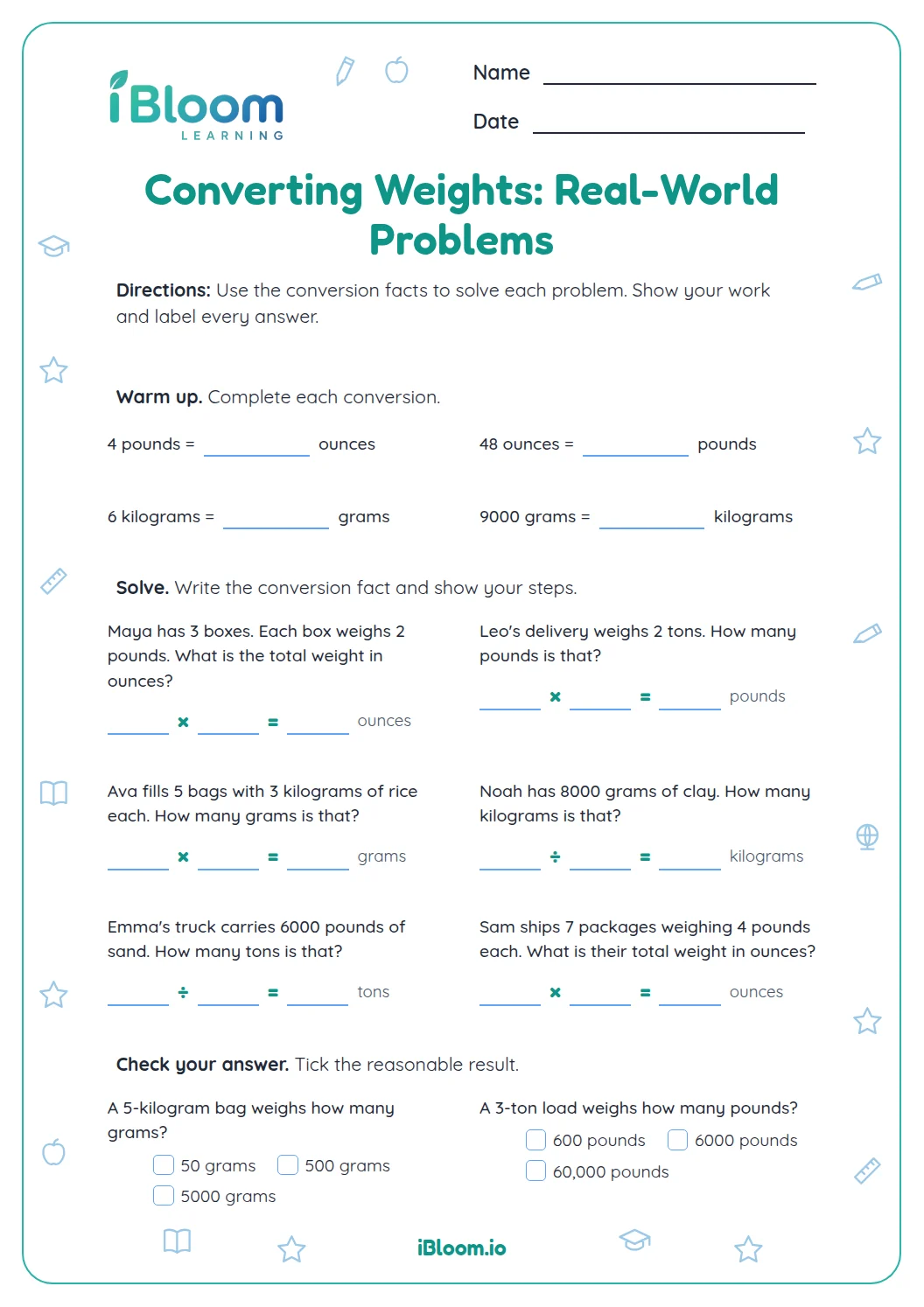
This printable Grade 5 worksheet practices converting customary and metric weights. Its 15 questions cover unit facts, a comparison, conversions between units in the same system, and short word problems. A separate answer key is included.
Aligned to 5.MD.A.1
How does converting weights work?
Use the relationship within each measurement system: 16 ounces = 1 pound, 2,000 pounds = 1 ton, and 1,000 grams = 1 kilogram.
The four parts move from unit facts and a comparison to direct conversions and short stories.
- 1Convert 5 pounds to ounces.
- 2Multiply by 16 ounces per pound: 5 × 16 = 80 ounces.
What will learners practice on this sheet?
The 15 questions ask learners to choose an appropriate conversion direction, calculate, and keep the unit with the answer.
How can a learner check the answers?
After finishing a part, use the answer key to check it. For a missed item, name the relationship or operation, solve it again, and compare.
How to use this worksheet
- 1Read the whole prompt and underline the quantity, unit, or feature it names.
- 2Complete Part A, showing the relationship used for each answer.
- 3Continue through the remaining parts and write units where they belong.
- 4Check each response with the answer key after finishing the sheet.
- 5Redo missed items and explain the step that changed the result.
Common mistakes and quick fixes
The mistake
Dividing when converting pounds to ounces.
The fix
Since ounces are smaller units, multiply the number of pounds by 16.
The mistake
Multiplying grams by 1,000 when converting grams to kilograms.
The fix
Since kilograms are larger units, divide the grams by 1,000.
The mistake
Writing a converted number without its unit.
The fix
Label every result in ounces, pounds, tons, grams, or kilograms.
Common Core alignment
This worksheet practices the following Common Core skill.
Convert measurements within one measurement system and use conversions to solve problems.
On this sheet: Learners convert customary and metric mass or weight units and apply those conversions in short problems.
Show the official wordingHide the official wording
Convert among different-sized standard measurement units within a given measurement system (e.g., convert 5 cm to 0.05 m), and use these conversions in solving multi-step, real world problems.
What to practice next
Make more practice
Further reading
Questions parents and teachers ask
Which weight units does this worksheet use?
It practices ounces, pounds, and tons in the customary system, plus grams and kilograms in the metric system. The questions convert within each system, compare weights after converting, and apply the relationships in short situations. Ask the learner to point to the clue in the prompt and explain how it supports the answer.
What conversion facts should learners know?
The 15 questions are grouped into four parts. They begin with unit facts, include a comparison, then practice direct conversions and finish with weight situations. Learners can check the units as well as the numerical results with the separate answer key.
How many questions are included?
There are 15 questions in two parts. Part A covers unit facts, conversions, and a comparison; Part B asks learners to write or correct conversion equations for weight situations. Ask the learner to point to the clue in the prompt and explain how it supports the answer.
Is an answer key included?
Yes. The answer key lists the answer to each question with its unit where needed. Check the unit as well as the number, since a correct numerical value with the wrong unit does not answer the conversion prompt. Ask the learner to point to the clue in the prompt and explain how it supports the answer.
How do I know whether to multiply or divide?
Think about the size of the unit you are moving to. Convert pounds to ounces by multiplying by 16 because ounces are smaller; convert grams to kilograms by dividing by 1,000 because kilograms are larger. Ask the learner to point to the clue in the prompt and explain how it supports the answer.