

About this worksheet
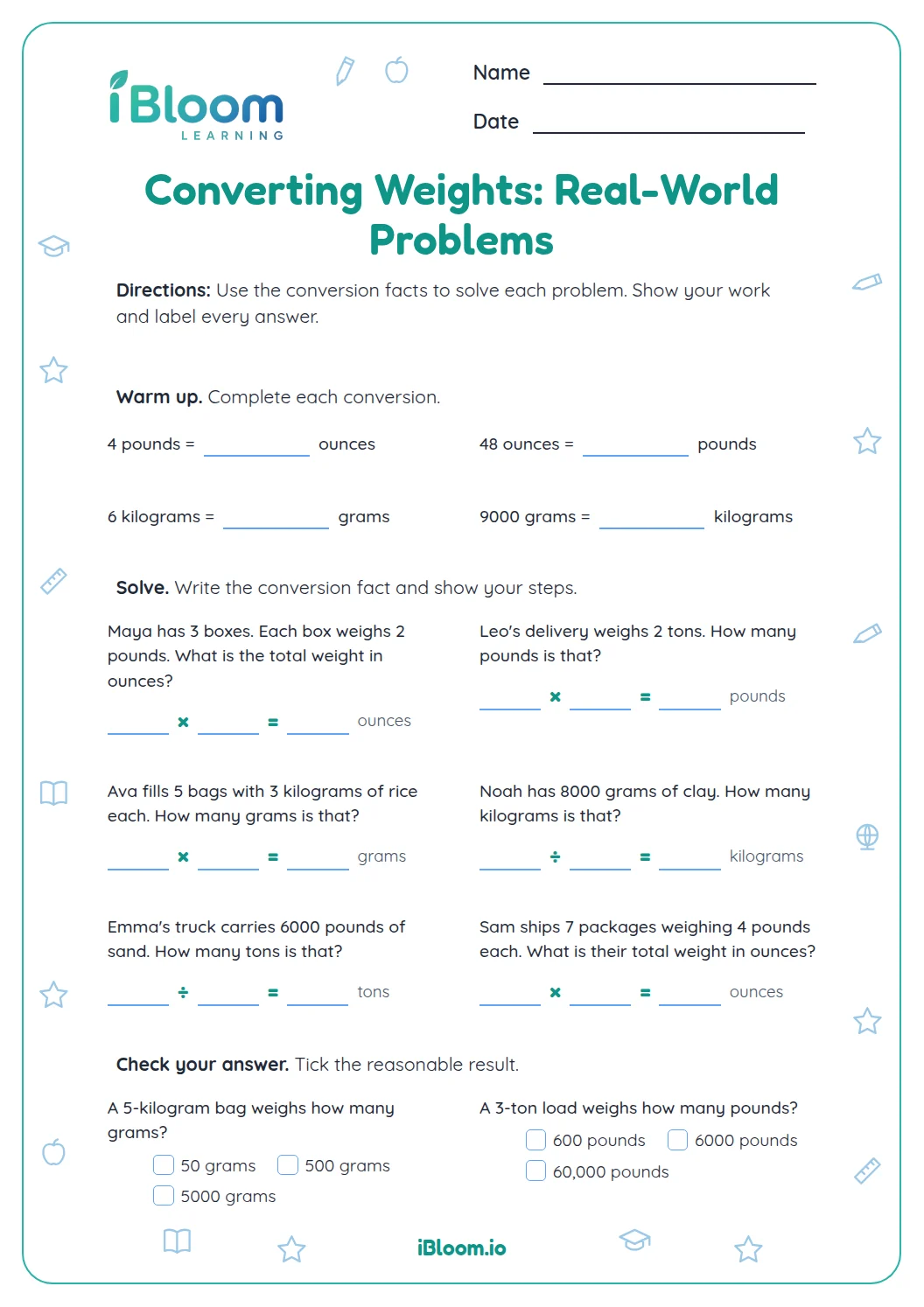
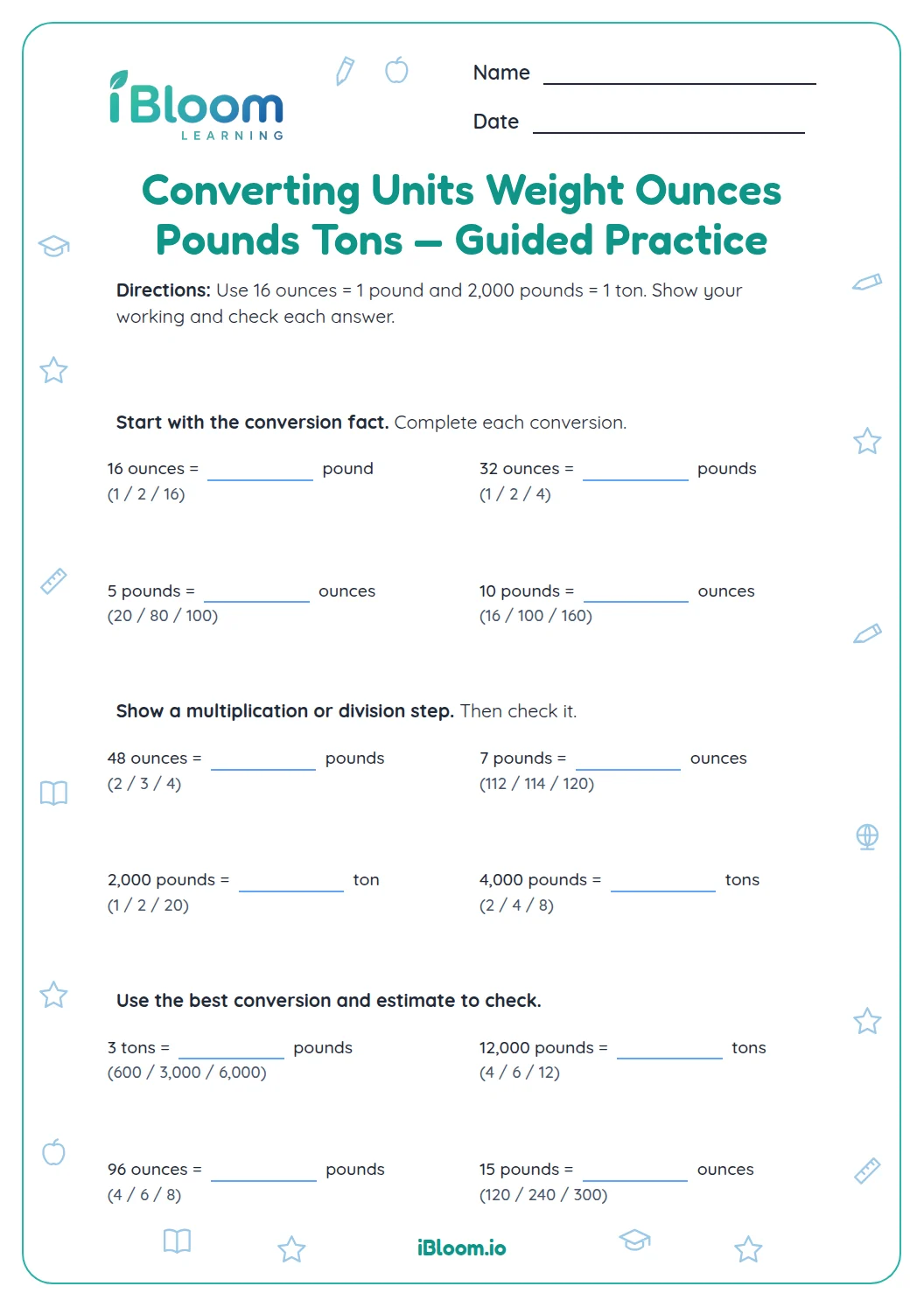
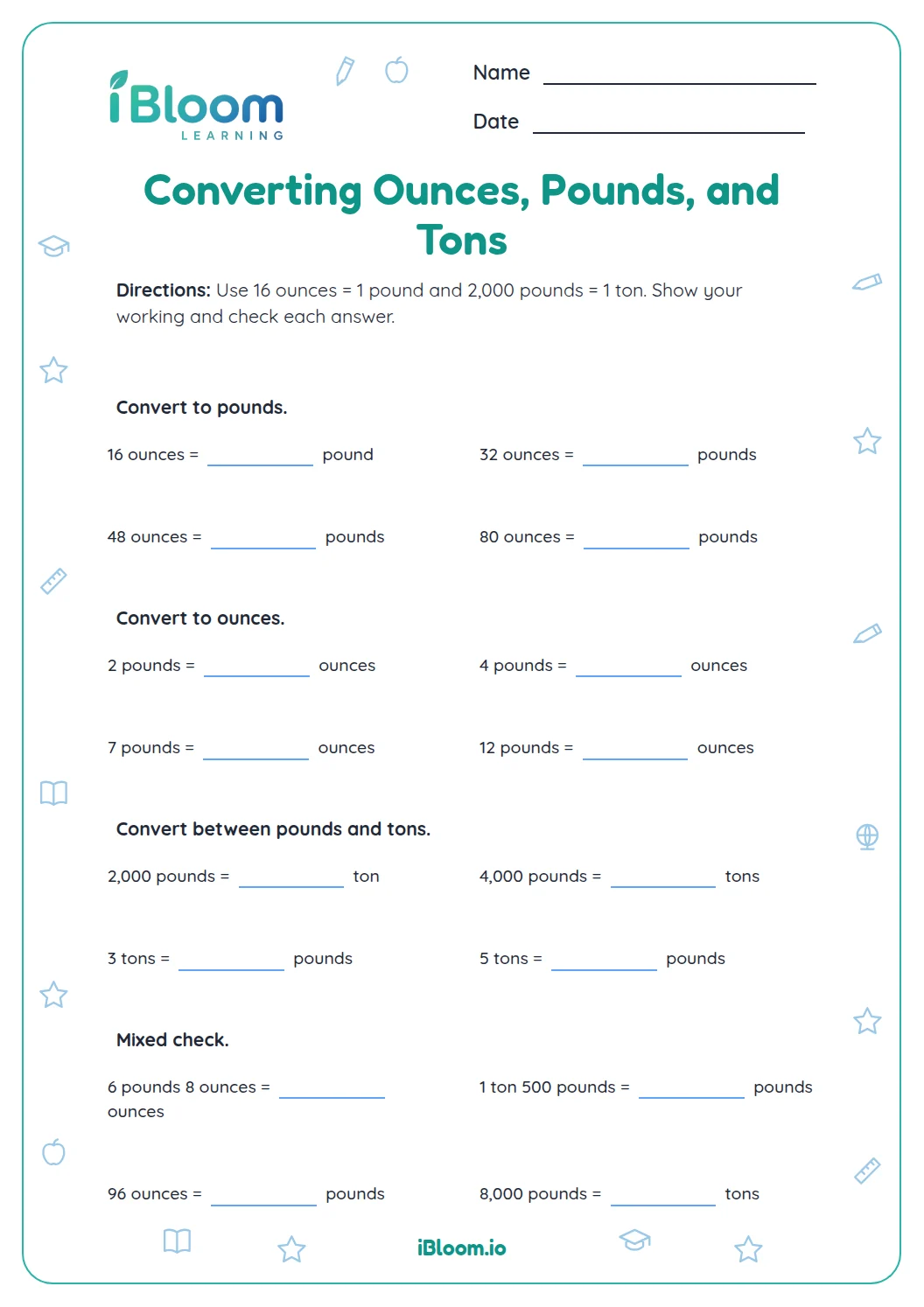
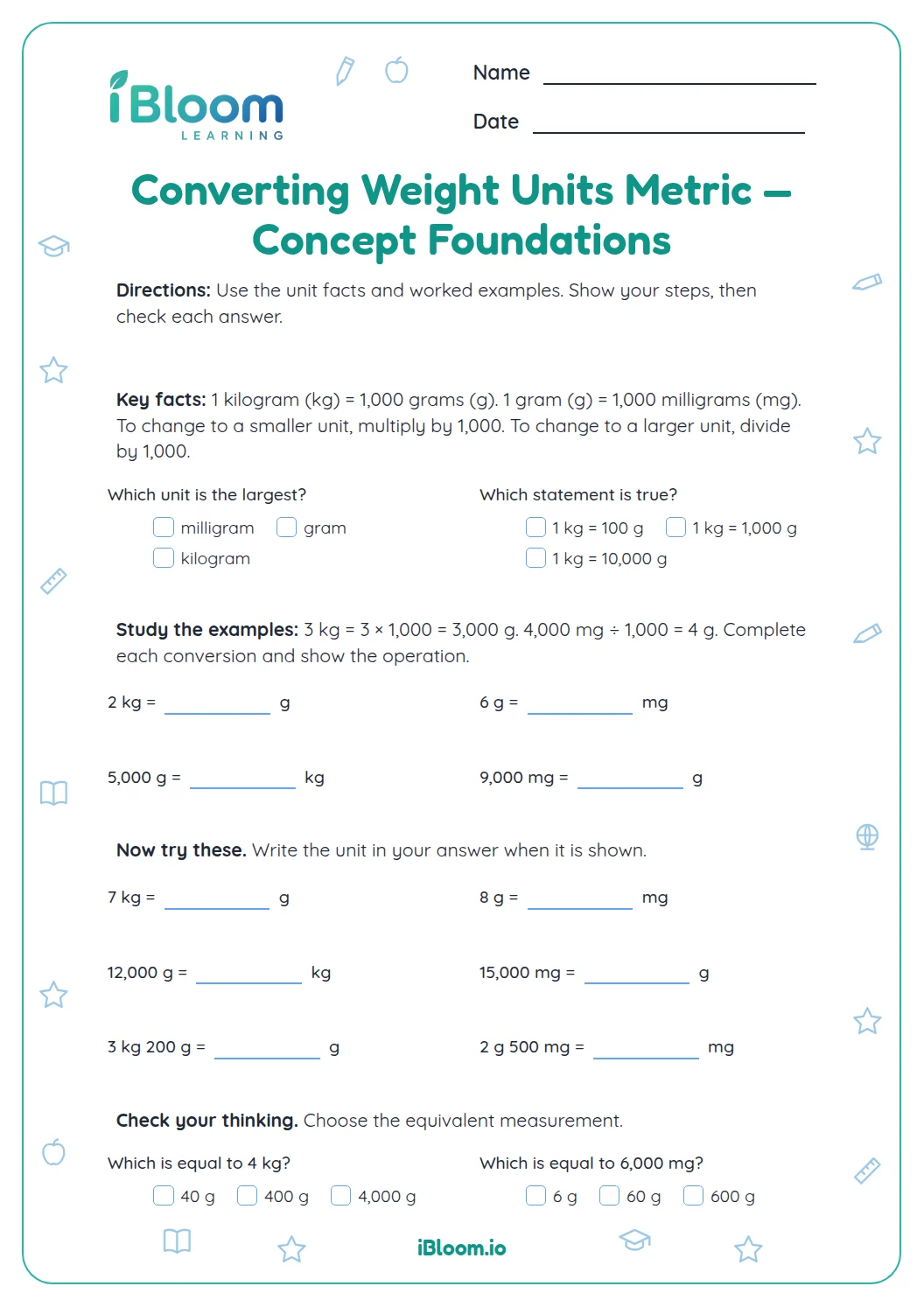
This Grade 5 measurement worksheet practices customary and metric weight conversions with equivalent-unit relationships. Students convert ounces and pounds, tons and pounds, milligrams and grams, and grams and kilograms, then use conversions in short situations and compare weights. A separate answer key shows each result with its unit. The practice connects to CCSS 5.MD.A.1, converting among standard units within a measurement system.
Aligned to 5.MD.A.1
How does an equivalent-unit model help?
Start with the relationship shown in the table. Then decide whether the target unit is smaller or larger. A conversion to a smaller unit uses more units, so the number grows.
- 116 ounces = 1 pound
- 232 ounces is twice 16 ounces.
- 3So 32 ounces = 2 pounds.
Which unit relationships appear on the sheet?
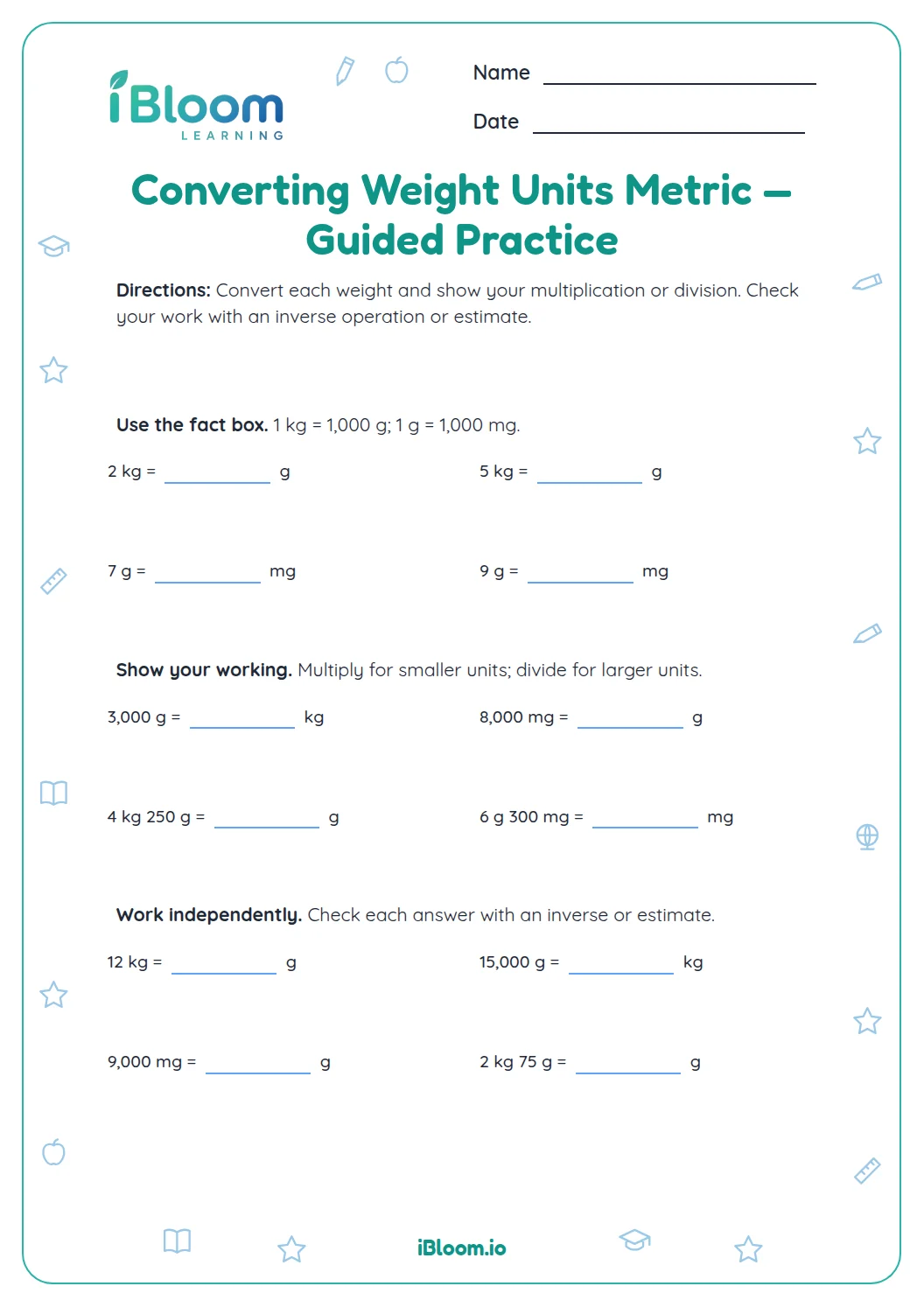
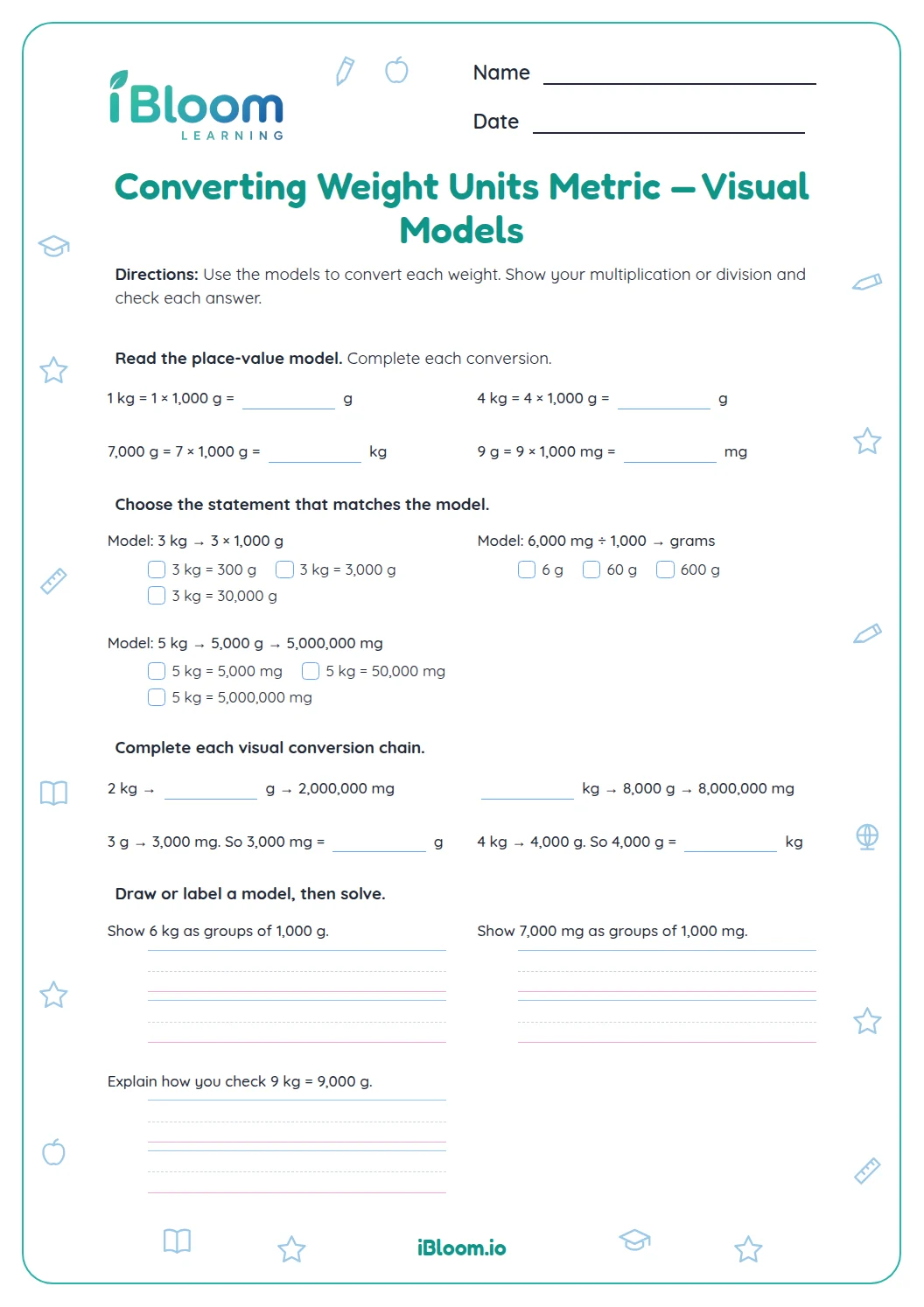
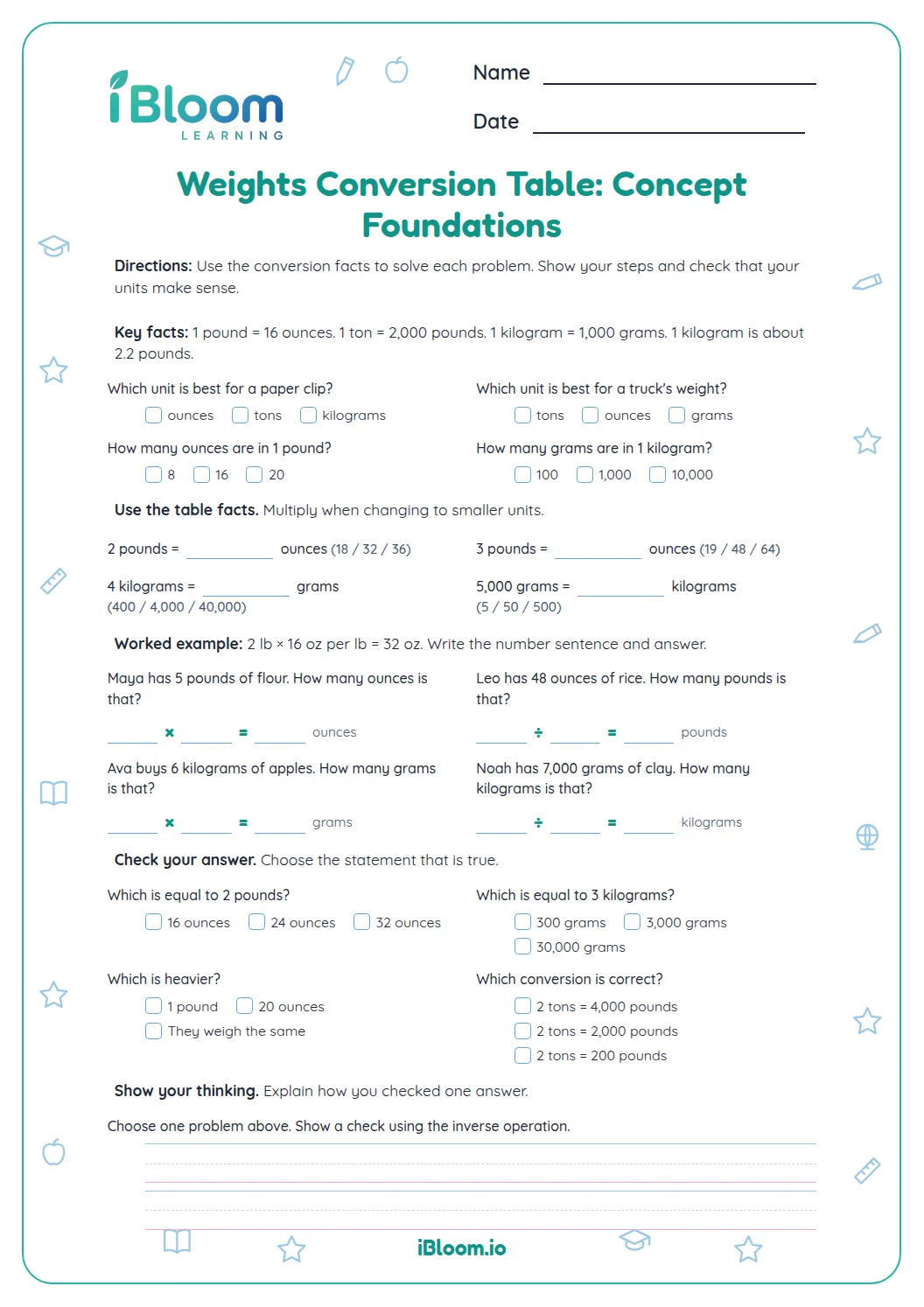
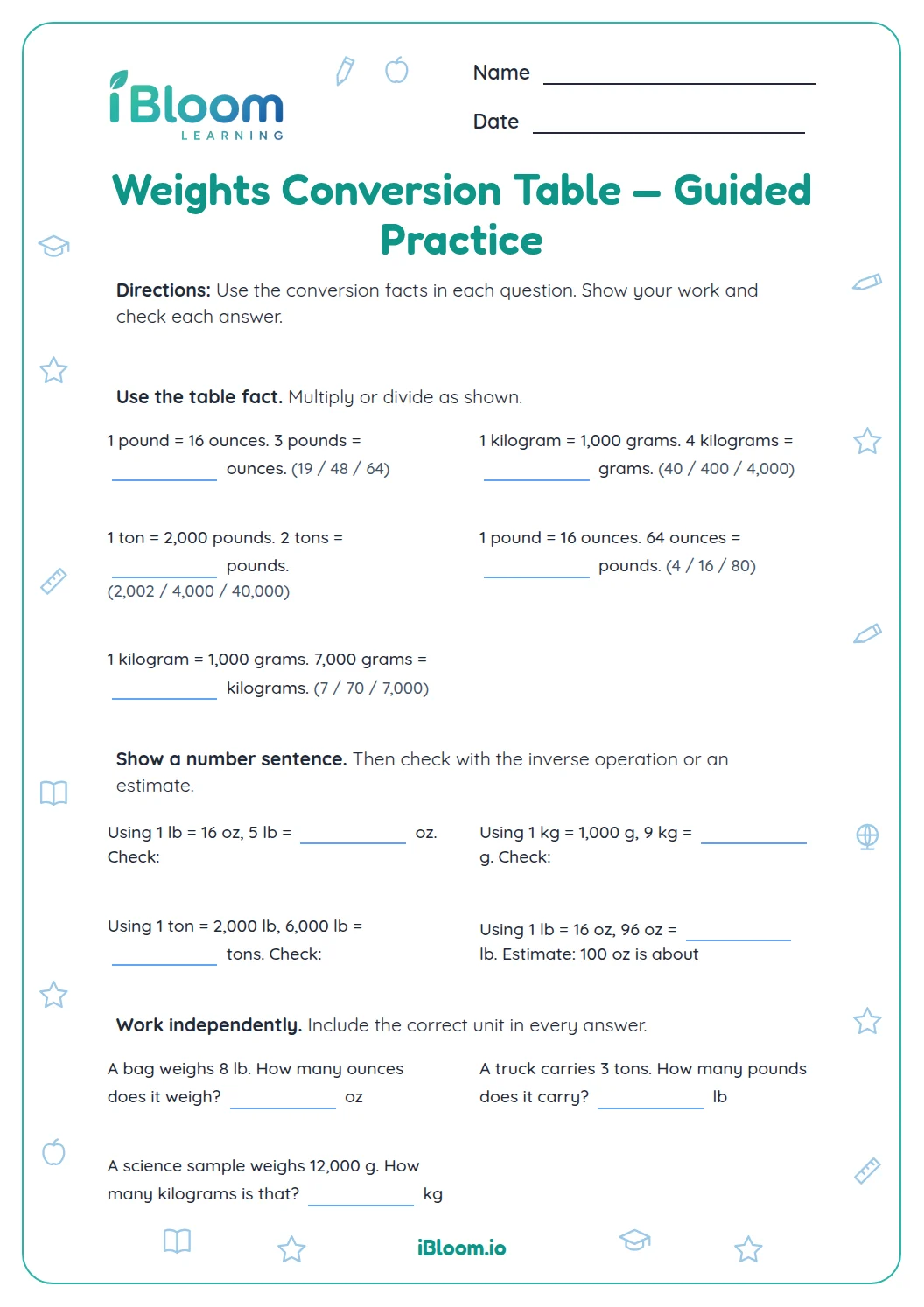
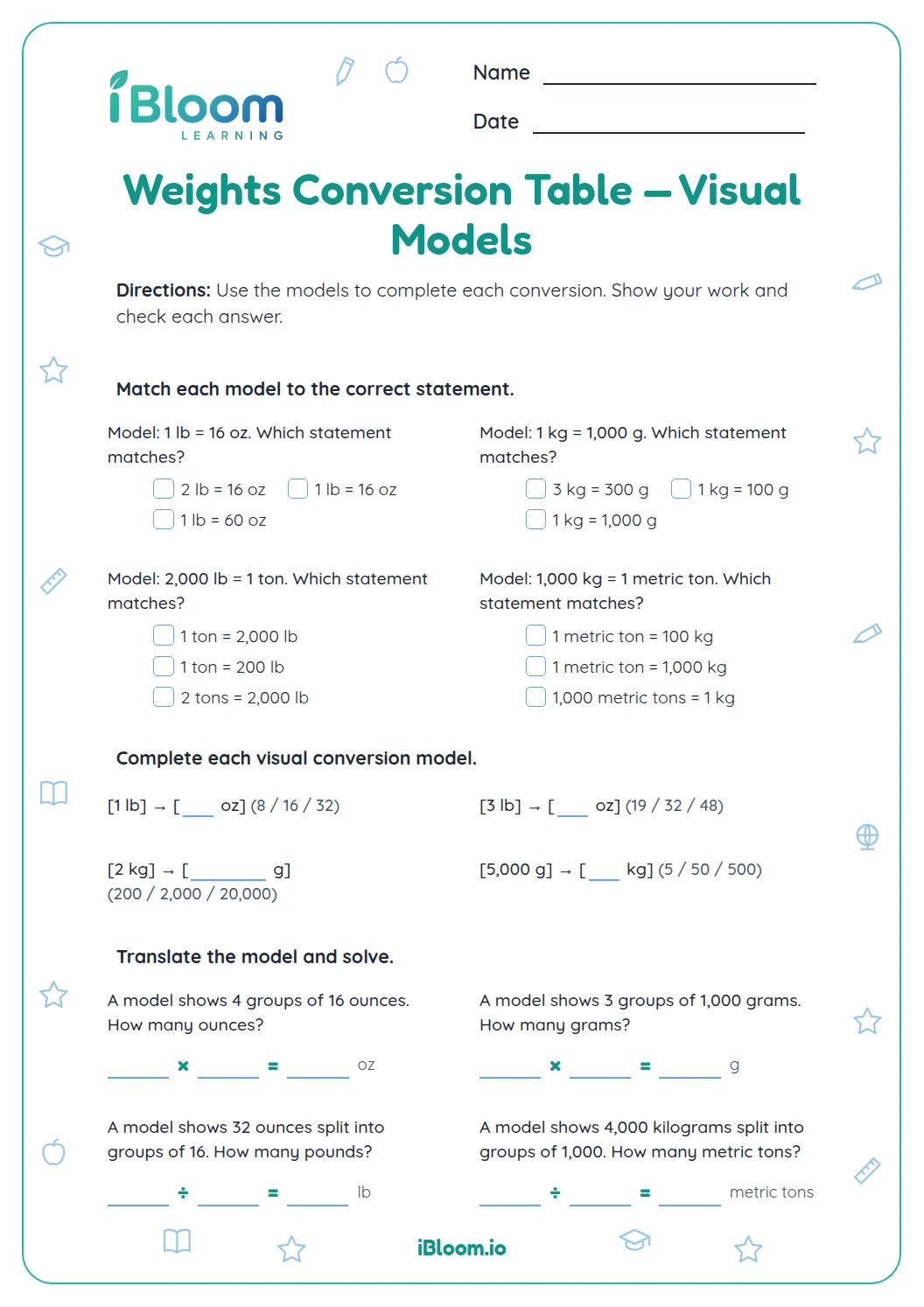
Customary questions use 16 ounces per pound and 2,000 pounds per ton. Metric questions use 1,000 grams per kilogram. Keep the unit labels with the values as you move between the rows.
How can you check whether a conversion is reasonable?
Estimate the direction before calculating. Kilograms converted to grams should produce a larger number; grams converted to kilograms should produce a smaller number. Finish by writing the requested unit.
How to use this worksheet
- 1Write the given equivalence with both units.
- 2Decide whether the new unit is smaller or larger.
- 3Multiply or divide by the factor in the equivalence.
- 4Keep the requested unit beside the answer.
- 5Check whether the number grew or shrank in the expected direction.
Common mistakes and quick fixes
The mistake
Multiplying when converting a small-unit count into a larger unit.
The fix
Divide by the number of smaller units in one larger unit.
The mistake
Changing the number but keeping the old unit.
The fix
Copy the target unit from the question beside the result.
The mistake
Using 100 instead of 1,000 for metric mass relationships.
The fix
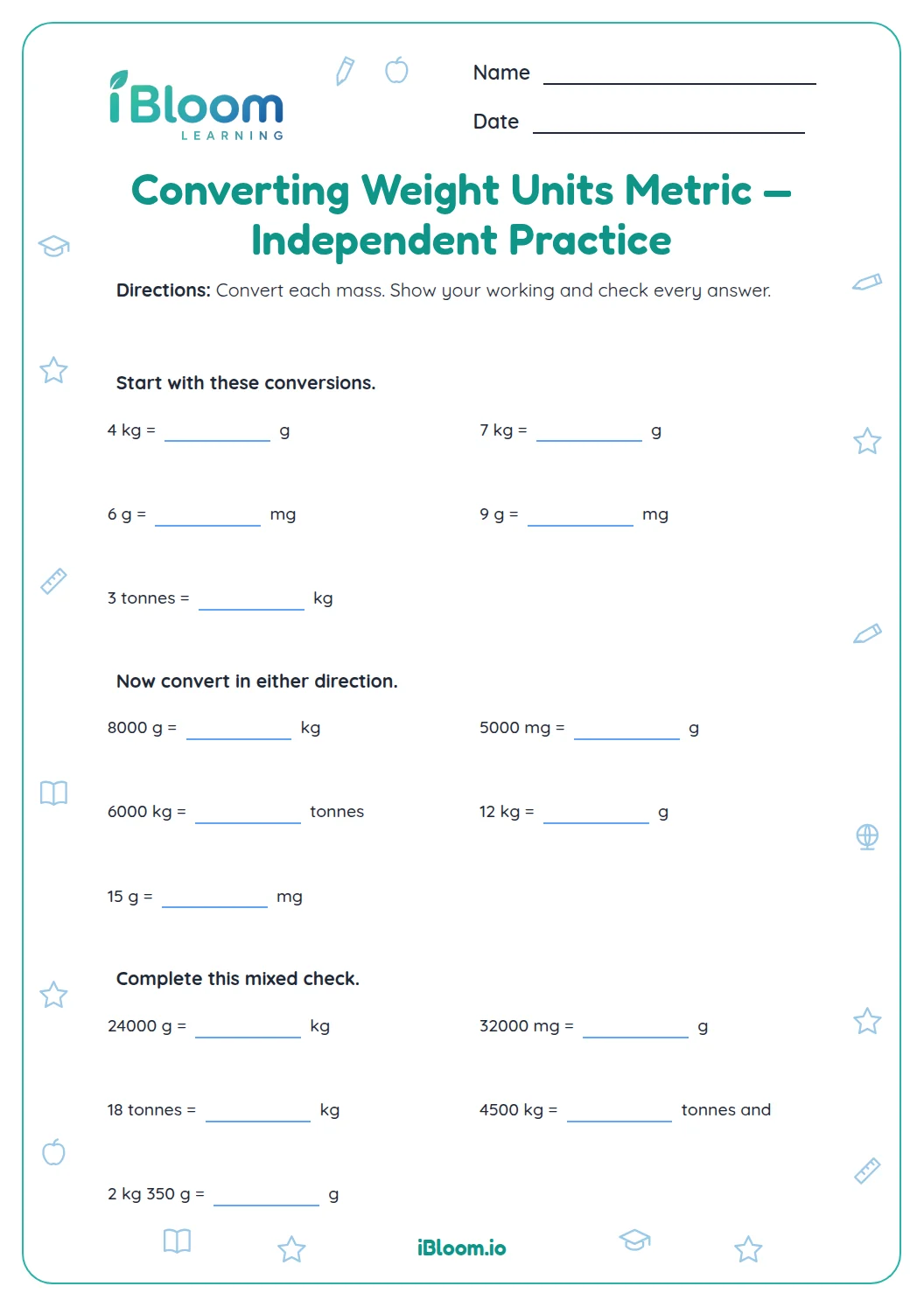
Recall that each kilogram is 1,000 grams and each gram is 1,000 milligrams.
Common Core alignment
Students convert between customary and metric units within each measurement system and use the conversions in short situations.
Convert between different-sized units within one measurement system.
On this sheet: The worksheet converts within customary or metric units and applies conversions in short situations.
Show the official wordingHide the official wording
Convert among different-sized standard measurement units within a given measurement system (e.g., convert 5 cm to 0.05 m), and use these conversions in solving multi-step, real world problems.
What to practice next
Make more practice
Further reading
Questions parents and teachers ask
Which unit relationships are practiced?
The tables and story questions use 16 ounces per pound, 2,000 pounds per ton, and 1,000 grams per kilogram. Students complete tables, convert amounts in short situations, and solve a multistep delivery problem by converting tons to pounds before subtracting.
How do students decide whether to multiply or divide?
Check whether the target unit is smaller or larger than the starting unit. Converting pounds to ounces or kilograms to grams uses multiplication; converting grams to kilograms uses division. The model tables show the relationship students need for each question.
Why should students write the unit with an answer?
A number alone does not show what quantity it measures. Writing ounces, pounds, grams, or kilograms with each answer makes the conversion clear and helps students check that they answered in the requested unit. In the number-sentence items, the unit is already printed beside the blank.
What does the error-check question ask?
Question 13 asks students to correct a change from 2.4 kilograms to 240 grams. Since each kilogram contains 1,000 grams, the correct amount is 2,400 grams. The larger number is sensible because grams are smaller units than kilograms.
What does the answer key include?
The key gives completed table values, converted amounts with units, the correction for the error question, and the comparison answer. For a check, students can use the relationship in the model and estimate whether the number should grow or shrink.