
About this worksheet
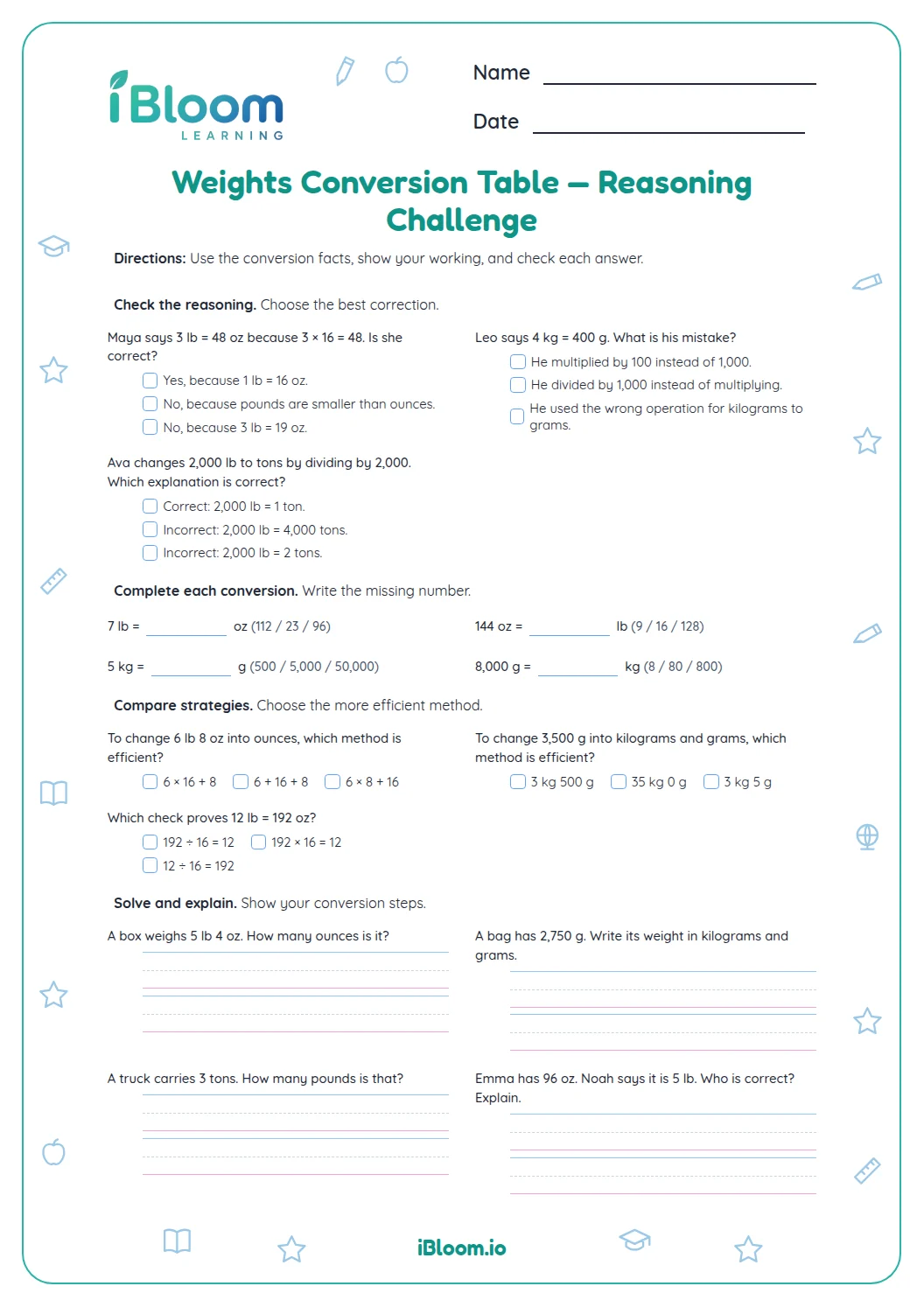
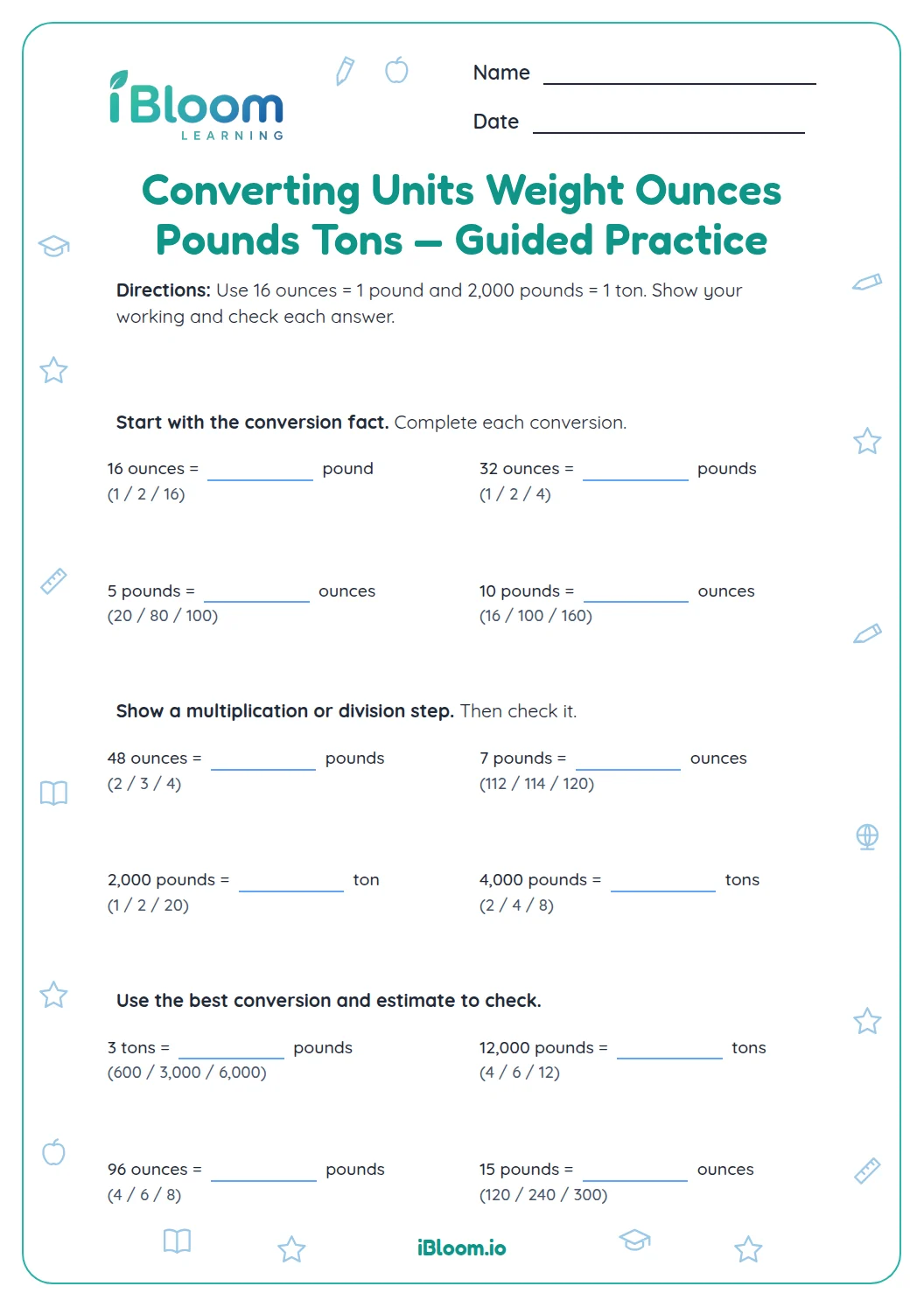
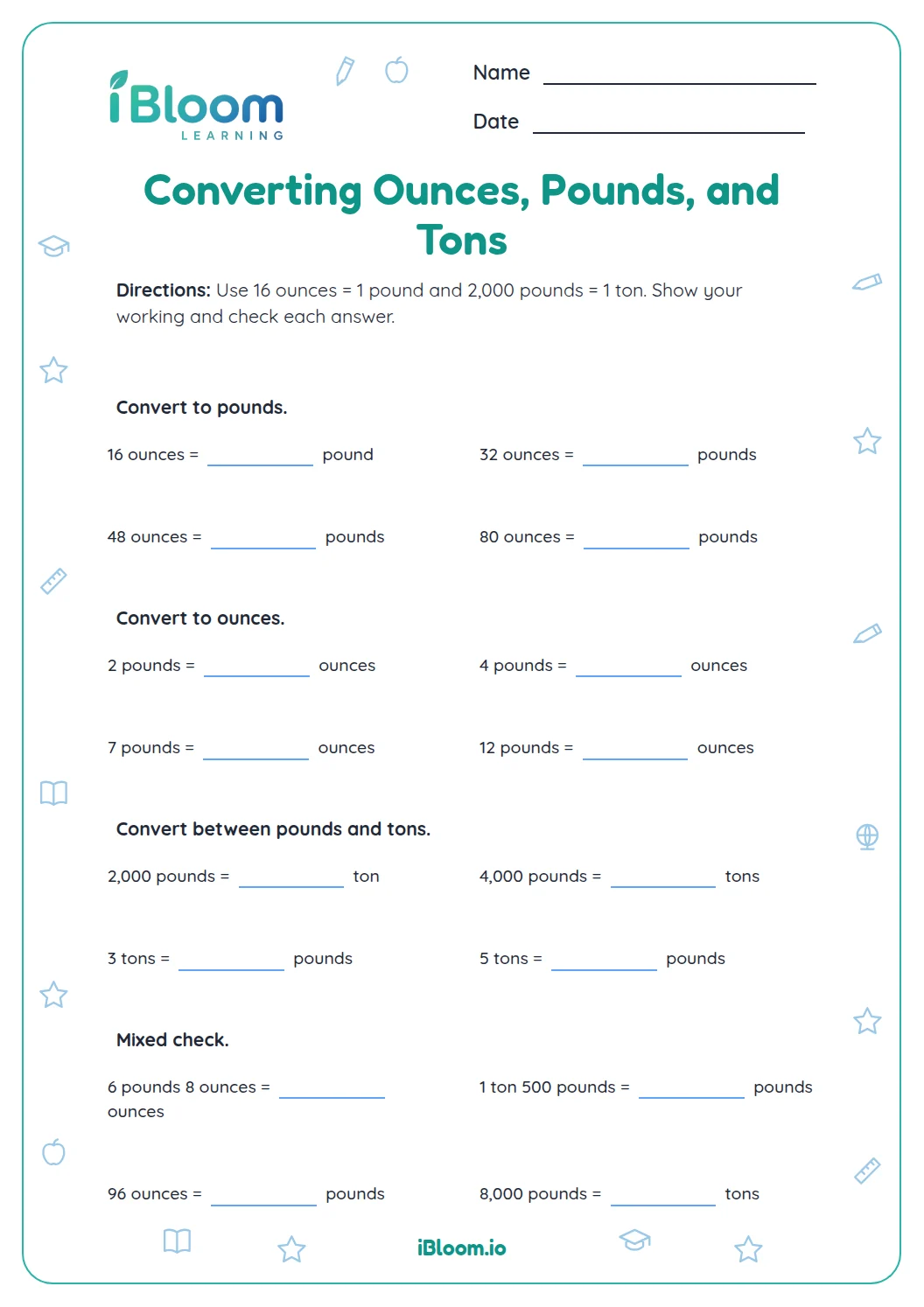
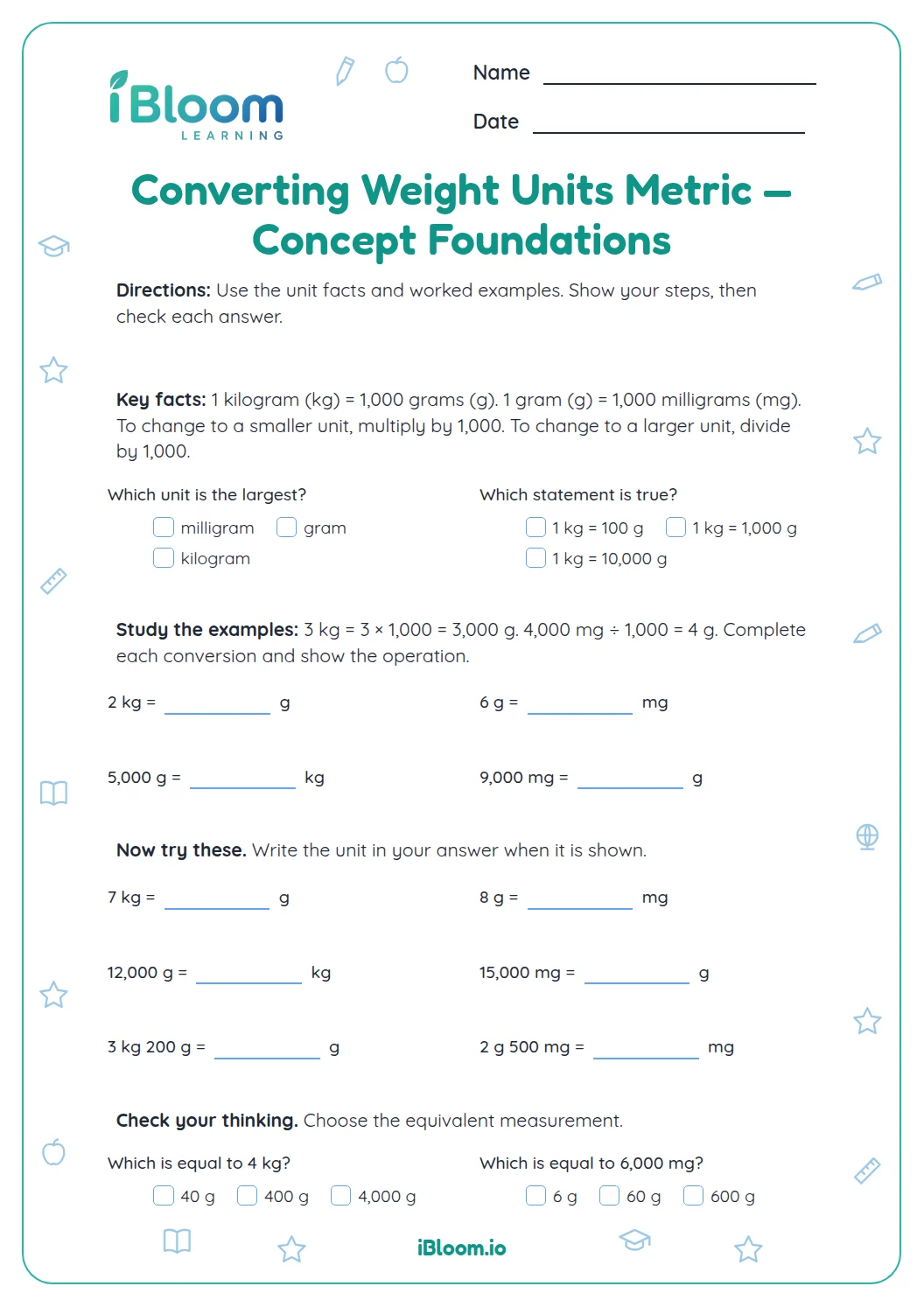
This free printable Grade 5 worksheet practices converting customary and metric weight units. The 14 questions move from familiar conversion facts to a pounds-and-ounces table, short word problems, and a comparison that requires using the same unit. Children use relationships such as 1 pound = 16 ounces and 1 kilogram = 1,000 grams. A separate answer key includes the expected units. The work supports CCSS 5.MD.A.1.
Aligned to K.MD.B.3
Which weight facts help with these conversions?
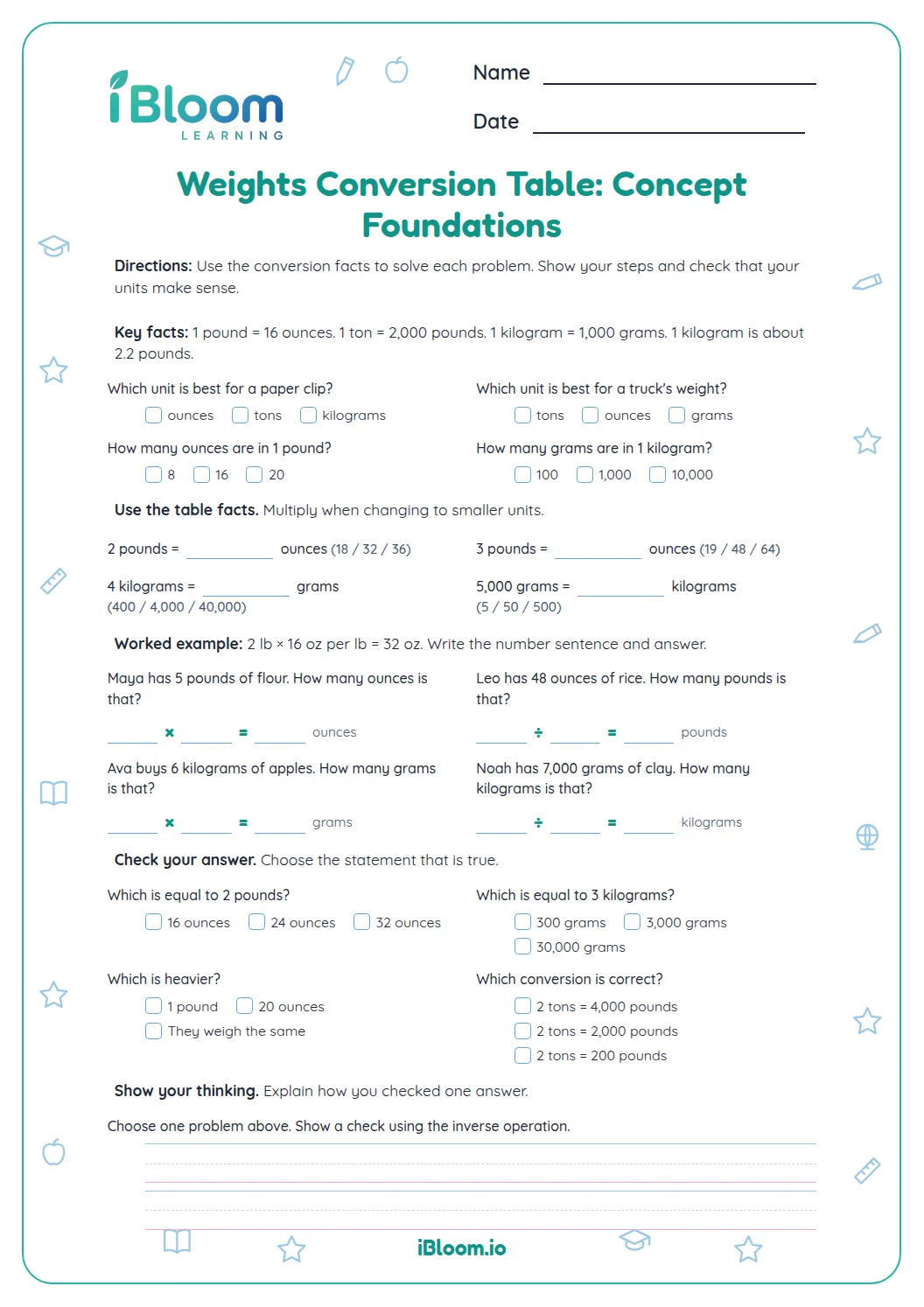
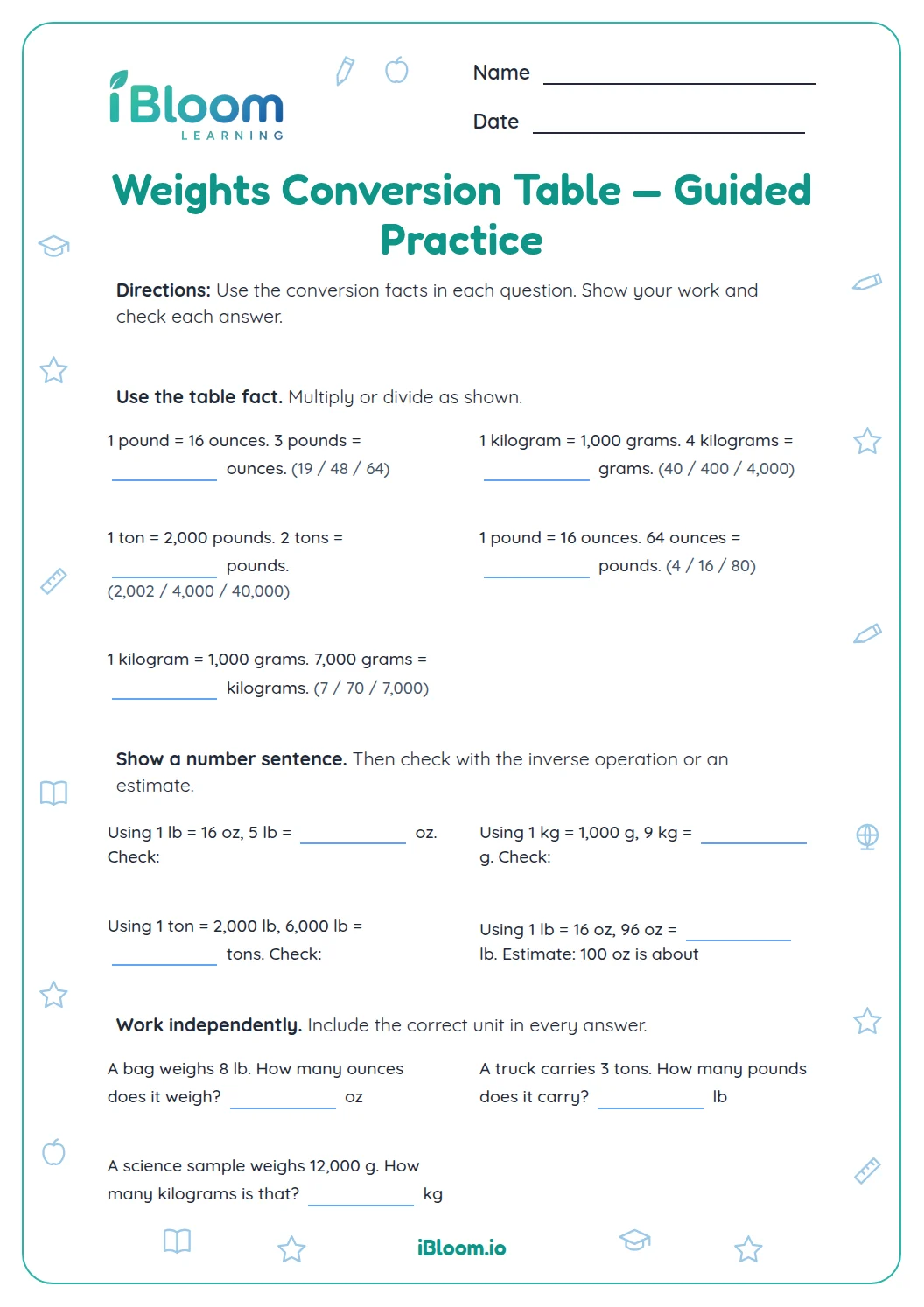
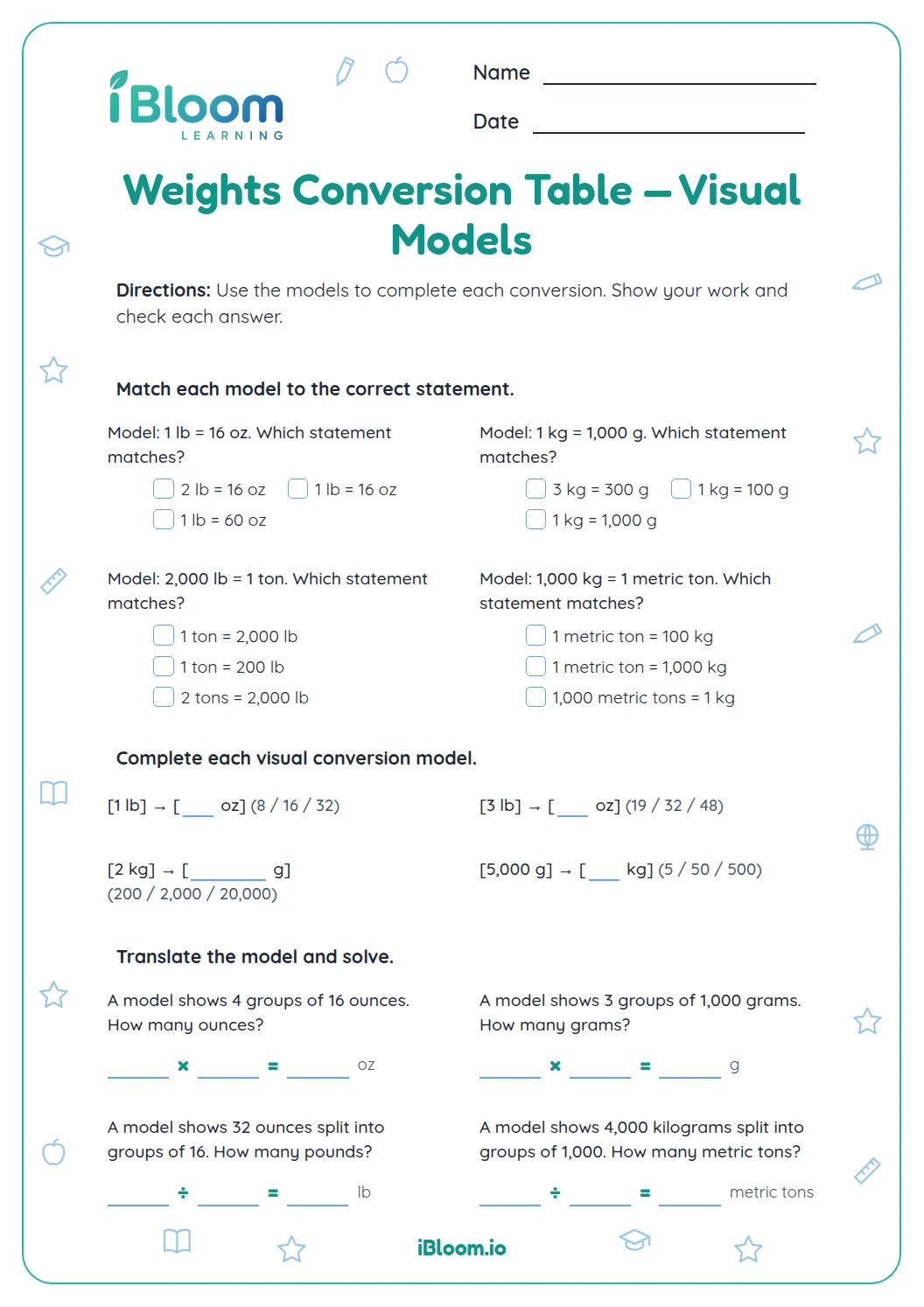
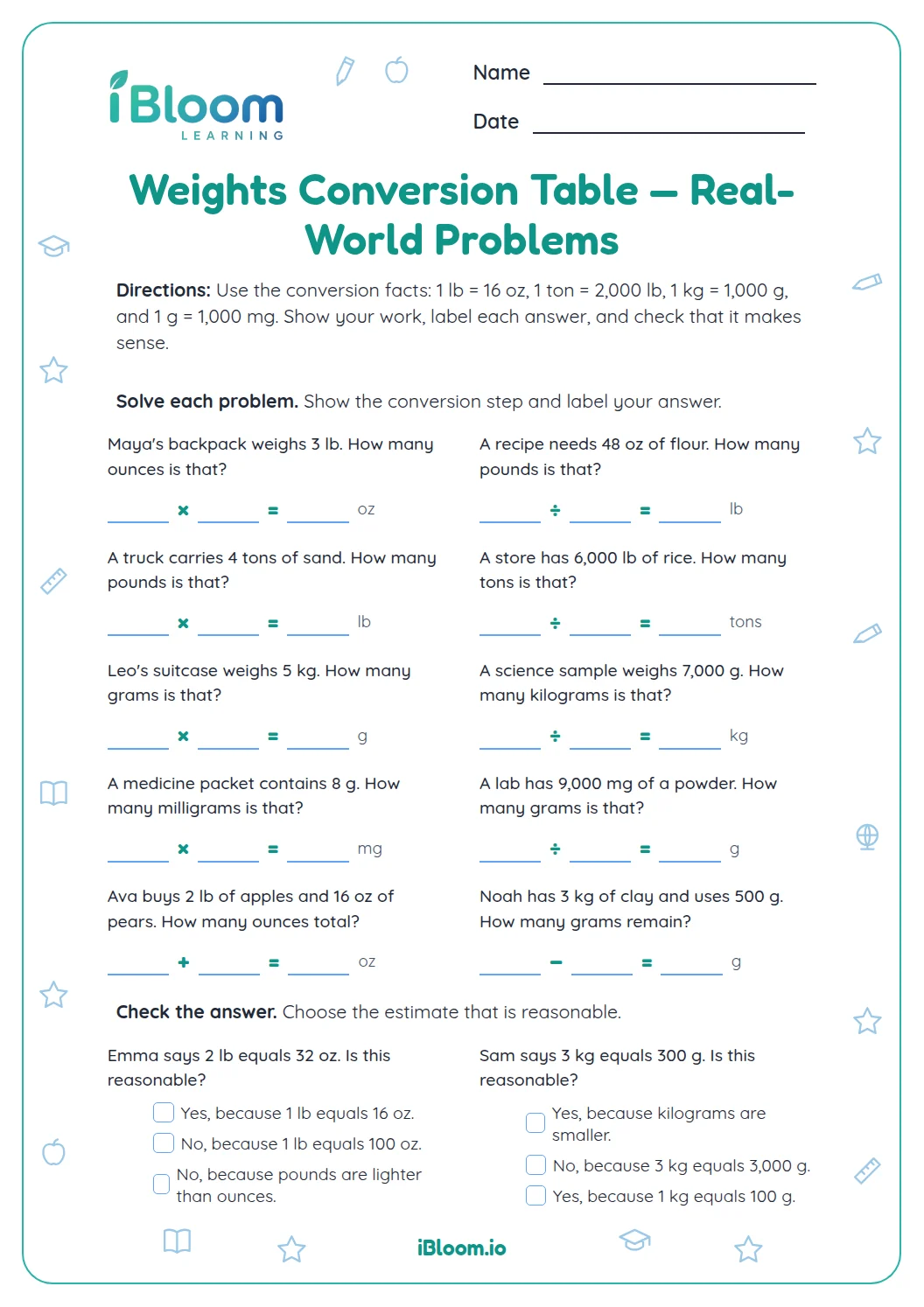
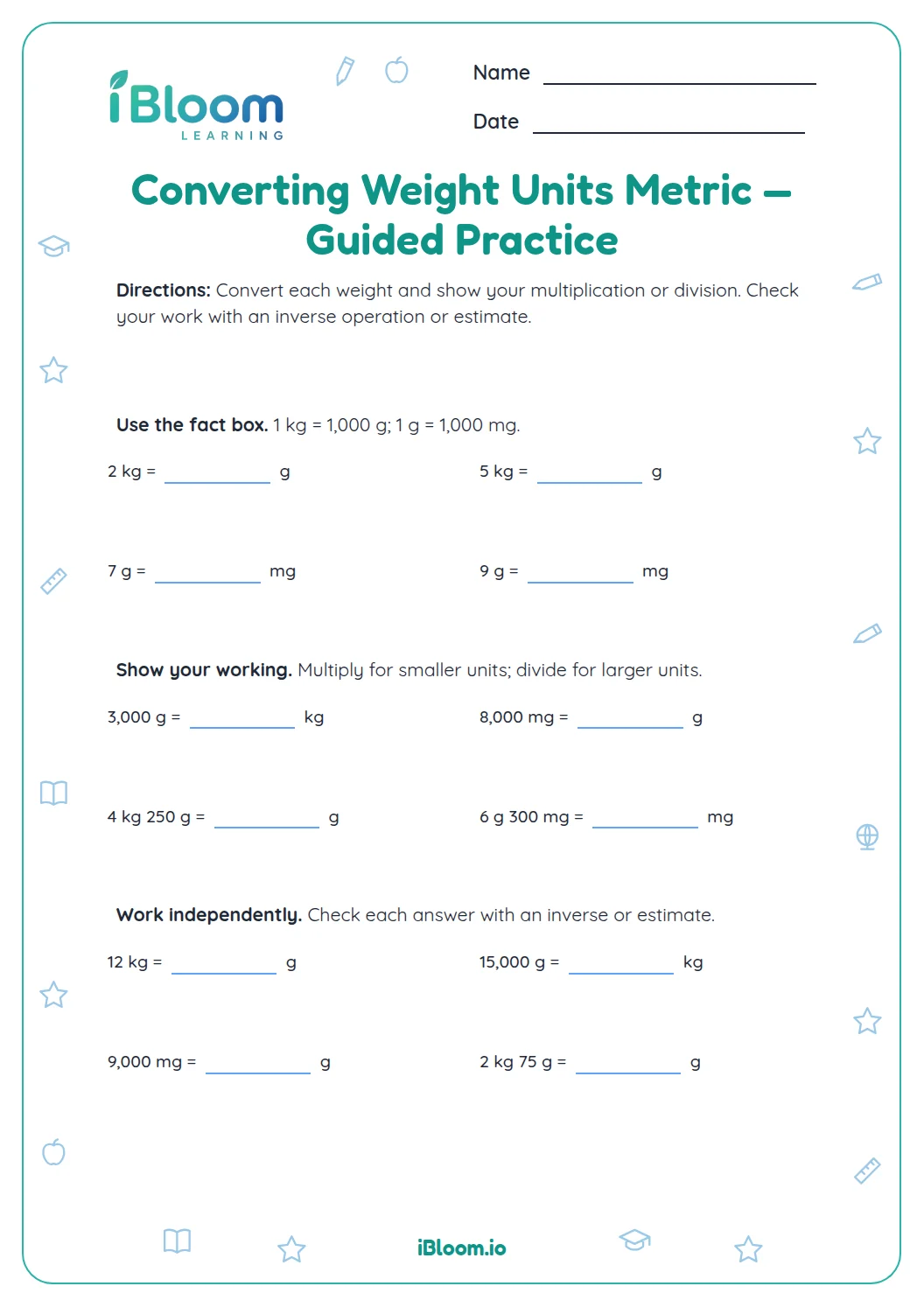
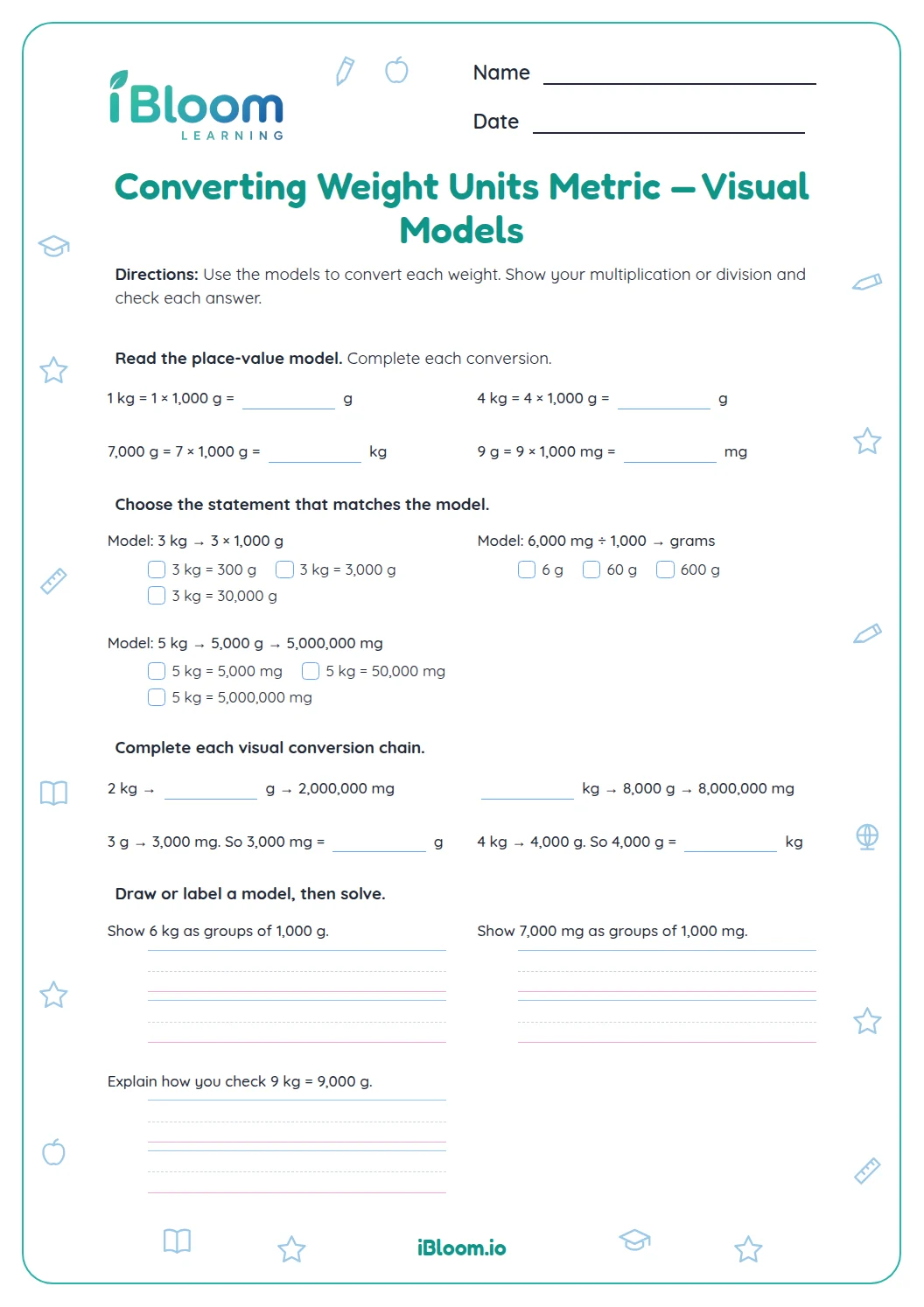
Part A uses customary facts (16 ounces in a pound and 2,000 pounds in a ton) and metric facts (1,000 grams in a kilogram and 1,000 milligrams in a gram). First identify the units, then decide whether the number should grow or shrink.
- 15 pounds 4 ounces = 5 × 16 + 4 ounces
- 280 + 4 = 84 ounces
How does the table show equivalent weights?
Part B pairs pounds with ounces. Each row gives two names for the same weight, so the missing value belongs to the row with 2 pounds. The known 1-pound and 4-pound rows help check the scale.
How can you compare weights in different units?
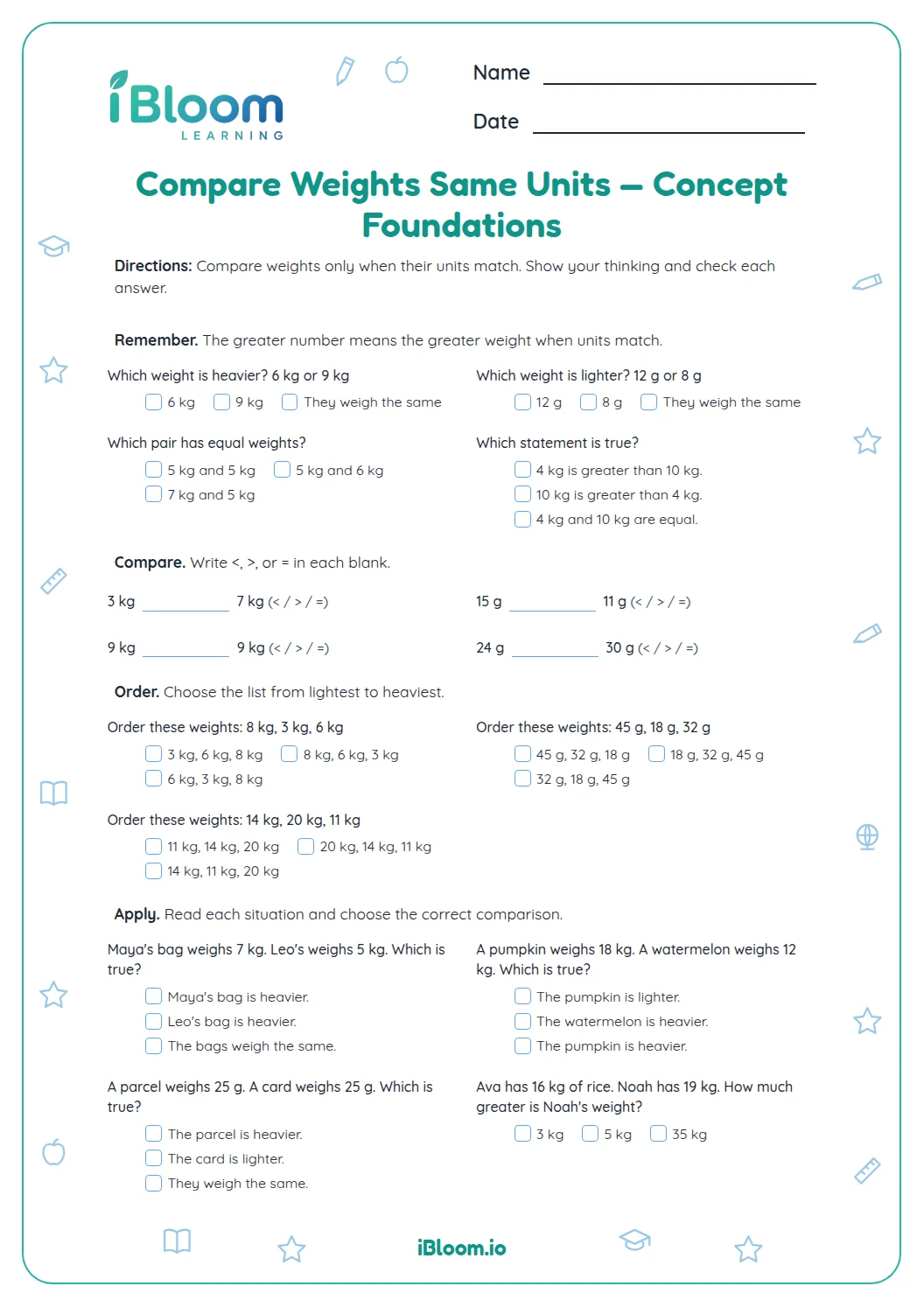
Part D asks you to compare 3 pounds with 45 ounces. Convert 3 pounds to 48 ounces, then compare 48 with 45. Keeping both quantities in ounces makes the comparison direct.
How to use this worksheet
- 1Read the unit names before choosing an operation.
- 2Write the conversion fact beside the problem.
- 3For mixed units, convert the larger unit first, then add the smaller unit.
- 4For comparisons, rewrite both weights in the same unit.
- 5Check each answer with the conversion fact and the answer key.
Common mistakes and quick fixes
The mistake
Multiplying when the target unit is larger.
The fix
Use division when changing many small units into fewer large units.
The mistake
Forgetting the extra ounces in a mixed weight.
The fix
Convert the pounds to ounces, then add the given ounces.
The mistake
Comparing a number of pounds directly with ounces.
The fix
Convert one weight so both values use the same unit.
Early math alignment
This worksheet practices sorting objects into groups by shared features at the stated grade level.
Classify pictured objects into groups, count each group, and compare their totals.
On this sheet: Children classify pictures, count two categories in question 13, and compare the group totals.
Show the official wordingHide the official wording
Classify objects into given categories; count the numbers of objects in each category and sort the categories by count.
What to practice next
Make more practice
Further reading
Questions parents and teachers ask
What conversion facts are used on this worksheet?
The customary problems use 16 ounces in 1 pound and 2,000 pounds in 1 ton. Metric problems use 1,000 grams in 1 kilogram and 1,000 milligrams in 1 gram. These facts are printed in Part A directions, and the answer key gives the results for every problem.
How do you convert pounds to ounces?
Multiply the number of pounds by 16 because each pound contains 16 ounces. For example, question 2 asks about 3 pounds: 3 × 16 = 48 ounces. To change ounces back to pounds, divide by 16, as in question 3.
How do I solve the table question?
Find the row labeled 2 pounds and use the relationship shown by the other rows. Since each pound equals 16 ounces, 2 pounds equals 32 ounces. The table makes the pairs visible, and the answer key confirms the missing entry.
Does the worksheet include metric weights?
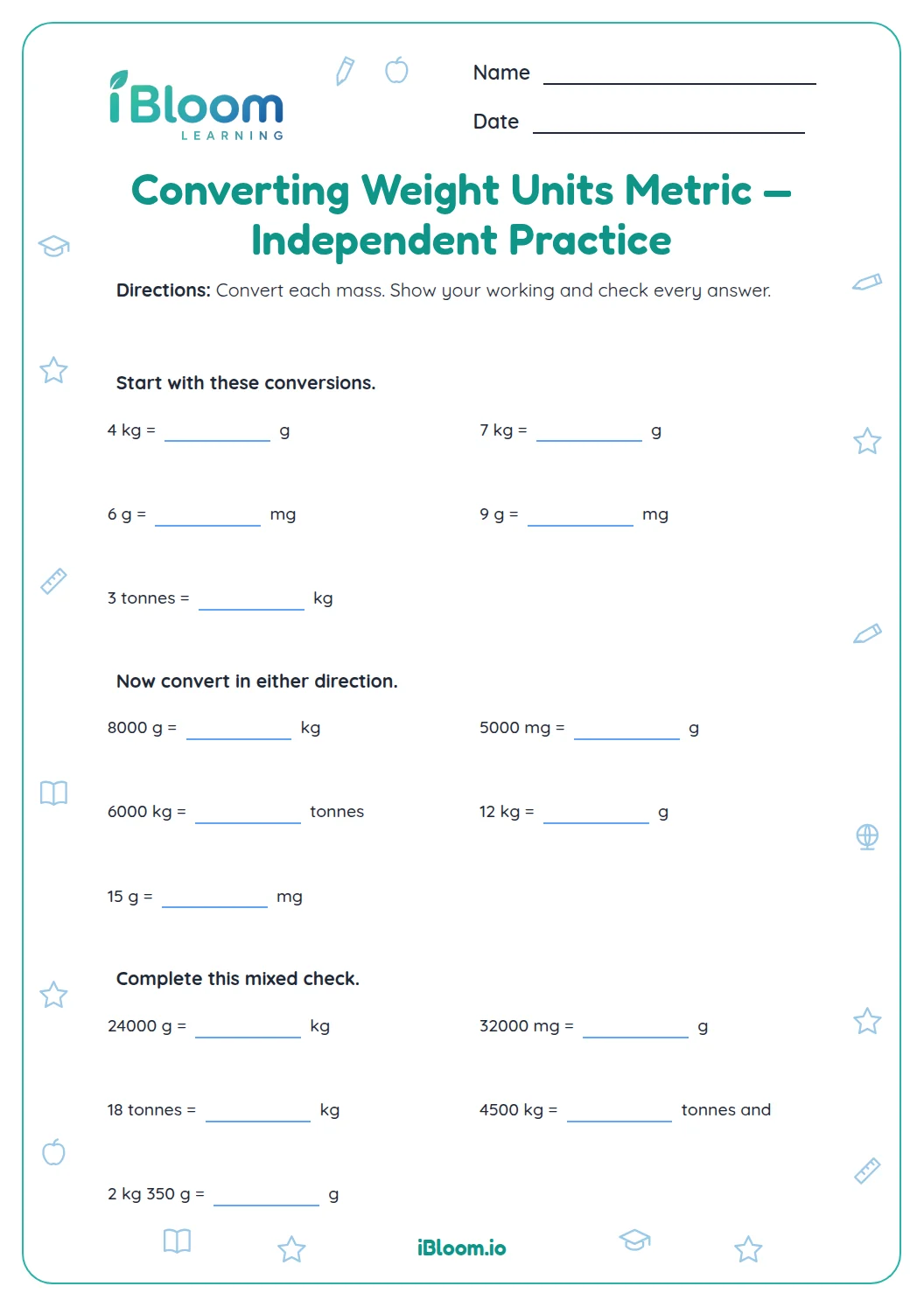
Yes. Questions 7 through 9 connect kilograms, grams, and milligrams. For example, 5 kilograms equals 5,000 grams, while 9,000 milligrams equals 9 grams. The customary questions use ounces, pounds, and tons. Check the printed unit beside each answer as well as the number.
How many questions and pages are included?
There are 14 questions across two worksheet pages, followed by a two-page answer key. The practice includes nine direct conversions, a small conversion table, two short weight situations, and two comparison or error-check questions. Check the printed unit beside each answer as well as the number.