

About this worksheet
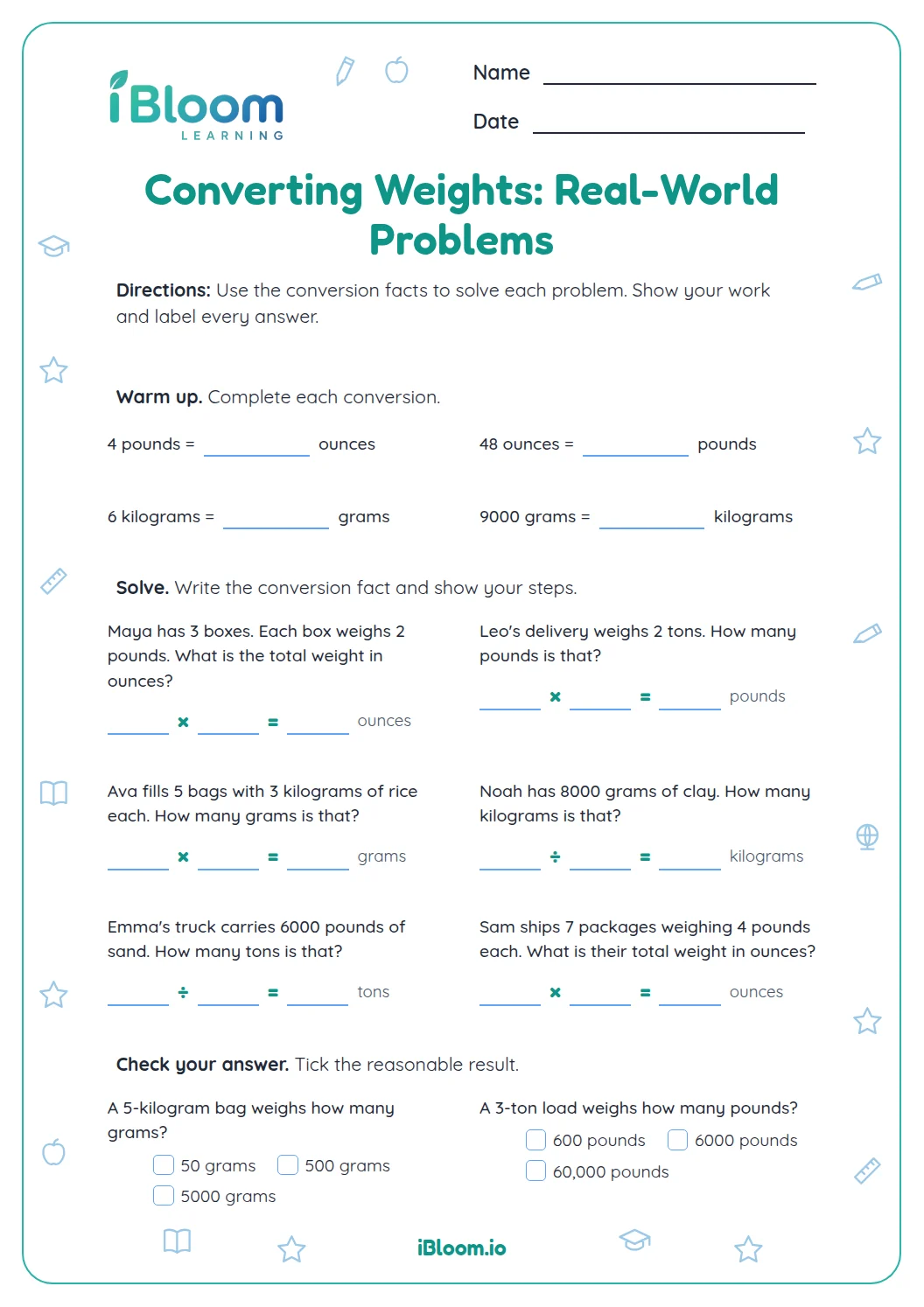
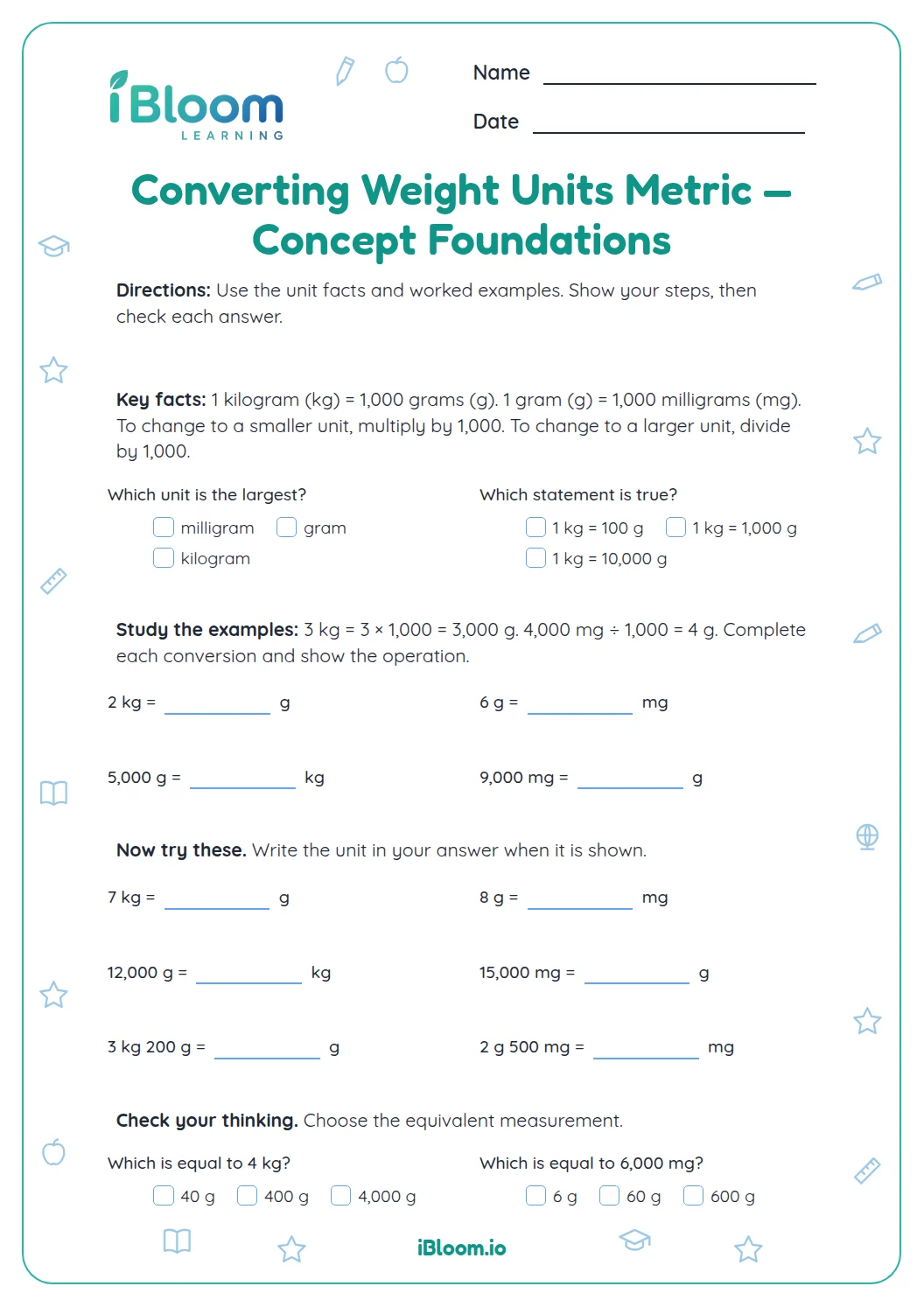
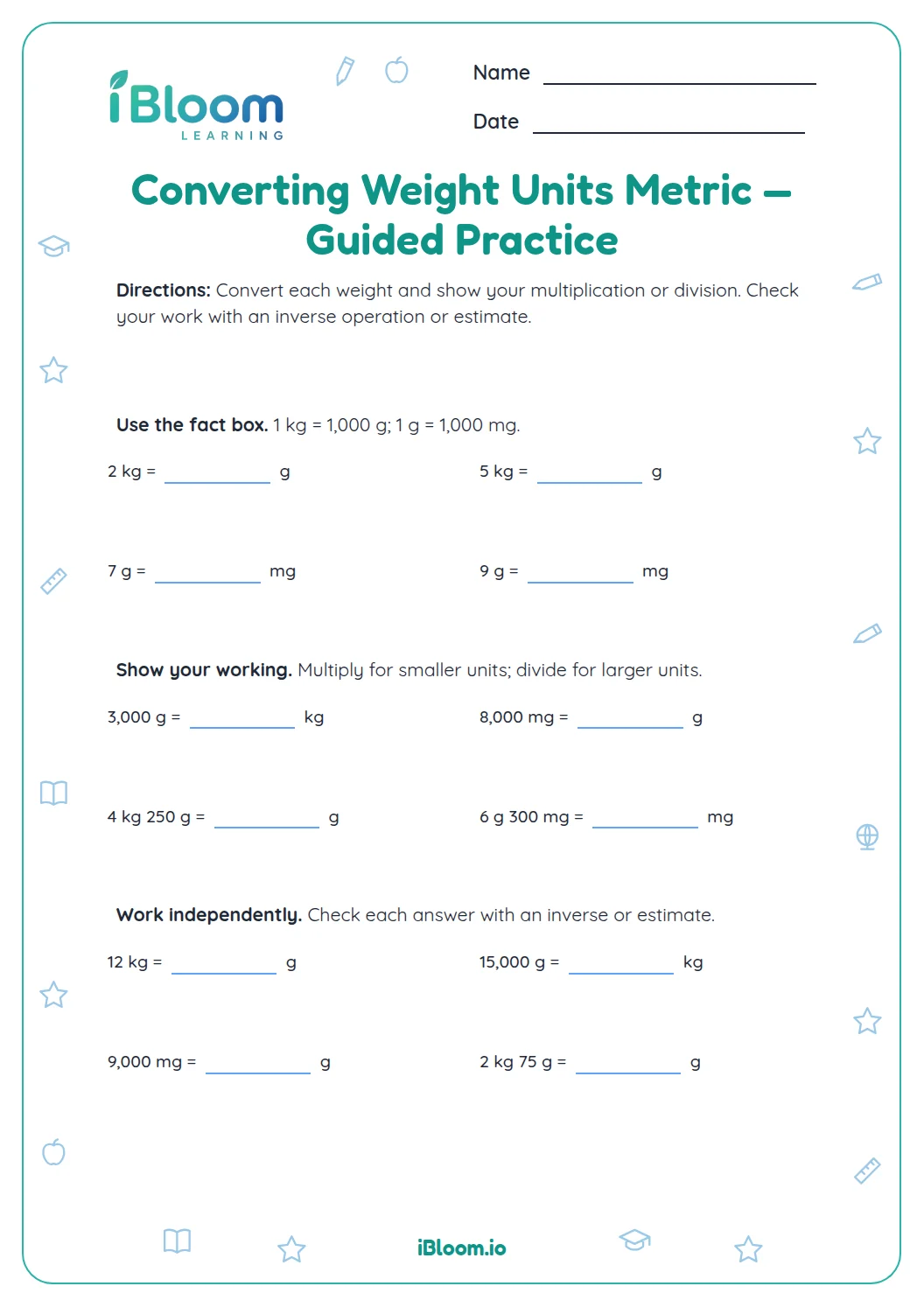
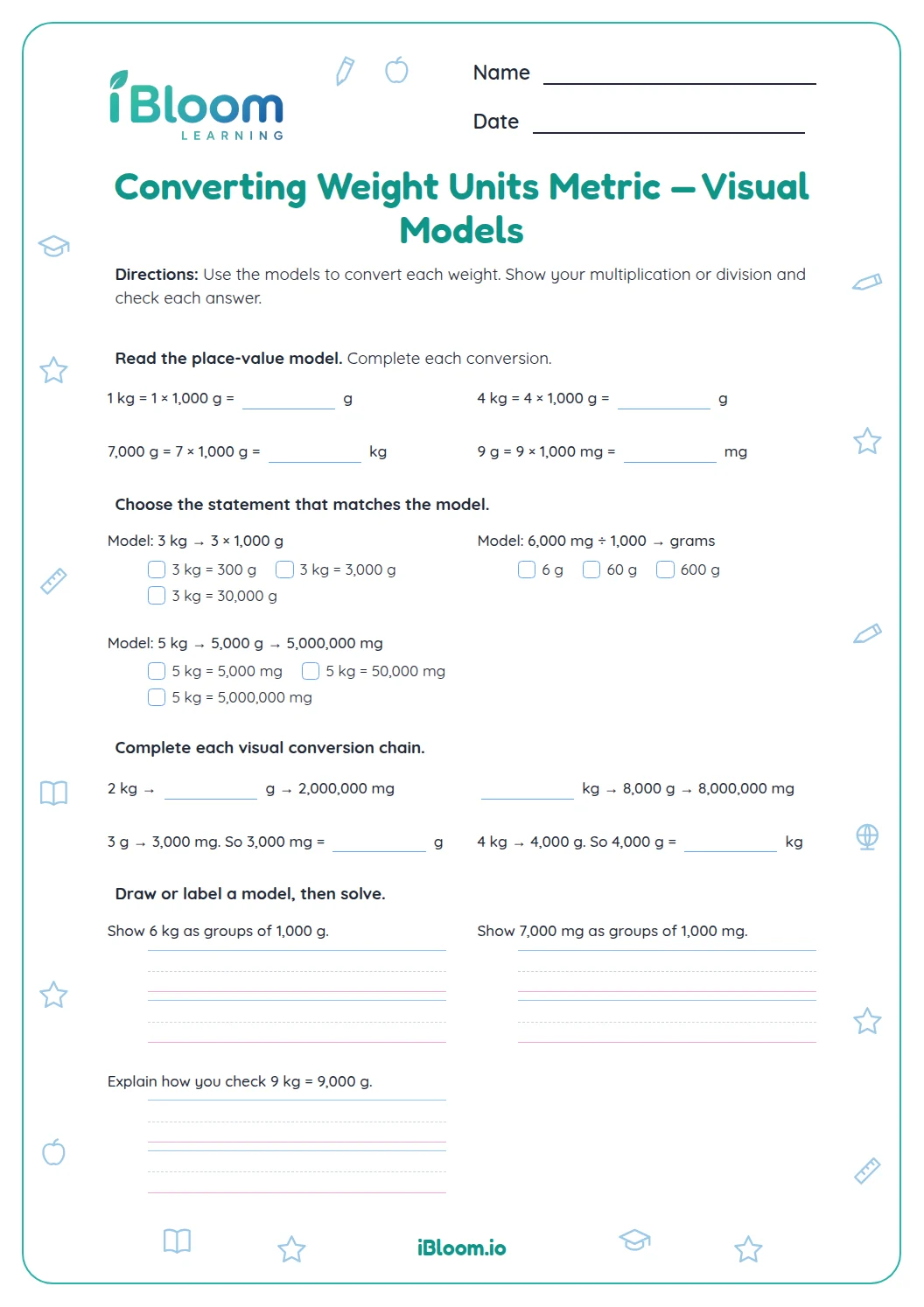
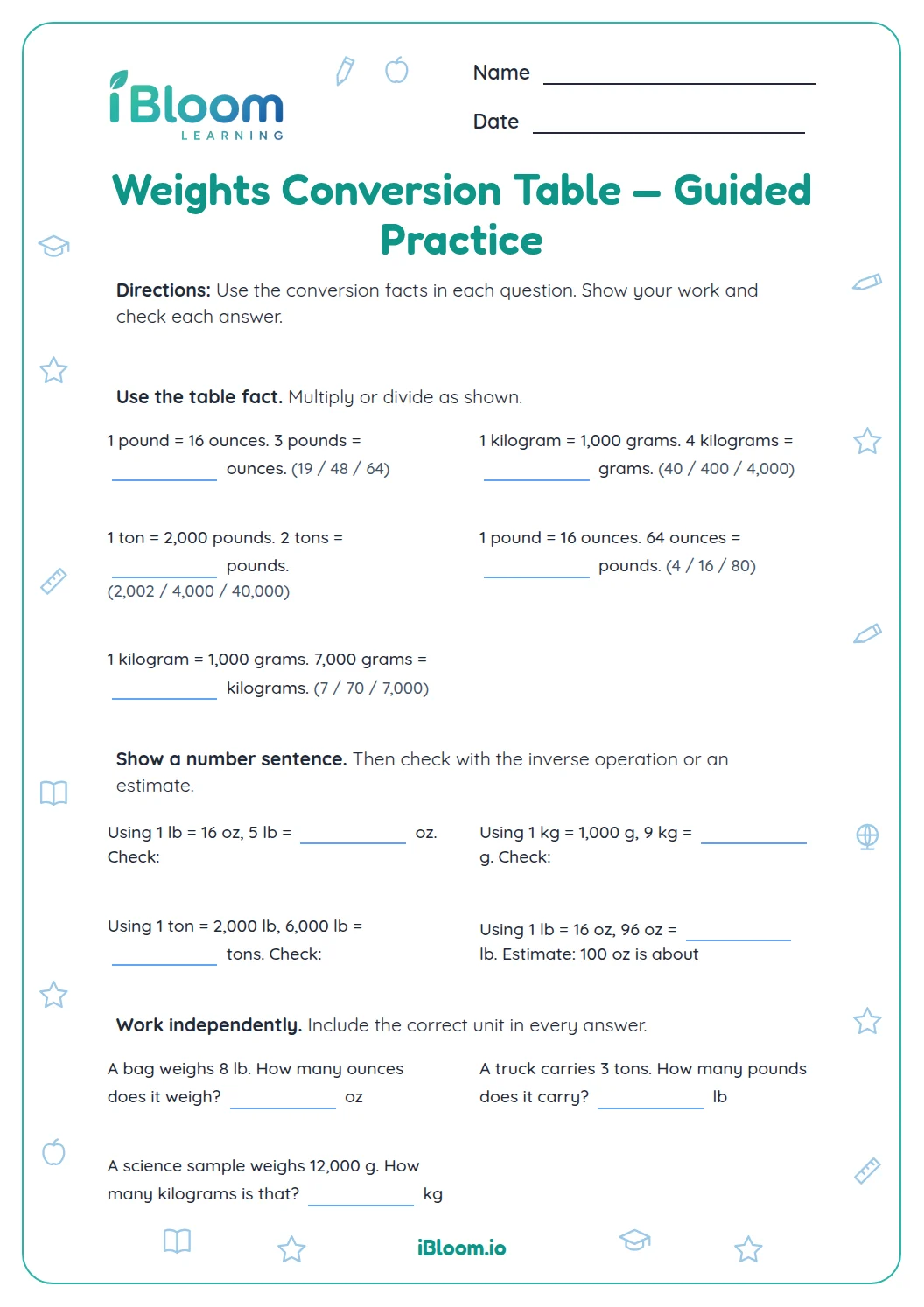
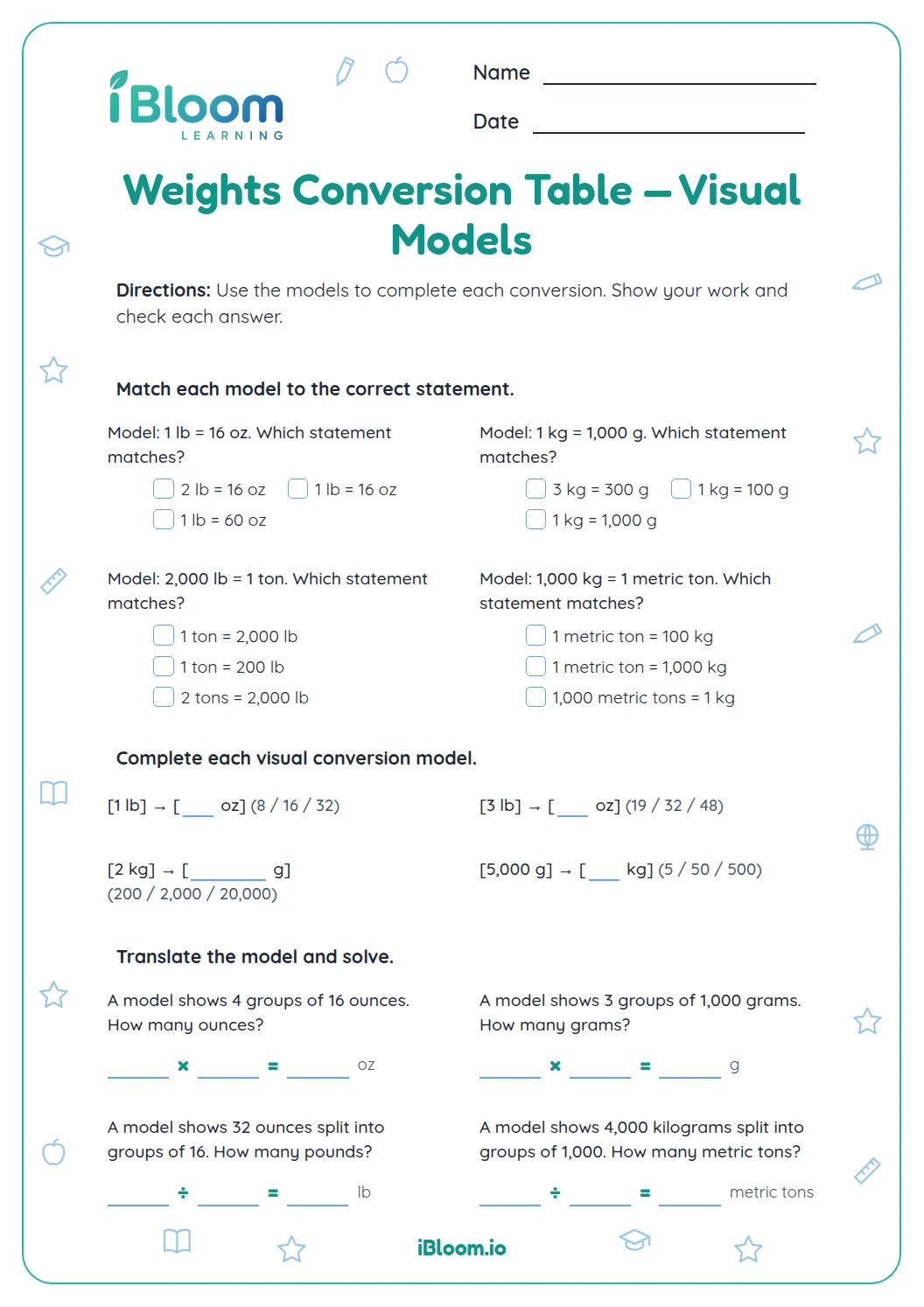
This free Grade 5 worksheet practices approximate conversions between customary and metric weight units. Students use the conversion fact stated in each question to move among pounds, kilograms, ounces, and grams, compare amounts in a common unit, and solve four short problems. The answer key includes labeled results and worked calculations so students can check both the arithmetic and the unit.
Which conversion facts do students use?
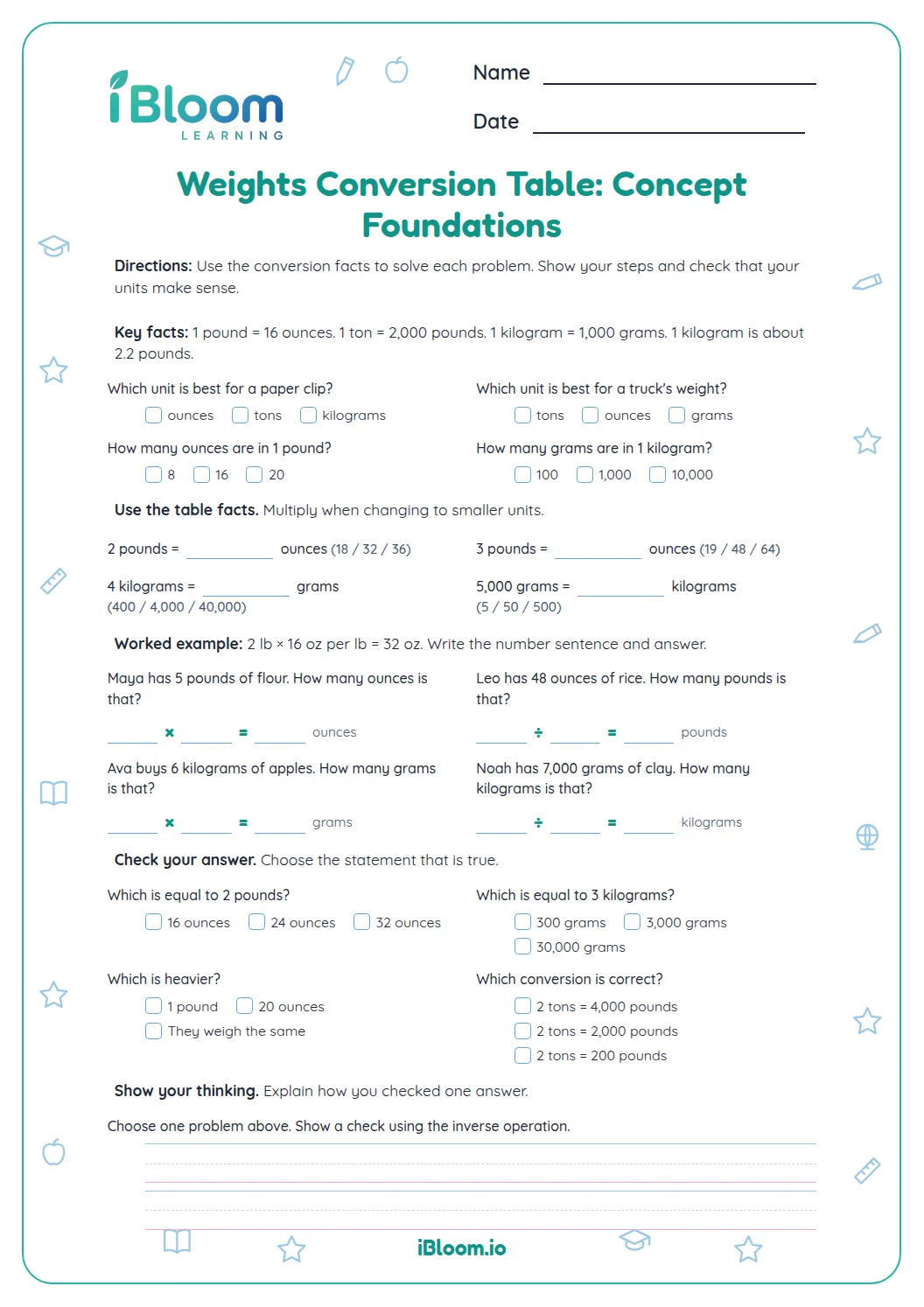
Each question supplies the equivalence needed for its calculation. Students multiply by 2.2 to change kilograms to pounds, by 0.45 to change pounds to kilograms, and by 28 to change ounces to grams. The answers are approximate because the conversion factors are rounded.
For example, using the stated fact, 4 kg is about 4 × 2.2 = 8.8 lb.
- 14 kg × 2.2 lb/kg = 8.8 lb
How can two different units be compared?
First express both amounts in the same unit. To compare 5 kg and 6 lb, convert 5 kg to about 11 lb, then subtract 6 lb. The difference is about 5 lb.
How can students check a conversion?
Estimate whether the converted number makes sense and keep the unit attached. A kilogram is a little more than two pounds, so 3 kg should be near 6.6 lb, not 66 lb. The unit in the answer should match the target unit.
How to use this worksheet
- 1Circle the conversion fact and target unit in the prompt.
- 2Multiply the given weight by the stated factor.
- 3Keep track of the target unit as you calculate.
- 4For comparisons, convert both weights to the same unit first.
- 5Mark answers as approximate and check the size of the result.
Common mistakes and quick fixes
The mistake
Using 0.45 to convert kilograms to pounds.
The fix
Kilograms to pounds uses about 2.2 pounds per kilogram.
The mistake
Forgetting that the answer is approximate.
The fix
Keep the ≈ sign or use “about” when writing a converted estimate.
The mistake
Subtracting weights before making the units match.
The fix
Convert both amounts to pounds or both to kilograms before finding a difference.
What to practice next
Make more practice
Questions parents and teachers ask
Which conversion facts are used?
The worksheet supplies 1 kg ≈ 2.2 lb, 1 lb ≈ 0.45 kg, and 1 oz ≈ 28 g in the questions. Students multiply by the stated factor and write the result using the target unit. The approximate sign reminds them that these are rounded equivalencies.
Why are the answers approximate?
The conversion factors in the questions are rounded equivalencies. For example, one kilogram is about 2.2 pounds, so a converted answer is an estimate rather than an exact value. The worksheet uses the approximation sign to make this clear in both calculations and comparisons.
How do you compare 5 kg with 6 lb?
Convert 5 kg to pounds: 5 × 2.2 is about 11 lb. Then compare 11 lb with 6 lb; the 5 kg bag is about 5 lb heavier. Converting to a common unit makes the comparison straightforward and gives a difference with a clear label.
How many questions are included?
There are 16 questions: twelve fill-in conversion or comparison responses and four word problems. Each question gives its own conversion fact so students can focus on setting up and interpreting the calculation. The answer key includes the target units and approximate values.
What should students practice next?
Try a focused set on metric grams and kilograms, then practice customary ounces, pounds, and tons. A conversion table can help organize the relationships. Mixed measurement problems give students another chance to convert, compare in one unit, and check whether a result is reasonable.