

About this worksheet
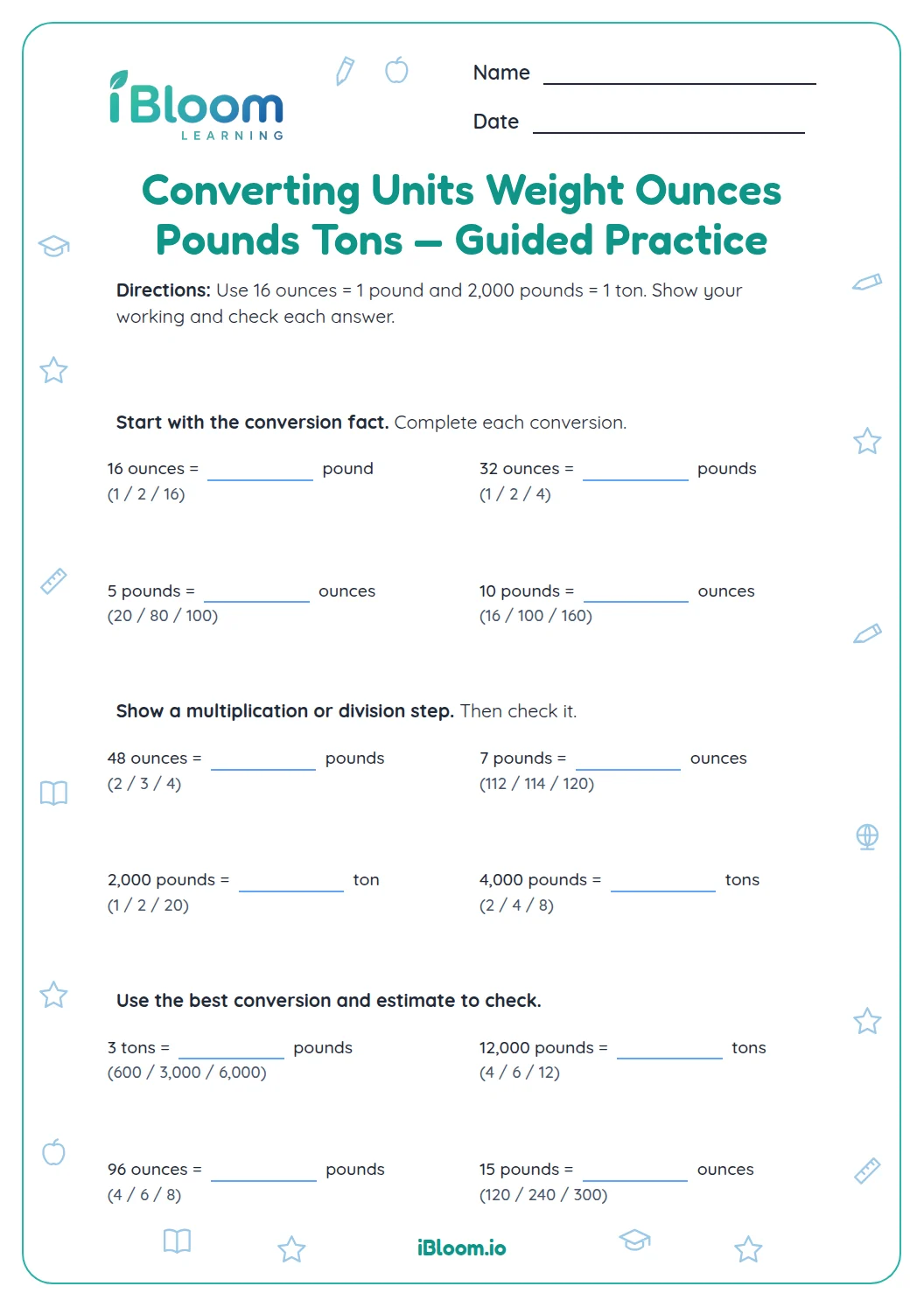
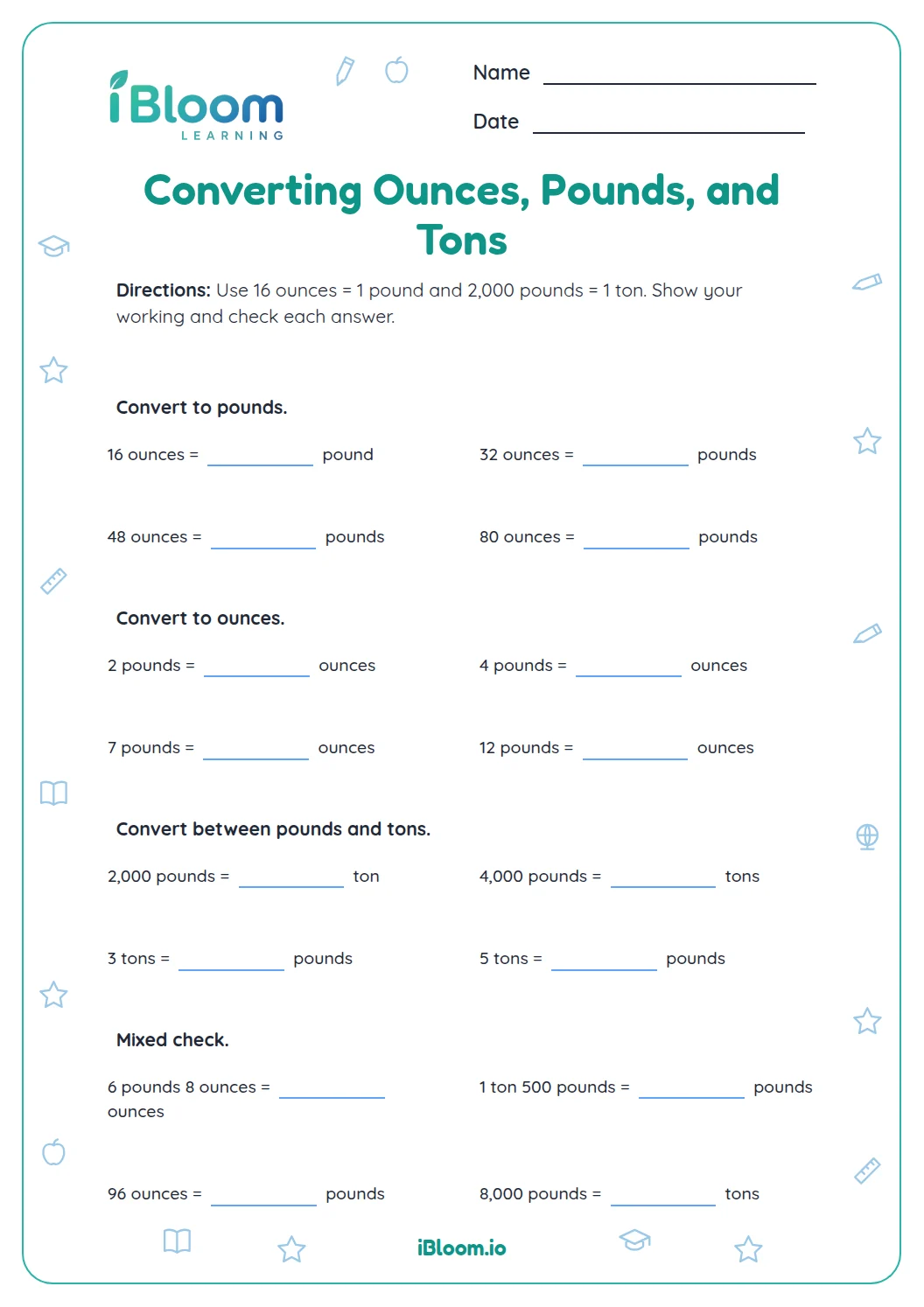
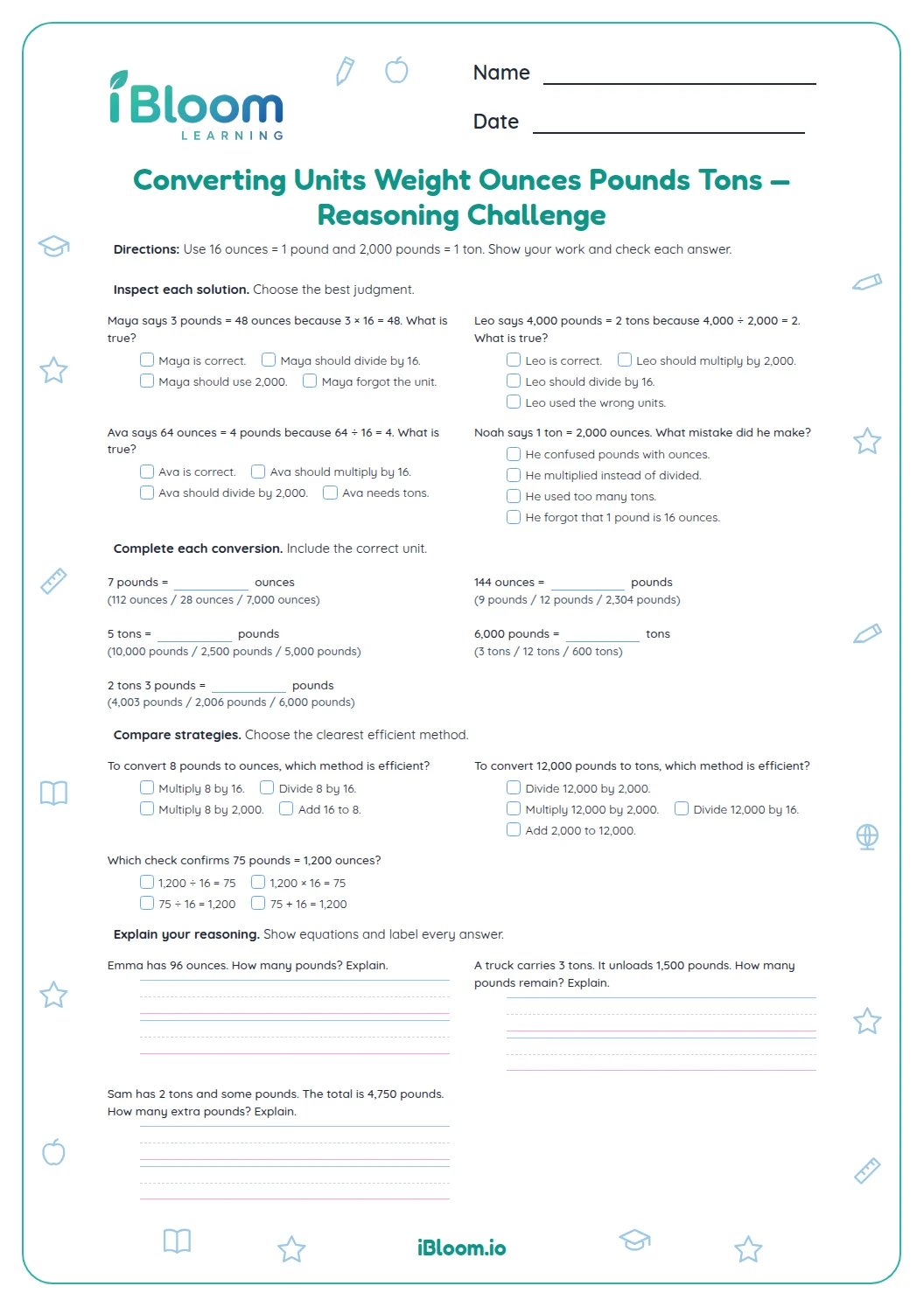
Learners convert among ounces, pounds, and tons using 16 ounces per pound and 2,000 pounds per ton. The worksheet starts with direct conversions, then uses those relationships in package, shipment, and load problems. The answer key labels each result with its unit.
Aligned to 5.MD.A.1
How do the problems build from conversion to application?
Learners convert among ounces, pounds, and tons using 16 ounces per pound and 2,000 pounds per ton. The worksheet starts with direct conversions, then uses those relationships in package, shipment, and load problems. The answer key labels each result with its unit.
- 13 lb = ___ oz
- 2Answer: 48 oz
How do the problems build from conversion to application?
Part A practices direct conversions, including mixed customary units. Part B applies those conversions to totals, comparisons, and multi-step weight situations.
How can a learner check a conversion?
Use the inverse relationship: if 3 pounds is 48 ounces, divide 48 by 16 to return to 3 pounds. Keep the unit beside each number while calculating.
How to use this worksheet
- 1Write the conversion fact beside the problem: 16 oz = 1 lb or 2,000 lb = 1 ton.
- 2Decide whether to multiply or divide.
- 3Convert mixed pounds and ounces into one unit before combining.
- 4Show each step for totals, differences, and equal loads.
- 5Label the answer and check it with the inverse conversion.
Common mistakes and quick fixes
The mistake
Multiplying when converting a larger unit to a smaller unit.
The fix
A smaller unit takes more units: multiply pounds by 16 to find ounces.
The mistake
Using 16 as the pounds-to-tons conversion.
The fix
Use 2,000 pounds for 1 ton.
The mistake
Combining pounds and ounces before converting to one unit.
The fix
Convert the pounds to ounces first, then add the ounces.
Common Core alignment
Convert among different-sized standard measurement units within a given measurement system (e.g., co
On this sheet: Sixteen ounce, pound, and ton conversions with multi-step everyday weight situations.
Show the official wordingHide the official wording
Convert among different-sized standard measurement units within a given measurement system (e.g., convert 5 cm to 0.05 m), and use these conversions in solving multi-step, real world problems.
What to practice next
Make more practice
Further reading
Questions parents and teachers ask
Is an answer key included?
Yes. The key lists answers with units for all 16 conversion and word problems. Review both the number and unit so the learner can catch a correct calculation labeled in the wrong unit. Ask the learner to name the starting and ending units, show the conversion fact used, and check that the answer keeps the correct unit.
How should the learner check an answer?
Use 16 ounces for each pound and 2,000 pounds for each ton. Multiply when moving to a smaller unit and divide when moving to a larger unit. Ask the learner to name the starting and ending units, show the conversion fact used, and check that the answer keeps the correct unit.
Can this be used for independent practice?
Yes. Part A practices direct conversions; Part B applies the same relationships to totals, comparisons, and multi-step situations. The key supports checking after each calculation. Ask the learner to name the starting and ending units, show the conversion fact used, and check that the answer keeps the correct unit.
What materials are needed?
A pencil is enough. The conversion facts are printed in the directions, and all quantities needed for the problems are included on the worksheet. Ask the learner to name the starting and ending units, show the conversion fact used, and check that the answer keeps the correct unit.
How long does it take?
Plan for about 25 minutes. Direct conversions are brief, while the multi-step scenarios need time to show work and label units. Ask the learner to name the starting and ending units, show the conversion fact used, and check that the answer keeps the correct unit.