





About this worksheet
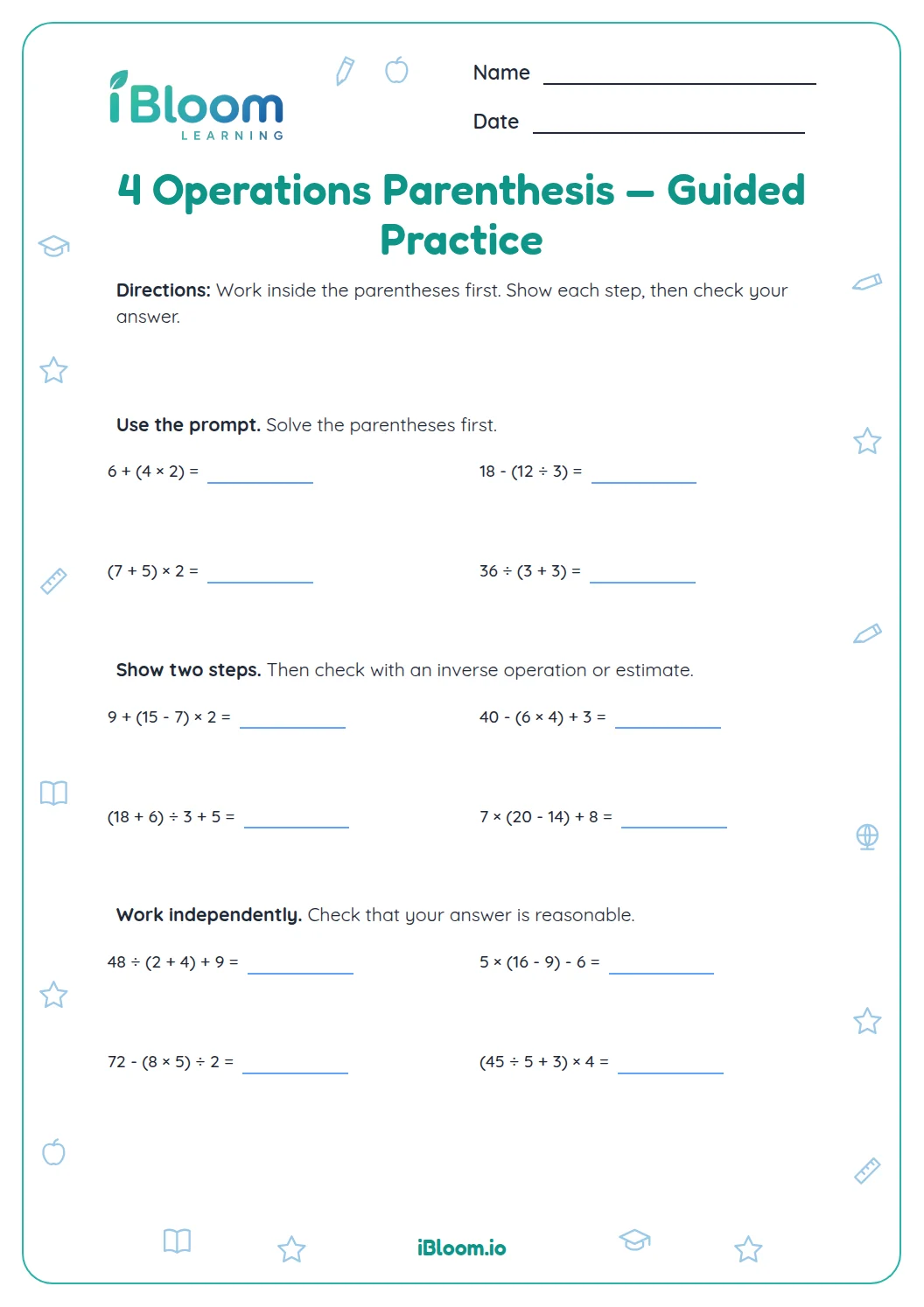
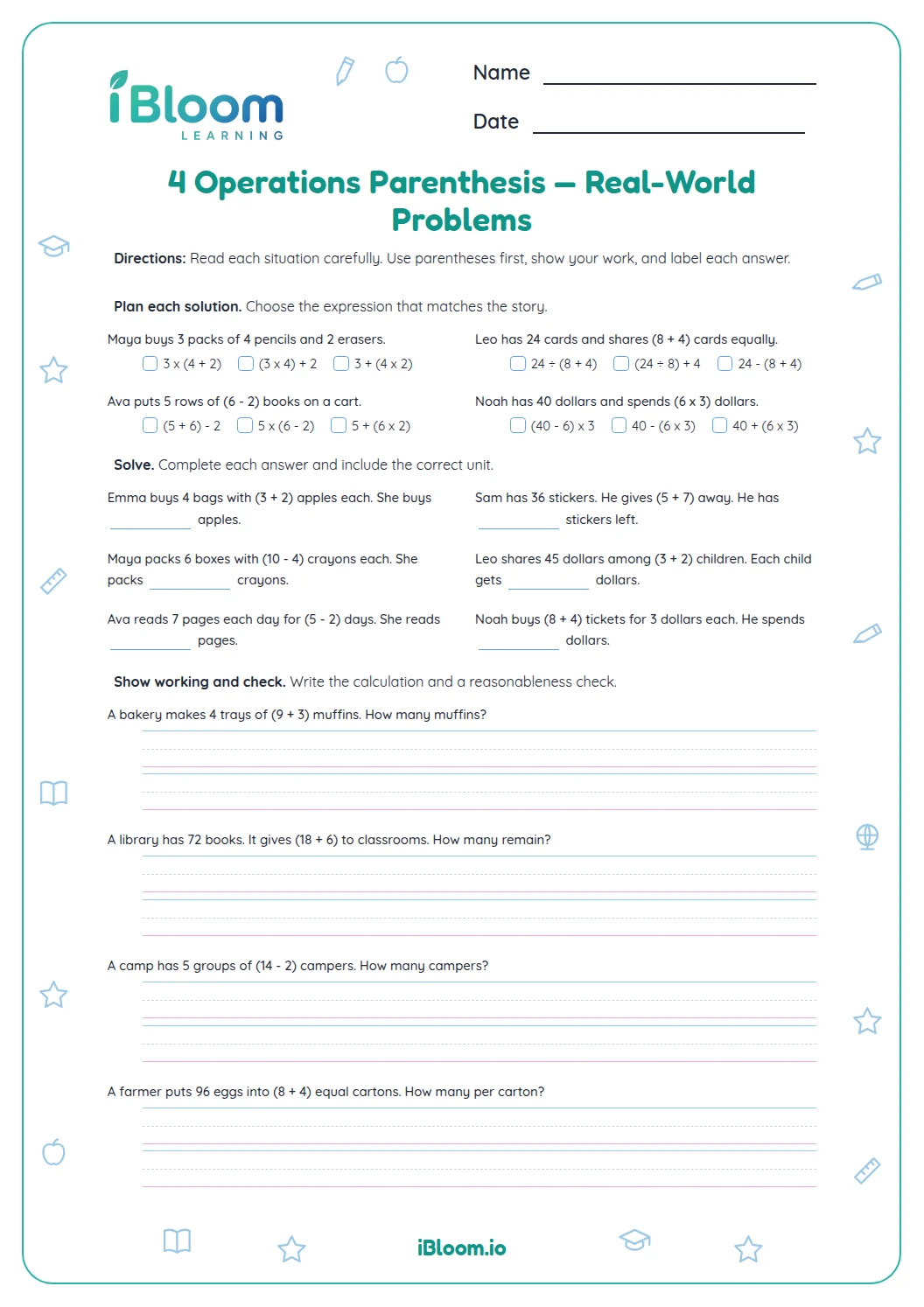
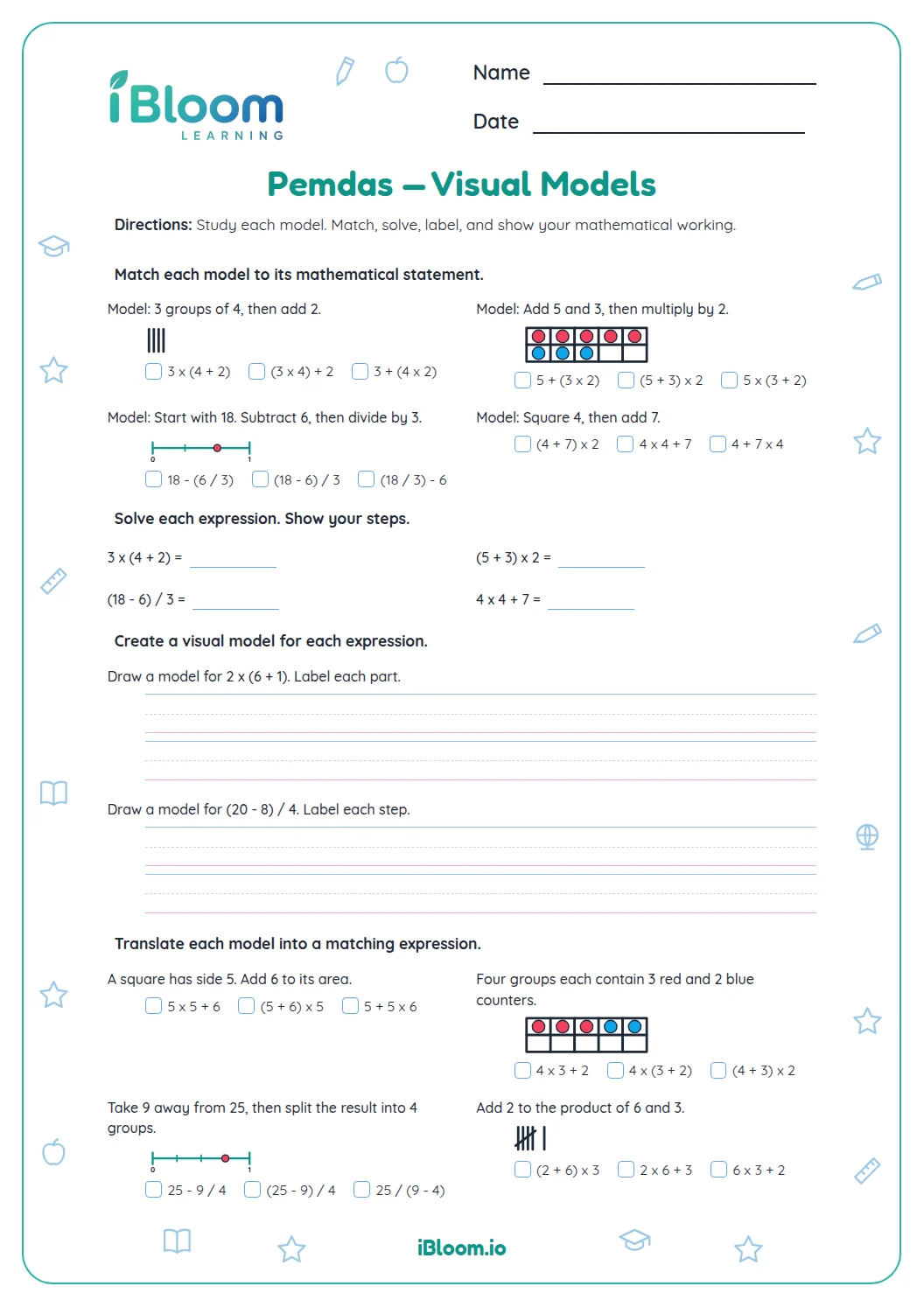
This free Grade 5 worksheet practices the order of operations with addition, subtraction, multiplication, division, and parentheses. Learners first write expressions for pictured group situations, then evaluate expressions and write expressions for two stories. The 14 questions are organized in three parts, with a separate answer key. Parentheses show which operations to do first, directly practicing CCSS 5.OA.A.1.
Aligned to 5.OA.A.1
How do parentheses guide the first step?
Parentheses group numbers that must be handled together before the rest of the expression. In question 1, three groups of four make 3 × 4; adding two more gives (3 × 4) + 2 = 14.
- 1Three groups of 4: 3 × 4 = 12
- 2Then add 2: 12 + 2 = 14
- 3The matching expression is (3 × 4) + 2.
What will each part practice?
The first six questions connect group situations and visual models with expressions. Next, learners evaluate expressions with parentheses and mixed operations, then apply an expression to each story.
- Part A: write expressions for visual models and group situations
- Part B: evaluate expressions and solve two short stories
How can a learner keep track of each step?
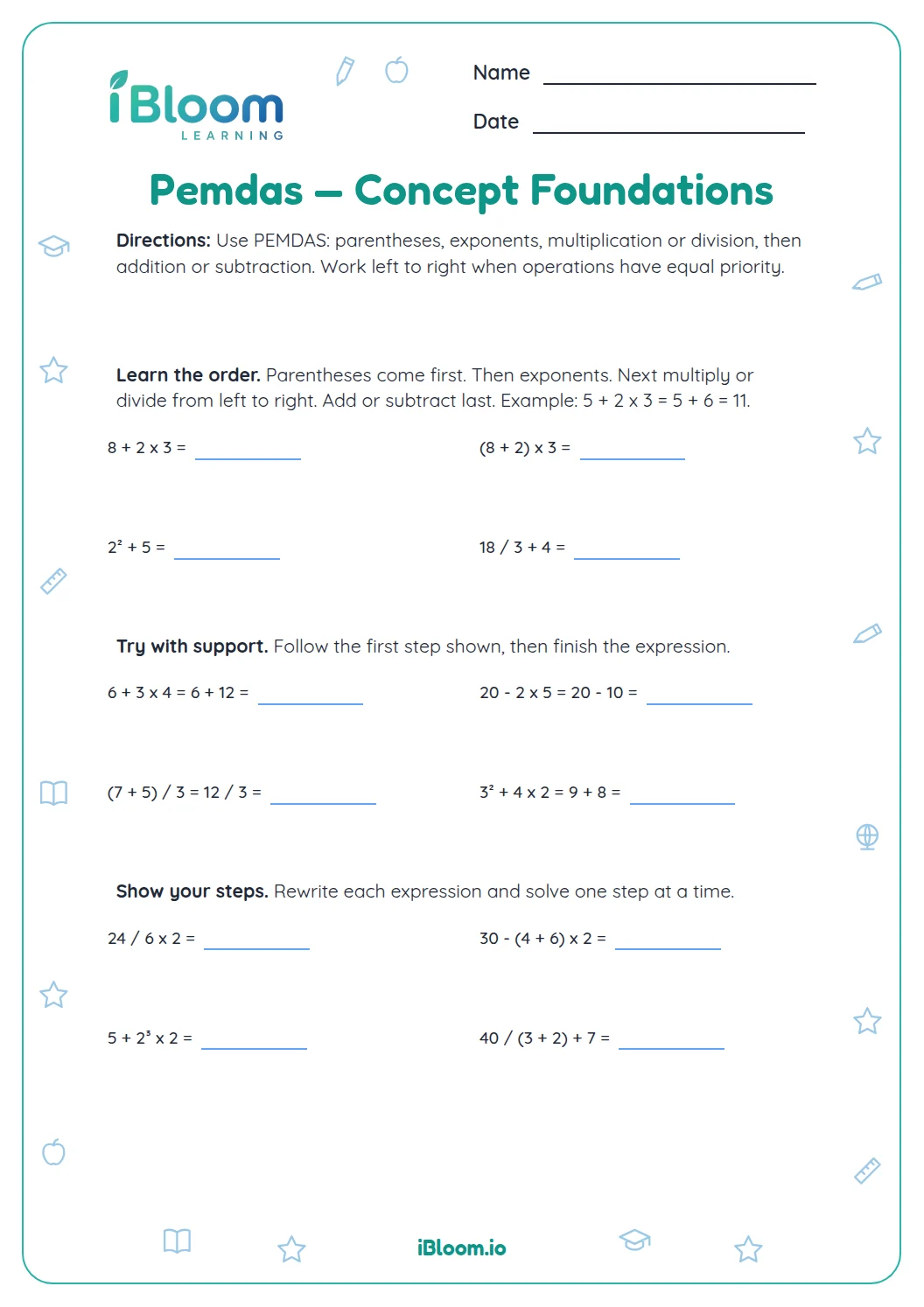
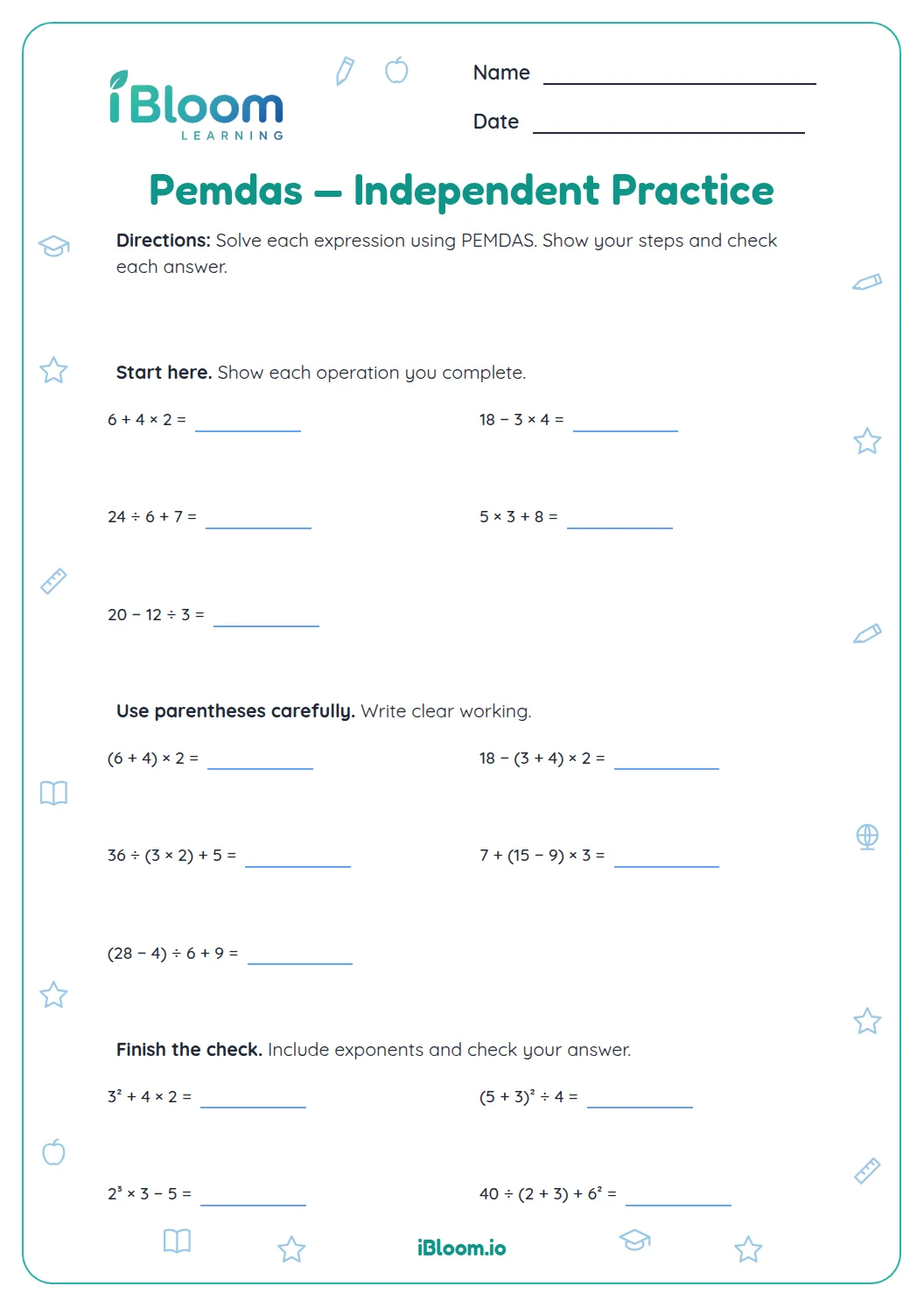
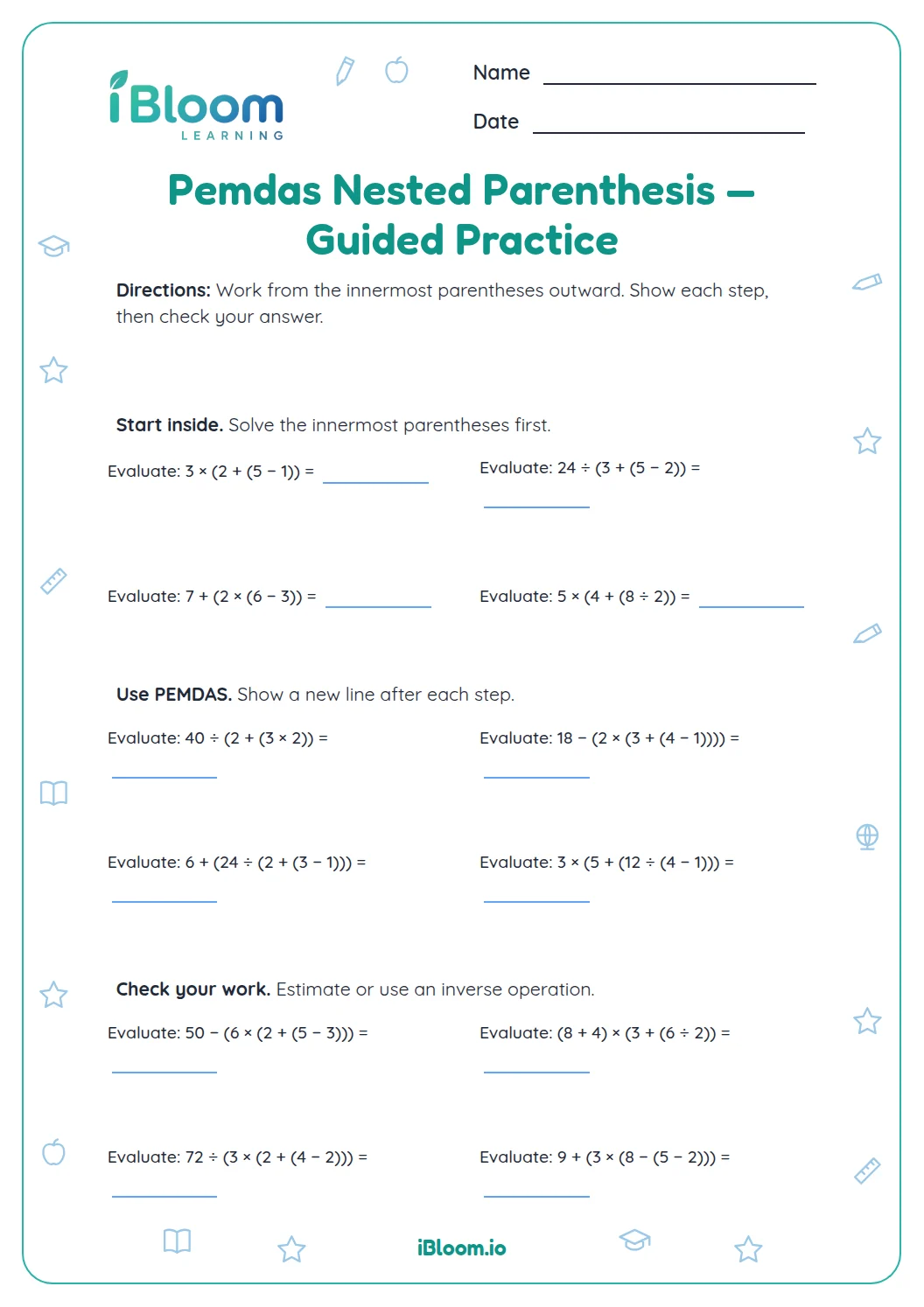
Rewrite the expression after each operation. Work through parentheses first, then multiplication or division from left to right, and finally addition or subtraction from left to right.
How to use this worksheet
- 1Use the model to identify the groups and actions.
- 2Write parentheses around the grouped operation.
- 3Do multiplication and division from left to right.
- 4Then do addition and subtraction from left to right.
- 5Substitute each result and check the final value.
Common mistakes and quick fixes
The mistake
Working every operation from left to right.
The fix
Do the grouped operation first, then follow operation priority.
The mistake
Always multiplying before dividing.
The fix
Multiplication and division share priority; work left to right.
The mistake
Adding before multiplying in 8 + 3 × 4.
The fix
Multiply 3 × 4 first, then add 8 to get 20.
Curriculum alignment
The worksheet uses parentheses in numerical expressions and evaluates those expressions.
Use grouping symbols to guide the evaluation of numerical expressions.
On this sheet: Learners interpret parentheses in model-matching expressions and evaluate expressions that use grouping symbols.
Show the official wordingHide the official wording
Use parentheses, brackets, or braces in numerical expressions, and evaluate expressions with these symbols.
What to practice next
Make more practice
Further reading
Questions parents and teachers ask
What comes first in PEMDAS?
Evaluate what is inside parentheses first. Then multiply and divide in the order they appear from left to right. Finally add and subtract from left to right. The first section uses story models to show why the parentheses belong around a group.
Do you always multiply before dividing?
No. Multiplication and division have equal priority, so work from left to right. In 36 ÷ 3 × 2, divide 36 by 3 first to get 12, then multiply by 2 to get 24. Ask the learner to explain the step and point to the matching question before checking the answer key.
Why do parentheses change an expression?
Parentheses tell you to evaluate a group first. For example, 8 + 3 × 4 is 20 because multiplication comes first, while (8 + 3) × 4 is 44 because the sum is multiplied by 4. Ask the learner to explain the step and point to the matching question before checking the answer key.
How do the pictures help with order of operations?
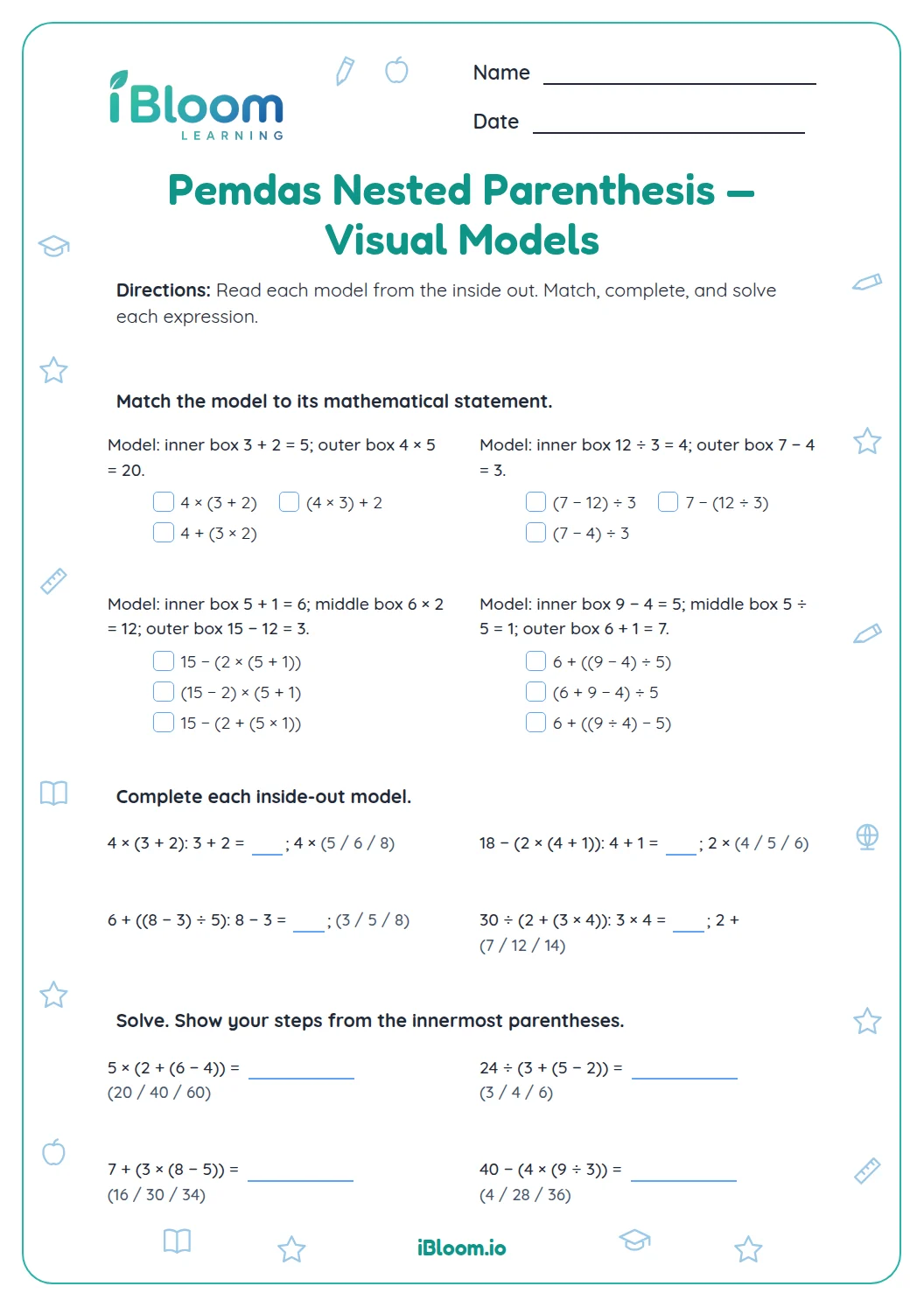
Arrays and a number bond show the groups or quantities described in the first section. Learners write an expression that represents those actions, including which operation must happen before another. The next section asks them to evaluate expressions with mixed operations and parentheses.
What is included in the answer key?
The answer key identifies the expression that matches each model, gives the value of each evaluated expression, and shows a sample expression and result for the two stories. Check the parentheses as well as the final number. Ask the learner to explain the step and point to the matching question before checking the answer key.