





About this worksheet
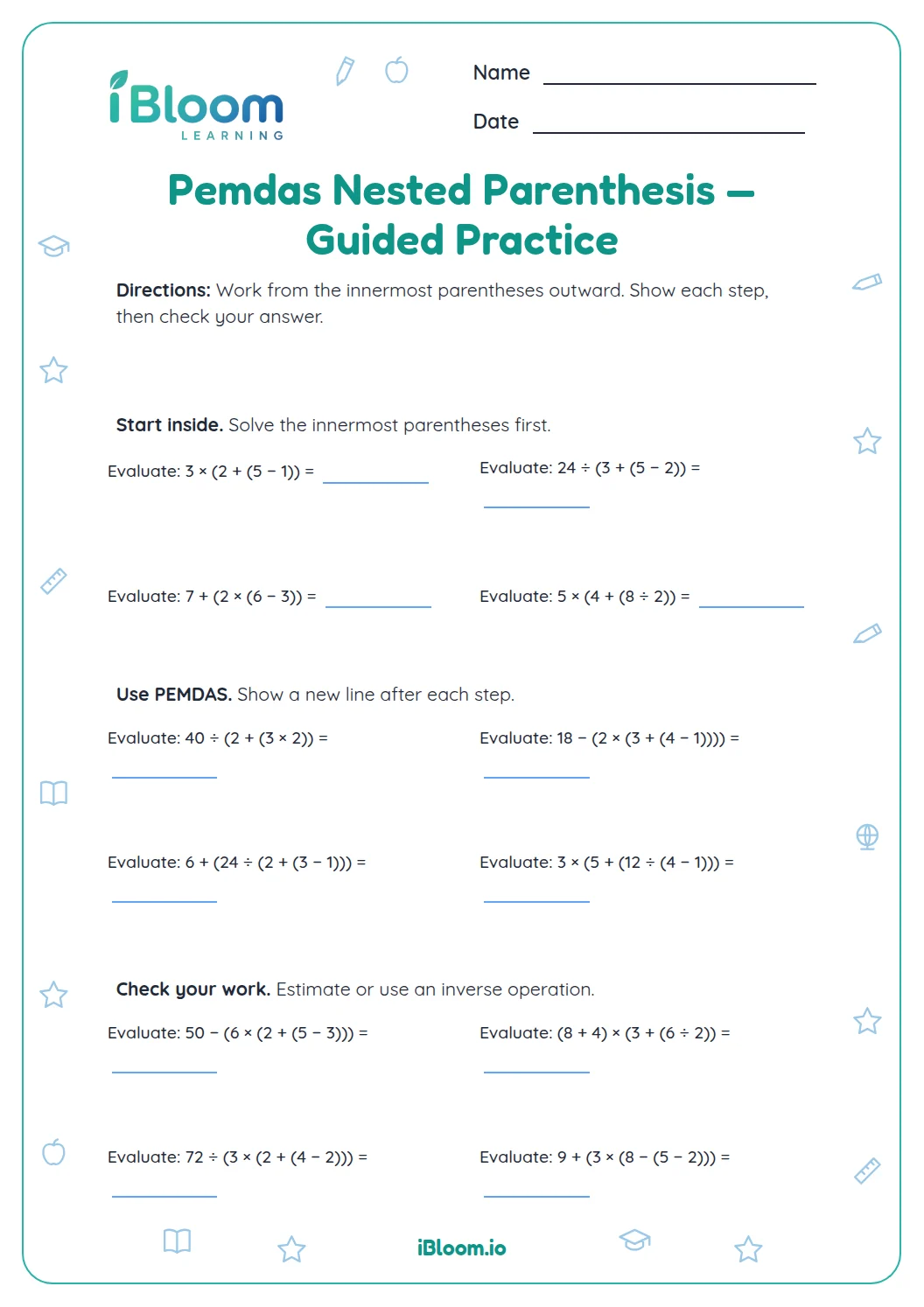
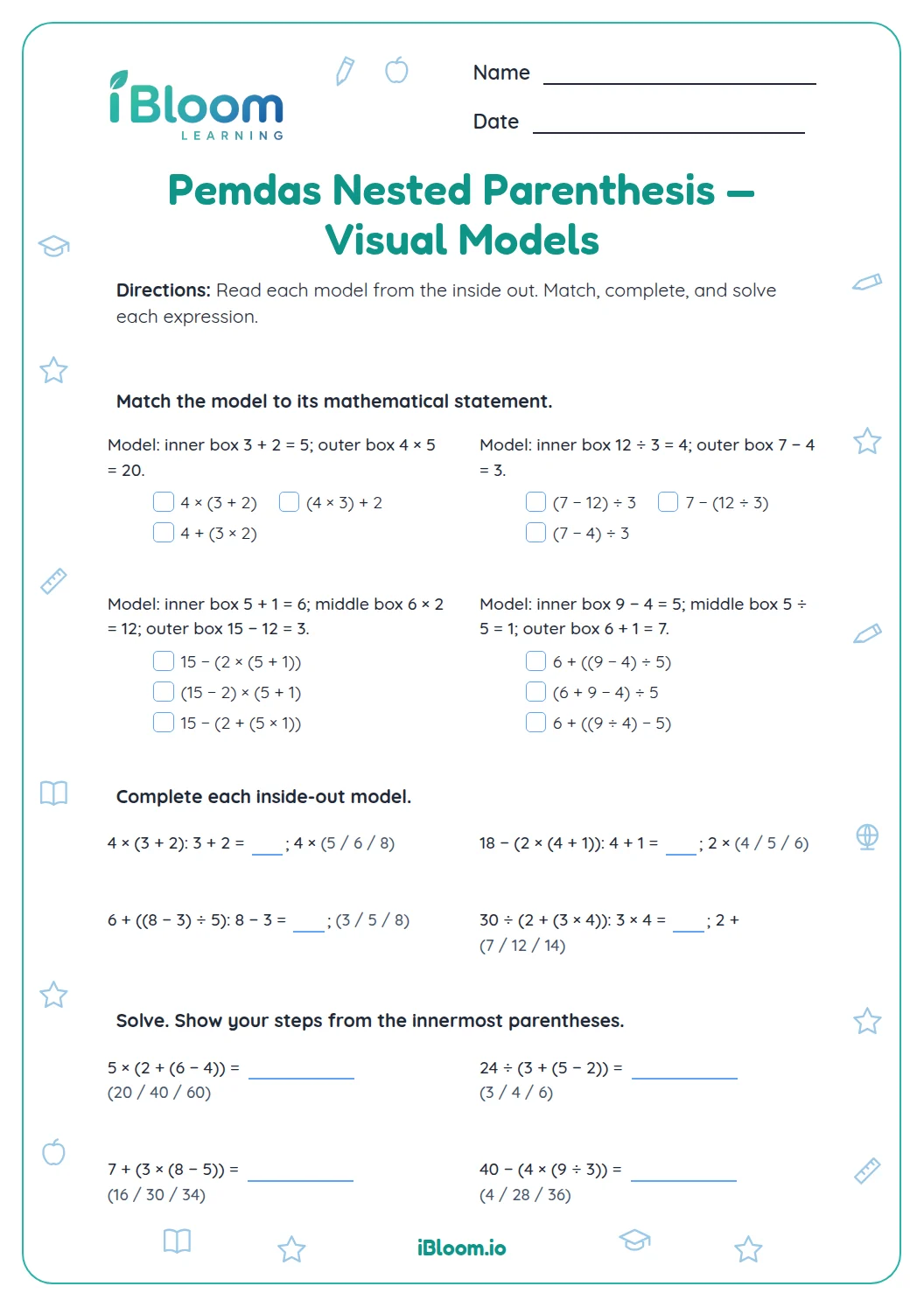
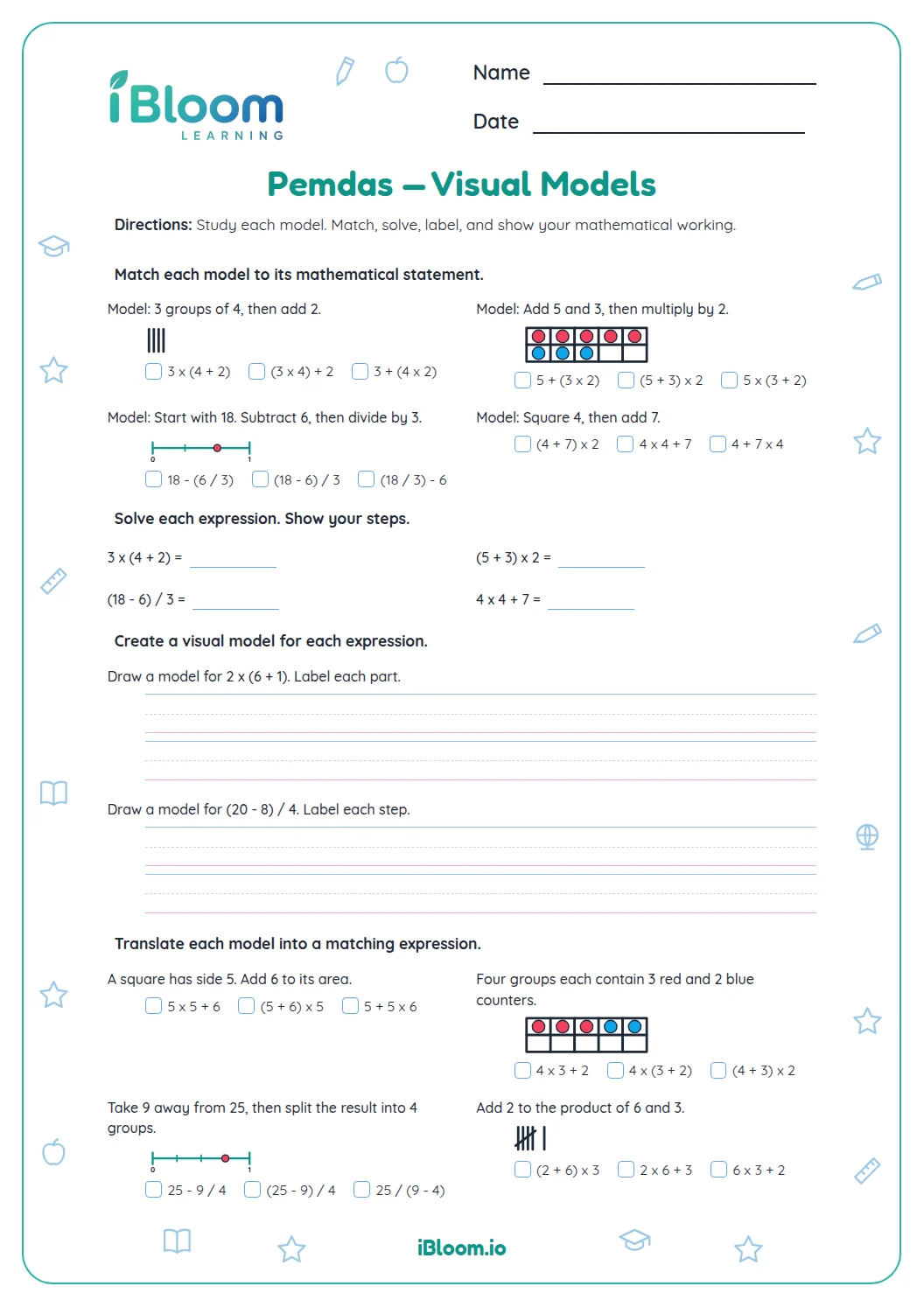
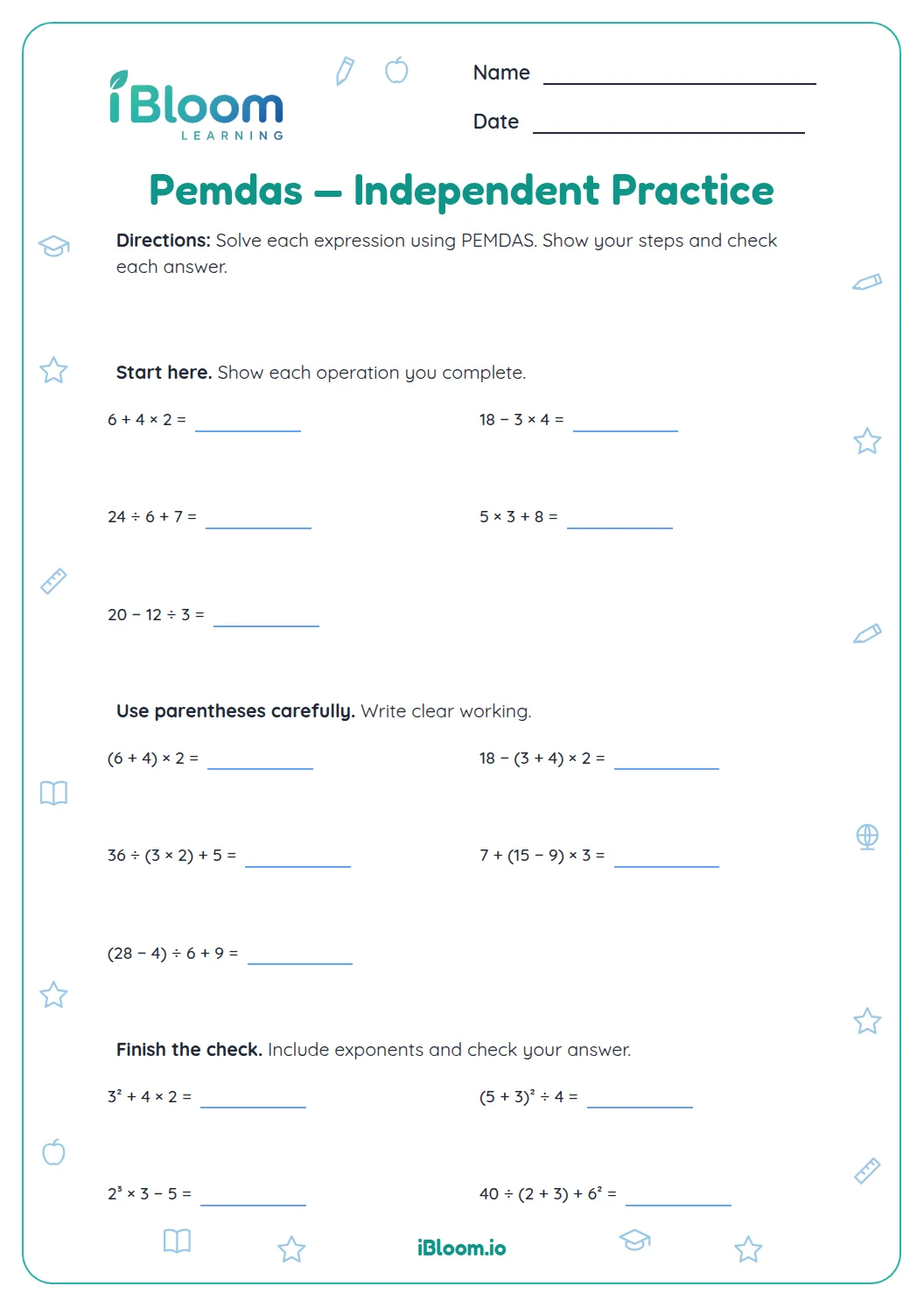
This Grade 5 worksheet gives students 16 expressions with nested parentheses, multiplication, division, addition, and subtraction. Students simplify one layer at a time, then complete the remaining operations in order. It includes practice and a separate answer key. The focus is CCSS 5.OA.A.1.
Aligned to 5.OA.A.1
Where do you begin with nested parentheses?
Begin at the deepest pair of parentheses, the one with no other group inside it. Replace that group with its value, then simplify outward. For example, 2 × (3 + (4 − 1)) becomes 2 × (3 + 3), then 2 × 6 = 12.
- 12 × (3 + (4 − 1))
- 24 − 1 = 3, so 2 × (3 + 3)
- 33 + 3 = 6, so 2 × 6 = 12
What comes after the parentheses?
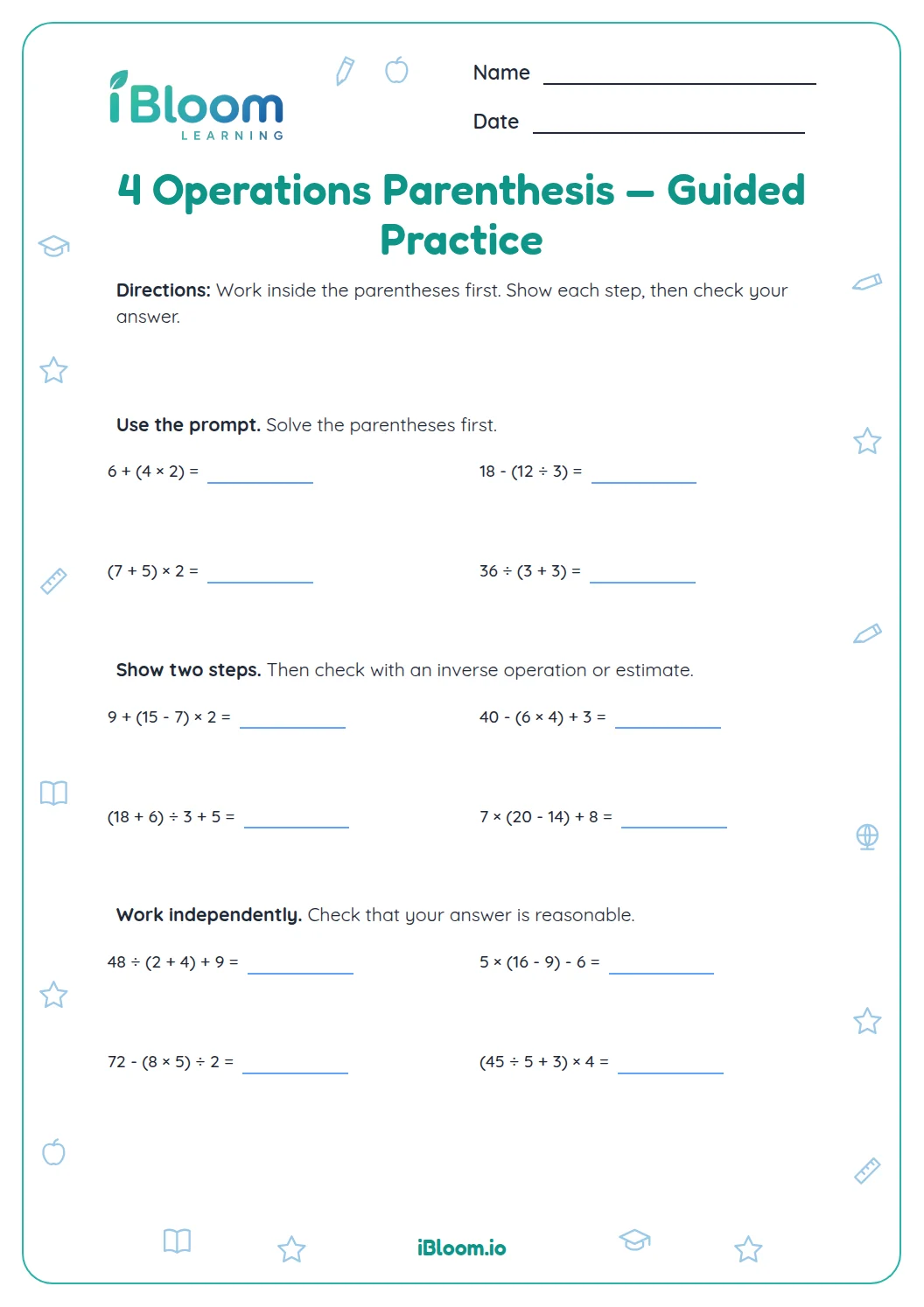
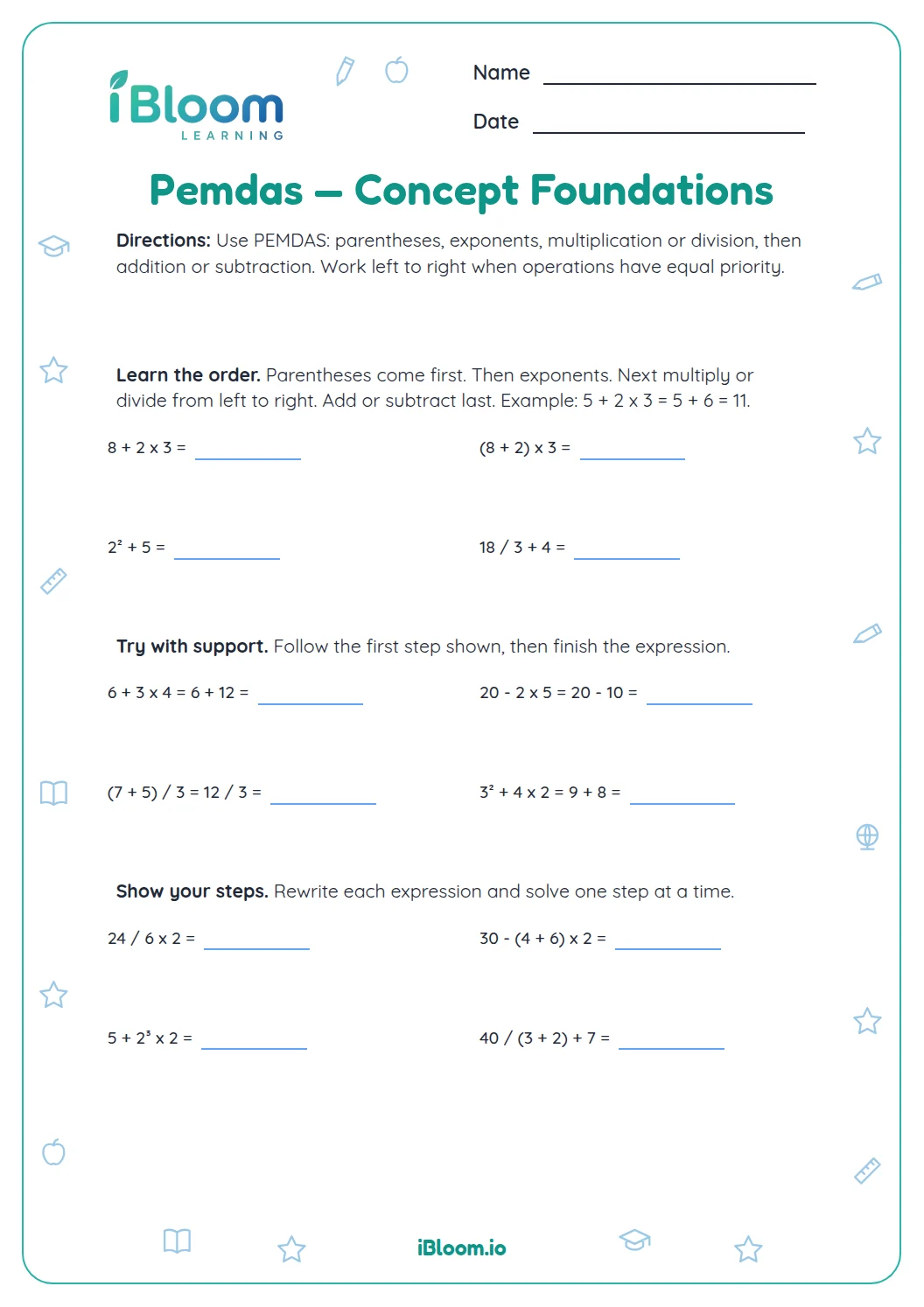
Once the groups are simplified, do multiplication and division from left to right. Addition and subtraction come afterward, also from left to right. Multiplication does not always come before division; they share a rank.
Why write each step on its own line?
A new line makes it easier to see which group has been solved and which operations remain. It also helps catch a missed grouping step before the final answer. The questions build from shorter nested expressions to combinations with more than one group.
How to use this worksheet
- 1Find the innermost pair of parentheses.
- 2Calculate only inside that pair and rewrite the expression.
- 3Repeat until no parentheses remain.
- 4Multiply and divide left to right.
- 5Add and subtract left to right, then check with the answer key.
Common mistakes and quick fixes
The mistake
Solving the outer group before the inner group.
The fix
Start with the pair that contains no other parentheses.
The mistake
Multiplying before dividing automatically.
The fix
Treat multiplication and division equally and read left to right.
The mistake
Combining addition and subtraction out of order.
The fix
After × and ÷, continue from left to right.
Common Core alignment
This worksheet gives focused practice with the standard below.
Use grouping symbols and evaluate numerical expressions in order.
On this sheet: Every expression uses nested grouping and asks for its value.
Show the official wordingHide the official wording
Use parentheses, brackets, or braces in numerical expressions, and evaluate expressions with these symbols.
What to practice next
Make more practice
Further reading
Questions parents and teachers ask
How do you solve an expression with nested parentheses?
Start with the innermost parentheses, simplify that group, and then work outward. After grouping symbols are handled, multiply and divide from left to right, then add and subtract from left to right. This sheet has 16 expressions and a separate answer key.
Is an answer key included?
Yes. The separate answer key includes responses for all 16 questions, including sample responses where wording may vary. Review it after the learner has tried each part, then revisit any item that needs another strategy. The key lists each value so a learner can compare the result and retrace an intermediate grouping step when an answer differs.
How many questions are on the sheet?
There are 16 expressions in four parts, moving from inner-group practice to mixed nested expressions. Each prompt asks for a value, and the answer key lists all 16 results. Students can compare intermediate steps as well as their final answers.
How can we use this for practice at home?
Work through one part at a time, writing each simplified expression on a new line. On question 1, solve 4 − 1 first, then 3 + 3, then multiply by 2 to get 12. The key can help locate a missed grouping step.
What should I do when an answer is incorrect?
Start with the parentheses that contain no other parentheses. In question 8, simplify the inner 3 + 3 to get 6, then calculate 18 ÷ 6 and add 6. The answer is 9; the key shows the final value for checking.