





About this worksheet
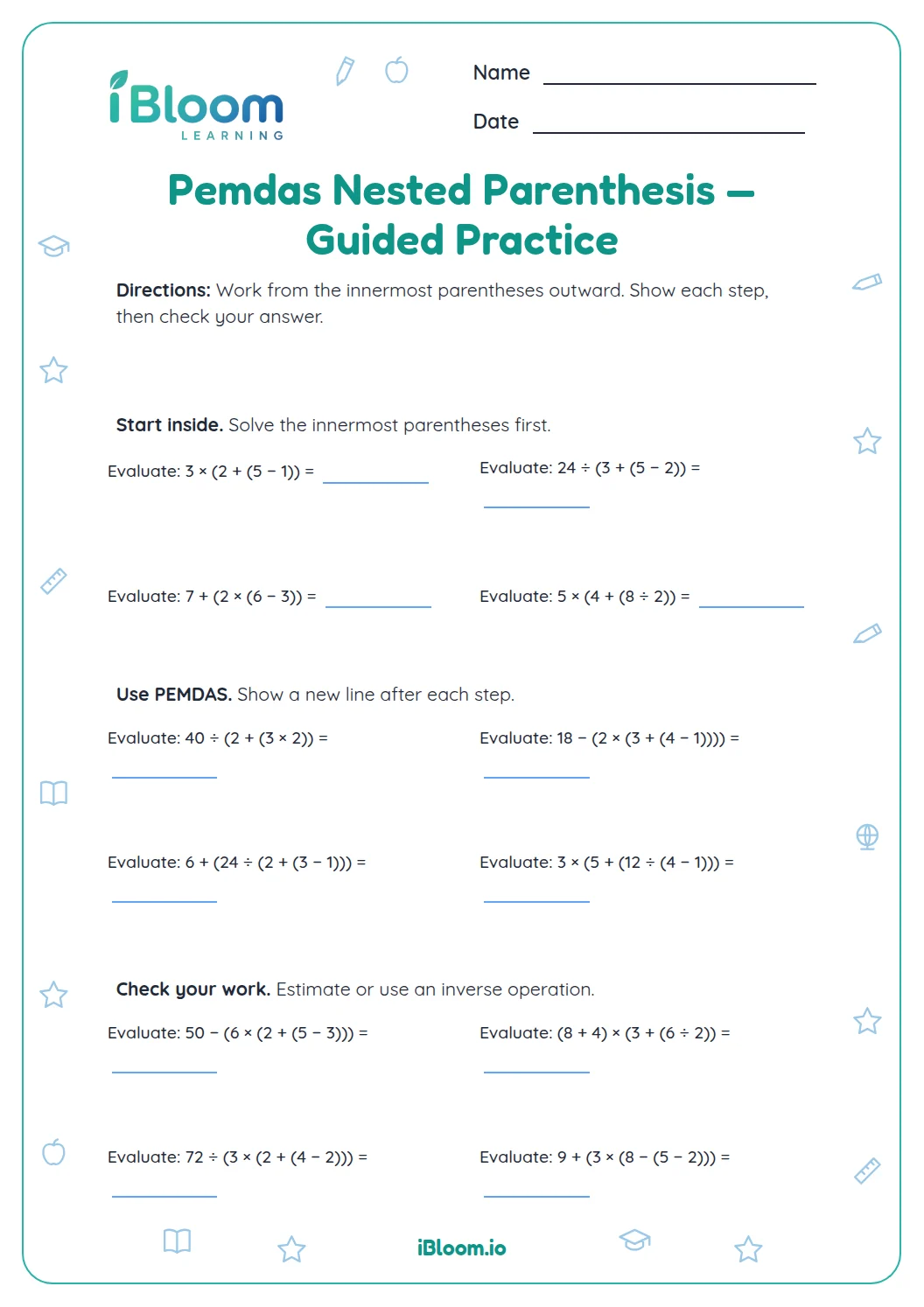
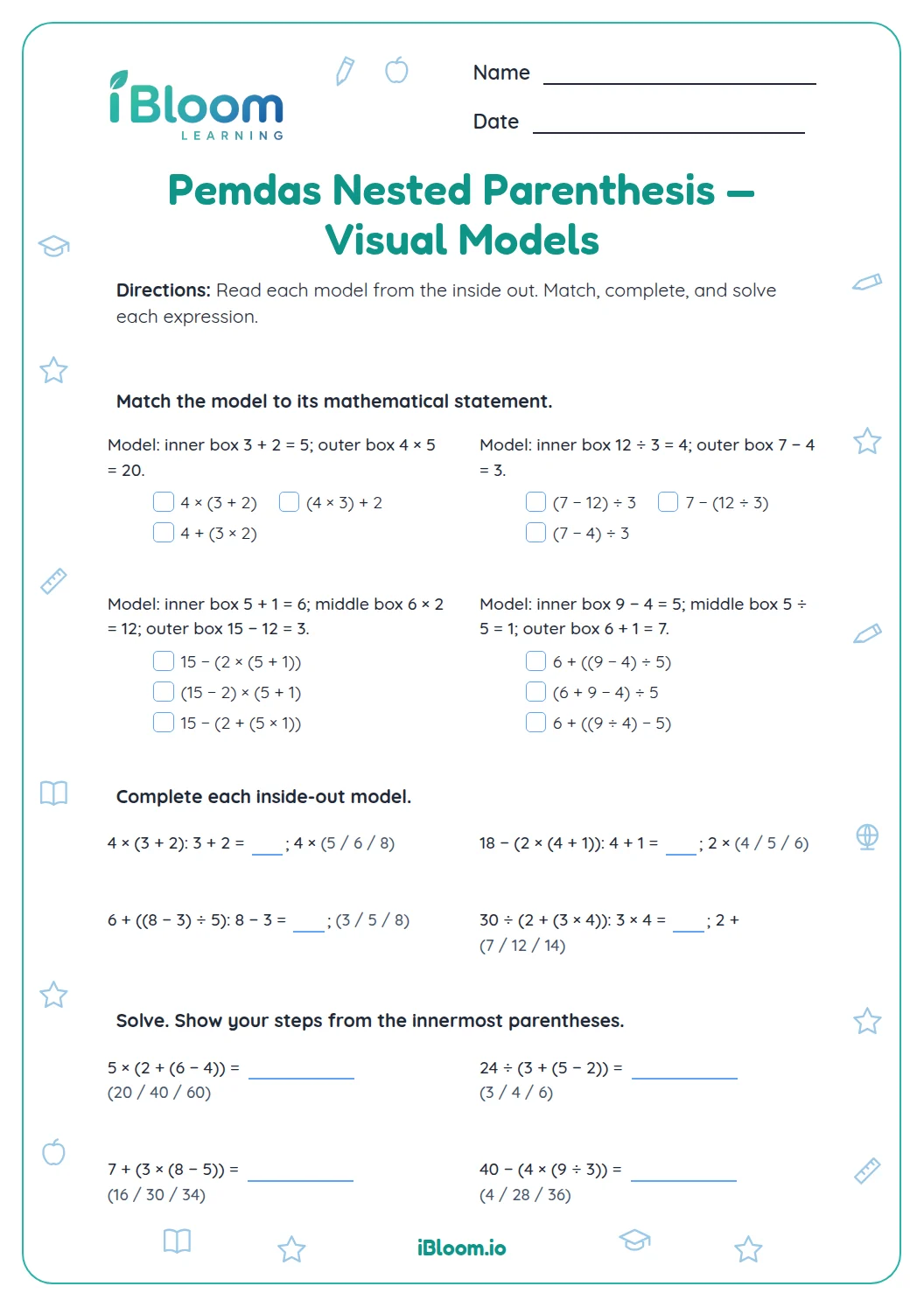
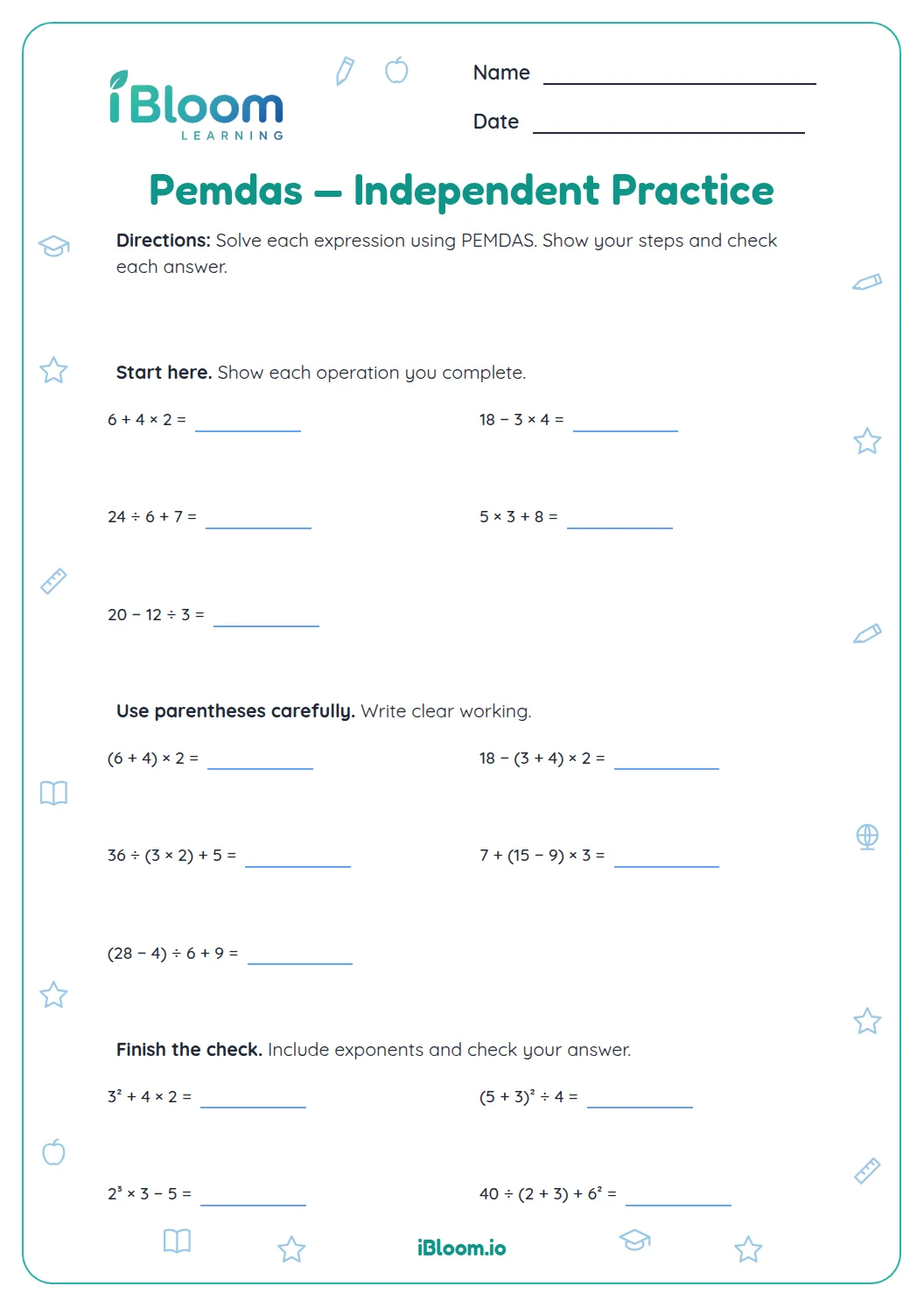
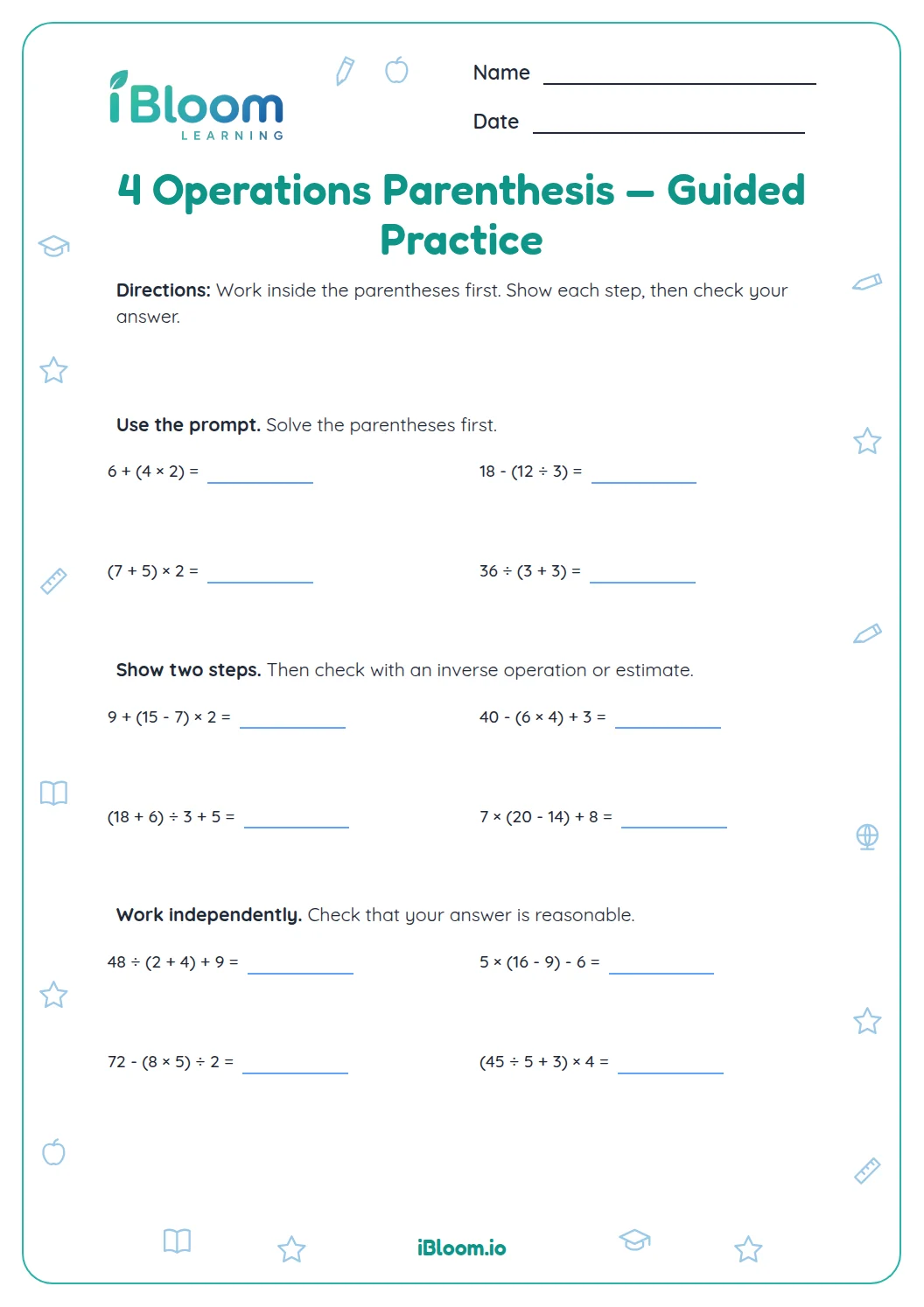
This free printable Grade 5 worksheet gives students 12 numerical expressions with nested parentheses to evaluate independently. Three parts move from one nested group to mixed operations and then two groups or deeper nesting. Students keep a record of their steps in the working space and write a final whole-number answer. The sheet practices Common Core 5.OA.A.1: evaluating expressions with grouping symbols. The separate answer key gives all 12 final values, while the worked example on this page shows how to preserve the outside operations as each group is simplified.
Aligned to 5.OA.A.1
Where do you start when parentheses are nested?
Start with the pair that contains no other parentheses. In question 1, that is (9 − 6). Replace that entire group with 3, leaving 4 × (2 + 3). The outer group then becomes 5, and the final multiplication gives 20.
Copying the unchanged numbers and signs at each stage makes it easier to see which operations still need to be done.
- 14 × (2 + (9 − 6))
- 2= 4 × (2 + 3)
- 3= 4 × 5
- 4= 20
Does PEMDAS mean multiplication always comes before division?
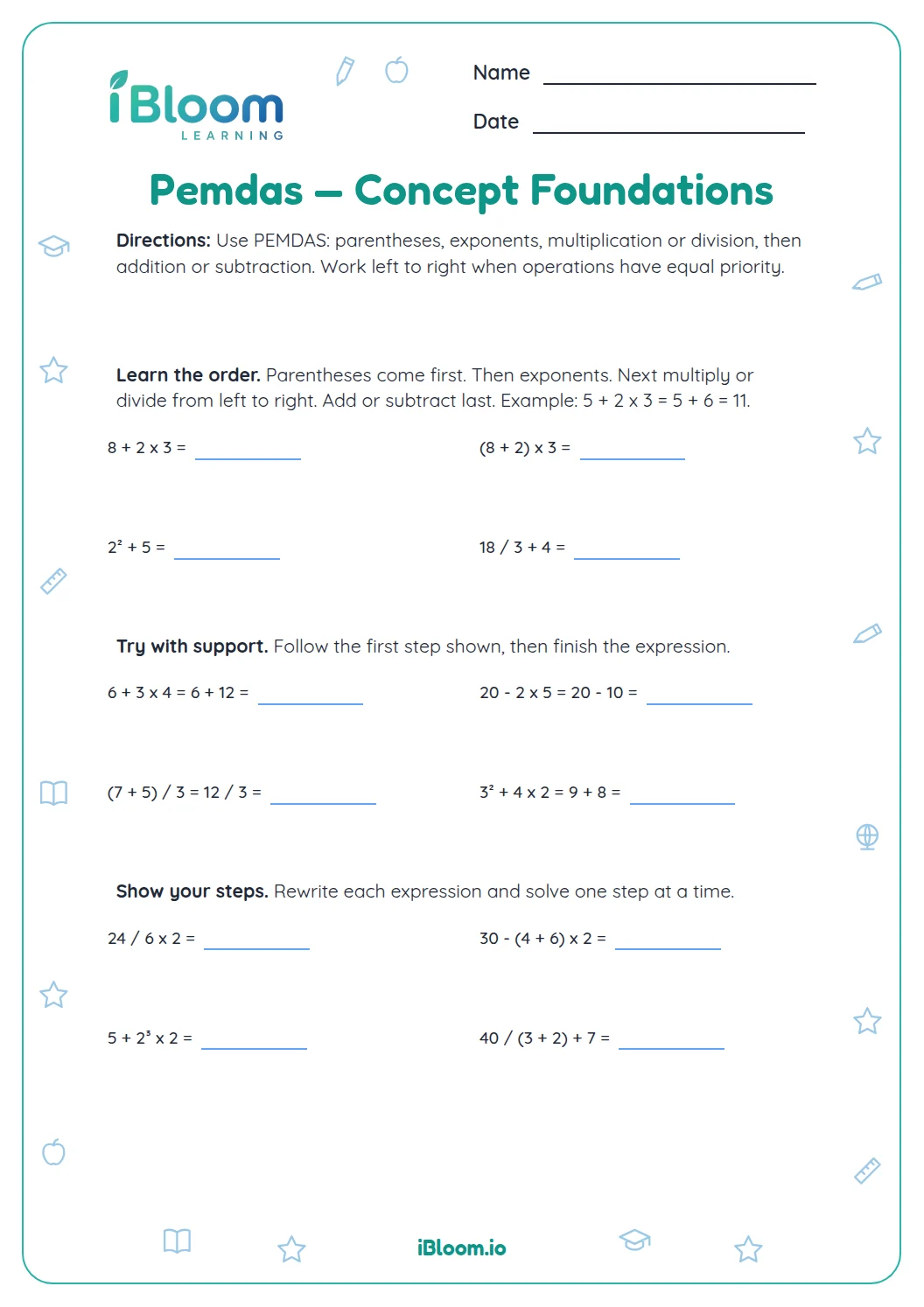
Multiplication and division share a priority level. Work from left to right when both remain at the same level. Addition and subtraction also share a level. Grouping symbols decide which smaller expression must be handled first.
Question 8 becomes (24 ÷ 4 × 3) − 5 after the inner subtraction. Inside the remaining parentheses, divide to get (6 × 3) − 5, then multiply to get 18 − 5. Subtract 5 to finish with 13.
What makes the last four questions more demanding?
Part C asks students to keep track of more than one group or three levels of parentheses. In question 10, (2 + 2) is nested inside a subtraction that is itself inside a multiplication. Question 11 has two main groups, each with a smaller group inside.
The arithmetic stays in whole numbers so students can concentrate on order and careful copying. Use the key to check final values, then inspect the working space to find the first step that differs when an answer is incorrect.
How to use this worksheet
- 1Have students identify the innermost group before calculating question 1.
- 2Let them complete Part A independently, writing each simplified expression.
- 3In Part B, remind them to copy operations outside the parentheses at every step.
- 4For Part C, check that every opening parenthesis has a matching closing one after copying.
- 5Compare final values with the key, then redo the first incorrect step in any missed expression.
Mistakes to notice while checking
The mistake
Reading 4 × (2 + (9 − 6)) from left to right and multiplying 4 × 2 first.
The fix
Begin with 9 − 6, then add 2, then multiply by 4.
The mistake
Turning 40 − (18 ÷ (6 − 3)) × 2 into (40 − 6) × 2.
The fix
After the nested groups, keep 40 − 6 × 2. Multiply 6 × 2 before subtracting.
The mistake
Dropping the outer parentheses after simplifying the innermost group.
The fix
Replace only the group just evaluated. In question 10, keep 72 ÷ (3 × (8 − 4)) as the next line.
Common Core alignment
Evaluate numerical expressions by working through nested grouping symbols.
On this sheet: All 12 expressions require students to evaluate nested parentheses and preserve the surrounding operations.
Show the official wordingHide the official wording
Use parentheses, brackets, or braces in numerical expressions, and evaluate expressions with these symbols.
What to practice next
Make more practice
Further reading
Questions parents and teachers ask
What should students know before using this worksheet?
Students should be comfortable with whole-number addition, subtraction, multiplication, and division, plus expressions containing one pair of parentheses. This sheet combines those skills with nested groups. A useful starting check is whether a student can explain why the inner subtraction in question 1 must happen before the multiplication.
Are all 12 answers whole numbers?
Yes, all 12 final answers are whole numbers, and the intended calculation steps use whole numbers too. That keeps attention on grouping and operation order. If a student obtains a fraction, first check that the entire divisor group has been simplified before carrying out the division.
How should students show their work?
Write a new version of the expression after simplifying a group or completing an operation. Keep every untouched number, sign, and parenthesis in place. For question 1, the sequence is 4 × (2 + 3), then 4 × 5, then 20; those lines make the order visible.
Why is question 7 equal to 28?
The inner subtraction gives 3, and 18 divided by 3 gives 6. The remaining expression is 40 − 6 × 2. Multiply 6 by 2 to get 12 before subtracting it from 40. Subtracting first would change the order and produce an incorrect result.
What does the answer key include?
The answer key lists the final value for every expression, using the same question numbers and layout as the worksheet. Check students’ written steps as well as those values. The worked example on this page models how to replace one nested group while preserving the rest of an expression.