





About this worksheet
This free printable worksheet gives Grade 5 learners 14 opportunities to evaluate nested expressions and apply order of operations to short stories. It moves from numerical expressions to real-world situations involving equal groups, totals, and what remains. The answer key is included, and the page practices Common Core 5.OA.A.1.
Aligned to 5.OA.A.1
Where do I start in a nested expression?
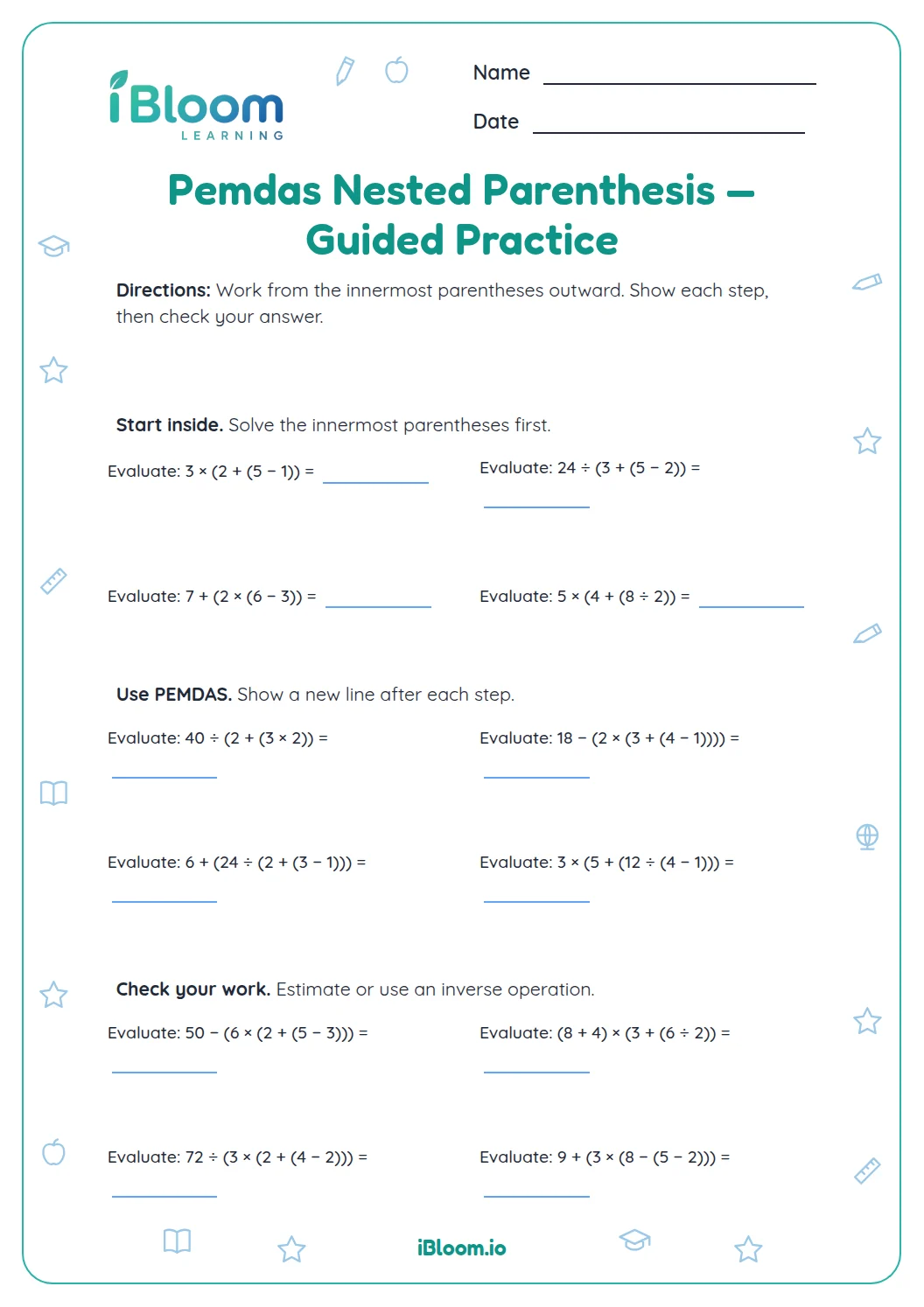
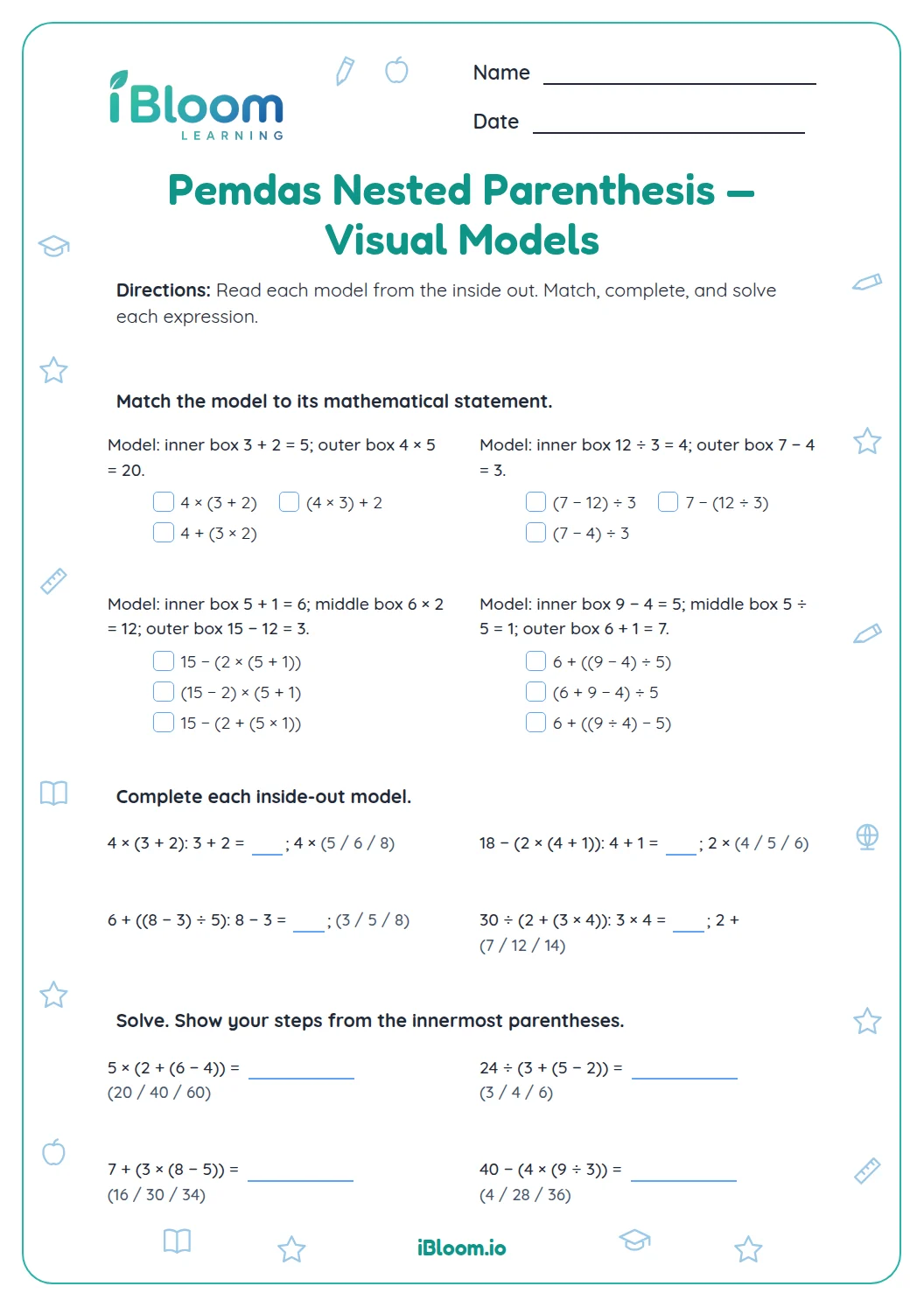
Start with the innermost parentheses. Then follow the remaining operations in order.
Question 1 begins inside the inner parentheses: 2 × 4 = 8. Then 18 − 8 = 10, and 10 + 7 = 17.
- 1(18 − (2 × 4)) + 7
- 22 × 4 = 8
- 318 − 8 = 10
- 410 + 7 = 17
How do stories become expressions?
Translate the situation into operations, then follow the grouping. In question 6, six bags hold 3 rolls each, so 18 rolls are packed; 30 − 18 = 12 remain.
What will learners practice?
Part A contains four nested expressions and three short situations. Part B has six more stories plus a first-step check, so learners practice translating, grouping, and evaluating throughout.
How to use this worksheet
- 1Underline the quantities and action words in each story.
- 2Name what each group of parentheses represents.
- 3Write the expression before calculating.
- 4Evaluate inner parentheses first.
- 5Check whether the answer makes sense in the story.
Common mistakes and quick fixes
The mistake
Starting with an outer operation before simplifying the inner parentheses.
The fix
Circle the innermost pair first, evaluate it, and then rewrite the expression.
The mistake
Multiplying only one term when a group is repeated.
The fix
Put the entire sum or difference inside parentheses before multiplying.
The mistake
Reporting the number of groups instead of the amount in each group.
The fix
Check what the question asks for and attach the matching unit.
Common Core alignment
This worksheet practices the listed Common Core mathematics skill.
Evaluate numerical expressions with grouping symbols.
On this sheet: Children translate short situations into expressions and evaluate nested parentheses.
Show the official wordingHide the official wording
Use parentheses, brackets, or braces in numerical expressions, and evaluate expressions with these symbols.
What to practice next
Make more practice
Questions parents and teachers ask
How do you solve nested parentheses?
Evaluate the innermost parentheses first, then work outward while following multiplication and division before addition and subtraction. Question 1 becomes (18 − 8) + 7, then 10 + 7 = 17. The first section practices that order before learners use it in short real-world situations.
How many questions and parts are included?
There are 14 questions in two parts. Part A has four expression evaluations and three short stories; Part B has six stories and one first-step check. The separate answer key gives the results, while the page leaves room for learners to write each missing value.
Does every story require a nested expression?
The stories focus on grouping and order of operations, but not every situation needs two nested pairs. Some use repeated groups and a total or remainder; others include a grouped sum or a group count. Learners should write an expression that matches the specific quantities and actions in each prompt.
What is the answer to question 6?
Question 6 asks how many rolls remain after 3 rolls are placed in each of 8 − 2 bags. First, 8 − 2 = 6 bags; then 3 × 6 = 18 rolls are packed. Finally, 30 − 18 = 12, so 12 rolls remain.
How can I check a word-problem answer?
Have the learner write the expression before calculating, then compare the result with the story. For question 11, 2 + 4 = 6 tables and 24 ÷ 6 = 4 cups per table. The unit and size of the result both fit the equal-sharing situation.