
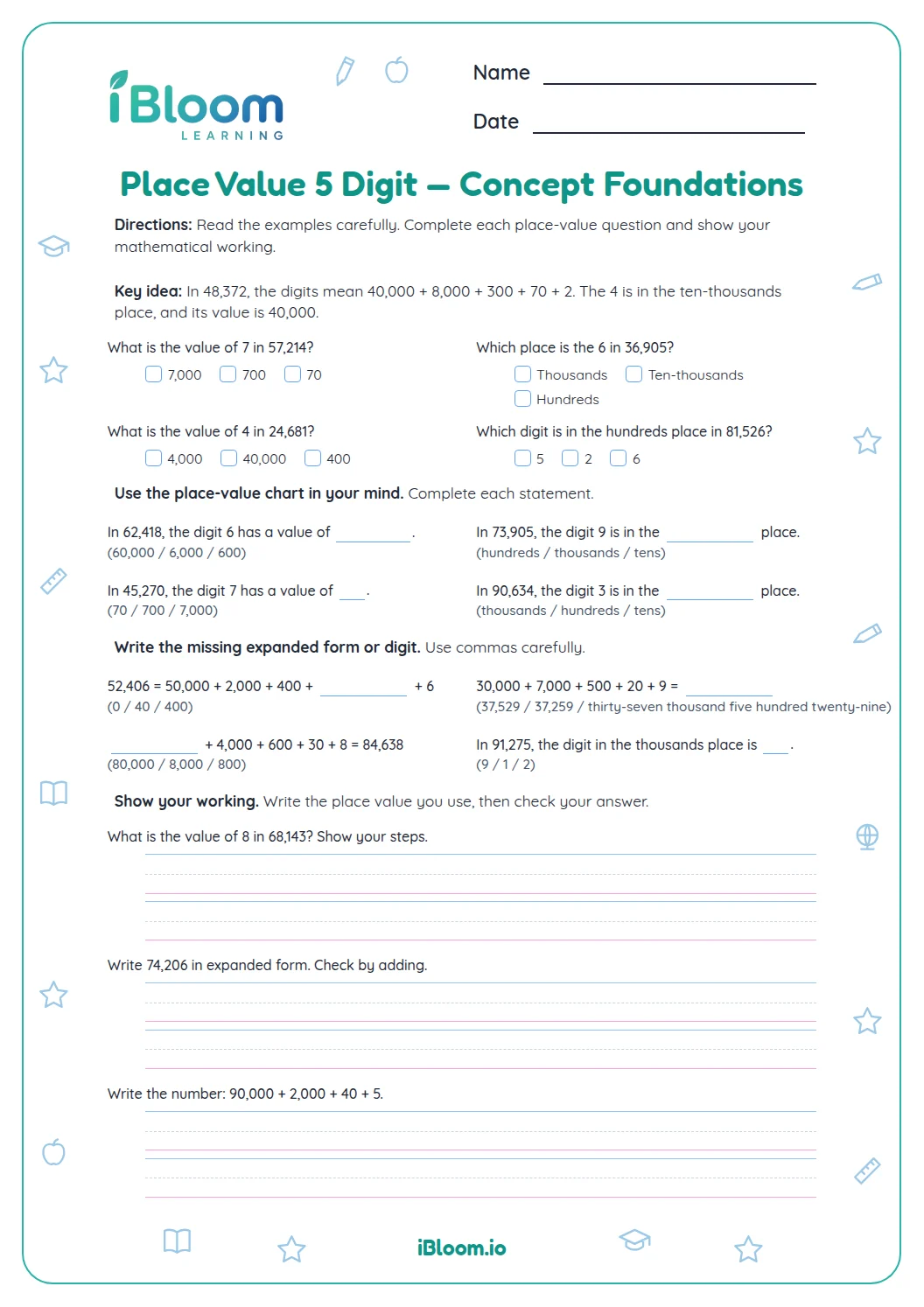
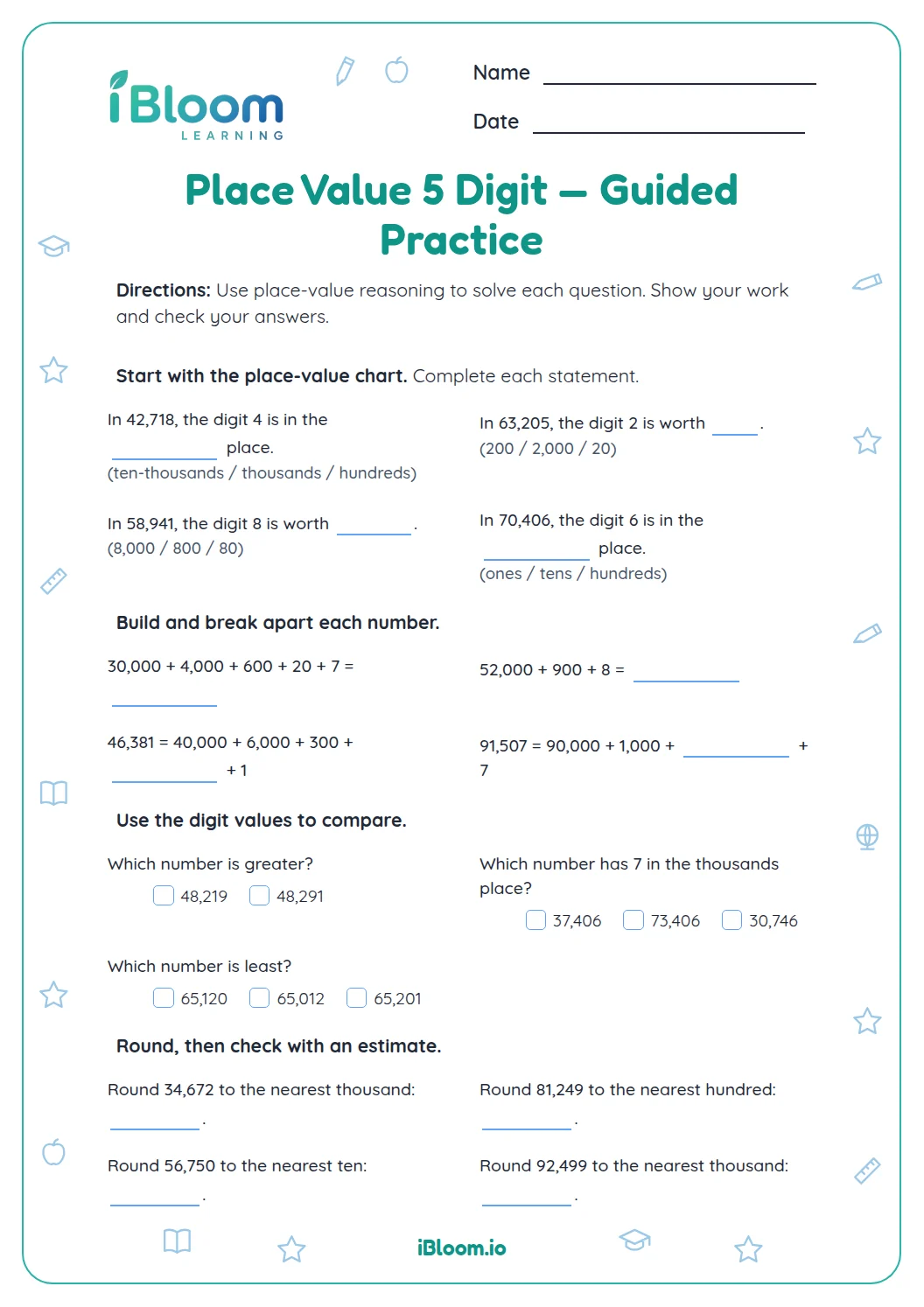
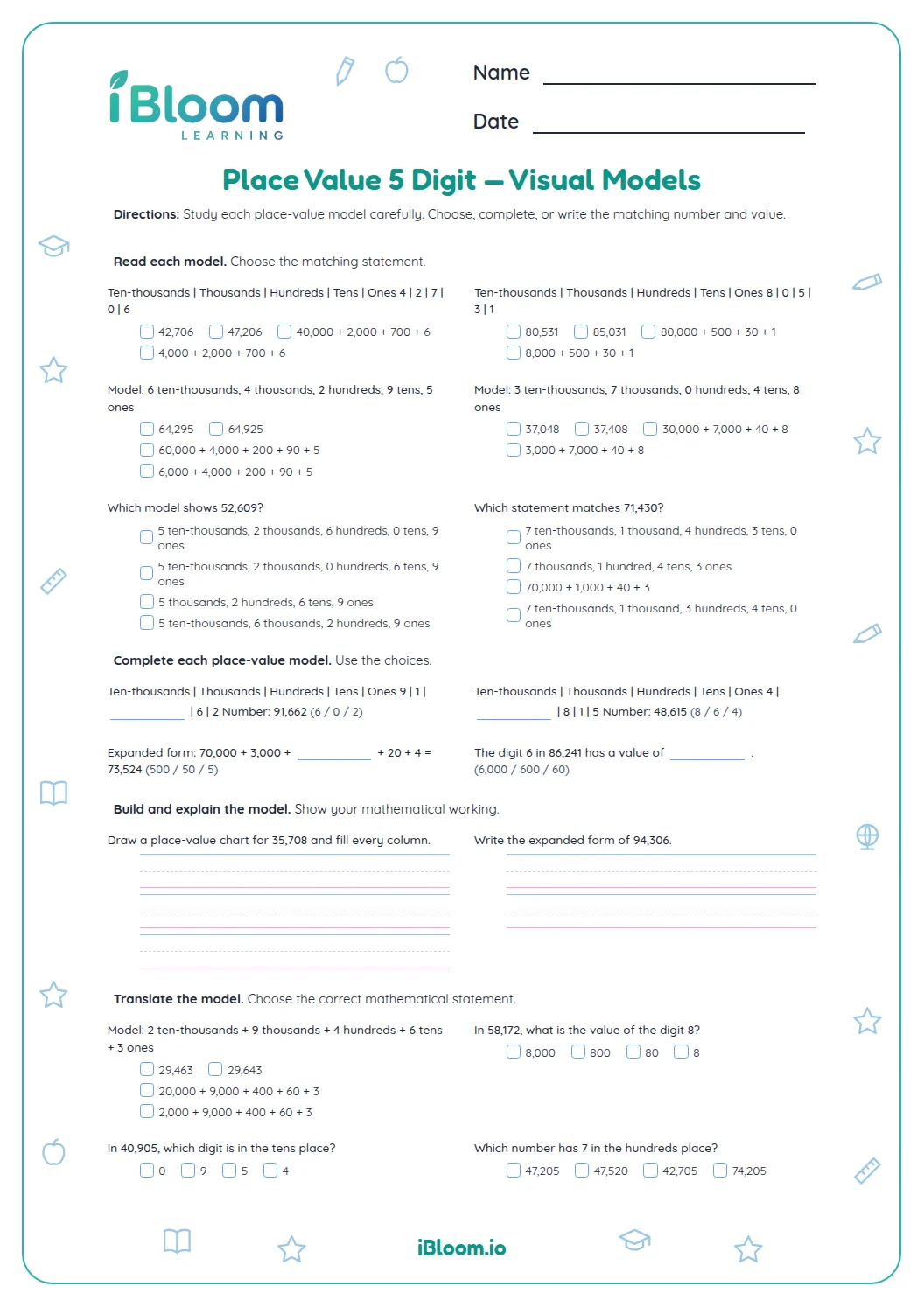

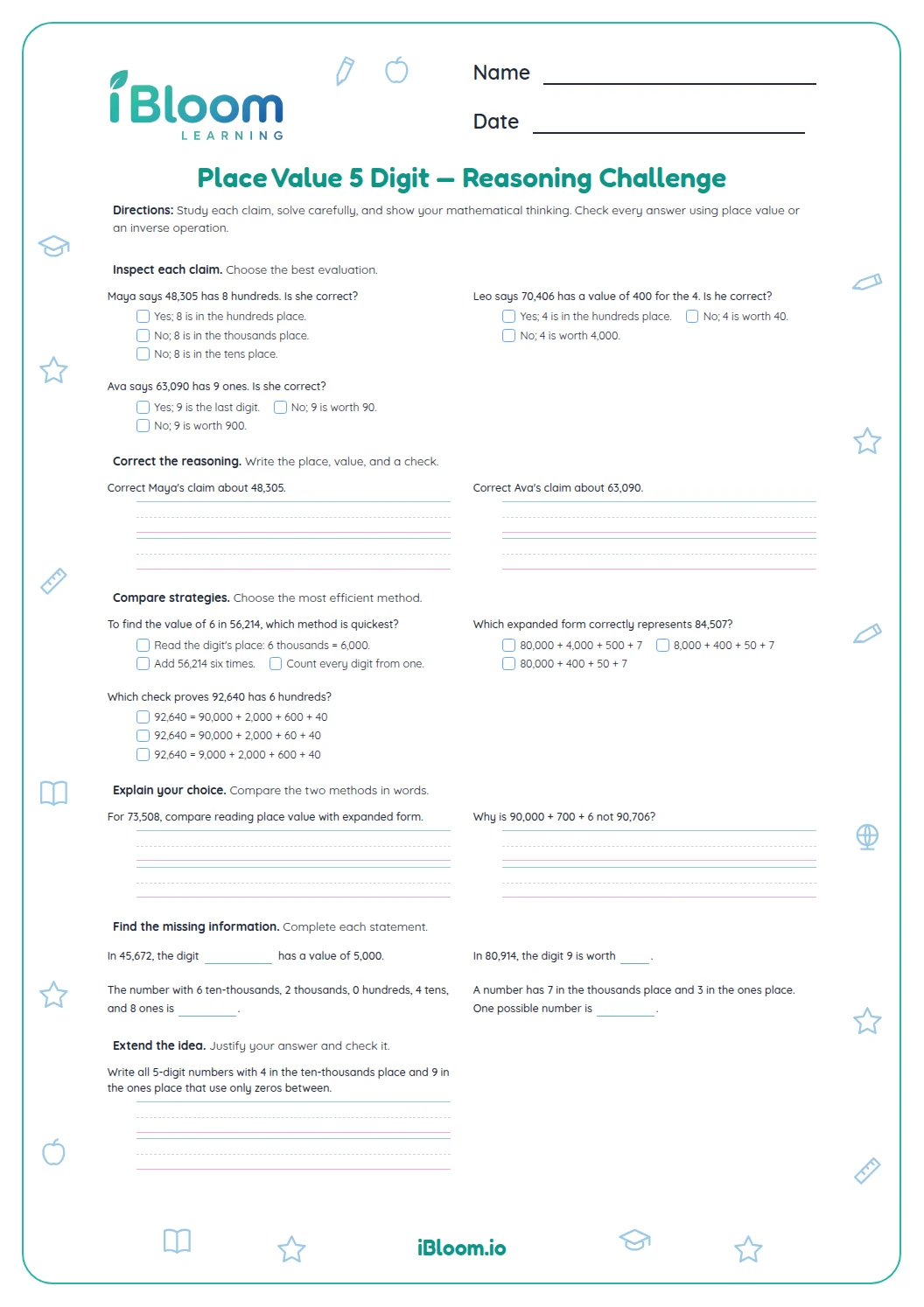
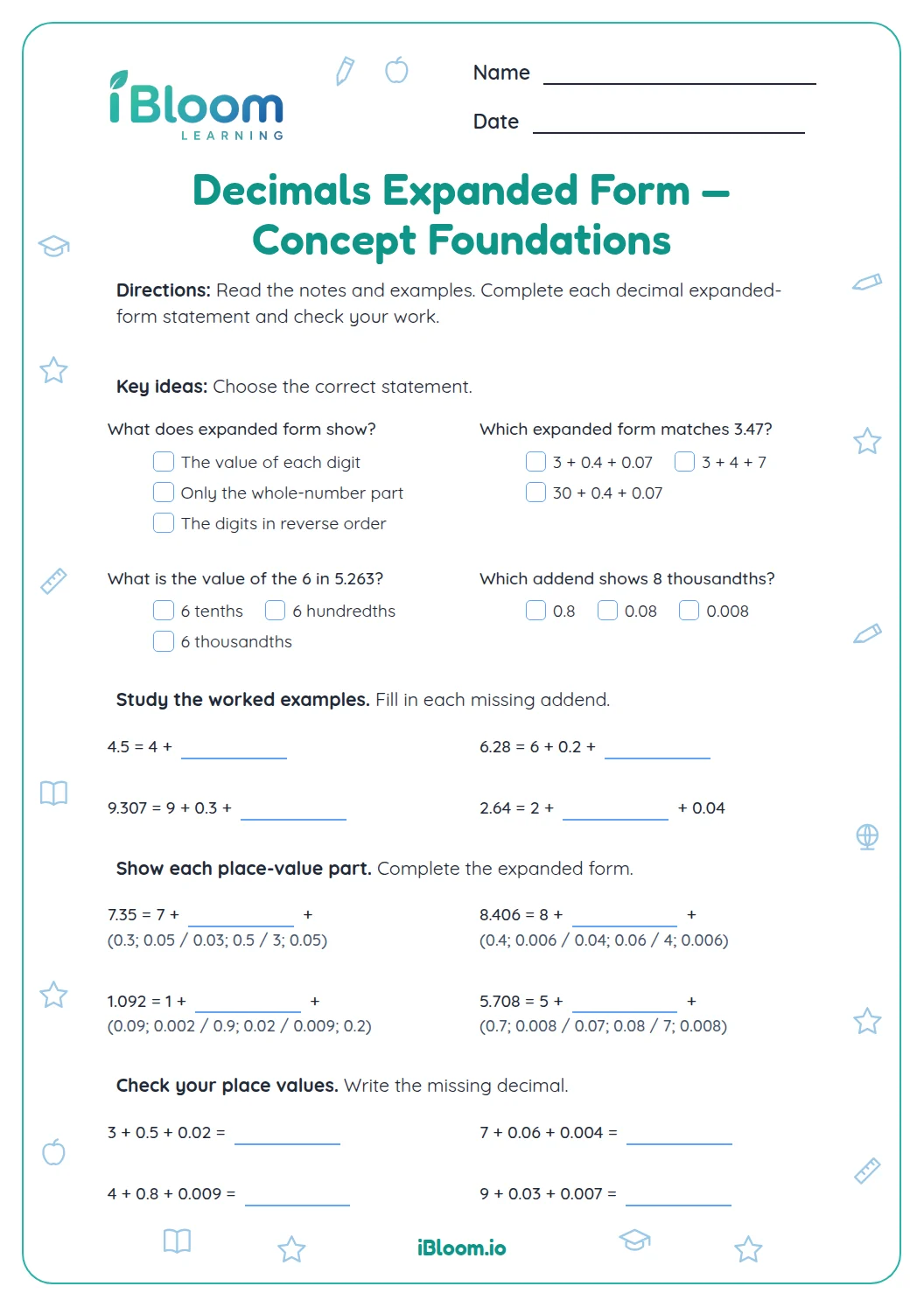

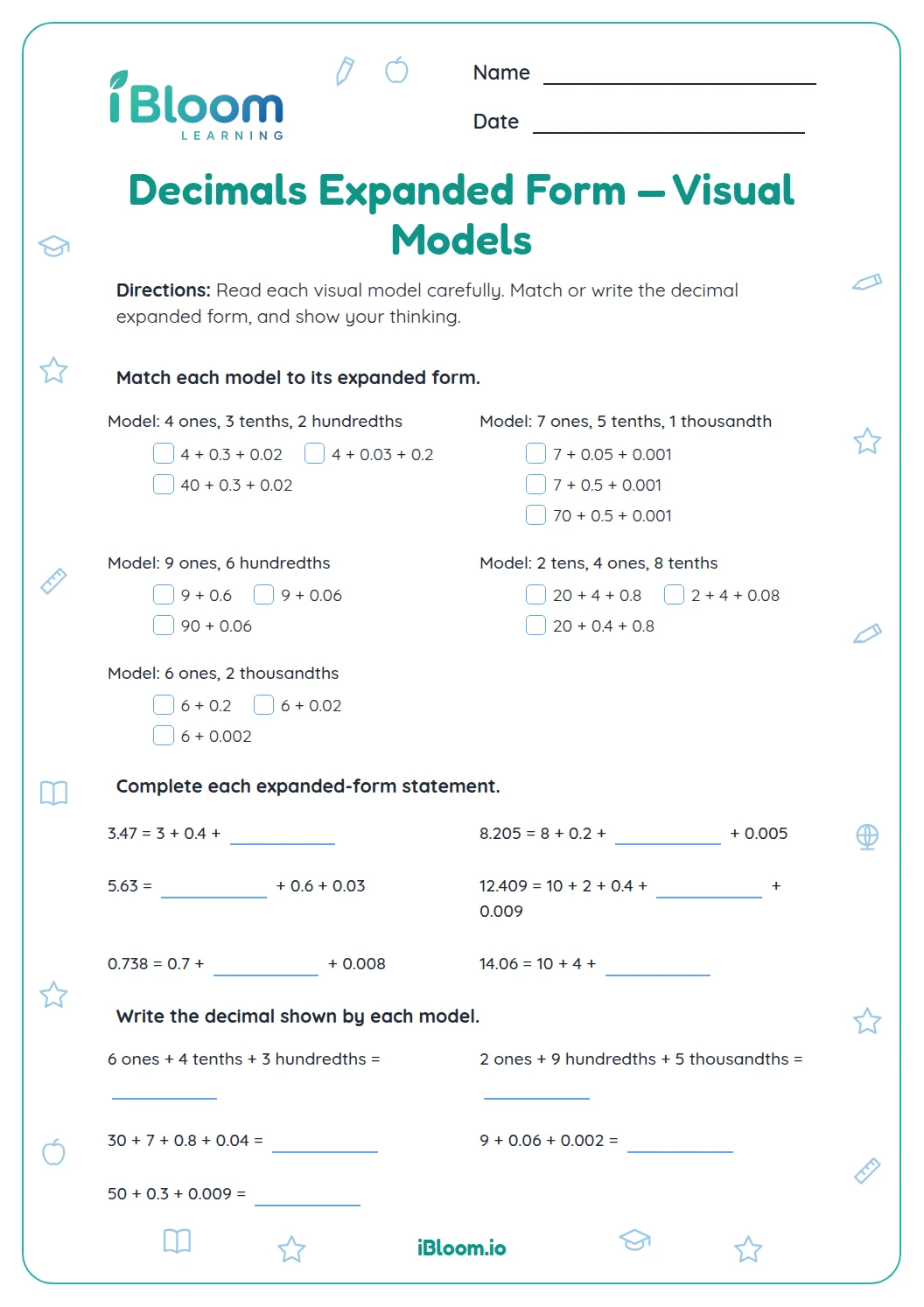
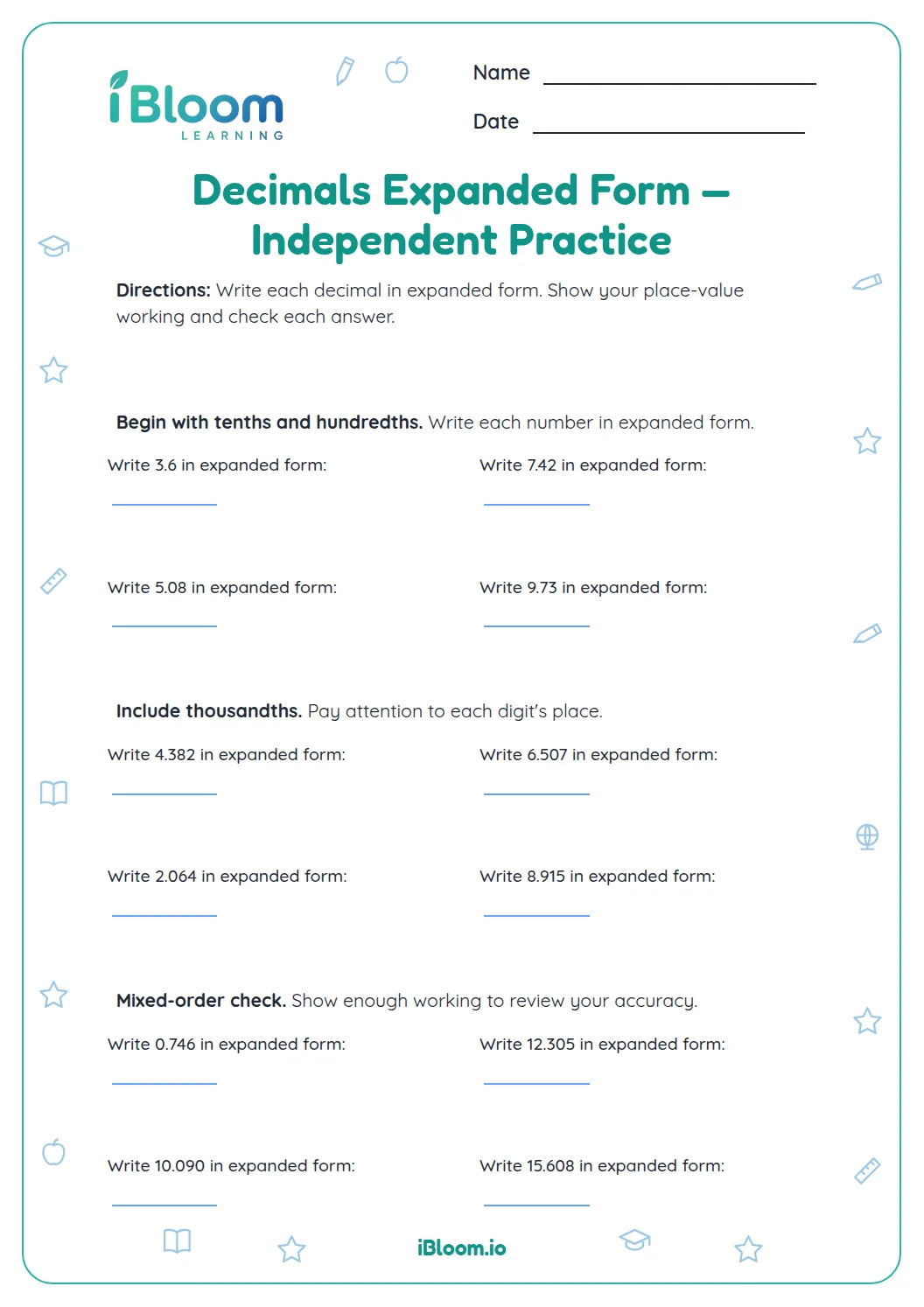
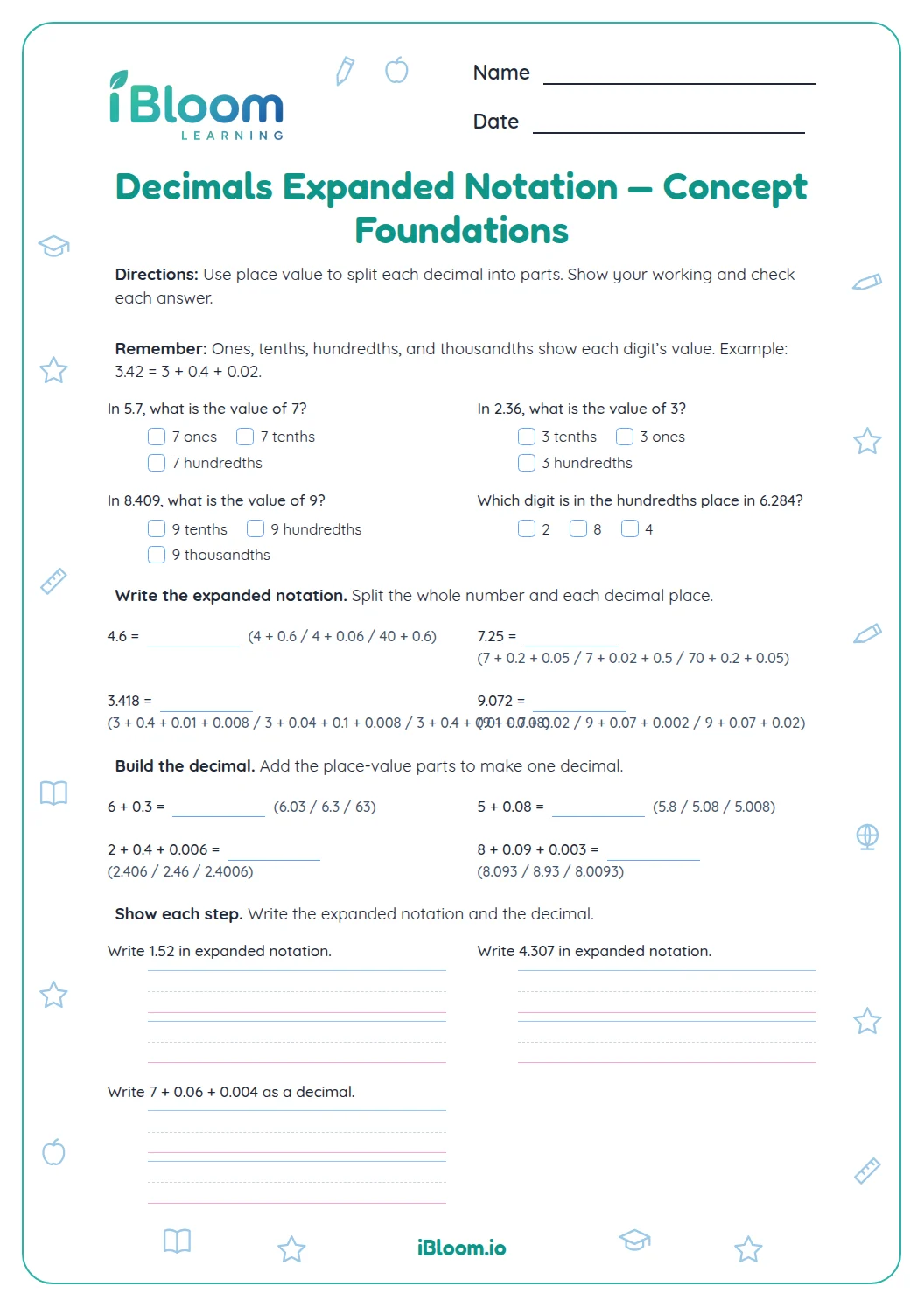
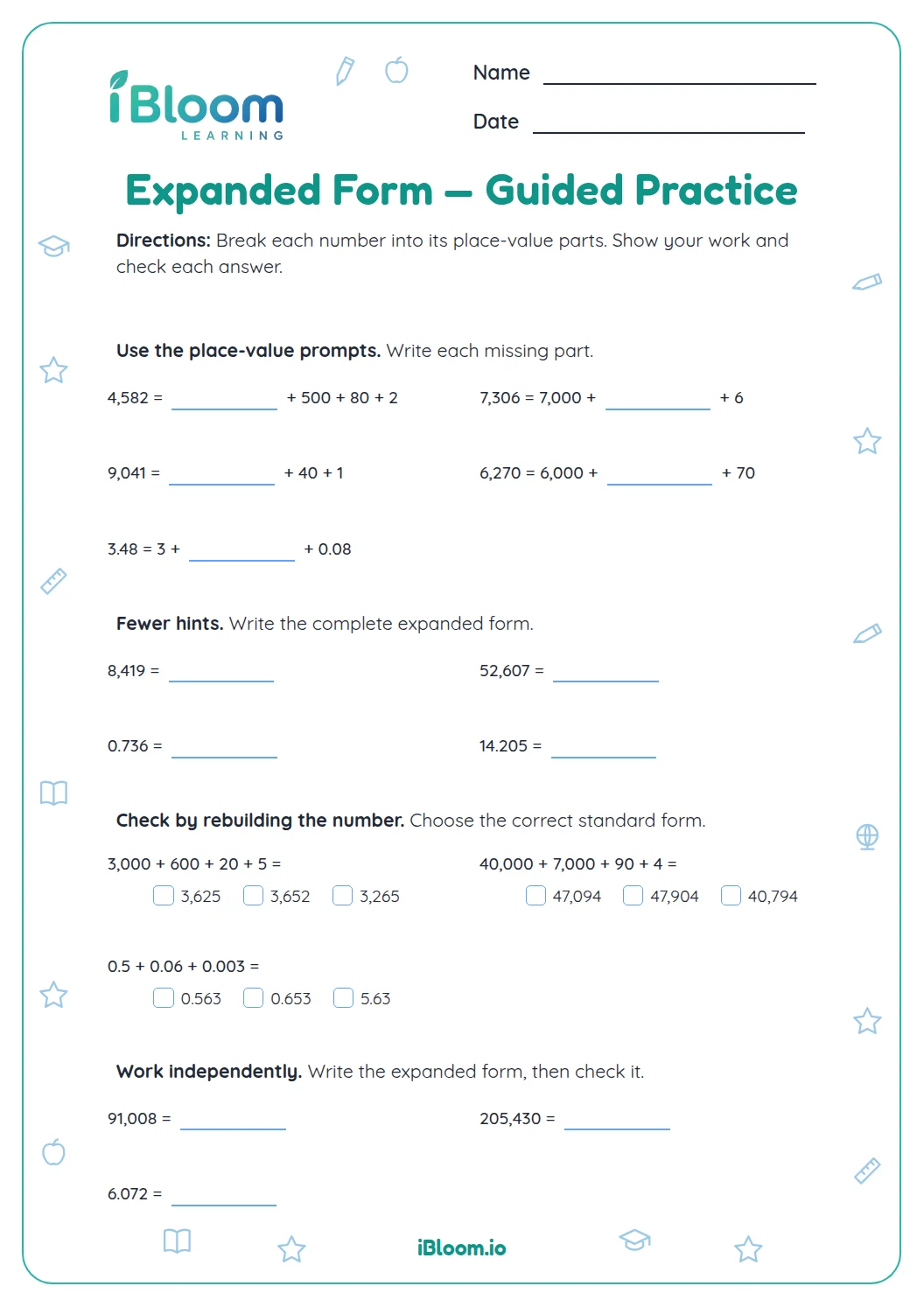
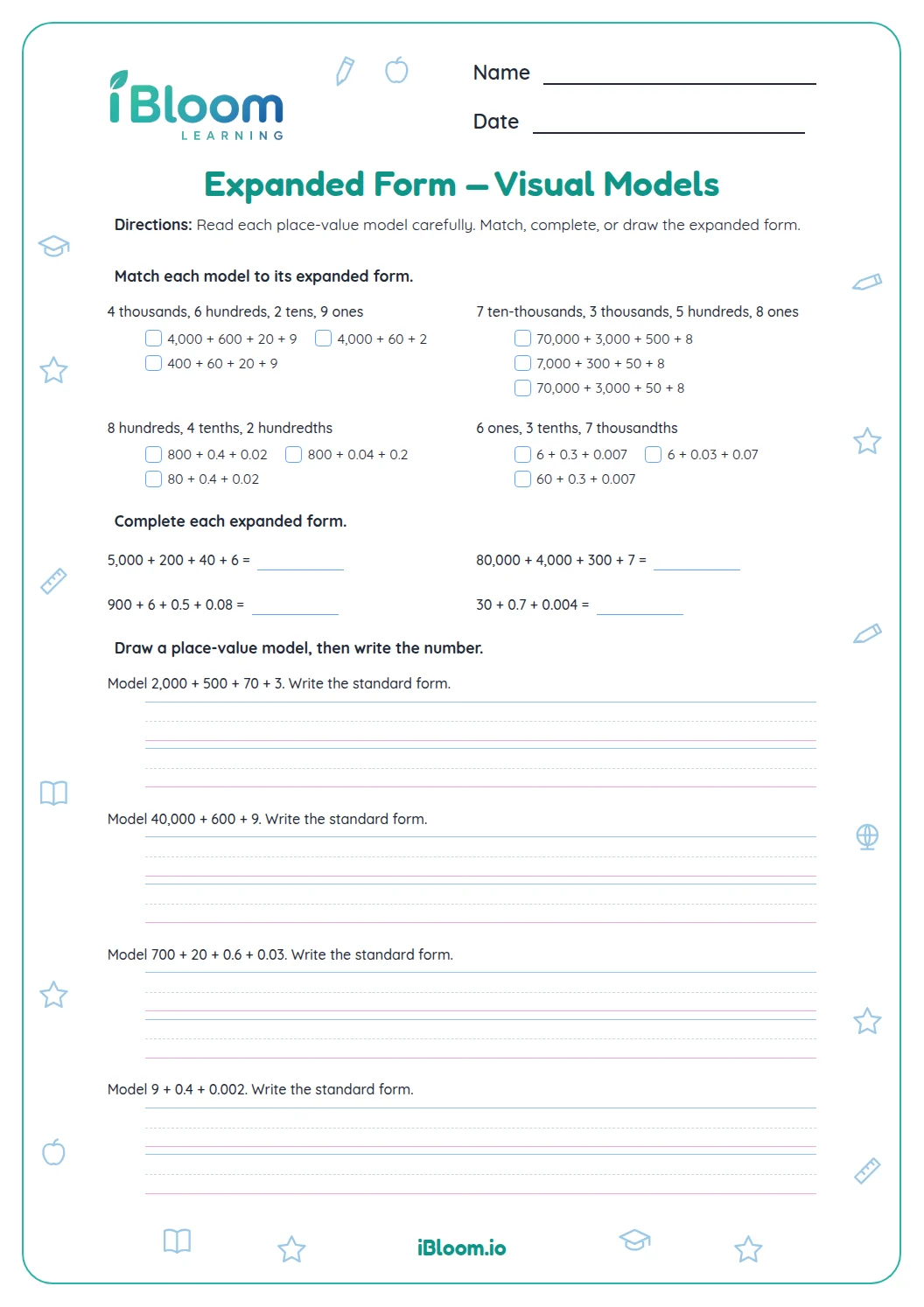
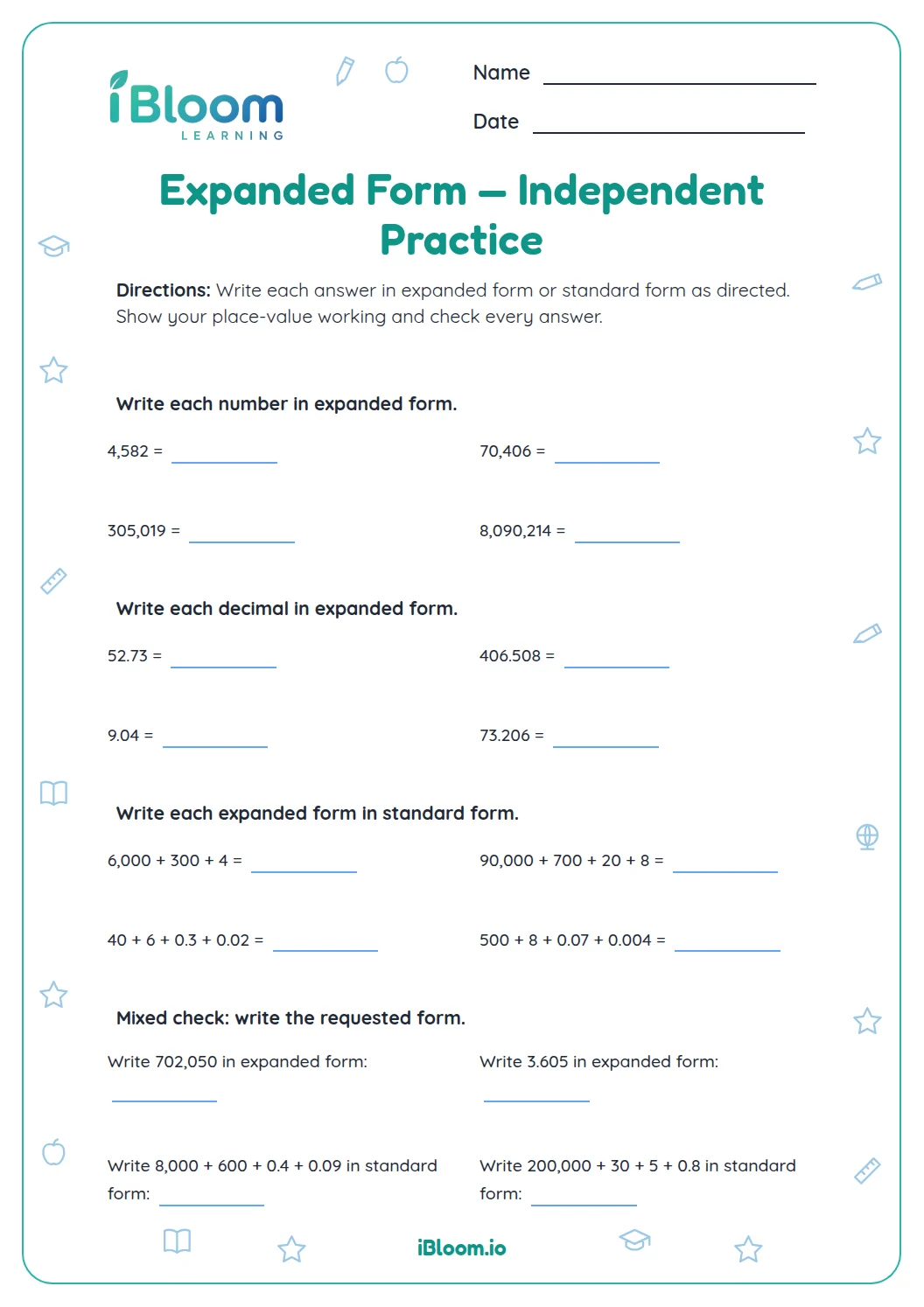
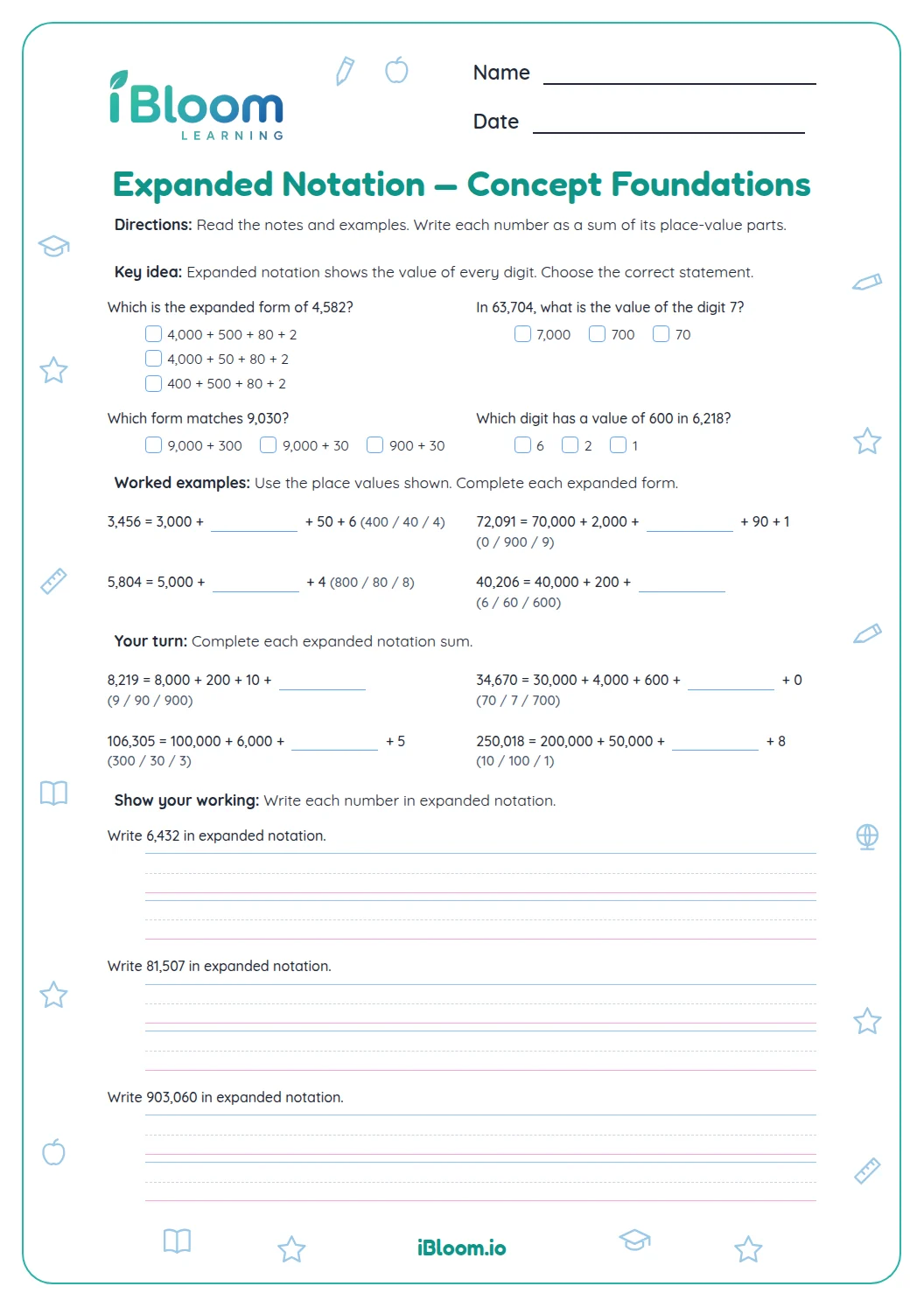
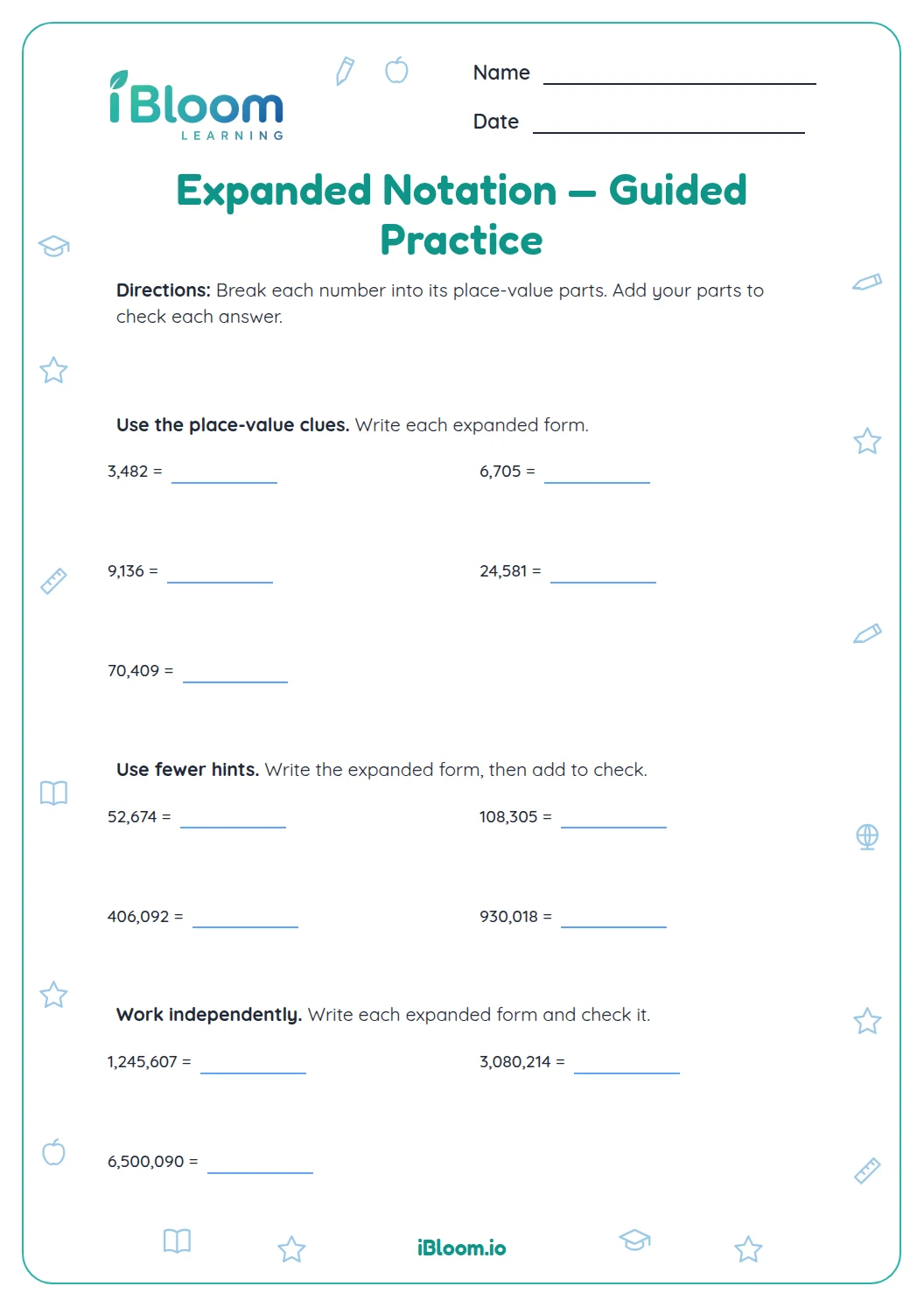
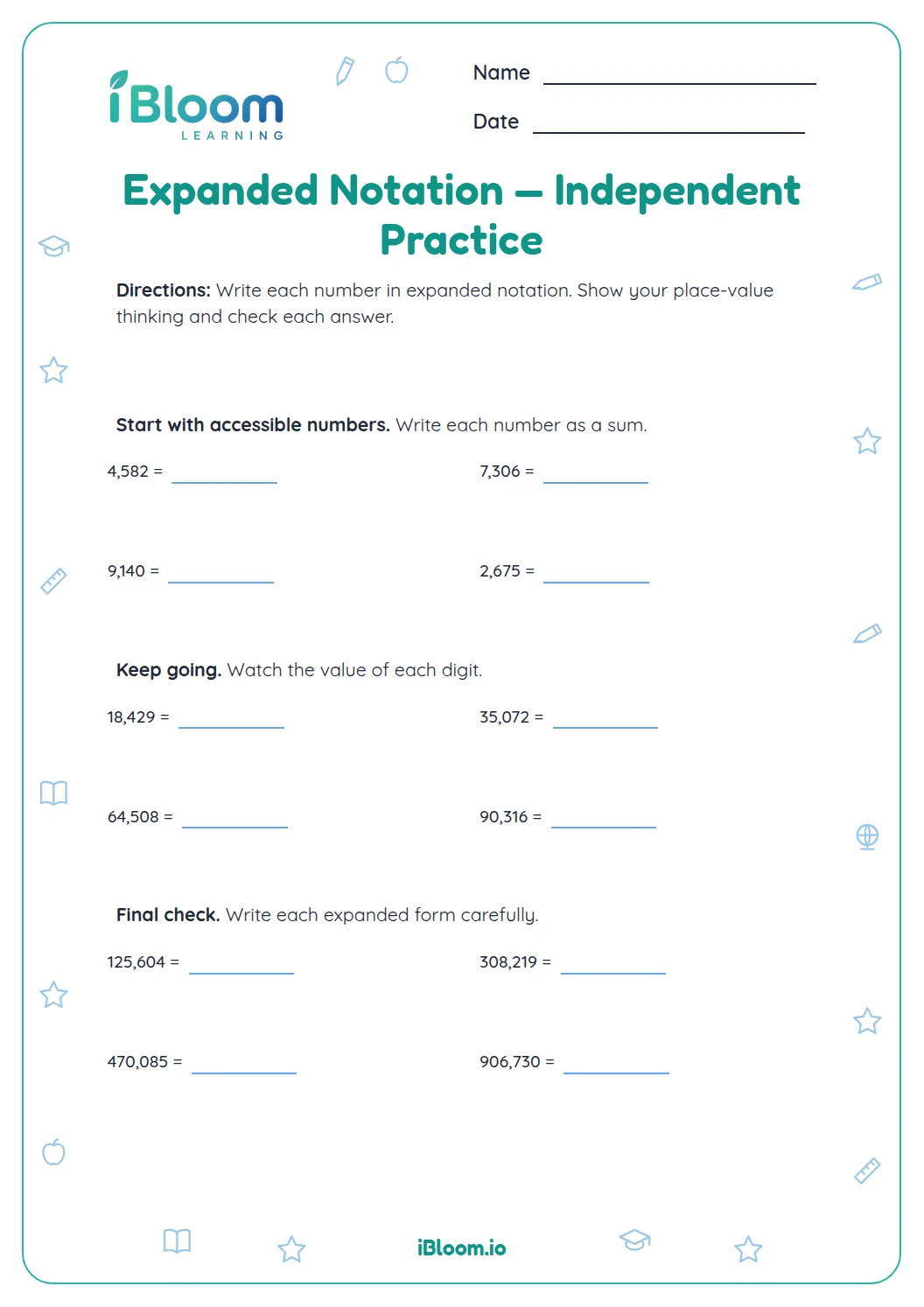
About this worksheet
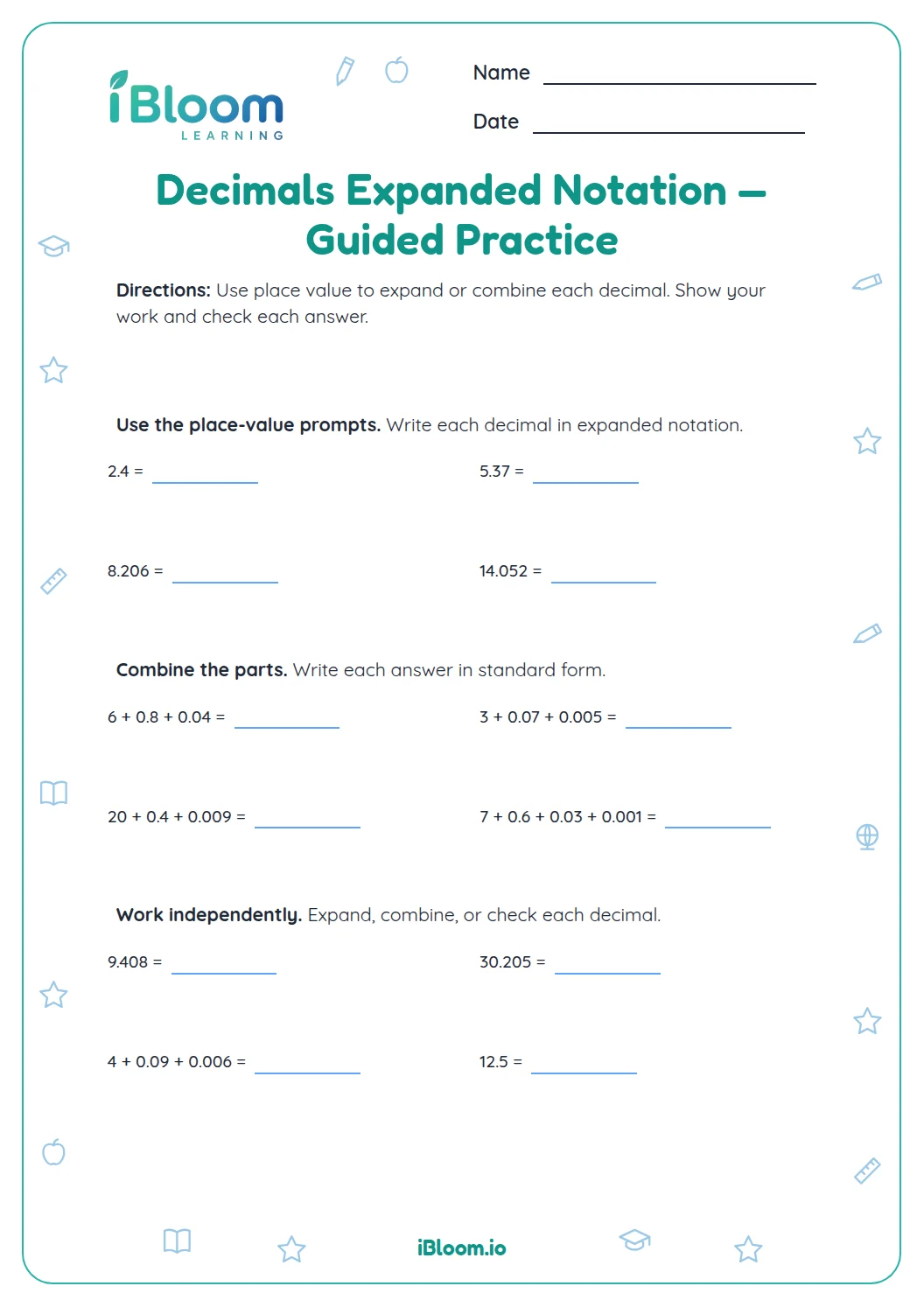
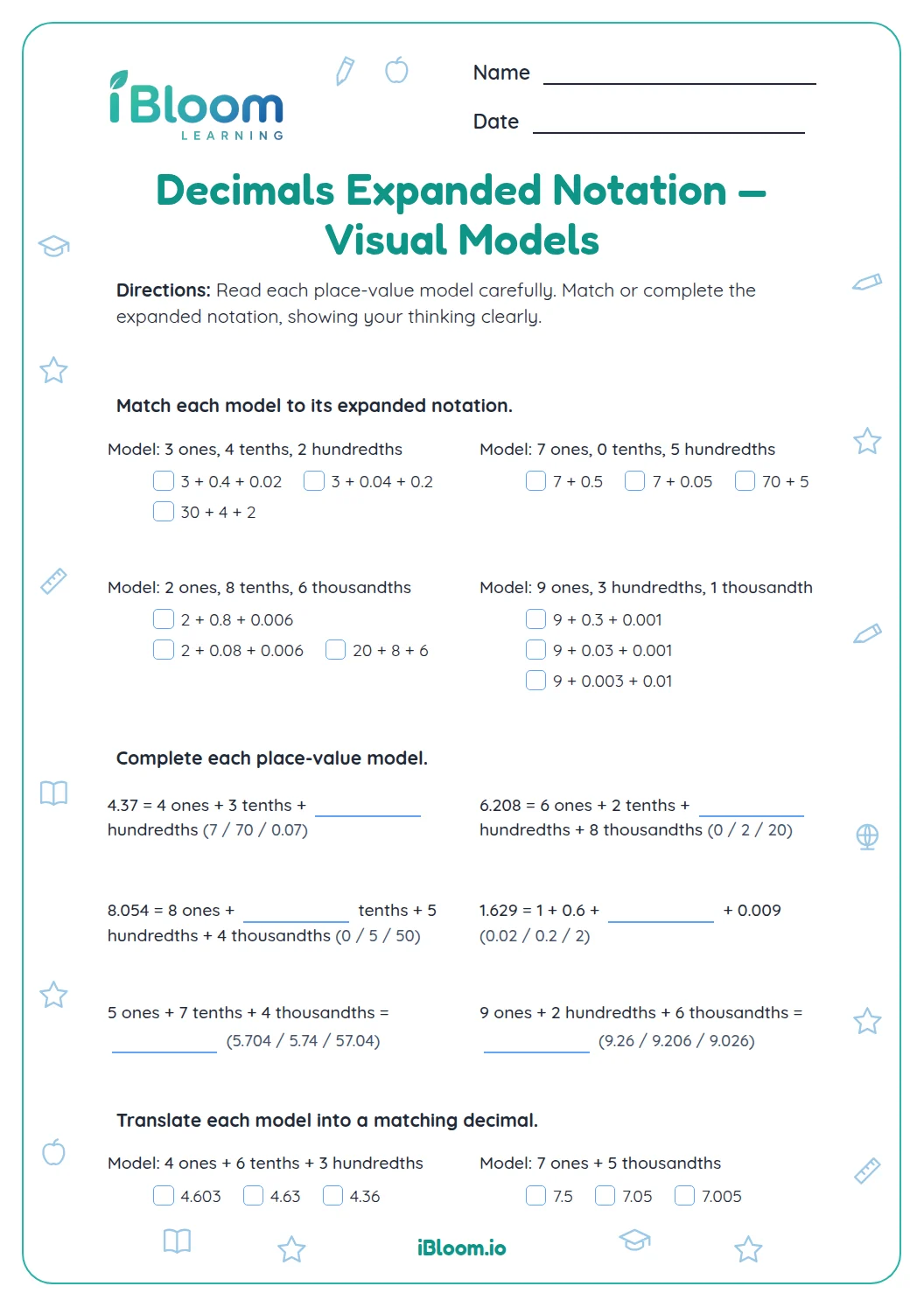
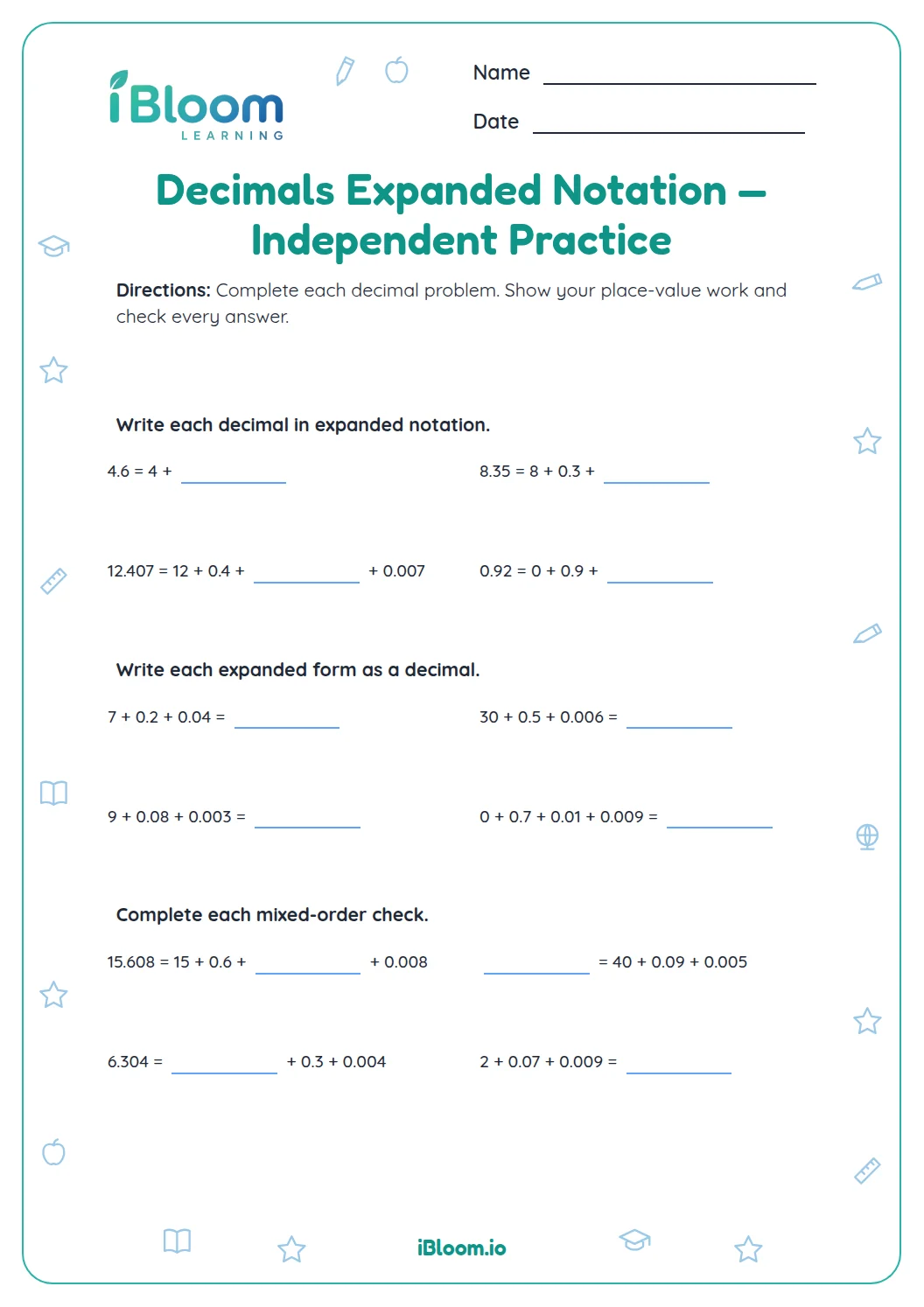
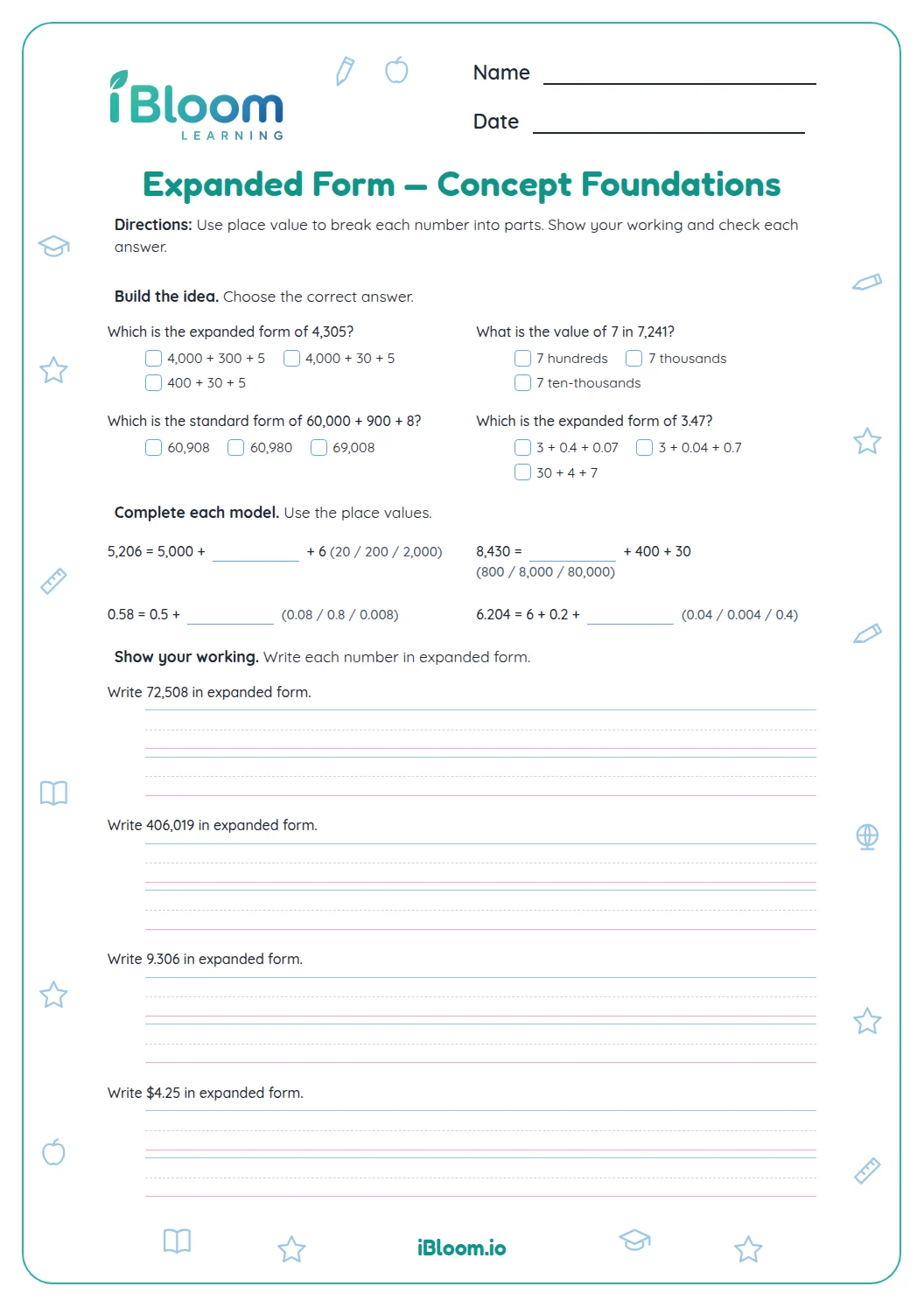
This Grade 5 worksheet uses counts from museums, schools, parks, and community events to practice five-digit place value and rounding. Students identify digit values and positions, round to the nearest hundred, thousand, or ten thousand, and compare two counts. The 14 questions include a separate answer key. The sheet practices CCSS 5.NBT.A.1 and 4.NBT.A.3.
Aligned to 5.NBT.A.1 and 4.NBT.A.3
How does a digit’s position change its value?
In 48,362, the 8 is in the thousands place, so its value is 8,000. Read each digit’s position from right to left: ones, tens, hundreds, thousands, and ten-thousands.
- 148,362
- 2The 8 is in the thousands place.
- 3Its value is 8,000.
How do students round a five-digit number?
To round to a named place, look one place to its right. In 37,568, the hundreds digit is 5, so 37,568 rounds up from 37,000 to 38,000 to the nearest thousand.
Why use real-world counts?
For an estimate, round the number to the place named in the question. When comparing counts, subtract the smaller count from the larger one and check that the difference is reasonable.
How to use the worksheet
- 1Read each five-digit number carefully, including the comma.
- 2Name the place before stating a digit’s value.
- 3For rounding, mark the target place and inspect the digit to its right.
- 4Replace all digits to the right with zeros after rounding.
- 5Use subtraction for the final comparison and check the result.
Common place-value mistakes
The mistake
Naming the digit instead of its value.
The fix
Say the place and write the amount it represents.
The mistake
Looking at the target digit when rounding.
The fix
Use the digit immediately to its right to decide.
The mistake
Keeping digits after the rounded place.
The fix
Replace them with zeros in the rounded whole number.
Common Core alignment
The questions connect digit value with rounding in real contexts.
A digit’s value is ten times the value of the place to its right.
On this sheet: A digit’s value is ten times the value of the place to its right.
Show the official wordingHide the official wording
Recognize that in a multi-digit number, a digit in one place represents 10 times as much as it represents in the place to its right and 1/10 of what it represents in the place to its left.
Use place value to round multi-digit whole numbers.
On this sheet: Use place value to round multi-digit whole numbers.
Show the official wordingHide the official wording
Use place value understanding to round multi-digit whole numbers to any place.
What to practice next
Make more practice
Further reading
Questions parents and teachers ask
What does the 8 represent in 48,362?
The 8 is in the thousands place, so it represents 8,000. Its position gives the digit its value. The worksheet asks students to identify values and places in several different five-digit counts. Students can write the digit’s position and value to make the distinction clear.
How do students decide whether to round up?
Look one place to the right of the place named in the question. If that digit is 5 or greater, increase the target digit by one; if it is 4 or less, keep the target digit the same. Then replace the digits to its right with zeros. The named place determines which digit to check and which digits become zeros.
How many questions are included?
There are 14 questions in three parts. Students identify digit values and places, round five-digit counts to different places, and use place value in short real-world situations, including one comparison. The examples use five-digit counts and ask for one clear place-value decision.
Does the worksheet practice expanded form?
The questions focus on digit value, digit position, rounding, estimating, and comparing counts. For example, students identify the value of a digit or round a five-digit count to a named place. Students identify places and round numbers in the situations on this sheet.
Is an answer key provided?
Yes. The separate key lists the answer to each of the 14 questions. Students can use it to check digit values, rounding decisions, estimates, and the final comparison. The key makes it easy to check each value and rounding result.