


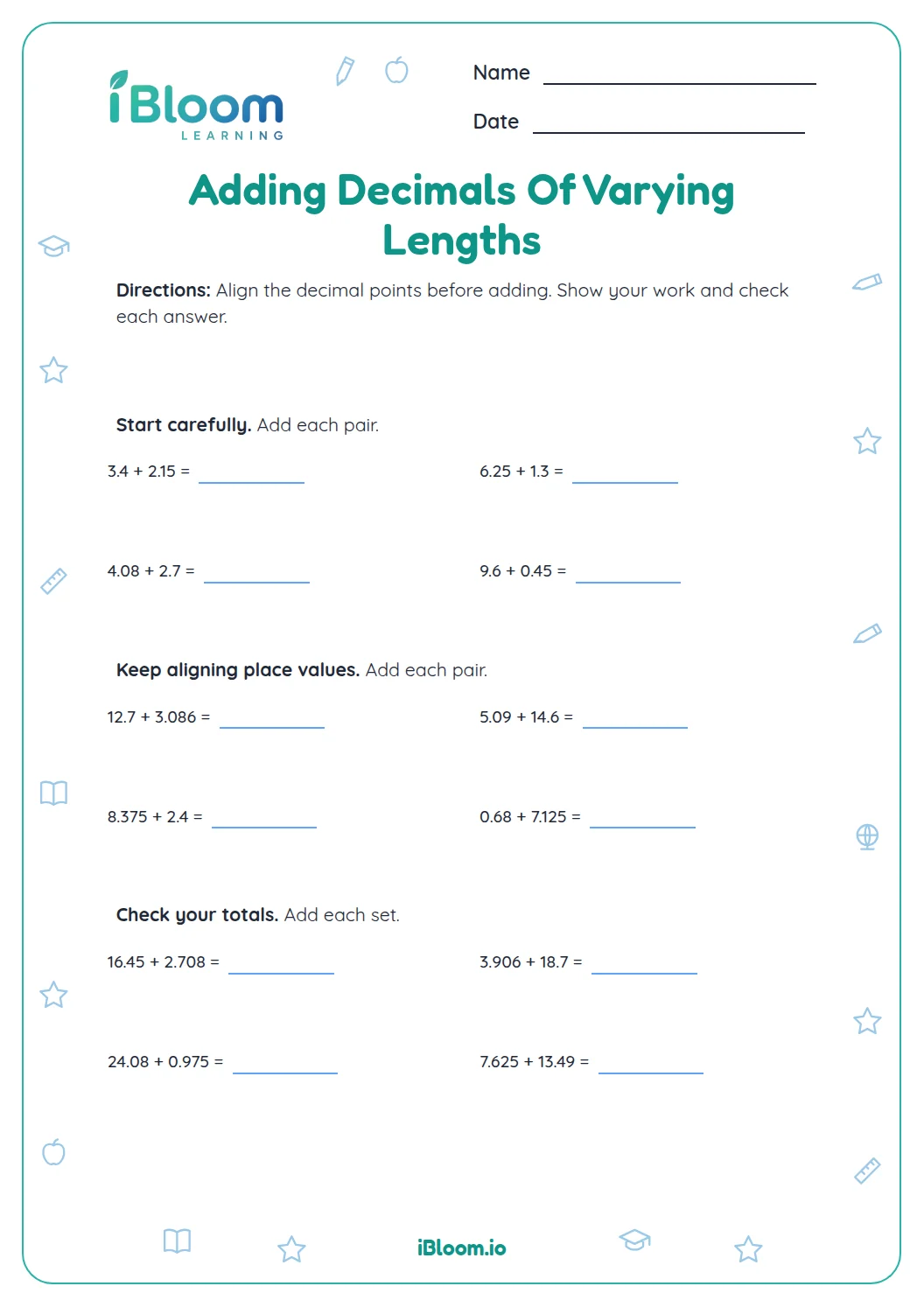
About this worksheet
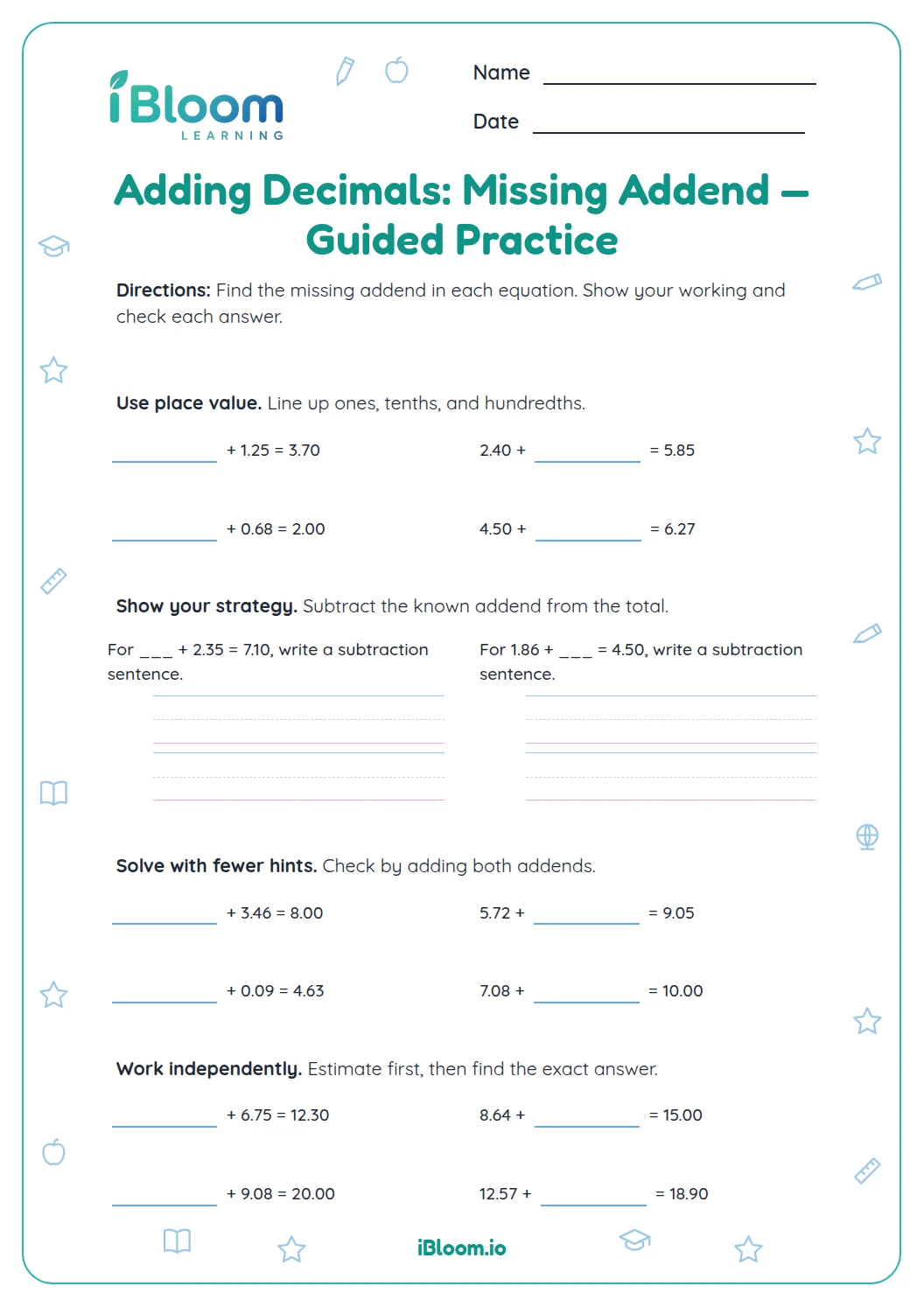
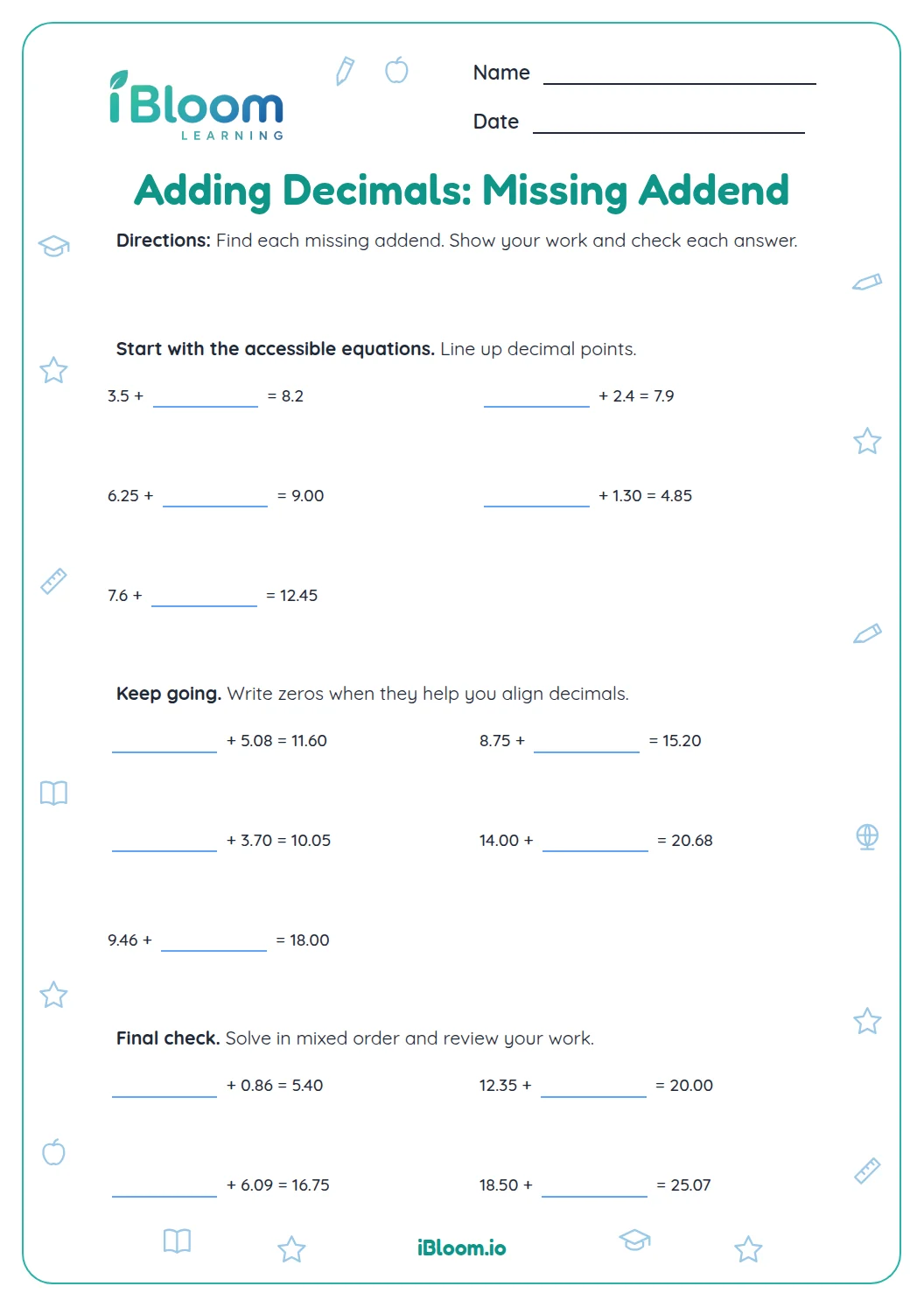
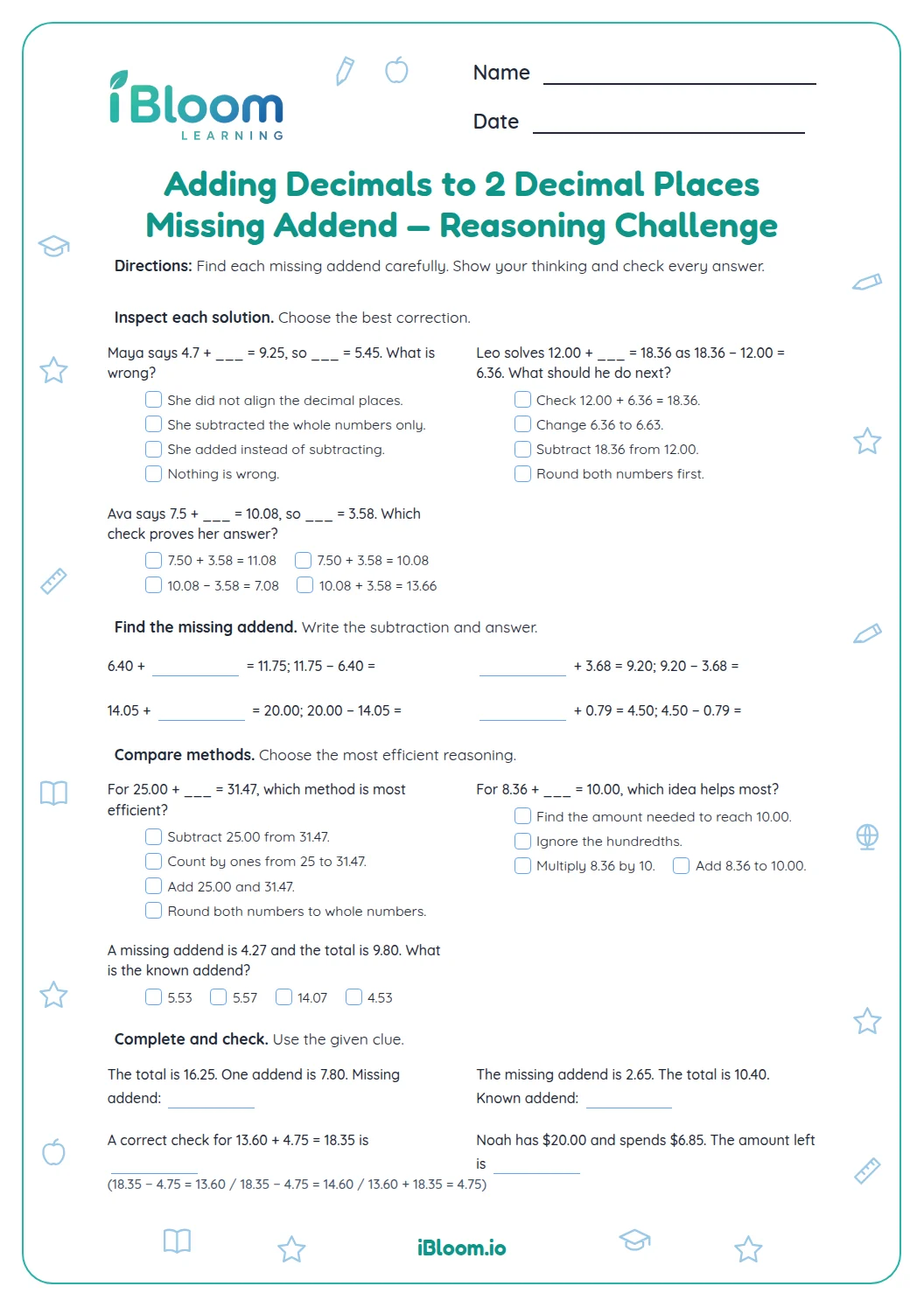
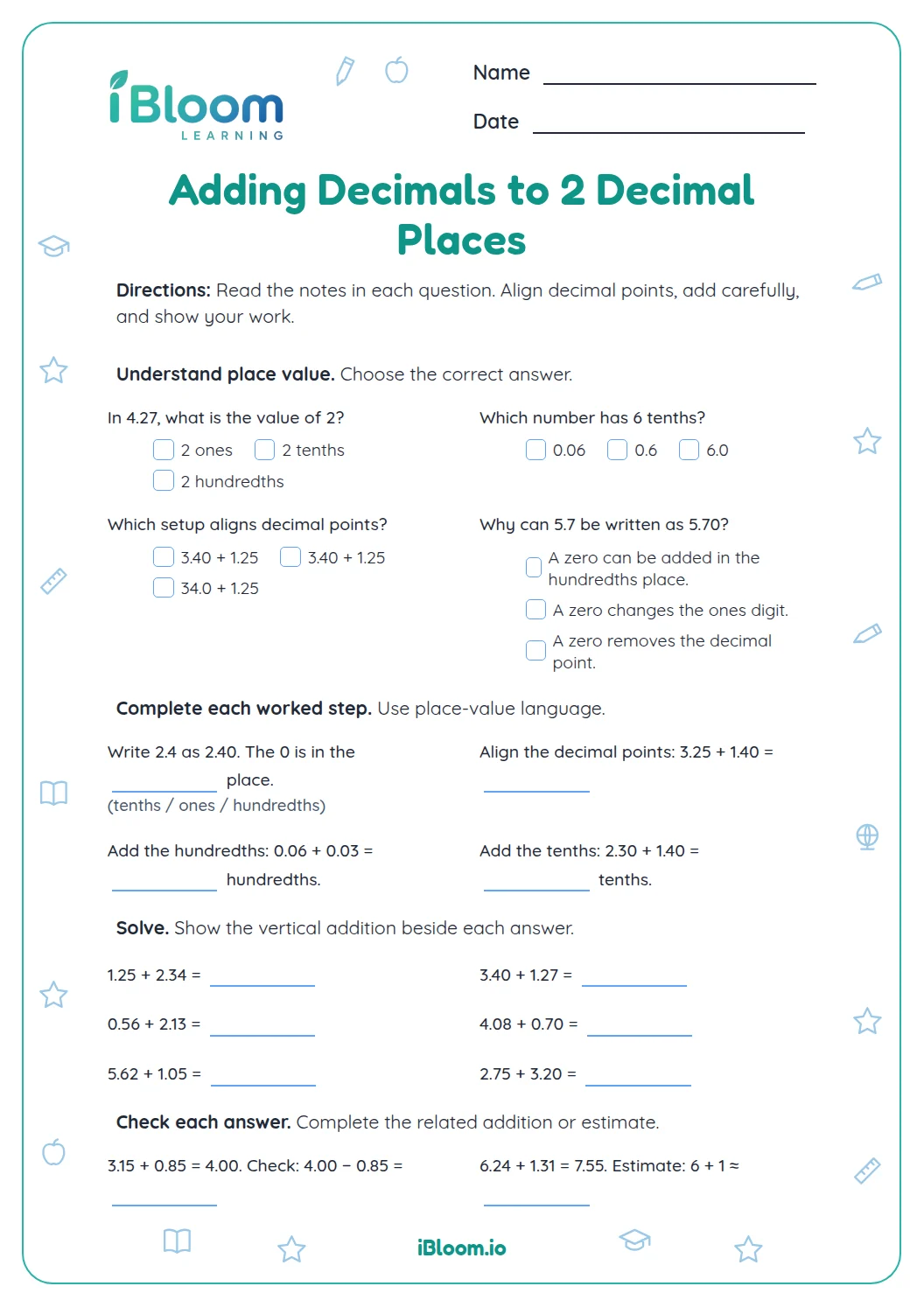
This Grade 6 printable builds missing-addend fluency with 20 decimal equations. The unknown appears in different positions, and values use tenths and hundredths, including totals with a zero placeholder. Learners align decimal points, subtract the known addend from the total, and check by addition. It practices CCSS 6.EE.B.7.
Aligned to 6.EE.B.7
What does a missing addend mean?
An addend is a number being added. In x + 0.46 = 1.00, the total is 1.00 and one addend is 0.46. The missing value is the amount needed to reach the total.
Question 3 asks for that missing start: ___ + 0.46 = 1.00. Subtract 1.00 − 0.46 to find 0.54, then check 0.54 + 0.46 = 1.00.
- 1___ + 0.46 = 1.00
- 21.00 − 0.46 = 0.54
- 3Check: 0.54 + 0.46 = 1.00
Why line up decimal points?
Digits in the same place have the same value. Put decimal points under each other, and use a zero placeholder when one number has fewer decimal places. In 0.08 + ___ = 0.50, the missing amount is 0.42.
What is on the worksheet?
The equations vary which value is missing, so learners practice reading the relationship between addends and totals rather than filling the blank in only one position.
- Part A begins with tenths and hundredths equations.
- Part B varies the missing addend and place values.
- Part C gives one equation for written work.
- Part D uses compact answer choices for the remaining equations.
How to use this worksheet
- 1Find the total and the known addend in the equation.
- 2Align decimal points before subtracting.
- 3Write a zero placeholder when a place is empty.
- 4Subtract the known addend from the total when an addend is missing.
- 5Add your answer back to check the equation.
Common mistakes and quick fixes
The mistake
Subtracting the smaller digit in each column without regrouping.
The fix
Use the standard subtraction steps with decimal points aligned.
The mistake
Dropping a zero placeholder.
The fix
Write 0 in an empty place so tenths and hundredths stay aligned.
The mistake
Using the two addends as the answer.
The fix
Check the equation by adding them and confirming the stated total.
Common Core alignment
This worksheet gives focused practice with the standard below.
Represent a missing addend with an equation and solve for it.
On this sheet: Each number sentence represents a missing addend with x + p = q.
Show the official wordingHide the official wording
Solve real-world and mathematical problems by writing and solving equations of the form x + p = q and px = q for cases in which p, q and x are all nonnegative rational numbers.
What to practice next
Make more practice
Further reading
Questions parents and teachers ask
How can you check a missing addend?
Add the known addend and your answer. Their sum should equal the total in the equation. For example, if 1.25 + x = 2.00, check that 1.25 + 0.75 equals 2.00. Line up decimal points vertically and use a zero placeholder when a place is empty.
Why does a decimal sometimes end in zero?
A zero at the end keeps place values aligned and does not change the amount. For example, 2.5 and 2.50 are equal. Writing hundredths can make subtraction easier when the other addend has two decimal places. Line up decimal points vertically and use a zero placeholder when a place is empty.
What if the blank comes first?
The unknown can be either addend because addition can be reversed. Find it by subtracting the known addend from the total, then check by adding the two parts. Line up decimal points vertically and use a zero placeholder when a place is empty.
What kind of equation appears here?
Each item has a total and one known decimal addend. Find the missing value that completes the sum. The set uses tenths and hundredths, with the unknown appearing in different positions. Line up decimal points vertically and use a zero placeholder when a place is empty.
How many questions are on this sheet?
There are 18 missing-addend equations. They use tenths and hundredths, include whole-dollar style totals such as 10.00, and vary which addend is unknown so learners practice reading the equation. Line up decimal points vertically and use a zero placeholder when a place is empty.
Is an answer key included?
Yes. The answer key lists all 18 missing addends. It is useful to check both the subtraction used to find the unknown and the addition that confirms the original equation. Line up decimal points vertically and use a zero placeholder when a place is empty.